
May 21, 2026
A Rise of Revolutionary Art?: A Review of Class Consciousness in Cinema
Cinema is being contested: capital seeks to leave its ideological imprint on the cultural sphere. But there is a counter-current represented by radical artists like Boots Riley.
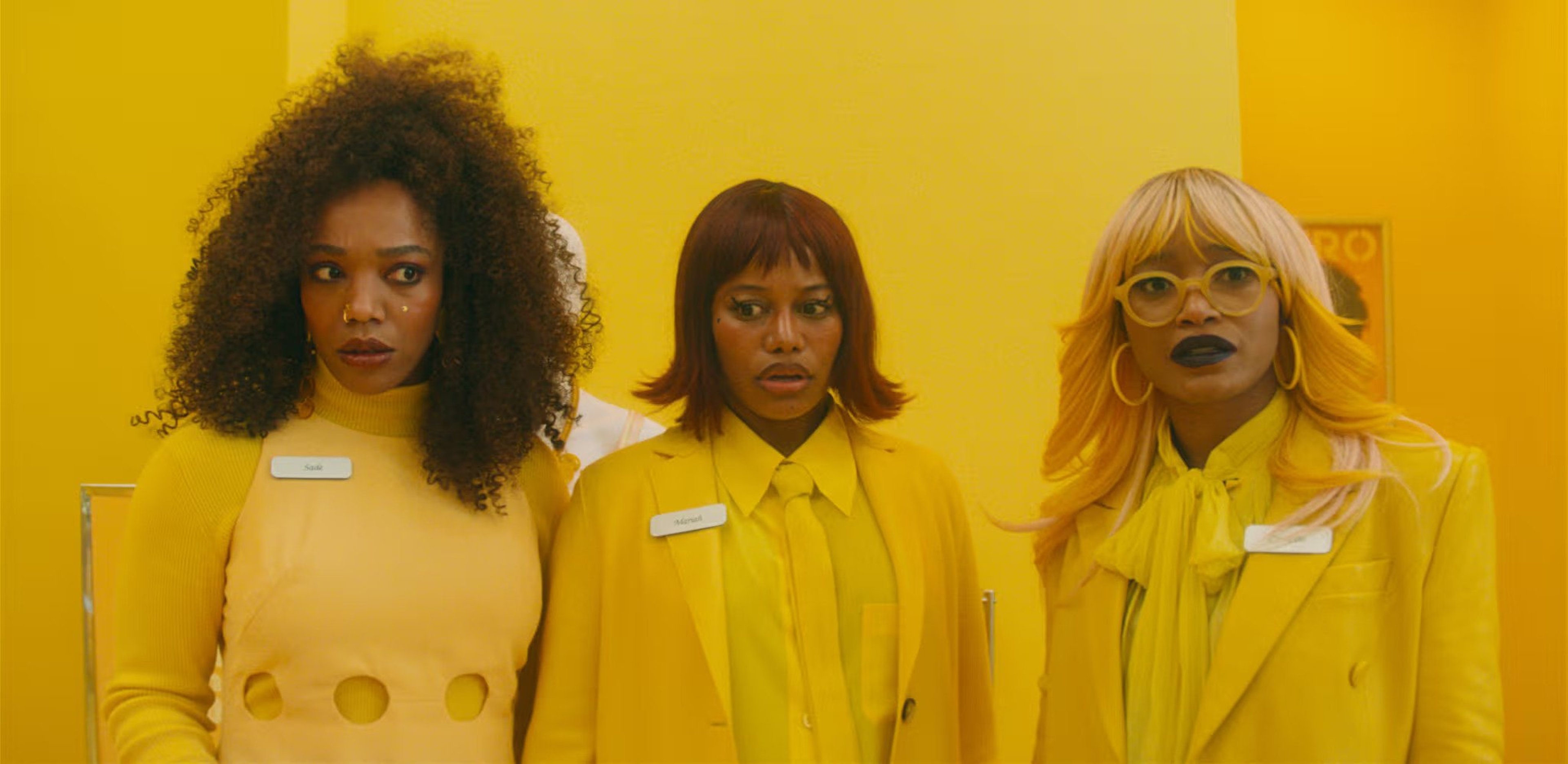
‘I Love Boosters’, the new film by acclaimed communist filmmaker Boots Riley, releases tomorrow, May 22, 2026.
This piece was originally published in the Red Star Tribune Substack and has been included here with a new edit.
Art is always and everywhere the secret confession, and at the same time the immortal movement of its time.
-Karl Marx
Intergalactic colonialism, anti-fascist revolution, raids against ICE concentration camps, urban uprisings, fierce class struggle, and more themes and concepts have become—in a sense—commonplace in art today. Not only commonplace, but majorly acclaimed and widely beloved ‘radical’ art has been produced at a rising pace.
‘I Love Boosters’, the new film by proclaimed communist filmmaker and auteur Boots Riley, is another piece of art in recent years to tackle questions of capitalism and exploitation. Even before its wide release to the public, it has already sparked a debate about ethical anti-capitalist art production, which is funded by reactionary figures–in this case, the Ellisons.
So naturally, the question of what makes art, film, TV, etc., ‘revolutionary’? What do we hope revolutionary art accomplishes? And what do we hope to learn from the art itself and its rising place in an increasingly monopolized and reactionary entertainment industrial complex?
It goes without saying that there is always a current of art in every epoch that challenges the dominant oppressive social structures and class dynamics. Ancient Greece, to Charles Dickens—and far more throughout the millennia—used artistic expression and mediums to question material conditions and sometimes call for revolutionary struggle.
In cinema (film and TV) and literature, there was a wave of radical works in the 60s-80s that was a direct response to imperialist wars such as the US invasion of Vietnam. Battle of Algiers, Star Wars, Apocalypse Now, Full Metal Jacket, Platoon, Predator, and even the first Rambo were prime examples. Movies such as Blade Runner and Alien questioned a future dominated by corporations.
Genres like science fiction became a hotbed for anti-capitalist themes. Neuromancer and Dune illustrated societies controlled by monopolies and mass exploitation—one through a techo-dystopian future and the other a stagnant semi-feudal intergalactic empire. Films like All the President’s Men and JFK were a response to US cover-ups and CIA assassinations. However, with a few exceptions, these were often social critiques disguised under subtext.
Films that glorified or romanticized colonialism, imperialism, or generally depicted revolution in a negative light became the norm. Westerns and war movies were dominant throughout the different epochs of cinema—John Wayne westerns, On the Waterfront, Enemy at the Gates, and so many more were always the mainstream. The 1980s had juiced up masculinity dressed in the US flag and machine guns. The sequels to Rambo were dramatically different. For every Predator that was a thinly veiled satire on US interventions in Latin America, there was Commando.
Then came the Black Hawk Down and Zero Dark Thirty post-9/11 world of Hollywood, where the US military became a more overt production force. Marvel and DC pushed the superhero boom, which was also heavily directed by the US military.
But art imitates life—and as the class struggle progressively altered post-2007, we see a return to art with social critique, class consciousness, and highlighting revolution. Snowpiercer, Parasite, Hunger Games, Andor, Dune, Athena, One Battle After Another, Judas and the Black Messiah, Sorry to Bother You, I’m a Virgo, The Menu, Avatar, Sinners, Westworld, and so many more films and shows highlight this rising trend to depict broadly anti-capitalist themes.
At the same time, the entire industry has been consolidated into growing monopolies. Disney has ABC, ESPN, Marvel, Star Wars, Fox Studios, and National Geographic. Paramount consolidated CBS, Viacom, Skydance, and now Warner Bros (itself a giant monopoly) in the latest deal, while Amazon bought MGM Studios. There have been mass strikes from the Writers Guild, intense concern over AI from the Actors Guild, and destructive union busting against below-the-line workers, such as visual effects artists—Disney just recently firing over a 1000 workers and artists is just a new example of this growing exploitation.
The industry is in a perilous and precipitous position. It has followed the path of other fading late-stage capitalist industries. So we can see this rise of class-conscious art as both reflective of the broader social crisis and particular to the film and TV industry’s contradictions. The terrain of politics in film has become a microcosm of class conflict at large.
The founders of Marxism emphasised that art was an important weapon in the ideological struggle between classes. It could reinforce just as it could undermine the power of the exploiters, could serve to defend class oppression or, on the contrary, contribute to the education and development of the consciousness of the toiling masses, bringing them closer to victory over their oppressors.
‘Marx and Engels On Literature and Art,’ Progress Publishers (1976)
Karl Marx wrote in the Economic Manuscripts of 1857-1858:
As regards art, it is well known that some of its peaks by no means correspond to the general development of society; nor do they therefore to the material substructure.” But he also pointed out that “capitalist production is hostile to certain branches of spiritual production, for example, art and poetry.” Art—great art—does not always correspond to social development. However, in the capitalist epoch, great art is viewed as “hostile.”
So, within a capitalist society, great art will challenge the status quo and be viewed with hostility by the ruling class. But an industry like film and TV needs to make great art to make money from the work of artists. That contradiction–and the conflict it brings–is where social agitation on the basis of art can proliferate and find a life of its own.
The social agitation and development that revolutionary art can have is vital to support. Its existence will naturally be caught in this web of contradictions. As Marxists, we have to look at developments dialectically–at what is in conflict and emerging from the existing material conditions. The rise of class struggle has manifested both within the production process of art and in the art itself. The imminent release of ‘I Love Boosters’ now begs the question: how can we continue to push the struggle forward at the level of the superstructure?