
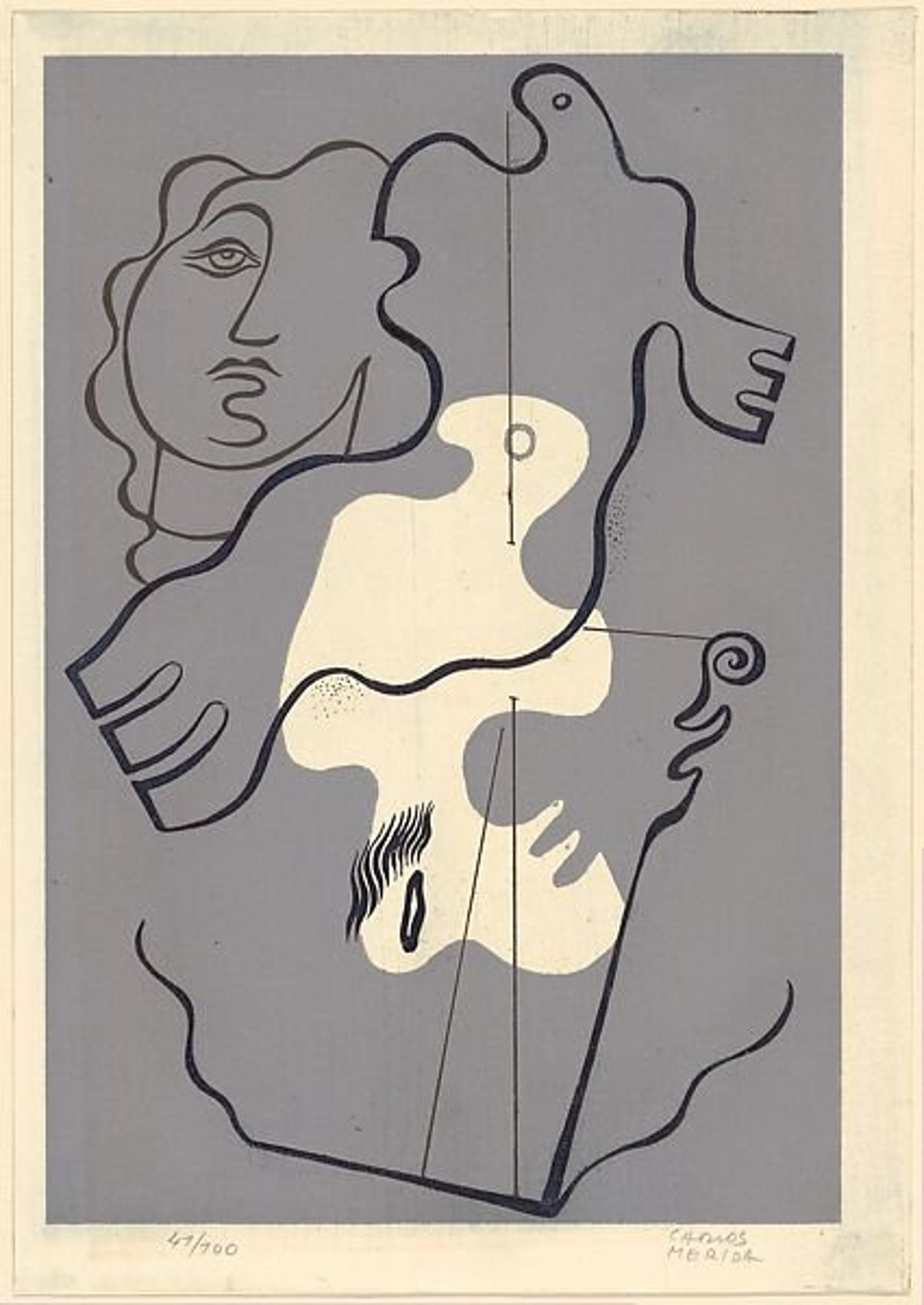
Abstract composition with a head and bird-like form, from the portfolio 'Motivos', Carlos Mérida (1936)
This essay is a revised version of an essay that was initially published on a MUG bulletin not open to the public.
This happened in 1993. January 1993. From then on, the killings of women began to be counted. But it’s likely there had been other deaths before. The name of the first victim was Esperanza Gómez Saldaña and she was thirteen. Maybe for the sake of convenience, maybe because she was the first to be killed in 1993, she heads the list. Although surely there were other girls and women who died in 1992. Other girls and women who didn’t make it onto the list or were never found, who were buried in unmarked graves in the desert or whose ashes were scattered in the middle of the night, when not even the person scattering them knew where he was, what place he had come to. (353)
It goes like this. Someone is killed, usually a woman, there’s a licentious glee and horror at the spectacle of a dead body, or the grim realism of a gruesome dead body, but a dead body all the same. This is a break, a rupture, something that all of society is supposedly designed to disallow. Perhaps there is no investigation or perhaps there is a corrupt investigation but, eventually, Rationality Himself walks in. Someone, usually a man, arrives and with him comes a Narrative, a rationalized structure which understands all of the clues, or a seemingly humanistic empathy which breaks through all the lies, but all the same, the rupture that the murder represents is closed by the Detective. While we feel bad for the victim or bad for the perpetrator or have forgotten all of it under the light of the detective’s genius, while the harm is never undone, society itself is redeemed by the institutionalized understanding of the crime.
That’s the procedural, or the noir, or the detective novel, the whodunit. It’s been around since at least Poirot. In its lifetime it has expanded such that almost everyone who I’ve known well enough to know their taste likes some of them. That breadth also comes along with any number of critiques of this model. Even pulpier noirs often feature murders where the blame goes all the way to the top or where the revelation has no effect on a calcified society. Pynchon’s Inherent Vice bounced off the conspiracist walls of the noir and has the detective discovering that the quest he’s been sent on points towards everything. Anno’s Paprika and Paranoia Agent treat detectives as the avatars of blindspots and faults of institutional rationality. Twin Peaks ends with Cooper literally trying to suture the wound and go beyond catching the supernatural killer to undoing Sarah Palmer’s death itself. This is just as traumatic as the original trauma, and forces Cooper and Palmer into a mundane and disturbing new universe.
But while all of these play with the form of the detective story, they still remain trapped within it. They still regard the detective as the protagonist who brings the rationalizing gaze of narrative onto the disordered crime. But that is not how policing works in our society. There’s the obvious element: that our society is disinterested in resolving many crimes and other forms of violence. That is, unless it would help throw more funding at the protagonists of procedurals and real life, the Cops. But the rational focus of procedurals always occurs through the eye of the state, or a state-like actor, and it privileges that perspective as the thing that resolves the suffering caused by the crime. Let’s not just be satisfied with saying this, but procedurals are, definitionally, copaganda.
“Do you mean you think Kelly is dead?” I shouted. More or less, he said without losing his composure in the slightest. What do you mean, more of less? I shouted. For fuck’s sake, you’re either dead or you’re not! In Mexico a person can be more or less dead, he answered very seriously. I stared at him, wanting to hit him. What a cold, detached man he was. No, I said, almost hissing, no one can be more or less dead, in Mexico or anywhere else in the world. Stop talking like a tour guide. (624)
The heart of Robert Bolaño’s posthumously published and award-winning novel 2666 lies in northern Mexico, itself the home of a wide variety of procedurals. In many depictions of the area, even in books and movies and shows made by Latin American or Mexican creators, we find that something is deeply wrong with Mexico, that there’s something in the land, that makes people evil, and that’s why ‘it’ happens. That’s tour guide shit, Pedro Paramo shit, says Bolaño. What he writes is instead an anti-procedural which depicts social murder done on the scale that it delegitimizes society.
2666 is a ‘torrential, massive, imperfect work’ written by Roberto Bolaño, a ‘working-class postmodernist’, at the end of his life in 2003. It is split into five parts, each of which slides into the other, with characters in one part showing up in the next, and is based around two ‘mysteries’. One mystery is the identity of Benno von Archimboldi, a reclusive German author. The other is a fictionalized account of the femicides of Ciudad Juarez in Santa Teresa. This review focuses on Part 4, the part about the crimes.
Part 4 starts with the discovery of a body, and a drastic shift in tone. While parts 1-3 and 5 of 2666 are told in Bolaño’s usual tone of sarcastic detachment, Part 4 has the matter of fact stylings of a true crime novel, or even police documents. This cold detachment is helpful as separating the reader from the truly horrific crime scenes we find over the course of the part, to the extent that many readers have complained of growing bored at reading “anally and vaginally raped” again and again and again.
This is all part of the point, because that first part of the procedural, the part where a body is found, before narrative butts in and starts aligning everything towards a tidying up, that is real life. To the people who work with these bodies, a way of dealing with the constant strain of seeing death is that exact numbness. These bodies come one after another, while other plots start appearing and disappearing between them. Suspects are found and imprisoned and this does not stop the killings. Some murders obviously display developing M.O’s while others are clearly unrelated. We meet Klaus Haas, a German computer store owner who becomes a prime suspect even though the murders continue as he sits in jail, claiming to have heard all the details of a narco-conspiracy which is really causing the killings. But as we see body after body after body, the feelings we have about the police, the government, the society of Mexico and the United States starts to change. Maybe this isn’t just incompetence, and maybe it won’t be temporary.
Earlier on, we meet the one person who’s closest to the ‘main character’ of a procedural: a state cop named Lalo Cura. His name is a double joke, sounding both like La Locura, the madness, and Lacuna, which matches his passive watching. Lalo is in some ways a better cop than his colleagues, although he is young and not in enough of a position of authority to do much. Near the middle of the book, we find that Lalo has this job only as a product of his relationship with a narco Don, and, soon after we hear that the municipal police squad assigned with tracking the killings are telling each other cruelly misogynistic jokes every day. After that, we find out the Department of Sexual Violence in Santa Teresa is staffed solely by one woman. “There used to be a secretary. But she got fed up and moved to Ensenada, where she has family.”
Before that, in a long aside about police investigations of snuff films, we see the narrative of one such original snuff film. A shoddy director unintentionally shoots an actress who was killed on set before exploiting the footage in the US underground, with the names of the directors replaced with the Epsteins. There was a reddit post on this connection, and while I think it’s unlikely Bolaño directly knew about Epstein’s crimes, I think that his name coming up is deeply evocative. Because, on the contrary to the plot of the greatest procedural ever told, a procedural which nearly overthrew our government on January 6, 2021, the crimes of Epstein were not an impossibly esoteric thing to understand. Epstein abused underaged migrant women, especially migrant women from the former Soviet Union. In that crime he was accompanied by Bill Clinton and Larry Summers, both because all three of them are rapists–but also because Bill Clinton and Larry Summers’ day jobs involved the abuse of the people of the former Soviet Union, women and children included. No one cared not because of, or not just because of, some conspiracy, but because our society is fine with dehumanizing migrants, dehumanizing women, dehumanizing the poor.
This brings me to the conclusion of the novel, where three plotlines emerge, which together suggest an ‘explanation’ to the crimes. Klaus Haas claims to have heard about the particularly violent Uribe brothers, members of a wealthy and influential family who live in the border town Santa Teresa, Arizona, connected to narco violence who are the perpetrators of almost every murder. We have the story of an upper level US FBI analyst coming to the city, who notes offhandedly that, even though dozens of women have been taken on the routes to the maquiladoras, there has been no bus route established to these factories. This means that the roads are often unlit and women frequently hitchhike along that route in dangerous conditions. And then, at the same time, we learn of an interview a journalist has with a congresswoman about a friend of hers, and the cover up of that conversation.
In that conversation, the congresswoman talks about her dear friend, one Kelly Rivera Parker. Kelly had a difficult time making it as a mixed Anglo-Mexican woman in Mexico City, but ends up welcoming one Azucena Esquivel Plata in the latter’s selling out of her previous radicalism to join the PRI. Kelly was a striver, as shown by her job where she got models to show up to the parties of the rich. Eventually, Kelly disappears and Azucena gets a private detective. The PI informs Azucena that, when you think about it, Kelly was a high-end madame, that this was prostitution. He then shows that Kelly gradually found that models were too expensive, that it was far easier, and for some more alluring, to send the most attractive young factory workers to these ranches in the desert where rich men have parties and where women occasionally disappear. Then Kelly herself disappears, is ‘more or less dead’, which is tour guide shit. Then the journalist who interviews Azucena dies, and mysteriously his notebook disappears. The whole of Part 4 ends with a murder that was much like the one before; and, after noting that the victims were assumed to be prostitutes and dropping the investigation, we learn that Santa Teresa celebrates Christmas joyously that year.
At the end of Lalo’s story, we get this:
There is no crime scene, said Lalo. It’s been deliberately wiped clean. Epifanio started the car. Not deliberately, he said, stupidly, but it doesn’t matter. It’s been wiped clean .(580)
What we are seeing here is not a story where a conspiracy fails to be uncovered. It is an anti-procedural which could only be written by a postmodern author at the height of his talent. Precisely because Bolaño writes in a way that can complicate any simple narrative, he’s able to document the whole scale of social murder. Who really killed all these women? Is it the Uribes? Even if they did it, No. Put yourself in the position of an actual human being living in Mexico and take away the racist narratives we have about the country. These killings could never be the provenance of one person, one set of people, one group of people. Procedurals tell us that when the state understands the nature of the violence done to you, when they uncover the thing that did it, that brings society back into alignment. But what could justify leaving the streets unlit? Everyone in power is implicated. It’s the fact that the city and federal cops are misogynists. It’s that the state cops are all owned by narco money. It’s that there’s one woman running the whole department of sex crimes, it’s that there is no public transit on routes where poor women are taken. It’s that tough guy macho act which says it’s strong to numb yourself to the violence our society enacts against women and poor people every day. It’s that women keep coming to Santa Teresa and other border cities to die to rapists or industry because it has the lowest rate of women’s unemployment in the country, because of the misogyny of Mexican society. The crime scene is not a deliberate coverup, it’s a stupid coverup, but it doesn’t matter because the people who allowed these killings to happen remain in power in both the USA and Mexico.
A quick aside: the motivation for this essay was that shortly after reading 2666, I had to listen to and read people's reactions to the book, especially post-Epstein trial. In one podcast where a bunch of literary critics talk about the book, the participants expressed shock that the Ciudad Juarez femicides were real. When they heard that the number of women killed was more than 1400 since 2004, they instinctively said “it's because of machismo and honor killings, right?” in the same tone my relatives took during the midst of the cold pandemic where everyone who died had to be overweight or have a heart condition or be sixty, or seventy, any number that would make the death okay, right? Immediately, I wanted to shake him. Didn't we just read the same book!!? And why isn’t it that we never ask if something is Evil in the land in the US that makes us FUCKIN’ BOMB EVERYONE? Why don't we ever ask if there was something evil in the land in Europe, ‘cause those motherfuckers started all of this! I guess there's a narrative that there's something evil in Germany, although that overwrites that, just as there were millions of victims of selective amnesia in Germany, they were also in France, the lowlands, Italy, etc. Bolaños' life taught him that the violence of the Nazis is not that different from the violence of colonialism, and there is nothing that can redeem that.
Why? Because the story I told you at the start of this essay is fake. We do not live in a society where murder is a rupture. Murder, social murder, happens every day, and not with any particular secrecy. It is mold peeking out of a landlord paintjob, it is deaths, millions of deaths, to a disease, and all of us immediately projecting some kind of justification on each one. It's the bodies of children destroyed by bombs we paid for greeting us in the morning. Our politicians every day come to us saying there is no alternative to mass social death, at our borders, in our poorest neighborhoods and buildings. And, beyond that, women, especially Mexican women, are seen as doubly expendable within both Mexico and the United States. Violence against women, against poor people, against children, is not something just done by Satanic masons in the darkest halls of the rich, it is done by those same rich men in view of the public every minute of every day. This violence and our callousness towards it is the cost of living as a subject of empire. Our political system tells us that violence done to certain kinds of people has nothing to do with our domesticated lives, and you could not come up with a bigger lie. That numb acceptance is part of what allowed people to march into fascism–the same fascism that Bolaño understood was continuing to rule despite its defeat.
No one pays attention to these killings, but the secret of the world is hidden in them. (348)