
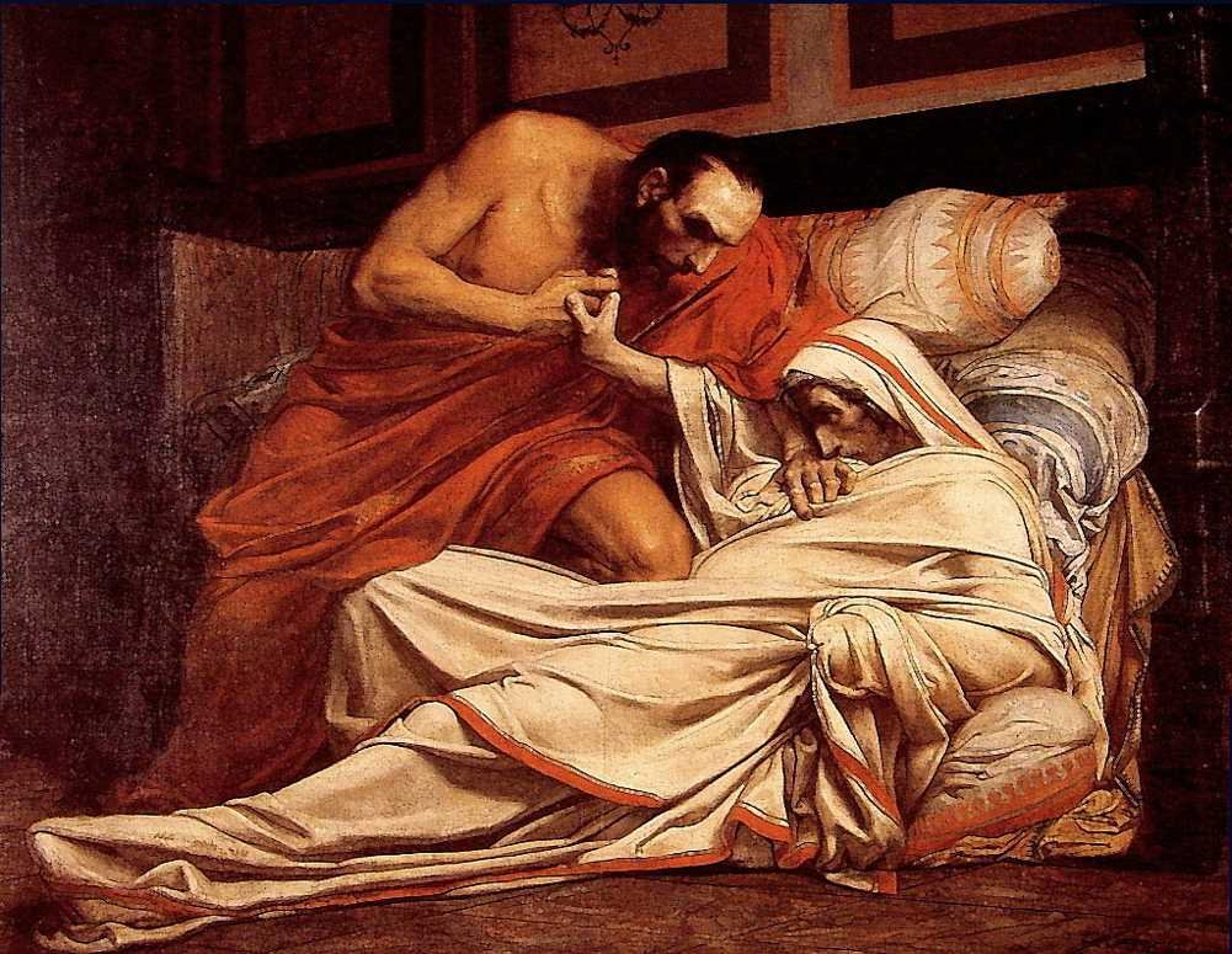
The Death of Tiberius (1864), Jean-Paul Laurens
Intro
Is there such a thing as human nature? The obvious variability of human characteristics and life manifestations gives grounds for a negative answer to the question. The logical consequence of this point of view is the conclusion that a person can be viewed like anything and molded into anything. Thus, the connection between a human and the various ways of his social existence disappears. Nevertheless, any form of social order must somehow conform to some fundamental and invariant characteristics of the human race. On the other hand, to metaphysically postulate, in the manner of Aristotle and Christian theologians, one or another definiteness of human nature as a set of fixed unchangeable qualities, is also wrong. All the metaphysical definiteness, and the resulting debates about whether human nature is "evil" or "good", have revealed their inconsistency (1). In order to understand the essence of the matter, it is necessary, along with indisputable variability, to find a certain invariance in human reality. A proper understanding of the issue will shed light on what is happening to a human now, in our time, and what his possible future is.
I. The Invariant Elements in Man
A. Needs
A human is formed by the interaction of consciousness and the outside world, not consciousness or outside world which are taken separately. Therefore, in order to find the invariance we are interested in, we must establish what connects the inner and the outer. What drives human interaction with the outside world (natural and social)? The driver is the needs inherent in a human being. The needs can be grouped into three main categories. The first one is the needs related to the body aspect in one way or another. This refers to the needs to satisfy the food and sexual instinct, the instinct of self preservation, the need for housing, clothing, etc. The second category, in general terms, is the need for co—existence with "others", which is differentiated into the needs for recognition, status, interpersonal relationships (communication, friendship, love), etc. The third category (the most unobvious, but the most important in the context of this study) is the need for subjective expansion, the extention of the sphere of life in which a person fulfils himself as an active and conscious being. The psychological term "the need for self-actualization" only partially and one-sidedly reflects the essence of the matter in this case. The concepts of modern psychology about needs as a hierarchical structure ("Maslow's pyramid", etc.) are not adequate from the point of view of philosophical anthropology. The needs are not hierarchically arranged by levels, they are arranged in a row and at the same time are mutually conditioned and interconnected.
Take the story of Robinson Crusoe. Robinson did not equip his life in such a way that he first sought to satisfy his bodily needs and ensure his safety in order then to begin to think about how he could get off a desert island. On the contrary, it was precisely the extreme deprivation of the need for "others" and the need for the expansion of "I" that motivated Robinson to equip his life, not as an end in itself, but as a means to leave the island. Confirmation can be found in the real stories of people stranded on a desert island. Those of them who lost hope of returning to human society, and, accordingly, did not make any efforts, quickly degraded, and the reason for that was not a hunger .
There are no impassable boundaries between categories of needs. For example, when representatives of the "middle" and "upper" class visit a very expensive restaurant or buy a luxury house, they not only satisfy their needs for food and housing, but also satisfy their needs for social status and recognition. The fact that in this case the satisfaction of needs occurs in a perverse way is another matter.
So, due to the universality of human needs as a driver of activity, they can be considered as the first level of an invariant aspect of human nature.
B. Species-being
Any human activity is a manifestation of dialectically interrelated human forces — deobjectification and objectification (2). Deobjectification is a process in which a person grasps the properties, essence, "logic of an object", "appropriates" an object in his consciousness in the form of an ideal, transforms it in his consciousness and, thus, expands his practical abilities. Objectification is an activity in which a person's abilities are transferred into the object he creates, embodied in the object, so that the object becomes a socio-cultural, or "human object". Marx wrote: "A spider conducts operations that resemble those of a weaver, and a bee puts to shame many an architect in the construction of her cells. But what distinguishes the worst architect from the best of bees is this, that the architect raises his structure in imagination before he erects it in reality. At the end of every labour-process, we get a result that already existed in the imagination of the labourer at its commencement" (3). But what is an architectural project? The architect has a specific task, determined by the needs of the customer or (and) his personal needs. The architect deobjectifies in his head the accumulated baggage of professional knowledge and transforms them in such a way as to solve the problem, possibly creating something fundamentally new from a technical and aesthetic point of view. The material embodiment of an architectural project is its objectification. Similarly, a worker, in order to produce a complex part, deobjectifies his skills and abilities, adapts them to the specific conditions of solving a specific task and objectifies them while working on the production of the part. Deobjectification is primary.
A human manifests himself in activities that are conditioned by needs and create new needs themselves. Activity is the reality of "human nature". This applies both to the individual and to human as a species (Hegel correctly wrote that "A man is nothing but the series of his actions") (4).
The term "human nature" (menschliches Wesen), burdened with numerous metaphysical and spiritualistic connotations, is not used in Marx's works. Marx uses the term "Gattungswesen", which is best translated as "species-being", "species-existence" (5). This concept reflects three essential points. Firstly, man is a social being, his existence goes in connection with the existence of the species as a whole. Secondly, man creates new "species" through his activities. In this context, "species" mean objects of material and spiritual production. Thirdly, human activity, within the framework of a particular form of social cooperation, changes a man himself. In other words, by producing objects, a man produces himself as an object (6). That is why human nature cannot be fixed as a strictly defined set of qualities. For the same reason, man, in a certain sense, stands on the other side of good and evil. This does not negate the fact that in practice people really share moral values and that one or another morality is a regulator of behavior in the human community. But in a philosophical sense, a man is out-moral.
Thus, we find the second level of invariance in a man as a "species-being".
II. The Relationship Between Invariant Elements and Crises of Social Formations
Needs and activity — these two invariant aspects of a man are inextricably linked to the growth of productive forces, they are the ones that push them forward. But man himself is a productive force too. Moreover, he is the main productive force of society, because his work, knowledge, skills and experience create products of labor and new technologies.
According to Marx, one or another model of social organization declines and gives way to a new
model when the growth of productive forces either slows down significantly and for a long period, or stops. But how does this relate to human needs and activities? In practice, this means a qualitatively and quantitatively growing, long-term (over the course of several generations) deprivation of the complexes of human needs described above. Of course, there can be no evenness of this process in a class society. When the slave-owning Ancient Rome or feudal France were collapsing, members of the ruling class indulged in gluttony and debauchery no less, but more than during the heydays of these societies (which in itself is an indicator of deprivation and perversion of super-bodily needs).
The objective mechanism of deprivation is as follows. Relations of production are basically the relations between people in the process of material and spiritual production. At a certain point, certain relations of production become obsolete and become fetters, a brake on the development of productive forces. The lower classes of society, the direct producers of a material product, face increased exploitation, they work more and receive less, and experience deprivation of the simplest needs. At the same time, as the growth of the surplus product slows down or stops, contradictions and struggles between the factions of the ruling classes intensify. All classes and strata of society are gripped by a sense of existential "tightness" and "nausea", a feeling that "one can't live like this". Ideology (religion, morality, political beliefs, etc.), which previously united people and, to a certain extent, smoothed out social antagonisms, is disavowed in the eyes of representatives of all classes, it turns into a meaningless social convention. Old social ties are either being destroyed or degraded, and new social ties are emerging. In the humanitarian aspect, these processes mean the deprivation and transformation of higher human needs: the need for co-existence with "others" and the need for subjective expansion.
The class that benefits from the new social order is looking for a way out. But members of a class that embodies the old order are also looking for a way out. Some of them are trying to engage in reforms. Others are going over to the side of the future, new order. Let's illustrate this with the examples of Ancient Rome and the Great French Revolution. Christianity originated in the eastern periphery of the Roman empire as the "religion of slaves". Initially, it was an ideological center around which the oppressed social strata and ethnic groups of the empire were grouped. But at its core, Christianity was best suited to the role of the ideological shell of the new order — feudalism. Long before the Edict of Milan and the legalization of Christianity by emperor Constantine, representatives of the slave-owning elite began to convert to Christianity. And then the emperors themselves established Christianity as the official religion and began to persecute pagans. Active participants in the bourgeois revolution in France, at its first stage, were aristocrats - duke Philippe d'Orleans, the king's relative, comte de Mirabeau, marquis de La Fayette and others. These aristocrats, as well as the radicals from the third estate (Robespierre, Hebert, Chaumette, Collot d'Herbois, etc.) fully shared the ideas of the French encyclopedists. The encyclopedists played the same role for the new, bourgeois ideology as the Apostle Paul did for Christianity — they adapted ideology for mass perception and gave it a universal character. Thus, despite the complete opposite in content, one can see the identity in one respect. In the context of the social crisis and the associated deprivation and transformation of higher human needs, both early Christianity and the ideas of the Enlightenment emerged as a spiritual orientation, as a means to meet the needs of co existence with "others" and subjective expansion in a new way.
The division of mental and physical labor, the division of society into managers and those who are managed, division of organizers and servants — these basic lines of division of labor inevitably lead to the alienation of a person from his "species-being", from himself, from other people and from nature. At a certain stage in the development of mankind, the division of labor was necessary in order for a man to get out of subjection to the elemental forces of nature. The uniqueness of the current historical moment lies in the fact that the productive forces have reached a level that made possible rapid progress towards the elimination of the division of labor. From the point of view of the development of the human race, division of labor becomes an anachronism (7), but it is supported and protected by the existing social structure.
Of course, alienation also affects the formation and satisfaction of needs. Since the goal of production under capitalism is not satisfaction of needs in itself, but profit, in pursuit of it, the capitalist machine must necessarily invent and fabricate a whole world of artificial needs that are unnecessary and often harmful to human development. Here, another aspect of alienation opens up — needs (along with the way they are satisfied) are imposed on a person from the outside, by an external, abstract and alien force (8). The desire to satisfy imposed needs generates frustration in a person, but at the same time acts as a force that binds him to an alienated society (9).
But this movement of the capital machine, which satisfies human needs indirectly, through the production of value, must be considered dialectically. In the «Economic Manuscripts of 1857-1859» (“Grundrisse”), Marx wrote:
Although limited by its very nature, [capital] strives towards the universal development of the forces of production, and thus becomes the presupposition of a new mode of production, which is founded not on the development of the forces of production for the purpose of reproducing or at most expanding a given condition, but where the free, unobstructed, progressive, and universal development of the forces of production is itself the presupposition of society and hence of its reproduction; where advance beyond the point of departure is the only presupposition. This tendency — which capital possesses, but which at the same time, since capital is a limited form of production, contradicts it and hence drives it towards dissolution — distinguishes capital from all earlier modes of production, and at the same time contains this element, that capital is posited as a mere point of transition” (10)
Thus, the tendency towards the universal development of productive forces, inherent in capitalism, at the same time manifests itself as a tendency towards the universal development of needs. The fact that needs take on a perverse character, and their satisfaction serves not the comprehensive development of man, but his devastation, is a consequence of the limited form of capitalist production.
Marx's words about "advance beyond the point of departure" (that is, permanently overcoming the existing "here-being") as the only prerequisite for a new, communist mode of production, it means that in the center of a possible new community ("Gemeinwesen") stands not the surplus value and other things alienated from man, but the "species-being" of man. Since material needs and the needs for co-existence with "others" will be freed from alienation and will take on a human appearance, the need for subjective expansion (Marx calls it "the comprehensive development of the individual") will come to the fore as a driver of the development of society. The idea of communism as a society of equalization, realm of mechanical equilibrium, in which there will be no contradictions, is purely bourgeois. People are not equal in their abilities, focuses of their personal aspirations, etc. In fact (see below) it is precisely modern bourgeois society that tends towards dead balance and "equality" in everything (except, of course, property). It is in the conditions of late capitalism that people become similar to each other, and it is in these conditions that the "mass-like man" exists. In a possible communist community, ugly capitalist competition must give way to emulation (agonism).
Thus, Marx notes the contradiction between the tendency towards the universal development of productive forces (including man himself) and the "limited form of production", which is capital. From the objective side, from the socio-economic structure, the contradiction manifests itself in regularly recurring economic crises, the imbalance of production and consumption, the destruction of the natural environment, etc. From the subjective side, from the human side, the contradiction manifests itself as a struggle of capital against species-being.
III. Is the History Moving Towards its End?
Does the story have a direction and, consequently, in a sense, a "goal"? In a polemic with the Hegelian concept of the "World Spirit" moving through history towards its absolute self-knowledge, Marx wrote: “History does nothing, it "possesses no immense wealth", it "wages no battles". It is man, real, living man who does all that, who possesses and fights; "history" is not, as it were, a person apart, using man as a means to achieve its own aims; history is nothing but the activity of man pursuing his aims” (11). This may be seen as a contradiction with the thesis about the objective nature of material conditions and relations of production. There is a contradiction, but it is a real dialectical contradiction between the subjective and the objective in history. In vulgar and contemplative Marxism, the Hegelian in origin ideas of a kind of "communist teleology" have spread, that the objective course of history, the change of formations, will inevitably, as if by themselves, eventually lead to the "goal" - communism. These ideas are wrong (12).
So, on the one hand, a man is the only real actor in the historical process, on the other hand, objective historical social conditions dictate a man's thoughts and behavior. The reality and inevitability of this contradiction become clear if we turn to the concept of alienation. Let's recall that alienation is a rupture of the original unity of a person and his activities, a state of society in which the world created by people through deobjectification and objectification opposes people themselves as an alien and hostile world to their free development. In other words, a man creates history by creating with his own hands and mind a world that is beyond his control and to which he is forced to submit as an external and alien force.
Let us also recall that "history" (as well as "society" and "civilization") began only when alienation manifested itself. When Marx writes that communism is "the solution to the riddle of history" (13), he means the elimination of alienation. This is not the case that Marx, like Hegel, comes to the identity of the subjective and the objective. In fact, the point is that in the new communist community (not to be confused with "society"), the contradiction between the subjective and the objective will lose its antagonistic character caused by alienation.
Is there any reason to conclude from this that history is moving towards a "goal", towards its "end", namely, the elimination of alienation? No. The end of alienation is not guaranteed, it is only an option, one of the options for the development of human society. Moreover, never in history has man been so alienated as in the modern era of the domination of a well-functioning, perfect technocratic value-producing machine, a machine that manufactures not only the brilliance of physically visible goods, but also thoughts, ideas, feelings, relationships between people, and human life itself from beginning to end...
IV. The Threat of a Posthuman Society.
If, from the point of view of the communist perspective, "the end of history" (14) is the possibility of resolving irreconcilable social contradictions and eliminating human alienation from society, from nature, from other people and from oneself, then from the point of view of capital, "the end of history" is the uncontested triumph of capital itself, the perpetuation of capital as a social and existential totality.
In the apologetics of capitalism, bourgeois scientists often refer to "human nature". But in fact, these scientists take a man crippled by alienation and capitalism, snatch out certain moments, absolutize them and perform them as the "eternal" nature of man. Justifying imagined worldwide victory of Western liberal democracy, Francis Fukuyama writes: "As people become richer, more educated, more cosmopolitan, they demand recognition of their status" (15). In this he finds an explanation for the craving for bourgeois freedoms, even in the conditions of economically successful bourgeois authoritarianism. According to Fukuyama, the thirst for recognition is "the lost link between liberal economics and liberal politics". Obviously, one of the fundamental needs mentioned above, the need for co-existence with "others", is interpreted here based on the paradigm of human alienation and boils down to purely quantitative "signs" of social status in a bourgeois society, ultimately to the amount of money in the purse of an individual who craves bourgeois "freedoms" (not to mention the fact that "recognition" here breaks away from the closely related need for subjective expansion).
Being unable to adequately understand and resolve the question of "human nature", Fukuyama nevertheless intuitively grasps one very important objective contradiction. Namely, the inability of bourgeois society to provide space for the human need for subjective expansion. Of course, in the presentation of the capital apologist, this contradiction takes a perverted form. He defines subjective expansion as "striving for superiority", suggesting that it must necessarily be realized at the expense of the "others". Fukuyama thus shows how deeply is embedded in his brain the idea of the "naturalness" of the relationship of domination and submission. Since bourgeois liberal freedom is a specific historical form of the relationship of domination and submission, it is actually quite logical that the "singer of freedom" in the depths of his mentality cannot escape from adherence to social sadomasochism. Having perversely presented the need for subjective expansion (the comprehensive development of the individual according to Marx), Fukuyama perceives it negatively as an obstacle to the “harmony" that should reign in the world of capital. On the contrary, Nietzschean's "last man" (a man of the crowd, an individual with an erased personality, atomic in his mass character and massive in his atomicity, a man of the late capitalist era) receives his approval (16). And it is no coincidence that in the very title of his book, "The End of History and the Last Man", the author emphasizes the importance of the theme of "the last man". It is precisely in the contradiction between the "pursuit of superiority" and the technocratic sterile social machine that Fukuyama sees the most serious internal threat to late capitalism. He is afraid that liberal democracy will be destroyed due to the inability to eradicate the "human desire for struggle" (read - if the need for subjective expansion will not be completely and definitively eradicated from a person). Fukuyama warns that after the triumph of liberal capitalism, a man "will struggle against the very cause. He will fight for the sake of fighting. In other words, people will struggle just out of boredom, they can't imagine living in a world without struggle". The author's fear is that "those who remain unsatisfied will always be able to resume the course of history" (17).
In the context of this problematics, it is appropriate to say a few words about Nietzsche. Nietzsche was neither a materialist nor a dialectician, and, of course, taken as a whole, his philosophy is either fruitless or reactionary. Nevertheless, it must be admitted that, while remaining on the ground of alienation, he rather shrewdly grasped the tendencies of alienation and aptly criticized its certain effects. The significance of Nietzsche is that, paradoxically, he was the last humanist from the galaxy of great bourgeois thinkers of the XVIII-XIX century, the era of the rise of the bourgeoisie. In his person, bourgeois humanism realized the extreme acuteness and irreconcilability of its own contradictions. Nietzsche tried to find a way out by rethinking humanism, but the attempt proved to be a failure. In the person of Nietzsche's epigones and interpreters, bourgeois humanism had come to its complete denial.
Nietzsche's "last man" is the antithesis of the "superman". The description of the "last man" has relative value (because we see his features in the mass-like and simplified individual of late capitalism), while the image of the "superman" is nothing more than a subjectivist fantasy, myth making. What criteria should distinguish between a human and a superman? Biological? Spiritual? Or both? Why and how should a superman emerge from the realm of the "last man"? In this case, we are dealing with a culturally mobilizing myth, not science, and we will not get answers to these questions. It is necessary to save a man, the human race. Subjectivist fantasies won't help here.
Capital is fighting against human species-being, reformatting it in accordance with its needs, removing from it everything that is potentially or actually threatening danger and contradicts the reproduction of capital. In left-wing thought in general, and in Marxist thought in particular, this problem is not given the attention it deserves.
Why does capital have such an opportunity to change a person "in his image and likeness"? As already noted, one of the essential aspects of species-being is that human activity within the framework of a particular form of social cooperation changes the person himself. By producing objects within the framework of a particular social model, a person produces himself as an object. In a society of alienation, this self-objectification of a person goes in accordance with the logic of reproduction of the social relations of the system. Capital strives to ensure that production of a human does not exceed the limits of the capitalist system, so that it serves to perpetuate this system.
It should not be thought that this is only about people who are directly involved in the production of material or spiritual objects. This is about all people, because each person participates in the reproduction of certain elements of social relations, or, in other words, participates in the production of objects of sociality. For example, a disabled person under capitalism participates in the production of the "bourgeois state — disabled" social relationship. A homeless person participates in the production of social relations between public and private charity and the homeless.
The offensive of capital on the species-being of man goes in many directions, for example:
Biopolitics. Prohibitions and rules, behavioral modeling can be useful or harmful. But from the point of view of the system as a whole, the question of their usefulness or harm is absolutely secondary. Their main function is "training", taming a human by capital.
The destruction of the ability to independent critical thinking and volitional choice. The fabrication of a "mass-like", "one-dimensional" person. This work is handled by the mass media, the entertainment industry, the near-scientific "expert" community, and the morally and intellectually corrupt part of the scientific and creative world.
Introjection of the alienated world of technology (including social technologies). Technologies (especially digital ones), subordinated to capital and functioning according to its rules, invade the inner world of a person, become a part of it.
Total control of almost all manifestations of human life-activity.
Without any conspiracy theory, just based on existing trends, it can be assumed that in the near future it will come to linking humans to the AI environment through the implantation of chips, manipulation of the human genome, and other wonders of the "new brave world".
Nietzsche's "last man" (with a minus sign) and Fukuyama's "last man" (with a plus sign) are more of an image, but not a notion. But, undoubtedly, ominous transformations are really taking place in modern man. The notion must be revealed based on the invariances of human nature — needs and species-being. A person's fundamental need for subjective expansion is stifled and, ultimately, withdrawn from him. Another fundamental need for co-existence with the "others" is perverted and minimized (18). The species-being is being destroyed. The essential powers of man, deobjectification and objectification, are becoming, on the one hand, more and more phantom, on the other hand, they completely lose any connection with the human self and authenticity. This is the definition of a posthuman. Of course, the transition from a human society to a posthuman one is not accomplished fact. This is about a growing trend that can and should be seen and distinguished.
V. Tragic Freedom.
Freedom is the recognition of necessity, "the capacity to make decisions with knowledge of the subject" (19). Having learned the complexes of necessities, i.e. the laws operating in the natural world, humanity has largely freed itself from its spontaneous power. Marx, Engels and Lenin
discovered general patterns operating in society. But when it comes to society, since the results of knowledge affect the material interests of large groups of people, classes and social strata, and also since the transformation of society requires not only shaking out prejudices and all sorts of rubbish from people's heads, but also requires the will, effort, and heroic spiritual uplift of large groups of people - correct knowledge, taken by itself, it by no means guarantees transformation of the human world. The problem of modern Marxism lies not in the irrelevance of its ideas to modern reality. As before, Marxism is able to explain actual reality more adequately than any non-Marxism. The problem is that it is unable to change reality.
There is an unprecedented economic crisis ahead, the collapse of the global financial bubble. A hybrid world war is underway. But in the decaying masses of consumer society, we see neither awareness of what is happening, nor, moreover, the will to achieve any changes. The phenomenon of the "silence of the masses", the "end of the social" described by Baudrillard, cannot be explained solely by the fact that over the past decades the world bourgeoisie has invested huge amounts of money in intellectual discourses and media propaganda in order to convince the masses that there is no real alternative to capitalism. There are objective reasons for "capitalist realism" (20).
To the extent that the masses are concerned in anything other than their daily survival and participation in the consumption race, they make a choice between "progress" and "tradition", roughly speaking, between the collective "Kamala Harris" and the collective "Trump" (with national specifics in any given country). Needless to say, this is a false choice, a choice between two hypostases of the same system. And in fact, this is where the main danger for the future lies. There is a danger that a comprehensive systemic crisis and decay in the scenery of super-modern technologies will only unleash a spiral of reactionary darkness and degradation, without any chance to find a positive outcome...
The recognition of necessity, when it is impossible to influence the negative nature of this necessity, is a tragic freedom. Nevertheless, the choice of tragic freedom is better for a person's dignity than ignorance of the "happy consciousness". This freedom also does not mean giving up the struggle. The young Hegel captured this dialectic of the clash of fatal objectivity and the subjective aspiration of thought and will in his poetic lines, which even today sound like an ethical imperative:
Bravely devote yourself, offspring of the gods, to further the battle.
Give up contentment,
Destroying this world
By means of your labour!
Challenge yourself.
You cannot
Become better than Time.
Yet, through your daring efforts,
Time itself will ascend.
(21)
Footnotes
1. It is worth to note that thinkers who claim that man is inherently evil, selfish, and corrupt appeal to external coercion. Thus, the Legalism school in Ancient China insisted that it was possible to prevent or limit the consequences of human depravity with the help of "correct" laws and regulations. Kant called for cultivating rationality as a limiter. Hobbes relied directly on the power of the state. On the other hand, proponents of faith in the "good" nature of man have little to bring in support of their opinion.
2. See more about it: Victor Yarov. "Late capitalism and alienation"
https://www.geesemag.com/late-capitalism-and-alienation
3. 3. K. Marx. “Capital”, vol. I. – K. Marx, F. Engels. Collected works, vol. 23, p. 189. Gospolitizdat. M. 1960.
4. Hegel G.W.F. "The encyclopedia of Philosophical Sciences. Part one. Logic". M. 1929. p. 236.
5. In the literature in Russian, this term is usually translated as "genus essence". It seems that this is wrong, since the term, firstly, obscures the aspect that human himself creates "species", kinds of objects, and secondly, it can generate metaphysical interpretations in the reader's head. The German word "Wesen" can mean both "essence" and "being", "existence". The term "species-being" much more accurately reflects the fundamental characteristic of humans as an active and social species.
6. “Not only do the objective conditions change in the act of reproduction, e.g. the village becomes a town, the wilderness a cleared field etc., but the producers change, too, in that they bring out new qualities in themselves, develop themselves in production, transform themselves, develop new powers and ideas, new modes of intercourse, new needs and new language”. K. Marx. "Economic manuscripts of 1857-1859". Collected works. Vol. 46. Part 1. Politizdat, M. 1968.
7. There are many confirmations of this thesis in the reality around us. These include the degradation of the management quality of the organizers of capitalist production and bourgeois politicians, the obvious degradation of intellectuals, stagnation and fraud in fundamental science, disintegration and decay of art and culture, etc. The progressive decline of bourgeois organizational and intellectual labor is complemented "from below" by the disintegration of the elementary work ethic of "executors", the gigantic expansion of "bullshit jobs" (David Graeber) and the social parasitism of a huge part of society.
8. For example, communication and learning new things are natural human needs. But the creators of social networks are interested in this need as a means to make a profit. By perverting natural needs, capitalist marketing has invented and imposed the need for virtual, anonymous, surrogate communication, as well as the devouring of vulgar entertainment content that gives nothing to either the mind or the heart. It takes many hours for many people every day.
9. Herbert Marcuse ("The One-Dimensional Man"), Guy Debord ("The Society of the Spectacle"), Jean Baudrillard ("Consumer Society: its Myths and Structures") wrote about false and imposed needs and their role in the functioning of the system. The undoubted value of these critical works is limited, however, by the fact that the problem is not linked to the objective evolution of the capitalist "basis" and a broad historical approach, in other words, it is not considered from the point of view of "totality".
10. K. Marx. "Economic manuscripts of 1857-1859". Collected works. vol. 46. part 2. M. Politizdat, 1968.
11. K. Marx, F. Engels “The Holy Family, or Critique of Critical Critique”. 12. It is worth noting that the Hegelian concepts of "sublation" ("Aufhebung", retention of elements of the old during the transition to the new) and "negation of negation", which migrated to the philosophy of Marxism, are not applicable to all phenomena and processes, that is, they are not universal, and, therefore, are not laws of nature, society and cognition. 13. K. Marx. "Economic and philosophical manuscripts of 1844". Marx K., Engels F. Collected works. 2nd ed. M., 1974. vol. 42. p. 116.
14. Marx interprets the history of class societies, from slavery to capitalism, as the "prehistory of mankind". The true history of mankind can begin only with the liberation of society and man from the shackles of private property and division of labor. In this sense, the "end of history" is the end of prehistory and the beginning of real history.
15. Francis Fukuyama. "The End of History and the Last Man". 1992. Free Press. 16. “What is love? What is creation? What is longing? What is a star?”—so asketh the last man and blinketh. The earth hath then become small, and on it there hoppeth the last man who maketh everything small. His species is ineradicable like that of the ground-flea; the last
man liveth longest. “We have discovered happiness”—say the last men, and blink thereby”. F. Nietzsche. "Thus Spoke Zarathustra”.
17. Fukuyama's predictions about the worldwide triumph of Western-style liberal democracy turned out to be empty, not because the "struggle of civilizations" unfolded and non-Western authoritarian models gained strength. In fact, we can witness the rapid convergence of Western liberal democracy and "authoritarian regimes". On a global scale, in the most essential things, late capitalism is unitary.
18. See Karl Popper's stage of the "anonymous society" which should follow his "open society". According to Popper, at that stage people will no longer feel the need for real contacts with each other.
19. F. Engels. “Anti-Dühring”.
20. "But wait, the general orientation of your texts is pessimistic and, thus, is grist to the mill of hopelessness and lack of alternatives, and this is exactly what the system inspires" — the reader may say. But it's about different things. The bourgeoisie has its own goals. If the proponents of the alternative are forced to state in their research that the situation is far from rosy, then this is not capitulation, but a real view of things.
21. «Dokumente zu Hegels Entwicklung». Hrsg. von Hoffmeister. Stuttgart, 1936.