
Oct 30, 2026
Carceral Municipalism and the Socialist Left’s Rehabilitation of the Prison-Industrial Complex (Part 1)
In line with a broader trend on the left, Mayor Zohran Mamdani has taken a tepid approach to confronting carceral power in New York City. In this two-part series, abolitionist organizers Nathan Yaffe and Linda Luu lay out the Mamdani administration’s position on policing and jails and caution that its current course is headed towards replicating the mistakes of past reformers who (sometimes inadvertently) expanded carceral power.
by Nathan Yaffe and Linda Luu
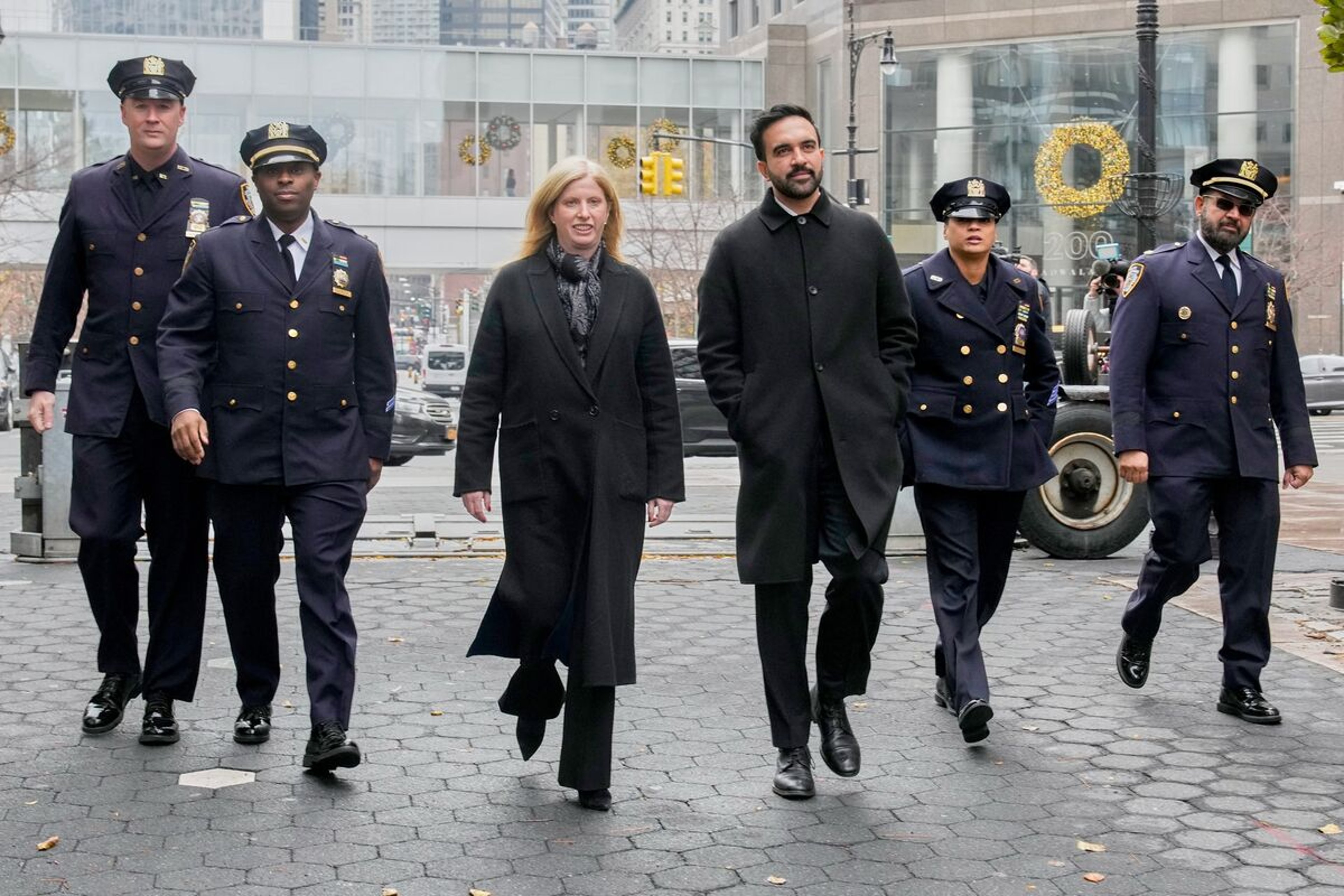
The left flank of the political establishment is in the midst of a full-scale retreat from confronting carceral power. Rep. Alexandria Ocasio-Cortez’s dismissal of “woke 1” as “crazy” indexes a larger shift on the part of progressive candidates and elected officials to walk back prior criticism or offer pledges of renewed support for policing. Recently, Jacobin published an article declaring the “moment” of abolition over and articulating a reformist policing platform. Prisons and jails barely register on the left’s policy agenda, with the caveat that some continue to organize against the physical and legal infrastructure of ICE’s deportation machinery. Even then, elected officials often exceptionalize “Donald Trump’s ICE” while reaffirming a commitment to law enforcement generally. This has broadly undermined anti-carceral organizing, as funders and former organizational allies abandon the issue. Meanwhile, the administration continues to heavily rely upon criminalization to further fascist consolidation without facing a serious challenge.
Reluctance to confront the police—not so long ago a hallmark of stodgy DNC types and met with derision by progressives—has become the party line among the electorally inclined left. Indeed, the progressive political establishment has gone all-in on the wager that a pro-working-class agenda can be won while maintaining a conciliatory stance towards the prison-industrial complex. The contours of this retrenchment are clearest in New York City under the leadership of Mayor Zohran Mamdani. His leadership is an experiment in democratic socialist municipalism that seeks to restore faith in public institutions—including, notably, the cops and cages. By all indications, Mamdani appears intent on leaving behind a stronger, larger, and more popular system of policing and imprisonment than the one he inherited.
We call Mamdani’s approach “carceral municipalism.” It reflects a fusing of carceral institutions into the socialist municipal project with an eye towards rationalizing and harmonizing their function. With socialist mayors winning office in several major cities, Mamdani’s mayoralty may serve as an important bellwether for this variant of municipalism. Unfortunately, in our view, carceral municipalism will inevitably lead to the expansion of carceral power over the city. If this emerging program is not rejected and abandoned, it could prove an existential threat to the progressive project its proponents champion. We argue instead that winning a socialist (or even just a meaningfully redistributive) agenda requires advancing abolitionist demands.
Supporters of Mamdani’s approach subscribe to the theory that the city can pursue a strategy of pairing public investment in social services with robust policing, in the hopes of later reducing reliance on policing once such investments chip away at the “root causes” of social disorder. However, this approach repeats the mistakes of past liberal reform efforts that have attempted to pair pro-social investment with concessions to carceral actors, only to see carceral institutions expand while welfarist policies withered on the vine. Using New York City as a case study, we argue that carceral municipalism is poised to further stabilize the deadly role of the police in the governance of public space and public life.
The Retreat from Confronting Carceral Power
The left’s shift on policing, as others have noted, at least in part reflects a lack of courage: some combination of capitulation and appeasement of both reactionary Democratic Party forces and imagined moderate voters. In particular, elected officials or candidates affiliated with Democratic Socialists of America (DSA), electorally-inclined chapter leadership, and prominent DSA backers have endorsed police and prisons or discouraged discussion of abolitionist politics. Some fellow-travelers go further, dismissing abolition as having been foisted on DSA by “the groups” or attempting to define a vision of “pro-police socialism.” In many cases, the disavowal reflects a fear that progress on affordability or economic issues will be imperiled by confronting police and prisons—notwithstanding the lack of evidence that abolitionist demands sparked electoral backlash.
Some left insiders even recognize the inherent harms of criminalization, yet nonetheless seek to defer confrontation with the carceral state. This view was on display in a recent episode of Jacobin’s podcast, The Dig. Host Daniel Denvir asked Fahd Ahmed, the Executive Director of Desis Rising Up and Moving (DRUM, one of Mamdani’s day-one endorsers), about the “new assessment” amongst the socialist left “that it’s a mistake to engage in a direct confrontation with the repressive state apparatuses.” Denvir recognized that the NYPD has been central to a 50-year strategy to establish a violent austerity regime, ensure real estate dominance, and entrench the color line—” the opposite of what we’re trying to achieve as socialists.” However, as Denvir put it, the left now must “build out alternatives to policing [and] transform society so there’s less disorder and crime,” which “will neutralize the cops’ legitimating claims” and erode “the sense that they’re indispensable to the city.” According to this logic, once the police’s legitimacy is diminished by beefing up other social institutions (including those for managing disorder and crime), then they can be confronted directly.
Ahmed concurred with this reasoning. Warning against “purist or moralist” approaches at a time when “movements around policing are weakened, and the common sense understanding of the role of policing has shifted rightwards,” Ahmed emphasized that the left must get the “order of operations” right. Now, he reasoned, given weak anti-carceral movements, the left must work on other priority areas first to “get in position.” Specifically, he noted that policing has been built “through the starving of social systems of health, of education,” which “further justifies the need for police because then you have people that don’t have treatment … and are out on the streets [and] homeless.”
The “order of operations” thesis blurs an assessment of exploitable movement weaknesses with an analysis of the institution of policing itself. Despite acknowledging that the NYPD can itself create street-level chaos and crime panic, Ahmed succumbs to the mistaken view that policing reflects some empirically existing social reality called “crime” or “disorder.” On the contrary, the expansion of incarceration as a tactic of responding to social problems and furthering dominant state interests has not been fueled by “crime,” itself a social category that does not exist outside the criminal-punishment system. Nor does it reflect “harm” or even the prevalence of people sleeping in the subway system. Instead, it reflects dominant class and racial formations, and indeed the interests of the police itself.
Versions of these views have found a home in the Mamdani administration. Alex Vitale, a Mamdani transition advisor on public safety issues, recently echoed these arguments: “If we only focus on long-term poverty reduction, we are leaving people to live with crime disorder, insecurity, whatever, and that is going to drive them into a pro-police position.” His solution is to massively expand “non-police public safety strategies” to preempt solidifying the putative working class attachment to policing. DSA’s early public articulations of its emerging goals for police reform under Mamdani mirror Vitale’s, discussing the parallel crisis response system DSA hopes to build—and not any NYPD functions, units, technologies, or tactics it hopes to eliminate.
These views are clearly reflected in policy. From the start, Mayor Mamdani’s policing platform was limited and did not include any reduction in NYPD headcount or budget. It focused on reducing the role of the NYPD in mental health crisis response and establishing a Department of Community Safety (DCS) staffed with social workers and others who will handle such response instead. Although largely unfunded and understaffed in its current iteration as a mayoral office, the DCS may eventually take on other roles, such as operating preventative programs like the violence interrupter and outreach network. As with his promise to dismantle the notorious Strategic Response Group (SRG)—which has consistently been used to brutalize protesters despite its nominal anti-terrorism focus—Mamdani has made little progress on implementing these policies.
The ICE shooting of Oscar Belgal earlier this month has dramatically underscored Mamdani’s unwillingness to tangle with the NYPD. Even as the shooting revived calls to end NYPD-ICE collaboration, Mamdani appeared at the post-shooting protests alongside NYPD Commissioner Jessica Tisch. During the brief remarks, Tisch read Belgal’s rap sheet, effectively justifying the shooting. In the days since, the mayor’s allies coalesced around a call to fire Tisch, forcing Mamdani to repeatedly reaffirm his faith in the wealthy zionist police commissioner adored by the billionaire class. And there has been no indication that he intends to use the incident as political cover to advance his stated goal of dismantling the SRG.
To the appeasement-minded, the less all of this is foregrounded, the better. To the order of operations advocates, meager progress on narrow promises is no cause for concern. Invoking Mamdani’s platform on mental health crisis response, the DCS, and the pledge to dismantle the SRG, Ahmed maintains there has been “good messaging” on these issues, “remind[ing] people that we do have a different vision” on policing, “but we’re not picking a fight around moving it yet.”
The time to critically probe whether this orientation makes sense is overdue. Currently, Mamdani’s public safety doctrine poses no threat to the NYPD’s stranglehold on municipal politics. Under Mamdani, the city is likewise not moving toward conditions that will enable confrontation with carceral forces in the future. We argue that this issue cannot be sidestepped in favor of an affordability agenda. There is no meaningful pursuit of socialism at the city level, where police authority reigns supreme, without challenging that authority directly.
Public Safety under Mamdani: The Contours of Carceral Municipalism
We are witnessing the emergence of an approach to public safety and municipal governance that we term carceral municipalism, a localized iteration of police-state socialism. This is a municipalism that is focused on reinvigorating public programs and services, and rehabilitating the public’s sense that the government works for them—including its police, prisons, and jails. Indeed, Mayor Mamdani has praised the NYPD and emphasized the centrality of policing, prisons, and jails to his vision of “delivering safety.” Even when it comes to the policing of poverty, Mamdani seeks not to abandon order-maintenance, but to remake it with a friendlier face. Carceral municipalism aspires to rehabilitate the NYPD by refocusing its role without reducing its budget or headcount. Because units like the SRG and the overtly racist practices of the department at large erode the legitimacy of the NYPD, this rehabilitation effort is furthered, not undermined, by efforts to end the notorious anti-protest police unit or the gang database. Notably, this rehabilitative effort requires distancing from abolitionist-minded attacks on the legitimacy of policing functions altogether.
Mamdani’s carceral municipalism encompasses several key ingredients. First, robust investments in programs and services targeting what officials see as underlying causes of the “disorder” that police predominantly address (e.g., expanding programs to create work opportunities for youth, preventive mental health care). Second, revitalizing tools for managing that disorder aside from the deployment of uniformed police officers—historically the only well-funded response—such as mental health crisis response and violence interrupters. This would then lead to an evolution in NYPD focus, such that—freed of the obligation to manage the visible signs of disorder in public spaces—it can “actually focus on serious crimes.” Third, continued expansion of carceral infrastructure, with an emphasis on expanding parts of the system deemed rehabilitative or care-oriented.
Carceral municipalism is a perversion of the abolitionist mantra articulated by geographer Ruth Wilson Gilmore that “abolition is presence, not absence.” The phrase—commonly invoked to defend against those who skeptically demand that abolitionists explain “what we do when we destroy prisons and jails”—is meant to emphasize that abolition is not merely about destroying and negating, but about creating conditions for collective flourishing in which we need not rely on the police and caging as solutions to social problems. Abolitionists have long pointed out that doing away with punitive and carceral responses to harm necessitates building up social institutions and relationships that support human flourishing and deal with harm without disposing of people in cages. Carceral municipalism, on the other hand, not only leaves carceral infrastructure intact, but expands its capacities.
This approach is not altogether new. Historically, there have been efforts to promote both social investment and robust policing responses to disorder and crime that have ended up decisively favoring carceralism. As historian Elizabeth Hinton has shown, 1960s Great Society domestic programs, the “most ambitious liberal welfare programs in American history,” combined a focus on remedying racial discrimination, ending poverty, and fighting crime in pursuit of “twinned social welfare and social control goals.” In a version of the order of operations argument, liberal reformists argued that harsh upfront crime control could soften over time as welfare-promoting programs remedied social issues. In practice, however, politicians empowered law enforcement in “the direction and administration of urban social programs” and required programs to collaborate with carceral institutions (police, prosecutors, courts) as a condition of funding. The “fusion of law enforcement and community action, job training, and public housing programs” allowed carceral actors to command an “ever-expanding network of institutions” which ultimately “metastasized into the modern carceral state,” Hinton writes. As a result, “national law enforcement program crowded out the goals of the poverty war.”
The same story unfolded when New York City tried a similar two-pronged approach within its jail system. Jarrod Shanahan’s Captives: How Rikers Island Took New York City Hostage details how, post-World War II, progressive reformers led by Anna M. Kross sought to promote social order by reshaping penal policy to “serve a positive social function.” As with Mamdani’s carceral municipalism, the idea was to retain the focus on order-maintenance but prioritize rehabilitation led by welfare-minded experts rather than mere incapacitation. Reformers sought to shift work (and power) from jail guards to social service providers, allowing guards to focus on controlling a smaller number of more “serious” criminals.
The gambit didn’t work. Ultimately, traditional carceral actors—cops, prosecutors, and guards—took advantage of liberal support for penal welfarism to balloon the carceral system. Fusing crime control and service delivery made nonprofits dependent on carceral institutions, ultimately “lending [jails] ideological cover and practical support” to safeguard their own funding and legitimacy. The rehabilitative and welfarist shift was defeated by a mix of police- and guard-union political influence and austerity. The end result was that New York “dramatically expand[ed]… the role of police, courts, and jails in the lives of working-class people” while building new jails throughout the city—jails that operated exactly like the old ones had.
Carceral municipalism replicates core logics from these earlier reform efforts, applied at the scale of the municipality. Indeed, if anything, the change in scale to the level of the city will likely exacerbate these dynamics. In the context of Great Society programs and Kross’s battle to reform city jails such as Rikers, law enforcement had to fight—sometimes in the face of opposition from policy designers—to ensure their power was not diminished by liberal reforms. Mamdani, by contrast, has sought to integrate the NYPD as a central pillar of his governance from the start. Moreover, as municipal chief executive, he exercises far broader programmatic powers than Kross did as jail commissioner and far more direct control than the federal policymakers behind the Great Society programs. And he is using that position to apply his formidable communication skills to spread a pro-police message while bending over backward to court NYPD support. Finally, whereas Great Society architects could always use the power of the purse to increase funding for social programs, municipal government is infamously fiscally constrained. Absent general taxing power or the ability to print money, budgetary decisions tend to resemble more of a zero-sum game with bloated budgets for cops and cages coming at the (literal) expense of other social programs—a core insight of the “defund” campaign of 2020.
It is useful to contrast carceral municipalism with what came before. Eric Adams, a law-and-order conservative, used his mayoralty to subordinate other city agencies to the NYPD. His Operation Roosevelt—a violent “cleanup” reminiscent of the Giuliani era, this time targeting the long-time working class immigrant neighborhood of Jackson Heights—saw the NYPD commanding 14 other city agencies in a coordinated enforcement campaign. He installed NYPD personnel in permanent positions in city agencies and briefly pursued a plan to make all city agencies train at the site of the NYPD Academy. His was a vision of outright domination by carceral institutions, with every other agency expected to support that mission. Yet such an arrangement was inherently unstable, sparking resistance from the public and electeds alike.
In contrast, carceral municipalism envisions reconciliation between government functions, rather than sacrificing all at the altar of law and order. Mamdani seeks to rationalize and harmonize public safety, with each agency specializing in what it does best. He pitches the vision of non-police emergency response as a pro-police measure: he reiterates that police are diverted from the “serious crimes” they want to address by the incessant demands of mental health emergencies and homeless outreach. Shifting their functions to other offices is not a way to reduce their power or importance but rather to help them respond to crimes faster and increase clearance rates. This is a recipe for permanently entrenching a stabilized policing bureaucracy alongside a softer law-and-order agency that handles its light work.
Mamdani sees himself in the lineage of his oft-cited inspiration, Fiorello La Guardia, who was mayor from 1934–1946. During this period, La Guardia sought to professionalize the police and liberalize law-and-order policing, separating the NYPD from the Tammany Hall machine. Believing interactions with the NYPD would be the most direct experience of government for many city residents, La Guardia wanted the NYPD to increase rather than erode trust in city government. Under his tenure, the number of civilian NYPD employees more than quadrupled, and the police force expanded dramatically. Notably, La Guardia also oversaw the opening of the first penitentiary on Rikers Island in 1935, a jail meant to replace the deplorable Blackwell’s Island lockup, which was initially lauded for its “array of rehabilitative programming, an impressive library, and… a state-of-the-art seven-story hospital.”
Professionalization, expansion, and integration with civilian governance could not, however, change the fundamental nature of policing and incarceration. La Guardia’s tenure closed with a massive police uprising in Harlem against the NYPD’s racist rule. While he may have made the NYPD less beholden to Tammany Hall, it remained a fount of anti-Black violence and a tool of capitalist rule wielded against the working class. Meanwhile, the reformist fantasy that Rikers Island would herald a paradigm shift in incarceration quickly gave way in the face of Rikers’ infamously brutal conditions.
In an ironic twist to the parallel with his predecessor, Mamdani is now tasked with building new jails, nominally to replace the jail La Guardia opened. This round of rehabilitation-branded jail-building, known as the “borough-based jail” (BBJ) plan, has vexed Mamdani. When it was pitched to the city as a path toward closing Rikers, Mamdani, then a state lawmaker, opposed the plan. He denounced the “false choice” presented by city officials who conditioned funding for community programs on passing the jail-building plan, and refused to consider more aggressive decarceral alternatives that would allow for closing Rikers. On the campaign trail, he scarcely acknowledged the issue. Since taking office, he has revitalized jail-building efforts, spurring construction and appointing de Blasio administration veteran Dana Kaplan as jail-building “czar.”
The scale of the project is enormous: In New York City’s most recent 10-year capital strategy, the BBJs were slated to be the most expensive project (out of more than 2,000) each year from 2024–2028. The capital plan was based on a projected jail-building cost of $11.5 billion, which has subsequently swelled to $16 billion. Meanwhile, the completion date has been pushed to 2032 or later. New York is on a course for the defining infrastructure project of Mamdani’s mayoralty—and perhaps the decade—to be a network of skyscraper jails to lock up over 4,000 New Yorkers at a time.
In this sense, Mamdani seeks to stand on the shoulders of political ally Bill de Blasio, who as mayor orchestrated the cooptation of an abolitionist movement to shut down Rikers Island jails, channeling it into support for the BBJ project as a nominal quid pro quo for shuttering Rikers. Despite foisting a massive jail-building spree on the city, de Blasio’s Rikers plan stalled under Mayor Adams, who made it clear he intended to never close Rikers. Mamdani now seeks to finish what de Blasio set in motion. As for the NYPD, de Blasio, like Mamdani, was conciliatory—hiring Giuliani’s notorious police commissioner and dramatically expanding NYPD budget and headcount. Nonetheless, de Blasio’s term was marked by dramatic public spats with the NYPD (even as he backed the blue in substance). Mamdani appears preoccupied with avoiding these aspects of de Blasio’s tenure, as part of his effort to stabilize the NYPD’s role in an expanded law and order machine.
Acknowledgments: The authors extend their deep gratitude to Mon M and Zohra Ahmed for their intellectual and editorial contributions to this piece and ongoing comradeship.