
Jul 28
Dune: Western Man, Colonialism, and Power
Dune isn't the revolutionary text you think it is. Herbert's universe is a beautiful, contradictory mess, and that's exactly why it resonates.
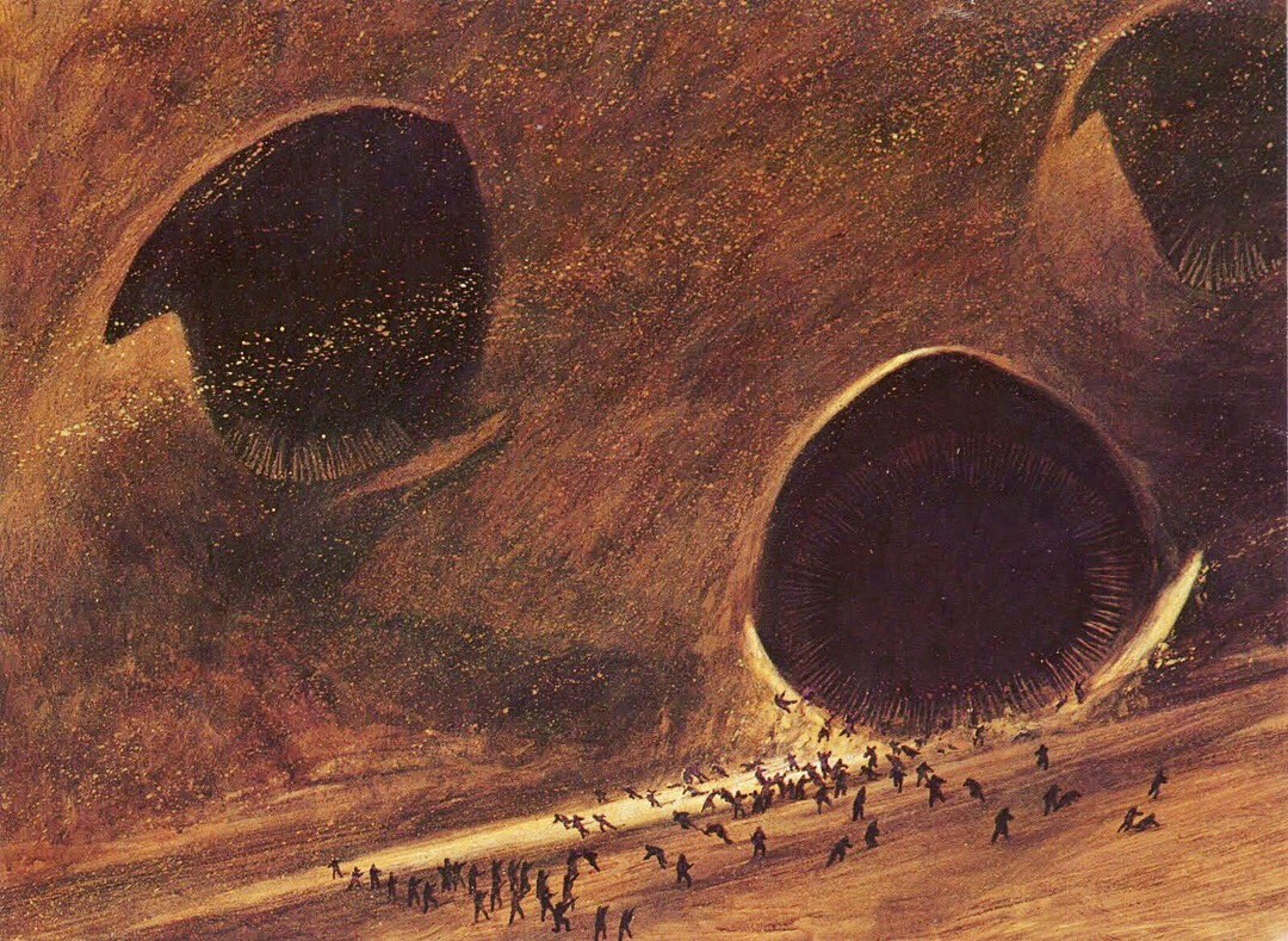
By John Schoenherr
“The trance state of prophecy is like no other visionary experience. It is not a retreat from the raw exposure of the senses…but an immersion in a multitude of new movements. Things move. It is an ultimate pragmatism in the midst of Infinity, a demanding consciousness where you come at last into the unbroken awareness that the universe moves of itself, that it changes, that its rules change, that nothing remains permanent or absolute throughout such movement, that mechanical explanations for anything can work only within precise confinements and, once the walls are broken down, the old explanations shatter and dissolve, blown away by new movements.” -Leto II, God Emperor of Dune, Frank Herbert
Dune is a story of spice, jihad, absolute power, and the dialectic between ecology and humans. The epic novels and franchise spawned by the mind of Frank Herbert have grown into a contemporary cultural phenomenon. Dune was already a highly celebrated series among book readers throughout the late 1960s-1980s, but the failed David Lynch adaptation and the controversial Brian Herbert sequels set the franchise back.
Instead, the main impact Dune had on modern culture was inspiring other, more well-known works, such as Star Wars. This changed with the Denis Villeneuve film adaptations, released in 2021, and with the possible cinematic conclusion in 2026. To date, the films have amassed over $1.1B USD in franchise revenue. The fantastical world of space jihads and time-altering drugs is now firmly back in the cultural zeitgeist and capturing the imagination of new generations.
Dune is a bizarre and hallucinatory tale of Paul Atreides, the son of a noble, aristocratic family in a galaxy-spanning empire called the Imperium. The story covers his rebellion and takeover of that empire with the use of the native people of Arrakis, or Dune. The sequels tell the stories of his family and the aftermath of his revolution and imperial rule. It’s a science fiction epic featuring mind-altering drugs, political scheming, and genocidal oppression.
The story of a galaxy-spanning oppressive empire overthrown in a violent revolution is not only beloved by the Left and 1960s hippies, but now a beloved mainstream franchise with millions of fans. It’s not too surprising why –themes of revolution, ecology, class struggle, colonialism, and more are increasingly mainstream ideas being explored throughout Western culture in both art itself and its accompanying social commentary
But what is it about Dune that has resonated with such a massive audience? How deep do these ‘class-conscious’ themes go with regard to how the story can be interpreted and from the author's point of view?
Frank Herbert: “Western Man” of Contradictions
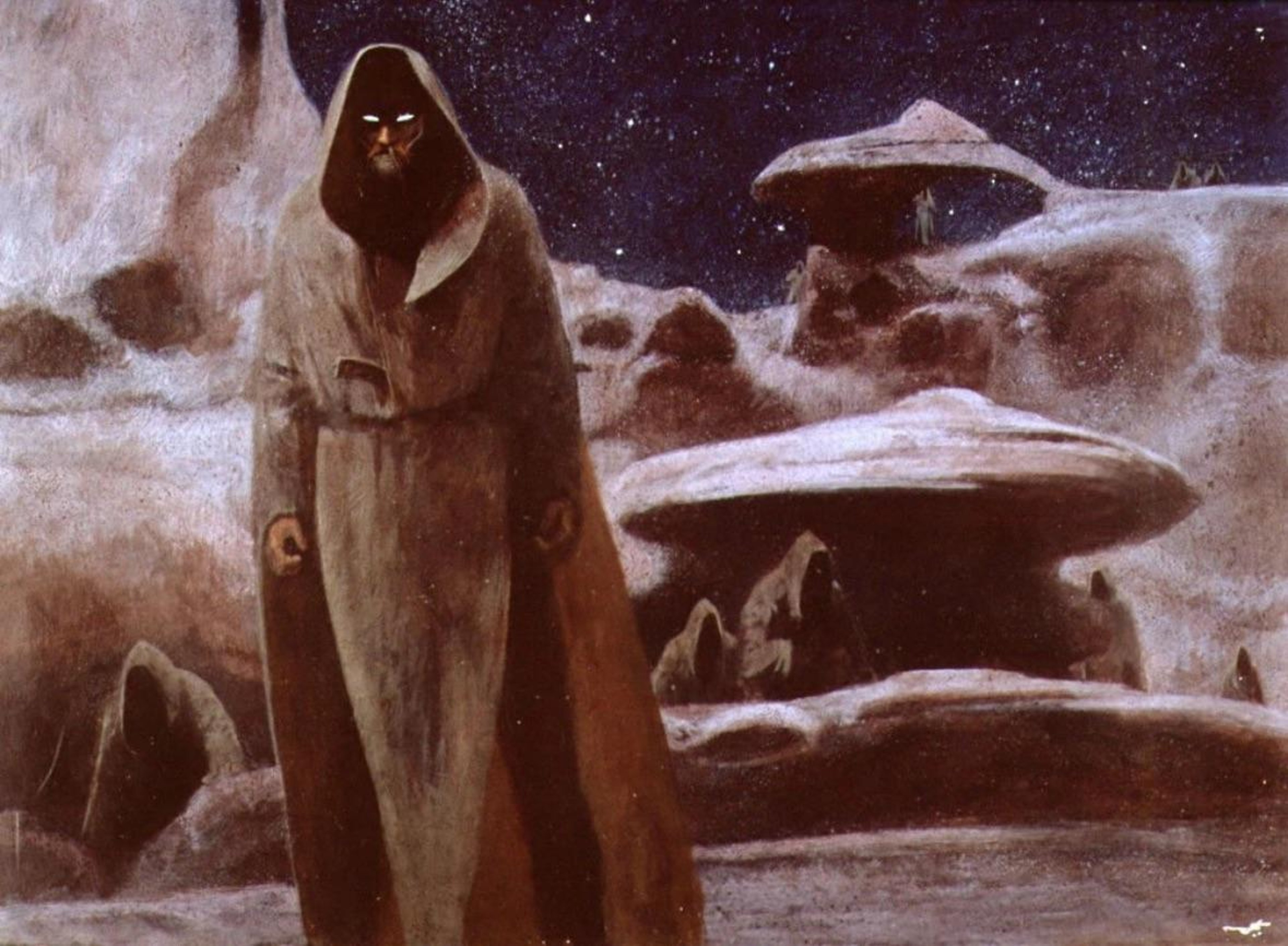
By John Schoenherr
To start analyzing the world of Dune and its socio-political themes, we must first start with its creator, Frank Herbert. The author of Dune was born into a Eugene Debs-era Socialist Party-supporting family in the Pacific Northwest. He served in World War 2 before suffering a head injury, and then met his wife in college afterwards. He would reject that socialist upbringing by first working for a Democratic Party newspaper and then becoming a GOP speechwriter. He would be introduced to the works of Freud, Jung, and Heidegger during that political transition.
In the late 50s, Herbert became inspired by observing and researching sand dune management in Oregon while simultaneously reading the likes of Robert Heinlein, the author of Starship Troopers. He was also a Vietnam War correspondent as the 1960s went on, which he denounced. Herbert believed John F. Kennedy was one of the most charismatic and dangerous presidents of his lifetime, while saying Richard Nixon was his favorite because Nixon reasserted distrust of government among the US public. All the material ingredients were there–he would bounce around different newspapers and magazines for years before the publication and relative overnight success of Dune, published in 1965. The rest is history.
Herbert, when asked what Dune was about, answered simply, “Don’t trust leaders to always be right.” While the story can be boiled down to that basic ingredient, it's also commenting on and critiquing many aspects of human reality that he was intensely afraid of, even if he was misguided in its root causes or possible systemic solutions.
For example, he critiqued Western civilization. In an early interview, he said: “Man inflicts himself on the environment. That is–Western Man. We tend to think that we can overcome nature by mathematical means. We accumulate enough data…and we subdue nature.” In turn, he romanticizes “Eastern Man”, saying they “utilize every drop of water.” Overall, he was fascinated with what he called the “Arabian and Navajo Mystique.” Herbert was quite aware that Western society’s way of production and manufacturing was constantly affecting the ecological crisis. But he never could make the connection to Western society’s capitalistic system being the catalyst for that crisis. And even though he saw something in Indigenous societies that was counter to that, he couldn’t understand the semi-collectivist nature of Indigenous nations. The world of Dune features a feudal space empire with capitalist dynamics. But Herbert’s conception and understanding of what feudalism was is quite odd:
“You have a classical feudal system here. It is my contention that feudalism is a natural condition for human beings. Not that it is the only condition or the right condition…Feudalism is a tribal organization. Tribal organization is a natural condition of humankind.”
In Herbert’s mind, the feudal system, which was predominantly a European social development that lasted for less than 1000 years, was the natural condition of humankind. This also explains his Orientalist attitude towards “Eastern” cultures: Herbert saw the communal or semi-collective social structures of Indigenous nations like the Navajo as analogous to Tudor England or the Habsburg dynasty.
Herbert replaced a serious analysis of the difference between capitalism, feudalism, and other pre-capitalist Indigenous formations by focusing instead on the theme of power. “The name of the game is power [in Dune], as it is today. We play the game today…with money. We talk about laws of supply and demand…as long as you only have one form of exchange…such as force…” Later in the same interview, he would say that “our companies are feudal.” So, it's not clear if he really had a grasp of these political economies and how they differed.
But Herbert’s critique of power did not seem to materialize in his real-life actions. He cited, for example, academic S.I. Hayakawa as a key inspiration for his work–the same Hayakawa that then-governor of California Ronald Reagan appointed to break up the 1968 strike at San Francsiso State University, led partially by the Black Panthers through the Black Student Union. Herbert personally went to the university to scab and help weaken the strike by organizing writing seminars.
Another reactionary tendency was his rampant homophobia. In his biography Dreamer of Dune, written by one of his sons, Brian Herbert, he said his father viewed homosexuality as an “immature, unseemly activity.” Even when his other son came out, Herbert never seemed to change his view.
Frank Herbert is often credited with being an ecologically conscious writer and advocate. He would rant about plastic pollution and the need, often in Western capitalist countries specifically, to negatively alter the ecology of their surroundings. Spice, the psychologically and physiologically altering drug that powers the entire social system of the Dune Imperium, is commonly seen as a critique of fossil fuels and their current centrality in capital accumulation.
However, Herbert didn’t compare Spice to oil. Instead, he compared the oil of our world with water and its shortages on the desert planet Dune. In an interview for the BBC, he makes clear that his concern is with reactionary conspiracy theories such as overpopulation, stating very clearly and alarmingly, “Water is a metaphor [in Dune] for oil…for clean air…it’s a metaphor for the shortages we are encountering because of overpopulation.”
For a man so radically concerned with power, it's peculiar that he could never connect the dots on who and what has the power to further pollute the earth and engage in imperialist wars: not the progressive student radicals he stood against, but the capitalist class stood behind. Herbert was a man with immense contradictions and conflicting worldviews that he seemingly never reconciled.
That social and political eclecticism of Herbert, which borders on a pseudo-fascism resembling that of other science fiction writers like Robert Heinlein, is also what makes the text of Dune able to capture the minds of a wide range of people. It is a beautifully written social commentary, but it is a deeply muddled mess of political understanding.
The Political Economy of the Dune World
“Governments, if they endure, always tend increasingly toward aristocratic forms. No government in history has been known to evade this pattern. And as the aristocracy develops, government tends more and more to act exclusively in the interests of the ruling class—whether that class be hereditary royalty, oligarchs of financial empires, or entrenched bureaucracy.” -Children of Dune
Dune is set in a socioeconomic order built around the exotic mineral and drug, spice melange, often shortened to “spice.” Herbert devised a 10,000-year-old stagnant semi-feudal empire where space travel is fueled by spice-consuming pilots called “navigators”, the techniques of which are monopolized by the Spacing Guild. The empire is led by an emperor, but one who is elected by and therefore must answer to the Landsraad, a semi-aristocratic institution of other feudal lords and houses. All were set up in response to the Butlerian Jihad and the outlawing of “thinking machines”, which did allow for more “anarchic” space travel and trade. The Butlerian Jihad was, according to Frank Herbert, before he died, a political, social, and ultimately religious movement that happened 10,000 years before the main story of Dune that outlawed all high-level computing machinery. After Frank died, his son would write many novels expanding on this lore, which has been controversial and at many times contradicts previous canon established by his father.
The trade between Houses and planets is entirely monopolized by CHOAM. The Dune Encyclopedia, which was edited and commissioned by Frank Herbert but later removed from the official canon by his son to clear the way for his spinoffs, describes CHOAM as:
“The Combine Honnete Ober Advancer Mercantiles [CHOAM] is usually thought of as an economic entity, and so it was. But the degree to which it was created by political and military forces, sustained by them, and in turn maintained those powers, is a far more important side of CHOAM. CHOAM was a creation of the empire…”
All Houses held shares in CHOAM and were constantly jockeying for more shares and greater control over spice. There is also mention of other trades such as "Logs, donkeys, horses, cows, lumber, dung, sharks, whale fur -- the most prosaic and the most exotic [commodities]…” But Herbert spends little, if any, time on how these commodities are produced. Importantly, though, he does center the monopoly control of surplus production, mainly of spice, as the guiding invisible hand of the empire. As Duke Leto says in the first Dune book:
“But the important thing is to consider all the Houses that depend on CHOAM profits. And think of the enormous proportion of those profits dependent upon a single product -- the spice. Imagine what would happen if something should reduce spice production."
The society is described as feudal and “faufreluches class system.” A society based on “a place for every man and every man in his place.” But there’s also a well-defined semi-capitalist trade and commodity production alongside the rigid caste system. We don’t see the peasants at the farms making rice, though rice production and peasants are mentioned. We don’t see steel or other metal production, though there is clearly mass use of steel and other metals via urban laborers. There are atomic weapons, space ships, laser guns, and more military supplies that clearly imply large-scale production. But all of the billions of people involved in that labor are in the far background of the narrative.
Herbert isn’t focused on the people in that part of the world; he mostly stays with the landed aristocracy, who engage in capitalist trade. Except for a few instances, such as Fremen characters, he retains the narrative from the reader's perspective of the “Western Men” and women who are part of the Great Houses. The focus is almost squarely on political intrigue between individuals and the nefarious Guilds and Schools. He highlights the interdependent accumulation of authoritarian political power and economic dominion, primarily with who controls spice production and gets gifted shares of CHOAM. If spice production or distribution is halted, interplanetary travel and trade stop. The story primarily details the struggle between Great Houses through themes of war and assassination to create its subtextual commentaries.
Because Herbert had such a poor understanding of class and differing economic systems, it's not surprising that we have this mismatch of finance and industrial capital in the background, with the moniker of feudalism as the political order. However, perhaps Herbert was attempting–most likely unknowingly–to link this semi-feudal and burgeoning capitalist society in Dune with the age of colonialism and primitive capital accumulation. Few books can so accurately nail the heart of class society, while flattening all class societies into one.
“The Name of the Game is Power”: Colonialism, National Liberation, and Revolution
“In a short fifteen years Paul and Alia were able to bleed the Fremen of their courageous young men and women, while on the home front Atreides policies made Fremen culture soft, dependent, wasteful, and impotent. Paul’s Fremen, without whom he would never have become emperor, were being systematically destroyed through an educational policy that cut the youth off from their cultural roots.” Dune Encyclopedia
One of the few times class is mentioned with any clarity is when Duke Leto says, “felt in this moment that his own dearest dream was to end all class distinctions and never again think of deadly order.” This was in response to the emperor writing that the Fremen were “barbarians whose dearest dream is to live outside the ordered security of the faufreluches…”
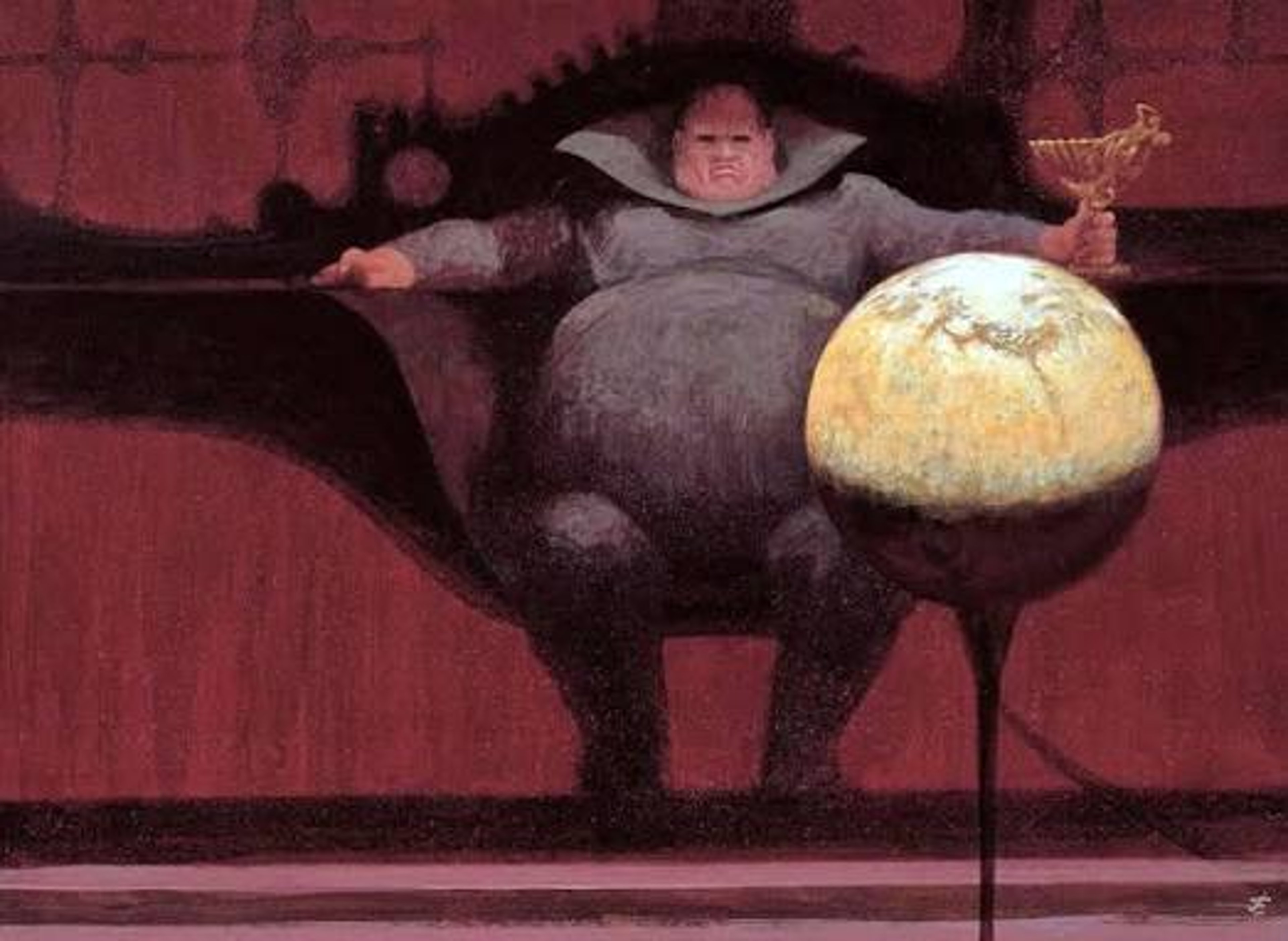
Baron Vladimir Harkonnen by John Schoenherr
A central component of the series is the struggle of Arrakis’ indigenous society, the native Fremen, against the imperial houses. Their subsequent co-optation by Paul’s mission of vengeance and gaining political power is the driving plot of the first four books. They are described as “semi-nomadic” and “tribal people.” Fremen are a mismatch of Herbert’s orientalist fetishizations of Indigenous communal societies.
The Fremen honor customs such as mass spice-laced orgies and a history of human sacrifices. They are described as “ultraconservative” within the context of their religious traditions, but are given a spiritual superiority over the “western men” of the great houses by having Tau, complete oneness with their community and environment.
On the surface, the Fremen are a backwards society in almost every regard except for a collective ethos of self-determination, which aims to throw off the shackles of imperialism and colonialism–only to commit more severe genocides than the Imperium in their capitulation to the orchestrations of the “western man” Paul Atriedes. Herbert craves to denounce this destructive accumulation of power by the Great Houses, yet feels compelled to make the oppressed nation of his universe even worse.
Herbert wants the noble savage to be thematically central, only to purposely invert it and paint the noble savage as the real danger due to this cultural backwardness. The struggle for Fremen sovereignty can only be co-opted by “Western man” and power in his view. Herbert never gives these oppressed people real agency due to his fetishization and orientalism. Paul compares himself and the Fremen jihad to Hitler, creating an odd foreshadowing of how modern Arab resistance to colonialism is still incorrectly associated with fascism, rather than colonialism being connected to fascism.
Edward Said wrote in Orientalism, “As anticolonialism sweeps and indeed unifies the entire Oriental world, the Orientalist damns the whole business not only as a nuisance but as an insult to the Western democracies.” Herbert may not have a cherished view of “western democracies” due to his libertarian leanings, and it would be easy to claim he was against western society broadly. But on the contrary, it’s clear that Dune replicates the chauvinistic Western view on indigeneity and passes a condescending moral judgment on the justifiable struggle for national liberation and revolution.
Paradoxes of Dune
“If there is no enemy, one must be invented. The military force which is denied an external target always turns against its own people...and...Men are susceptible to class fixations. They create layered societies. The layered society is an ultimate invitation to violence. It does not fall apart. It explodes. Women only do this if they are almost completely male dominated or locked into a male-role model.” Leto II, God Emperor of Dune
Dune is poetically eclectic. It’s a reflection of Herbert himself, his genius, and hubris. Why do we love it? If it’s a work of political chaos and confusion, what is there to gain from the series?
Art is as much a part of societal influence as society influences it in turn. Dune was made during the whirlwind of the 1960s, when anti-colonialism, revolution, and violence were global constants. Herbert was a “Western man” attempting to grapple with that reality, and his political eclecticism was not uncommon in larger societal grapplings, such as those found in sections of the anti-Vietnam War movement. Dune centers concepts of violent revolution, imperialist capital accumulation, ecology, and corrupt political authority.
These are themes that will be consistently relevant in our struggle against a capitalist world. The material realities of the imperialism that committed genocide in Vietnam that Herbert witnessed are historically inseparable from the US-Israeli genocide against Palestine today that we have all watched on live stream for years. Herbert’s haphazardly opined solutions to these social crises, or lack thereof, do not detract from the richness of what can be gained from attempting to dissect these themes both in our real-world struggle and within the art that the struggle develops.
Herbert wrote in God Emperor of Dune, “Paradox is a pointer telling you to look beyond it. If paradoxes bother you, that betrays your deep desire for absolutes. The relativist treats a paradox merely as interesting, perhaps amusing or even, dreadful thought, educational.” Dune and Herbert are works of paradox; they are both contradictory. Its themes and messages are at odds throughout the text. Much of art is that way. It's all created in the ecosystem of the “Western Man.” Dune works on a mass appeal not because it's a theoretically sound revolutionary text, but because, like the masses, it's grasping in the darkness trying to find a solution among the paradoxes of our world.