
Oct 19, 2026
How Do Smaller Fights Turn into Bigger Fights?
Politics is not a causal chain, but the radical commitment to a project that transforms reality.
by Kolya Ludwig
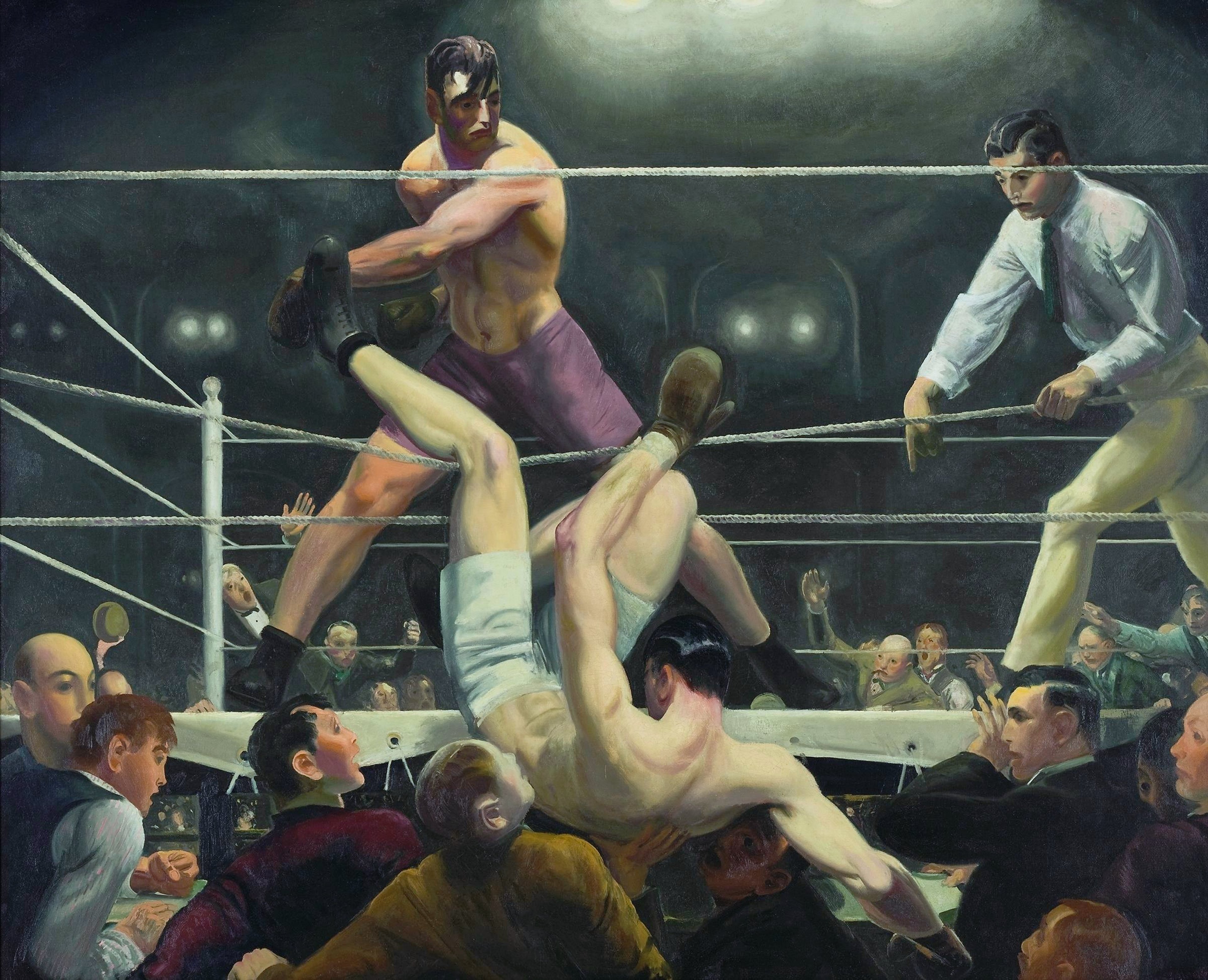
George Bellows, Dempsey and Firpo (1924)
Democratic socialism isn’t a particular set of policies; it’s the possibility of a crescendo of social transformations coming together to achieve victory. It’s the idea of an overflowing of democracy: from the electoral realm to the state, from the state to the economy, to the factory, to the bank, money, property, and so on.
Alvaro Garcia Linera [1]
In his book Why Buildings Stand Up, Mario Salvadori makes the simple observation that the purpose of all structure—the framing of buildings to allow them to stand and endure stress—is to serve the functions of a building’s surfaces. He calls architecture the most conservative of all the sciences because the basic utility of its surfaces has remained more or less constant for thousands of years: shelter from the elements, moderated exposure to light and air, and mobility among the surfaces’ various modes (such as access to a cooking area, a bedroom, or a patio). There is no need for a structure without the original need for these functions.
It is this simultaneous separation and interdependence between surface and structure that, I think, has historically lent itself to political metaphor. In fact, Salvadori’s meditations on architecture are so politically intuitive that one could imagine a follow-up treatise called Why States Collapse. In lieu of that non-existent work, let us revisit the famous architectural metaphor of politics, aided by Salvadori’s disarming clarity, and see if we have actually exhausted its capacity to theorize, for example, the contemporary concept of ‘democratic socialism’.
In the history of socialist theory there are abundant references to the notion of ‘revolution’ as a revolution in structure. This is not surprising. In a situation of social antagonisms, injustices are perceived that lead to questions about their causal mechanisms, which lead to observations about the durable features of society that may be culpable. Thus in the Marxist tradition, there has been a proliferation of economic-structuralist theories, from ‘base-superstructure’ to ‘determination in the last instance’ to ‘dominant role’ to ‘structuring principle’. In every variation, the economy is deemed the ultimate cause of important social phenomena (granting, of course, degrees of complexity within the causal chain). With this fundamental insight, socialist interventions have aimed to dismantle the capitalist features of the structure in order to emancipate society.
There is a problem, however, with the way this tradition has rendered the structure primary: to critique a structure on the basis of the structure itself is an absurdity. It is only by reference to a desired surface that the limitations of a structure may be observed and called into question. This is where the notion of democratic socialism becomes relevant; here socialism is no longer understood as ‘the dictatorship of the proletariat’—a particular social structure that inverts existing sociological categories (though not without great expectations, of course)—it is instead the logical extension of democratic struggle. Even if a certain democratic element was never absent from socialism, the relationship between the terms suffers a lingering ambiguity that a reformulation is necessary to resolve.
We may, further, think of the mode of this struggle as a general spontaneous will to assert democratic prerogatives (or, in the architectural metaphor, surfaces) which, if effectively articulated, become the horizon of all social desire and the basis for real rupture. It is only this universalizing form of desire which makes any “turn to structure” politically thinkable. The mere conceptual recognition of a structure’s faults will always be the domain of die-hards, never the passion of mass movements. Even the very moment of a state’s demise is incidental to the remaking of a society.
Determination versus Limits
Previously, I and others at Geese have written about the politicized form that such mass desire takes, which, following Ernesto Laclau, may be termed ‘populism’. For a populist moment to develop, a particular object of struggle assumes the metaphorical identity of an emergent people, and comes to represent far more than its explicit grievances (a fact that has always frustrated the literalists of the managerial establishment). And since we still reside in the democratic epoch, the ethical articulation of the object will not be derived from an unrealized proletarian essence (or an unfathomable point of total revolution, a prospect to be discussed later), but from the universalist categories of modernity: equality, liberty, citizenship, etc. (within a rich texture of other social and cultural elements, both ancient and cutting edge, to be sure).
In this sense, democracy is both the content and the form of democratic socialism: the struggle itself is the condensation of a plurality of demands not beholden to any prohibitive authority (democratic form), and the demands are rooted in claims to particular rights, conceived as belonging to universal human rights, that exceed what an existing state will allow (democratic content). [2] To confront a state with such demands is to confront its limits; or, put another way, to confront capitalism’s widely felt inadequacy as a social system.
Here we have already begun deviating from the standard Marxist models by speaking in terms of a structure’s “limits” as opposed to its “determination” of the surfaces of experience. The reason is relatively transparent: the range of activities we encounter in a society, while restricted in various ways, is not meaningfully determined by a structural essence. Returning to the architectural metaphor: if, for instance, a living room is too cramped, its inhabitants may not be able to slide a sectional couch into it; but they still have uncountable alternative ways to arrange this limited space. If what this family truly desires, however, is the spacious couch they’ve had their eye on, to the point that its acquisition becomes their raison d'être, no amount of excuses about the space’s confines, about its various other merits, etc., will satisfy them. The couch must go in. At a certain radical point, then, the question of the couch becomes a question of changing the home’s structure—an eventuality that is less interested in debates about causes and limits as it is in achieving its goals.
There is a further salience in the metaphor here: the aspects of a structure that must be changed—those that are truly at odds with the vision of our apartment dwellers—are only knowable, and thus subject to reformation, retroactively. In fact, aspects of a structure once considered antagonistic may, to our surprise, prove amenable in the course of a revolution. Markets, in post-revolutionary Russia—once treated as a simple structural enemy—became instrumental to the revolution’s survival in the New Economic Policy. The same phenomenon has reappeared in subsequent socialist experiments from Latin America to East Asia.
What follows is that to remain politically fixated on the features of what we have deemed ‘structure’, to give it an ultimately ‘determinative’ status, is to lose sight of the unpredictable passage of antagonism through society—that is, the confrontations involving a prohibitive status quo and the investment of mass desire in a contingent, forbidden object.
The Contradictory Position of the Revolutionary
But what explains this fixation? Why is our constituency so captivated by this invisible cause, which it alone perceives? If you inquire directly, you will hear a story about the economists who “answered a question that was never asked”, or the “general illumination which bathes all the other colors” in its light. There is the legend of Capital as “the most terrible missile that has ever been hurled at the heads of the bourgeoisie”, which somehow left the body operational (a shot to the head, after all, remains within the paradigm of the cogito). And you may believe these rhapsodic verses, as I once did. I would only propose that their allure is sustained by an impossible promise, whose desire is not without merit, but which cannot ultimately be salvaged: that is, the promise of a complete breakthrough.
Such a breakthrough is, of course, not conceivable. In order for any rupture to be grasped, much less desired, its terms must be legible—to some definite degree—before and after its event (and to anticipate purification through a mere inversion is an even greater feat of optimism). If all meaning is constructed, as Saussure proposed, on the axes of combination and substitution, some aspects of a discursive structure must persist in order to accommodate new aspects. Without some mutual point of agreement, some purchase by one antagonistic identity on another, there is no struggle to speak of. [3]
Thus even in a revolution, there is always a conservative element. Attempts to escape this contradictory position tend to seek, in alternative modes of production, a kind of Pandora’s box of unknowability: who is to say what the proletariat is capable of, once it gets up on its feet? But even the premise of this question suggests that a bullet from another direction has already passed clean through, and has left political Marxism staggering about, as if undead, liberated from the traditional forms of sustenance on which we ‘irrationalists’ still depend. [4]
No one, of course, pretends to anticipate the full picture. But to treat the proletariat as a body imbued with mystical potentialities, or a pure subject acting in an unsymbolizable space, is to both overlook what is prosaic in revolution, and to miss its awesome singularity at the same time. [5]
From the ultra-leftist perspective, then, there is no adequate fight that doesn’t culminate in the complete replacement of one structure by another; and since the new structure is paradoxically known in advance (in the concept of ‘the dictatorship of the proletariat’), and any other structure is hopelessly compromised, safeguarding the integrity of this new structure, or at least its blueprint, becomes paramount in our political orientation. A fight that backs off of the structural claim (in rhetoric, by refusing to announce its ultimate intentions, or in deed, by working within a ‘bourgeois coalition’) is always perceived as a co-optation. Retreat is never appraised for what it actually is: the simple failure of a movement to radicalize its own inchoate desires.
The Stakes of a Small Fight
The structuralist fixation, as we have said, is defined by its inability to grasp the boundaries and potentials of real political struggles—and this is precisely where democratic socialism offers a more viable real-political framework, and avoids some of the reactiveness common in leftist political strategy.
There is still a reflexive anxiety in our movement about straying from whatever demands are determined to be the true socialist demands in a given situation. Should a particular leader not uphold these demands, or worse, bloc with conservative forces on a compromised agenda, they are deemed not fully committed to the overhaul of the structure, having been captured by bourgeois interests.
However, if we consider the epochal struggle not, foremost, as a fight over structure, but as Democratic Revolution, which consists in the ethical substance of all contemporary struggles, then we have a basis for conceptualizing the transition from a smaller fight to a bigger fight, and its material relationship to the structures of concern. We will also have new criteria for supporting pro-democratic campaigns that represent not a balance sheet of pro- or anti-capitalist aims, much less vibes, but the potential for what Linera has called the “overflowing of democracy” into every social discourse.
We can look to any number of examples as a means of demonstration. Medicare for All, the watchword of the El-Sayed, Angie Nixon, and AOC programs, is one such campaign: it is an eminently popular-democratic demand, concomitant with the logic of democracy, in which universal human rights include the right to life; here posed as a question of state investment in life-producing and life-saving mechanisms. By choosing Medicare for All as a “small” fight (meaning it is not a conscious fight for a complete structural break, but merely the expansion of an existing policy), an antagonism begins to emerge that has the potential to become a more radical social rupture; because to assert the alternative “right”—the right to sustain existing levels of profit within the healthcare industry—is to expose capitalism’s ethical (and structural) failure to accommodate a genuine mass desire. The key point is that even campaigns announcing themselves as reformist or pro-capitalist, if they are also creating openings for the broadening of democratic struggle, are integral to socialist strategy and not somehow outside of its area of interest.
Nithya Raman’s Los Angeles mayoral campaign offers its own chances for smaller struggles to intensify. Clearly, Nithya has not made the issue of Palestine—and this was a main grievance of her socialist detractors—principal among her campaign issues. However, what reason have we to assume Palestine would be the only possible channel, or nodal point, for a mass politics in Los Angeles? Why couldn’t, for instance, her greater emphasis on ending homelessness and democratizing City Hall constitute adequate entry points for the broader Democratic Revolution? Couldn’t the articulation of the democratic horizon evoked in ending homelessness in LA (an accomplishment that would itself signify an immense democratic advance) lead somewhat naturally to the demand for weakening the local port’s ties to Israeli commerce, for instance? Unless, that is, we believe indefinite occupation and genocide are separate instances from the issues of democracy and universal rights, and belong exclusively to the discrete category of ‘socialism’. What we have seen, in fact, is that there can be no meaningful separation of socialism from anything occurring in the political field; we can already observe how the national electoral insurgency—itself a democratic socialist insurgency—has pulled Nithya’s pseudo-independent campaign toward the irresistible persuasion of democratic struggle. [6]
Therefore, what appears to the ultra-leftist as only a narrow demand, in the context of deepening conflicts on the terrain of democracy and tyranny, is precisely the basis for a threat to the structure of capitalist logic. The sectional couch, that is to say, has arrived at the doorway. It is at this moment that socialism locates its true enemy not in “co-optation”—which suggests a secret adherence to one or another structure—but in meekness, which instead reveals an insufficient investment in the project. Are we moving this couch in or are we not?
Surpassing the Architectural Metaphor
If the well of the architectural metaphor is not totally dry, there are still good reasons to go beyond it; not least because the social desires of peoples—unlike the relatively fixed purposes of buildings—are subject to historical change. Even within a given period, there are innumerable such rearticulations. This is certainly true in capitalism, which disobeys the old analogy by its contamination not just of structure but of the very surfaces of desire. That is, the logic of capital, even as it ceases to fulfill the needed social functions (giving people greater individual autonomy, options for creative expression, the ability to have families and get an education, etc.), begins to exhibit its own social function, if you will, as a form of desire (instant gratification, celebrity culture, and so on). The ‘structure’ in this case is not only a limit, but a set of practices to which a libidinal (i.e. affective) attachment develops. In other words, the mass subject becomes identified, to an extent, with capital itself. What was once perceived as strict coercion, or at best ‘false consciousness’—the coercion of the dominant rationality, as rationality—now flows out into the more problematic terrain of consent. In such a case, what obscures the democratic horizon is no longer reducible to a metaphorical structure “out there”, but learned desires of varying degrees of intensity and habituation. This is the phenomenon Laclau calls forth when he speaks of the economy as itself ‘politically constituted’: it is a sedimentation resulting from past struggles over the forms of social desire that would come to dominate.
This transition across metaphors, from surface-structure to the geological image of ‘sedimented practices’, involves what we have elsewhere referred to as the Freudian break—past which the old structuralisms, with their established ‘bases’ and essentialist properties, cannot follow. [7] In this unforgiving place, antagonism registers not as a struggle between identities external to ourselves, but between attachments that denote the very core of our subjectivity.
It is because of the problem of sedimentation that simple ‘consciousness’ of a structure cannot translate into social revolution. A profound attachment (dare we say, addiction)—the condition in which we find the body politic—is never overcome by its rational deconstruction, however meticulously the effort is conducted. A revelation must also propose an alternative form of desire, or it will not take. We need only remember the conclusion to Brecht’s Galileo where, even after Galileo’s apprentice, Andrea, demonstrates that the woman casting shadows in her domicile brandishes not a flying broom but a ladle, the gang of street children knows no better than to resume their cruel song and dance: “One, two, three, four, five, six, old Marina is a witch.” The devastating insight is consummated when a customs officer permits Andrea’s passage with his master’s forbidden Discursi, because it is merely a book of facts and figures; and there is, we are told, “no harm in figures.” [8]
Despite the dangers involved in accepting the phenomenon of desire as our situation, it is still true that capitalism remains a limit on other desires; its canalization of activity comes at unacceptable costs: the proper functioning and flourishing of families and communities; meaningful democratic citizenship for increasing layers of people (including formal “citizens” in the whole spectrum of the disenfranchised populace); overcoming existential threats such as climate change; and so on. And at the risk of trafficking in a certain essentialism of our own, it is worth appreciating which identities still claim the mantle of the current period. What is revealed, under such scrutiny, is that capital—for all its conquests—can be nothing more than a pretender, because it is only made intelligible through other ethical discourses. When ‘free enterprise’ makes its overtures to liberty, it does not subvert liberty; it is enslaved to it. The unstoppable proliferation of freedom struggles, which arise in antagonism to private accumulation (and related anti-social tendencies), is enough to demonstrate this.
So even as capital succeeds, to an extent, in its capture of desire, it does so only insofar as it borrows its signifiers from discourses which remain primary—signifiers that, even now, cannot be totally emptied of their content. Capitalism is thus parasitic on democracy, and on other venerated life-giving practices (meaning, desires), without which it cannot function.
We may expect, then, that as the current arrangement continues to disappoint us in fundamental ways, and as those disappointments become articulated into increasingly consequential fights, its ethical ground will be exposed as infirm, at which point no sector can carry on in neutrality. This is why a wager on the democratic struggles of the present is in no way a retreat; it is the only meaningful form socialism can take. To make such a wager is to get with the times. It is to accept the fights we are given, which bear in them something at once suggestive and radically open. It knows full well that a fight, with enough hype, becomes the fight that puts Dempsey “through the ropes”.
Footnotes
[1] From an interview with Linera by Jacobin Latin America, syndicated by Progressive International.
[2] As we will discuss later, even political content that we would consider anti-democratic makes recourse to the democratic language of the epoch to justify its aims. Thus even a reactionary movement follows the logic of both democratic form and content, no matter how tenuous its relationship to the democratic tradition may be. The problems posed by this fact were addressed briefly in my previous article, and will continue to be a theme in our investigations.
[3] This is how Laclau retains the concept of ‘relative autonomy’ which was at risk of dissolution in frameworks that still rely on ‘determination in the last instance’. Cf. Ernesto Laclau and Chantal Mouffe, "Post-Marxism without Apologies," New Left Review, no. 166 (1987): 94.
[4] That premise being that a particular subject, whose sociological position and essential ideology are already more or less known to us, will somehow bring about a total break with all that currently exists.
[5] There is no doubt broad recognition that a revolution’s terms must arise from what Marx called the “premises now in existence”. But by locating an ‘ultimately determining essence’, whose action remains cleverly disguised by ideology, a certain magical thinking is reintroduced whereby a structuring principle’s collapse opens the way to presently unfathomable realms of experience.
[6] Evident, for example, in her growing confidence to speak out on the issue of Palestine, even in front of hostile crowds.
[7] Laclau prefers this metaphor, which he inherits from Husserl’s notions of ‘sedimentation’ and ‘reactivation’.
[8] Brecht’s own conclusion was that some “cunning is necessary to spread the truth.”