
Jun 17
ICE, Riots, and Revolution: A Report from the Ground at Delaney Hall
As a Delaney Hall hunger strike sparks street clashes with ICE and state troopers, a report from the ground asks what it would actually take for the movement to win.
by Zach H
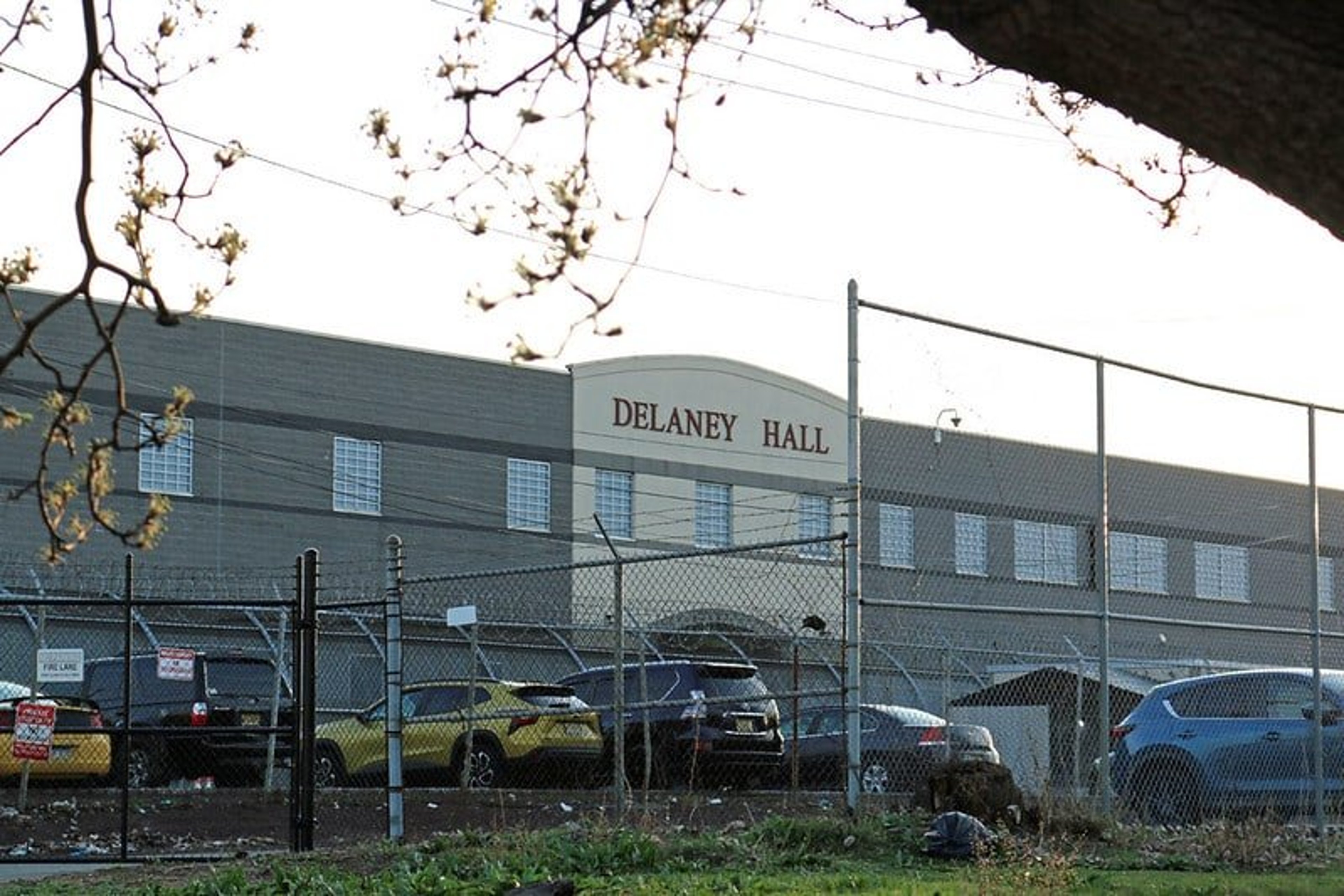
Delaney Hall, Newark, NJ.
New Jersey has come back into focus after hundreds of detainees inside the Delaney Hall facility launched a coordinated hunger strike last month in protest of the lack of due process and horrific and inhumane conditions inside the facility. Their letters detail violent arrests, lengthy and complicated legal proceedings, the separation of families, and mass illnesses amongst prisoners. Notably, the first letter begins with an apology for entering the United States. In the days since the hunger strike began, the leaders of the hunger strike have been separated, sent to other facilities across New Jersey and the country. This is when the protests began outside, initially facing ICE agents and their GEO Group comrades (the private guards who run the facility) in an effort to show solidarity for the movement inside the facility and to prevent the relocation of hunger strikers.
Delaney Hall is a small grey box surrounded by a large fence that curves inwards towards the facility. The facility sits in an industrial area of Newark where thousands of large tractor-trailers pass every day, surrounded by warehouses, power plants, a railroad, and a New Jersey state correctional facility. The entire area has a pungent chemical smell (even before the tear gas is deployed) and is largely grey and lifeless. The facility has two main entrances: one to the north, where press conferences are held, and Congresspeople enter, and one to the south, where the vast majority of ICE vehicles enter and exit, carrying compas (fellow migrants), to their next detention site or eventual deportation. This is where most of the confrontations took place, just feet away from a major truck route and around 100 feet away from the facility.
In the first days of the protests, young people in colorful bloc squared off against ICE agents from the Enforcement and Removal Operations division and Homeland Security Investigations division. Some agents were lazily masked and wearing jeans and baseball hats, whilst others were clad in their best Zero Dark Thirty cosplay. They partake in a kind of rhythmic dance with the protestors. It starts like this: a line of a few dozen protesters forms in front of the southern entrance, just off the sidewalk where the ICE agents have their “Defend the Homeland” liveried Ford Explorers parked. The agents sit against the cars, forming a loose line and stare back at the protesters, some of them returning insults, others having conversations with live streamers. “One is coming from the right,” crackles over the agents’ radios, and they form a front as the large gate to the parking lot slides open. The protesters lock arms, and the ICE agents pull out batons and pepper spray, spewing “GET THE FUCK BACK” in variations. The protesters back up slowly as the agents move forward, batons swing into the air as they crack against people's arms and legs. The protesters slowly lose form as the ICE agents move forward like a varsity offensive line, spraying and punching their way to an opening large enough to allow a white van to cut inside towards the parking lot. The van drives in, the gate shuts, the agents retreat, the protesters push back to the sidewalk, and the dance begins again until it’s time for the next vehicle. Despite efforts by activists on the ground, the hunger strikers are separated, and ICE vehicles continue to frequent the site.
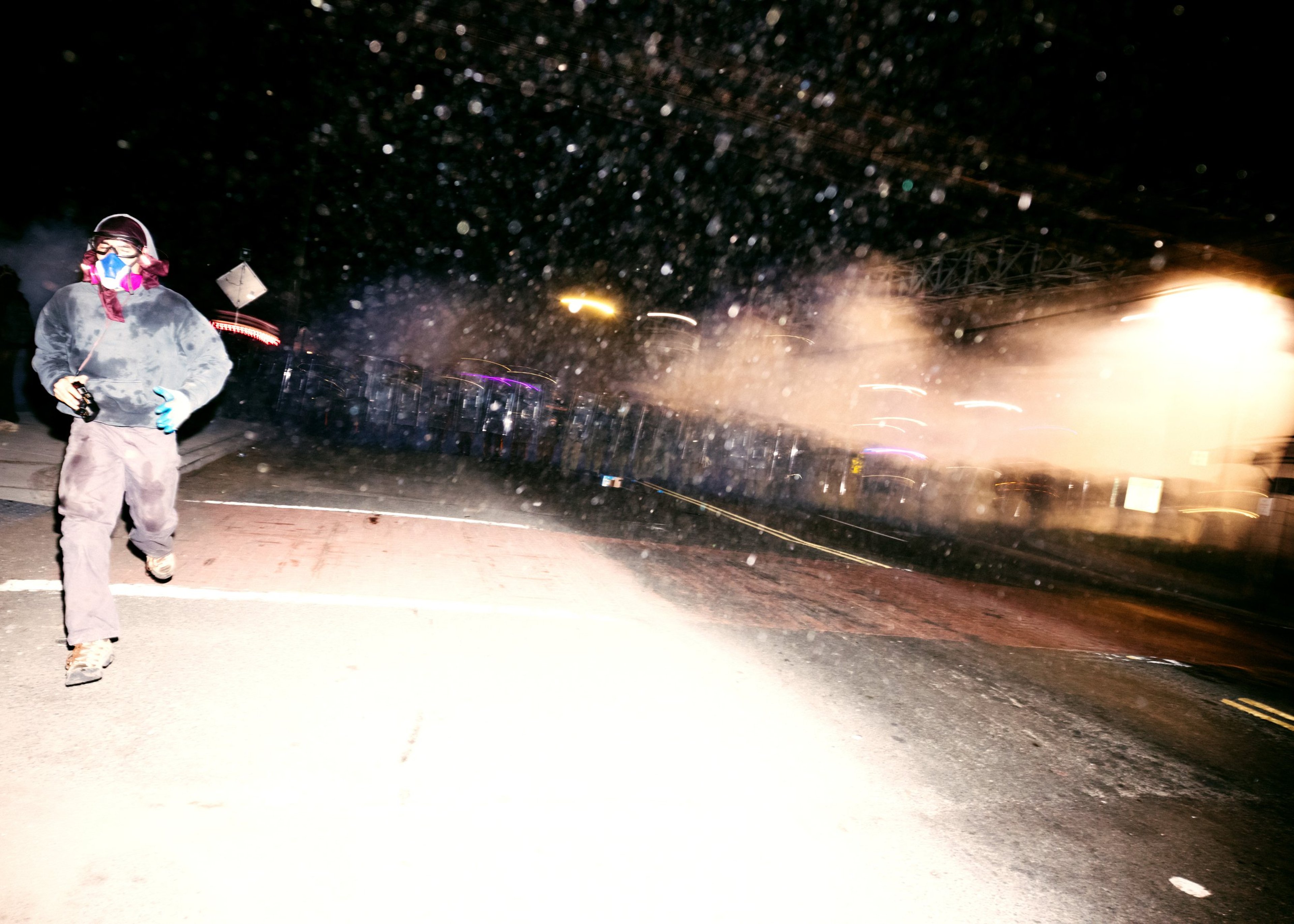
Protestor at Delaney Hall runs as police advance.
For days, this scene repeats with minor deviations. At night, it heats up, and more organized activists arrive with plans to pop tires and more effectively blockade the facility. There are arrests, with scrawny protesters zip-tied and dragged inside the facility. One protester is pushed under a 16-wheeler by an agent, their leg twists grotesquely under the weight of the rig on pixelated video. Others take serious blows by batons and even more become familiar with the taste of thick orange pepper spray that drips down their faces. As you return day by day, you recognize some of the agents and begin to learn their mannerisms and their responses. One particularly tiny agent often gets separated in the chase for the cars and can often be seen cowardly holding his mace up to a large crowd as he crawls back to the ICE lines. Another agent, a tall Latino man, hurls back insults and swears and is so eager to beat protesters that he routinely loses his baton in the wind-up.
This continues until the arrival of the New Jersey State Police, which marks the beginning of a new choreography. During the day, the movement retains the same character as before. But at night, the state police deploy in full. Hundreds of cops are delivered by dozens and dozens of police cars that race down the long industrial roads. The cops line up, their blue uniforms covered almost entirely by thick body armor. The state police corral the protesters away from the southern exit and towards the northern part of the facility, where they form a line that runs from the train tracks right up to the fence of Delaney. The first row holds riot shields; they bark through their amplified gas masks to “BACK UP.” In between them are officers who mark targets with strobes and cops armed with 40mm less-than-lethal rifles or air-powered pepper ball guns. Every so often, you hear a pop and a clink before somebody starts screaming for a medic. Behind these two rows are the mounted police cavalry, who tower above the front line on gigantic 2,000-pound draft horses. With this order of battle, the state police march forward.
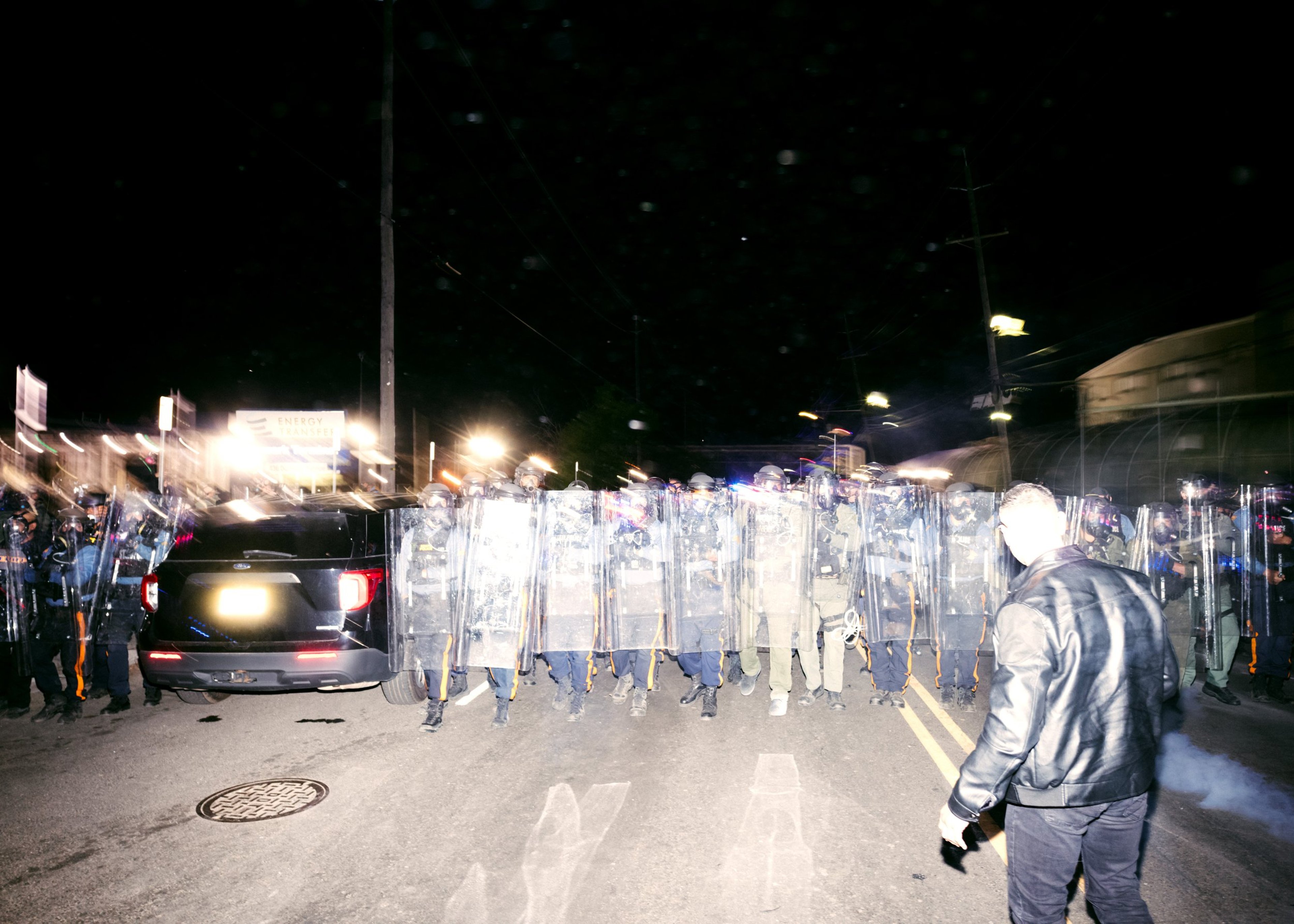
State Police stage to advance.
The protesters hold the line a good 50 feet from the front of the police line. The police give marching orders and fire tear gas that streaks above them, the canisters leave a glowing trail as they deploy amongst the main body of the crowd. Those amongst the protesters given the duty of controlling tear gas race to smother the cannisters, others, less prepared, either kick them or hurl them back at the police. As the tear gas pours out of scorching hot canisters, the police throw flashbangs wherever the protesters have made a makeshift barricade. Under the cover of the tear gas, the police steadily march forward in a complete line. As they make their way forward, young activists can be seen hurling rocks, wooden planks, and whatever else they can get their hands on towards the staties, who are visibly shaken as stones pelt their shields and armor. If a barricade is too strong, the state police open their lines. “HORSES HORSES HORSES” is called out by the protesters as a stampede of one-ton horses flow through the split in the direction of the barricades. Some throw rocks at the cop jockeys and others use their shields, made out of split road drums, to smack the horses. Between the horses and the constant bombing and tear gassing, the protesters are pushed back over half a mile from the detention center. The state police hold their new line, far from Delaney Hall. As they hold, the protesters disperse, and the night ends with “we’ll reorganize, come back tomorrow.”
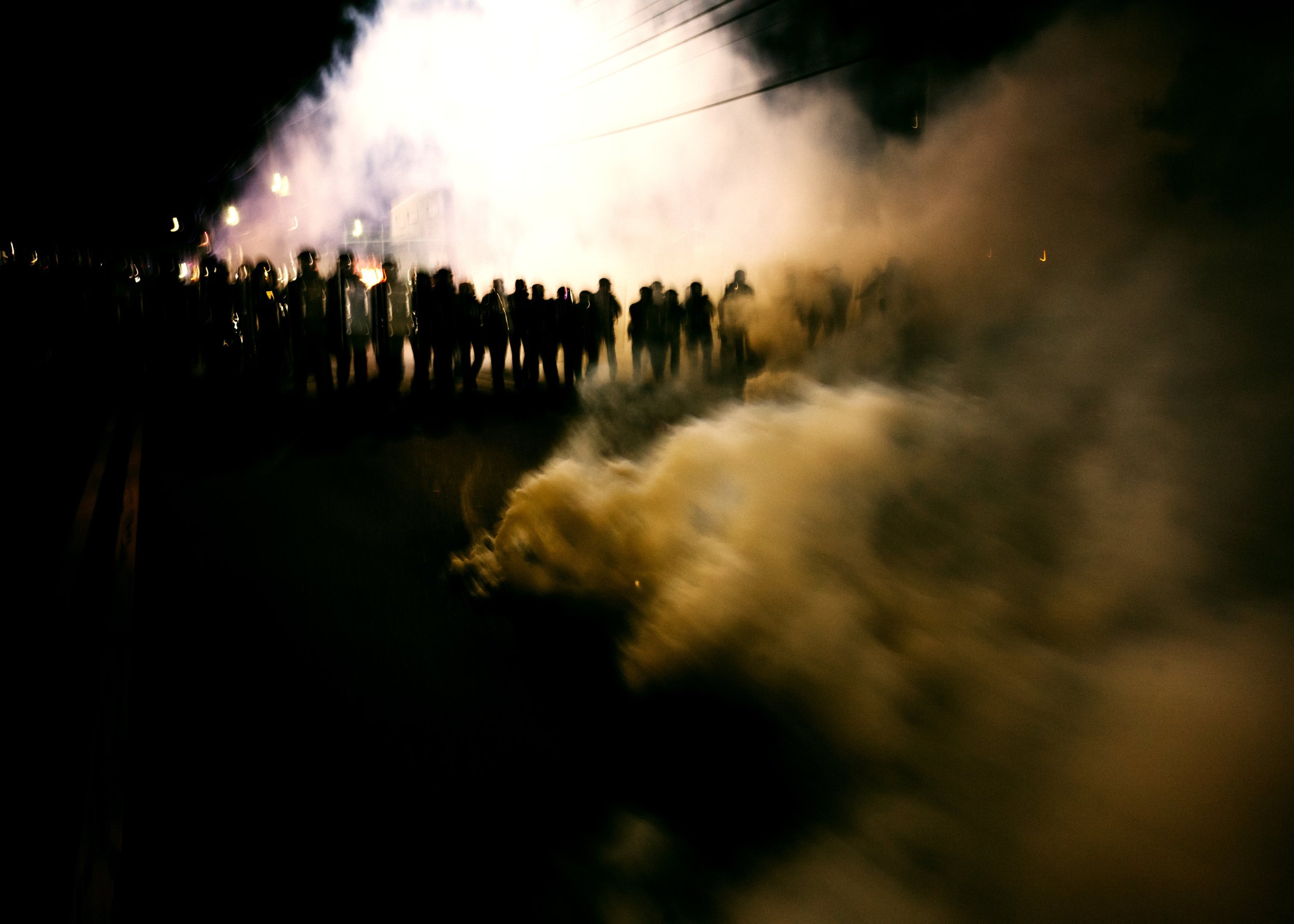
Tear gas bursts in front of police.
This, the idea of “coming back tomorrow” is why on the ground, we see little success. What we have done has amounted to very little, yet we intend to return with the same tools expecting a different result.
It’s hard to deny the revolutionary intention that was present. Political streamers and local pundits have described the nighttime confrontations outside the facility as “the battle for Delaney Hall.” Fleeting moments were reminiscent of iconic photos from Palestine or Nicaragua: youth with covered faces and wild eyes, hands loaded with stones, facing off against heavily militarized state thugs. The romance of such a scene is eternal. They slow for a minute, letting the last rounds of teargas fade, and then steadily come forward. The group of protesters forms no threat to the police line. We comply with their orders to “back off,” even if it requires some tear gas and pepperballs. Slowly and intentionally, we are driven back until Delaney Hall is only visible if you squint. Now what? The makeshift barricades thrown together in front of horses only slow their advance for a moment, if that. We can form lines in front of cars for days, but what's the use if they all get through?
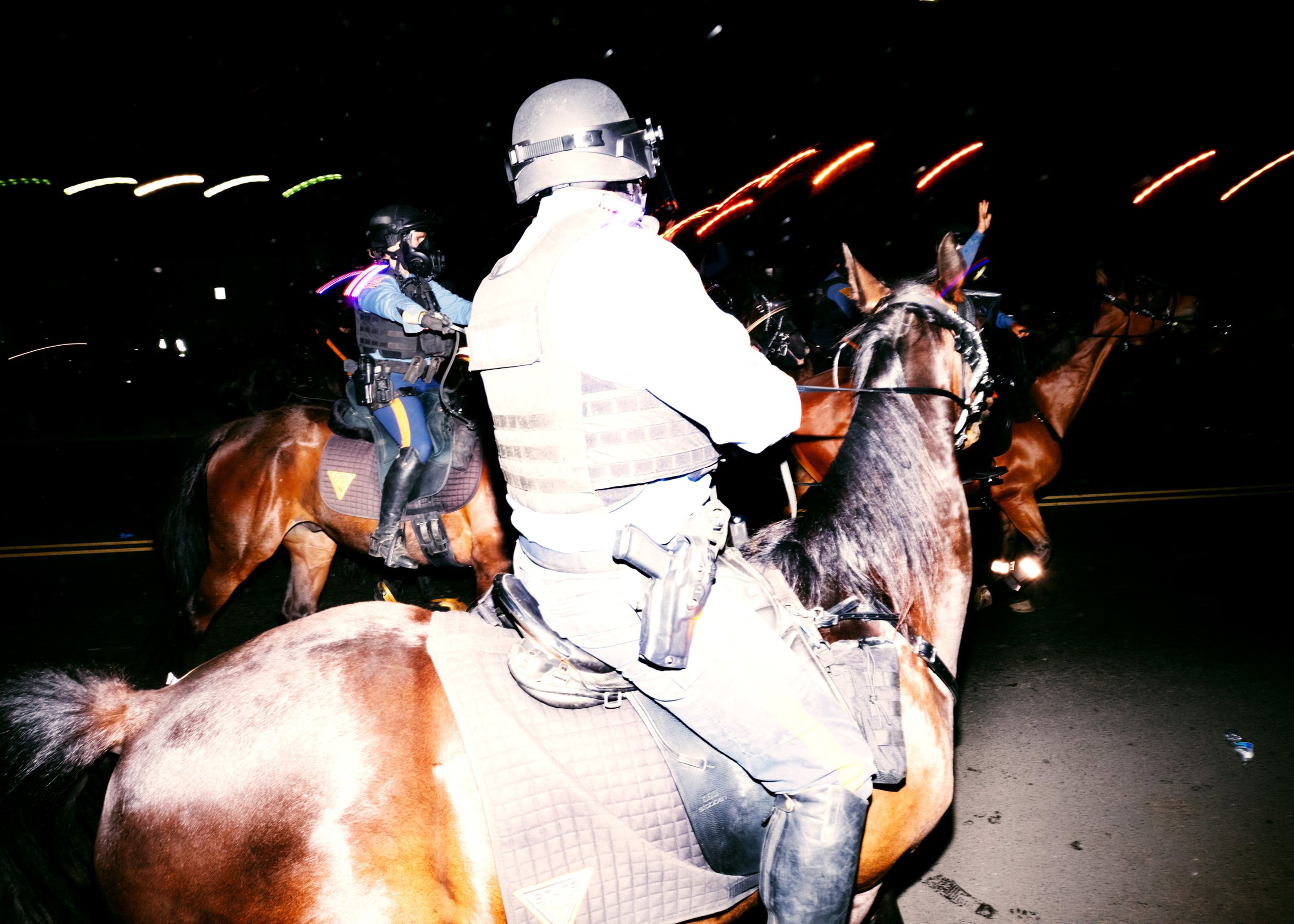
Mounted Police break through barricades
Standing face to face with ICE officers, protestors yell endlessly. “RAPISTS. MURDERERS. MONSTERS.” If we truly believe that these men in front of us, just inches from us, are exactly that, what does that say about our movement that the best we can offer are petty personal jabs? Inside Delaney Hall, just feet in front of us, our people are suffering. Siblings who have are separated from their families by state thugs, beaten, abused, and left to rot; forced to work as slaves in for-profit detention centers while an unjust legal system chews them up until they are ready to be shipped out to some faraway country that they may or may not even be from. Anger lives on the ground at Delaney Hall, alongside their shrieks and blood. But we cannot come back another day if we are here now. If our principles tell us that this is our enemy, then we need to treat them like one. Organization, action, and sacrifice are the only way forward in our struggle. We must push the state to make mistakes, to heighten their contradictions. What will they do when they’re scared? Will they decide to back down, or will they show us who they really are? There is no revolution “next time.” We must seize the time now. We must have the political will and the courage to dare to challenge the atrocities that face the most vulnerable in this country. A random rock or a popped tire won’t slow down empire for long enough.
Our moment has passed in New Jersey. But there will be another moment. There will be a next time, but that is not something we can rely upon as a method of change. The protesters on the ground at Delaney, despite their good intentions, did very little to alter the situation on the ground or within the detention center. When the ICE agents stepped back, we did not step forward. When the cops marched forward, we stepped back. In fact, the front lines of the protest group facing off with the state police were mostly made up of journalists and a few disorganized individuals who bravely faced the police alone. The main body of the actionists was behind the press, far from the police shields. Even when the protesters started a fire, they started a fire behind the main line of protesters, effectively kettling the main body, trapping the protesters between the fire and the police. On the ground, everybody knows the moves. They wear thick gloves to toss back tear gas canisters and dispatch teams to put them out. We have street medics marked with duct-taped red crosses and enough insults to fill a novel, but we don’t have an on-the-ground strategy that can win. There is a lack of love, a lack of excitement. Our tactics are easily managed, choreographed by the police. The romance on the ground outside Delaney seems more of a pantomime than a genuine lust for change. Revolution should be riveting. This is our moment to change the world for the better, what could possibly be more attractive?
At Delaney Hall, both the ICE agents and the New Jersey State Police were reacting rather tamely to the groups of protesters. Sure, there were injuries, and it wasn’t peaceful, but within the overall power of the state, the repression that was put out was fairly minimal. The vast majority of arrestees were processed and back on the streets within a few hours, with nothing on the record besides a summons and a fine. There is a fear of consequences and a fear of success amongst the movements on the ground, a failure to grapple with what sacrifice and success look like. Being there isn’t enough to win. Comrades are prepared to be arrested, but comrades are not prepared to stand their ground against the immigration police. No matter the injuries we sustain, the vans carrying compas flow out of the facility, barely impeded.
That there is yet to be a fully established prisoners' movement in the United States after three years of genocide in Palestine and six years post George Floyd speaks volumes about the state of our movement. Those who have given up so much for our movement, namely their freedom and precious time from their lives, have little recognition or support from the general populace or organizations within our movements. The comrades of ours who dared to sacrifice like Jakhi Lodgson-McCray are relatively unknown. These are not comrades we should cower from associating with, but rather be upheld as the champions of our struggle. We need to be prepared not only to be incarcerated but also prepared to support those who are taken from us in the name of liberation and freedom for those we care about. The way in which the movement, even as far as mainstream liberals, coalesced around Mahmoud Khalil’s detention is how we should be treating all of our political prisoners.
The struggles that the radical frontlines in America aspire to, the struggles in Palestine, Latin America, and the Global South more broadly, manifest under conditions alien to ours in the West. In Palestine, the violence of the occupation never ceases; in the West Bank, checkpoints, soldiers, and drones are ever present and deliberately visible. The possibility that you may be killed either intentionally or more wantonly by either soldiers or settlers is part of everyday life, the same way that Americans worry about their rent or the state of traffic. Decolonial movements in the Global South form in response to decades of overt violence that sees no use for legal precedent or litigation. This violence is absolute. In America, those who choose to resist make deliberate choices to put themselves in spaces like Delaney Hall. It's a clash between young New Jerseyian men in riot gear and post-grad students in bloc. There is no tenable connection to the material base of our struggle, particularly immigrant communities. The struggle is alienated, rushed through on the front lines in industrial areas by a select few who are able and willing to confront the state directly. A mass movement needs to be of the masses. Reaching the masses in a way that doesn’t appear transactional or pretentious is something that our movement needs to reflect on heavily.
On the streets outside Delaney Hall, many yelled that they were prepared to die for the struggle against ICE, yet cowered in the face of plastic shields. Despite the retreat, there are people on the ground who stood up against the horses and the flashbangs, only conceding when the rest of the group decided to retreat. We have a cowardly movement, not a movement full of cowards. We need to decide whether this struggle is something that we take seriously, that revolution is something that isn’t posted online or read about in history books, but is something that we can make right now. Every opportunity that slips by is a chance to inform our future tactics. Famously, the revolution will not be televised (or live-streamed).
We must hold our line, we must take a step forward at every opportunity we are given. Until we are prepared for that reality, our movement will be little more than radical roleplay; the other half of the police state dance.