
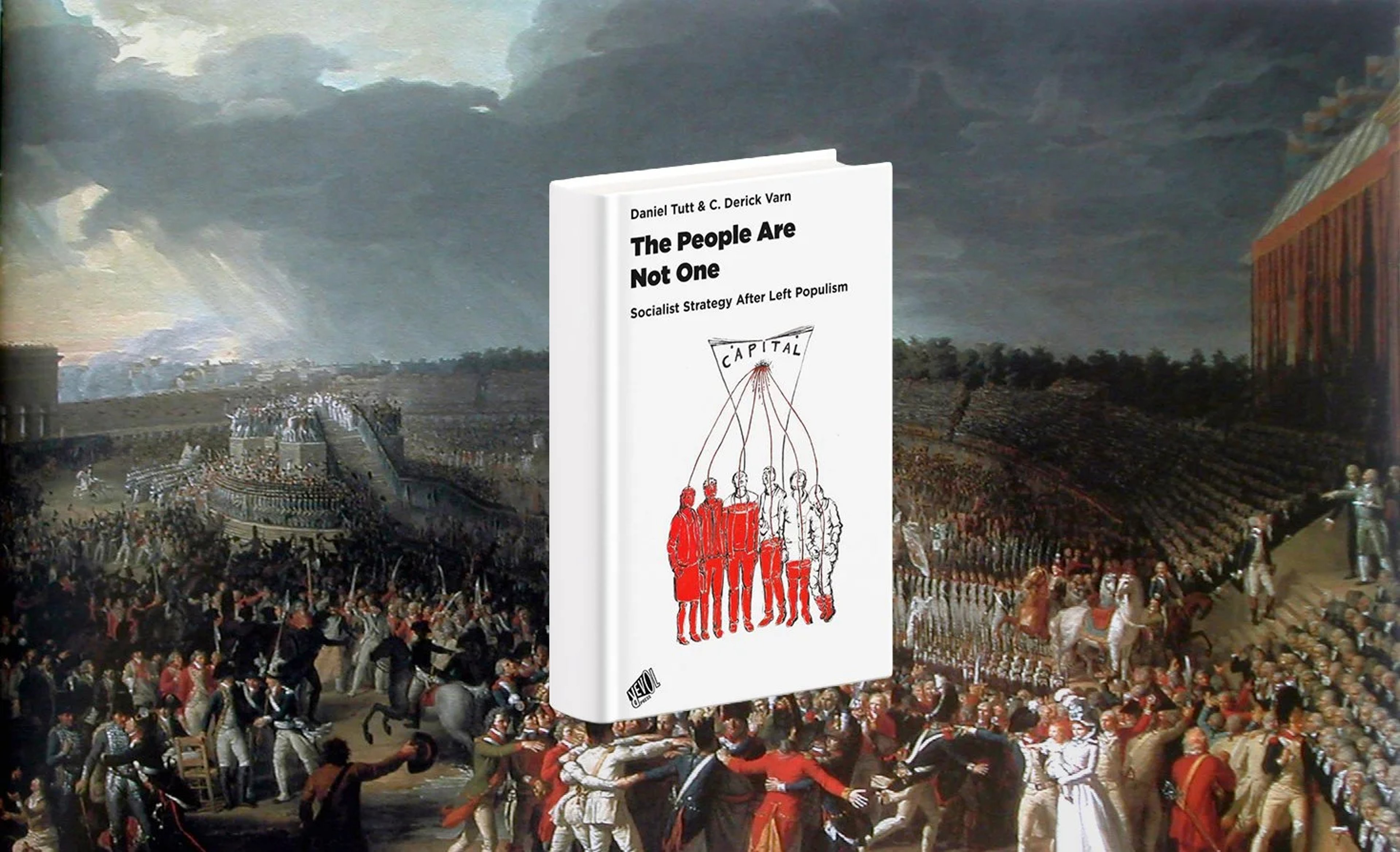
The People Are Not One by Daniel Tutt & C. Derick Varn releases today, June 25, 2026, and can be purchased here
As the story goes, the French diplomat Charles-Maurice de Talleyrand-Perigord once remarked to a servant, at the sound of civil unrest in the street below, “Oh, good! We are winning!” The servant asked, “Who is We, mon Prince?” Talleyrand replied, “Not a word! I’ll tell you tomorrow!”
The tale of Talleyrand is generally told as a teachable moment in political cynicism, highlighting how his politics shifted with the changing winds of power, the implication being that perhaps he was disloyal or lacked principles. This may be a correct observation in the abstract, but reading the story in this way ignores an important kernel of truth. Talleyrand was able to recognize that political antagonism exists in the modern world already, and every person has to pick a side. Perhaps there is more to Talleyrand for us to parse in the contemporary than what the common interpretation would let on.
Today, conflicts about trans rights, the genocide in Gaza, expanding the Supreme Court of the United States, and voting rights rage on, whether one chooses to intervene or not. If we do choose to intervene, we have the option of making the case that a deeper and more originary contradiction is at the heart of the dispute, but if we declare that the dispute is really a deflection, psyop, or expression of ‘false consciousness’ to distract from some other thing that nobody involved is yet aware of or interested in, we marginalize ourselves and our ability to make our intervention. We engage the existing sides first to be involved in the conversation, and we cannot announce that the conversation itself is really a distraction. In Talleyrand’s case, he was a single individual with a great deal to gain or lose if he picked the wrong side. For the organized Left in the United States, the situation is much the same. The metaphorical battle in the streets downstairs rages on without us, and the only available choices are whether to intervene and which side to choose if we do.
Of course, Talleyrand was not the only figure able to grasp this basic point in the context of revolutionary France. In fact, Karl Marx developed his theories of class struggle and historical materialism in many ways as a commentary on the French Revolution and its consequences, and, for many, the chief insight of Marxism is that the political conflicts which appear before our eyes are in fact manifestations of a deeper underlying structure in history which necessarily produces crises and antagonism. Marx’s intervention in modern revolutionary politics, then, is the notion that the victory of labor over capital is the only event which can surmount the unending conflicts of modernity.
Indeed, in The Poverty of Philosophy, Marx teaches us that
“The working class, in the course of development, will substitute for the old bourgeois society an association which will preclude classes and their antagonism, and there will be no more political power groups, since the political power is precisely the official expression of class antagonism in bourgeois society."
Thus, Marx argued that in class struggle “political power groups” writ large would be displaced as actors by two sides: labor and capital, with the working class acting as a “class for itself”. While Marxists have taken this to be an iron law of history, we must recall that Marx developed it as an analysis of the political struggles of his day, arguing that the conflicts he witnessed could ultimately only be resolved through class struggle.
Of great import, then, is how one imagines the transition from politics as it appears to class struggle. Can the conflicts on the surface be abandoned through the development of a class-first politic? Or can a class-first politic only be developed via the resolution and exhaustion of the political struggles visible in what Laclau has termed “the surface of historical life”? Support for either reading can be found in Marx’s theory, thus I argue that we can only find the answer by regarding Marx in his historical moment: 19th-century Europe.
Historicizing Marx in this way, we are able to glimpse that communist theory began as a comment on the politics of Marx’s time, and that the tension between Marx’s theories and the Marxist critic’s acceptance of the terms of politics as it is experienced in a given historical period is what has created “Marxism” as a really existing social project unfolding over the last century and a half. Thus, to understand Marxism as a set of concepts which one particular academic used to make sense of history and from which we can glean a useful set of insights entirely misunderstands and in fact undermines what Marxism actually is. Everywhere, always, and already, Marxist theory exists in tension with its unseen and inchoate shadow self. What is the name for this excluded “other” from which Marxism can never truly decouple, and indeed, Marxism can only exist as a critique or augmentation of? Its name is populism.
In The People are Not One: Socialist Strategy After Left Populism, Daniel Tutt and C. Derick Varn (referred to henceforth as “the authors”) set out to disentangle the complex relationship between socialism and populism. As the title would suggest, the authors’ viewpoint is that the moment of “left populism” has reached its exhaustion, and their intervention is intended to resuscitate socialist strategy in the wake of left populism’s failure. Indeed, their analysis begins as mine does, with Marx’s comments on French politics in The Eighteenth Brumaire of Louis Bonaparte. We see the authors quoting Marx’s oft-repeated observations that “the revolution of the nineteenth century must let the dead bury their dead in order to arrive at its own content” and citing him to argue that left populism itself has become a tradition which “weighs like a nightmare on the brains of the living”. This is to say that the authors argue, like Jager, Zizek, and others before them, that the failure of left populism can give rise to a rejuvenated form of socialist strategy.
In this reading of Marx, he is taken to be arguing for a dismissal of the political frameworks of the past in favor of new readings of the situation, which can generate a new set of strategies for socialists to contest the power of the bourgeoisie and escape the deadlocks of bourgeois politics by refusing its terms. Thus, populism itself is identified in the authors’ argument as a failed strategy previously embraced by socialists, which can give way to a more coherent theory and strategy now that it has reached exhaustion. To wit, they argue that the failure of populism demands two responses: a theoretical account of how “post-Marxists and more recently, Democratic Socialists, came to adopt populist methods of class analysis and the limitations this has imposed on social practice,” and, subsequently, “the construction of strong theoretical alternatives rooted in Marxist solutions alongside empirical analysis of working-class fragmentation”.
To summarize, the authors seem to be arguing that the embrace of populism by the left has primarily been an intellectual error which failed in practice as a result of the analytical shortcomings of populist theory. As a corrective, they offer a different set of theories which accurately apprehend and explain the roots of class oppression and thus will lead to better results. At this time, I will note that this is a very interesting argument in that the authors present a novel reading of left populism, which engages it as a political practice and endeavors to excavate an underlying theory of politics which motivates the practice. Secondly, their acknowledgement that populism has become central to organized leftism in the past few decades is an important one, and I welcome how generative the book's arguments are in terms of prompting thoughtful and dynamic reflections on left populism in the years to come.
However, upon completing the book, I do not believe that the authors marshal evidence and reasoning to support their central claims. As a reader, I did not leave The People Are Not One at all convinced that abandonment of populism is necessary for socialist strategy in the 21st century, nor did I find the authors’ alternative prescriptions compelling as a replacement for what they describe as populism.
I will summarize my critiques of the work as follows:
The authors fall into the first classic trap of critiques of left populism: they fail to articulate a robust theory of what “populism” even is and, as a result, their argument fails to maintain analytical consistency across its 80 pages. Populism is defined in different terms in different chapters, and thus the reader is unable to follow the authors’ steps from claims to conclusions.
The authors fall into the second classic trap of critiques of left populism: a total lack of any engagement with left populism’s impressive political victories across the world in the 21st century and the ways in which left populism has enabled the resuscitation of organized leftism such that a media ecosystem and political infrastructure hospitable to debates about left populism can even exist. Put simply, while I, too, remember a time in American leftism before the rise of Bernie Sanders, no honest critique of Sanders can elide the ways in which his late career has transformed the political landscape of the United States. Thus, any critique of left populism must contend with the ways in which left populism has transformed the author’s own historical moment.
Finally, as I state in the introduction to this exercise, I do not believe that Marxism and populism can ultimately be separated, as Marxism on its own as a body of theories is inert until it is given life by virtue of its use in political interventions which accept the terms laid before the critic. Put simply, the Marxist critic is like the tree falling in the forest, only making a sound if someone is there to listen. What the authors term “populism”, I would say, is simply the acknowledgement by Marxists or socialists that we must accept politics as it appears, not as we ourselves might prefer it to appear. Anywhere on earth where statues of Marx or other Marxist figures still exist, it is as a result of this process. Anywhere Marxism is marginal, it is such as a refusal on the part of Marxist critics to accept politics as it is.
In what follows, I will work my way through a sampling of the book’s sections and outline my points of agreement and disagreement with the authors’ arguments. I greatly enjoyed the book, and I believe the authors have raised some of the more pressing questions facing the Left today, even if I disagree with some of their conclusions.
The book’s first section discusses the relationship between populism and neoliberalism. It argues that, while populism is as old as liberalism, it has become especially prominent amid the rise of neoliberalism on both the left and right. One example they provide is Stuart Hall’s depiction of “authoritarian populism,” which arose in neoliberal Britain in the age of “the decline of political parties and in the era of the depoliticization of the working class from bourgeois elections”. Thus, the authors read Hall as arguing that the collapse of civil society and the post-war social democratic consensus in Britain led to a vulgarized form of politics embodied by Margaret Thatcher and “moral panics” along with “culture wars”. Thus, the crises created by unregulated market capitalism find themselves represented in politics as vague and irrationalized panics and emotional manipulations by cynical actors like Thatcher, and populism appears radically democratic while leading to policies which further immiserate the majority of the body politic.
Indeed, populism does in many cases represent the displacement of the real antagonisms of capitalism onto other conflicts. For the authors, the task of the Marxist critic is then to disabuse the working class of their ‘false consciousness’, lest they fall victim to the populist manipulations of a figure like Thatcher. On the left, the authors note that some populist rhetoric has been used by figures like Biden and Macron, who appear on the surface to reject technocratic centrism with their appeals to “the people” and “the left behind”. Thus, these appeals to the basic populist rhetoric of “the people” vs “the elites” can be superimposed onto any ideological orientation and can therefore, for our authors, only reproduce bourgeois politics in the end.
Curiously, the authors do not explore the question of why this rhetoric is so powerful, or why it has been employed to such effect by a wide range of political figures to begin with. While the oneness of “the people” as compared to “elites” is in many ways an unwieldy formulation when subjected to analytical scrutiny, it is undoubtedly politically generative. Why is this? For the answer, we can look to Marx and Talleyrand: the basic contradictions within liberal democracy remain unresolved, and the intellectual architecture generated by the French Revolution remains remarkably robust, even amidst unforeseen pressures. Again, I argue that the Marxist critic who insists that the really existing political battles of their time are mere projections of the real underlying antagonism guarantees an audience of only other Marxist critics.
Next, the authors argue that populism has become the “refuse of bourgeois politics in the absence of mass politics, the decline of socialist parties, and the weakening of organized labor”. This is a rather broad historical argument, difficult to prove or disprove in the last instance, but it does contain an important kernel of truth. Indeed, socialist parties have declined in Europe and North America, and organized labor is weaker now than it was at its peak. And, indeed, left populism has emerged in the space left behind. It is here that the authors’ failure to avoid a classic pitfall of scholarship on left populism becomes most apparent.
Yes, at this time, the historical base of leftist politics is weaker in comparative terms than at its height. However, labor unions and socialist politics are now far stronger than they were even 20 years ago, and an embrace of left populism by union leaders and socialist politicians is the direct cause in both cases. Unions and socialism are growing in support in the United States in particular, and political engagement on the left is growing, not receding. By acknowledging that left populism exists in the absence of the traditional base for the reproduction of leftist politics, the authors tacitly acknowledge left populism’s success, even if not in so many words. As is so often the case, even a critique of left populism’s failure is a subtle acknowledgement of its success.
For a concrete contemporary example, we consider the controversy over New York City mayor Zohran Mamdani’s failure to rein in NYPD hiring and his refusal to fire Jessica Tisch. The argument is that a socialist mayor with some level of responsibility to abolitionist politics and Palestine solidarity has no excuse for governing in such a way, and that this contradiction serves as an indictment of democratic socialism or left populism. Read the sentence over again. The entire rhetorical thrust of the criticism of Zohran Mamdani is derived from the observation that New York City has a socialist mayor with some level of responsibility to abolitionist politics and Palestine solidarity.
This is a success of left populism. This contradiction was unthinkable even two years ago, and is itself proof of the generative ability of the political approach. Yet, many of Mamdani’s most vociferous critics in the present insisted that his campaign was a total waste of time well into the primary. Much like the French Revolution itself, our own movement will not spawn fully-formed, but will consist of a series of defeats exactly like the one in New York City; progressive defeats that advance our situation rather than maintain our stagnancy. This sort of defeat isn’t to be mocked, but rather heralded as a barometer for the movement’s advances in real time.
Of course, Mamdani must be criticized, but the condition of possibility for the criticism is the objective success of his campaign. That left populism can be critiqued to begin with implies that it exists and has achieved genuine effects in its political environment, such that its failures become visible–and especially salient–to the critic. The same can not be said for any of the ideological positions from which left populism is critiqued, especially in recent years, which have only expressed themselves concretely in the further encroachment of left marginality and against mass politics.
Thus, the authors’ detailed list of left populism’s failures ultimately fails to prove their point in the sense that the list of parties and movements they marshal is known to them based on these movements’ successes as well as their failures. The political program which the authors propose as an alternative, something like America’s Socialist Party, cannot be critiqued on the same grounds because it has achieved nothing since the early 20th century and has no actual contemporary existence. The proof of the pudding is, in other words, in the eating. Thus, the argument both succeeds and fails.
The book’s strongest chapter, where I will conclude, is the section on Post-Marxists and their embrace of left populism in recent decades. Here, the authors correctly read Post-Marxism as an attempt to make sense of the failures of socialism to achieve hegemony in the West in the 20th century and envision alternative paths forward. Indeed, the Post-Marxists took as their task an honest accounting of the inability of socialism to succeed in their societies and the regeneration of the possibility of socialist politics by way of a re-theorizing of the core questions in Marxist theory. Perhaps fittingly, we recall Marx himself subjecting the French Revolution and its failures to the same treatment, and could even go so far as to say that the Post-Marxists in fact performed the only true Marxist theory of their period by taking seriously its changing political conditions and reimagining how Marxist criticism could intervene in politics as it exists.
Indeed, this is how I read the authors’ recounting of Ranciere’s embrace of radical democracy: for them, Ranciere “re-frames a conception of politics in accord with the populist horizon” and “points out why populism has become inevitable from the standpoint of reigning bourgeois politics”. Here, they are correct. This is Ranciere’s argument. Where they err, however, is how they apprehend Ranciere’s development of his argument. In the essay in question, Ranciere argues that the task of radical democracy is to accept the ruling class’s terms and merge “the people” as the political subject with the “dangerous masses” as they are imagined by the ruling class. Here, Ranciere is depicting the basic confrontation between elites and the masses, which frames public discourse in what he terms the postpolitical era. In a world where the ruling class exerts almost total control over the flow of information and governance has been taken almost entirely out of the hands of citizens, populist demands for popular sovereignty have, as the authors note, become inevitable.
Where the authors differ with Ranciere is whether or not left populism can succeed. In their reading, “...the populist horizon aims to address the anti-democratic character of ruling class politics, but its activation risks becoming ensnared in the very reductive and totalizing image of “the people” that the ruling class projects as an original fantasy”. Thus, the populist horizon risks conforming to the terms laid out by the ruling class and thus reproducing bourgeois politics. Note, here the authors do not claim that the populist horizon must or will do this, only that it risks doing so.
I agree, any political undertaking risks reifying the same underlying power paradigm or replacing it with one which is just as oppressive. However, what else have we ever done? What strategy escapes this danger? Only one which never gets close enough to victory to see its own defeat. At bottom, Tutt and Varn’s critique of left populism ultimately undoes itself by setting an impossible standard for victory and proposing an alternative program which purports to achieve that impossible standard by dictating to the masses that they abandon the political conflicts animating their lives in favor of abstract notions of class. It is notable that the metric of failure for left populism is precisely the same as the metric of success for the offered alternative: the potentials therein, not their real historical impact.
Our authors put it better than I could when they claim that, “the populist imaginary thus suffers from political impatience at its very core, an impatience that eschews the priority to develop a more thorough itinerary of the deeper economic and political fragmentation that has worn down the political resolve of the working class”. Yes, we are impatient! The battle in the streets downstairs rages on without our permission.
Talleyrand chose to wait until morning and pick a side. Our task is to head downstairs and step into the confrontation that exists before us, boldly, without reservation. And we cannot allow theories of a different–or even better–world to make us hesitate in doing so.