
Nov 25, 2026
On Deliverism, Revolution, and AOC 2028: What is the Significance of the Opposition to Hakeem Jeffries’ Election to Speaker of the House?
J. Ryder argues for a socialist congressional caucus and a mass political movement through AOC's 2028 presidential campaign.
by J. Ryder
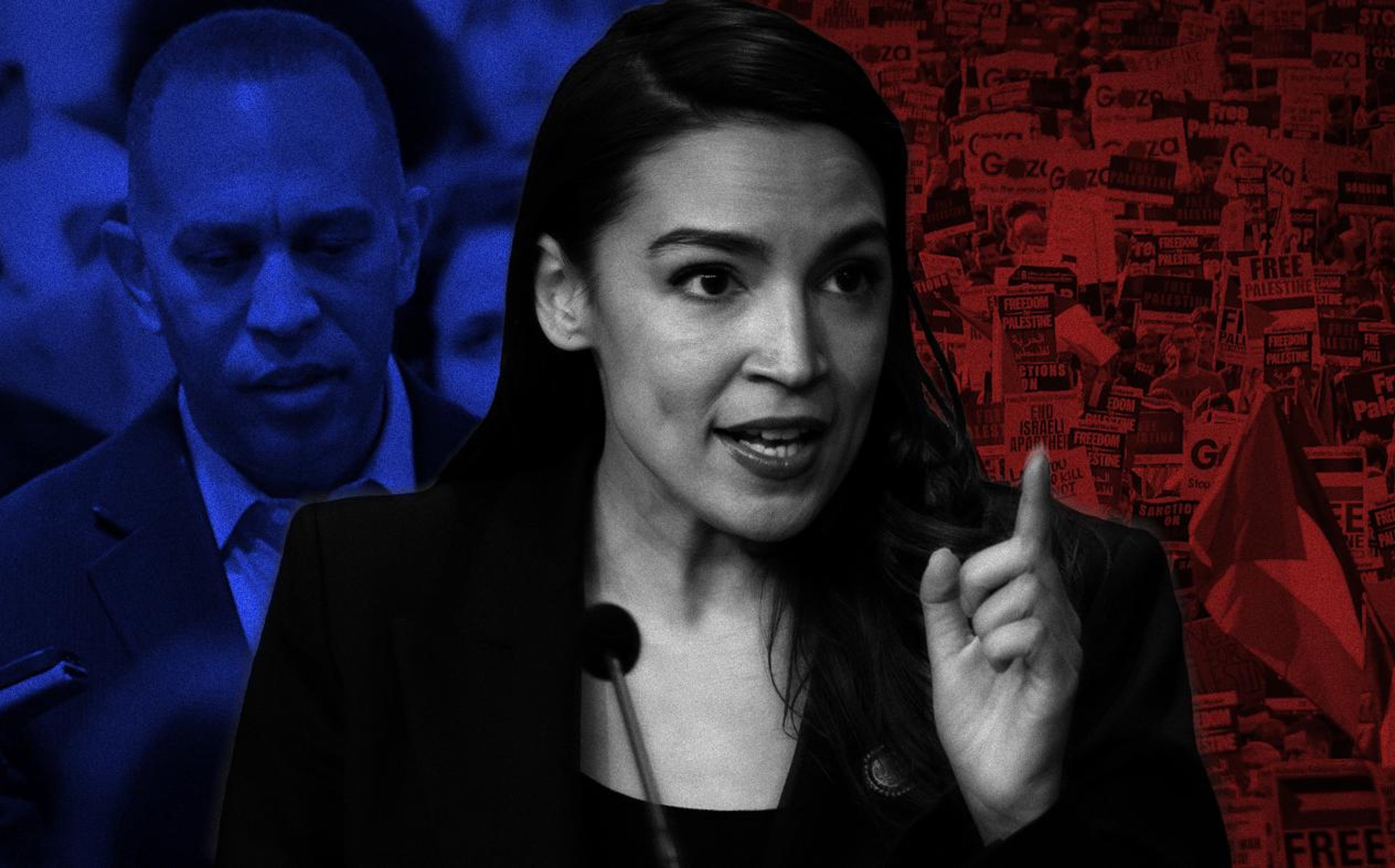
On November 18, 2026, House Democrats nominated Hakeem Jeffries to become the next Speaker of the House in a closed-door caucus vote of 251 to 11. Jeffries’ nomination came on the heels of the Democrats’ sweeping victories in the November 3 midterm elections, in which the party reclaimed control of both chambers of Congress, with at least 259 seats secured in the incoming House and 56 in the Senate. Due to the sheer number of seats won by the Democrats, Jeffries is expected to easily become the Speaker of the House when the full chamber votes on January 3, 2027. Yet the significance of the vote is not simply the overwhelming victory of the Democratic leadership, but the fact that eleven members refused to affirm it.
Among those opposing Jeffries were incoming progressive representatives Darializa Avila Chevalier, Adam Hamawy, Melat Kiros, Donavan McKinney, Chris Rabb, Claire Valdez, Don Leonard, and Angela Gonzales-Torres. These members opposed Jeffries over his refusal to make sufficient commitments around Medicare for All, accountability for ICE, campaign finance reform, and the genocide in Gaza. Many of those who voted against Jeffries belong to or have been endorsed by the Democratic Socialists of America (DSA). Their opposition was not sufficient to threaten his nomination. Nor should we pretend that eleven votes constitute an organized revolutionary bloc. But their significance should not be measured exclusively by their immediate capacity to defeat this robust, mafia-like DNC leadership.
For the first time, a division that has until now existed only as a theoretical disagreement among socialists in marginal online circles has acquired a tangible political expression beyond the walls of left subculture and into the United States Congress. The struggle between the Democratic Revolution, a strategy of opposition to the establishment that sustains struggle beyond the election cycle in order to build a political subject and sees fundamental societal change as its ultimate horizon; and Deliverism, a strategy of compromise with that same establishment for the purpose of immediate and primarily economic “tangible gains,” has begun to manifest inside the very institutions of the American government–a place that, for a long time, saw only internecine conflict between liberal capitalists.
Forces for socialism now have the nucleus of a congressional caucus, one that is already showing a willingness to make its opposition to the Democratic establishment explicit at the level of national political leadership, even when outnumbered. These lines of demarcation, previously only theoretical disagreements, are now taking institutional form. This is an important development, and the socialists who refused to endorse Jeffries deserve lauding. But the real question, given that the opposition lost the vote, remains: what comes next?
Demystifying the Establishment Narrative of the Midterms
The first task is to understand the political character of the elections on November 3rd, especially as the establishment begins to contest its implications. The “blue wave” was not an affirmation of the Democratic Party’s resonance, but rather a long-boiling repudiation of the Trump administration and the very real crisis his fascist politics has created. The electorate rejected a governing project defined by economic insecurity, rising costs, an authoritarian secret police state, and foreign policy governed by chauvinistic imperialism. The people responded decisively across the country, propelling candidates associated with a more confrontational, populist, and explicitly socialist politics to public office and winning a historic rout against the Republican Party.
But the establishment has a different vision for the trajectory of this victory. The liberal media apparatus has wasted no time framing the November elections as a mandate for the restoration of traditional Democratic Party authority. In their opportunistic account, the same institutional forces that presided over the party’s previous failures–whose colossal failures led directly to Trump’s rise and reelection–are now presented as the heroes of the movement that defeated him in the midterms. All evidence points to one conclusion: that this narrative could not be farther from the truth; that the Democrats won despite their leadership, not because of it. The attempt to revise the narrative and co-opt popular energy is the fundamental political operation underway in the nomination of Jeffries.
The truth is that the people did not vote on November 3 to install Hakeem Jeffries, a corrupt AIPAC crony, as Speaker. They voted to remove Republicans from power, and more than that, they voted for a future with money out of politics and accountability for Trump’s regime and its collaborators.
The broader question now is whether the political forces responsible for producing the present insurgency will be permitted to challenge the institutional arrangements that preceded it. Jeffries’ answer to this pressure has been a sudden (and quite clearly disingenuous turn) towards affordability, institutional cooperation, and tired emphasis on ‘the need to get things done ’–a conveniently timed epiphany after years in office with nothing to show for it except successful groveling to the donors that built his career. This language is familiar; it is the language of a political establishment seeking to reduce the movement’s demands to an administratively manageable set of policy objectives while leaving the underlying distribution of political power in the hands of the stewards of capitalism. This is precisely where the contradiction with Deliverism becomes acute.
What Is the Real Significance of the Eleven No’s?
The opposition to Jeffries should be understood as something more than a symbolic protest against an establishment politician. For a considerable period, those frustrated with the tendency of socialists in office to conform to Democratic Party norms and authority lacked a meaningful political mechanism through which to express that disagreement on a national scale, resorting instead to online forums and Twitter threads to vent discontent within a subculture predisposed to agree or disagree but never to build politics.
The November 18 vote marks the beginning of a different kind of scenario. Here we have a group of elected representatives who, on the strength of an electoral win with a mass mandate, are prepared to use an actual institutional position to refuse the automatic consolidation of establishment authority. They have an electorate, a public platform, a parliamentary position: a mass base with the capacity to make their disagreements visible to millions of people. In this context, the “no” votes should be understood as an opening for a new historical phase.
The opposition remains a small minority, but it must be made clear that this minority position in the halls of Congress represents the majority at the ballot box earlier this month: those who are fed up with business as usual in both parties and want accountability consolidated in the form of popular power. This, in essence, is the Democratic Revolution, not the return of mundane, corporate managerialism, but the unrelenting fight against forces of corruption attempting to thwart the popular will.
Now, the work of political organization begins; we must develop a coherent program, articulate a recognizable alternative to establishment leadership that people can mobilize around, and establish a relationship with the constituencies whose political demands have been repeatedly diluted by the establishment. Not just affirmation or declamation–but the steady work of agitation and education of the millions questioning the existing political arrangement and seeing that alternatives are possible.
We should also recognize the limits of the present alignment. Those who publicly explained their opposition still did not declare the explicit creation of an alternative socialist leadership, nor have they declared themselves as a congressional caucus. The opposition has become visible, but it has not yet consolidated itself into an independent political force. In other words, a vote against Jeffries is not, in itself, a Democratic Revolution. It becomes meaningful insofar as it contributes to the formation of a broader political opposition and a corresponding mass subject that can mobilize outside of the House floor alone.
Although many on the left would like to compartmentalize elections and formal politics from other avenues of socialist organizing, this is a moment to emphasize their interdependency. The significance of the elected bloc is exactly this: that so many, no matter where they are or how we find them, have been presented with a national fissure that can only–unlike in previous junctures–drive them towards further radicalism and political independence. The opportunity is in the new possibilities shown to the American people in opposing retrograde political leadership–and the necessity of the task of winning additional seats and further consolidating this alternative political bloc.
AOC, Deliverism, and the Risk of Co-Optation
The most revealing aspect of this development, however, is not simply who voted against Jeffries. It is the contrasting political position taken by those within the socialist movement who were willing to cooperate with his leadership.
AOC’s relationship with Jeffries cannot be understood as a spontaneous arrangement struck in the days immediately preceding November 18. The relevant political bargain was established months earlier. On June 23, Jeffries selected Ocasio-Cortez and Representative Terri Sewell to co-convene House Democrats’ “Cost of Living Healthcare” Working Group. The arrangement placed AOC inside the Jeffries leadership’s own policy-development apparatus, giving her an institutional role in shaping the healthcare agenda of the prospective Democratic majority.
This was not a position outside leadership challenging its direction. It was a position within the leadership, tasked with assembling a policy framework for Jeffries’ agenda as Speaker. This arrangement functioned as an advance bargain: a place within the leadership’s agenda-setting structure in exchange for political cooperation with the leadership project visible in AOC’s public statements on the matter.
AOC subsequently defended Jeffries, going as far as to say there is no alternative to his candidacy for Speaker, emphasizing the promises and potential benefits associated with his leadership. The caucus ballot was secret, and there is no public record establishing how she marked her individual ballot, but her public political alignment was unmistakable.
Some socialists were quick to justify AOC’s position on the vote as tactical, and of course it must be recognized that there is some truth to this. As she said herself in press appearances on the matter, Jeffries was running without any real opposition. Under those circumstances, and given the real concessions extracted, it is entirely reasonable to believe that the opposing Jeffries was not worth the squeeze. AOC’s actions must be analyzed sincerely, rather than dismissed as careerism or even betrayal–attitudes that avoid struggling with the messiness of politics by appeal to moralism.
What AOC’s reasoning misses, though, is the scale of her influence in the emerging political landscape–the same influence that made her support for Jeffries worth concessions in the first place. Her public standing, national visibility, and relationship with the increasingly young and left-wing electorate give her an ability to articulate opposition at a scale that few other politicians currently possess. Precisely for this reason, her decision to situate herself within Jeffries’ leadership project reflects a profound underestimation of socialism’s prospects in the new relations of force.
The question is not whether the healthcare working group might produce valuable recommendations. Expanding healthcare access and confronting the power of private insurance are indispensable political objectives. Sometimes, tactical compromises must be made, and there is nothing intrinsically wrong with winning concessions from a hostile establishment. But these compromises must be judged on their own terms, on a case-by-case basis. And in this case, it’s become clear that this compromise sold our movement short at a moment of strength, just as our mass mandate became tangible.
Here the distinction between Deliverism and the Democratic Revolution as alternative modes of political strategy becomes decisive. Deliverism conceives of political success primarily through the production of “tangible gains” within the existing institutional arrangement. Its orientation is toward administrative “competence”, policy negotiation, and the demonstration that progressive politicians can govern more effectively than their opponents. The “socialist politician” in this framework becomes the person who can make the existing system “work the same, but better” (a nonsensical promise under capitalism, whose routine crises can undo such gains at a moment’s notice).
The Democratic Revolution, by contrast, understands material demands as the starting point for a much broader process of political mobilization. Its objective is not merely to improve the functioning of existing institutions, but to transform the relationship between popular power and the institutions that govern society, opening a dialogue that can produce an active revolutionary political subject. It seeks to turn people from recipients of political administration into participants and intervenors in the exercise of political power.
Healthcare, ICE, the genocide in Palestine: these are not simply matters of administrative competence; they are essential questions of values and national direction. Jeffries and the rest of the corrupt establishment, a milieu whose competence at high-level corruption should not be downplayed or misconstrued, would have no problem executing Medicare for All on this basis. It is their rather lack of political will generated by the extraordinary power private capital exercises over their governance. Housing, employment, education, freedom, imperialism and the cost of living are likewise not discrete policy failures that can be remedied independently of the social relations producing them. They are political contradictions through which the possibility of a different social order becomes intelligible.
A working group can compile recommendations and fax them to the Speaker’s office all they want. It cannot, by itself, mobilize a population against the interests that prevent those recommendations from becoming reality. A politician’s compromise may alter the trajectory of the leadership it serves in an immediate sense–and this must be insisted on against the ultra-left that believes it is impossible to win concessions whatsoever–but it does so by weakening the very forces that gave that politician their power in the first place. Popular mobilization gave us the ‘blue wave’ we saw in the midterms: popular mobilization, then, is the queen of our aims and objectives.
In accepting a bounded role within Jeffries’ leadership apparatus, AOC has helped affirm the establishment narrative at the very moment when the socialist movement had an opportunity to challenge its legitimacy at a much larger scale.
The establishment is extraordinarily adept at recognizing popular movements, incorporating their most recognizable representatives, and redirecting their political energy toward manageable objectives. Its greatest strength is not always its ability to defeat opposition outright. It is its ability to co-opt it. The task of socialists at this juncture must be: to refuse.
The Prospects of AOC 2028 for the Democratic Revolution
Many in socialist circles have been quick to use AOC’s compromise with Jeffries to dismiss any potential her presidential campaign would have for the consolidation of democratic struggle. In reality, the opposite is true: the political mistake would be to confuse the necessity of opposing Deliverism with the necessity of abandoning the political campaign that may be most capable of expanding the forces of the socialist movement.
The immediate task is to defeat the fascist MAGA right and consolidate the broadest possible forces capable of challenging its political power. That must include, and even prioritize, contesting the presidency in 2028. At the same time, we must wage an independent struggle against the Democratic establishment, whose conservative institutional arrangements have repeatedly frustrated the development of a genuine popular alternative, and we must challenge the conservative elements within our own movement and among our own candidates.
These struggles cannot be seen as compartmentalized or mutually exclusive. The broad democratic struggle against MAGA, the internal democratic struggle of socialism against the Democratic establishment, and the innermost struggle of socialism against its own self-imposed limits must all be seen as part and parcel of the necessary process of creating a new and better world.
We must, however, weigh these struggles against the actual relations of force. Our forces for Democratic Revolution remain comparatively small; it remains an internal contradiction within the larger socialist upsurge. The socialist movement has made extraordinary advances, but it has not yet acquired the organizational capacity or political coherence necessary to independently direct the entire breadth of the present insurgency with principle and discipline. We cannot afford to mistake the existence of a more advanced theoretical position for the possession of the political forces required to realize it.
An AOC presidential campaign would provide an extraordinary opportunity to bring millions of people into direct contact with socialist politics. It would place questions of healthcare, housing, foreign policy, and the democratic character of the state before a national electorate. It would create a political focal point around which existing movements, organizations, campaigns, and constituencies could begin to cohere.
We have already witnessed the organizational consequences of these electoral moments. The Bernie Sanders campaigns of 2016 and 2020 dramatically expanded the American socialist movement. AOC’s initial congressional victory in 2018 helped generate another wave of political interest and organizational development. Zohran Mamdani’s mayoral victory in 2025 further demonstrated the capacity of a successful socialist campaign to bring millions of people into political life.
The same potential exists, on a greater scale than we’ve ever seen before, in 2028. A presidential campaign is not simply an electoral mechanism for winning an office. It is an instrument of political subjectivization on a national scale. It can establish a new political frontier and create an entirely new generation of socialists.
The question is whether socialists will be prepared to take advantage of this opportunity with all its complexities. An AOC campaign would inevitably contain the contradictions of its candidate. Her Deliverist instincts would not disappear simply because she entered the presidential race. Indeed, they could become more pronounced as the demands of a national campaign draw her toward institutional accommodation. But these contradictions are precisely why organized socialist participation and intervention are necessary.
We should not support AOC because we believe she has already resolved the contradictions of the Democratic Revolution. We should support her because her candidacy offers an unparalleled opportunity to bring those contradictions, which have only just begun to become legible, into the center of American political life and expand the forces capable of resolving them.
The task now is to participate in the development of her campaign, and contribute to making it a vehicle for socialist political expansion. We should simultaneously maintain our independent organization, our theoretical commitments, and our opposition to the political compromises that threaten to unnecessarily limit our movement.
A socialism that refuses to participate in a mass political moment because its principal representative has conservative tendencies will inevitably surrender the political terrain to forces that have no intention of advancing the socialist project. The alliance must therefore be understood as tactical, not as the surrender of one political tendency to another. The Democratic Revolutionaries must not demand ideological purity as the precondition for cooperation, but neither should they sacrifice the possibility of independent opposition in exchange for proximity to power.
Our influence over the direction of an AOC candidacy will be determined less by the conditions we announce in advance than by the organized strength we bring to the struggle. The larger the socialist movement becomes, the greater our ability to make political demands upon its leading figures. A presidential campaign of this stature at a crucial juncture would accelerate precisely the mass-political development required to make those demands effective. The campaign is not the destination, but a terrain: a means toward revolutionary ends.
The Makings of A Socialist Congressional Caucus?
The electoral successes of the last several years have brought the socialist movement to a new stage of development. We are no longer simply attempting to establish that socialism can exist as a recognizable political position in American public life. We are now confronting the question of what happens after socialism becomes a real political force–when its representatives occupy positions of power, when its growing popular constituency begins to make demands upon the institutions governing society.
This transition inevitably produces new contradictions. The old struggle against marginality has not disappeared, but it has acquired a new dimension. The movement must now defend itself not only against exclusion, but against liquidation. It must learn not merely how to win elections, but how to prevent its electoral victories from becoming instruments for the reproduction of the existing political order.
The emergence of a visible congressional opposition is therefore a development of considerable importance. The eleven votes did not defeat Hakeem Jeffries, but they did something politically significant: they demonstrated that his authority is not beyond question, that the socialist movement contains forces willing to challenge the institutional leadership of the Democratic Party, and that an alternative political orientation can begin to find expression within Congress itself. Those representatives should be lauded, but now their opposition must be expanded, organized, and connected to the broader popular forces that produced the victories of November 3rd.
At the same time, we must insist upon the necessity of an AOC presidential campaign in 2028. Not because her politics are beyond criticism, not because Deliverism represents the final horizon of American socialism, and certainly not because she has “earned our trust” (a claim seemingly now popular among abstentionists that need have little to no bearing on our tactical action, action that must be predicated entirely on calculus of a purely political character). Rather, because the political expansion made possible by such a campaign is indispensable to the future development of the socialist movement. The eleven No votes are themselves the product of this type of work: material proof that these tendencies remain linked in practice, even as they struggle against each other.
The next stage requires abandoning the false belief that every contradiction within our movement must be resolved before we can act together. We should support AOC in 2028, and we should oppose the political arrangements that have brought her into alignment with Jeffries. We should build the campaign, and we should challenge its limitations. We should celebrate the electoral advances of socialism, and we should insist that those advances become instruments for a more profound transformation of political power.
The Democratic Revolution is not accomplished by the accumulation of progressive officeholders, nor by the gradual improvement of administrative institutions. It is accomplished through the development of a popular political force capable of subordinating those institutions to democratic will–i.e., by using every tool available, and every avenue of agitation possible, to build a popular revolutionary subject.
That force does not yet fully exist; it must now be constructed. The November 18 vote offers an indication of what its initial political contours might look like. A small congressional minority has begun to make visible the opposition that our movement must develop. The next task is to turn that minority into a recognizable political current, that current into an organized movement, and that movement into a force capable of transforming the balance of power in the country.
This can and must mark the beginnings of a socialist congressional caucus, one that can act in unison despite unresolved internal contradictions. This caucus must be in opposition to the conservatism of not only its GOP enemies but also that of the so-called “progressives”, those who collaborate with the forces of oppression at every convenient turn for the mere possibility of opportunistic, careerist “tangible gains”.
It has become clear that the road to socialism cannot run through the restoration of Democratic Party normalcy, nor will it run through the isolation of an intellectual minority whose agenda remains purely theoretical. It must run through the gauntlet of mass political struggle led by millions of people, through the contradictions of existing institutions, and through the organization of a force capable of carrying the democratic aspirations of the present moment beyond their existing limits. The eleven votes against Jeffries are a beginning, and an AOC presidential campaign can be another. Our task is to make sure that neither is the end.