
Aug 8
rs21's "Should the British left build its own DSA?" is Asking the Wrong Question
Is copying the DSA model the answer for the UK? Gigi G argues rs21 is asking the wrong question.
by Gigi G
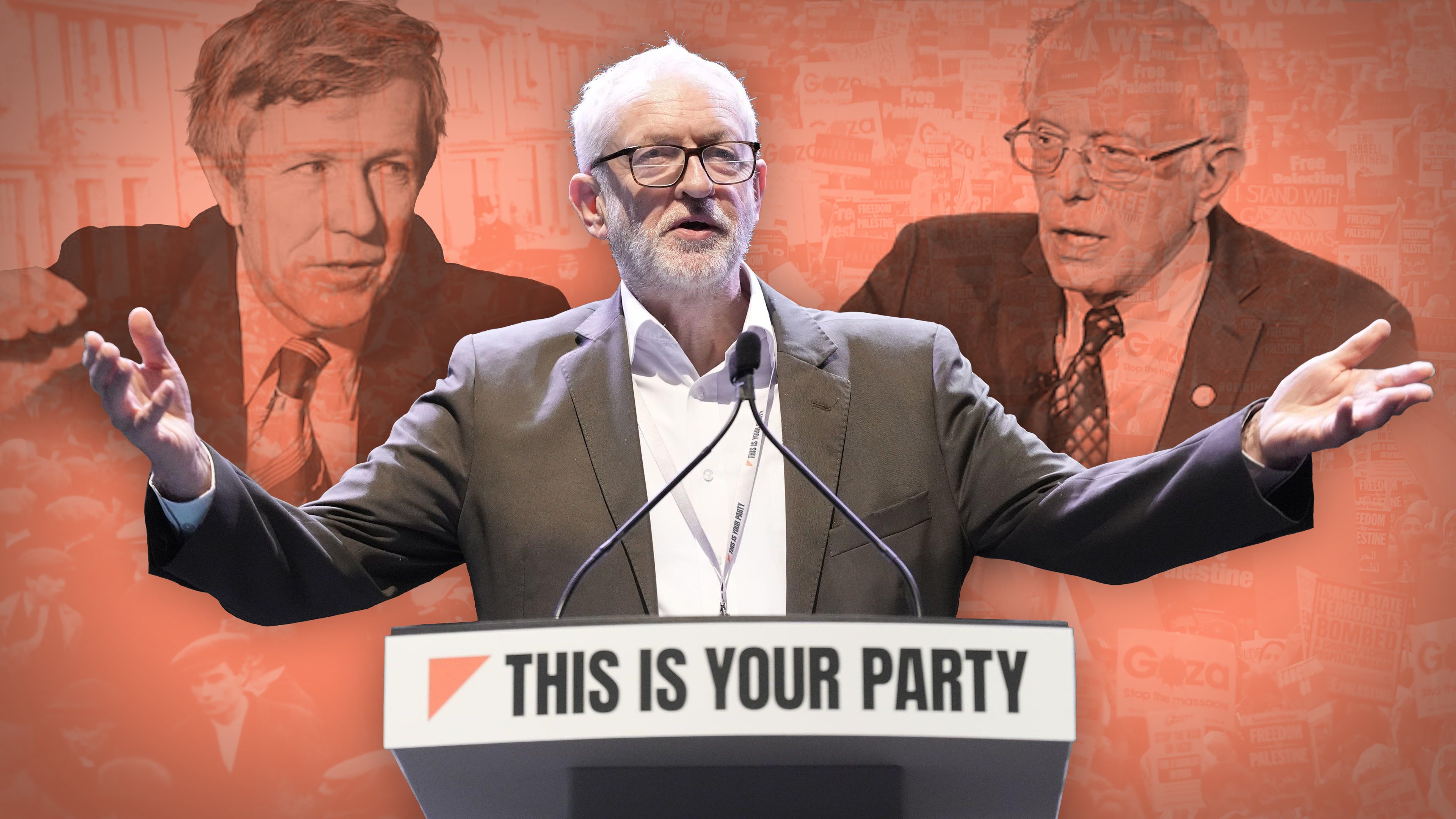
The DSA was constituted in 1982. Its activity and history were largely unknown until 2016, when Bernie Sanders ran for president and said that he was a “Democratic Socialist.” His campaign and the surge of interest in socialist politics skyrocketed the “Democratic Socialists of America” into national popularity.
Almost no members of DSA are still around from 1982. Members who joined in 2016 are considered elders, and those who joined during or before 2015 are prehistoric. People who start learning the history of the DSA often come to believe that our organization's prominence is little more than a lucky coincidence—seizing on the opportunity presented by Bernie Sanders. After all, Bernie Sanders was technically not endorsed by DSA; the organization didn’t have anything to do with his presidential campaign in 2016. He just happened to call himself a Democratic Socialist.
In comments and responses to “We can’t onboard the working class,” which offers a history of the DSA and the Democratic Socialist movement from 2016-2026, many objected to the idea that DSA had anything to do with Sanders. Instead, they argued that DSA had “no role” in producing the Bernie Sanders moment, that DSA’s upsurge during this period was just riding the wave of public sentiment. Many new DSA members who have joined, especially since Zohran Mamdani’s historic victory in the NYC election, as well as many international observers such as rs21, have come to accept this version of history. They conclude that the task is to build an organization prepared to receive the next wave.
This is incorrect. What was the mass sympathy for socialism that DSA is supposed to have merely ridden? It was the Democratic Socialist movement itself. It was generated by our own politics, and it did not appear spontaneously in 2016.
Bernie Sanders' relationship with the Democratic Socialist movement started before DSA itself was founded. The year it was founded, 1982, Sanders was already a well-known Democratic Socialist and was invited as a keynote speaker at the DSA’s first statewide conference in New Jersey. Democratic Socialists were already organizing, fundraising, and canvassing for him, and generally engaging in activities to support our shared Democratic Socialist positions. With the support of Democratic Socialists—including DSA members, but not the instrumental organizational support of DSA itself—Bernie Sanders rapidly rose to national prominence and became the most popular politician in America.
By November 2014, CPUSA and DSA members were the first to create and publicize organizations to support Bernie Sanders’ Campaign for president four months before he announced it. Bernie Sanders was just one of thousands of politicians for whom we provided organized backing, professionalized political knowledge, grassroots support, and a general staff needed to seed their rapid popularization. This activism represented a notable, but small, underdeveloped, and often internally-divided section of this struggle. A more significant section came from the left-liberal wing of the Democratic Party we had intentionally rebuilt through advancing our shared political ideas.
This early support has become one of the main reasons for political Marxist organizations to exist—as Democratic Party bodies abstain from partisan organization out of ‘neutrality’, they disorganize the working classes during critical periods, and give free rein to well-organized, well-funded, permanent capitalist activist influence, and only organize the whole body once key decisions have been reached by these activists. As such, DSA and CPUSA have become the only options for our class to self-organize against the capitalists in the form of a permanent campaign.
DSA and CPUSA were notable primarily for being the largest two explicitly Marxist organizations engaged in this permanent campaign, with CPUSA representing the continuation of ideas of the ‘old left’ and the strategy of working ‘outside’ the Democratic Party, and the DSA representing the ‘new left’ and the strategy of working ‘inside’ the Democratic Party.
To understand this, we should look back into the history of the organizations. In 1996, DSA was issuing ‘paper endorsements’ in thousands of democratic party primaries, including controversial figures like Nancy Pelosi. At the same time, the CPUSA had stopped running candidates, seemingly disengaging from electoral politics entirely.
During the disorientation and political repression of the 2001 war on terror, DSA and CPUSA were compelled to practice the opposite of what we said and what we represented. After Bernie Sanders’ failed 2016 primary election, DSA’s Jason Schulman, a member of the NYC-DSA steering committee, rejected even a pragmatic endorsement of the Democratic Party.
Supporting Clinton does not help us challenge the right. [...] If Clinton wins the nomination, neither the DSA nor I will be advocating a vote for her.
CPUSA, on the other hand, while nominally following a long-standing policy of not endorsing Democratic Party candidates, became one of the most notorious supporters and backers for Hillary Clinton to become President of the USA.
Joe Sims, Co-Chair of the Communist Party USA reflected upon this in a recent YouTube Short:
The Communist Party fundamentally stopped functioning as a political party, and kind of functioned as an appendage to the Democratic Party. We didn’t see ourselves that way. But, objectively, if you look at it, that’s kind of what happened.
The confusion on the organized left that is complained about today was even more magnified back then. Regardless of this confusion, both the inside and outside strategies were constantly being applied by Democratic Socialists.
In truth, the inside and outside strategies are just two sides of the same coin. Bernie Sanders was a Democratic Socialist who straddled the line between inside and outside. He was an independent Senator, but he also caucused with the Democrats. As such, both sections of activists identified with him. He was not a DSA member, not a CPUSA member, and not a member of any of the other countless micro-party organizations (he was often critical of these organizations’ ‘conservative’ leanings).
The models of both the Communist Party and the Democratic Socialists of America during the periods of our strongest growth in history produced the exact same debates, tendencies, ideas, responses, actions, divisions, weaknesses, strengths, and people who show up in both organizations despite having ‘polar opposite’ models, because we share the ideology of Democratic Socialism. Even the task of working inside or outside the Democratic Party bypassed our model. The differences between our models seem to have no imminent or inherent stakes at all.
By the time Bernie Sanders was running for president, he and countless other Democratic Socialists, especially DSA, had built the Democratic Socialist movement into a mass struggle that was capable of representing and moving just shy of a majority of the left-liberal movement inside and outside the Democratic Party’s internal election process.
What rs21 (and the various sects who occupy themselves with similar debates in DSA) need to understand, if nothing else, is that what holds the Democratic Socialist movement together, what makes it a rising power in America, is not the model or structure or even activity of any particular Democratic Socialist organization. It is our mass history, our populist politics, our millions of sprawling supporters, activists, and politicians—many who do not even formally believe in democratic socialism, but who do believe in our values, our class alignment, and our mission—organic intellectuals who construct, expand and perpetuate the Democratic Socialist ideology autonomously and in defiance of the terroristic rule of the American capitalist ideology and its struggle to maintain white supremacy, male supremacy, and class dictatorship. The DSA is the crest of a wave—it is the product of the mass struggle, not a new piece of organizational technology that has figured out a clever way to succeed on its own.
Democratic Socialism and DSA surged in 2016 because we had spent decades re-gathering the struggles of millions of Americans who had been dispersed, disoriented, and disorganized by terroristic political repression of all progressive movements back into a coherent struggle against the ruling class. This identity was constructed not by any one organization alone, but by populist politics: Democratic Socialism. Even where we as individuals and activists failed, the masses continued: Occupy Wall Street, the insurgent elements of Obama’s campaign, the historic movements against police brutality, the environmental movement—each of these was a necessary ingredient for the modern socialist organization; each of them is the real source of our power and influence today.
DSA’s greatest organizational success was in proving that affiliating yourself with such a socialist movement was no longer ‘revolutionary suicide’, as joining the Black Panthers and other ultra-left groups had become, no longer something that branded you as associated with a foreign enemy state, no longer blacklisted like the CPUSA. It is now something hundreds of thousands of Americans have the right to freely do. This is the real political movement that led to some 200,000 members joining DSA and another 50,000 joining other socialist organizations over the past decade.
This is the form that the history of class struggle has led to in the United States.
Rob Owen and Vic Chechi-Ribeiro of rs21 do not reckon with British history, left defeat, or how to make new history. They debate questions around the topic of whether Britain should ‘build its own DSA’. They take the lessons from DSA they want to—activist culture, internal organization, and voluntarism, like they're asking “which option off the menu of strategies should we select?” The significance of democratic socialism and the question of mass politics is left in the margins as an afterthought.
Q1: "What problem is the DSA model trying to solve, and is that problem the same in Britain?"
Owen claims that the DSA’s model was trying to provide an organisational form for socialists to operate within the American two-party system. Vic C concurs, adding that this attempts to solve a problem similar to their own—a lack of working-class political independence, and the “albatross” hanging around their necks: sect forms of organization.
In the first issue of Democratic Left, which today has become DSA’s official magazine, Michael Harrington, the founder of the DSA and editor of the paper, describes a very different task. He writes:
The immediate tasks are obvious enough: to build a progressive majority for the Democratic Party in 1974 and 1976 as a first step toward the transformation of the nation. [...]
We believe that the left wing of realism is today found in the Democratic Party. It is there that the mass forces for social change are assembled; it is there that the possibility exists for creating a new first party in America. [...]
The Left, more than ever before, needs thought, self-criticism, candor and communication. [...]
And a very different problem:
The only way to build a new majority for social change is for labor and the new politics to come together. [...] If this split continues, the Republicans will hold the Presidency for the foreseeable future.
Harrington is not concerned primarily with the organizational form of socialists operating inside the Democratic Party. He is also not concerned with immediate formal political independence or the supposed albatross of sect forms of organization. These are secondary questions that would be derived from decades of praxis.
Instead, he is concerned with political tasks and political problems. Self-criticism and reflection on past mistakes. Historic new opportunities in the current Democratic Party, in the current structures of mass political participation, and theorizing on that basis a way to build a new political party to transcend and defeat the two-party system.
Hugh Cleland's "Reform Begins in the Democratic Party," published in the same issue, concurs, and elaborates on what these historic opportunities are. He writes:
McGovern Reforms' have opened the Party to young people, blacks, women, working people, in unprecedented fashion [...] It was because of this tangle of arbitrary rules that socialists and trade unionists despaired of influencing the Democratic Party [...] the reforms strike at the heart of the mechanism whereby the regular organizations kept control.
Key committees of the party and convention have been democratized. In accordance with the principle “one Democrat one vote.
The goal of the Democratic Socialists of America was to re-unite the American Liberal movement and Left movement into the Democratic Party, as a political pole aligned against the capitalist right-wing movement inside and outside the Democratic Party after a period of terroristic repression had opened up into democratic freedoms. Its goal was not to provide an organizational form for the socialist movement that it had theorized, abstractly, as a correct organizational form suitable for activists to merely ‘operate’ inside the Democratic Party. In order to achieve this task, and from this task, over the course of decades, it developed its organizational form in many directions, splits, associated groups, joint actions with other groups, and so on. Its members acted independently, in secret groups, in other formations, and so on. Its lodestar was not the organizational form, but adaptation of the organization and its politics to the salient issues of mass struggle in a particular period. In this sense, it has largely succeeded in these original ‘realignment’ goals in our ‘prehistory’, and we have since moved on to new tasks and new forms of organization.
Britain, like the USA, has no shortage of microparties engaged in such nebulous shifts of organizational forms of all kinds, some of which have been comparable to DSA from time to time, and comparable to other such organizations in America.
The problem with these British organizations is not their structures.
The mass struggle in Britain lacks a left, lacks left-populism, antagonism, a pole around which the dispersed class struggle can re-gather. The Labour Party, similarly to the American Democratic Party, absorbs and disperses this energy in cycles, in a ‘passive revolution’. For a brief moment, it looked like Your Party might regather this energy into an independent form—only to squander it on the same petty and myopic organizational debates rs21 reads as the relevant element of DSA’s success.
Meanwhile, the populist right reorganized under Farage by doing little more than an imitation of Trump, and the Green party’s Zack Polanski had the common sense to capture a fragment of the energy by simply mimicking Zohran Mamdani. Obviously, no strategy model or politics can be copied wholesale from elsewhere—but this only makes the relative success of these cheap imitations and gimmicks so tragic.
Q2. “What does the DSA model assume about the current task of socialist organisation and its relation to the broader left, as well as the working class in Britain?”
Vic C states that “the primary crisis facing socialists and those fighting oppression is one of leadership and organisation.”, and argues that the “task of socialists is therefore to build such an organisation.” Owen concurs that this is the crisis, but also suggests that “the crisis of the left is a symptom, not a cause, of the problems facing our movement.”
Owen, addressing the root cause, begins to suggest a completely different task:
Since the struggles of the late 1960s, the far left has been isolated from the levels of working-class struggle that give our politics vitality. Comrades who experienced the revolutionary hopes of the early ’70s are now in their twilight years, the organisations they built slowly calcified by practices adopted to survive a downturn in struggle.
Our task is not to group together with the damaged fragments of the Marxist left, but to learn lessons from past high points in struggle and sniff out opportunities to work with new forces capable of breaking the cycle of defeat and starting to rebuild our movement. [...]
Owen is on the cusp of the right direction: the far left's problem is its isolation from working-class struggle, and the task is to "sniff out opportunities to work with new forces capable of breaking the cycle of defeat." Owen begins to sound like DSA’s Harrington! However, Owen turns back from concretizing this task, and proposes a viewpoint on organizational squabble in the form of a ‘task’.
Our task today is to sustain a revolutionary organisation that makes new socialists and prepares us to throw ourselves into potential movements with the confidence to listen, raise revolutionary politics, and advocate for strategies that deepen self-activity. This will help prepare us to seize the next opportunity [...]
The task is degraded to "sustain a revolutionary organisation." This organization will “make new socialists and prepare us to seize the next opportunity." The task he originally identified is demoted to a future spontaneous "opportunity." Once again, the task is the same as it apparently has always been: have the correct form of revolutionary organization.
An organization which can conceive of doing nothing but ‘prepare’ is not useful, and as such sustaining it would objectively be a waste—this is precisely why the vast majority of people, historically, have refused to engage with such sects, trust them, defend them, grow with them, protect them, and empower them. The DSA was not such an organization; it had immediate political tasks, and it was organizing the fight to achieve them.
Harrington's proposal in that first issue was ultimately to create a political party. The difference between Democratic Socialism and rs21 is where the party is supposed to come from. Harrington located it in forces already assembled and already moving—labor, the new politics, the newly enfranchised delegates of a democratized convention—and understood the organization's job as convening what already existed. rs21 locates it in rs21.
Finally, the sects rs21 considers an ‘albatross’, in the modern mass political world are hardly anything at all. At worst, they abuse people and valuable organizational resources, which could be said about all organizational forms. At best, they serve as a useful punching bag to antagonize.
Q3. “What would a DSA-style organisation do differently in the next four years in Britain that rs21 and other existing Marxist organisations don’t currently do?”
Both Owen and Vic C agree that ideally, it would do nothing different, and that they would act as a guardrail to prevent it from doing anything different. It would merely serve as a structure for them to continue doing what they were doing in the SWP with a larger base of activists to draw from and influence. They accept that this is just an ideal, and content themselves with a marginal position within the organization. Compared to the status quo, this would be a ‘strength in the long term’.
rs21 is beginning to sound like a real DSA faction. Factions like DSA’s Libertarian Caucus, Reform and Revolution caucus, and the Liberation caucus have made the same arguments towards Anarchist, Trotskyist, and Maoist sects respectively.
Q4. “What would the British left lose if it embarked on such a project, and what is the worst-case scenario of the DSA model?”
Vic C brushes the question off: the British far left, he says, is "so weak that it has little to lose," and the worst case is merely that its factions harden into something "incapable of building unity through diversity"—which is actually descriptive of the status quo. Vic C only sees potential benefits. He writes:
A Marxist faction would also act as a guardrail against liquidating politics into mass work, ensuring ‘community organising’ has an explicitly political purpose and pulls individuals into a DSA-style party.
No faction in DSA has ever performed this function, and all the factions of note in DSA are ‘Marxist’. What you will find is the reverse: our most valuable individuals pulled out of mass work to duplicate party organizational work, whip votes, and litigate the ‘model’. The factions in DSA cannot act as guardrails against the liquidation of politics into mass work because they are organizations of the liquidation of mass political work into internal politics.
Groundwork DSA is one of the self-conscious and notorious liquidators. They maintain the largest and most advanced factional organization, including expansive lists of supporters. Interestingly, they have used that power to drag ‘internal’ questions outward into national political visibility: debates that many sectarians believe ought to have stayed internal, for example, over what our relationship to AOC is and who gets to speak for it escalated into public spectacle in part due to their agitation of private lists, leading to the most observed National Political Committee meeting in history.
Owen warns that the DSA model draws activists toward "the easier task of winning internal motions, positions and majorities within small socialist organisations" and away from "the hard work of winning arguments in the wider movement," that it "fetishised formal democratic processes over roots in the wider movement."
But what Owen posits as a worst-case future is again the status quo of the British left; in fact, it is what they are doing now and what they are struggling to break free of in this very debate. Both Owen and Vic conceive of losses only in terms of organizational numbers, how left activists engage and think, and have no conception of political development of the broader population at all! No organizational structure can produce the political struggle from which structure derives.
Both are correct that the British left has nothing to lose, but they do not understand that this is because, after squandering Your Party, it has nothing left at stake. It can basically do whatever it wants, and nobody cares. The British people clearly have much to lose, stakes which are still utterly neglected.
Conclusion
rs21 was founded in January 2014 by 166 former members of the Socialist Workers Party, who left after a year-long faction fight over the SWP leadership's handling of rape and sexual harassment allegations. rs21’s goal in creating a potential British DSA is to use the clout of the organization to push forward their brands of pseudo-radical politics and paternalistically “save” their own DSA. They believe they can conjure a political party into being amongst themselves by play-acting that they have the legitimate power and authority to act as a “guard-rail” instead of actually acting as a “van-guard”.
Sectarians have come to realize that they can prioritize and internally out-organize the majority of Democratic Socialists who were not particularly interested in this sort of maneuvering, as Owen warns the structure is susceptible to. DSA's national political organization is besieged by such organizations who reject its political tasks of regrouping, intellectualizing, and theorizing a new left.
rs21, like the sects in DSA, only support Democratic Socialism opportunistically—to advance their own politics—not on the basis of its own ideas. They intend to join the ranks of these irrelevant, powerless, and doomed groups in a new ‘British DSA’. The best prospect for such efforts is to drag such an organization back down into marginality with them, as they successfully did with Your Party and as they risk doing with the DSA now that AOC is preparing to run for president.
The DSA has been divided into two great wings: the “Mass Politics” wing, which puts forward its politics amongst the people first, which Geese magazine gives voice to; and the ultra-left wing, represented by countless microparties and sectarian organizations who compete and conspire privately amongst each other for positions within the organization from which to remake the model of the organization and capture its base.
The sects lack confidence in the ability of their own ideas to gain support among the people, so they organize to opportunistically seek power and status within the organization in a doomed attempt to shortcut their micro-parties into relevance, as if by commanding the national political committee of the Democratic Socialists of America, this will somehow let them command the Democratic Socialists in America.
In America, Democratic Socialism is irrevocably in motion because we have set it in motion. The sectarians that fancied themselves as ‘guard-rails’ are now lashing out wildly trying to stop it, but really have their hands tied. We are nearly ready to build the new first party in America. The DSA organizational model that produced this movement is nearing the end of its significance.
As the British left learns from their collapse and looks to the relative success of DSA, it is necessary to learn about what DSA really is and why its politics succeeded, to address your own political situation, and to derive an organizational form from political objectives with real stakes you actually intend to win.