
Jun 22
The Law of the Common Good
How the revolutionary use of law against monopoly power can clarify the relationship between democracy and communism.
by M. Sanchez
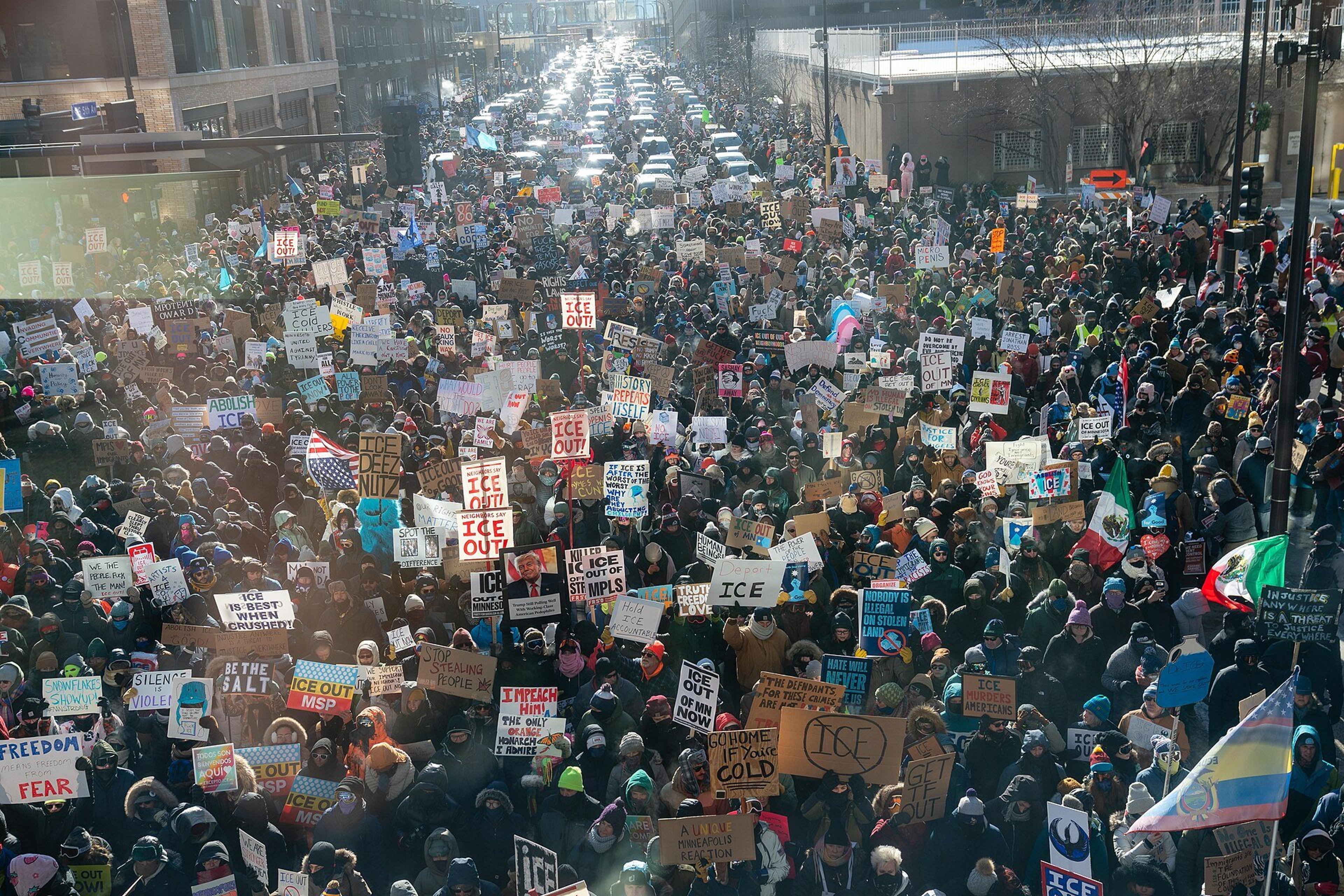
ICE OUT NOW Protest, Downtown Minneapolis, January 2026
Among democratic nations it is only by association that the resistance of the people to government can ever display itself: hence the latter always looks with ill-favour on those associations which are not in its own power; and it is well worthy of remark, that among democratic nations, the people themselves often entertain a secret feeling of fear and jealousy against these very associations, which prevents the citizens from defending the institutions of which they stand so much in need. The power and duration of these small private bodies, in the midst of the weakness and instability of the whole community, astonish and alarm the people; and the free use which each association makes of its natural powers is almost regarded as a dangerous privilege. [1]
—Alexis de Tocqueville, Democracy in America, vol. 2 (1840)
If the injustice is part of the necessary friction of the machine of government, let it go, let it go: perchance it will wear smooth,—certainly the machine will wear out. If the injustice has a spring, or a pulley, or a rope, or a crank, exclusively for itself, then perhaps you may consider whether the remedy will not be worse than the evil; but if it is of such a nature that it requires you to be the agent of injustice to another, then, I say, break the law. Let your life be a counter friction to stop the machine. What I have to do is to see, at any rate, that I do not lend myself to the wrong which I condemn. [2]
—Henry David Thoreau, “Resistance to Civil Government” (1849)
Part I. The logic of rebellions
Section IA. The language of the unheard
American leftists know that they want to win, and even that they must win. But they cannot agree on what this actually means. Even those who advocate for the political independence of the left or the working class from existing institutions dispute among themselves whether or not this path passes through the Democratic Party. It is not just a debate over which means can achieve a pre-established consensus of ends, but of the meaning and direction of the left itself.
This is a line of questioning that is characteristic of something which has not yet become a movement, yet which already struggles to organize itself into a faction. But the American left cannot become a coherent faction, capable of disputing means and ends, without being impelled into relevance by participating in and sustaining the efforts of a mass movement. Until then, leftists will remain a fringe appendage of progressive liberalism for reasons of their (often unconscious) institutional allegiances: their class background, shared media ecosystem, and overlapping organizational networks.
This does not mean that the left has to win over a majority of voters, at any level of representation, before it can claim any legitimate victory. The prerequisite for political power is not a majority, but a mass of partisans—a mass which must be reckoned with by the other partisan masses. But justifying any one of our positions on the basis of speaking for “the masses” is just as unsatisfactory as attempting to deduct the right course of action from pure theoretical reason alone. To come together into a faction, organizations need to ride the tide of an overwhelming force, brought to life by the infectious energy of crowds. Barring this condition, an organization can never claim to be a pre-party formation. Anyone who says they have already reached the stage of working out a party program is a delusional sectarian who has mistaken their own plans for the will of “the masses.”
Though sects are the expected cancers of a political terrain without sustained movement energy, minorities always have their own part to play in charting the way forward for masses. A movement is the tide that a self-directing faction can grow from. For this to be possible, masses of people need to learn to redirect themselves away from the standard, ready-made routines of life. These statistical averages of behavior are shaped around our roles as cogs in a machine—workers and consumers. The modern masses, composed through the conglomeration of millions into collective bodies, are a product of the institutions which bind them together, assign them to their roles in the cooperative work of society, and plan the course of their lives for them.
The power of monopoly capitalism has trained them into people with needs which compel them to buy what is for sale, seeking the satisfaction of their inner lack in pre-fabricated commodities. Yet capitalism can never satisfy these needs one and for all. To do so would cause capitalism to no longer be able to change and extend the nexus of production and consumption into new realms ripe for exploitation. The inner lack in each of us remains a fertile site of ambiguity. Capitalist society must train and re-train us to continue to seek relief for the lack in what is on sale, but the lack always escapes and exceeds the outcomes planned by monopoly capitalist institutions—and so the cycle of consumption continues.
At the same time as automation throws masses into a superfluous existence as a standing reserve of potential workers and consumers, it also forcibly reduces the scope of needs for the unemployed. Beggars cannot be choosers. While, for many, this existence compels them into the depressive fatalism of mere survival, for others it is an impetus for struggle. This creates a problem for the monopolists’ ability to control the masses. This constant crisis motivates an elite “carrot and stick” strategy: Philanthropists provide incentives to keep the “deserving” destitute morally disciplined through the hope for reward, while neoliberal politicians punish the “undeserving” poor for their indiscipline with austerity and imprisonment. The lack, trained into a pursuit of consumer objects by monopoly capital, converts into a dangerous excess of life which must be tightly managed and systematically wasted in order to prevent the frustrated surplus population from growing into insurrectionists who simply take whatever catches their eye.
When life is rendered disposable by a system of social organization, it becomes a liminal site of uncontrollable energies. When everyday life goes on as usual, these energies are usually directed laterally, as in gang violence, which sees the enemy in competing gangs rather than in the monopoly powers which dictate the rules of the market for everyone, or in horizontal identification, as in sports fanaticism, which imagines that the success of the players vindicates the efforts of the fans. In moments of overwhelming discontent, when the situation cannot go on as it was and the rulers have grown too complacent and sclerotic to maintain the old order, these energies overflow into a rebellion.
Rebellions do not begin from clearly articulated logic. They rarely begin from demands. Riots are, as Dr. Martin Luther King Jr. put it, “the language of the unheard.”[3] Demandless riots, sustained by affect and passion, are often the starting point for a movement’s rupture with an established political order which can no longer encompass those it casts aside as disposable. In recent history, we might think of the 1965 Watts Riots or the 1992 Rodney King Riots in Los Angeles. Both events are starting points for modern neo-abolitionism, which directs its efforts against the police state and mass incarceration. In the genealogy of the populist right, however, remembering the blind rage of the white families who resisted Federal desegregation in the ‘60s and ‘70s is more urgent for the present than tracing the demands of the White Citizens’ Councils and Alabama Governor George Wallace. Left and right alike draw on this circuit from rebellion to demand, even while the goals of their movements are distinct.
Rebellions unleash creative energies which can then be articulated by leaders (who need not be institutional elites) into demands, but they do not themselves begin from the articulation of a collective subject or interest group, which they may transform into at a later point. Before articulate leaders begin to articulate a rebellion into a demand or series of demands that outline a plan for reorganizing the system, it is more often that charismatic heroes driven by some inner compulsion emerge who personify the energies of the rebellion. For John Brown to organize his raid on Harpers Ferry in 1859 as a means to initiate the refoundation of the U.S. along abolitionist lines, Nat Turner had to lead a chiliastic movement for the affirmation of Black energy against the white enslaver’s republic of Virginia in 1831.
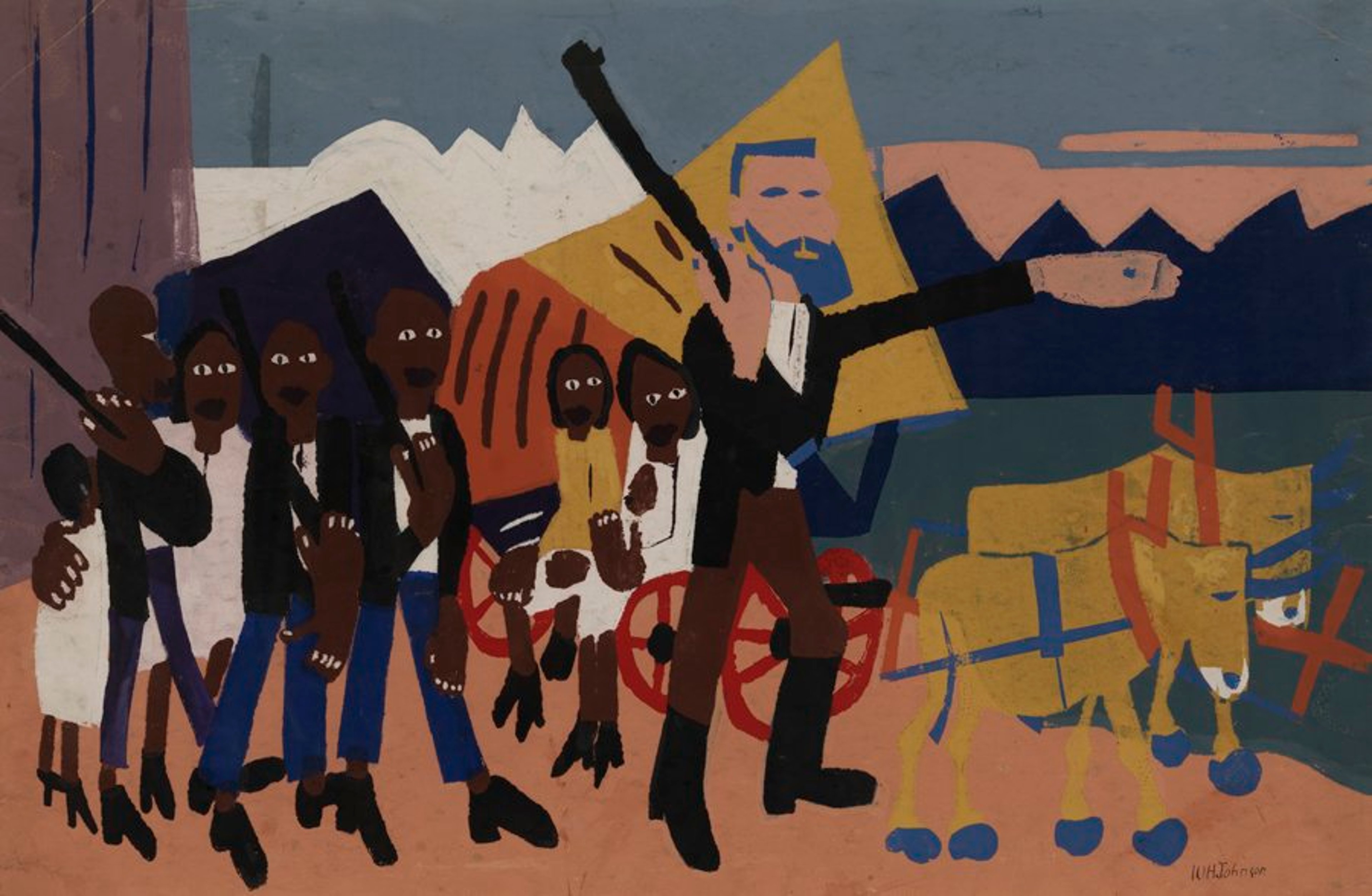
On a John Brown Flight - William H. Johnson
However, the elemental force of refusal in a riot or rebellion does not automatically lead to a revolution. Demandless riots just as often leave people to reproduce the dominant lifestyle rather than challenge it, such as by looting luxury items from stores. The inner lack, trained today by the dominant power of monopoly capital, can only link up with the energy of the crowd when they begin articulating themselves in a “NO”—a Great Refusal of the pre-existing institutional organization of the masses which has designated those masses as disposable waste. This tendency can even be found in forms one wouldn’t expect, such as a subterranean affective current drawn on by the ideology of hustling, which calls on individuals to carve out their own way in the landscape of post-industrial capitalism.
But automation, inflation, and mass unemployment do not only generate resentment of the waged and taxed towards the welfare beneficiaries and desperate destitutes, or of the avaricious consumers towards the overburdened producers. As autoworker and Black Power militant James Boggs noted, these problems also push politics beyond the problematic of development and towards the issue of what kind of society we are seeking. While neoliberal technocrats may seek to reduce this political question to the augmentation of arbitrary wealth measurements upwards, the existential precarity faced by millions instead “makes the question social because it poses the relations of man to man.”[4] When recessions strike and politics devolve into a reactionary blame game of identifying the purposeless and undeserving poor to be punished, the terrain of politics is also shifted towards a juncture in which a Great Refusal of the old way of doing things can be organized.
Charismatic leaders can become the face of this oppositional refusal by lending their voice to it and converting its energy into criticisms and demands thrown in the face of the authorities. But the voice of a movement is more than the faces of its leaders. A voice is not a thing, it is not an organ within a person, but something between organs. Screams, singing, and speech—the voice encompasses all of these, and all of these transcend and unite individuals. Discourse, grammatical language which expounds on shared concepts, turns the voice into a medium for interpreting experience, investigating truth and lies, and articulating demands for conduct.
Revolutionary movements, as opposed to rebellions, must discursively explain their cause and convince people in order to organize themselves into associations which can convert their demands into realities. A charismatic leader may unite the energy of a movement into a symbol, but a movement must exceed and outgrow this individual in order for its energy to spread into an organizing power that sustains its efforts through many cycles of rebellion and restoration. A rebellious movement only becomes an articulate revolution, with a program for the path to a new world to come, after setting to work in reproducing and defending its revolts. This is, substantively, the only means of making them independent from the institutions of the dominant order.
The discursive critique of the dominant order, which accompanies the effort to organize an alternative to it, is what marks the partisan distinction of a movement from an ephemeral revolt or atomized forms of non-participation. Without this discursive critique, it is impossible to challenge the established system with an alternative vision of society.
Section IB. Populist gangsterism and the collapse of institutions
What is the pervading discourse that critiques the established system today? It is the accusation that it is blind capriciousness: that our institutions defend the narrow, gangsterist interests of billionaire monopoly capitalists, who use their power to dictate norms on the rest of us, who enclose collectively produced wealth and extract profit and rents from it, and whose Epsteinian personal networks traffic and rape whatever vulnerable people they can get their hands on. What do socialists say they want today? From the Bolivarian Revolution to Yanis Varoufakis, from Claudia Sheinbaum to the Democratic Socialists of America (DSA), socialists call for a fight against monopoly power and an effort to affirm the public good against it. So far, so good.
But what happens when the public institutions are themselves part of the problem? President Donald Trump’s imperialist adventures and despotic direction of policy find welcome ground in the mutual isolation of political power and masses in the United States. The American state has long since been unaccountable, governed by special interests and their friends. In this context, “the people” of Trump’s Presidency amounts to a small, fanatical minority. To lay all hope for salvation in the rotten institutions which paved the way for Trump in the first place is a technocratic fantasy. Trump’s attempt at conducting a nationalist revolution from above has itself demonstrated that, barring the intervention of a mass movement, extreme parties have no choice but to either accommodate themselves to the existing institutions as isolated technocratic reformers or to tear society apart without achieving legitimacy for a new order.
Nothing makes this clearer than the free fall of the system towards disorder in the past year. Large swathes of professional jobs are being eliminated overnight, cornerstone institutions are shuttered, official procedures are totally disregarded, public resources are thrown into foreign wars without any justification to the public, and, in short, nothing works as it’s “supposed to.” The liberal and liberal-left response to this crisis has been to call for the restoration of the formal rule of law, which is supposed to put everything back in its proper place so that we can set to work on sustainably reforming it. “King” Trump is the enemy of institutional reason, which elevates procedure over politics.
In reality, the institutions can hardly save themselves—and they certainly cannot save us. There is no way out of this dilemma except if the masses assert themselves. This need not be the apocalyptic final struggle, the long-awaited proletarian Last Judgement that some Marxists imagine as the inevitable result of crisis and destitution. A mass opposition can be a force for the rule of law, but only of a law that moves people and meets their needs. The old law of monopoly capitalist liberalism was not this rule of law, but a technocratic and formalist one. The populist offensive of Trump can only be defeated by a populist opposition which learns to out-organize its enemies and to impose its vision for the world with the force of law. That means political power—power which dictates the conduct of social organization for everyone.
We need people who don’t just take whatever indignity they are subjected to as if it were merely a law of gravity. The reign of the experts teaches people to outsource decision-making, and thus renders law a realm of institutional procedure left vulnerable to any executive who might cast it aside rather than an social-ethical force which captures the passions of masses inflamed in a democratic populism. We need people who can take responsibility for themselves and commit to a collective project instead of setting anchor wherever and whenever the established institutions direct them to. In the name of their own popular reason, they have to be willing to be unreasonable to their enemies. They have to learn to impose their partisan will as an objective force that overrides the institutions and the enemy parties. That will is what mass movements are made of, not policy proposals drafted by campaign advisors or opinion polls.
In the struggle of factions for power, political philosophers Ernesto Laclau and Chantal Mouffe are right to insist that “no attempt to bridge the chasm between political will and communitarian space can ultimately succeed”[5]. But there is a terrain that can unite the two, and simultaneously function as an objective social force and a contested battlefield: the rule of law.
The 20th century enemies of communism understood this principle. As the post-war settlement erupted into the competition of the U.S. and Soviet blocs, New Deal liberals took on an offensive against global communism and the rebellions of the forgotten poor that threatened to strengthen the left. While they attempted to combine the “stick” of military and police force with the “carrot” of welfare and Civil Rights, their opponents took advantage of the crisis of the New Deal state in the ‘60s and ‘70s to seize power and simplify the anti-communist strategy into a straightforward capitalist restorationism.
Neoliberals converted counterinsurgency into a campaign against the welfare state and public ownership of wealth in favor of the law of free enterprise (for monopoly capitalists) and personal responsibility (for the left-behind poor). The global rise of neoliberalism immediately provoked a struggle between the partisans of the law of free enterprise and the partisans of the law of the common good—its fronts were in Chile, Iran, Grenada, Nicaragua, France, and elsewhere. Initially, the common good was defined as the national sovereignty of governmental decision-making against free market globalization and foreign creditor-imposed structural adjustment. Today, the right-populist reformers like Donald Trump have co-opted this movement and critique free enterprise from the standpoint of xenophobic national enterprise and local elite capriciousness. This changes the terrain for those of us on the left: we have to clarify that our opposition is to monopoly power rather than to immigrants and cosmopolitanism.
Modern left populism need not be patriotic per se; it only needs to bring people together. We will have to seek allies wherever we can find them, and that means looking beyond national borders and institutions. The present crisis, characterized by a rapidly growing disjuncture between society and the state, creates an opportunity for those of us on the left to pursue political independence from the established party machines and monopoly capitalist special interests which have held command over decision making power in representative politics for the past few decades.
We will not achieve hegemony or the force of law over society without trying for more than is presently declared as possible. Every new law is born from what began as a stab in the dark, and grew into a conscious collective ethical imperative. The emancipation sought by the rule of the law of the common good would mean using society’s wealth and power to free people to pursue a plurality of projects rather than survive for the sake of perpetuating the accumulation of capital and the careers of technocrats. We have to learn how to travel far beyond the beaten path to set out on the way to this possibility.
Part II. Movement demands, political hegemony, and the rule of law
IIA. Law and political will
Most elections, especially in the United States, rarely succeed at drawing out the vast majority of eligible voters, much less all of them. The reign of populism in modern politics poses a problem to any understanding of democracy as merely the procedural supremacy of decisions made by the majority of voters and their elected representatives. Electoral cycles are increasingly dominated by highly emotive, enraged campaigns, which draw their strength from collective resentments towards elites more often than policy promises.
Yet, the inner life of individual voters does not tell us much about the nature of these politics of populism. To say that people join the Make America Great Again (MAGA) movement because they’re selfish suburban Boomers, or that others become woke because they’re college educated downwardly mobile professional-managerial Zoomer neurotics, avoids the question. It does not answer why boomers prefer MAGA or neurotics prefer wokeness. It cannot tell us how these movements speak to multiple constituent groups at once, come together behind charismatic leaders, and stick with each other through failures and disappointments. Those of us on the left will not know how to chart a course forward—towards victory—without understanding the structure of political persuasion.
Human beings are incomplete creatures, and so we are needful things. When we try to articulate our needs through the language and symbols of politics, actively seeking its satisfaction from something or someone in our world, we make a demand. Laclau and Mouffe note that a political demand does not spring out of the individual objective interests of a pre-existing subject, but are fundamentally social in character. The demand becomes something that “we,” whoever “we” are, make to others, who “we” delineate from ourselves. In other words, the demand reflexively creates a collective subject: the demand creates “the subject positions” by discursively unifying and interpreting “the points of antagonism and the forms of struggle” into a political faction.[6]
This pattern of development from demand to faction may seem familiar. The demand of subjects to a (usually unresponsive) authority appears at first as a partial struggle (i.e., freedom of association for trade unionists). But when partial demands cannot be satisfied by partial concessions from the state (as when the government is led by a particularly intransigent and hostile party), those demanding are compelled to seek each other out and aggregate their demands into a singular chain that makes up a general opposition to the established party or parties. The multiple demands of this opposition are bound together into some multivalent signifier of a broad subject—”the people” being the classic example. “The people” never actually includes everyone, in spite of its emptiness as a signifier. But it does mark an intention towards totalization. For example, someone branded an “enemy of the people” is one whose personal interests disrupt and denigrates the unity of “the people,” while a “man of the people” is one who lends his face and voice to the political body that claims to be “the people.” “The people” is rife with inner tensions—in its formal sense, it may refer to a state, the already-prevailing political organization of society that claims to represent it in its totality, or it might mean a movement or a united series of movements which are contrasted to those enemies which impel a collective motion. For Laclau and Mouffe, these unifying concepts exist to mobilize political subjects rather than be true in-themselves. The nature of that mobilization comes down to its organization, strategy, and alignment relative to other factions of society.
Every movement moves towards something. Even an opposition movement is not only negation, but affirmation. When an opposition manages to strike an effective balance between the extensional broadness of the coalition of demands (how wide the faction is) and the intensional deepness of the tie between collective needs and political demands (how deeply the faction speaks to a given demand), the movement strengthens its capacity to imagine a possible world of its own—to be organized in practice by taking power and disorganizing the opponents of this possibility.
The abolitionist movement in the United States is an illustrative example. The struggle made its passage into the phase of political antagonism when the civil strife of Bleeding Kansas and the territorial disputes between pro-slavery and anti-slavery advocates over Free Soil elevated the latter’s vision into a political faction disputing what the near future of the country would hold: the Republican Party. When a mass faction reaches the point of a faction fighting to impose its own intentions on the other factions, the very association itself becomes the force of the faction’s virtual utopia in the terrain of real politics. This is the struggle for hegemony, a relation which emerges when it “becomes necessary[...] to represent the totality of the chain [of equivalence between oppositional demands], beyond the mere differential particularisms of the equivalential link,” i.e., when the disparate demands must come together into a multivalent signifier. Through this process, a particular group “transforms its body in the representation of a universality transcending it (that of the equivalential chain)” and “assumes the representation of a universality entirely incommensurable with it.”[7]
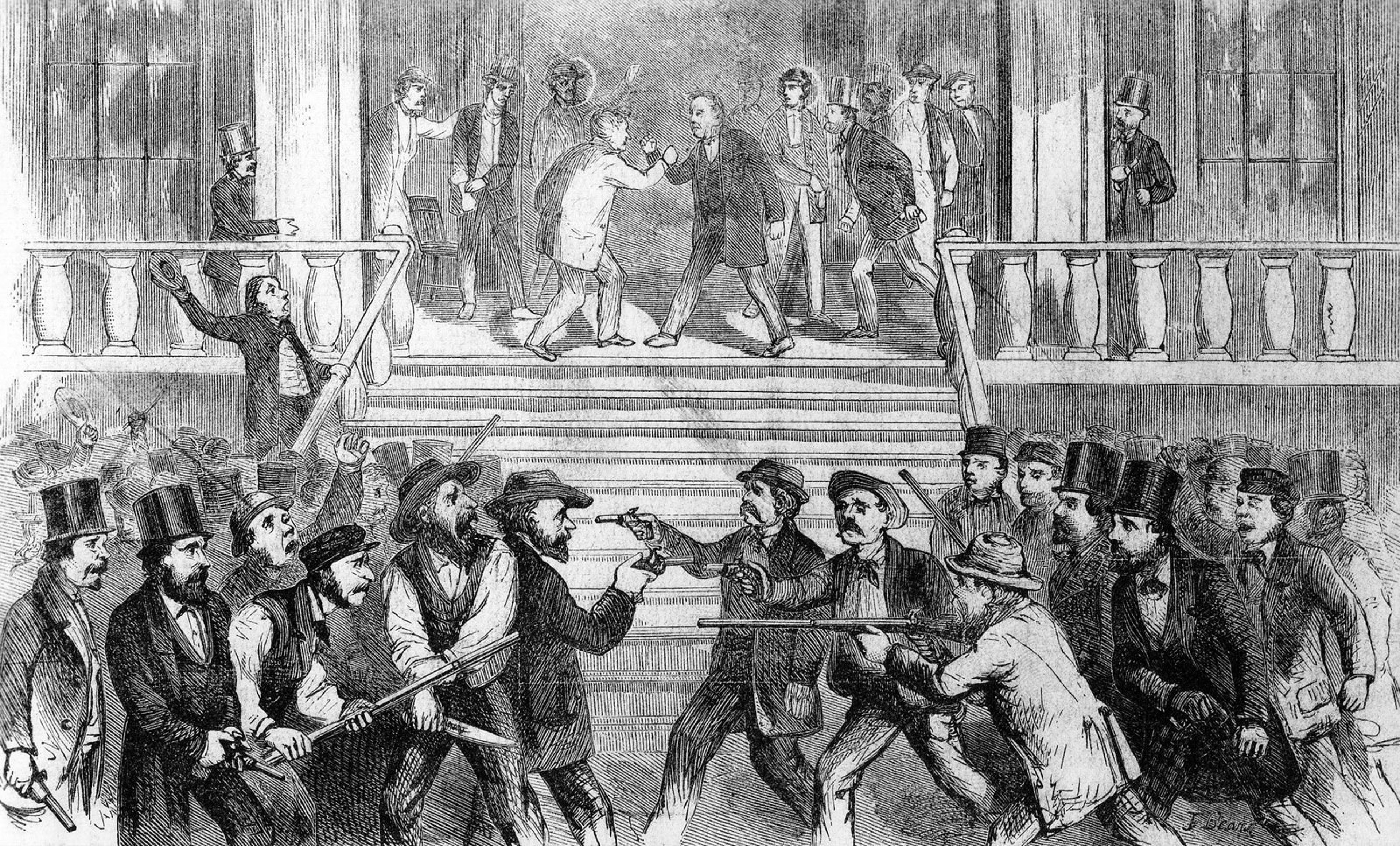
Clash between proslavery and antislavery groups in Fort Scott, Kansas Territory, 1850s.
On achieving and consolidating its hegemony, a rising party holds the power to convert this represented universality into a code of conduct for each and every part of society. It becomes the ruling party of society by learning “to impose its conditions of existence upon society as an over-riding law.”[8] This law is not mere caprice or opinion forced on the world arbitrarily by the ruling party. This law is social reason converted into social force. It is the power to make a world, imposing an objective ethical horizon on the everyday conduct of everyone as an overriding law of organization. The Republican Party’s abolition of chattel slavery at the conclusion of the U.S. Civil War was the conversion of abolitionism from a demand into law through a hegemony achieved in a total war against the enslaver enemy.
Law, however, is not the imposition of one party’s hegemony alone. Law rarely codifies the vision of any single faction with absolute fidelity. Even the opponents of a law are compelled to conduct themselves in accordance with it. Consequently, the rule of law marks a shared ethical system of rights and duties. Law draws from multiple sources and takes on multiple meanings. Even the word “law” reveals this dilemma. Most of us think of law in juridical terms, as the official codes of conduct and legal principles which tradition and legislatures generate, and which lawyers and judges administer as a matter of their professions.

Cole Tomas Allen courtroom sketch
But law may also mean an authority, like a sheriff, a general pattern or norm, such as the law of self-preservation, or even a will articulated as a dictate for conduct, i.e., the law of God. Distinguishing “law” in general as a concept from juridical law is important for us to be able to understand how antagonistic factions vie for hegemony over each other. The same people who speak of “law and order” might face troubles in courts of law themselves; the names of Presidents Richard Nixon and Donald Trump, who both invoked the same slogan, hardly bring to mind juridically lawful conduct. Law is perhaps better construed as broadly meaning: righteous conduct, demanded from everyone. This meta-meaning of law can encompass both the codes of procedure imposed by the professionals of state bureaucratic institutions and the norms imposed by hegemonic parties, which often disrupt the workability of those codes. Further, it provides guidance to the conditions of development of law itself. Law stretches across the gap between society and the state—but rather than its reconciliation fusing the two into a perfect system, it persists as a virtual terrain of struggle.
Law is discursive language which demands that extra-discursive life take a particular shape, though the nature and meaning of this demand remains indeterminate and contested among different schools of thought in practice. The name of a law-giver or body of law only points to the origin of that law or what it concerns without claiming to comprehensively expound either. The Ten Commandments of Moses came from an unseen God who manifested his power through natural miracles and told his prophet “I AM WHO I AM.” Modern juridical law claims to codify the traditions and will of a people, but it can never decide once and for all who “the people” is, even if it might regulate the procedures of citizenship and voting. The rule of law dictates that all individuals, parties, and institutions in a polity are accountable before the law, which is reasonably and equally applied to each of them. But this law, an imaginary ethical totality, is riven within by logical contradictions between its different codes as much as politics is riven within by the antagonisms between factions.
The contradictions within a law allow opposing parties to interpret it as demanding things that are mutually incompatible with each other. The United States was founded on the assumption that governmental power is meant to serve humanity’s natural rights to “Life, Liberty, and the pursuit of Happiness,” and that when any government “becomes destructive of these ends, it is the Right of the People to alter or to abolish it, and to institute new Government, laying its foundation on such principles and organizing its powers in such form, as to them shall seem most likely to effect their Safety and Happiness.”[9] Critics of the United States government, both from the left (abolitionists) and the right (Confederates), have long drawn on this principle in order to justify their revolts against the juridical laws of the state as in fact launched in defense of the rule of law. The “one” of the objective ethics of law turns out to divide into the “two”: of rulers and opposition, state and society, and of outer norm and inner conviction.
The passage from a need to a political demand to a law is founded throughout the process on the strength of an inner conviction. When the rule of law in the administration of society is thrown into disarray by the breakdown of lawful procedure in the bureaucracy, the impotence of civil society in the legislature, and the ascendancy of one-sided special interest gangsterism in the executive power, the inner conviction grows. In the crises of the late Roman Empire, this manifested as inward-facing Stoicism and Christianity. In the 19th century United States, the Second Great Awakening sought to meet the cold injustices of chattel slavery and political capriciousness with the strength of an inner light, the law of God written on the heart of the believer. In the United States of the 2020s, the strength of one’s convictions offers a final refuge for law and ethics in a world which no longer pretends to justify itself to us. When these convictions override our ability to conform with the order of the world that we find ourselves thrown into, intensifying into the overwhelming sense that we must do something, that we cannot neglect our duty to conduct ourselves a certain way, they become an inner law.
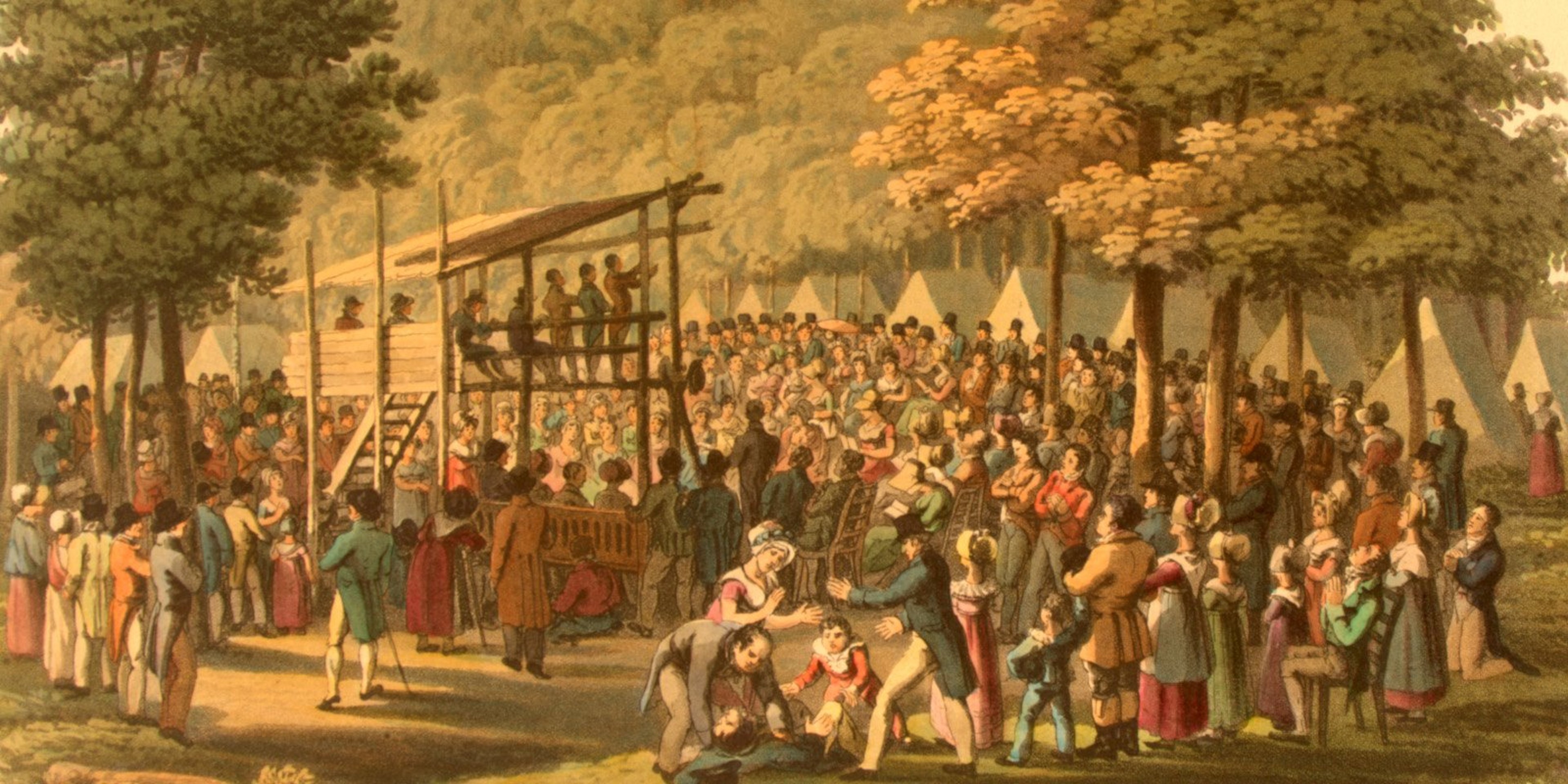
The Second Great Awakening - Methodist Camp Meeting
The inner law’s dictates on the conduct of an individual necessarily drive them into association with others who share the same obligation and seek to live out the will of the law in the world. The nature of their group solidarity may vary, whether it stems from an intellectual resonance or is founded on mutual aid, but it always draws on an overwhelming legal-ethical power which obliges the members to come together. This power may be symbolized as a common descent from shared spiritual ancestors, a personal communion with Christ, or the intervention of elemental forces in consciousness.
These symbols mark the relationship between the power of association and the many inner lives of the associators. The associative power tends to come forth from a common compelling affect, such as is embodied in a symbol, rather than the careful, rationalist arguments of a detailed plan. The Haitian Revolution, the first successful revolution of enslaved people in history, began with a Voodoo ceremony at Bois-Caïman in 1791 rather than springing from the Enlightened tongue of Toussaint Louverture. The first language of an inner obligation to intervene in the world is the unconscious argument of symbols and the ritual cultivation of the impulsive forces that they draw on. These are the first materials of any association as it initiates its struggle for the universalization of its law.
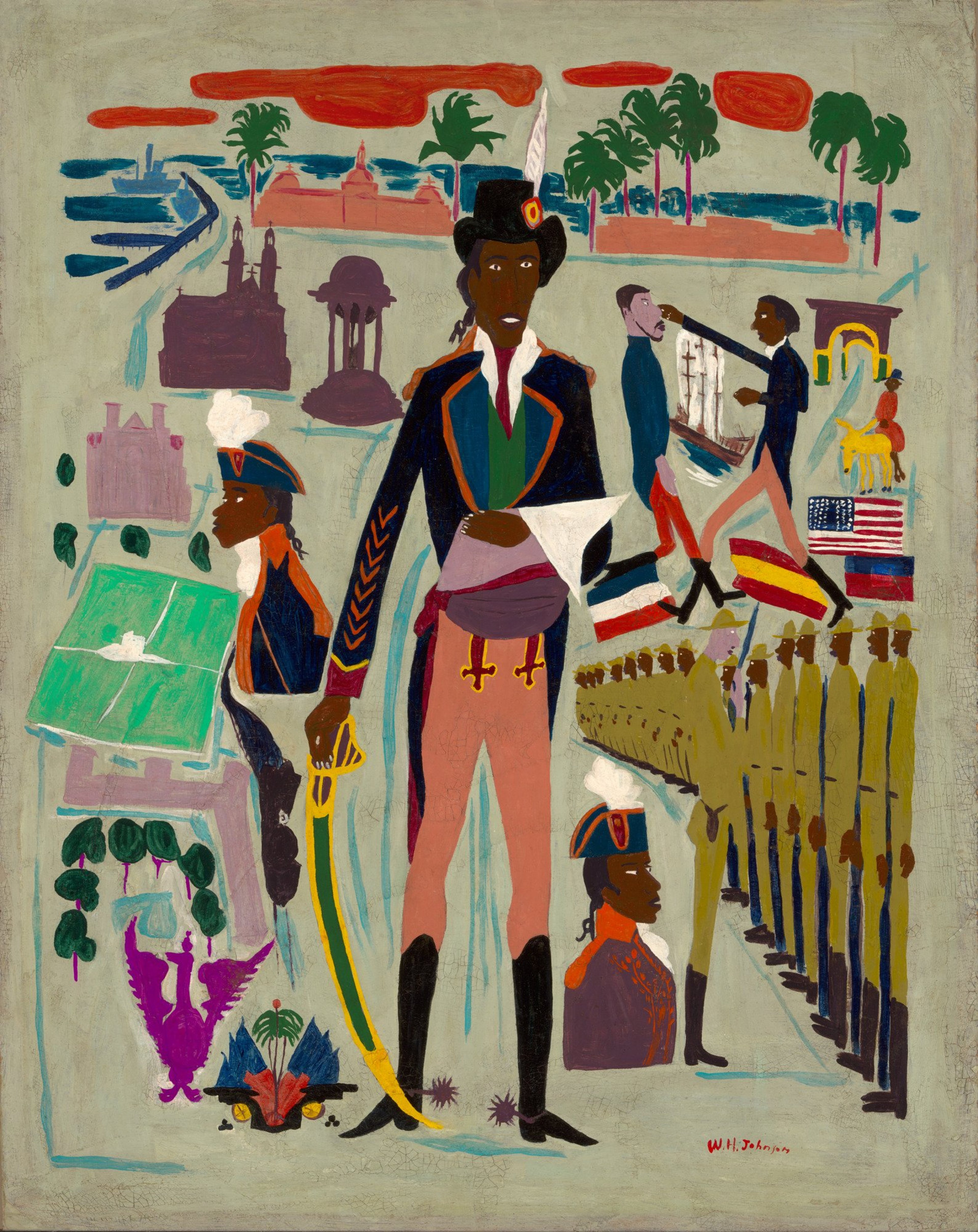
Toussaint l'Ouverture, Haiti. Painted by William H. Johnson
The inner law takes on external form through organization. The association is built in accordance with its obligation to bring the world that it wills into reality. But this organization is only possible after people have proved the practical meaning of this inner law in a struggle against the pre-existing organization of the world. This struggle is not always a direct confrontation against the concentrated centers of expertise and power which maintain the existing law, though it usually reaches its most clear expression in these strategically and symbolically weighty struggles. Any voluntary association organized for the purpose of realizing some principle, whether it is a church or a mutual aid society, is organized by inner laws or even a written constitution. The experiment in externalizing the inner law brings up a series of questions: What brings together those driven by the law? How do they accomplish their obligation in the world such that the law becomes a collective movement-force? What impedes the force of this law, and what can be changed accordingly in order to permeate everyday reality with lawful organization?
For every association motivated by a common reason for existence, there must be some way of finding a seed of the ultimate goal in the immediate tactics, and the ultimate goal must be a motivating ethical force for the immediate tactics. Reflecting together on the outcomes of any short-term actions that we take can help clarify the nature of our long-term trajectory. In the words of Marxist philosopher Georg Lukács: “Organization is the form of mediation between theory and practice. And, as in every dialectical relationship, the terms of the relation only acquire concreteness and reality in and by virtue of this mediation.”[10]
Law must be interpreted in a struggle to implement it in a manner conducive to the wellbeing of the communities who share it. By contrast, sectarianism, characterized by inner-facing organizations focused only on maintaining and expanding themselves, amounts to a despotic attempt to force the world to conform to the measure of an otherworldly command, guarded from outsiders by the jurists who interpret it. This is an excess of legal formalism that ruptures the link between the inner law and organization. There must be some reasonable harmony between the ultimate goal and immediate tactics at the same time as between fidelity to the law and people’s everyday needs. The future society of the new law cannot be prefigured by the sheer discipline of an organization, as if the organizers were a construction crew following a blueprint. A new law begins with a revelation that something must be so, but it has to be rationally expounded, made convincing, and given a shared organizational and strategic meaning in order to become fit to achieve the rule of law.
When a law achieves the rule of law, it means that it is able to take root in the social space shared by all parties of society. Even many of its former enemies are then compelled to acknowledge its victory and seek their own egoistic and partisan aims in its general implementation. This was the significance of Republican President Dwight D. Eisenhower having expanded the New Deal reforms that he personally opposed, or Mikhail Tukachevsky’s transformation from a noble nationalist into a Red Army general. The enemy of the upstart ruling party is forced to adapt to the novel framework of the political terrain that has achieved the rule of law.
The power of an ascendant law does not stem from its advocates imposing absolute conformity on whoever they can reach. The law has to become something personally meaningful to people for it to have any staying power. Its power is exercised through a common goal and shared tasks. And this common goal, as it transforms from an inner law to a factional program to a law of social organization, is something which elicits a variety of interpretations which are only compatible with each other insofar as they are advocated by people committed to the same struggle and bound together by the feeling of necessity and their voluntarily shouldered responsibilities.
Of course, the members of an association do not always see eye to eye. But although each reaches out in a variety of directions, this reality does not mark any deficiency before the law. Members of the association do not need to be remolded into units of the exact same type for the association to operate as a cohesive faction advocating a new law. The innovations made by the unpopular, minority directions often come back and redefine the prevailing, normal interpretation of the association’s law. The fringes are just as important for outlining the organization of the whole association as the center is. Their participation is what keeps the flames stoked in the association, because their questioning of the outer organization from the standpoint of the inner law seeks to point the way to how we might better conduct ourselves in the realization of the law—and also, inversely, plays an essential role in defining the inner.
Antinomianism is necessary to disrupt the grip of an ideological order and the prevailing system of law that it consecrates. Law, however, cannot be done away with in favor of an unmediated, unorganized, organic, or transparent totality, especially not when a society is already organized by the measure of a law. Law is not a neutral codification of a necessary order or an illusory instrument of domination. That law is indeterminate, and that the world is more than the law, leaves the meaning of law perpetually open to contestation by a variety of factions—if they are capable of making their stand. Experimentation in new ways of living is always an option where the dictates of an old law fall short, though the means for it is not always easy or obvious.
Today, the flows of social networks are managed by monopoly capitalists through social media platforms and commodity circulation centers, but they cannot themselves create the streams of creation or repetition from nothing. The collective impulses of social life exceed any established order that struggles to tame them and direct them to its own reproduction. At the same time, emancipation is not a question of removing all structure and freeing the forces to achieve their “natural” organization, because the disjuncture between state and society is not that of an artifice concealing a hidden truth. Rather, the disjuncture in its contemporary form stems from the monopolization of organizational power by a state which fails to elicit the investment of the multitude’s energies in a shared project of institution-building.
The disinvestment of the masses from existing forms of organization is a failure of law. But it also opens an opportunity for the reinterpretation of the old law or the ascendancy of a new law through a more dynamic and strategically intelligent exercise of the forces of sociality. Law is not a closed totality, a perfect system, but a site for antagonism within a system, or at a higher point of struggle between two mass factions, between right and right. Combined with the assistance they rendered to runaway enslaved people, the resistance of urban masses to the Fugitive Slave Act of 1850 marked not a descent into lawlessness, but the struggle of a new law of society against the law of a state that had become captured by enslaver interests. Today, the antagonism between the agents of Immigration and Customs Enforcement (ICE) and the everyday people who resist its Gestapo-like encroachment into their lives and those of their neighbors seems to hold the promise of a similar struggle between right and right.
IIB. Representation, law, and myth
Law is meaningless without masses who organize it into an everyday reality. We call elected representatives lawmakers, but, in truth, this is an obfuscation. Representatives are better understood as prominent members of their community, who claim to personify their constituents before the rest of the world, and as functionaries, who formulate policies in accordance with the established law and sometimes attempt to pull it in the direction of their own faction. They may act both more or less in accordance with a law, and they may even be straddled between two or more laws. If a faction wishes to exercise power through its elected representatives, it must treat them as if they were mere masks of their own power and hold them accountable according to their fidelity to their role. If they do not wish to play a role, then they do not deserve the investment of the energy of the masses.
A movement must be clear about what it is aiming for and ruthlessly measure its leaders by it, never hesitating to cast them adrift when they claim the right to personify the community and yet disobey its law. A leader can only lead a movement by obeying the same reason for existence and giving it a presence as an articulate stance among the other representatives. Otherwise, by attempting to substitute their own faces (and careers) for the movement, they reduce its force to the narrow stream of opportunist personal investment, which may initially achieve a high point of intensity, but quickly exhausts itself in the limits of the person at hand.
It is unavoidable that every movement shares the mortal arc of every living thing from the cradle to the grave. Nothing lives forever, not even things that live in millions of lives. Some, however, live with more dignity than others. To grow and change is nothing to be ashamed of, but to learn to live as only the instrument of something else is to lose one’s own cause and decline into nothingness. How many times in history has a party transformed from a faction seeking the rise of a new law to a cog of the same old machine with all of its same old flaws? When no goal of action can be found other than what is immediately expedient within an exhausted, passionless system, a movement has ceased to strive and has begun to die. A movement can only sustain itself, live a long life, and survive itself in the rule of a new law by renewing itself, drawing on the creativity of minorities, encompassing many directions, and always seeking new horizons. When its horizons achieve hegemony and settle into the present terrain that the society as a whole struggles for, then a new era begins under a new law.
We live in a time where the new era and the new law have been arrested by the suffocating monopolization of power under bought-and-paid-for functionaries who are unaccountable to those social movements which act at a distance to the established state. Through the rise of MAGA, an irrationalist movement which has refused the rationales of technocratic functionaries, the nationalist right has had far more success in imposing its will on American society than anyone else. Yet, they have done so without elevating a new law to power, because they cannot articulate themselves beyond the force of Trump’s charismatic authority. To secure the rise of a new law, Trump and his followers have counted on the outside intervention of a silent majority (something that never actually comes) to ensure that everything will work out in the end. They know how to live dangerously and act boldly, but not how to out-organize the technocracy with a law that all parties can struggle over the practical significance of. Between the impulse of nationalist populism and the symbolic authority of Trump, MAGA has not worked out a new mode of organization to mediate the two. With the apparatuses of the old law of neoliberalism and technocracy eroded or stripped for parts, and without a coherent new law for the executive power to elevate into a new historical code of conduct, we are left with nothing more and nothing less than a crisis of the rule of law.
The decline of the rule of law leaves naked power without justification. Individuals are left to work things out for themselves, leaving them frustrated and without a hegemonic outlet for converting their energy into institutional changes (however minor they may turn out to be). The atomized individuals are left to turn inward in defeat or begin striking out at faces in search of a just reality behind them. Luigi Mangione and the other vigilantes of our time are not mindless criminals, but are actionists without a law. They act in search of a law, but do not know how to mediate between their sense of inner justice and outer reality. Their justice is reduced to an inner monologue, and the impotence of their personal revelations of what must be done radicalizes them into assassins. They are not irrational or insane—or at least, not more insane than the rest of the society—but neither are they forces of law.
This does not mean that the rule of law would be pure, impersonal rationality. The rule of law also depends on linking irrational inner compulsion and the rational organization of society by making it possible for the former to be sought and fought for in the latter. Law is not a plan that consciously works out every detail of existence, because nothing which matters to us can be so exhaustive. Everything is more and less than we think it is, and that must be so for us to go on living. Our mother is more than our mother. A name is less than the thing it names. Politically, the indeterminacy and multiplicity of society makes democracy possible, yet it also exceeds any “state of the people” formed out of it. There can always be new demands for inclusion, which compel the existing order of the law to justify itself. While life itself does not and cannot justify itself, every dictate that we come together and live life a certain way must justify itself to each and everyone that it needs the heads and hearts of in order to become a shared reality for all.
Part III. Democracy and the common good
IIIA. Problems of democracy and law
What is democracy? We might describe it as follows: democracy is an attempt to bring society into the administration of the state. The overarching supremacy of the legislature in state administration is a widespread variation of this attempt rather than being the nature of democracy itself. That democratic nature is the active participation of all citizens, members of the polity, in determining the common good of said polity. The common good is not merely whatever consolidates the state, but is instead that good of each member which is only attainable through the community as a whole.
The character of the polity, its difference from the society which it organizes (i.e., the classical distinction between an unorganized “multitude” and a unified “people”), the definition and extent of citizenship, the scope and site of participation in administration, and the meaning of the common good all remain politically contested. The members of the community come together out of needs which cannot be met in isolation, and, in their administration of their rights and duties, the factions of a democracy struggle to work out the ultimate structure of self-governance of a shared generality.
When the society that is supposed to intervene in its own administration grows larger, more complex, more divided within itself by power and knowledge, driven by forces and fortunes beyond the understanding of any one citizen, the generality to be administered becomes an affair of political professionals. Because these professionals require certain conditions for their production, they typically come from the more wealthy and prominent social groups or families of the community. However, whether through popularity, symbolic weight, or expertise, the power of these professionals is ultimately understood to derive from the community. The community’s self-administration is lent or outsourced to them, and they become the administrative faces of “the people”—literally, a delegate.
The public administrative power must justify its role in the community as the caretaker of its generality, the good of all. Founding myths become convenient for interpreting this relationship between the vocation of politics and generality. It is said that the state is founded to secure peace, to protect property, to arbitrate between factions. By pretending to not be a faction itself, or a particular interpretation of the democratic law of the common good, the public power conceals the relationship between society and the state. This abstract justification is most visible in the judiciary, which claims to neutrally and fairly adjudicate and interpret the formal letter of the law. On the one hand, this imaginary neutrality gives individuals and minorities a real basis for one potential recourse from the overwhelming power of the administrators and the community’s prejudices. On the other hand, it conceals the factional nature of the state, and the intimate relationship between hegemony and law.
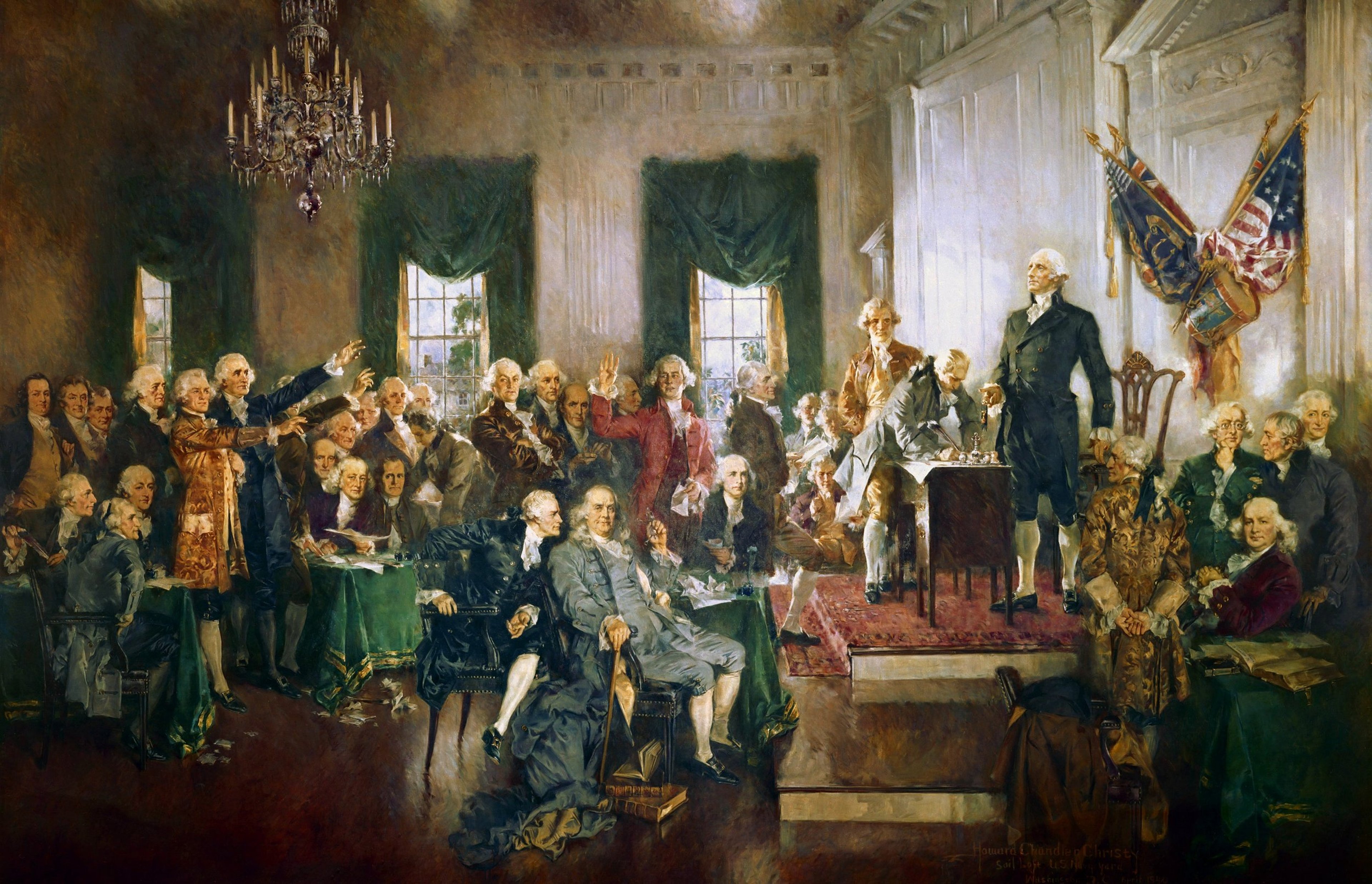
Signing of the Constitution of the United States.
The judiciary’s constant need to re-adjudicate and reinterpret the formal law is the consequence of this concealment, which sublimates the inherent indeterminacy and inner antagonism of law as such into the expert’s problem of fitting the many laws together into one coherent system. Those classes and factions of society whose power depends on the institutions of the formal law, such as the urban bourgeoisie in the European Middle Ages who used appeals to the supremacy of law in the struggle against lordship, begin to seek a solid, certain basis for this legal system. Formalist legal revolutionaries attempt to generate a law from pure reason, administrative justice, the will of the people, the laws of history, etc. But they ultimately cannot eliminate the indeterminacy of law, and each new system eventually erupts into new disputes over the nature of the public power and the meaning of the common good which it is supposed to oversee.
How can the generality of the formal law be reconciled with the generality of democracy? This reconciliation can never quite be consummated, but the idea that it can be is what forms the basis for the founding myths of states. The modern myth for this reconciliation is the ‘social contract.’ This concept holds that the state is a necessary form of association in order for organized society to be possible, and claims that the origin of the state lies in the rational consent of its various members who give up some share of their freedom in exchange for the state securing their life, liberty, property, or equality from their neighbors and foreign powers. The contract theory was not initially a democratic doctrine, but became so when its explanation for the basis of law became the popular myth of liberal and nationalist revolutionaries opposing the ancien régime in the 18th century, as they achieved the rule of their own bourgeois law. This social contract myth was well-fitted for a capitalist society in which the legal self-ownership and the products of one’s own labor is bound with the state’s guarantee that justice reigns in the realm of commerce, in which equivalent is exchanged for equivalent.
The social contract myth was one which foretold the emergence of a state founded not on the lineage of the ruler, but on the administrative power to lawfully manage the security, territory, and population of society. The contractual parties in this system must be rendered commensurable; they are reduced to countable, exchangeable units whose competing claims can be weighed, taxed, and administered in aggregate. These practices of quantification are the precondition for the basic units of modern representative government: the census, the tax roll, the electoral district. But the act of bureaucratically counting citizens always sets out with some ideological criteria for who will be counted, crafted in advance. Those without recognized legal or symbolic personhood—the enslaved, the undocumented, the disenfranchised—are left as instruments in the hands of those who do count, rendering them a multitude of raw material outside the decision-making contractors but inside the aggregating power of the administration.
The 1787 Three-Fifths Compromise crystallized this logic: enslaved people were counted as a fraction in the census not for their own sake, but to amplify the political weight of their enslavers in the representative body. The boundary between citizen and non-citizen is never a ready-made one. It is always drawn by the faction which currently dominates the administrative machinery of the state. It is drawn in such a way as to stabilize administrative procedure in the favor of the most powerful factions and their allies.
Yet, even within the charmed circle of recognized citizens, there is no unified will. The democratic subject is itself divided—by class, by geography, by faction. The decision of elections and referendums, made by a majority rule of votes, attempts to flatten these divisions into a single aggregate number that represents the best approximation of the interests of all. It simultaneously assumes a community interest to be measured and operates according to the reality of a common good which is already fractured and must be fixed in place by a quantitative approximation of an imaginary totality.
In practice, this favors the power of the greatest aggregators, which today are the titanic electoral machines that can count on the support of official institutions, generous monopoly capitalist donors, and the lobbies of foreign powers, all of whom shamelessly seek the favor of career politicians in the one realm of the state that is the most isolated from the electorate. The majority manufactured by an election and the media circus which attends it is not any unmediated “will of the people,” even if it gives the elected the mandate to govern over all. Majority rule is the arithmetical resolution of an ongoing struggle among the many parts of “the people.”
IIIB. Law as a fortress; law as a battleground
The constitution is the document by which the representatives of a “people” attempt to give the nation permanent form in an abstract-ideal state organization. The U.S. Constitution was, in its nascence, a compromise between rival propertied factions: the merchants and financiers established in the North, the plantation slaveowners gripping the South, and the land-speculating frontiersmen expanding everywhere. The three-fifths clause, the protection of the slave trade until 1808, and the provisions for the re-enslavement of runaway enslaved people were not aberrations but load-bearing pillars of the bourgeois liberal law that this constitution attempted to organize into a system.
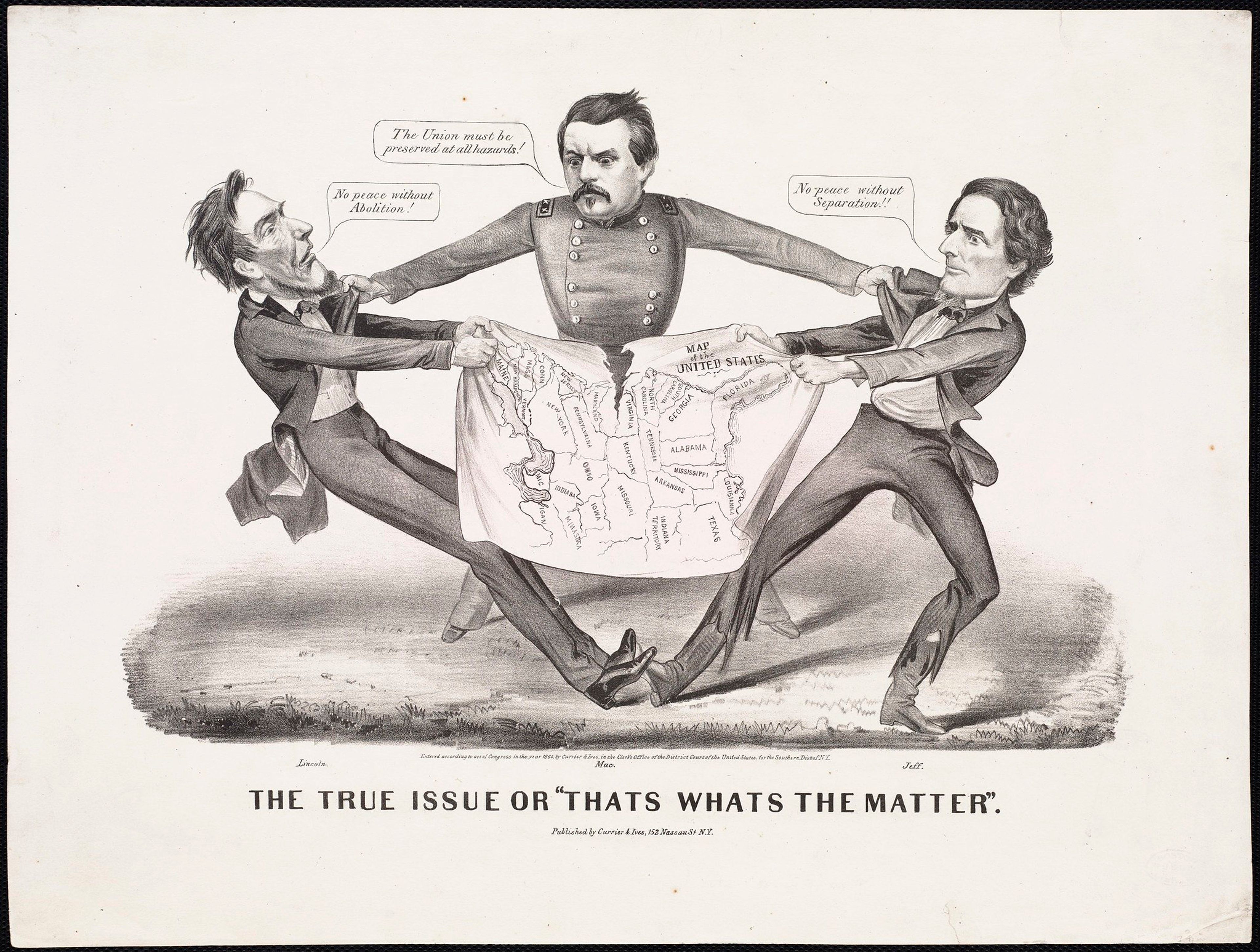
Torn in Two - political cartoon
What the Founders built was a constitutional architecture flexible enough to be wielded by whatever propertied minority could most effectively organize itself to capture its centers of power. Over the long arc of American history, through the alliance of the various ruling parties with the beneficiaries of brutal expansionism and wealth-seeking adventures, it has been the organized power of monopoly capital that has proven most adept at this organization. The counter-majoritarian features of the Senate, the Electoral College, and the power of judicial review, were originally designed to protect slaveowners from democratic interference. By the 20th century, these very same instruments became the ones with which gargantuan corporate institutions checked the redistributive impulses of the insurgent democratic masses, who organized against the monopolists in the movements of Populism, anarchism, socialism, and progressivism.
But this also bred a counter-tendency. The Civil War and Reconstruction had refounded the country on the law of free labor (free from both chattel slavery and possession of power over society’s wealth). In the hands of the masses, the demand for equality, enshrined in abstract form in the bourgeois Declaration of Independence, Constitution, and Reconstruction Amendments took on new life as a force of an ascendant democratic anti-monopoly law.
The outcomes of these struggles between monopoly and anti-monopoly forces were never decided in advance by the abstract, formal provisions of the American constitution. The gap between constitutional law as a narrowly specialist practice and democracy as a series of mass demands was itself the terrain upon which law was contested and reinterpreted. The intervention of the mass associations in the form of anti-monopoly regulations, against the arbitrary power of monopoly capital, required an ability to convert law into an actuality of practice.
Democracy in any vital sense requires not merely the periodic registration of aggregate preferences and prejudices in elections but the constantly renewing self-governance of an organized “people.” This requires securing free space and free time for coming together for the sake of deciding what our shared reality should be. In especially hostile conditions, this could take insurrectionary forms, as in the railway strike waves of the United States which began in the 1870s. The first general victories are those which accomplish some partial transformation of the operative law of society, such as when unions achieved recognition of their right to struggle and act against capitalists in the Wagner Act of 1935. As fresh air floods the space of mass politics, and some portion of the social wealth is won back from the monopolists, the oppositionists are able to take on more permanent forms to sustain their resistance over the years—popular assemblies, mass parties, and cooperative societies being the classic examples. The capacity to act collectively outside the routines of work and consumption, dictated by monopoly capitalist institutions, becomes not only a means, but an end for political associations. In their organization, these associations begin to take on the character of the law that they come together for the sake of, which in the 20th century was overwhelmingly the law of mass democracy as counterposed to monopoly.
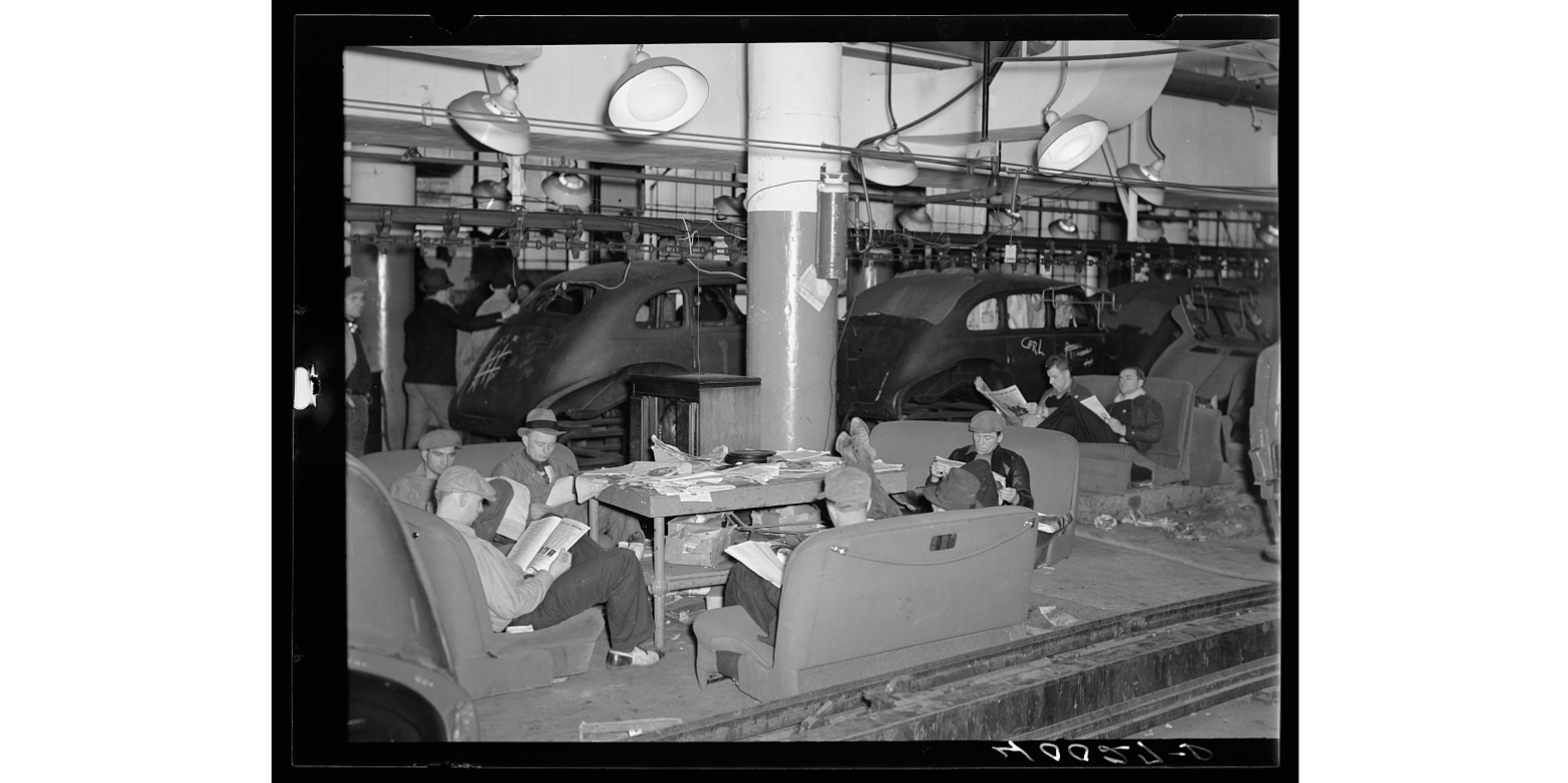
Sitdown strikers in the Fisher body plant factory number three. Flint, Michigan
Free space and time for mass politics can be secured legally, through the formal rights of freedom of association, assembly, and petition. But it can also be seized directly by illegal or semi-illegal means. Often, the latter is taken as a means to wrest the law away from monopoly powers, as in the wave of sit-down strikes that swept the industrial midwest in 1936 and 1937. During this massive workers’ movement, United Automobile Workers (UAW) strikers occupied the factories of General Motors, organized their own internal governments, and refused to vacate until union recognition, better pay, and limits to despotic management were granted. The same logic animates the encampment, the liberated zone, and the popular assembly, from the workers' councils of revolutionary Russia and Germany to Occupy Wall Street and the Gaza solidarity encampments of 2024. In each case, mass politics interrupts the specialist administration of formal law by constituting an alternative site of law which erupts in the interstices of society and the state, wresting the power to determine the common good from those who monopolize institutional administrative power.
The 20th century's great experiments in mass mobilization made the question of the common good unavoidable at the scale of entire societies. Total war, socialist revolution, and anti-colonial liberation movements each demanded that the private interests of individuals and classes be subordinated to historically urgent collective causes. The Russian Revolution of 1917 combined all of these elements into a new kind of state—albeit one which increasingly conflated the politically determined common good with the formally determined public interest of shared institutions and their bureaucratic administration. The Soviet Union organized enormous collective investments in industrialization, literacy, and public health on the premise that there was a social good which transcended the market calculus of individual accumulation.
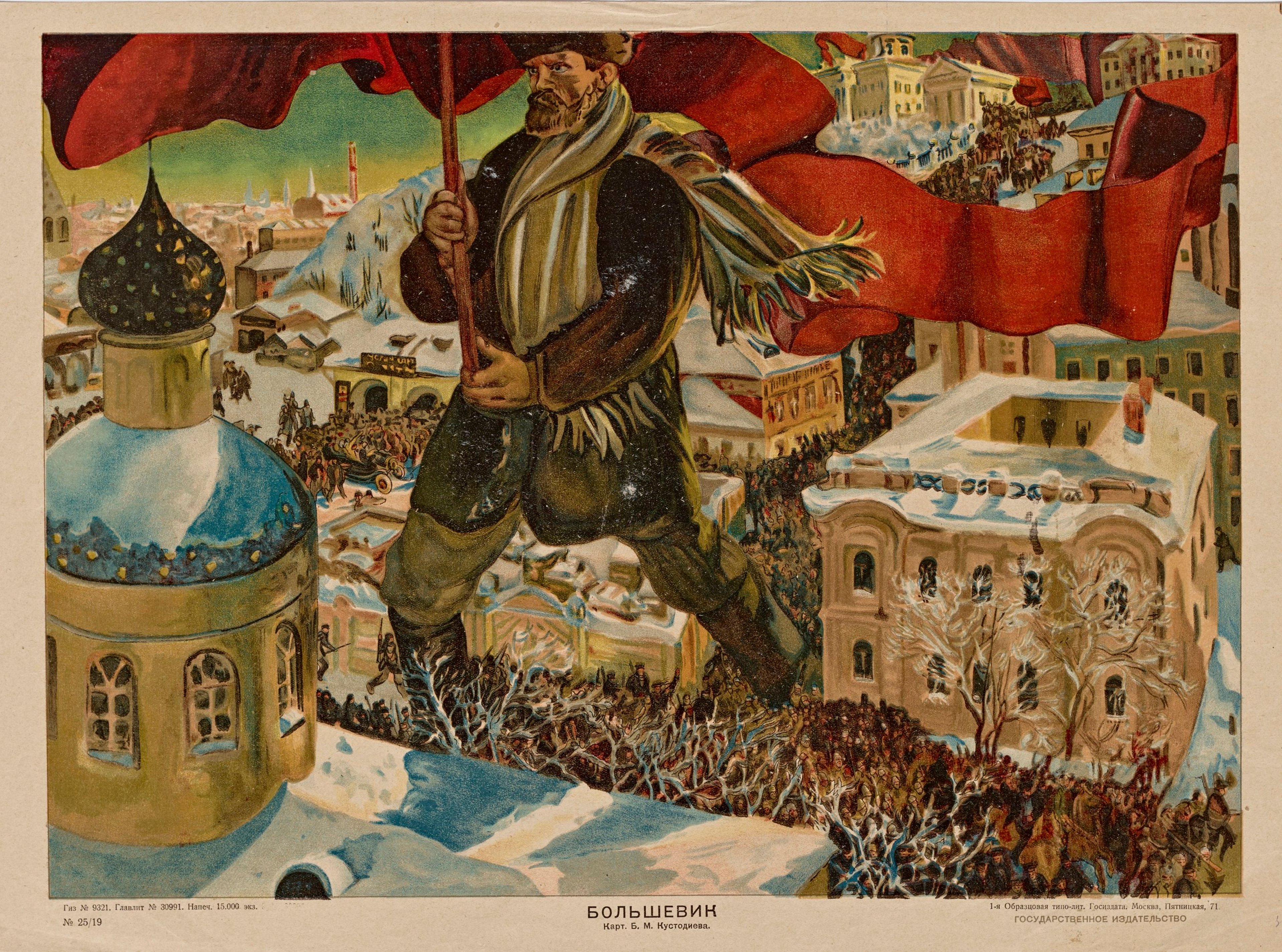
The Bolshevik - Boris Kustodiev
What the Soviet state failed to produce was a plural common good which all were personally invested in. This was not a problem stemming from communism as such, but of the total mobilization of society in the state, which is exhausted when common institution-building projects are completed or become unattainably distant. The same dilemma came to plague all mass societies of the 20th century, which experienced total mobilization in its various forms—the national-populism of the Mexican Revolution, Italian Fascism, German Nazism, American New Dealism, the People’s Republic of China…
The post-World War II settlement in the advanced capitalist countries managed the threat of revolutionary mass politics by outsourcing democracy. Drawing on the Keynesian economics which had grown into a global doctrine during the experiences of wartime total mobilization, bureaucrats and monopoly capitalists began to speak of the common good as a technical question concerning efficient management and strategic institution-building. The politically contested questions of the common good were repressed into technical problems to be resolved by a welfare capitalism managed by professional administrators, economists, and planners. The technocratic bargain held that the complexity of modern society was too great for direct democratic management and that only credentialed expertise could optimize the abstract variables of growth, stability, and welfare. Though they could not always bring themselves to acknowledge it, these criteria inherently concealed the profound questions of a new law.
Underlying the technocratic claim is a fantasy of mathematization: the idea that the social world, like the physical one, obeys regular laws discoverable by empirical science, and that political antagonism can therefore be replaced by purely evidence-based management. But the social system is not a machine whose behavior can be reliably predicted from its components. Rather, it is an antagonistic field shaped by the very decisions that purport to merely describe it, by the investments and disinvestments of millions of actors who respond to each other’s tactics strategically. It can be judged—evaluated on whether it serves the needs of those it organizes in accordance with its promises—but this judgment is irreducibly political, because it depends on whose needs count, who decides, and which law reigns. When the administered and the left-behind demanded inclusion and autonomy, then faced resistance to their self-organization, they revealed the class-factional nature of modern technocracy—and exposed its irrational underbelly.
The political continued to find new outlets each time a regime was shaken up by a coup, a revolution, or any other sea change. Populism began to emerge as a global return of the repressed democratic impulse, insisting that the common good could not be decided by experts on behalf of “the people,” but must instead be actively made by people themselves as a force and a passion intervening in history. The weakness of populism, however, was the insufficiency of any of its charismatic leaders to represent or sustain its impulse. The leaders promised certainty for victories that they could not always actually accomplish, because they themselves were situated in the same technocratically organized state apparatus that they vented mass frustrations against and wished to temper the attempts to smash it up into a fundamentally new terrain. Populists became a force of democracy, but democracy as will without law—as the direct expression of a sovereign people's rage against its enemies, unmediated by the independent ethical forms that convert popular energy into durable social self-organization. The force of charismatic authority, while it unites popular energies into one campaign, serves as an absolute impediment in the transformation of mass will into new law.
In the end, populist leaders like Gamal Abdel Nasser or Mao Zedong could not help but turn against the anti-technocratic modes of organization taken up by their followers, because they could not bear to see their movements outstrip them. Throughout the entire process of struggle, the popular offensive against technocratic organization had to navigate the twin deviations of charismatic authority and consumerist avariciousness, which threatened to limit or even disperse the force of total mobilization that they struggled to wrest away from institutional elites and direct for their own aims.
As the impoverished and racially oppressed peoples of the world elevated inclusion and autonomy into the law of a global struggle, they initiated a new era of pluralist democracy. In the United States, the pluralist offensive grew out of the frustration of working class Civil Rights activists with the compromises of the New Deal Democratic Party with racist whites. Inspired by internal critics of Civil Rights moralist pacifism and technocratic elitism, such as Ella Baker and Robert F. Williams, organizations like Student Nonviolent Coordinating Committee (SNCC) began to turn towards more confrontational direct actions against the established power structure. Coordinating on the principles of self-governance and self-defense, they sought to bring the Civil Rights struggle to a more generalized and assertive level in the form of Black Power. At the same time, Civil Rights-aligned left organizations like Students for a Democratic Society (SDS) grew into the New Left. The New Left of the 1960s and 1970s articulated one of the most expansive visions of democratic self-governance in American history: a plural, egalitarian democracy that would include those whom the New Deal settlement had excluded under the principles of guaranteed welfare and self-governing autonomy.
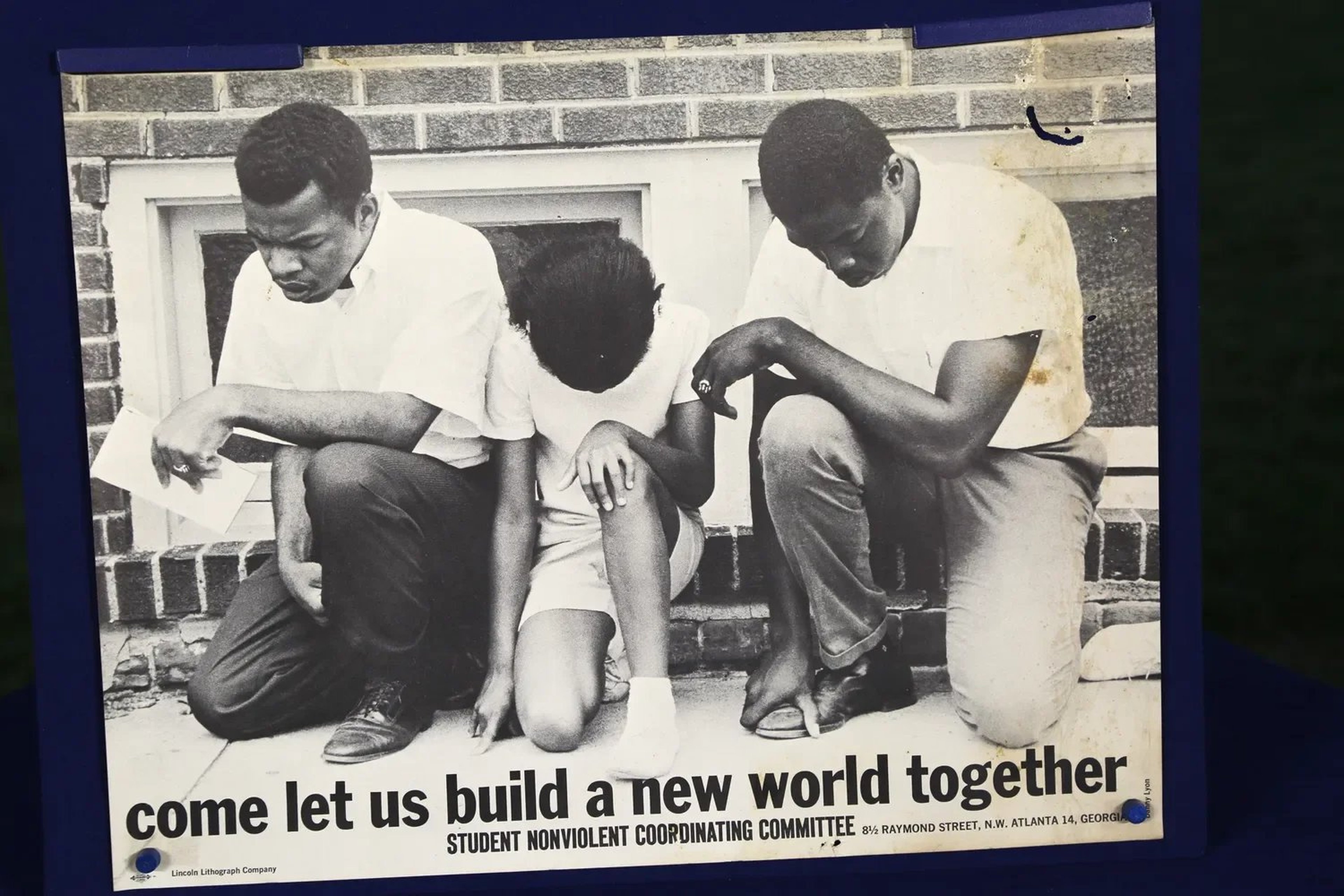
SNCC Civil Rights Poster
The movements of those years genuinely constituted new subjects of law, forcing the state to recognize rights that it had systematically denied—the right to be free from discrimination, the right to free love, the right to have your basic needs taken care of, the right to choose if you will have children, the right to publicly criticize and oppose public authority. But the rights revolution carried within it the seed of its own defeat in its actionist criteria of success as delivering immediately tangible results, usually the legal recognition of new rights. To secure the gains of the movements against the inevitable backlash, many activists turned to legal and professional institutions—the federal courts, the administrative agencies, the wealthy foundations, the nonprofit sector, social work—as the primary targets of struggle. This was always a law borrowed from elsewhere: a liberal technocratic law of procedural rights and institutional reform that the movements had not themselves built and did not control.
On the other hand, those activists who were willing to confront the repression of the state apparatus that had disproportionately fallen on themselves found themselves increasingly isolated from the mainstream of the left as it made this easy-victories turn. Activists like Black Panther Party member and prison organizer George Jackson influenced much of the language of the era (i.e., the description of the U.S. as a fascist empire) but were usually shut out from influencing the strategy of the national left organizations. The militants were left to adopt terror tactics, which grew increasingly desperate as their network of supporters dried up. The diversion of the two forms of actionism combined with the decline of the urban industrial centers, which had been hot points of struggle but now faced the existential crises of offshoring and hyperinflation. The movements of Black Power and the New Left withered until they were finally incapable of maintaining themselves as a distinct faction.
When the institutions turned to the new law of neoliberalism, as the Supreme Court slowly did from the mid-1970s onward, and as the Democratic Party did more decisively still under Jimmy Carter, there was no independent organizational base capable of defending the gains of the New Left from below. The War on Crime and the War on Drugs became means to smother the antagonism of the Left and throw the racially demonized surplus populations of the unemployed into fascistic prison systems to be forgotten. The rights won by mass action were progressively dissolved by elite counter-action, with the support of resentful consumerist and entrepreneurial masses, while the movements themselves had withered into professionalized advocacy organizations dependent on elite patronage. The law of inclusion and autonomy that the New Left briefly glimpsed was surrendered, in practice, to a deadening mode of organization—the technocratic law of managed recuperation—before it could take root as a new democracy.
Owing to their failure to achieve hegemony, the New Left could not elevate the new law into power. But the crises of the 1960s and 1970s themselves undermined the institutions of social democracy and created the urgent need for a new law. Neoliberal technocrats, businessmen, and celebrities offered the law of free enterprise as a much-needed solution to the stagnation of state-directed economic growth. Neoliberalism shifted the site of freedom in the law away from the determination of the common good and towards an individualized dreamland of personal responsibility and infinite consumer options. Neoliberalism did not merely shift economic policy, but dissolved the institutional premise of the common good as a public responsibility.
By privatizing public institutions, dismantling the social wage (those public benefits which had once been understood to maintain the maximum employment of society’s workers as productive forces), and reducing state administration to the imposition of peace through war against factions and the sponsorship of entrepreneurial enterprises, neoliberalism converted the collective wealth produced by the millions into the privatized playground of monopoly capitalists.
What remained of the rule of law was simplifying into an all-pervading conformity based on the reign of property, contract, and non-obligation. The law became a fortress behind which private power could entrench itself against the intervention of the poor, rather than a weapon by which democratic masses could impose their will on political life.
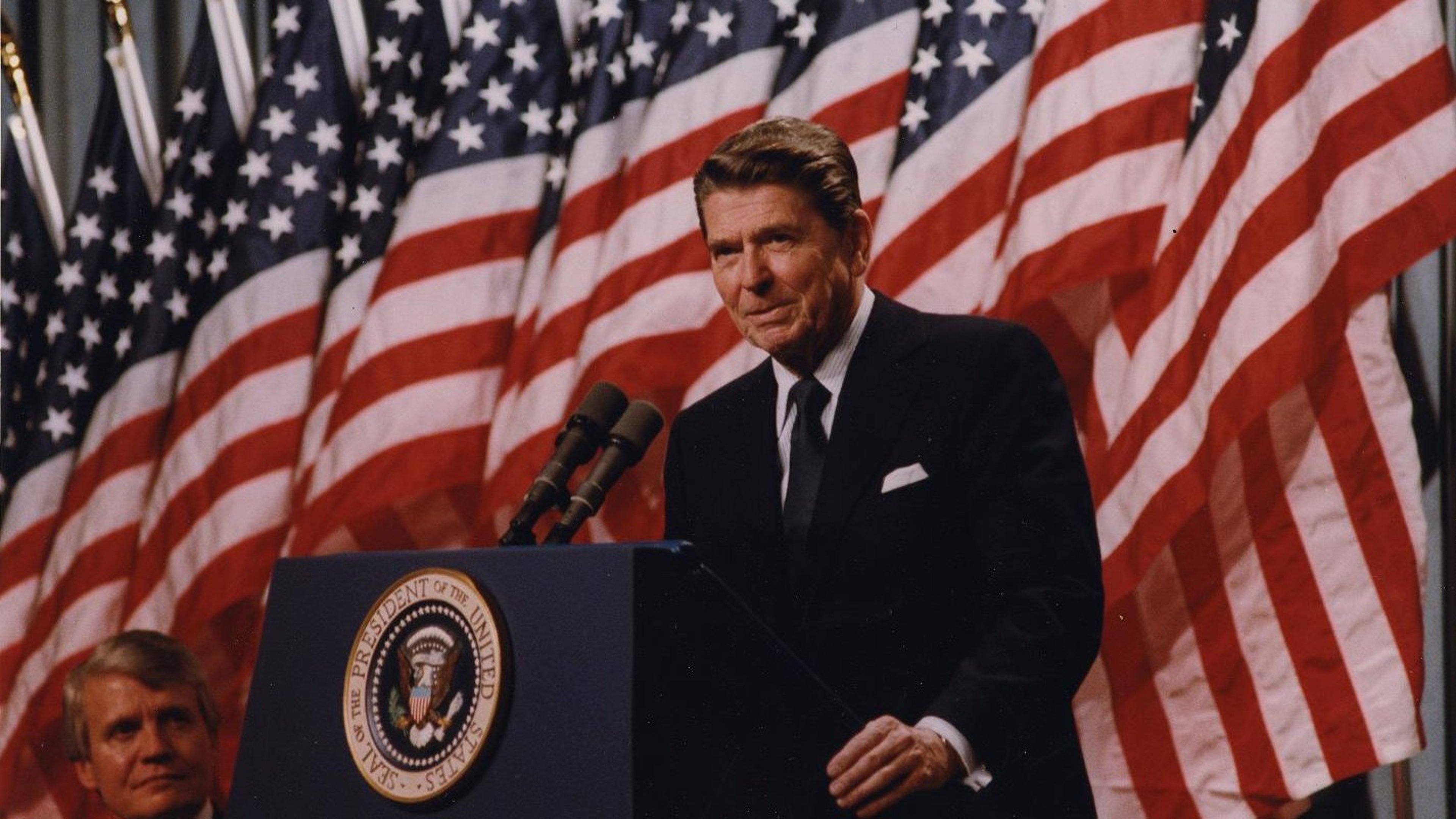
President Reagan in Minneapolis
IIIC. A voice with many faces
The ideological culture of neoliberalism celebrated the entrepreneur as the protagonist of democratic freedom. The entrepreneur was imagined as the individual who, through will, risk, and ingenuity, builds something from nothing and thereby earns the right to shape the world as they please. The social wage of the regulative welfare state, by contrast, was re-imagined as a fetter on progress rather than the guarantor of the common good that the New Deal had once treated it as. This mythology obscured the actual dynamics of modern capitalist competition, in which contracts between the state and monopolies secure an unfair advantage for some, and market competition is pursued with the hope to eliminate all competitors. Winners like Walmart or Amazon get to accumulate the capital, infrastructure, connections, and market leverage to crush or absorb their competitors.
The fall of the Soviet Union in 1991 and the initiation of endless Wars on Terror in the post-9/11 period compounded this erosion. The national security state normalized executive impunity and the suspension of individual rights, carving out vast zones of extralegal power while voluntary associations and their everyday concern with civic life atrophied from mass impotence, apathy, and blind faith. The formal law of democracy could be suspended in the name of a mythic crusade to endlessly secure the conditions for its rule from the forces of chaos. Interventions and regime change were supposed to somehow free “the people” of various enemy countries to practice democracy by providing them ready-made apparatuses and scripts to be trained in the exercise of. In truth, they served to spread the law of free enterprise in its most arbitrary and despotic forms.
Activism, meanwhile, lost its inner sense of law and was professionalized into a nonprofit-industrial complex. Organizations optimized for professional legal advocacy, grant-writing, and media attention-seeking rather than the patient work of facilitating and sustaining organized mass participation in self-governing associations. The U.S. Constitution, in this context, functioned primarily as a defensive tool for elected representatives and activists to invoke in attempts to slow the advance of the most egregious excesses exercised in the name of the law rather than used as a positive force of democracy. Today, as these defensive functions are being stripped away from law by an executive that openly disdains procedural constraints on its will, the limits of this constitutional liberalism are fully exposed. An imaginary shield, meekly held up like a sign of the cross to ward off an overwhelming evil, without any sword to accompany it and impose the rule of law on authorities, may be fit for one who only wishes to forget their suffering—but it is worth next to nothing for those who are driven by their cause. MAGA has learned the lesson on power implied in this distinction better than we have.
With the failure of the liberals and the near-absence of the left, the entrepreneurial myth was left to mutate into a new terrain of its own accord. Healthy competitive ambition, in any organization, requires a degree of identification with the organization itself—the willingness to see one's own fate as bound up with a collective project that exceeds any single participant, even if it concerns all of them. What the neoliberal law of free enterprise began to breed instead was a solipsistic conviction that every organization is the extension of the founder's will, that its legitimacy derives from his genius and thrift rather than from the mutual commitments of its members or the needs of those it claims to serve. The rise of the Epsteinian entrepreneur who does whatever must be done to succeed and does away with whatever fetters his unlimited power marks the limit of the law that once served as the deranged figure’s cradle.
Trump is the apotheosis of this entrepreneurial type in politics. He has proven capable of mobilizing mass resentment and channeling it through his own persona with extraordinary effectiveness. But he cannot convert this charismatic authority into a durable organizational form because he recognizes no horizon of law beyond his own will—not even any implicit law of the movement that brought him to power, which he shows little respect or appreciation for. Every institution he touches is subordinated to his personal interest, or, barring that, discarded altogether. What this produces is not a new law and corresponding political order, but a personalist regime sustained by a continuous performance of entrepreneurial dominance, inherently fragile because it has no foundation. His imaginary national enterprise, presented as an unlimited independent power that must be recovered from the unfair excesses of free trade through a revolution from above, fails to capture the masses because he does not include them as its agents. The recipe for total mobilization is lost to him, because the exhausted law of free enterprise that he now stretches and bends to his will cannot be reverse engineered into the organization of social forces that had once sustained the combined activity of the masses in the 20th century.
The concentration of power over social wealth in the hands of a few and the dispersion of masses into networks is the shore which all social movements crash and shatter on today. Electoral populism attempts to muster it through the unity of charismatic leaders, but it fails to convert it into a law which supersedes them. The elected instead merely tweak or stretch the entrepreneurial law of the neoliberal order, and, so, electoral forms of populism tend to fall apart with the bad fortunes of their elected faces. This is not to suggest that the left ought to adopt a decisionist stance, strategizing without any consideration for how to navigate constituencies and institutions on the road of victory. A willingness to transgress the norms of institutional duty, professional respectability, and the profit motive marks radicalism, but not yet the eruption of a new emancipatory revolution. Trump and his MAGA movement have flouted procedural constraints, defied academic expert consensus, and scandalized the technocratic managerial classes more thoroughly than any left politician in living memory. What this has produced is not emancipation or the birth of a new law but the reorganization of the technocratic neoliberal state into a simplified personal network of opportunistic plunder, imagined as a hard-won nationalist restoration wrested from globalists. Trump does genuinely attempt something democratic in a formal sense. He seeks to constitute a new “people,” albeit by decree, with the backing of secret police terrorism and concentration camps. MAGA has attempted to give a political form to mass resentment against neoliberal technocracy and the globalization of wealth, to name an enemy and mobilize an affective community against it. But the common good Trump articulates is, in substance, little more than the hegemony of petty elites and monopoly capitalists without any claim to the lawful universality of a new, shared political terrain that concerns everyone.
The transition from neoliberal free enterprise to Trumpian national enterprise does not relocate the center of gravity from the global market to a revived, domestic Fordism. It instead subsidizes opportunistic grifters by dismantling the institutions that they are shut out of and allowing unregulated speculative investments to run wild while simultaneously forcibly shuttering free trade with real estate wars and blindly deployed tariffs. There will be no return of widespread prosperity in this framework, which has instead overseen a rapid reduction in quality of life for most. The hopes of many voters in the 2024 election for an end to inflation, foreign wars, and mass immigration (which most ideologically interpreted as both a cause and a symptom of the growing precariousness of all) were misplaced.
In a situation in which administrators are failing to sustain any solid organization of society and its wealth, ready and able opposition factions have the opportunity to consolidate their own control over their political terrain. The same is true of the left, which can only take advantage of the situation by acting boldly against the monopolization of wealth and administrative power by a few. The passage from MAGA’s failing experiment in national enterprise to a genuine common good—one that subordinates monopoly power to the politically defined needs of the community—cannot be achieved from above, by decree. It must become a mass political project, and it can only achieve this by passing through the divide between state and society. Hope should not be located in the assumption of an automatic eruption of a new order, but in what begins as the survival alliances formed by those whom the state has abandoned, and which holds the promise of converting their solidarity into a new rule of law through the organization of their associations into a politically antagonistic opposition which is capable of fighting for the hegemony of that new law.
Liberalism in its present decadence has nothing more to offer us. Having exhausted its capacity to deliver any promised political reality to be shared by everyone, it survives primarily as a culture of procedural grievance—cataloguing the violations of norms, defending the rationally organized institutions from their irrational enemies, and insisting that the problem is not the system but the deviation from it. This naysaying posture is an expression of a deeper paralysis of imagination, a symptom of an inability to will a world into being and to act to achieve it. Today, liberal doctrine is lifeless, while impulsive nationalistic populism is incapable of achieving a lasting rationality as a system. This leaves the stage to a left which is too miniscule and professionalized to secure power in its present form of loose social clubs and tightly managed formal organizations. In order to achieve hegemony, the left must be willing to be unreasonable towards other factions, especially the decadent liberals, and prove itself capable of becoming a mass force of demands that sweeps aside technocracy and seizes what it wishes for just as boldly as MAGA has done for the past decade.
The left must refuse the terms that liberal technocrats set for what is politically possible and assert everywhere, according to the prospects of each situation, what must be made possible on the way to the common good. This is not a matter of capturing existing consultant-defined constituencies or of winning the endorsement of their pollster-established spokespersons. The Democratic Party's voter base, alongside its allies in the union bureaucracies and the nonprofit sector, are not raw material waiting to be pushed left into a new movement. They are the remnant organized forms of an exhausted political order. What shifts the terrain is not a better appeal to these structures but the emergence of a force that shatters the pieces and rearranges them into something else. This requires making demands that the system cannot absorb, building organizations that the system cannot co-opt, and sustaining the energy of mass politics through the cycles of defeat and renewal. MAGA achieved this by treating the Republican Party as little more than an instrument to be mercilessly bent to their movement’s will. Why can’t we learn from them and navigate all existing institutions similarly rather than allowing ourselves to be recuperated?
The recuperation of opposition movements by those they oppose does not merely stem from submission to an outside force. It also manifests where movements settle with the power of the old law by claiming that every concession made by the state is a victory for their cause and is therefore the same as their achieving some share of the institutional administrative power that stretches into all of society. In this ideology, a movement only becomes real from its concrete, calculable, and technocratically legible policy results. This technocratic prejudice, resulting from a weakness of mass participation in deciding the meaning of the common good, paradoxically reinforces the strength of charismatic authority. Every movement produces faces—leaders, martyrs, symbols—who become the points through which the energy of the masses is cathected into an object and made legible to the outsiders. The danger is that these faces, who are easily institutionalized with promises of long careers and prominent cabinet appointments, are mistaken for the voice itself. The institutions which amplify faces (media platforms, party structures, electoral campaigns) can simply capture such a celebrity-worshipping movement, which substitutes the faces of its representatives for its voice, by capturing its representatives. The movement's organization must therefore be strong enough, and the disjuncture between its forms of association and the established institutions wide enough, that no single representative can speak for it and thereby silence the voice of the whole with their own policy wonk drivel.
The voice must always exceed the face; the movement must always be more than its most visible leaders. Despite Trump's enormous personal centrality to MAGA, the movement he leads has proven capable of surviving betrayals, legal defeats, and policy failures that would have destroyed any sectarian personality cult. It did so by drawing on a diffuse reservoir of resentment and solidarity organized through local personal networks, alternative media ecosystems, and virtual affective communities that no single institution controls. The left needs an analogously antagonistic partisanship, drawing on a depth of connection between people that is not dependent on any single node, and a culture of movement commitment strong enough to hold its own spokespeople accountable to the people they claim to represent rather than the institutions that amplify them. That means we must never subordinate ourselves to those whom we cannot control; and those who seek our alliance, we must treat with the utmost suspicion. MAGA accomplished something like this with its attitude towards Congress before hitting a wall in the exhaustion of its own central charismatic authority. The dissension of figures like Marjorie Taylor-Green and Nick Fuentes indicates that they are now facing almost the exact same dilemma as we are, but inverted. The question of who will work things out and re-emerge first is still open.
The difference between us and them is that we are still capable of becoming the force of a new law in our being consistently oppositional, while their opposition is driven by blind impulse. Forget about the monopoly capitalist nonsense about the despondent poor and the left as forces of lawlessness. Consider instead what our recent history has demonstrated about the disjuncture between state and society. The rebellions of Black Power in the late 1960s, the Rodney King riots in 1992, the Ferguson uprising in 2014, the mass insurrection of summer 2020, and the street resistance to ICE in Minneapolis and Los Angeles in 2025 each sought to make the same fundamental point: that the American state is less and less a force of law or a guarantor of the common good, and more and more a parasitic force of waste organized for the management and disposal of surplus populations that it has designated as expendable. The demand to abolish this overgrown police apparatus is not an abstraction conjured by intellectuals, but arises from the concrete daily experience of communities for whom the police are an occupying power rather than a public service. The revolts against this power have a reach that extends beyond the national frame—in 2024, student encampments began to seek some alliance between the nascent American left with Palestinian resistance against Zionist genocide. If we manage to achieve the independence of a mass opposition movement to the present lawlessness of the state, the admittedly weak oppositional internationalism can be transformed into the first step in a global offensive against the regimes of blind waste and destruction which reign today and for the rule of the law of the common good.
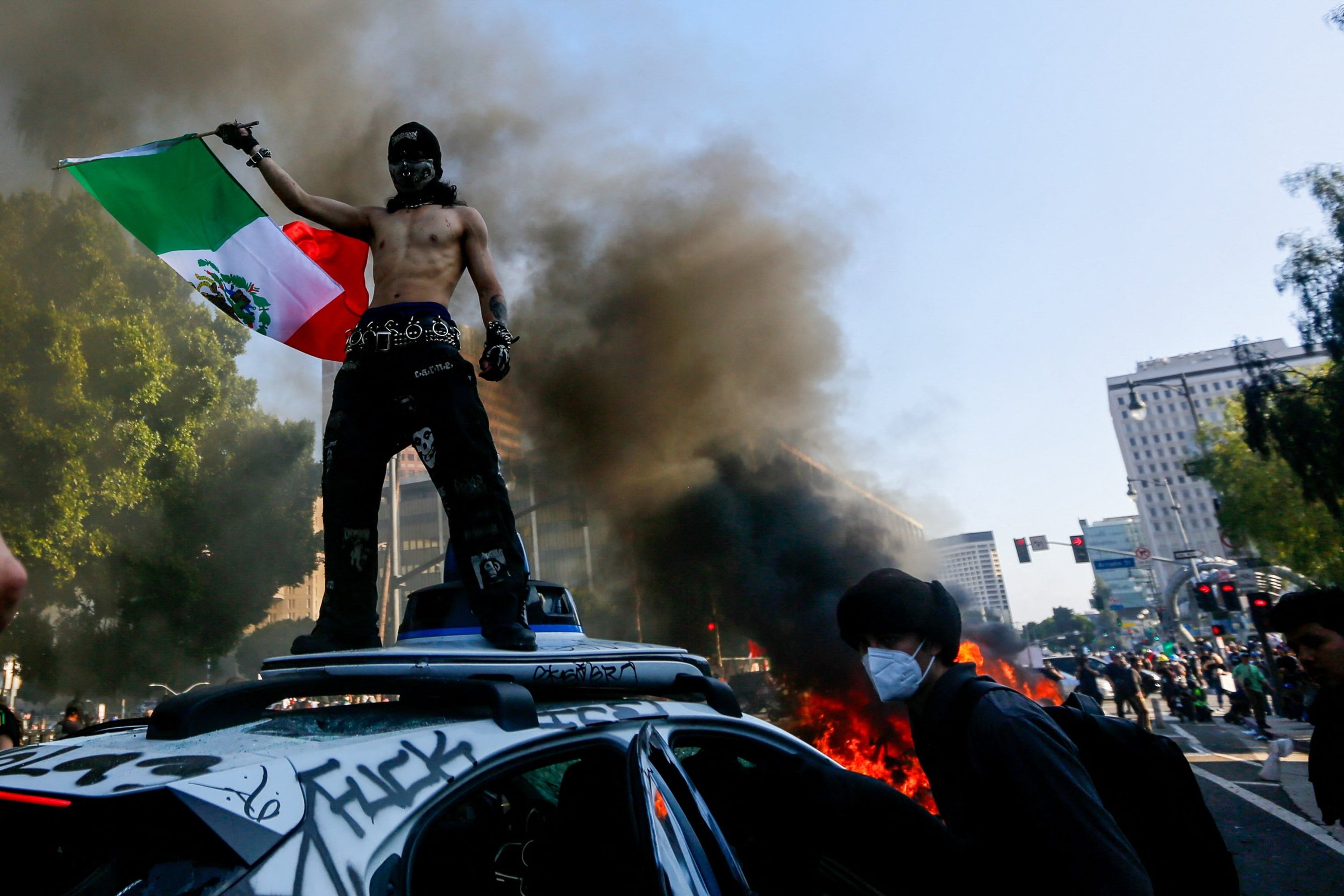
Protestor Holds Up A Mexican Flag As Burning Cars Line The Street
Insurrections are not soap bubbles. They leave behind organizational residues, altered political cultures, shared memories of collective efforts (however isolated from each other) in the long arc of struggle across multiple cycles, and new generations of people who have learned that they can act for themselves. Nevertheless, we should resist the temptation to read into every street rebellion whatever inner law that we wish to find vindicated in the world. The 2020 uprising encompassed both the most expansive abolitionist efforts in decades and also a backlash that strengthened the draconian crime panic crackdowns across the country. The Party of Order drew on the patronage of monopolist elites and the anxiety of the decadent bourgeois-aligned weaklings who wanted to return to the same old routine of working and consuming. The Party of Anarchy dispersed into isolated activist efforts and small acts of criminalized disobedience. The question of how rebellious energy is converted into durable demands, and those demands into a hegemonic force capable of imposing a new law of social organization, is not answered by an insurrection itself. It can be answered, or left unanswered in failure, by the organizational continuity of struggle that accompanies and outlasts it.
The struggle to instate the rule of the law of the common good is what we must represent, as opposed to the cannibalistic law of free enterprise and the lawless project of national enterprise. Our immediate task is to seize hold of anything which might provide the resources for free time and space, form networks of associations with each other wherever possible, find the capacity to turn our "NO" into a vision in a struggle for demands, and learn to transform that vision into an organized political will which is willing to mercilessly force the dictates of its own law on monopoly power and any of the other factions of society that draw their power from it. Such a movement is already nascent—we must develop it to its maximum for it to become a party.
Part IV. From the common good to communism?
IVA. Planting the seeds of the good in burnt ground
Every political project must emerge from the bowels of the unconscious, as a compulsion, before it becomes a cause. Every conviction is a conscious articulation of unconscious desire as a demand. Every political faction is held together not only by shared interests and organizational ties but by a shared imaginary—an idea of the world as it might be, which must be wrenched forth from reality in struggle against its enemies. The syndicalist philosopher Georges Sorel said of these mobilizing ideas that “men who are participating in great social movements always picture their coming action in the form of images of battle in which their cause is certain to triumph.”[11] His well-known example was that of the myth of the general strike, where the proletariat would do away with the capitalists by refusing to work for them any longer. Writing in the heat of industrial class war at the sunrise of the 20th century, Sorel emphasized the irrational affective significance of these myths. Today, in a time suffering from a drought of mass politics, we might rather focus on the fact that the utopia sought by the realist strategy of every party is a virtual horizon which the strategy aims to reach, converting it into a shared reality.
This virtuality is not the opposite of strategic realism but its precondition: without any sense of what kind of world we are ultimately working towards, there is no measure by which to assess whether our immediate tactics are bringing us closer to or further from the ultimate goal. Even the most pragmatically hardheaded assessment of what is possible in the present tacitly sets out in its evaluation with some sense of what can and should be sought out. Factions are not made up merely of their leaders, their programs, their organizational charts, or their membership lists. They are made up of a shared sense of obligation to something that does not yet exist—a common future that compels collective action in the present. This solidarity in the virtual realm is what allows factions to endure defeats, absorb internal disputes, and keep the force of their shared will from dissipating into the routine management of whatever arrangement of things is already given in the present.
In the 20th century, countless Marxists rested their claim to the inevitability of communism on their conviction that they had gained insight into the laws of reality and could work out the route to communism in an objective plan of action. Among other critics, Laclau and Mouffe offered a necessary corrective to that belief: “Our thesis is that antagonisms are not objective relations, but relations which reveal the limits of all objectivity. Society is constituted around these limits, and they are antagonistic limits.”[12] Laclau and Mouffe's account of hegemony established a crucial theoretical point: there is no closed social totality, and, thus, no objective determination of what the common good means that can be read out of social structure independently of the mythic virtual horizon of political antagonism. Every claim to represent the universal is a particular claim that never supersedes its particularity, and hegemony is the process by which a particular group temporarily stabilizes this representation by forming a chain of equivalences between partial demands.
We should accept this limit to objectivity as strategically significant. But the problem of law and ethics, of what binds the members of a community to each other and to the terms of their association, and the historical terrain that all parties struggle over, cannot be reduced to the semiotically empty logic of hegemonic articulation alone.
Ernesto Laclau and Chantal Mouffe
The modern demand for the subordination of the state to society—the insistence that the political forms through which power is exercised must be answerable to the needs of those they organize, and in the final analysis, can and should be cast away when they impede the purpose—is not simply one more articulable demand among others. It expresses an ethical horizon within which the whole present contest over hegemony takes place. To overcome mere legal formalism, the left must insist that the rule of the law of the common good is not only a procedural achievement but a substantive one. A law which does not promise to secure the conditions for a good life for all those subject to it, whatever they might determine that good to mean, fails to link each good in the political good. It is not yet law in the deepest sense, but remains the administrative code of a particular hegemony.
The good is the name for what every human association ultimately reaches toward as its virtual horizon. It is a condition in which needs are met, excess energy is disposed of creatively rather than surrendered to enemy forces or carelessness, and life takes on the shape that it wills as right for itself. In the opening of Genesis, after each act of creation, God surveys what has come into being and declares it good. Not merely functional or orderly, but good, which is to say worthy of existence for itself—lawful. Though at least one narrative in Genesis would have it otherwise, each act of creation is not actually ex nihilo, but instead a bringing-to-form of a preexisting chaos into a willed and determined form. Creation is made possible by a lack or nothingness in each determined thing, which is also the excessive fullness of undisposed potential beyond each pre-existing form.
The good is not the imposition of an abstract ideal as a measure to whip passive matter into shape. It is the evocation of the best conduct that a situation's latent energies make possible for the many, who will it as their own good and recognize it as the good of each other. This form of creation is also the structure of any free political association. It does not create its members from nothing, rebirthing them absolutely anew as units of itself. It finds them already formed by needs, capacities, and histories, by wounds and by desires. Drawing on their inner sense of law, it offers them a form—a shared project, a common cause—in which those needs can be met and those energies can find expression rather than stagnation or exploitation. The good is therefore not a blueprint or a final state but simultaneously a force and a law. It is what draws people together and gives their association its ethical reason for existing. It is always more than what has already been achieved, always immanent in what is already present without ever being a finally achieved presence, and it unites the many in one and is the one that has room for many.
Though the good gathers many together in common, it can never rule out antagonism. Every vision of the good must engage in antagonism against opposing parties to some degree, because the height of the stakes do not allow brokering and compromise alone to work out the nature of the good. Every faction must truly believe that their good is better for everyone involved in it than all of the competing factional goods. This is not to say that their good must actually be shared by everyone to lay claim to an ethical totality—advocates of chattel slavery like Thomas Carlyle and George Fitzhugh argued that it was good for every party, while those who resisted enslavement clearly did not think so.
While this talk about the good may sound highly abstract, it has a clear significance for our own practice of politics. Any movement for the law of the common good today would have to treat representatives as tools, not because we hate them, but because the stakes of the struggle and the weight of their own claim to authority compel us to hold them to a strict, even impossible conduct. Anyone who wishes to decide what will be done with the common must justify their use of it to the whole, but each must also be left to their own affair for the good to be truly their own good as well. When a few possess everything and the majority have little stake in anything, having become accustomed to being done wrong, the common ends up reduced to a hunting ground for caprice and destruction. Modern ruling class Epsteinism, which seeks to push everything to its limits, engaging in bored cruelty in search of some reality at the outer extent of total power, is the product of a world where the powerful monopolists have neither need nor compulsion to care for any notion of the good at all—not even their own good, but instead their convenience.

Jeffrey Epstein with Bill Gates
21st century monopoly capitalism, which is organized by gangs instead of institutions, has achieved an arbitrary naked power that leaves individuals incapable of acting lawfully. They may act within their roles, performing the social functions expected of them by their immediate superiors, but they do not do so in the fulfillment of any law. This is the greater significance of the long slippage into fascism that liberal democracy has tended towards since the 20th century. Writing of the reality of Nazi Germany’s corporatism for everyday people, legal theorist Franz L. Neumann said:
This atomisation and synchronisation of all social groups, this abolition of every democratic principle within corporations, and this supersession by the principle of leadership, leads to the complete atomisation of society, and therefore enables the State to control the individual effectively. [13]
Neumann was describing a very different sort of state than any that exists today, but the effect on the distribution of power is familiar to anyone who has tried to act against the decentralized yet highly concentrated power of market forces today. Total control and total victory may be achieved in an atomizing system, but not lawfulness. Neumann would say that there is no state machinery in such a system, because no systemic rationality, but rather only untrammeled gangsterism. There is no reason for the system’s existence. Its power elite feels no need to justify itself to others. They simply do whatever they wish, and, without any inner harmony to bind society’s antagonisms together onto a common terrain, it decays into mutual hostility unlimited by any ethics.
The formal commitments to rule of law, democratic accountability, and public welfare that once provided ideological cover for monopoly capitalism have been stripped away under Trump with remarkable speed. What Trump's attempt at reform by decree has revealed is that the system's ethical commitments were always thinner than they appeared, and yet, at the same time, that the illusion of neutrality still served as a force of cohesion, under the framework of which a majority could make peace with each other. The institutions of liberal governance were not independent expressions of a shared common good but instruments of a particular form of domination which nevertheless retained some minimal responsiveness to popular pressure as long as that pressure remained credible according to the criteria set by institutions. The crisis of the 2008 global financial recession threw the neutrality of the old liberal law and its institutions into question without unleashing a new law in its place. As the relevance and legitimacy of the institutions whittled away, and society grew increasingly apathetic towards the affairs of the state, the basic capitalist forces of liberalism were left without any ethical framework.
In 2020, the global crisis set off by the COVID-19 pandemic created the conditions for the tensions provoked by growing unemployment and police terrorization of racialized surplus populations to spark into a general social movement. The riots and protests set off by Minneapolis police officer Derek Chauvin’s murder of George Floyd failed to elevate the abolitionist law of the common good imagined by some activists, but the ethical laziness of the attempts made by institutional elites to recuperate their demands did expose how empty in substance the apparent lawfulness of the modern state actually is. In this vacuum, the looting and burning of stores, the occupation of public buildings, and the general disengagement from work are all, in their different registers, attempts to directly appropriate wealth, space, and political power without passing through representative elites (the elected representatives, the bureaucrats, the owners, the influencers) whose management of access to these things constitutes the everyday operation of domination. These insurrections are imperfect, partial, and often self-limiting acts, marked off by the monopolist elite from politics through the hysterical discourse of criminality, but all of them express a real political logic: the refusal to wait for the common good to be cared for by those whose authority depends on monopolizing social wealth and political power.
After witnessing the disobedient and despondent mood that masses of the propertyless had entered after the 2020 crisis, monopoly capitalists like Jeff Bezos and Mark Zuckerberg realized that they needed to clear away the last institutionalized remnants of the old liberal law in order to reassert total control. Silicon Valley capitalists have begun to openly declare their intention to use speculative investments in Large Language Models (LLMs) and data centers to supersede the need for human labor and even overcome humanity itself. While this is a delusional mythology that treats circulation emancipated from production as a Last Judgement and which does not actually square with the main usages of LLMs—reducing the employment of expensive professionals, streamlining the production of advertising, and facilitating a more rapid circulation of commodities—it reveals a total disinvestment in the rule of law. The monopolists have not not bothered to sponsor a new law, because they assume that all they need is the strong arm of Trump’s executive power to crush their enemies and offer them a cut of any imperial spoils he might steal. Trump, in turn, has expected the monopoly capitalists to put in far more effort in supporting his national enterprise reform project than they actually have provided. With both overestimating the other, and neither willing to actually build new institutions on the basis of a new law, we are entering a juncture in which populism and the rule of law might find a cause for alliance.
The energy of everyday revolt, marked off as mere criminality, and the force of organized populism, dismissed as blind impulse, can only fuse into a new social reason if both join in the process of formulating a new law—the law of the common good. The underground and the aboveground, the illegal direct actions and the legal mass organizations, must share a common ethical horizon if they are to reinforce rather than undermine each other. This shared horizon is not a policy platform. The demand to “tax the rich" is far from enough–not because redistribution is unimportant, but because a tax proposal, however radical in its ambitions, remains a demand addressed to the existing power elite to play their role and give their fair share rather than a declaration that we will do everything in our power to achieve hegemony and liquidate them.
To make a new law operative—to give it authority in the actual organization of daily life, not merely as a declared intention—requires a movement-force from outside the existing institutional order. It can only be impelled by masses that assert their own organizational authority against the claims of the established powers and their expectation that we grovel before them. Today this force is dispersed across a thousand partial refusals that do not yet know their own collective name or act as the force of a new law. The question of whether activists can stand in for the common—can claim, in advance of the actual consolidation of mass power, to speak as substitutes for the movement—is a sectarian deviation. No professional advocacy, no matter how militant, can substitute for the organized power of the many—though political cadres might play their part in striking out at decisive points to win fresh air, free time, and free space for mass politics. What activists can do in the present is facilitate the conditions under which the dispersed partial refusals can consolidate their independence by experimenting in the organizational forms, the cultural discourses, and the strategic intelligence that allow partial struggles to meet together, recognize what they have in common with each other, and build something shared from their encounter.
The radicalization of populism, its development from an emotive community of resentment bound together behind a charismatic authority into a self-governing movement of the common good, requires the liberation of the chain of equivalences from the representative faces that currently anchor it. The populist "NO" must be converted into a positive ethical affirmation of social reason become social force. The language of this ethical populism will not have to be entirely discursive. Prominent faces will have their part to play in this transformation. Those martyrs who have paid with their wellbeing, and even their lives, for their efforts to live by a new law in a world organized by the old one are not merely commemorated sentimentally by a movement. They are vindicated by its successes in the dismantling of the world that mutilated them.
The red flag of communism is a symbol of the blood of the martyrs returned as a mass force of change, the dead redeemed by the actions of the living. Every new law, until it achieves hegemony, is the law of a faction struggling to make its particular reason the universal one. The dictatorship of any class is the process by which a particular interest imposes itself as the general interest, but it is only the modern struggle of the propertyless against the monopolization of titanic social wealth that might end the condition of class rule as such. The ascendancy of a red flag in a socialist revolution marks the conversion of the faces and lives of these martyrs into the vignettes of a force that had such strength that its advocates were willing to die so they could know for certain that they would be vindicated.
IVB. Us against monopoly power
The modern struggle for the law of the common good is a struggle against the most capricious monopoly power in history. The common good can only take on material life through the class struggle against the concentrated private power that organizes the conditions of everyone's existence. The enormous productive forces that human cooperation and ingenuity have assembled are daily directed not toward the satisfaction of human needs and the common good, politically determined, but toward the perpetuation of private accumulation and waste in luxury and military destruction.
The liberation of wealth from monopoly power and its reorientation toward the cooperatively determined needs of a self-governing association is the material content of what the law of the common good must mean. It will have to begin now with a mass democratic populist revolt against cannibalistic monopoly power and its feckless technocratic accomplices.
The rule of the law of the common good would first mean the absolute limitation of monopoly power under the authority of the demos—the many, organized as the self-governing political community of “the people.” But "the people" cannot be defined solely by who it identifies as its enemies. A politics organized purely around the distinction between friend and enemy tends toward the closure of the people around a single leader or party who claims to embody it, and toward the exclusion of every internal difference as a potential enemy fifth column. A genuine common good cannot be secured on these terms, because a “people” that knows itself only through what it opposes has no positive account of what it is trying to achieve. The implementation of the law of the common good must be accomplished not only by executive measures, but an everyday actuality of justice and virtue, only made possible in a form of social life in which people administer their shared conditions of existence and find in that administration the basis for their own fuller development and ethical affirmation. The movement which seeks to install this law must itself be animated by it, organizing its own internal life as the agent of the law. The struggle for the common good is not only a struggle against unaccountable power and ideological misrepresentation, but a struggle to live differently, to constitute forms of association in which the powers currently monopolized by capital and the administrative state begin to be exercised by and for those who have been rendered powerless within the present order.
The implementation of a new law does not wait for executive or legislative power to be fully transferred to a new political party. It begins wherever people organize themselves in accordance with the law they intend for the world, refusing the authority of the law they oppose and building the authority of the new law. The greatest example of this in American history is the abolitionist movement and the network of people who facilitated the escape of people from their enslavers. Long before the Civil War ended slavery by law, these escapees were already struggling to live outside and against the system’s terms. The maroon communities—those self-governing settlements of escaped enslaved people dwelling in the isolated mountains and swamps of the Americas—were not merely zones of refuge but practical experiments in a different social order organized not by the right of ownership over life but by the mutual recognition of freedom. They were not simple prefigurations of any universal social organization to be simply scaled up, and they formed alliances with various political powers from the world of enslavers according to geopolitical expediency, but their very existence was a direct means of transforming the terrain of politics. What we must learn from these past struggles to elevate a new law is the need to always treat our political interventions on the terrain organized under the old law as directed beyond it.
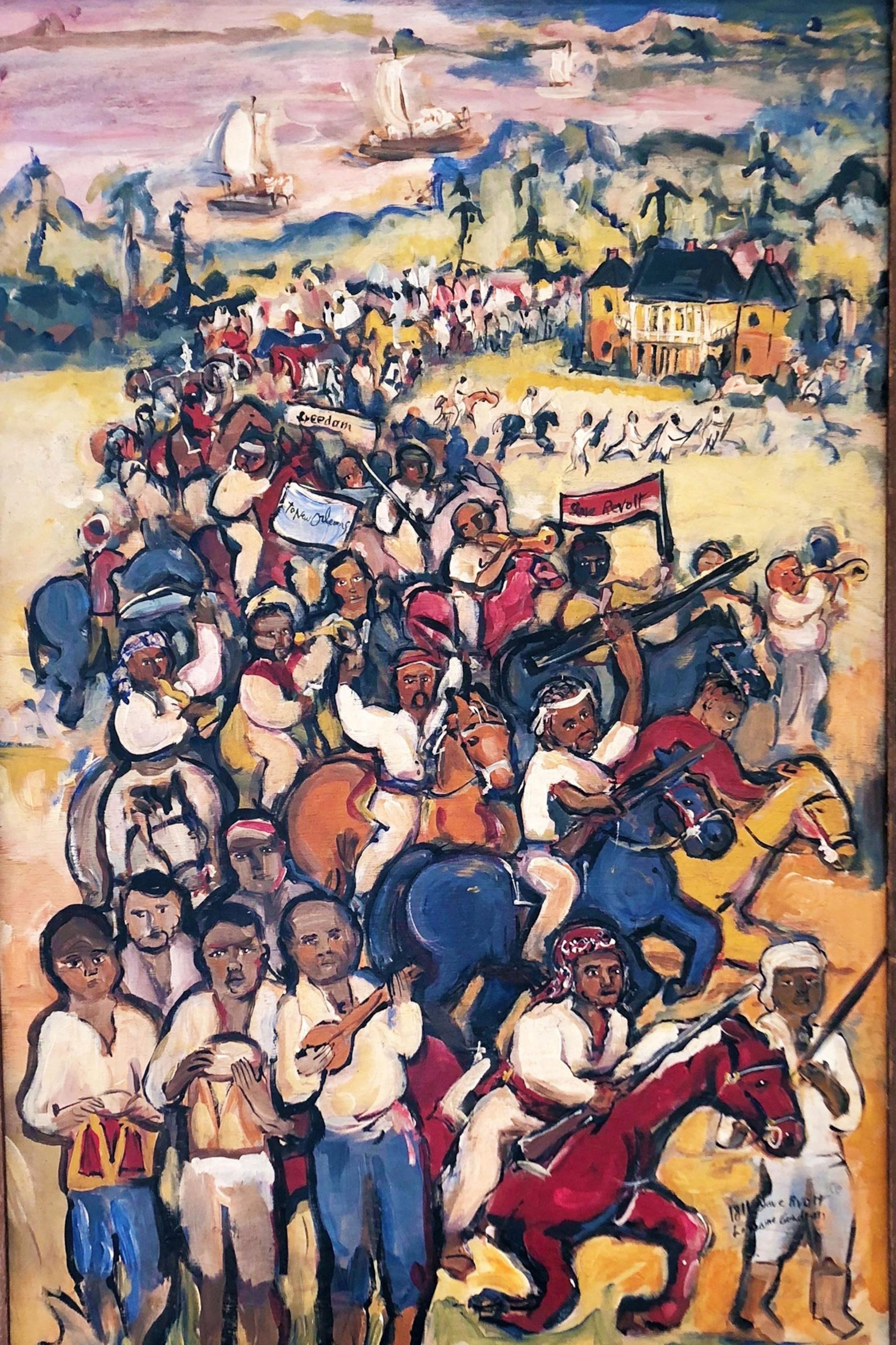
1811 Slave Revolt
For a revolutionary movement, electoral and parliamentary politics must always remain a means for extra-parliamentary purposes. The legislature is not society as such, but society within the state. To treat the legislature as the high point of all struggle is to imagine that the face of a thing is identical to the thing as a whole. The movement for the common good ought to use the legislature as mere means, always dwelling at some distance from the state and within the disjuncture between society and the state. The movement should be thought of as the organism or assemblage of organisms, while the parliamentary fraction should be considered merely one organ, useful when it advances the movement's purposes, to be disciplined or abandoned when it substitutes its own career interests for those purposes. The real site of the common good's development is not the legislature but the associative life of civil society—the rank-and-file unions, neighborhood associations, mutual aid networks, tenant organizations, community centers, communication networks, and commons of every kind through which people learn to govern themselves, work together on a common project, and do good by each other. In the long run, this education in self-governance is the only means for the maximum reduction of the deadening administrative machinery.
Every advance of a new law creates the conditions for its recuperation into little more than an appendix to the old law. The crystallization of a movement into leaders and institutions is unavoidable. This is what makes a movement comprehensible and organizable. Yet, it also also creates central points in the movement that can be sutured to the old leaders and institutions through interpersonal alliances that shift the momentum of these nodes away from their movement. The recuperated crystals become means to co-opt the energy of the movement back into the circuits of the old law, stripping it of its subversive content and reinvesting it into the system—perhaps even injecting new life into it and using it to strengthen its own ability to maintain itself.
There is a long history of the left merely developing new techniques of domination for use within the established system: the investment of abolitionists in the apprenticeship system, communists in technocratic planning, feminists in criminal law… When the movement-energy begins to be monopolized by its crystals, whether they are prominent leaders or policy wonk projects, the movement should redirect its efforts and destroy the recuperative function however possible. This may look like divestment of energy from the node, demonstrating that the movement’s goals are better pursued elsewhere, or even overidentification with it, radicalizing the demand tied to the node into one that demands decisive independent action (i.e., transforming the affective significance of “tax the rich” into expropriating monopoly capital).
This is not to discount the need for a movement to always seek the conversion of demands into law where hegemony can be achieved. Such a conversion depends on an independent mass force placing pressure on the old law and forcing it to recognize the power of the new law in its desperate efforts to hold the old terrain together. This was the significance of the 8 hour law, which recognized the working class’s right to be something other than a source of capital, and, today, it would be the significance of any law that helps wrest free time and space from the dictates of monopoly capital as a first step in the general ascendancy of a new law.
The left today should be understood as a broad association of movements and tendencies held together by a common commitment to the law of the common good against monopoly power. This rising pluralist left cannot be enclosed in any single organization or represented by any single political formation without losing the excess—the semiotic and organizational slippage—that is the source of independent vitality and innovative force. The left is always more than any of its representations, and it must preserve this excess as a source of its strength rather than treating it as a problem of discipline to be solved with boring conformity.
What communism names, within this left, is not a final utopia to be achieved in which all contradictions will be abolished, but the virtual horizon toward which the rule of the common good ultimately points. It is a society organized by the law that each should give to the common according to their own ability and each should receive back from the common according to their own needs. This is the rule of a law which does not act as a predetermined yardstick for all—but as a framework for the many to seek their own good in the good of all.
[1] Alexis de Tocqueville, Democracy in America, 7th ed., trans. Henry Reeve (Edward Walker, 1847), p. 332.
[2] Henry David Thoreau, “Resistance to Civil Government,” in Aesthetic Papers, ed. Elizabeth Peabody (G.P. Putnam, 1849), p. 198.
[3] Martin Luther King Jr., “The Other America,” Stanford University, April 14, 1967, rev.com, https://www.rev.com/transcripts/the-other-america-speech-transcript-martin-luther-king-jr.
[4] James Boggs, The American Revolution: Pages from a Negro Worker’s Notebook (Monthly Review Press, 1963), p. 37.
[5] Ernesto Laclau, “Populism: What’s in a Name,” in Populism and the Mirror of Democracy, ed. Francisco Panizza (Verso Books, 2005), p. 34.
[6] Ernesto Laclau and Chantal Mouffe, Hegemony and Socialist Strategy: Towards a Radical Democratic Politics, 2nd ed. (Verso Books, 2014), p. 11.
[7] Laclau and Mouffe, “Preface to the Second Edition [2000],” Hegemony and Socialist Strategy, p. xiii.
[8] Karl Marx and Friedrich Engels, The Communist Manifesto (Pluto Press, 2008), p. 51.
[9] Thomas Jefferson, “Declaration of Independence: A Transcription,” The U.S. National Archives and Records Administration, July 4, 1776, National Archives, www.archives.gov/founding-docs/declaration-transcript.
[10] Georg Lukács, “Towards a Methodology of the Problem of Organization,” History and Class Consciousness (Foreign Languages Press, 2021), p. 335.
[11] Georges Sorel, Reflections on Violence, ed. Jeremy Jennings (Cambridge University Press, 2004), p. 20.
[12] Laclau and Mouffe, “Preface to the Second Edition [2000],” Hegemony and Socialist Strategy, pp. xiii-xiv.
[13] Franz Leopold Neumann, The Rule of Law: Political Theory and the Legal System in Modern Society (Berg Publishers, 1986), p. 297.