
May 28, 2026
The Black Lamp Collection
Collected here are two essays on the relationship between Marxism and science.

The original articles can be found on the Black Lamp website.
The Science of Solidarity
(Originally published May 15th, 2025)
The more observers learn about scientists and their livelihoods, the more we come to appreciate the sheer diversity of their activities, the vast compass of their societal locations, and the multitude of ways their findings have become stabilized and accredited as knowledge. What keeps this daunting multiplicity from defeating analysis is the dominance of certain identifiable institutional structures involved in organizing scientific inquiry in the modern period. Scientists have never subsisted as a purely autarkic self- organized discourse community, contrary to the rhetoric dominant during the Cold War era. Rather, they have always been enmeshed in complicated alliances with and exclusions from some of the dominant institutions of our era: primarily, the commercial corporation, the state, and the university.
—(Mirowski 2011).
Although science has traditionally lurked in the shadows of headline news, scientists have found their field thrust into the limelight with increasing regularity in recent years.
A cursory glance at the home page of the Financial Times recently warned of the consequences of the Trump administration’s ongoing funding cutbacks, both in terms of research output and national reputation; the rise of the anti-vax movement as symptomatic of a dwindling faith in science, and Google’s new AI co-pilot, tasked with bootstrapping biomedical research by overseeing the creative burden of generating research programmes. Absent a working knowledge of the history and economics of science, one might be forgiven for diagnosing the current moment as one of exception, a moment where a reckless new presidential administration is running roughshod across an otherwise stable and vital infrastructure.
As with so many other political crises however, Trump is merely an apotheosis—a local optimum—of processes that were set in motion and cultivated over several decades. To attempt to clear a path forward, I want to provide a brief history of the changing economics of science in recent decades. Once the heterogeneous nature of science as a social process—as opposed to some centuries old monolith—is established, we can start thinking about what a truly democratised science might look like, and—crucially—whether it is feasible to build the political power to bring such a vision into existence.
The Changing Face of Science
I will preface this section by noting the considerable debt I owe to the works of Philip Mirowski. His understanding and articulation of the shifting sands of the economics of science have greatly informed my own understanding of this subject. It is true that the future of science in the US looks less certain than in recent memory, but the assault on basic research and the shift toward the commercialization of science has a long and well-documented history, for those who care to seek it out. Indeed, the commercialization of science tracks well with the advent of neoliberal political hegemony.
World War 2 and the Cold War were the backdrops against which the state was heavily involved in generating, organizing and funding vast scientific research programmes, be it on the vast scale of the Manhattan project, or the production of the ICBM. In most cases, the military was a centrally important player in these projects. This was not unique to the United States. For example, the choice to locate CERN—founded in the early ‘50s—in Geneva was largely driven by the need to impose a pan-European physics laboratory on the German physics community in the aftermath of WW2 (Krige, 2006). In such an environment, grand scientific narratives were easy to buy into, both for those within the scientific community, and for the general public.
A number of significant events shifted the structure of research funding. Although we tend to look to the end of the Cold War, the commercialization of science and the shift toward private funding sources began much earlier than with the dissolution of the Soviet Union in 1992. Indeed, as Slaughter and Rhoades point out, the rhetoric of globalization seeped into the scientific agenda with the advent of neoliberalism:
The ‘competitiveness’ agenda was proposed as a basis for science and technology policy in the 1980s, during the Reagan and Bush administrations, and found an articulate and ardent champion in President Clinton. Science and technology policy directed toward competitiveness uses government funds to commercialize science and technology via corporations and R&D agencies. The aim is to increase U.S. shares of global markets and to increase the numbers of high-technology, high-salaried jobs in the domestic economy. With the breakdown of the traditional epics—‘winning the cold war’, ‘the fight against disease’—that justify spending on science and technology, the rhetoric of ‘global competitiveness’ is an effort to create a new narrative of heroic proportion that serves similar purposes.
—(Slaughter and Rhoades 1996).
Although the 1980 Bayh-Dole Act has garnered the most attention, it was but one piece of a raft of legislation that ushered in this new era in science. The Bayh-Dole act enabled universities and businesses to own the patents to discoveries that were made via government funding. One can already see in this act the incentivisation to shift away from basic research—that which focuses on the generation and refinement of theory and prediction—toward the potentially far more lucrative realms of applied research (concerned with developing marketable technology or protocols). We also see an increase in private funding of scientific research, relative to federal government funding, a process that ramps up in the late 1970s, as depicted in Figure 1, taken from Mirowski (2011).
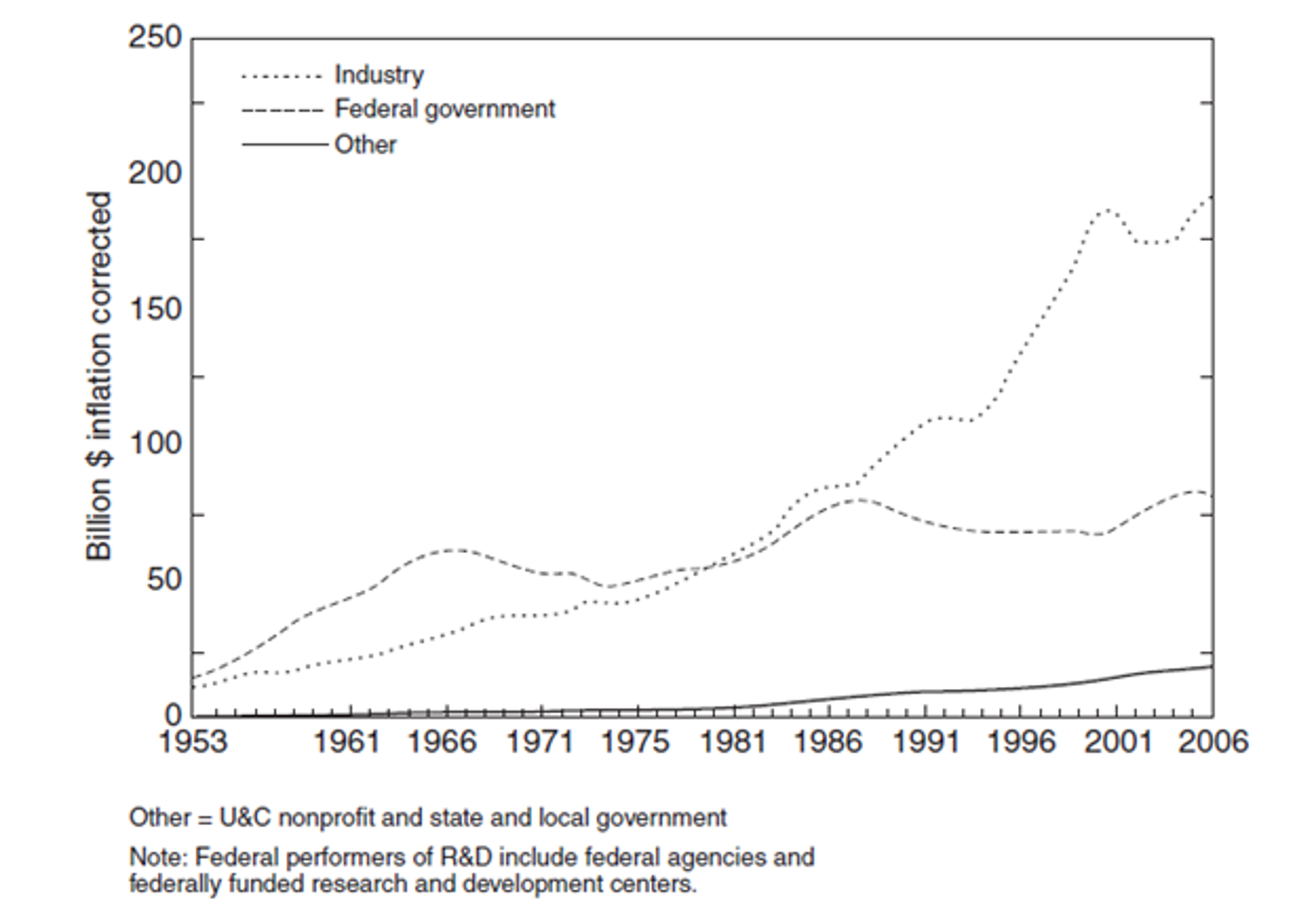
Figure 1: Decline in federal government R&D funding relative to industry, 1953-2006.
At this point it might be tempting to lay the blame for these changes in the funding landscape at the hands of a small number of political actors. However this would be akin to losing oneself amongst the foliage of political programmes, and missing the topography of political economy in its entirety. Indeed, the shift toward the commercialization of science and the focus on enforcement of IP, was a consequence of the long economic downturn, the beginning of which Robert Brenner locates in 1973:
Far from achieving unparalleled prosperity thanks to the freeing up of capital and commodity markets that has taken place over the last quarter century, the advanced economies have performed decreasingly well since the end of the long postwar boom around 1973, and their performance during the years from 2001 to 2007 was the worst for any comparable period in the last half a century.
—(Brenner 2010).
The end of the post-war boom ushered in an era of declining profit rates, with little incentive for the capitalist to invest in industrial production, given the falling rate of return. Here we find the driver of the shift toward financialization and the commercialization of science. However, even here it is a folly to attempt to ascribe any grand narrative to the commercialization of science. It has been—and continues to be—a heterogeneous process; the interaction of long-term trends and political choices.
The Academic Career Pipeline
Before proceeding any further, we must attempt to identify the concrete conditions of the scientific worker today. We can start with the actual career pipeline for the academic scientist. For those outside of the profession, much of this remains rather opaque. Scientists are rarely effective at communicating about either the content of their research or the nature of their industry (a 2024 Pew poll found that less than half of US adults think scientists are good communicators, and it's hard to argue with this). The expected career path in academia involves following up an undergraduate degree with a PhD. Together these are likely to take a decade to complete, though there is much variability. Following the PhD, the graduate will undertake contract work as postdoctoral researcher—a further training position.
Having acquired further experience as a postdoc, the scientist will enter the highly competitive tenure track job market, where hundreds of scientists will be competing for a handful of jobs. Who gets the job will depend on a myriad of factors, including how good a fit the candidate is deemed to be, how appropriate their research programme is, their teaching experience and their publication record. The rewards are significant.
Once one has acquired a tenure track job, they are on the road to a permanent position and significant job security. After several years as an assistant professor, a tenure review board assesses the scientist’s various achievements in terms of research, teaching and service. If deemed satisfactory, the scientist is tenured and now an associate professor. At this level, considerable job security has been achieved. The final step up is to full professor, based on significant research output and international reputation.
This professional academic pipeline is ever in flux, responding to a number of political economic factors. For instance, the postdoctoral position only came into existence in the United States after World War 1, and only really gained prominence when the state stepped in to fund postdoctoral positions via bodies such as the National Science Foundation (NSF) that was founded in 1950 (Kaiser 2005). The postdoc position has since become a necessary stepping stone in academia, spanning multiple years, and often multiple postdocs, before the scientist is deemed experienced and competitive enough to proceed onto the tenure track academic job market.
A common justification for postdoctoral research is that it facilitates the sort of hands-on, focused training that the trainee scientist is somewhat sheltered from. Although it was not always so (prior to the hegemony of the postdoc pipeline, it was not uncommon to expect to attain an assistant professorship straight out of graduate school), the necessity of postdoctoral work is also a response to the increasing number of graduate students year on year, whilst the number of tenure track jobs has remained relatively flat (see Figure 2 below).
Although postdoctoral research can be immensely stimulating (it is a unique phase in an academic career in which research is the primary focus, without heavy teaching loads or administrative burdens), they are also riddled with the same issues as any insecure contract work: an uncertain future, an inability to put down roots (postdoc contracts vary considerably in length), considerable dependence on ones relationship with their supervisor (who will be writing letters of recommendation when they hit the job market), and no guarantee of a stable secure job at the end of it all.
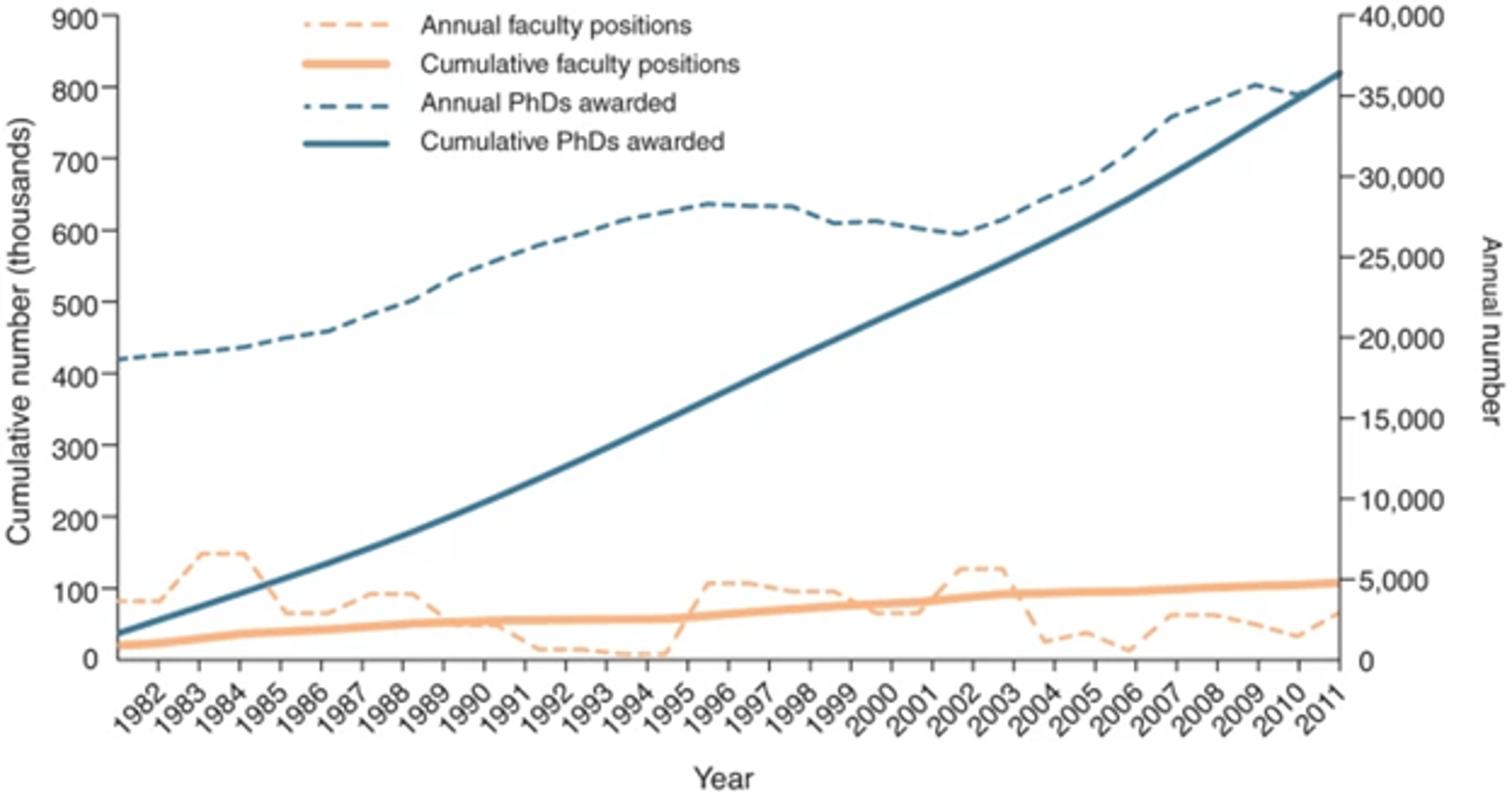
Figure 2: from Schillebeeckx et al. 2013: Since 1982, almost 800,000 PhDs were awarded in science and engineering (S&E) fields, with only ~100,000 academic faculty positions created in those fields within the same time frame. The number of S&E PhDs awarded annually has also increased over this time frame, from ∼19,000 in 1982 to ∼36,000 in 2011 whilst the number of faculty positions created each year has not risen substantially.
What is evident from this brief sketch is that if one conceives of a pyramid with graduate students at the base, followed by postdocs, with the various tenured positions toward the top, recent decades have seen an ever-fattening base layer, whilst the hallowed upper echelons remain as narrow as ever. Combined with the increasing focus on funding applied science projects over basic research (see Figure 3 below), what we are seeing is an industry that is undergoing continual recomposition toward the ever increasing commercialization of science and—as we will see later in this essay—an ongoing process of the deskilling of the scientific worker. Crucially this is a process that has been ongoing well beyond the Trump administration’s recent attacks on the NIH.
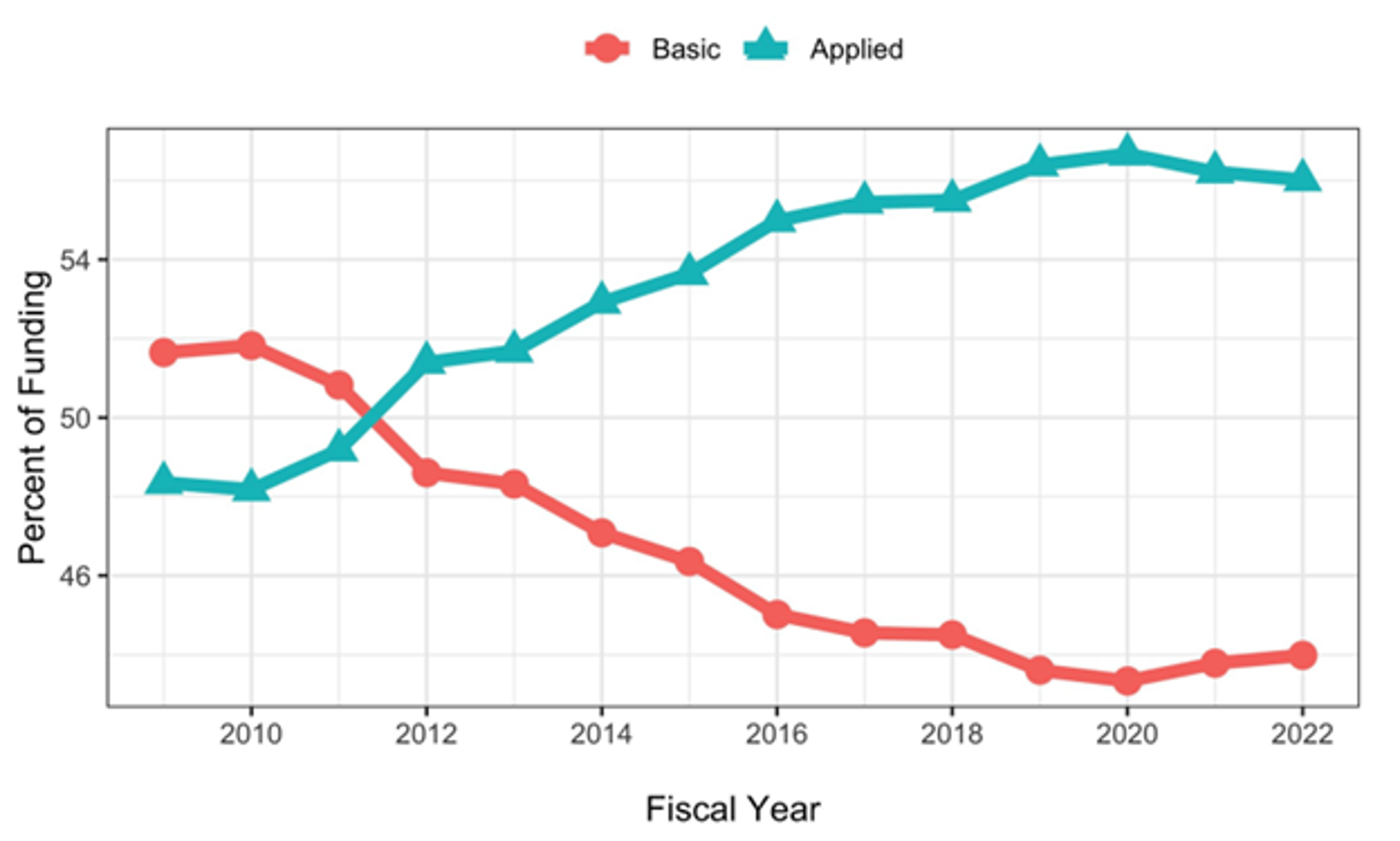
Figure 3: Inflation adjusted funding for applied and basic research, 2010 to 222. From https://nexus.od.nih.gov/all/2023/10/31/trends-in-nih-supported-basic-translational-and-clinical-research-fys-2009-2022/
The Science Lab—Structure and Conditioning
The structure of the academic science lab is a reasonably straightforward hierarchy: at the top there is the principal investigator (PI), under whose supervision sits the whole lab. Next there are postdocs who are somewhat more independent than the next rung down, graduate students. Finally there are masters and undergraduate students, who may be joined to the lab for a brief project or for an entire honors thesis.
There can be substantial variation within labs. Some will have staff scientists and lab technicians, both of which have considerable responsibility and authority. Indeed, because labs are largely shaped by the interests and motivations of the PI, the training experience will inevitably be different from lab to lab, with considerable variation in between. The academic science lab shares much in common with the petty bourgeois small business: there is a formal hierarchy that is often blurred through the sort of informal social interactions that are characteristic of small businesses in which bosses and workers interact on a daily basis (by contract most blue and white collar workers are unlikely to regularly—if ever—interact with the owners, board members, or CEOs of larger corporate institutions).
Concurrently, there is a greater level of specificity within the academic science lab and small business, relative to the more uniform, juridically ironed out structures across large firms. In short, the tone and structure of the work environment is largely set out by the PI, with little oversight. Whether a lab member thrives, and the specific details of their workday, will predominantly depend on their relationship with—and the whims of—their PI.
In spite of these dynamics however, the academic lab is disciplined by external forces, just as the small business and the large corporation are. The currency of academic science always remains the same: publishing papers and being awarded grant funding. These are somewhat analogous mechanisms to the profit motive that disciplines businesses, in that if one wishes to remain operational in the academic research sphere, one must continually remain competitive by publishing papers and obtaining grant funding.
Thus, the incentive structures are clear—utilize resources (both in terms of fixed and circulating capital, and—most pertinently—labor) as efficiently as possible to produce the maximum output. One might have a generous, considerate PI in the same way that a worker in an independently owned bookstore may have a generous and considerate owner. However the wider structural incentives will in both cases result in a tendency toward ever greater exploitation of the worker.
Where the water gets muddied is that the temporal dimension is not always explicit, and indeed is getting more and more hazy. An 8 hour work day is quite concrete. Both inside and outside of academia however, more of the working day is happening off the clock. For academics this has always been a double edged sword, with the tilt of the blade largely dependent on the specific lab working conditions. Being able to manage one's own hours can be a great boon. On the flip side, it is a recipe for increased unremunerated labor, particularly when the worker is incentivised to churn out as many papers as possible to remain competitive on the academic job market.
To give one example of differing working conditions, a major categorical difference between science labs is that of wet and dry labs. Put simply, the wet lab is the lab we often see in popular culture—scientists working with specialised equipment, wearing white lab coats and safety glasses (those cultural signifiers). The dry lab is really just being sat at a computer, performing analysis on data that has already been generated. Where the wet lab is often (though not always) tasked with taking material input and converting it into data, dry labs often work downstream of wet labs, performing analysis on this data.
Again, these are broad generalizations (much theoretical dry lab work is centred on producing analytical or simulated models for example), but they help us to begin to understand the differing nature of these two environments. The spatio-temporal elements are significant here. The wet lab is a physical space with highly specialised equipment, used for time sensitive work. The nature of the wet lab scientist's workday will to a large part be dictated by the materials they are working with. Thus, they are tethered to the lab space in a very concrete manner. By contrast, the dry lab is more concept than physical reality. Often the data has already been generated and thus dry lab members can work where and how they see fit, logging into VPNs to work from wherever is convenient. They are tethered to neither time nor physical space by the work itself. Instead, it will often be the expectations of the PI that dictate whether they must clock in at certain hours, and whether they must be physically present.
Thus, both types of lab will be conditioned on the expectations of the PI, though also by the nature of the work itself. Indeed some PIs expect their lab members to clock in and clock out at the end of the day, whilst others are unconcerned with such spatio-temporal discipline, focussing instead on actual output.
Revolutions in the Content of Work
Periodization is a fraught yet necessary endeavor. Fraught because history is too messy and heterogeneous to be confined to neat temporal categories; necessary to help us make sense of the world. We can periodize the changing labour process within a specific industry under capitalism as an initial period of the formal subsumption of labour, whereby increased profit is squeezed from the workforce via increasing the length of the workday. This of course has natural and social limits, in that a worker can only work for so long. As an industry begins to hit these limits, capitalists are incentivised to innovate to gain a competitive advantage over rivals.
Thus, centralisation occurs as larger firms outcompete and absorb smaller firms via the productivity advantage given by newer technology, which in turn requires less labour to produce more commodities. This is the revolutionising of the labour process, known as real subsumption of labour. These processes were well described by Karl Marx (1867) over 150 years ago. However, we can also frame them in terms of the subsumption of science within the capitalist production process. Harry Braverman describes it thus:
Science is the last—and after labor the most important—social property to be turned into an adjunct of capital. The story of its conversion from the province of amateurs, ‘philosophers’, tinkerers and seekers after knowledge to its present highly organized and lavishly financed state is largely the story of its incorporation into the capitalist firm and subsidiary organizations. At first science costs the capitalist nothing, since he merely exploits the accumulated knowledge of the physical sciences, but later the capitalist systematically organizes and harnesses science, paying for scientific education, research, laboratories, etc., out of the huge surplus social product which either belongs directly to hum or which the capitalist class as a whole controls in the form of tax revenues. A formerly relatively free-floating social endeavor is integrated into production and the market. —(Braverman 1974).
Attentive readers will immediately note how the commercialization of science fits into this framework as the latest ongoing development in the reorganization of science. What we must ask ourselves is how these processes change the very nature of work, particularly in terms of the division of labor. Let us consolidate what we have so far:
The commercialization of science has resulted in a shift of emphasis and funding away from basic research and toward applied research, with a greater proportion of funding coming from private interests than has been the case previously.
The increasing number of graduate students and declining number of tenure track opportunities has resulted in an increased level of precarity at the earliest career stages within academia.
The currency of academia is publications and grant awards, creating incentive structures toward productivity above all else.
Taken together, we see a trend toward an assembly line model of the science lab, and a division of labor that encourages ever more niche specialization, to the detriment of a more totalizing view of any given research programme. More specifically, with a vast array of lab protocols and computational tools widely available, and access to an intensely competitive labor pool (due to the lack of secure job opportunities), a research pipeline in which specific lab members are focused on specific parts of the pipeline, with the PI masterminding the theoretical underpinnings of a given project will maximise productivity in terms of publications and grant funding. Thus, the worker is stripped of the subjective element of the labor process with this division of labor, a trend that is endemic to the capitalist production process:
In its early stages, a new division of labor may specialize men in such a way as to increase their levels of skill; but later, especially when whole operations are split and mechanized, such division develops certain faculties at the expense of others and narrows all of them. And as it comes more fully under mechanization and centralized management, it levels men off again as automatons. Then there are a few specialists and a mass of automatons; both integrated by the authority which makes them interdependent and keeps each in his own routine. Thus, in the division of labor, the open development and free exercise of skills are managed and closed.
—(Wright Mills 1951).
It is worth emphasizing again that these are the incentive structures that exist, not a blanket condemnation of every scientific lab the world over. Indeed, tenure facilitates some level of “checking out” of the productivity fetish because a PI can maintain a stable career without having to worry about publications and grants. However, these are the measures of success, and thus ambitious PIs are incentivised to shift toward an assembly line model of science, and away from a space in which creativity and constructive failure are considered part of the scientific process. It is also important to emphasise that this isn’t just about PIs. In the absence of any countering narrative, this view of science has become dominant. As a trainee scientist in an intensely competitive industry, it is not surprising that you likely view your individual interests as tethered to a productive publication record. When the Russian biologist Leonid Margolis visited the US he observed that,
Young scientists start to think that science consists of putting the results produced by one machine into another, and then into the next one, and of arranging thus obtained beautiful pictures and graphs into a publication.
—(Margolis 1992)
What Margolis saw was a division of labour within the sciences that had stripped away the subjective element of the labor process and created the separation of specialists (PIs) and automatons (postdocs, graduate students etc). What we have described here is the process of the deskilling of the worker, a tendency that Karl Marx identified as inherent to the capitalist mode of production. Indeed, the trends we see in Figures 1-3 point to this very phenomenon. Our task now is to relate this all to the current moment.
The Politics of Science
The response from the scientific community to the Trump administration’s assault on scientific funding and structures has predictably centered on a moral and instrumentalist appeal to the value of scientific work. This is premised on a return to the linear model of science, in which there is a linear pipeline from federal funding for basic research, which informs applied research, which leads—via development of technology and scaling and marketisation—to tangible social benefits. The addendum to this model is one of science as a public good. Thus, not only can we attempt to quantify the value of scientific research, but we can also invoke its role in generating public knowledge that transcends quantification. Both these positions—science as quantifiably valuable, and science as a public good—fail to stand up to scrutiny. As Mirowski writes,
The linear model held forth a promise that apparently nonmarket, nonaccountable (except possibly in some transcendental search for truth) activities could nonetheless cogently be tamed through a cost/benefit calculation, by “backward imputation” from the empirically observed value of the final goods to the virtual value attributed to noneconomic activities that had initially set them in motion.
—(Mirowski 2011).
In other words, the argument is that although we cannot a priori quantify the benefits of basic research, we can perform such quantification post hoc, and thus justify the public expenditure on basic research. Thus, it can be reasoned that science justifies investment in market terms. The linear model of science—whilst attempting to justify public funding—simply reinforces the commercialization of science by placing the market as the ultimate arbiter of merit. Whilst the linear model argues for an empirical-rational justification for the funding of science, the notion of science as a public good covers the moral argument, stating that science doesn’t need to justify itself as a profit making endeavor, for its contribution to the commons is as a qualitative good. An example of such argumentation is demonstrated by the tweet thread below.
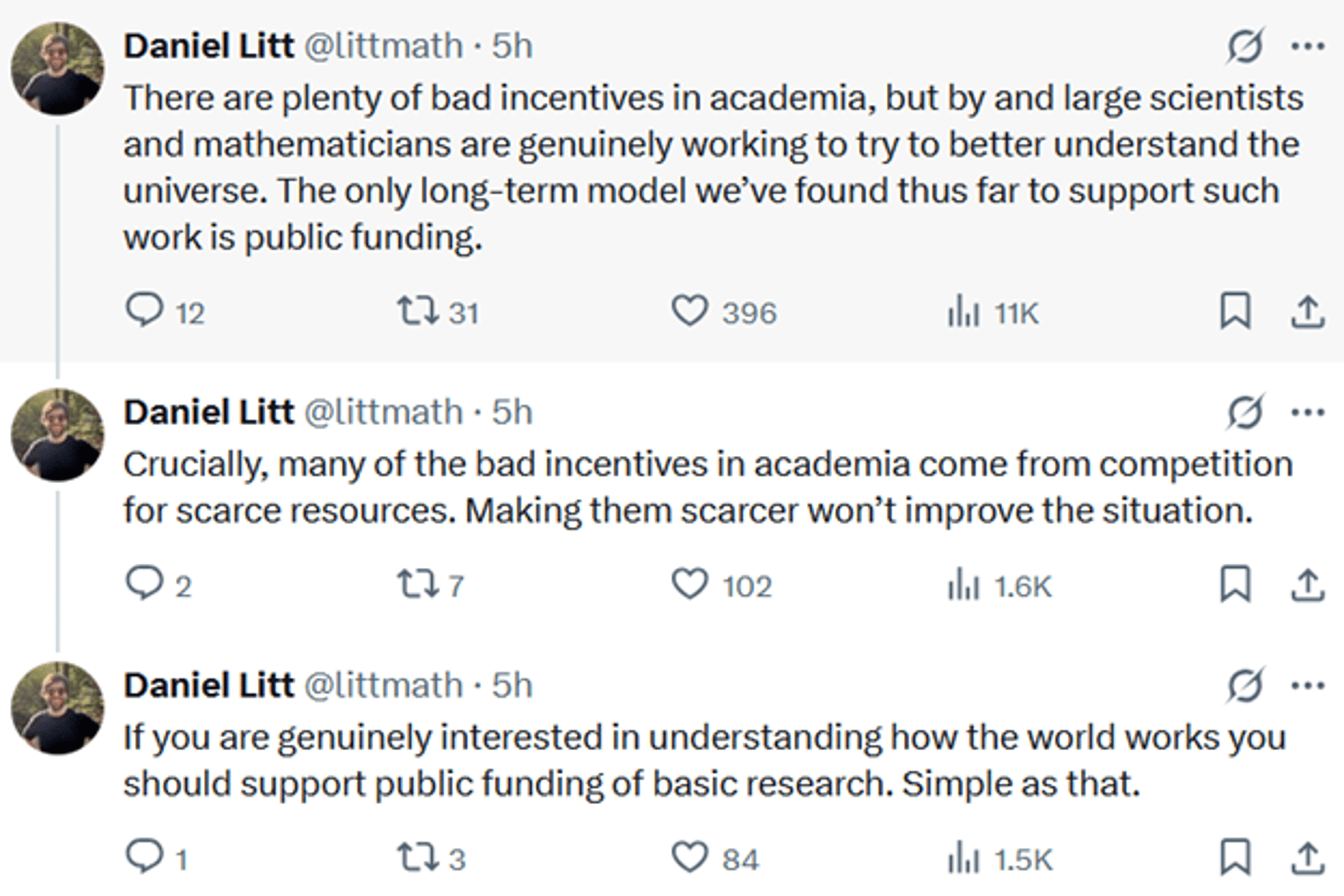
I do not mean to target this individual specifically, but these tweets are a paradigmatic example of scientists failing to read the room. The entire argument hinges on a notion of science as some noble endeavor undertaken in purely altruistic fashion. And yet, what does it mean to better understand the universe when the fruits of such research are locked away behind paywalls in journals that profiteer at both ends, charging both to publish, and then to access those publications?
The public are expected to accept this state of affairs under some abstract rubric of progress. It is important to note that few lament the state of academic publishing more than academics themselves, and I will return to the question of publishing later. For now however, the point worth emphasizing is that asking the public to have faith in the idea of science as a public good without that same public having the capacity to directly scrutinize scientific research is the sort of hubris that is grist to the mill for anyone looking for easy anti-establishment narratives; narratives that Trump has proven remarkably adept at weaponising.
This begs the question that really sits at the heart of this essay: Why are scientists so ill-equipped to deal with Trump’s assault on science? This is of course a political question, and scientists have consistently vacated the political space when it comes to their own field, in no small part due to the hegemonic notion that science is an objective pursuit, shorn of ideological interests and driven by the search for truth. This runs counter to every aspect of science, from the day to day activity of the scientific process, to the high level decisions on how research is funded. This notion of an apolitical science is not just limited to scientists themselves, but across the scientific terrain:
The making of evaluative decisions and the exercise of authority or advisory authority is a pervasive fact of scientific life: in directing the work of subordinates, in asking funding bodies for resources, and the like. But this political ‘decision making’ character of science is also a largely underdiscussed fact—whether by commentators on science, philosophers of science, or sociologists of science. The reason for this neglect, in part, is that these decisions occur under a particular theory or ideology: the idea that the scientists making the decisions are operating neutrally or meritocratically, and that the public role of science itself is neutral. Science is thus mundanely political, but its overtly political features are conceived to be unpolitical.
—(Turner 2002).
Many scientists will have experienced the sinking feeling of receiving a scathing peer review in which a paper is outright rejected, before submitting to a different journal and having that very same paper sail through peer review in glowing terms. Scientists are partisan, ideologically biased, and politically motivated, and science is a social process. By conceiving of science as apolitical however, the response to obstacles is always a technocratic fix. Birukou et al.’s (2011) review of alternatives to peer review is a good example of this. Discussed are a range of tweaks and workarounds to the peer review process, without ever touching on the specific relations between journals and the labor that they exploit and profit from.
The same might be said for endeavours such as the preprint server arXiv—useful in its own right, but merely an appendage to the peer review publication machine that is utterly hegemonic (as usual, Mirowski (2018) has a comprehensive commentary on how Open Science has largely been a vehicle for the corporate tech sector to impose social-media style platformism on the sciences). Because the currency of science is publications, a truly radical alternative cannot simply coexist in the same ecosystem. Instead, this is a political question, rooted in power dynamics within the corporatised sciences.
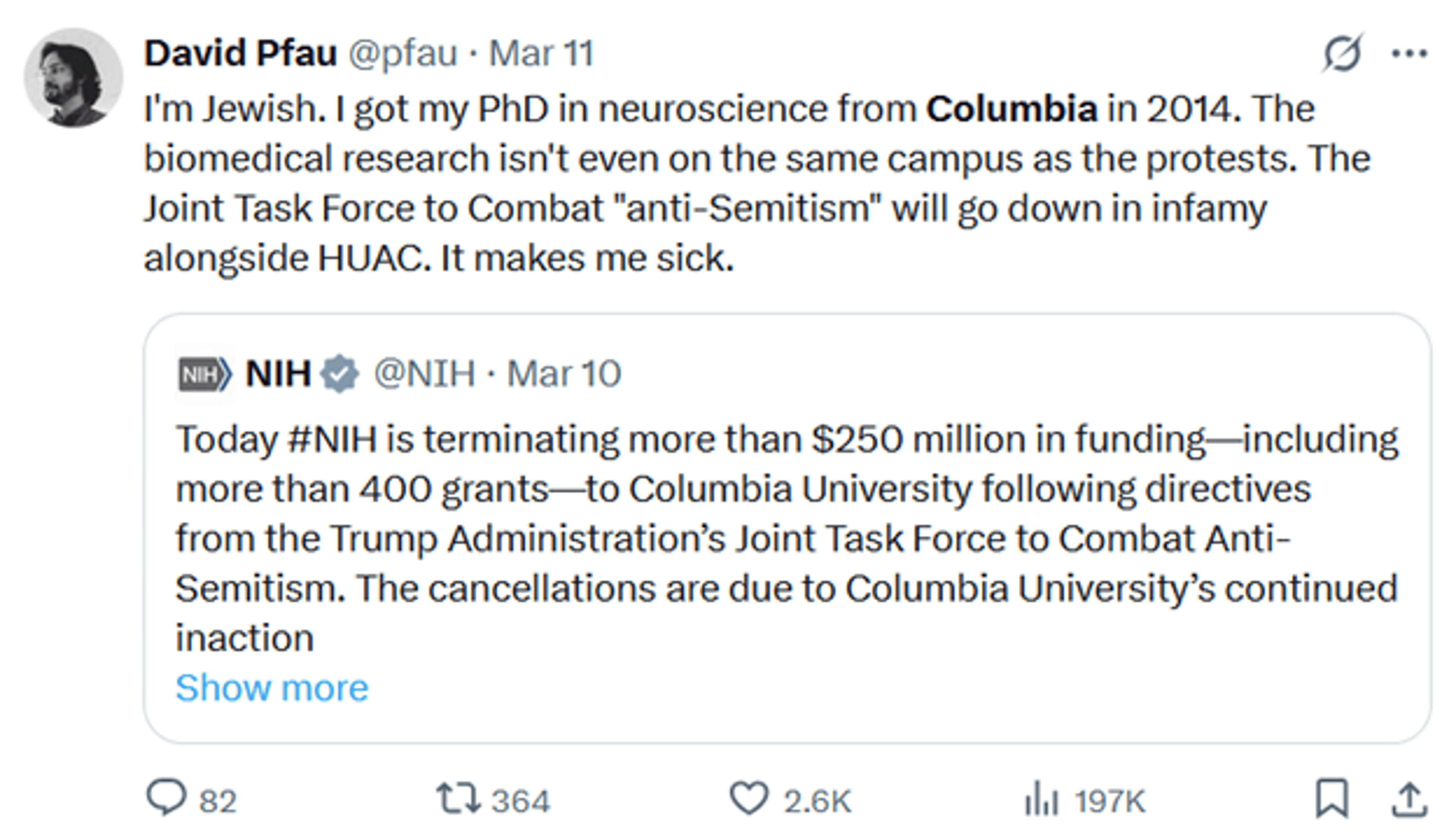
The Trump administration's current assault on academia has brought some of these latent questions out into the open. Nowhere has this been more acutely felt than at Columbia University. On March 10th, the NIH announced that $250 million in funding across over 400 individual grants was to be pulled from Columbia, at the behest of the Joint Task Force to Combat Anti-Semitism. This was a direct reaction to the pro-Palestine encampments which were first set up at Columbia in April 2024, catalysing a raft of further encampments at university campuses across the US.
A day after this announcement, Mahmoud Khalil—student activist and negotiator on behalf of the Columbia encampment—was abducted by ICE agents from his apartment. The agents produced no warrant, removing Khalil—a green card holder—from his apartment and transporting him to LaSalle Detention Center in Louisiana. Khalil has thus far not been charged with any crime or been deemed to have engaged in any illegal activity.
The thread connecting the encampments and the abduction of Khalil to the stripping of NIH grants from Columbia scientists requires little scrutiny to identify, and yet the response of the science community has not been one of political engagement, but one of distancing, often in a very literal spatial sense, on the grounds that biomedical research is conducted on a different campus than that on which the encampments were set up! Instead the focus has been a moral appeal to the importance of the work being conducted at Columbia, and the altruistic nature of scientists at all levels. One is tempted to ask who this appeal is to. The Trump administration and the wider MAGA movement have clearly identified academia as an ivory tower of elitism, and have no interest in moral appeals. Besides which, why should the wider academic community—nevermind anyone else—stand with scientists against this assault when there is a collective silence around the abduction of a member of that community?
There is a very obvious line running through the genocide in Gaza to the stripping of science funding in the US, and an abject failure on the part of scientists to draw attention to this line, for fear of suffering from the backlash both from the state and from their peers. This fear is somewhat understandable given livelihoods are at stake, and a single voice speaking out is unlikely to make a material impact. What this highlights however is the complete absence of collective power that would allow these threads to be drawn together into a coherent narrative critique, as opposed to the fear any individual has of exposing themselves to opprobrium. This is the focus of the next section.
Academia, Class and Solidarity
It is not unreasonable to ask why any academic should stick their head above the parapet and link these issues, given the Trump administration’s swift retaliation to any dissent (student visas are being revoked daily in reaction to any dissenting views on social media). We might rephrase this question: why is academia so weak as to be unable to produce material solidarity with those within its ranks that are having their lives overturned, be it via loss of funding or—far more consequentially—deportation? Again, we are faced with a question of power.
Throughout the history of capitalism, workers have banded together in collectives (formally, though no exclusively, via unions) to struggle for better working conditions. A single worker that demands a better wage or a safer working environment is easily replaced. A whole workforce is much harder to dislodge, particularly when they exercise power by withholding their labor during a strike. Of course, a successful labor action requires opportune conditions, including but not limited to a level of workplace solidarity that ensures strikes will not be undercut by scabbing (workers refusing to join the strike and continuing to work) and a set of concrete demands.
Universities are no strangers to both radicalism and strike action. There are spatio-temporal aspects of university life that facilitate collective action. These are uniquely densely populated spaces, with more flexible demands on time than in other workplaces. However there are important differences between student radicalism and the sort of ongoing building of solidarity that cuts both beyond the physical university space, and the academic hierarchy. Student radicalism is ephemeral by its very nature, specifically because students are passing through the university space over a short number of years.
Thus, such radicalism is rarely able to reproduce itself. Within an even shorter timescale, each academic year is broken up by a long summer holiday during which students will disperse from campuses, diffusing any discontent that may have been percolating over the preceding months (this point makes the heavy handed response to the pro-Palestine encampments by university administrators and the police particularly puzzling, given that they could have waited activists out until the nearby summer break, whereupon the size of the encampments would inevitably collapse).
The question of longer term organizing and reproduction of collective power must look beyond just students, and to academics themselves. The inability of academics, and indeed white collar professionals to organize and show material solidarity with their fellow workers is often explained by their being part of what Barbara and John Ehrenreich called the Professional-Managerial Class, or PMC. In their 1977 essay, they defined the Professional-Managerial Class as,
Consisting of salaried mental workers who do not own the means of production and whose major function in the social division of labor may be described broadly as the reproduction of capitalist culture and capitalist class relations….Thus we assert that these occupational groups—cultural workers, managers, engineers and scientists, etc.—share a common function in the broad social division of labor and a common relation to the economic foundation of society.
—(Ehrenreich and Ehrenreich 1977).
A great deal of subsequent work has added to this initial theorization of the PMC, mostly focusing on the habitas of professionals. To take the example of academia, those in the field have to be geographically mobile to have any chance of obtaining a secure career within their field of interest. The number of positions are small, temporary, and—as already discussed—with little job security. A graduate student might find themselves undertaking their PhD on the other side of the country, then leaving the continent to undertake postdoctoral research, and finding further geographical instability when searching for a tenure track job.
This spatio-temporal dislocation is anathema to putting down deep roots and building community. The competitive nature of academia also encourages the centering of the individual over the collective. One's colleagues are also one's competition for an ever more scarce number of jobs. The question of building the bonds of solidarity that translate into collective power then cannot be answered without accounting for these habitual constraints.
One might conclude from such an analysis that attempting to overcome such habitual constraints is futile. However, it is worth emphasizing that these constraints are questions of habitas, more than a rigorous class analysis. This is not the place to relitigitate the patchwork landscape of Marxist and—patchier still—non-Marxist theories of class. It is important to note however that the majority of academic workers are proletarianized. That is, they must sell their labor power (i.e. their capacity to work) in order to reproduce themselves (i.e. purchase the goods needed to survive). The PMC is not a distinct class category.
However, it does provide us with an analytical framework for understanding why this cross-class stratum of salaried mental workers acts within differing incentive structures than what might be called—for want of a better term—the traditional working class. The main take away here is that these incentive structures help us explain the lack of solidarity and collectivity across mental workers, and—pertinently—that these barriers are not hard structural barriers that cannot be overcome. They help explain our present. They need not explain our future. To paraphrase John Holloway, if the professions were characterised by the total objectification of the subject, then there is no way that we, as ordinary people, could criticise our alienation. What then might a path forward look like?
The Utopian and the Concrete
How are bonds of solidarity formed vertically across the academic hierarchy, and horizontally across industries? As always, there is a conjuncture-agency dialectic that must be navigated. How much individual agency we have is both shaped by, and is constantly shaping the material conditions in which we operate. The conditions seem bleak.
Looking beyond the habitual obstacles to solidarity within the academy that I have identified in the preceding section, workers have been on the backfoot for several decades, often engaged in defensive struggles to maintain some semblance of reasonable working conditions against the neoliberal agenda of deregulation and erosion of job security. Against this backdrop there is no out-of-the-box viable strategy for workers inside or outside academia, that if applied properly would guarantee the improvement of the lot of workers. In a nutshell, emancipatory agency is limited in the current moment.
The first step then is to identify what our goals are, both short-term in the face of attacks on science from the state, and long-term with regards to a truly emancipatory and radical reshaping of science. This must of course be a collective dialogue. It is all well and good lamenting the state of peer review, and the unsustainable decrease in secure jobs in science relative to cheap graduate student labor. It is quite another to start thinking about what science could actually look like, shorn of the profit motive. Thus, some level of utopian theorizing is necessary. For example, in The German Ideology, Marx envisioned a society in which,
Nobody has one exclusive sphere of activity but each can become accomplished in any branch he wishes, society regulates the general production and thus makes it possible for me to do one thing today and another tomorrow, to hunt in the morning, fish in the afternoon, rear cattle in the evening, criticise after dinner, just as I have a mind, without ever becoming hunter, fisherman, herdsman or critic.
—(Marx 1845).
It is easy to dismiss such a statement for its irrelevance to such specialized forms of labor such as science and engineering. One cannot simply pick these up and put them down at a whim. However, it is far more generative to take up Marx’s vision and seriously consider how it might be applied to the sciences. What does a truly democratic version of the scientific process look like? It must surely be a far cry from the current structure in which the majority of the public are locked out of science both by paywalled journals and by the fact that scientists are incentivised to be effective at communicating their work to their peers (via peer review and grant panels), rather than to the public.
Notice how even this preliminary consideration of Marx’s utopian vision has opened up space for critique of the concrete structures in which science is conducted today. In some ways the negative critique is straightforward enough—much of this essay is concerned with negative critique of the practice of science as it currently exists. Much more difficult is the positive vision. I do not intend to paint a comprehensive forward vision here. Instead a few broad brush strokes shall suffice.
The fundamental point about notions such as “every cook can govern” is not that everyone has the aptitude or interest to pursue scientific research. This is a rather uncontroversial point, and so is the notion that anyone who does have an interest should be able to engage with scientific practice. I am not exclusively concerned with equality of opportunity here, but with how science is a social endeavor that must be an ongoing dialogue between social actors. Just because someone doesn’t wish to commit years of study to perform scientific research, does not mean they should be shut out of science entirely. To democratise a system means to nurture engagement within that system. It is worth briefly noting that most scientists speak in glowing terms about SciHub, which has democratised access to science papers.
This is no mere technocratic fix. This has materially changed how scientific knowledge is distributed, and its importance cannot be understated. However SciHub alone is of course not enough. Democratisation of access is necessary but not sufficient. We must change how individuals relate to science too. Everyone with the inclination and time is capable of grasping the key debates in any specialised field of study, and this is the crux of the matter. Inclination and time. We have rather innocuously found our way into one of the simplest and most radical of demands: that of the increase and control of our own free time. Again from Marx:
Free time – which is both idle time and time for higher activity – has naturally transformed its possessor into a different subject, and he then enters into the direct production process as this different subject.
—(Marx 1857).
This is the overcoming of alienation and the unleashing of the creative potential of the individual: scientists no longer just brainless cogs in an assembly line, and science as a property of the commons, not just of profit-seeking entities and tenured professors. It takes no great leap to understand how such an outlook facilitates engagement with basic science as an important end in itself, and not just as a necessary cost to facilitate downstream profit-generating projects.
A key task then is to flesh out these ideas of what a democratized radical science might look like. We must be utopian in the sense of envisioning another world, yet concrete enough to understand the processes, logistics, supply chains, and funding sources that currently make up science and would have to be accounted for.
The Current Moment
I suspect that some readers may at this point be thinking that its all well and good to theorize utopian futures, but that does little to account for the here and now, and the Trump administration's slash and burn approach to state based scientific agencies. The problem is that no institutional infrastructure has been built to withstand these attacks. Thus, there is no collective power. Exploring the reasons for this lack of collective power has been a principal concern of this essay.
When a PI hears of grants being cancelled at a university on the other side of the country (or indeed even in the same institution), the forums to express their concern are social media, or through university mediators. There is no independent forum where scientists can collectively think through the current moment, and collectively respond. And it must be emphasized that collective responses must go beyond public letters, which may highlight moral objections but also highlight a lack of power to do anything about anything. Collective power is the collective ability to down tools; the collective ability to show what happens when scientists en masse reject funding cuts or exploitative peer review or early career precarity.
What’s more, it is political power. Whether scientists wish to acknowledge it or not, they are political actors by definition, and it is within the political sphere that the assault on science is occurring.
This collective power is not easily built. We have seen it eroded across much of the globe as geographical, financial and job stability have been slashed. As I have shown, it is perhaps even harder to build in professional vocations such as science, where mobility and competition incentivise individualism to a qualitatively greater extent than in many other industries. However that does not mean it is impossible. There is a direct link between building intra and inter-industry bonds of solidarity, and the thinking through of the utopian visions discussed in the prior section. Technocratic tweaks that sidestep politics will not save us. Only collective action stands any chance.
High Priests of Telescopes and Cyclotrons: Marxism and Revolutionary Strategy as Science
(Originally Published April 22nd, 2025)
Having set out to change the world, rather than produce one more interpretation of it, Marxist theory must ultimately be weighed on the scales of history.
—(Alvin Gouldner, 1980)

Within my lifetime as a political radical, I have seen the Occupy movement collapse under its own incoherence, revolutionary aspirations dampened by subsumption into bourgeois party politics (Corbynism was my experience, though across the Global North many variations of this theme were evident), and now a return to the demands for a revolutionary party. When you are in the midst of these moments it is difficult to look beyond them. We are bombarded by those who speak with the surety of science about what the strategy must look like, and yet when movements collapse the only explanation is the betrayal made by those in power.
Because I am a practicing scientist and someone who follows in the Marxian tradition, the notion of Marxism as science—indeed scientific socialism—has been a point of both interest and conflict for me. What does it mean to attempt to evaluate—and ultimately accept or reject—a revolutionary strategy? There are a number of obstacles preventing a generative dialogue where these subjects are concerned, mostly centering around definitions. What is science? What do we mean by strategy? What do we mean by socialism?
Putting the—by no means insignificant—question of socialism to one side, I want to think through the relation between strategy and science in an accessible manner. As such the whistle-stop tours through one lineage of philosophy of science, of classical Marxism, and definitions of strategy are by no means comprehensive, nor are they intended to be. Indeed, the examination of Marxism’s claim to being a science has been undertaken many times and by critics as diverse as Karl Popper and Michael Burawoy. Here I would like to provide an accessible grasp of these debates around what science is and the evaluation of the claim that Marxism is a science, moving these discussions more concretely toward strategy, providing a framework from which to think through the interrelation of Marxism, science and strategy. Finally I would like to think about what the jumping-off point is for revolutionary theory that does not simply emerge from the bottlenecks of the past.
What is Science?
Such a simple question has challenged philosophers for centuries now. By contrast, most scientists don’t think much about it at all, they simply do it. But what do they do that is distinct from any other mode of investigation? The usual starting point—whose first articulation is generally credited to Francis Bacon—is inductivism, the idea that accumulated observations of nature can be generalised into natural laws. Though induction remains a central part of science in practice today, many called into question the predictive power of inductive logic. Having observed the sun rising every morning, we can generalise a theory, and therefore predict that the sun will rise again tomorrow.
However, we cannot rationally justify this—uniformity in nature cannot be demonstrated based on an accumulation of observations. After all, irregular events do occur. This problem—referred to as Hume’s problem of induction, despite having been highlighted as early as the 2nd century AD by Sextus Empiricus—forms the rational kernel of Popperian falsification. Karl Popper—renowned anti-communist and Vienna Circle member—showed that inductive logic sees science in purely probabilistic terms. Inductive logic bases the demarcation of science and non-science on the probability of any theory. If the mathematical probability of a theory is high, then it qualifies as science; if it is low, then it is not scientific.
Taking the problem of inductivism to its logical extreme, Karl Popper argued that we can never prove any theory (i.e. the probability of any theory is close to zero). Instead he argued for falsification as the true demarcation criterion between science and non-science. Any theory is scientific if an experiment is proposed that can falsify it. Furthermore, falsification is all we can hope to achieve. A theory can never be proven, it can only be falsified and therefore rejected. Here science proceeds through the refutation of theories. Though this appears to be a useful common sense definition of science at first blush, the result is a science that is dehistoricised and abstracted from its practice. We all—not just scientists—use scientific laws to anticipate the future and engage with the world around us. Moreover, theories are not just junked once disproven. Often additional hypotheses are generated to explain the anomalous results.
It is clear that both induction and falsification must have some role in science, though neither alone can demarcate the category of science from non-scientific investigation in a manner that satisfactorily explains the practical workings of science. A number of considerably more sophisticated definitions of science have been proposed. I will briefly describe two of these. The first is the Kuhnian paradigm shift.
Unlike Popper, Thomas Kuhn was a practicing scientist, trained in physics. His The Structure of Scientific Revolutions is one of the most influential philosophy of science texts within the scientific community itself. Kuhn conceived of science as comprised of the process of “normal science” followed by revolutionary breakthroughs in a series of punctuated equilibria. The period of normal science involves the quantitative build-up of evidence that refutes a theory. This is the day-to-day practice of the scientist: diligent research attempting to corroborate and quantitatively put flesh on the bones of the overarching paradigm.
The paradigm itself is simply a scientific theory together with an example of its successful application that is sufficiently convincing that other scientists commit to dedicating their careers to it. This suggests that there is no hard quantitative evaluation of whether a new paradigm is taken up. The paradigm shift is not a purely data-driven process, because data is perceived through the lens of the currently dominant paradigm. There are no simultaneously active competing research programmes and falsification is rejected. Instead, the paradigm shift is a predominantly social process, with scientific revolution cast as an irrational change. There is no absolute measure of how progressive your theory is, there is only the value placed on it by the scientific community at large.
What the scientific community values is, of course, historically contingent. Anyone familiar with day-to-day scientific practice will experience this, even if they are not cognizant of it. Who and what gets funded, which papers are published, and who gets hired are all strongly socially determined. To give just one example, as a working scientist I have had a paper outright rejected by one journal with seemingly partisan reviews, and then accepted in another with only stylistic edits suggested. It is likely that the first set of reviewers were hostile to the research programme I adhere to, whilst the second set were fellow travellers. It’s worth noting that despite this being a commonly observed phenomenon, scientists by and large appear to have an idealised conception of modernity and the scientific method. As James C. Scott puts it, high modernism—the absolute faith in scientific progress—is:
The ideology par excellence of the bureaucratic intelligentsia, technicians, planners, and engineers. The position accorded to them is not just one of rule and privilege but also one of responsibility for the great works of nation building and social transformation.
—(James C. Scott, 2020)
The reality of scientific practice—with all its interpersonal animosity and subsumption into the profit motive—is treated as the exception, whilst the abstract ideal is framed as the real scientific method. Kuhn provides a useful antidote to such idealism. However, the problems for demarcation are clear: because everything is conceived through the lens of the dominant paradigm, the history and methodology of science are rewritten with every paradigm shift, leaving us with no approach for demarcating between scientific progress and intellectual degeneration; science and pseudoscience become indistinguishable. Furthermore—as touched on in my example above—multiple research programmes are almost always running concurrently, often in antagonism with one another.
At this point we appear to be caught between two poles. Clearly Kuhn’s turn toward historicism—the notion that scientific practice is historically and socially determined—is a valuable corrective to the overly abstract conception of science as pure falsification. However with this overcorrection we have lost all ability to demarcate science from any other form of inquiry. One attempt to move beyond falsificationism and historicism was that of Imre Lakatos.
Lakatos—a student of the Hegelian Marxist György Lukács—distinguished between progressive and degenerating research programmes. Where theory leads to the discovery of novel facts in the former, the degenerating research programme is characterized by the fabrication of theories in order to accommodate known facts. Indeed, a research programme can be active for a long while in a state of degeneration, and can even be restored to a progressive footing if the above criteria can be satisfied (this is certainly an important point in relation to Marxism, as we will see).
Lakatos argued that the constituent parts of a research programme are the hard inner core of the programme—the so-called negative heuristic—that can never be directly rejected, and the auxiliary hypotheses—the positive heuristic, or protective belt—that face the onslaught of tests and tweaking in light of the outcomes of these tests. Lakatos gives us the examples of Newton’s gravitational theory:
The classical example of a successful research programme is Newton's gravitational theory: possibly the most successful research programme ever. When it was first produced, it was submerged in an ocean of 'anomalies' (or, if you wish, 'counterexamples') and opposed by the observational theories supporting these anomalies. But Newtonians turned, with brilliant tenacity and ingenuity, one counterinstance after another into corroborating instances, primarily by overthrowing the original observational theories in the light of which this 'contrary evidence' was established. In the process they themselves produced new counter-examples which they again resolved. They 'turned each new difficulty into a new victory of their programme'.
—(Imre Lakatos, 1989)
Scientific research programmes can be eliminated when a rival research programme explains the success of this prior programme, and supersedes it by a further display of heuristic power. A research programme is progressing as long as its theoretical growth anticipates its empirical growth. It is stagnating if its theoretical growth lags behind its empirical growth (providing only post hoc explanations of chance discoveries). Hilary Putnam provided a similar framework in The Corroboration of Theories, arguing that auxiliary statements are the boundary conditions that scientists actually test. These are the abstract models to which the set of laws (the scientific theory) are applied.
Research Programmes as Strategy; Auxiliary Statements as Determinants of Tactics
Two points become evident from the preceding section. The first is that a research programme is the theoretical underpinning of strategy. In his piece on Strategy and Tactics, Dan Frost noted that “the strategist takes a top-down view and writes up the rules of the world,” whilst Mike MacNair notes that “the essence of ‘revolutionary strategy’ is its long-term character: it is the frame within which we think about how to achieve our goals over the course of a series of activities or struggles, each of which has its own tactics.”
What is strategy then, if not the process of abstraction, i.e. the process of modeling the state of a system. Within any model, or research programme, or strategy are a number of assumptions. In the conception of orthodox Marxism outlined above, one example assumption was that of the inevitability of communism, via the radicalisation of the working class as it became fully subsumed into wage labor. History proved this assumption to be erroneous.
Bernstein’s response was to junk the whole Orthodox Marxist strategy, because the assumptions of this strategy had been proven false. Luxemburg by contrast bolted on a further auxiliary statement to explain why the working class had not been continually more radicalised. The underlying research programme/strategy was maintained, with the auxiliary statement explaining the lack of alignment between the Marxist model of the world and reality. Within this auxiliary statement lay the retheorising of the mass strike as a tactical weapon. Thus the core theory remained intact, whilst the tactics were attenuated to respond to real world data. Practicing scientists do the same, as discussed above. Auxiliary hypotheses are developed to attempt to explain discrepancies, whilst the core research programme remains intact.
Within this framework I can see no reason why we cannot call Marxism a science. Indeed, the real question should not be about whether Marxism is a science, but whether it is good science. Any model can be fine tuned until its logical basis is coherent, but the most important question is always whether it is an accurate representation of reality. Of course, the question of whether any research programme or strategy is good science is not a static one. Ultimately we are asking a similar question to the one asked by Lakatos: Is a research programme progressive, or is it degenerating? And, of course, the research programme/s that constitute Marxism have changed over time.
This brings us neatly onto the second point that is evident from the preceding section. Multiple research programmes—and indeed multiple versions of research programmes—are live at any given time. Even those that have degenerated might be resuscitated in light of new evidence and a changing environment. Though the inevitability of communism may have been taken as a given in the late 19th and early 20th centuries, two world wars, the Keynesian post-war rebuild, the advent of neoliberalism (driven by the long post-1973 crisis) and the collapse of the Soviet Union have so radically altered the global landscape as to shake even the most optimistic of Marxist forecasts.
So what are some of the more coherent extant research programmes within the Marxist tradition that exist today? And can we evaluate their progressive and degenerative content? This will involve attempting to identify their underlying assumptions and assessing them relative to the world around us, which is a trickier endeavor with social systems due to processes that cannot be quantified such as ideology.
Though this is by no means an exhaustive list, I will briefly attempt to evaluate the scientific content of two research programmes: The strategy of patience/merger formula, and the theory of riot. These choices are Global North focussed. This is regrettable, but I aim to talk about what I know and understand. After all, science is an attempt to understand reality, and I cannot speak with any confidence about strategic frameworks which are being developed and enacted in environments with which I have little familiarity.
The Strategy of Patience and Merger Formula
Recent years have seen the resurgence of an interest in Kautsky’s strategy of patience, with its new iteration being variously called Neo-Kautskyism, orthodox Marxism, or just Leninism, depending on who is espousing or critiquing it. Mike MacNair’s Revolutionary Strategy has been hugely influential on this milieu, providing a relitigation of Orthodox Marxist strategy and its relevance for the modern day.
It is worth stressing how important this book was for my own thinking. MacNair’s focussed approach whereby he defines his categories, and carefully follows the links in his chain of argumentation results in a work which forces the reader to concretely think about revolutionary strategy without hand waving mystification, without confusing strategy for tactics, and without falling back on moralism. Indeed, it is a model approach for discussing strategy in my opinion.
MacNair describes the strategy of patience as the strategic orientation of the Marxist centre, relative to the Marxist right and left:
The centre’s strategic line was, then, a strategy of patience as opposed to the two forms of impatience; those of the right’s coalition policy and the left’s mass strike strategy. The strategy of patience had its grounds in the belief that the inner-logic of capital would inevitably tend, in the first place, to increase the relative numbers and hence strength of the proletariat as a class, and, in the second, to increase social inequality and class antagonism. —(Mike MacNair, 2008)
He goes on to describe the strategy of patience as articulated by Kautsky in The social revolution as follows:
This strategic line can be summed up as follows. Until we have won a majority (identifiable by our votes in election results) the workers’ party will remain in opposition and not in government. While in opposition we will, of course, make every effort to win partial gains through strikes, single issue campaigns, etc, including partial agreements with other parties not amounting to government coalitions, and not involving the workers’ party expressing confidence in these parties.
When we have a majority, we will form a government and implement the whole minimum programme; if necessary, the possession of a majority will give us legitimacy to coerce the capitalist/ pro-capitalist and petty bourgeois minority. Implementing the whole minimum programme will prevent the state in the future serving as an instrument of the capitalist class and allow the class struggle to progress on terrain more favourable to the working class.
—(Mike MacNair, 2008)
MacNair highlights the assumptions underlying this strategy that we have already seen did not hold up to reality: An increase in numbers and strength of the proletariat, and an increase in social inequality and class antagonism. Going further, the neoliberal turn further decimated the strength of the proletariat, and whilst inequality has exponentially increased, class antagonism has been numbed, relative to its peaks in the 20th century. This brings us to the merger formula, in which the socialist movement merges with the workers’ movement to form a mass party, which is the agent of revolution. Implicit in this formula is, of course, the existence of a workers’ movement. Rosa Janis has argued in Cosmonaut Magazine that the merger formula is,
Implicit in Marx and Engels’ Communist Manifesto, Karl Kautsky’s The Erfurt Programme and Lenin’s concept of the vanguard party. The role of the socialist movement, according to the Merger Formula, is to develop the concept of socialism through theory and implant it into the consciousness of the workers’ movement, which acts as the mass base for socialism. In this way, the socialist movement can be thought of as the mind of the revolution and the workers’ movement its body. While some might reject such a formula as it implies that the workers are incapable of imagining socialism for themselves, this would be a simplistic misreading since—much like the literal mind and body—the socialist movement and the workers’ movement are never completely separated: the socialist movement is made up of the most advanced elements of the workers’ movement, and the workers’ movement is made up of the most advanced elements of the socialist movement. —(Rosa Janis, 2018)
Janis here softens the distinction between the socialist and workers’ movement relative to how it was conceived of by Kautsky (again, quoted by Lenin in What is to be done?):
But socialism and class struggle arise side by side and not one out of the other; each arises under different conditions. Modern socialist consciousness can arise only on the basis of profound scientific knowledge. —Rosa Janis (2018)
Kautsky is also explicit as to where this scientific knowledge comes from:
The vehicles of science are not the proletariat, but the bourgeois intelligentsia: it is in the minds of some members of this stratum that modern socialism originated, and it was they who communicated it to the more intellectually developed proletarians who, in their turn, introduced it into the proletarian class struggle where conditions allow that to be done. —(Karl Kautsky quoted in What is to Be Done?) (his emphasis).
This is as clear a framing of the Marxist as scientist expert as described in the previous sections of this essay. Indeed, this framing has been central to many critiques of scientific Marxism and vanguardism—the separation of subject and object, of teacher and taught. Whilst these critiques are extremely important—as exemplified by Janis’ softening of this dualism—this is not place for that discussion. What we are purely concerned with here is extracting the scientific content from the merger formula and strategy of patience.
Assumptions of the Strategy of Patience/Merger Formula
So what are the assumptions of this model?
The existence of a socialist movement.
The existence of a growing workers’ movement.
A mechanism by which to merge the two that coheres around the political content of the former.
The discipline to hold the line and not take power until a majority is achieved.
The time to build this majority.
As Janis’ essay describes, these conditions have not been met yet. Socialists are largely scattered in an incoherent manner, and the workers’ movement is still at a nadir (as measured by union membership and strike days). Thus the order of proceedings is to firstly cohere the socialist movement around a programme, and it is only with a coherent and disciplined socialist movement that the workers’ movement can be rebuilt. So really, the prior aim is to create the conditions in which such a strategy is viable. This, of course, leads to a set of prior assumptions:
The socialist movement can be cohered.
The workers’ movement can be rebuilt.
The first assumption leads to a number of tactical questions around how to cohere the socialist movement (in the US case for example, entering into the DSA and building it into a disciplined organisation cohered around a programme). The second assumption is where things get a little trickier. The common argument is that the tactics of the pre-Fordist era—centering workers’ parties and alliances between the employed and unemployed—fail to address the starkly different conditions between then and now, namely the current lack of high profit rates, productive capacity, and minimal labor protections which made for an era ripe for capital accumulation. In his book “Riot. Strike. Riot” (which is the theoretical undergirding for the next strategy I will discuss), Joshua Clover correlates the zenith of the workers’ movement with that of capital accumulation:
The conditions that historically enable the socialist vocabulary — real accumulation, a taut labor market, the possibility of gaining power by appropriating a share of that accumulation, an expanding industrial proletariat — no longer obtain. The progressive gains that might empower and embolden the mass party depending on labor organizing are no longer within reach as they were during economic growth, expansion, and boom. —(Joshua Clover, 2016)
The plot below shows the number of work stoppages in the US between 1947 and 2023, with data taken from the US bureau for labor statistics website. What is notable is that the economic crisis of the early ‘70s correlates with a decline in labor struggles that has never recovered. Indeed, the recent uptick in labor disputes is significantly higher than the last few decades, but pales in comparison to the pre-‘73 period.
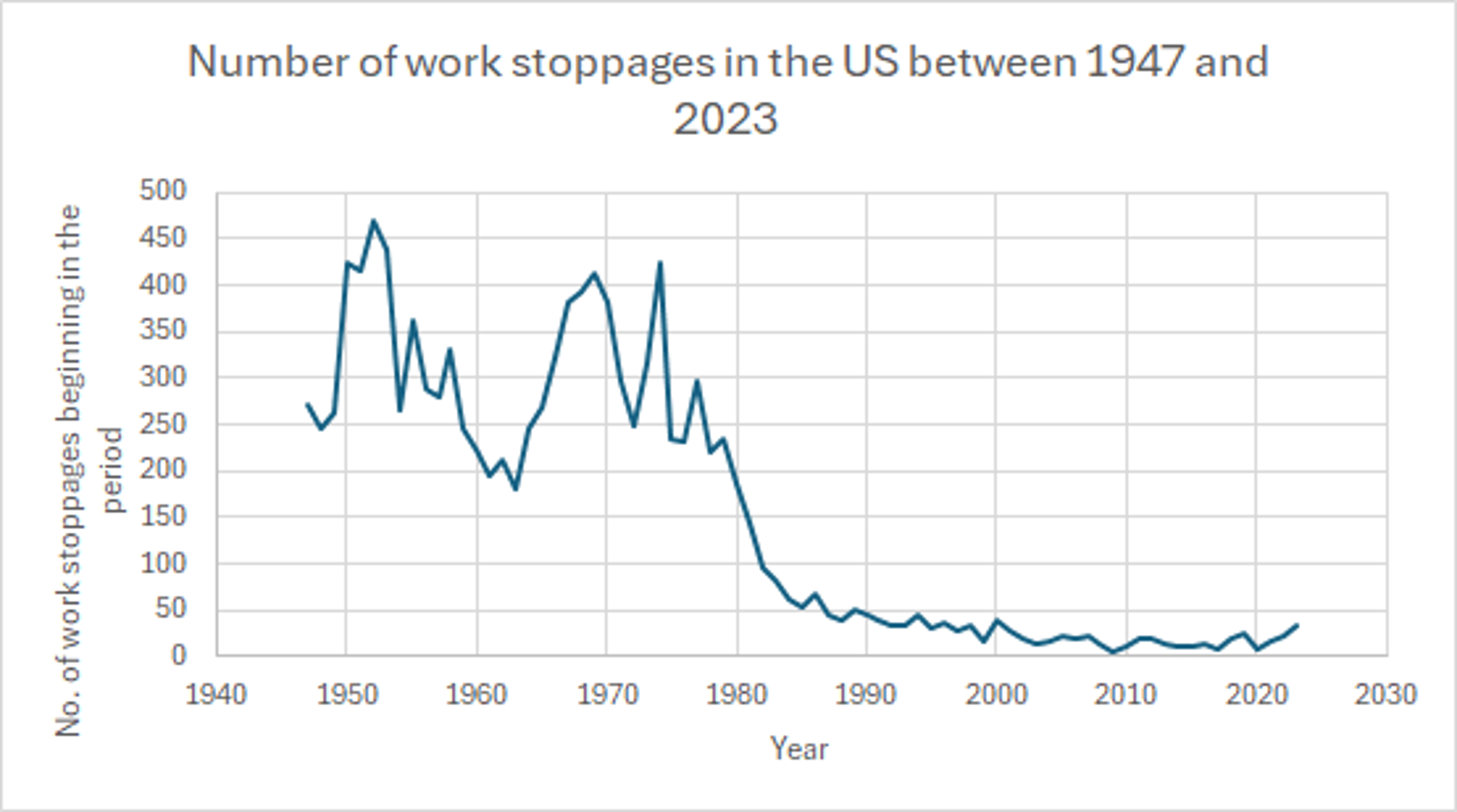
Number of work stoppages in the US between 1947 and 2023.
Capital accumulation has stagnated, and with it demand for labor. Whilst there have been fluctuations between periods of crises, Aaron Benanav notes that:
Global capitalism is failing to provide jobs for many of the people who need them. There has been, in other words, a persistently low demand for labor, one which is no longer accurately registered in unemployment statistics. Labor underdemand is reflected in higher spikes of unemployment during recessions, as in the 2020 pandemic recession, and in increasingly jobless recoveries, a phenomenon likely to be repeated in the pandemic recession’s aftermath.
—(Aaron Benanav, 2020)
In a review of Dan Evans’ A nation of shopkeepers, I argued that this was due to the process of lumpenisation, and an expanding stagnant surplus population globally. Marx describes this category as:
A part of the active labour army, but with extremely irregular employment. Hence it offers capital an inexhaustible reservoir of disposable labor-power. Its conditions of life sink below the average normal level of the working class, and it is precisely this which makes it a broad foundation for special branches of capitalist exploitation. It is characterized by a maximum of working time and a minimum of wages.
—(Karl Marx, Capital Volume 1)
Returning to the strategy of patience and the Merger Formula, we can empirically show that the conditions that gave rise to the workers’ movement that was such an integral part of initial orthodox Marxist theorising have qualitatively changed. What does it mean to go in and organise your workplace today, when precarious contracts, fragmented working conditions, and workers having to pick up multiple jobs to stay afloat is becoming more and more common? What does it mean when,
The social foundations on which the workers’ movement was built have been torn out: the factory system no longer appears as the kernel of a new society in formation; the industrial workers who labour there no longer appear as the vanguard of a class in the process of becoming revolutionary?
—(EndNotes Collective, EndNotes 4: A history of separation)
These trends do not diminish the importance of workplace organising on the scale of the individual workplace, but they do call into question the return of a powerful workers’ movement as an undergirding assumption of a revolutionary strategy. As far as I can tell, this has simply not been addressed in any concrete manner by adherents of the Strategy of Patience/Merger formula. Deindustrialisation and the shifting nature of work are not mentioned in MacNair’s Revolutionary Strategy, and whilst other commentaries on this strategy acknowledge the decimation of the workers’ movement, the underlying assumption is that it can be rebuilt in mass form.
In short, the workers’ movement has become a hollowed out container, despite its foundational status within the Strategy of Patience/Merger formula. Although the workers’ movement itself has not been eternised as a permanent entity, the category itself has become more assumed than explained. In other words, the line of argumentation is that the workers’ movement was the vehicle of socialist power once, and therefore it must be again. The question then, is can it be, given the conditions that gave rise to it are so different to those that exist now? The failure to address this point is the root of the degeneration of the Strategy of Patience/Merger formula as a scientific research programme.
Joshua Clover’s Theory of the Strike
It is somewhat appropriate that Joshua Clover provides us with a periodisation which explains the rise and fall of the workers’ movement, given that the second of our strategic orientations to critique is also his theorisation. These are not mutually exclusive. Put concisely, Clover argues that the strike as a weapon—and with it the rise of the workers’ movement—are directly linked to capital accumulation, not capitalism as a mode of production in toto:
The social content of the strike is also productivity itself, and this is all-important. It is not ‘capitalism’ in some abstract or general sense from which the strike depends…An evident if often neglected fact is that the limited, demand-based strike’s effectiveness by and large coincides not with capital’s frailty but with its vitality, when the wage-commodity circuit is yielding surplus value and accumulation. When production is not expanding, a capitalist has less interest in preserving its continuity and may endeavour to outlast strikers.
—(Joshua Clover, 2016)
Clover argues that with capital accumulation well and truly stalled, the strike (a point of production struggle over the wage) has given way to the riot (a struggle over prices, i.e. over social reproduction), and with this transition the locus of proletarian power has shifted from the workers’ movement (agent of the strike) to the mass mob (agent of the riot). This is the crux of his critique of orthodox Marxism, that the socialist horizon of programmatism,
Accurately refracts the real conditions of the world in which it arises…it arises with the rising power of industrial labor, which is why workers in this sector are able to stand as the revolutionary class fraction. Their growth is capital’s expansion. This does not, however, imply an immutable standpoint or form of struggle…It is from the far side of accumulation’s rainbow that programmatism’s historical limits become evident. When the class fraction that centered the program era no longer exerts a peculiar power over capital, such a course of struggle is foreclosed.
—(Joshua Clover, 2016)
With capital accumulation as the seemingly necessary condition for the workers’ movement, the Strategy of Patience/Merger formula needs to be able to explain how a powerful workers’ movement as revolutionary subject can be rebuilt in the absence of accumulation, where the long post-’73 downturn has resulted in the patterns of underemployment described in the last section.
In Revolutionary Strategy MacNair argues that because the Marxist centre:
…addressed neither the state form, nor the international character of the capitalist state system and the tasks of the workers’ movement, the centre’s strategy collapsed into the policy of the right when matters came to the crunch.
—(Mike MacNair, 2008)
Here MacNair is using auxiliary hypotheses to explain why the Strategy of Patience failed. However, the failure to explain how that workers’ movement can be rebuilt in the absence of capitalist accumulation results in the degeneration of the research programme, resting as it does on assumptions unsubstantiated by history (i.e. a global workers’ movement built in an era absent of accumulation).
Before we move onto Clover’s theory of riot, I must emphasise that this is not an attack on the MacNairist programme, nor an attack on the much weakened workers’ movement. The programmatic demands that MacNair argues for in Revolutionary Strategy—centered around democratic republicanism—are important and place necessary foundations for countering bourgeois rule, and the necessity for cohering the revolutionary left is self-evidently important for building networks and community. What I have tried to do is dispassionately evaluate the scientific content of the Strategy of Patience/Merger formula.
It may also happen that capital finds a way to kick start accumulation. Though the crisis times we are in have a qualitatively different flavour in light of climate collapse, capitalism has found innovative ways to escape “final crisis” time and again, and though it seems unlikely, may do so again. In different conditions the Strategy of Patience/Merger formula may once again feel appropriate, regaining a progressive scientific content (remember, no research programme is ever binned for good!)
One important point to briefly linger on is the 5th of my list of assumptions of the Merger Formula/Strategy of Patience: that is the time to build the socialist majority. Given the speed of climate collapse, the Strategy of Patience is by its very nature temporally desynchronous to the moment we live in. There is more than a hint of irony in my raising of this point, given that The Black Lamp has advocated for the space and time to think through our moment and theorise appropriately for it. This temporal desynchronisation is the jarring reality for communists today, one which haunts our generation more than any other.
Joshua Clover’s Theory of the Riot
If the strike and the workers’ movement are at their most potent at the apex of capital accumulation, Joshua Clover argues that the riot is the dominant form of struggle outside of these moments. I shall attempt to do Clover’s framework justice, but I would recommend his book to everyone. Just as with MacNair, his is a powerful and thought provoking framework, even if the reader may not agree with his conclusions. Briefly, Clover starts with Giovanni Arrighi’s Braudelian account of cycles of increasing and falling accumulation:
In the shift that follows crisis, capital, unable to generate adequate surplus value or growth through conventional manufacturing production, is compelled into the space of circulation to compete for profits there, by decreasing costs and increasing turnover time for an ever greater volume of commodities. Struggles in this space are thus central to each given capital’s ongoing existence. There is scant imitation that this generates accumulation in the manner of industrial production.
—(Joshua Clover, 2019)
The complete sequence moves from circulation to production to circulation once more:
The recurrent structure is a tripartite sequence beginning with a financial expansion originally led by merchant capital; material expansion ‘of the entire world economy’ led by manufacturing or more broadly industrial capital, in which capital accumulates systematically; and when that has reached its limits, a final financial expansion. During this phase, no real recovery of accumulation is possible, but only more and less desperate strategies of deferral. Historically, the financial sector of the leading economy has in such a situation found a rising industrial power to soak up its excess capital, thus bank-rolling its own replacement. This new hegemon will form on necessarily expanded grounds, able to restore accumulation on a global scale but by the same token beginning from a position closer to its own limits for expansion.
—(Joshua Clover, 2019)
This periodisation is melded with Robert Brenner’s thesis of a post-’73 long and terminal downturn:
The spiraling reach of long centuries may have run out of room to expand; reformation on a larger scale does not seem to be in the cards (though we should not too easily dismiss capital’s ability to rescue itself from seemingly total crisis). Productive capital held sway from, say, 1784 to 1973. It may yet again. For the moment, this seems uncertain. Far from underwriting a rising hegemon, the United States in its decline is — despite its hypertrophied financial sector — ending its run as a massive debtor nation. It is now possible to argue that, even at a global or systemic level, capital finds itself in a phase of circulation not being met by rising production elsewhere — a distinct phase we will inevitably have to name circulation prime.
—(Joshua Clover, 2019)
Circulation prime is the third part of the sequence circulation-production-circulation prime, with each moment in the sequence signifying the dominant logic of accumulation (in other words financial accumulation followed by productive accumulation followed by financial accumulation to complete the cycle). Clover’s insight is that the riot and the strike as the dominant forms of struggle map onto this cycle such that riot-strike-riot prime are the dominant moments relevant to circulation-production-circulation prime.
What then is the distinction between the strike and the riot? The locus of the strike is the workplace; workers halting capitalist production. Consequently, the strike is a struggle over the price of labor power. By contrast, the riot is centered around consumption. It is a struggle over the price of the very market goods needed to reproduce oneself. There is no collective identity but dispossession.
It is the prime in each sequence (circulation-production-circulation prime and riot-strike-riot prime) that denotes the unique nature of the current long downturn identified by Brenner — a recovery and a restart of the cycle does not seem possible, as evidenced by the cycle of poorer recoveries post-crisis resulting in underemployment, noted by Aaron Benanav in the quoted passage above (see the section titled ‘Assumptions of the Strategy of Patience/Merger Formula’).
This is the core insight of the book. As Clover states in the Final Remarks of a symposium on Riot Strike Riot in Viewpoint Magazine,
The wagers are these: that the riot can now be thought as a fundamental form of class struggle rather than an impolitical spasm; that we can recognize in this the ascending significance of surplus populations within the dialectical production of capital’s antagonists; and that the riot can be in turn seen as a sundial indicating where we are within the history of capitalist accumulation. One may haggle intellectually over periodization, but the existence and seriousness of the dossier together do a good job of telling time.
—(Joshua Clover, 2016)
The core scientific content—i.e. the core of the research programme—is clear here:
Brenner’s long-downturn thesis.
Arrighi’s tripartite periodisation.
The tracking of riot-strike-riot prime to circulation-production-circulation prime
From this descriptive framework, Clover produces a prescriptive model in the form of the commune:
The riot, the blockade, the barricade, the occupation. The commune. These are what we will see in the next five, fifteen, forty years. —(Joshua Clover, 2016)
In an otherwise cautious account of historical dynamics, Clover’s pivot toward the inevitability of the commune is somewhat surprising:
The commune, then, has a continuity with the riot. It presupposes the impossibility of wage-setting as a means to secure any manner of emancipation. It is likely to be inaugurated, like many struggles in the first era of riots, by those for whom the question of reproduction beyond the wage has long been posed—those who have been socially forged as the bearers of crisis…
…At the same time, the commune also ruptures from the riot’s basis in price-setting, because provisioning toward subsistence is no longer to be found in such action. It is beyond strike and riot both. In such a situation, the commune emerges not as an ‘event’ but as a tactic of social reproduction. It is critical to understand the commune first as a tactic, as a practice to which theory is adequate…
…The coming communes will develop where both production and circulation struggles have exhausted themselves. The coming communes are likely to emerge first not in walled cities or in communities of retreat, but in open cities where those excluded from the formal economy and left adrift in circulation now stand watch over the failure of the market to provide their needs. —(Joshua Clover, 2016, his emphasis)
Here then is the auxiliary hypothesis to the core content—the inevitability of the commune, and we are finally in a position to evaluate the scientific content of Clover’s theory of riot.
The Programmatic Notion of the Commune
In The Civil War in France, Marx described the commune as,
Essentially a working-class government, the product of the struggle of the producing against the appropriating class, the political form at last discovered under which to work out the economic emancipation of labor.
—(Karl Marx, 1871)
Clover cites this passage from Marx, suggesting—when combined with his arguing for commune as tactic—that proletarian self-governance will arise as a tactic in the face of failing social reproduction. Despite Clover’s rejection of programmatism that we saw earlier, the advocation and prescription of the commune form ultimately reproduce many of the aspects of a political programme that he rejects in orthodox Marxism.
There is the deterministic element—here the inevitability of the commune—that in turn informs practice (i.e. the commune as tactic). However, what results is something far more incoherent than the Strategy of Patience/Merger formula, because the very notion of a programmatic subject is rejected. This is also why the commune is a tactic rather than a strategic orientation, sprouting up somewhat independently across heterogenous struggles.
The commune then is a necessary tactic within Clover’s framework, rather than one that springs from within a wider strategy. It is a logical consequence of the failure of social reproduction. However, one cannot help but feel that this is a somewhat handwaving leap from the otherwise careful periodization that makes up the core thesis. Indeed, it is clear that in the time since Clover wrote Riot. Strike. Riot. the commune form has not been reproduced across global struggles. It is hard not to agree with Alberto Toscano’s summation in his contribution to the Viewpoint Magazine symposium:
Too much of this concluding narrative is mortgaged to the idea—whose historical record in the age of strikes speaks for itself—that increasing immiseration is a driver of concerted challenge to the system, and that an increase in the incidence of revolts announces their coming composition. Banking on the utter fraying of state and capital, on a ‘great disorder’ from which will rise ‘a necessary self-organisation, survival in a different key’ is weirdly optimistic for a text with such a keen emphasis on the ‘limits’ of struggles. Why fill the formal gap in the periodizing theory with this unnecessary hortatory content? Why even name the commune, if it is not a social form or relation, but (as the book’s last line declares) ‘nothing but the name for …a peculiar catastrophe to come’?
—Alberto Toscano (2016)
Indeed, the descriptive and prescriptive elements cleave apart with ease, and one cannot help but feel that the necessarily scientific periodisation has great utility in explaining the degenerated aspects of orthodox Marxism, whilst conjecture about the commune form has thus far failed to be proven correct and is too vague to even evaluate appropriately on any spatial or temporal scale. In summation, the linking of periodisations has great utility for the scientific evaluation of strategy.
However, the deterministic invocation of the commune appears to have no scientific basis whatsoever, leaving us in a somewhat contradictory position. Clover argues against programmatism and does not advocate any revolutionary strategy, but extracts a revolutionary tactic from his theoretical framework that is also an inevitability. With his vague timeline and no sense of the determining conditions that will generate the commune beyond the failures of social reproduction, we cannot even properly evaluate these claims against reality. Recall that for Lakatos, a degenerated research programme is one whose auxiliary hypotheses achieve no increase in explanatory power. By that definition the inevitability of the commune is degeneration, given that this hypothesis has no explanatory power due to its vagaries. However, the periodisation remains intact, and a valuable framework for scientific progress.
Science and Critique
I mentioned the split between Marxism as science and Marxism as critique earlier and this is worth commenting on briefly. The core of the rejection of Marxism as science is rooted in the argument that Marxism is really critique, or critical science (as opposed to bourgeois science). John Holloway—who was part of the collective that published Open Marxism—argues that critical or revolutionary science,
...can only be negative, a critique of the untruth of existing reality. The aim is not to understand reality, but to understand (and, by understanding, to intensify) its contradictions as part of the struggle to change the world…For Marx, science is negative. The truth of science is the negation of the untruth of false appearances.
—John Holloway (2019)
The tension between the scientific Marxism that has been the subject of this essay, and the critical Marxism as described by Holloway is baked into the very foundation of Marxism, from the writings of Marx onwards. The goal was always to change the world, but this necessitated interpreting it.
The central question then, is whether it is possible to prescribe positive action, or simply to unravel the contradictions. I do not have a satisfactory answer to this question because—unlike the partisans of either path—I do not believe there is one, and this is because I do not believe in a static framework that is permanently relevant (i.e. a metaphysic).
Certainly the prescriptive framework of orthodox Marxism constituted a progressive research programme at a specific period in history. As I have argued above, I believe that moment has passed, and that the underlying assumptions of that programme no longer hold. However that does not mean that prescription must be done away with altogether. What I have attempted to do in this essay is work through the assumptions of a couple of research programmes to identify degeneration. This, after all, is what doing science is all about.
Mētis, Dialectics, and Systems Theory
This essay has been almost exclusively focused with modern Western forms of investigation, largely due to my own familiarities and ignorances. I was however drawn to James C. Scott’s description of Mētis in Seeing Like a State, from which much of the detail of this section is drawn. Mētis is an originally ancient Greek concept that, broadly understood,
Represents a wide array of practical skills and acquired intelligence in responding to a constantly changing natural and human environment.
—James C. Scott (2020)
Its significance for this essay is in showing that the modern scientific method is by no means the only useful mode of inquiry for understanding and interpreting our world. Science—by its very nature—is a slow and conservative process. It is also a broadstroke process with a high level of abstraction involved. The more complex the system being investigated, the higher the level of abstraction. Mētis by contrast is concerned with experiential adaptation to rapidly changing environments (i.e. systems). As Scott puts it,
Mētis is most applicable to broadly similar but never precisely identical situations requiring a quick and practiced adaptation that becomes almost second nature to the practitioner. The skills of Mētis may well involve rules of thumb, but such rules are largely acquired through practice (often in formal apprenticeship) and a developed feel or knack for strategy. Mētis resists simplification into deductive principles which can successfully be transmitted through book learning, because the environments in which it is exercised are so complex and nonrepeatable that formal procedures of rational decision making are impossible to apply.
—James C. Scott (2020)
Mētis then is extremely specific practical knowledge, relevant to a specific environment and its fluctuations within some bound. In other words it is local, contextual, and particular. When I first read about Mētis I was incredibly excited at some of the analogues to systems theory and dialectics. Whilst Marxists have argued over what dialectics is, and what it is for — often with the terms of debate laden with mystification — I have found systems theory to provide an analogous framework, whilst eschewing the obfuscatory language of dialectics and facilitating the analysis of complex systems.
In his review of Lewontin and Levins’ now classic work of philosophy of science, The Dialectical Biologist, the evolutionary biologist John Maynard-Smith argued that the language of dialectics was obsolete, given the advances in mathematics and the establishment of systems theory:
One interpretation of dialectical materialism would be as follows. Marx and Engels wished to analyse the behaviour of highly complex systems. At that time, mathematics was adequate only for the description of simple dynamical systems. Therefore they were obliged to borrow from Hegel a set of verbal concepts, such as the negation of the negation and the change of quantity into quality. Today developments in mathematics make reliance on such vague verbal concepts less necessary. This argument can be made more explicit by considering the change of quantity into quality. We now have a mathematical language for describing such changes.
Imagine a dynamical system described by a set of differential equations. If we gradually change the parameters in the equations, the behaviour of the system will also change gradually: for example, if the behaviour is to oscillate, then the period and amplitude of the oscillation will change gradually. But ultimately, as we continue to change the parameters, we reach a threshold, or ‘bifurcation’, at which the behaviour changes dramatically: for example, the system may cease to oscillate, and start to grow exponentially. This, I take it, is a mathematical description of the change from quantity into quality. When one has played with a few systems of this kind, one has a better feel for how things are likely to behave.
—John Maynard Smith (1986)
Now whilst the significant increase in computing power today means that we are capable of modelling the behavior of far more complex systems than in Marx and Engels’ time, it is not—and will never—be possible to write down equations that model the totality—the entire system, a system so complex we could not even know all of its parts. What systems theory does provide us with however, is a framework within which to understand how parts of a whole (which can be modelled) interact, and how no system can be understood except relationally.
These are the very qualities of extension and utilizing various vantage points that Marx employed in Capital (and crucially quite distinct from his approach in the introduction to A contribution to the critique of political economy), as discussed in this essay, as well as an approach to unravel contradictions which can inform future behaviour. Moreover, they move us away from the idea that science is all about isolating a variable from its environment and testing causation, i.e. Cartesian reductionism. The interaction between two variables in an isolated system can only ever give us limited information about the interaction between two variables within the complex systems they actually exist in. It is the interaction that is key.
Thus, not only does systems theory provide us with the tools of dialectics, but it does so without all the mystificatory bullshit that is as likely to shut down collective inquiry as it is to unravel the underlying contradictions within society. Mētis—like systems theory—attempts to understand system behaviour within its specific environment, and whilst the language and framework of systems theory is relatively new, Mētis has been a practical tool that one could argue goes beyond our species. It is the understanding of the specific system of focus, whilst systems theory facilitates knowledge of the interaction of systems.
Whilst neither Mētis, systems theory nor dialectics provide us with an out-of-the-box revolutionary strategy, they do provide us with the tools for understanding how to navigate the heterogeneity and complexity of the social systems that we wish to overturn. What does change look like at the local level? How does this interrelate with larger forces that the individual can rarely comprehend? This I believe is the starting point for revolutionary theory appropriate for the current moment.
Marxist Scientists or Sales Reps?
I am a firm believer in the idea of Marxism as a science, but its practitioners have failed to consistently hold their espoused variants of Marxism to those standards. It is vitally important that we understand our collective revolutionary past. Indeed, many of the errors of the electoral, popular frontist left—constantly seeking alliances with class enemies—are a result of a failure to learn the lessons of history.
However, we cannot pick up the programmes of history without concretely understanding our present either. Now, more than ever, Marxist historiography and critique feels far more robust than prescription. This is a direct consequence of a lack of meaningful power, which leads to underexplored assumptions. To give one example, there has been a vibrant and generative recent body of work on climate change and Marxism.
However, many of these works feel the need to provide a prescriptive conclusion which is underbaked, whether it is a Green New Deal predicated on a workers’ movement (as critiqued here), or a vague nod to decoupling from growth. With no pathway to enact these demands, it is no surprise that this is the form of prescription. Even where it is well worked through—as in MacNair or Clover—there are glaring assumptions that simply do not pass scrutiny.
Which leads me to the question: Are we pitching a product, or are we scientists? This is not a reframing of the critique vs science argument, with science now switching roles. I do believe science can be used as a prescriptive revolutionary tool. The level at which prescription is viable may be, or may no longer be at the same scale as the orthodox Marxism of old. This is why I espouse the system theoretic framework discussed above, because it enables us to evaluate across different scales. Bourgeois science is riddled with hypocrisy, with an often gaping chasm between its idealised self-conception and reality. I do not believe that systems theory or dialectics or whatever one wishes to call it is a catch-all solution, but it does help us think about how we might restructure the lab environment; about how the links in the funding chain are constituted; and what an alternative science absent the profit motive might look like.
This is the science that Marxists must espouse, one that is self-aware and self-critical, and not beholden to the bottlenecks of historic lineages.
References
Birukou A, Wakeling JR, Bartolini C, Casati F, Marchese M, Mirylenka K, Osman N, RagoneA, Sierra C, Wassef A. 2011. Alternatives to Peer Review: Novel Approaches for Research Evaluation. Front. Comput. Neurosci.
Braverman, H. 1974. Labor and Monopoly Capital: The Degradation of Work in the Twentieth Century. Monthly Review Press.
Brenner, R. 2010. The Long Downturn: The Roots of the Crisis in the Real Economy. New America Foundation.
Ehrenreich, B. & Ehrenreich,J. 1977. The Professional-Managerial Class. In Radical America Volume II, Number 2.
Forman, P. 1997. Recent Science: Late-Modern and Postmodern. In P. Mirowski & E. M. Sent, Science Bought and Sold. University of Chicago Press.
Holloway, J. 2002. Change the World Without Taking Power. Pluto Press.
Kaiser, D. 2005. Drawing Theories Apart: The Dispersion of Feynman Diagrams in Postwar Physics. The University of Chicago Press.
Krige, J. 2006. American Hegemony and the Postwar Reconstruction of Science in Europe. Cambridge. MIT Press.
Margolis, LB. 1992. Does American Science need Russian Humanitarian Aid? New Biologist 4: 413-417.
Marx, K. 1845. The German Ideology.
Marx, K. 1857. The Grundrisse. Penguin Classics.
Marx, K. 1867. Capital: A Critique of Political Economy, volume I. Penguin Classics.
Mirowski, P. 2011. Science-Mart: Privatizing American Science. Harvard University Press.
Mirowski P. 2018. The future(s) of open science. Soc Stud Sci 48:171–203.
Slaughter, S., & Rhoades, G. 1996. The Emergence of a Competitiveness Research and Development Policy Coalition and the Commercialization of Academic Science and Technology. Science, Technology, & Human Values, 21(3), 303–339.
Turner, S (2001). Scientists as Agents. In P. Mirowski & E. M. Sent, Science Bought and Sold. University of Chicago Press.
Alvin Gouldner (1980). The Two Marxisms. Seabury Press, P.3
James C. Scott (2020). Seeing Like a State: How certain schemes to improve the human condition have failed. Yale University Press, P.93
Imre Lakatos (1989). The methodology of scientific research programmes. Cambridge University Press, P.48
Paul Feyerabend (1993). Against Method. Verso, P.14
Black Lamp Editorial Collective (2023). In Search of New Models. Online.
Paul Mattick (2019). Theory as Critique. Haymarket Books, P.20
Helena Sheehan (2017). Marxism and the Philosophy of Science. Verso, P.7
Michael Burawoy (1990). Marxism as Science: Historical challenges and theoretical growth. American Sociological Review, P.775
Frederik Engels (1883). Dialectics of Nature. Online.
Paul Paolucci (2009). Marx’s Scientific Dialectics. Haymarket Books.
Karl Marx (1859). A contribution to the critique of political economy. Online.
Rosa Luxemburg (1900). Reform or Revolution. Online.
Vladimir Ilyich Lenin (1902). What is to be done?Online.
Karl Marx (1867). Capital Volume 1: Preface to the first German edition. Online.
Bertell Ollman (2003). Dance of the dialectic: Steps in Marx’s Method. University of Illinois Press, P.75
Dan Frost (2020). Strategy and Tactics. Online.
Mike MacNair (2008). Revolutionary Strategy. November Publications, P.25
Rosa Janis (2018). Building the Mass Party: The Merger Formula in the American context. Online.
Joshua Clover (2019). Riot. Strike. Riot. Verso, P.145
Aaron Benanav (2020). Automation and the future of work. Verso, P.9
Karl Marx, Capital Volume 1 (Penguin Classics, 1990). P.795
EndNotes Collective, EndNotes 4: A history of separation. Online.
Karl Marx (1871). The Civil War in France. Online.
Alberto Toscano (2016). Limits to Periodization. Online.
John Holloway (2019). Change the world without taking power. Pluto Press, P.118
John Maynard Smith (1986). Molecules are not enough. Online.