
This essay was originally published in ‘Supermaterialist’.
Since those few weeks when seemingly everyone was rewatching Mad Men, I’ve been preoccupied with a question I saw repeatedly: why do so many of these characters seem to hate advertising?
To those of us living in the long shadow of global capitalism, the preoccupation of thinkers of the last century with consumerism, advertising, and authenticity seems quaint. Personal branding is no longer just for celebrities, it is no longer reflexively off-putting to average people to speak of themselves as commodities, many industries essentially require it. Advertising isn’t separate from “content,” that slurry of video and voiceover and music that populates our social media feeds; with influencers and product placement, the two are deeply entangled. There is no conceivable alternative to an identity based on consumption for those of us who spend a significant amount of time online.
There was a time when Adbusters’ circulation reached 120,000, and movies like Fight Club agonized over the hollowness of an identity built around owning things to popular acclaim. There was a time when it was common to worry about our minds and our desires being hijacked by advertising. That time is over, and this ideology of consumer identity has thoroughly diffused into the air we breathe, a basic and unquestioned tenet of modern life. Now, even counterculture, once concerned with reducing consumption, can be bought on Shein.
Advertising has taken on new forms in the age of social media. Influencers were inaugurated as a new (supposedly more democratic) form of celebrity, a new career path, made possible through brand collaborations and paid promotion. The fundamental principle at work is identical to traditional advertising: associate the product with an aspiration, a desire, a fantasy: a lack conjured by an image.
The kinds of images found in advertisements, created to inspire want and aspiration, have been with us as long as modern advertising, and arguably as long as visual art. But now, through the technological democratization of photography, photo editing, publication via social media, and AI image generation, some sense of separation between ourselves and the things and selves we desire in these images has been lost. We are no longer positioned as passive consumers of media: the accessibility of content creation gives any person with a phone and an internet connection the ability to appear in images for potential mass consumption, the ability to not only fantasize, but to directly place ourselves in fantasy images. This shift has deeply affected our drives and our imaginative worlds.
SELLING FANTASIES
Visual media has always been able to shape our fantasies because fantasies are themselves narratives. When people talk about “romanticizing [abuse/eating disorders/depression],” or that children will emulate violent video games, or when they used to talk about the evils of advertising, this is what they’re getting at: the anxiety that our deepest desires will be influenced in destructive ways by fiction. Our desires for love, power, comfort, success, ease, and pleasure are given narrative form. For people with less life experience (the very young, sheltered, or chronically online), fiction can start to look like the only satisfying expression of those desires. Men who watch so much pornography they struggle to find real women attractive, women so engrossed in romance fiction that real life courtship seems uninteresting and passionless (pornography and erotic novels are, of course, not exactly equivalent), boys who can spend hours per day completing video game objectives but who feel no drive to succeed artistically, academically, in a career, or even in their own self-reproduction, girls who struggle to imagine a happy version of themselves where they aren’t beautiful.
None of this should be taken as a condemnation of reading, watching movies or TV, or playing video games. Some fantasies are dangerous, impractical, or impossible. Many people fantasize about being a hero, and, unless they want to dedicate their entire life to that as doctors or firefighters, RPGs can be a fun, healthy, and accessible outlet. We very much need our outlets. The problem arises when fantasies overtake the real experiences they are meant to push us toward. If a lonely woman puts all of her free time into romance books and leaves no time for attempting to form meaningful relationships, her loneliness will continue. Among the most distilled versions of this is content generated by social media influencers, because it is media specifically intended to inspire aspirational fantasies.
Something that strikes me about influencer content is how little it resembles most traditional advertisements, despite functioning as advertising. While the basic logic of “connecting something that stimulates the viewer to the product” holds, in paid promotion, the product almost feels incidental. The real ad is for a lifestyle, or really just a fantasy of one. The product might just help get you there, and they’re just a normal person letting you know about it. This is not like ads for household products, where the product’s utility is demonstrated. It’s similar to clothing ads, but clothing ads still notably exist in a universe defined by the fact that every person wears the same brand of clothing. What they really resemble are advertisements for perfume.
In a perfume or cologne ad, it is impossible for the viewer to experience any facet of the product aside from the shape of its bottle. To make up for this, perfume advertisements operate more than other advertisements on the logic of fantasy: this is what it will feel like when you smell like this, this is how people will see you. It’s selling a lifestyle, or just a vibe, in the same way influencers do. Unlike perfume ads, influencer content is sought out and enjoyed for its own sake as entertainment. And unlike perfume ads, while influencers certainly do advertise products, they also advertise the experience of being an influencer. It seems to be especially effective on children, who have consistently rated content creators high among their ideal careers for a decade.
Early last year, a video came across my timeline with the caption “Casual Parties at Lake Como” (the original video is gone, but clips from the video can be found on this TikTok account). While Twitter users were repelled by the unselfconscious posturing required for this video to exist, the status-anxious influencers and their fans who put the “Old Money aesthetic” on the map over on TikTok were enthralled. It was well-timed with New York Magazine's The Cruel Kids’ Table feature: young people, dressed like a middle-class striver’s simulacra of country club chic, captured in opulent scenes, their cocked eyebrows and knowing smiles suggesting to the viewer some secret, something we’re missing out on, a club we’re not in.
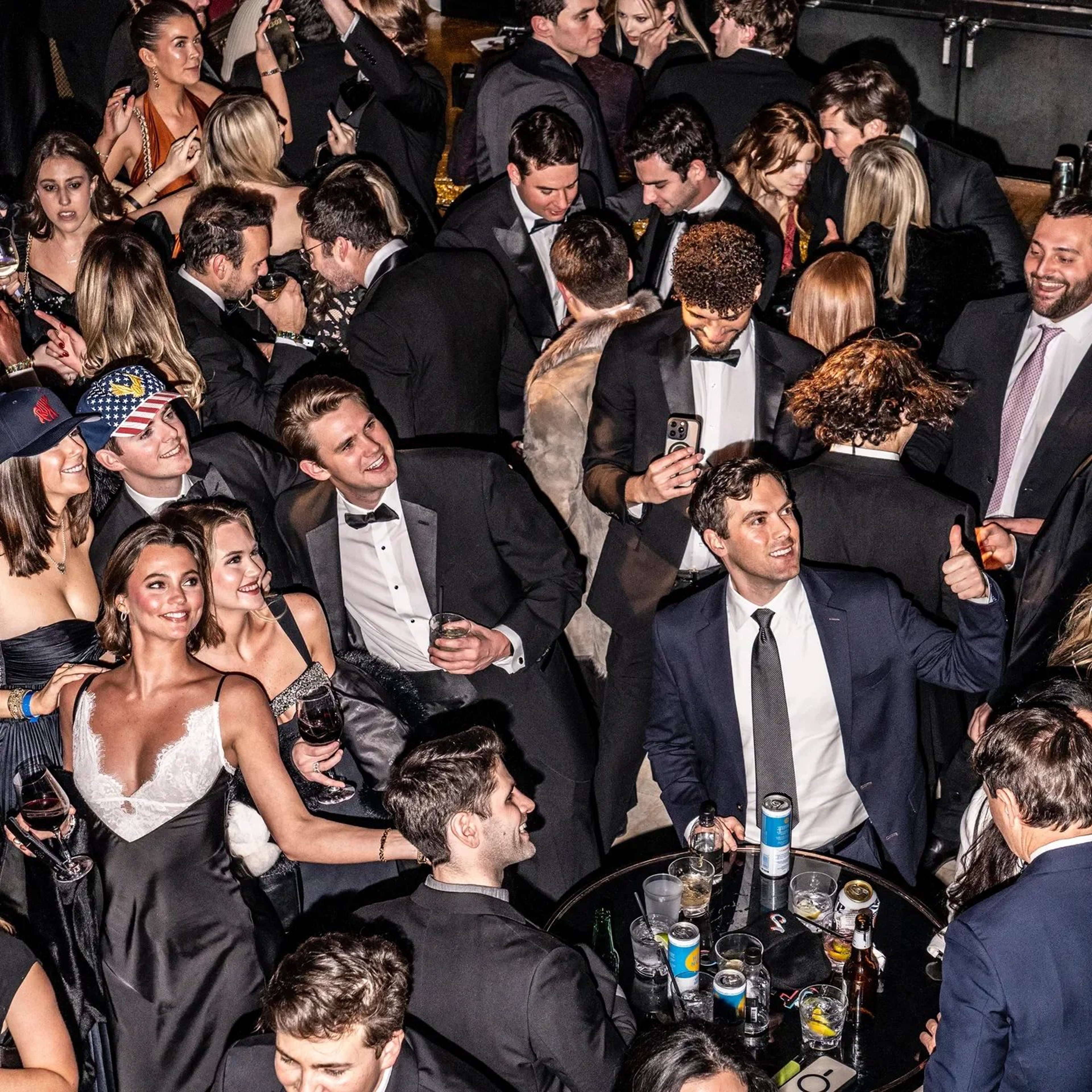
‘The Cruel Kids’ Table’ (2025)
In the case of the Lake Como video, that secret club turned out to have a membership fee: thousands of dollars for access, not to a social club or a luxury vacation, but to content creation opportunities for influencers with this “Old Money” aesthetic in mind.
How did we get to this place as a culture, where it is possible for the illusion of an experience to be more desirable than actually experiencing it? And make no mistake: it’s not possible for a video shoot, in an attempt to create a spectacle for consumption, to resemble the experience it attempts to simulate at all. Dinnertime conversations filmed to look good on camera are not enjoyable conversations (and people who would pay thousands of dollars for an immersive selfie museum do not make for good conversation partners). Real food does not film well and would have to be replaced if you actually tried to eat it. Video shoots require early mornings for good light, long days, multiple reshoots, hair and makeup touchups, and certainly don’t feel like a party. Conversely, while filming a real dinner, a real boat ride, with friends can produce a beautiful memory for those of us who appreciate the lack of pose and polish of candid video, it would not produce the kind of picture-perfect content these influencers rely on to capture attention and imaginations.
None of this is to say ordinary people are clamoring for memberships to the Tuxedo Society Inner Circle; I’m sure most people who find the fantasy represented here appealing would not aspire to pay thousands of dollars to produce video content of themselves. But they want something of it, something more than the experience itself; they want the full fantasy, and that fantasy is inexorably tied up with the images being generated, and a desire to fit into them. This desire can inspire endless, covetous scrolling and often emulation: a friend’s Instagram feed may contain the kernel of influencer ambition.
PICTURE PERFECT
A bellwether for this underlying drive is the shift in personal style, makeup, and hair. I’ve heard some Millennials lament the shift away from the bright, expressive makeup trends of 2016 in favor of the more muted Clean Girl look popularized in recent years, but they have one crucial thing in common: they look good in photos and videos taken on a phone. This is the unifying quality of the most popular aesthetic trends since the social media revolution: makeup is saturated and defined enough to look good on camera, hair reliably falls perfectly (or not at all in the case of slicked back buns), clothing is thin and conforms as closely to the body as possible to leave no exaggerated impressions of the wearer’s shape and size.
Presentation for the digital audience often comes at the expense of reality. New York City, full of wannabe and bona fide influencers, turns out to be an excellent field site for seeing the failure of translating virtual aesthetics to the real world. We’ve all seen Instagram makeup that looks startling in person; even the healthy glow of more subdued Clean Girl makeup can lean oily in reality, and often still involves thickly applied foundation and dramatically feathered brows that look exposed in the harsh light of day or the subway. Those slick buns lend themselves well to carefully selected angles, but tend to create an exaggerated silhouette on some heads and emphasize asymmetry, not to mention closed comedones. Not to mention the stark difference in how filler looks in photos compared to in person. Close-fitting clothes often rely on elastane and spandex for fit, and while well-made versions of polyester blends exist and can look nice, the standards for what looks passable on camera are much lower. Cheaper options that look awful in person and feel worse get the job done, and allow for much more variety: a crucial consideration given that repeating outfits might induce boredom, a death sentence for a social media feed.
Contrast any of these with makeup videos produced by Bobbi Brown or Lisa Eldridge, Vidal Sassoon Style Academy hair tutorials, or old “wash and go” routines in Cosmo. The emphasis is generally on blurred edges, hair that moves and gives shape and body, and expects frizz, makeup that wears well and decays gracefully, working with shadows more than blunt lines, which doesn’t always show up well on camera.
The proliferation of cheap goods enabled by global exploitation has enabled unprecedented levels of self-curation. Never in all of human history could masses of people access clothes and accessories so cheaply, and in sync with influencer lifestyle content, the expectation of access to these kinds of goods has become commonplace for working class people of all incomes. Higher quality items, especially more sustainably made ones, often spark outrage online from women who can’t afford them even when this higher price better reflects the labor put into making the garment. These women defend their purchase of extremely cheap clothing produced by impoverished women abroad as a kind of victory over the previous gatekeeping of luxury goods by the very rich. Gatekeeping, rather than exploitation, is the cardinal sin of the ruling class for working people without class consciousness. Intertwined with mass consumption of faux designer items is the worsening anxiety around aging, is a sense in these women that even if they could work to a higher wage, they would age by the time they had enough money to furnish their fantasy life and no longer fit into the fantasy. Shein ameliorates the dire humiliation of being young and poor and unable to live like a rich girl.
This tendency isn’t restricted to personal style: decor in homes, restaurants, and hotels is overwhelmingly plastic attempting to look like something other than plastic. Plastic plant walls with imitation neon lights, resin side tables blended to resemble marble, bricks painted on drywall. Smoothness is the signature style of the digital age. It all looks passable on camera and lends the appearance of curation and quality in pictures and videos, but up close, the results are often underwhelming and end up looking as cheap as they are. Such places tend to be successful: they’re the backbone of touristy neighborhoods in New York, but versions of them can be found in trendy areas of most cities.
It seems that for even the average, socially adjusted, young woman (and her boyfriend), the quality of photos that come out of an experience is as important as the experience itself, but why? Observers without this neurosis tend to assume the cause is simple attention-seeking, social status, and, in the case of influencers, of course, money. These clearly can all be part of the equation. I’ve personally taken photographs of friends that were explicitly meant to make an ex or a friend jealous, or to attract someone’s attention. And of course, plenty of people also feel it’s important to let friends and loved ones see what’s going on in their lives (I’m certain their mothers would agree). But there’s something else going on.
At the risk of exposing my own enthrallment, I’m getting at a feeling I have known well. I have been on a boat with friends, day drunk and not over-full of fresh ceviche, enjoying the warmth of the sun from under a large hat, radiating love for my friends and boyfriend, when the cameras come out. A picture is, at its best, a souvenir, crystallizing and preserving all of the feelings of a time well spent. At its worst, it can pop the bubble of your fantasy of that time. While, as an adult, I can usually appreciate a photo through squinting red eyes and unthoughtful posture and vacation bloating, as a teenager, I felt a great deal of disappointment in these images, and they would retroactively shatter the way I felt about myself in a moment, replacing the joy of the memory with a sense of shame. For some reason, it felt important for my feelings while I was living an experience to correspond to my fantasy of how that experience ought to look, what I ought to look like in it.
I think this was something more than just an insecure teenager’s desire to feel beautiful. I was among the first generations to grow up on the Internet, and with teen girls’ unfettered access to the Internet came an endless stream of amateur “aesthetic” photos: girls my age who looked beautiful and ethereal and perfect. My notions of beauty standards were less tied up in what girls I went to school with looked like and much more with these highly stylized images that had more in common with fashion magazines, selling not just the beauty of an individual, but some kind of holistic image, an ideal self perfectly staged and posed, exactly the way she is supposed to look, an Icon.
ANOREXIC TRANSHUMANISM
AI image generation opened the floodgates, particularly the pictures people made of themselves. Filters (and their attendant body dysmorphia) were an obvious predecessor to the AI profile picture, but AI seemed to break down the reserve of those who had never made a habit of posting edited selfies. People I had never known to be particularly vain suddenly began to post dozens of avatars, digitally altered to look like more conventionally attractive versions of themselves, often as literal fantasy characters: elves, witches, space warriors, super heroes. The draw of this drive clearly goes beyond young, attractive women.
Tied up in the draw of these images is something more than wanting to be desired (and given the increasing number of women who recoil from sexual interest, sometimes has nothing to do with it). When I search for this feeling in myself, it’s a desire for something like transcendence. An Icon never fails to embody its aspect, doesn’t decay, can’t be debased, it is never caught at an unflattering angle, it doesn’t make unattractive faces when dealing with strong emotions, it is an object of fantasy, not mortal lust.
The drive so many women seem to feel to become an Icon is not one that arises spontaneously or independently. This is the highest expression of the pressures placed on women to fulfill contradictory fantasies, and unsurprisingly, has a lot of overlap with the fantasies men have of women. While I’ve primarily focused on the generation of images intended for consumption by women, they are dwarfed by the scale of fantasy images generated of women for consumption by men.
A recent New York Times Magazine article analyzed sexualized images generated by users of X’s Grok Imagine. As anyone familiar with controversies involving Grok image generation might expect, many of the images were deepfakes undressing women, and yes, children. But there was also a different kind of image, ones generated using AI with no intention of appearing realistic. These images feature beautiful, “ethereal” women; they are celestial beings, goddesses, elves, fantasy pirates, smiling gently, approaching the viewer. The author of the piece describes the dichotomy well: “On the one hand, images of real women subjected to violent and humiliating fantasy; on the other, images of fantastical women coming to life and walking into our world.”
In Male Fantasies, Klaus Theweleit observes a similar dynamic in literary and poetic depictions of women. He writes that the nameless women invoked in these scenes are abstractions of women, reduced to “the principle of flowing, of distance, of vague, endless enticement,” to “the image of an immeasurably perfect and all-deserving Beatrice." Theweleit contrasts this with the treatment of real, especially non-noble, women, who are instead shackled to gendered labor and the expectation to embody a standard that was never intended for them. Very few of us resist the urge to mold ourselves into a shape that might inspire devotion. AI has only made the generation of highly specific fantasies widely accessible.
No aesthetic trend is as emblematic of this desire to become an image as anorexia. Anorexia is often misunderstood as simple adherence to beauty standards. Certainly, thinness is part of the price of entry for acceptance in the upper echelons of social hierarchy, and it’s almost impossible for women to escape having its importance hammered into our heads. And yet the self-mythologies of anorexics in their fiction and social media presence and research drawing from patient self-reports reveal this drive for transcendence, they describe “pursuing the ideal of an asexual, angelic, even disappearing body.” The fact that some women want to escape sexualization by starving away their breasts and thighs should perhaps not be surprising, given the link between sexual abuse and eating disorders, but even for women who haven’t been direct objects of abuse, anorexia can function (in their fantasy) to elevate them to impenetrable Madonna from fleshy “whore.”
While further research is required, initial review of the data suggests eating disorders spikedduring the COVID-19 pandemic. In the isolation of the pandemic, there was a momentous shift in the proportion of people whose social interaction took place primarily online. Pre-pandemic social media was, of course, already ubiquitous, but for a typical well-adjusted teen or young adult, social media was supplementary to real-life socializing, and it was considered a sign of maladjustment or social stuntedness to spend more time online than with friends. With the lockdown and the subsequent reduction in in-person activities, screen time increased across the board and has remained high; adolescents and young adults spend more of their lives than ever on the Internet, and with that, their sense of reality, their desires, their fantasies are increasingly shaped by the virtual world.
Anorexia is particularly suited to the aesthetic sense of the virtual world. Like makeup and clothing trends, the kind of body favored by phone cameras is made up of sharp, well-defined lines. The adage that “the camera adds ten pounds” is even more true with the flattening effect of digital photography. Bodies that look sickly and emaciated in person look striking on a social media feed. There’s a kind of cartoon effect at work: extreme proportions propel images into the realm of iconography.
This kind of body dysmorphia, once practically the exclusive domain of women (and gay men), is now also motivating a generation of young men to “looksmax,” scrutinizing and disciplining their faces, bashing themselves with hammers, abusing steroids, and even meth in an effort to reach physical perfection. They, too, seem to want to become something more than human, to escape the shame and self-consciousness and fear of humiliation that inevitably undergirds such extreme monitoring and taming of the body. And of course, it all needs to be streamed.
COMING TRUE
Nostalgia distorts our perceptions of the past, but I don’t think it’s just nostalgia that makes me believe that, when I was growing up, normal adults did not care this much about their image. Undoubtedly, there have always been concerns over image (as reputation), and my WASPier neighbors certainly aspired to make their families picturesque, but these family photos were curated for an audience they immediately knew, not for an entire internet of imagined fans.
Online, an image will be compared to an endless stream of other images, other beautiful women in perfectly composed moments. The perfect vacation, the perfect date, the perfect night out, the perfect engagement, the perfect debut, the perfect glow up. It's still a matter of beauty standards and perfectionism, but it's perfection of the souvenir, not the moment.
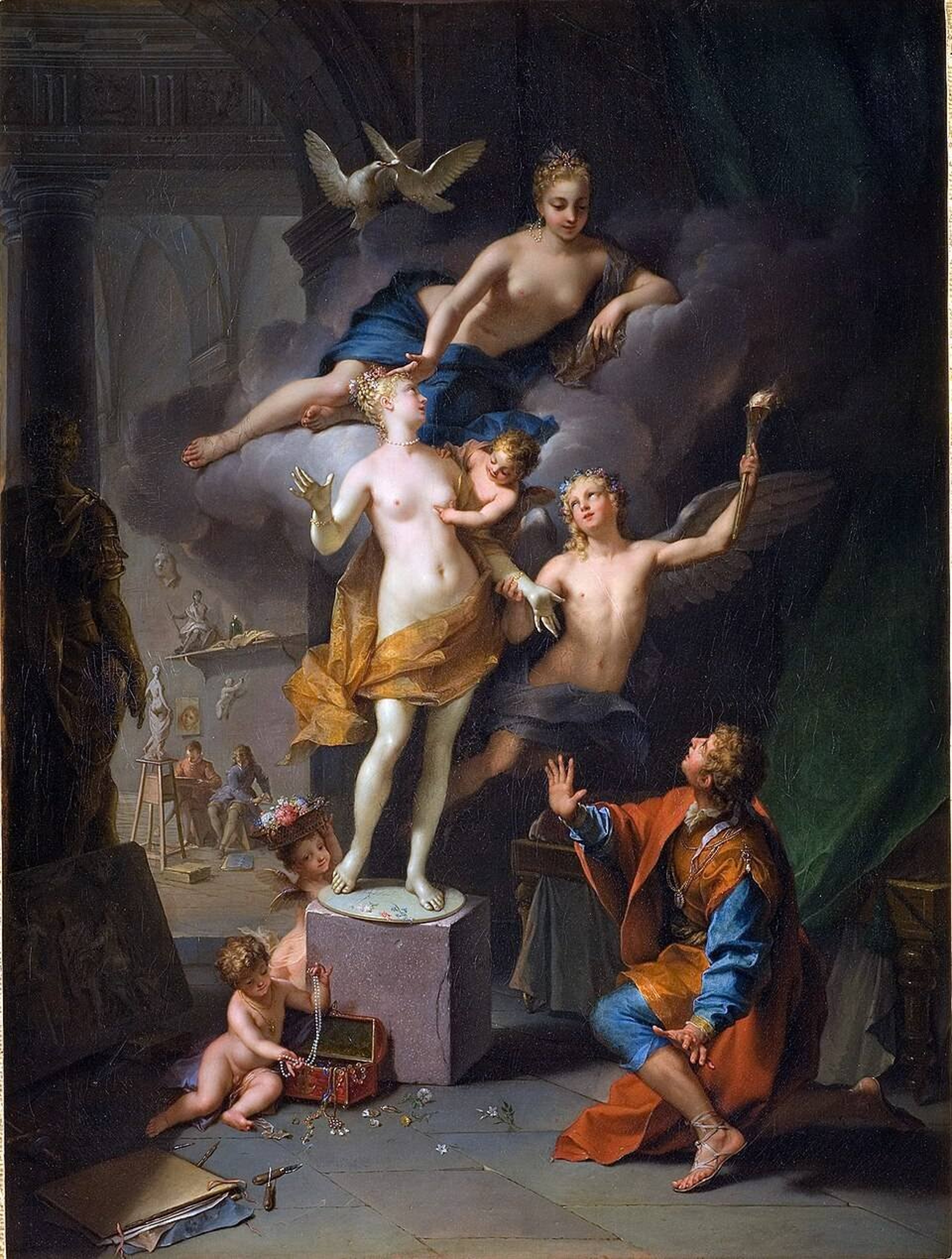
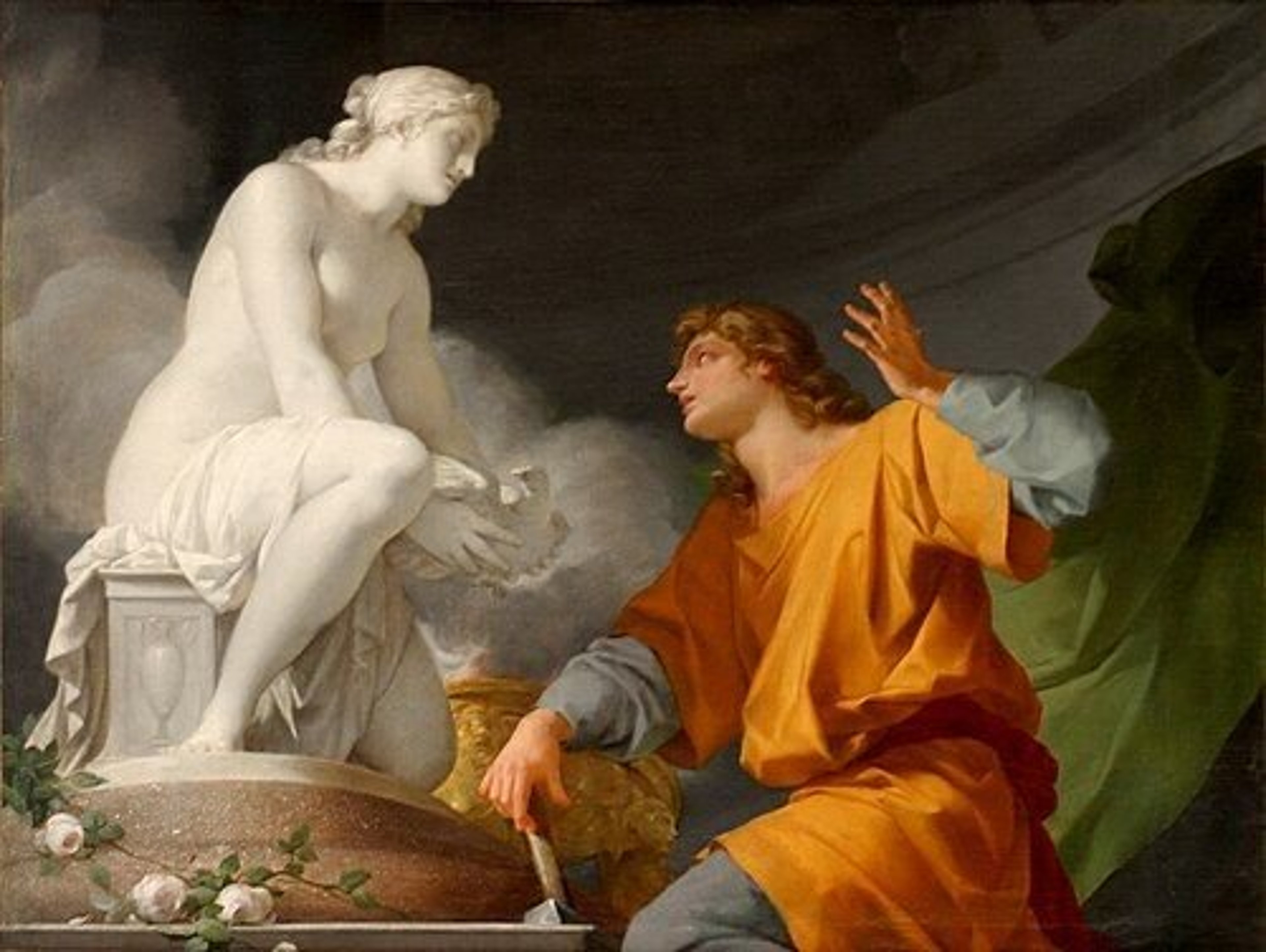
‘Pygmalion Adoring His Statue’ Jean Raoux (1717)
In lucid moments, I sometimes ask myself what it actually is I want. I don’t want to be an influencer or a model; I don’t really even post or take many pictures of myself. Even if I did, it wouldn’t be satisfying. The contradiction of the production of even a stunning image is that the image is not you. It will stay the same as you change and grow old. The image will only really resemble you in particular lighting and from particular angles. A person cannot endure the burden of living as an image, and the attempt to do so hollows out the human beauty those images attempt to represent. There is no real transcendence there.
Life is meant to be lived, and images, at best, should inspire us to see the beauty in the real world, in ourselves, in one another. This is not about getting off the Internet or social media–that isn’t a practical solution when so much of our social lives have moved online and when most of us are reliant on it for information about our loved ones, the news, and the culture. I admire people who have disconnected, but I dislike the feeling of disconnection. Instead, I think most of us need balance, sources of self-esteem that come from our impact on the real world and the people we affect around us.
You will never produce an image of yourself that will show you how you really look in the eyes of someone who really sees you. That’s what all this iconography and digital fantasy is really grasping at, and it’s something no image can truly capture. The images produced for social media are the cheap, compulsive gratification of the desire to inspire something in another person. A friend, bright-eyed and laughing and lounging in the park, a lover furrowing his brow in intense concentration, a striking woman, illuminated by a ray of light just as she pushes her hair back and crosses the street. These are brief flashes of something unconscious, unpredictable, and divine that paintings and photos have always attempted to capture. I don’t know if there’s a way to stop wanting it; I think some would prescribe asceticism. But in lieu of that, making an audience of people I actually know at least feels like going back to the wellspring.
The only way to tear your self-concept away from the demanding, often cruel gaze of untold numbers of virtual eyes is to resituate yourself in something real; something that you can shape back at the same time it shapes you. If it’s true that it’s transcendence we’re after, we will never find it in the virtual world, our Idols will be lost in an endless deluge of real and artificial rivals, our digital records have less practical permanence than stone tablets. The only real transcendence is how we affect other people and the world around us. At a moment in history when it feels like real change is possible, will you spend it building toward a better world with people you know, or enthralled by the tyranny of images?