
Mar 3, 2026
These are the Vile Nations of Trump’s America.
An examination of the different nationalist ideologies that form the Trump coalition.
by T. E. Moon
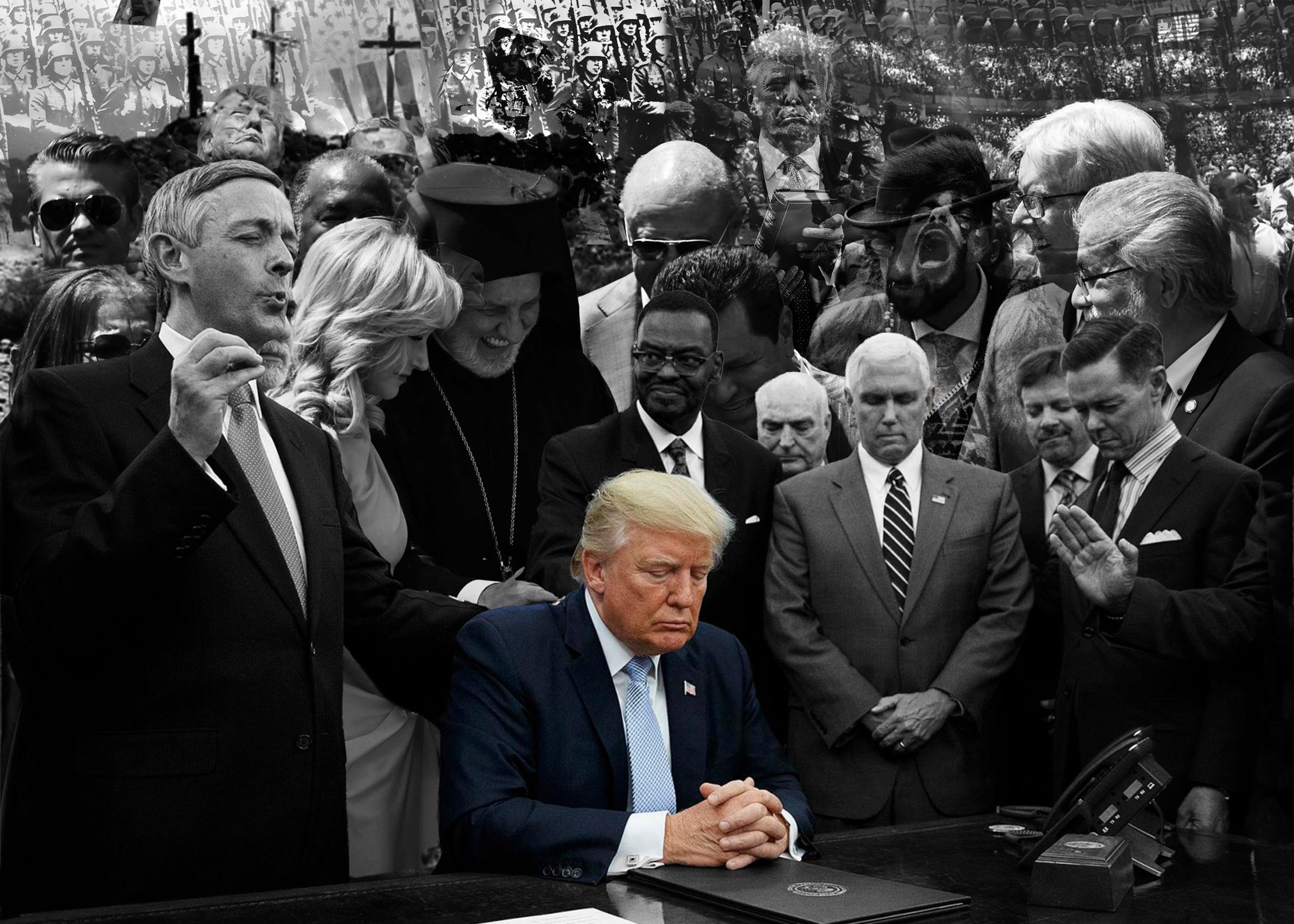
Imagine, for a moment, that you’re an American oligarch. You sit atop a vast economic junta, extracting the labor value of tens of thousands to enrich your lineage in perpetuity. There is no friction in your life; nothing is without a price, and you can always afford to pay it. If you felt the need to touch the stars, thousands of STEM graduates stand ready to devote their technical expertise to defy gravity for you in exchange for steady employment.
You pay a cohort of people to maintain your personal apparatus of control and fulfill your every capricious wish. Cooks, cleaners, and security guards. Drivers, personal trainers, and groundskeepers. A legion of lawyers so vast they couldn’t gather in one room without appearing a conspiracy. Experts in the stock market, experts in banking, experts in spiritual advice. Wizards in tax avoidance, wunderkind in communications. Lobbyists with the personal phone numbers of ninety Senators in their contact lists. Even the odd moocher or hanger-on. Whatever you need, whenever you want it.
The source of your wealth might be a package delivery network, tracts of mega-farms, or cutting-edge technology firms. Globe-trotting ships, a collection of oil rigs, and a series of mines in the DRC. Maybe the facilities that make the bombs dropped on families in Gaza. You could own one of the brands sewn into the clothes of most Americans, as well as the textile factories in South Asia, with suicide nets placed outside the windows. Internet platforms, apartment buildings, media outlets, entertainment studios, pharmaceutical companies, or insurance funds.
You commodify people’s health, shelter, or food. You spend billions getting others to scientifically design machines built to catalogue and carve up the attention of every person on earth, to transform them into addicted consumers. You sell to fretful new parents; to neurotic, lonely teenagers; to the bereaved, the desperate, and the filthy rich. Consumer money disperses only to end up with you at the end of the day anyway.
Maybe you loan cash to other capitalists, or you’re part of a fund that bets on their failure—there’s always money in that. Maybe it’s a little bit of everything. A healthy portfolio is a diverse portfolio, after all: a little bit of crypto, a little bit of gold. Some data centers in the foggy marshes outside Memphis, some intellectual property in a downtown office in New York City. Everything you can get your hands on. Your burning genius will surely guide you towards eternal growth. It’s not like you can fail, anyway. You always have the money to fall back on.
What would be your limits if this were your world?
The ever-growing list of predators and enablers exposed by the botched cover-up and release of the Epstein files proves that some oligarchs believed any limits were erased long ago—if they ever even existed at all. The ceaseless examples of open corruption by Trump-aligned plutocrats are simply the latest manifestations of a startlingly common mindset among this narrow class: it is their right to do whatever they want. This is the logical conclusion of a class privilege that produces indisputable madness, a madness born of enjoying personal utopia at the expense of the suffering of billions.
However, this seemingly endless power should be seen as little more than an illusion. There is indeed a limit to the ability of the oligarchs to impose their will on the world, and that limit is firmly drawn by the capabilities of mass politics. These people know, despite their derangement, that they are few and we are many. They are minuscule minorities even within their own class. More than half of the proletariat are hired by firms that employ more than 500 workers. These 20,000 firms or so are owned by a handful, a thousand or fewer, total households. Another large chunk of workers are employed within the dubious legal grey zone of being an “independent contractor” or “solo practitioner.” However, an overwhelming majority of the American owning class, upwards of 99 percent, owns small firms that employ the remaining segment of the American working class. These small business owners are driven deeper into exploitation by the inevitable pressure imposed by monopolies and oligopolies, as large firms take advantage of economies of scale to offer workers higher wages and customers cheaper products.
All of these owners, whether mom-and-pop or oligarch, represent somewhere between a measly 2 to 5 percent of the total American population. The other 95–98 percent of people depend on selling their labor—or on those who do—to survive. They work to eat, day in and day out. Some are paid well enough to identify their own future with the general success of the capitalist economy. Others, hoping to climb the ladder of capitalist management, adopt the worldview of their bosses in an attempt to ascend through sheer belief and hard work. Even more seek to avoid selling their labor by living dependently on what they can obtain from charity or welfare. The vast majority simply accept the world as it is, seeking to make as much of a life for themselves, their friends, and their families as they can muster.
There are divisions in the working class, of course, which the oligarchs know very well. Between those with houses and those who rent. Between the citizen and the non-citizen. Between men and women, black and white, rural and urban. Between the well-paid, the poorly paid, and the unemployed. Those who can manage a family vacation every year and those who sleep in shelters, in cars, or on the street. America contains multitudes; it contains all types: weirdos, freaks, lovers, fraudsters, dreamers, doctors, and addicts. Each wants their say, if they can find their voice. They want to belong to a community that values them; they want to freely shape their own lives; they don’t want to have to sell their labor to pay rent. They yearn for liberation even if they don’t understand their own yearning—even if it manifests as hatred for the world that hated them first.
The oligarch yearns for something else. In a different time and place, when the feudal landowners and slavers ruled the world, the capitalists sought to break absolutist despotism. They launched revolutions to bring the political structures of their societies into line with the economic transformation that had occurred in early modernity. Technological advancement, a market in land rents, urbanization, the displacement of the peasants, global colonialism, and unparalleled profit. All of this change had to mean something, and it couldn’t mean the enduring, eternal rule of a hereditary class of dandy warlords who stifled dissent and seized property whenever it suited them.
What it meant was mass politics and revolution. It meant Yankee Doodle and La Marseillaise. It meant liberation in Haiti and liberty in Gran Colombia. It meant the engine of history turning its gears. Parliaments, constitutions, and the rule of law. Caudillos, barricades and secret police.
It meant the birth of nations and the death of empires.
In short, it meant the bourgeois project of liberalism, and more relevantly, of nationalism. The European empires returned with a vengeance in the late 1800s, after their defeat in the Americas, backed by a new generation of rapacious capitalists, only to be overthrown once again by national liberation movements in Asia and Africa. Revolutions in Russia, in China, in Cuba. A mosaic of nation-states, a global economy. The collapse of the Eastern Bloc and the rise of the “unipolar, American, liberal world order.” Two hundred and fifty years of chaos, bloodshed, hope, reform, revolt, despair, transformation, and profit.
What these oligarchs yearn for is a way to force history back into the bottle, with themselves installed as the new aristocrats. They bankroll pseudointellectual morons like Curtis Yarvin to argue for a future where they are permanently seated as a hereditary class of owner-nobles. They look back with barely concealed envy at the fortified castles of the old lords, buying whole islands and ring-fencing them with automated defense systems to recreate the effect of a moat. Their endgame is the total commodification of existence: forcing the rest of us to pay them rent just to breathe in the digital and physical spaces they hold under contract.
If they had their way, they would toss “nationalism” into the waste bin of history. They would declare themselves and their progeny a divine stratum, blessed by a God of hierarchy to rule in perpetuity. And yet, it is but a consequence of inheritance and property law, backed by the force of the state and of social custom, that the capital generated by their workers' endeavors is reserved overwhelmingly for them. They wish to dismantle the very world that made them, both in the historic and immediate sense. This is their true yearning: a reaction not just against mass politics, but against the forward motion of humanity itself.
While communism, as the movement to abolish the present state of things and move humanity forward, remains marginal in American politics, the oligarchs still prove themselves unable to turn back time. And so, they are forced to return to the well of mass politics and ideology. The spectacle of bourgeois democracy requires convincing vast swaths of the aforementioned 95–98 percent to mobilize behind some segment of the bourgeoisie. They must put aside any notion of class consciousness—if they ever had such a notion at all—and instead take their place in the subordinated ranks of some class-collaborationist faction of nationalists. An eternal reformist popular front from above, a carousel that never stops spinning.
It is from this need that modern American ideology and political factionalism arise. Oligarchy is an international phenomenon; it floats above borders. Oligarchs can, and do, exist anywhere in the world. Elon Musk and Jeff Bezos have no loyalty to America, nor to any community. This is best evidenced by the constant moaning of these types, forever threatening to flee with their capital, whenever a progressive campaigns on implementing something as modest as a minor tax increase. They belong to no one but themselves and to capital itself. They use the concept of the nation only because people respond to it. They find in the nation the only tool capable of doing the job.
Human beings, living with the burdens of millennia of history, living in the context of diverse languages, foreign cultures, divergent skin tones, historical oppressions, and state borders, ascribe meaning to these factors. An individual is made into a member of a nation by the structural apparatuses that precede their birth and determine the circumstances of their lives. Further, those unique circumstances create a personal identity that puts that individual in community with or in opposition to others.
Lenin attempts to define a nation as a specific social relation arising out of the context of the collapse of feudalism, meant to facilitate the expansion of an administrative state within a particular geographic area, populated by people who speak a common language, to make commerce as simple as possible. I would quibble on the essentiality of the characteristic of language as a necessary component of actually existing nationalism. Clearly, unifying characteristics like religion or citizenship have proven to be equally effective mechanisms by which to forge national identity.
Nations are not ephemeral fads spun up in a corporate boardroom or focus-grouped by modern political consultants. Rather, they are the fossilized remains of centuries of brutal material struggle. The cultural, religious, and geographic identities that define these older nations are the inherited superstructures of past political economies. When the early colonists needed to justify the expropriation of Indigenous land or the chattel enslavement of Africans, the material necessity of that extraction forged the ideology of white nationalism. Both concurrently and over generations, this economic utility calcified into deeply held, independent cultural identities. Today, these identities possess a relative autonomy; they operate as historical material forces in their own right, motivating human behavior and demanding blood long after the specific economic conditions of their birth have mutated.
This particular analysis focuses on the ways in which the Presidential Administration of Donald Trump and its allies, as of the early months of 2026, utilize nationalism to mobilize fractions of the American working class behind fractions of the owning class. This does not include an analysis of the Democratic Party and its class collaborationist, liberal nationalist, and progressive nationalist tendencies. Much of the early history of nationalism was, as stated above, fundamentally liberatory in nature. Some might argue that this is still the case in some circumstances, as in Palestinian liberation or Pan-African nationalism. Such a further analysis would require a distinct essay; suffice it to say that those arguments are irrelevant here. In this case, I am not discussing the nationalisms that claim to free mankind, but those that openly advocate that some segment of it band together to dominate all the others.
It is a coalition of this kind of nationalist that makes up both the current Trump administration as well as most of its official opposition. The ideologies of class collaboration that lie below offer us nothing save, perhaps, tactical instruction.
They are our enemies. They must be defeated.
The Don
“There has to be a point at which Dad comes home!”
Tucker Carlson, 2024
Any analysis of the contemporary American political regime must begin with the big man himself. A pedophilic billionaire in his own right, Trump is a real expression of the unfiltered id of the oligarchs. He lives only for hedonistic pleasure, personal enrichment, never-ending praise, demonstrations of power, and an ethereal legacy. Trump identifies his own personal interest as indistinguishable from that of the state, believing it his right to pat down the cushions for as much spare change as he can find. He slaps tariffs on countries because he didn’t like how their leaders spoke to him on the phone. He’s arbitrary and vacillating in his decision-making, often simply following the advice of the rich guy who spoke to him last.
His narcissism is biblical; for him, every political issue is framed into one simple question: “Is it good for Trump?” Trump is instinctually racist, although his racism is one of ignorant arrogance and cruel indifference rather than seething hatred. That, he reserves for mouthy women. Mostly, though, he simply doesn’t care if you suffer, so long as you don’t make a scene and suffer all over the floor of one of his properties.
Trump divides the world into two camps: those who are loyal to him and his enemies. It doesn’t really matter who you are, so long as you bend the knee. A Kennedy black sheep, a billionaire casino owner, a waiter at a local restaurant. Bend the knee. Respect the King. Kiss the ring. For those who take the offer, they may indulge in the debauchery, violence, and corruption that fuel his movement. Those who oppose him must be treated with maximum prejudice.
Those searching for an ideology within Trump beyond this might as well seek the fountain of youth. He will do whatever it takes to maximize what he perceives to be his personal prospects, at all costs, until the day he dies. He will throw anyone overboard, sacrifice a thousand lambs, to live for but a fleeting second longer. Death clearly terrifies him, and he sinks further into myopic senility with each passing day.
He has already demonstrated he shares no sentimentality for ideological concepts such as “preserving the peaceful transfer of power” or “following the rule of law.” In fact, he openly and notoriously instigated a mob of his supporters to illegally storm the Capitol building to overturn a democratic election. He simply doesn’t care. He’ll take the whole ship down with him. How then does Trump seek to use nationalism to stay in power? The same way he did before, of course: by calling upon his own nation.
The biblical concept of nation comes from Abraham, with the Israelites all being identified as the descendants of this quite literal patriarch, locked forever in covenant with God. In this understanding, a nation is familial. A nation is a chain of mothers and fathers, sons and daughters, in unbroken links of blood stretching back to before people can remember. It is a metaphorical notion of this premodern kind of nation that undergirded the ideology of the Tsars and the Kaisers. As a father rules his family, so must the Emperor rule his nation. He is a good and just Father who wants the best for all his children. He offers bread for good behavior and a switch for bad. For the good of the Father, for the good of the family.
Some commentators have remarked on the patrimonial nature of Trump’s administration. With the notable exception of the immigration enforcement armies, he has eschewed constructing a rigidly loyal bureaucratic apparatus to enact his will by force. He prefers to operate in an almost pre-modern way, with personal favor, bribery, and intimidation being his tools of choice. I am not the first to identify this as a form of government by organized crime, in which the ideological particularities of action are less important than ensuring that they materially benefit the organization and its leader.
This also explains the highly reactive and piecemeal nature of Trump’s retaliations. An indictment of a political enemy here, an occupation of a city there, media consolidation and preposterous personal enrichment always unfolding in the background. He thrives on the stage, playing a wrestling character you hate at first but eventually cannot deny. The message is clear: tell Daddy how much you love him, don’t do anything to piss him off, and everything is going to turn out just fine. Maybe you’ll even get rich if you know how to work him right.
Trump offers a direct incentive structure: identify with me and be rewarded and entertained; oppose me and be humiliated and crushed. He offers a side to choose because he’s unafraid to point at his opposition and plainly call them enemies, with all the truth and force that such a declaration entails. And once someone follows him, once they name him Father, it becomes difficult to switch sides. Reality quickly becomes warped. Questions arise from a place of emotional defensiveness and communal delusion. Why should we listen to all the loony leftists? Have you not seen how they attack him? How can they attack us for staying loyal? By attacking Father, they’re attacking the family, after all.
There’s a perverse freedom in submission to such a dynamic. Once you’ve acknowledged him, a whole new world opens up. He doesn’t care if you’re an evangelical Christian, an atheist of Jewish heritage, or even, as Mayor Mamdani can attest, a Muslim socialist. Father is the only God that matters. He’ll even allow women or non-white people to publicly carry out his will. Father’s generous like that. He’ll let you pursue your own projects, so long as they don’t disrupt his own. He’ll let you enrich yourself. And like any malicious and bored parental figure, he’ll often pit his kids against one another for sport. The greatest venom is always reserved for the outsiders, but there’s plenty of room for white nationalists, Zionist propagandists, teamster presidents, oil tycoons, tech billionaires, and fascist deportation officers to all backbite over their differences. They struggle against one another like squabbling children, overeager for Father’s approval.
There is, of course, a distinction between those strategically submitting to take part in Trump’s coalition (who will be dealt with later in turn) and those who have fully taken Trump’s side. This group is fully drunk off the toxic stew of regime media, communicating in a language only intelligible to the initiated. Conspiracy functions as a signal of belief. It’s those rotten Democrats! The woke liberals, the deranged leftists! Nancy Pelosi and shifty Adam Schiff! The Biden crime family, the cabal, and the ghost of Hugo Chavez! Our good and just Father would never do us wrong! It must have been those tricky boyars. Father's advisors like Pam Bondi and Kash Patel are scheming to betray Father and his people! If only he knew!
For the true believers, there is no bottom to this kind of conspiratorial thinking. Anything can be upheld as a shibboleth for the one, true doctrine. Anyone can be denounced as a despised heretic. For them, Trump truly did win the election of 2020. For them, there remains a vast and indescribable network of Islamo-communist transgenders who have taken over every movie studio and neighborhood school. These are those who hung on every Q drop, those workers and small business owners and oligarchs alike who truly look to him as Father. For many, their friends and family all do the same; their pastor does, their coworkers all do. How could they not, if they wish to keep the life they knew?
This is a cross-class alliance forged in submission to a charismatic, bloated bully. It will last for as long as he does. It may even outlive him, through his children. After all, Trump was chosen by God. God saved Father’s life, you know? Turned his head that day in Butler. He chose Father. Blessed His nation. Are you with us or against us?
Some have even stooped so low as to identify Trump as a “cult leader.” He commands, and they obey; Father knows best. But this, I think, is an insult to Trump. Now granted, most cult leaders don’t tend to start with the advantage of being a nationally recognizable billionaire media-hound, but they do tend to sputter out at around a couple hundred followers or less. It’s rare to find a cult leader who dies peacefully in their own bed, surrounded by throngs of their pacified followers. Most of the time, these con men eventually find themselves facing the collapse of their enterprise, one way or another. But Trump has managed to blow past commanding a handful—or even hundreds—of weak-willed dimwits to dress in robes or clip his toenails.
Trump has forged a nationalist coalition whose central pillar is publicly demonstrating faith in Donald Trump personally. Only he can fix it. He’ll cut taxes on tips, drive out the Mexican-born competitors putting your pool-cleaning company under, and topple the ruler of Venezuela just to repossess some rusted-out oil refineries to add to your corporation’s list of assets. Just pick his side. Join his team. Give your Father the respect he deserves.
What is articulated above is nothing more than a set of observable social practices that define one as a “Trump supporter.” Going to rallies. Buying his crypto trading cards, autographed Bibles, or golden sneakers. Taking potshots at your lesbian niece and making yourself unwelcome at your sister's house. Who needs em’ anyways? You always have your MAGA buddies. And if you don’t have them, you always have all the smooth-talking hucksters paid millions to lie to you.
It becomes a material dynamic with time. Trump offers them jobs in his paramilitary. He offers them pardons when they rip people off or commit crimes in his name. He offers them enemies to hate and leaders to follow. Many Trump fanatics were faking belief when this all began. What does it matter after everything they’ve done and said? For them, even if his flaws were once clear, they become fuzzier with each liberal or leftist whine. The true believers find comfort by bathing themselves in hatred. For them. The outsiders. They hate us. But don’t worry, Father is right here.
The Conservative Nationalists
“I've spoken of the shining city all my political life, but I don't know if I ever quite communicated what I saw when I said it. But in my mind it was a tall, proud city built on rocks stronger than oceans, wind-swept, God-blessed, and teeming with people of all kinds living in harmony and peace; a city with free ports that hummed with commerce and creativity.”
Ronald Reagan
Not every Trump supporter has given up their ideology wholesale. There remains a fundamentally coalitional nature to his administration and movement, as the width and breadth of a society as massive in scope as America demands. There are older nations in America, with longer shadows and deeper roots. Members of these nations identify Trump and his loyalists as simply the vehicle for their own empowerment, a battering ram to crack open the rotting gates of the liberal world order. A Great Man by whom their visions are made manifest, where their compatriots are dominant, and their enemies are gone.
The vestigial remains of the so-called “Old Guard” of the Republican Party have latched onto Trump by such reasoning. But who are these types? Are they simply some scared handful of old men scattered about the Senate and some increasingly ignored think tanks? Are the Neocons still lurking in the tall grass, sharpening their teeth? Do they still represent a genuine fraction of the reactionary movement? Of the American owning class? What were they in their past, and what do they wish to be in the future?
Trump did not arise in a vacuum. He seized center stage in a time in which the ideological milieu of conservative thought was still lost in the world of seventy years prior. This school of thinking was a product of the utter transformation of the American state and the breakneck ascendance of the American empire that took place over the course of the mid-twentieth century. The New Deal and the Second World War transformed the state into an entity of such size and scale that it seemed—if you ignored its many failures—capable of accomplishing anything, quashing any enemy.
In the first era of American imperialism, the American cavalry had encircled and eviscerated the Indigenous nations of the continent. American Marines spent the next era toppling governments for the sake of companies that sold bananas. But the Second World War was a truly dramatic effort. It asserted the American Empire on a global stage, checked only by enormous red armies in China and the Soviet Union. America became the preponderant power. By 1945, the armies of the Republic had conquered much of the world. Every department had swelled in size. Whole new military institutions like the Air Force, CIA, and the Joint Chiefs were created to match the recently established civilian New Deal institutions like Social Security, the NLRB, and the TVA. The American State was fully reborn as a modern, powerful entity—eager to assert itself on the global stage with confidence.
By the dawn of the Cold War, the tools at imperial disposal had exponentially multiplied. Thousands of bureaucrats were hired to deduce, debate, and carry out every possible course of action. Feverish meetings were held, straight out of Dr. Strangelove, in which the deaths of billions by pre-emptive nuclear hellfire were discussed with such monstrous banality as to put the Nazis to shame. Anything to stop the Soviets, to stop communism. Anything to justify the next contract with Boeing. Anything to make sure those pesky elected leaders don’t nationalize American property in Iran or Chile or Guatemala. How could ExxonMobil be expected to extract oil under these conditions?
Anything to make use of the tools we have, the tools we made, the tools we buy, the tools we sell. All these guns have to be used; all these bullets have to be fired. Why else have them? What do we have all these planes for? To look badass? Or to kill people? Why train spies and saboteurs if you aren’t going to use them for espionage and sabotage? How else are all these arms manufacturers supposed to make money? Once a thing is built, it becomes inevitable that voices will arise to advocate using it. More than that, these constructed internal political institutions function as ideological mechanisms of discipline. Individuals float seamlessly from the highest rungs of civilian and military command to the insides of armament firm boardrooms and partisan think-tanks. They issue communiques, plans, briefings, theories, and studies to help guide the maximal ascendance of the American empire, reserved for discussion only within their insular community.
This blob, as the Obama liberals famously put it, endlessly harangues officials in both parties to never stray from the golden path, deduced by their best minds to surely lead to a thousand year American empire. The more of the national security state they construct, the larger the blob becomes. And these folks are nothing if not ambitious builders of the national security state. They seized upon their own incompetence in allowing the 9/11 attacks to unfold to construct the skeleton of the fascist bureaucracy. They eagerly violate the civil rights of Americans to spy on them to the maximum extent possible. They deem any opposition to the American state, or its proxies like Israel, as an internal virus, a disease to be burned out with speech laws, monitoring software, and “enhanced interrogation techniques.”
They always resented the doe-eyed liberals for trying to limit this raw national power by submitting it to something as trifling as international law and organization. For them, America is the great exception, and it shouldn’t be bound by what some pinkos in the Hague have to say. Who cares if those international organs were constructed as extensions of the American empire in the first place? These bodies refuse to acknowledge the absolute freedom of action America has earned by the imagined right of blood and victory, and so they must be ignored, undermined, and co-opted at every turn.
At bottom, these people’s nationalism is defined by nothing esoteric. Nothing so intangible as religion and nothing so limiting as race. They’re loyal to the State, period. Order defines their nation. Are you loyal to America? Are you an ally in maintaining its dominance over other foreign states? The primary anxiety is found in American relations with other states and peoples, a consequence of the contradictions inherent in drawing a bunch of lines between billions of people, enforced by enough firepower to end the world. What if those non-Americans come storming over the seas to occupy us, Red Dawn style? Anyone against the state is an enemy, but anyone is capable of helping the state, of servicing order. Give us information. Sign up to serve your country, to defend your country, to live and kill and die for your country.
Post-war conservatism, led by the figures of Nixon to Reagan to Bush the younger, was highly coalitional in its own right. Nebbish patricians like William F. Buckley and the ilk who followed him attempted to define their movement as a three-legged stool: economic libertarianism, social conservatism, and hawkish foreign policy. This formulation was meant to forge a real political coalition. Economic deregulation and tax cuts would ensure the support of capital, both small and large. Free trade agreements and the kneecapping of agencies like the FTC and the SEC would ensure that oligarchic capital would always continue its consolidation unaltered. A war on drugs would facilitate the militarization of the police and the escalation of counterinsurgency tactics against the Black population. Gay people would be allowed to die of AIDS, as God decreed they deserve.
Anything to keep an executive at JP Morgan in New York City, a homophobic doctor who owns his own practice in Michigan, and a racist truck driver in Arkansas, all in the same movement. It should have been clear long ago that the old conservative rallying cry of “small government” was always properly to be read as: “no government opposition to economic and social exploitation.” The shrinking of the government always seemed to mean a wimpy and hobbled regulatory state or a slashing of public healthcare or pensions. It meant the government stopped hiring lawyers who would sue to prevent monopoly consolidation and sex discrimination. It never seemed to mean abolishing the police or the intelligence agencies. It never meant tearing down our prisons or decommissioning our nuclear program.
The fact that the social conservatives, if not the high capitalists, were a junior member of the post-war coalition is revealed by the relationship the movement held with immigration. With the notable exception of Dwight Eisenhower’s viciously racist “Operation Wetback,” there were no self-conscious, sustained, overt efforts to carry out a violent ethnic cleansing on American soil. In fact, Ronald Reagan famously offered amnesty for millions of undocumented migrants, a position so boldly pro-immigration that few Democrats would step forward to proudly advocate for it today.
But why? The answer is simple: immigrants can often be highly useful. Corporations can exploit their lack of legal protections to underpay and overwork them. Further, the center of the Cuban counter-revolution is based in Miami, a flock of birds constantly screeching to finish choking the life out of the people of the island. It was the Iranian diaspora militating for bombing the Islamic Republic, attempting to co-opt an organic revolution and sacrificing the lives of tens of thousands of protestors in a vainglorious attempt to impose the Shah, and American and Israeli imperialism with him, on an unwilling nation.
These emigree communities have fled socialist revolution or global instability (often caused by earlier manifestations of American imperialism). They hail the American state as a savior, not a predator. They’re often true believers in capitalism, in order, in empire. These communities function as the rearguard of the empire, as demonstrated in the political identities of figures like Ted Cruz and Marco Rubio, who utilize their parents’ immigrant status to explain their devotion to America dropping more bombs. It was they, and those like them, who mutter disdainfully at the failure of the Trump administration to go all the way in taking out the Venezuelan government. Kidnapping Maduro and killing eighty people while invading Caracas was nowhere near enough. The whole Chavista state must be swept into the Caribbean Sea, and some puppet like Maria Machado must be propped up as the first step to total hemispheric domination.
Even Black figures, like Colin Powell or Tim Scott, are welcome so long as they toe the line. The point is order, the maintenance of control, to continue to exploit America’s position of dominance over much of the world. Anyone on board with this project is welcome, subject to what the reactionaries within the coalition can stomach.
Aside from these immigrant fractions, the primary base of conservative nationalism remains upwardly mobile anti-progressives. From massive military-industrial firms and their executives to the small business owners and proletarians who delusionally imagine themselves as future haute bourgeois. From those basking in the sun of the American empire, not in some theoretically universalist, liberal sense of democratic principles but because we, America, are strong and they, the world, are weak.
Their particular goals might shift with the times, but their general orientation is like that of a seemingly immovable mountain. They are not trying to put history back in the bottle. They’re not attempting to forge a new world. They want to keep things exactly as they are, with America on top. Even if they are idiots who fool themselves into thinking their actions function to accomplish their goals, this is the great hill they are climbing: to stand atop the churn of modern-day geopolitics and force out another American imperial century. They are willing to discard any previously espoused principles to accomplish this, and to carve out a space in the Trump coalition.
They are the “zombie establishment.” They gaze nervously at the zealotry of the reactionaries and pine for the good old days when they were in charge, and the reactionaries had to bend to their will. But they will soldier on. That’s all they are, after all. Soldiers follow orders, and they don’t question their superiors. Much better to whisper advice in the ear of the King. A bombing here, a coup there. They’ll allow and facilitate the white and Christian nationalists “purifying” the country because they have neither the organization nor the inclination to stop them. But they don’t really get their hackles up either way. They wouldn’t mind if the reactionaries had to pound sand. But here we are, so concentration camps it is. Anything for the State. Anything for the Empire.
The Reactionary Nationalists
“America is not just an idea...[but]…a group of people with a common history and a common future.”
J.D. Vance
What changed then? How was the dominance of post-war conservatism disrupted? Flags, parades, and torturing for your country is all well and good, but slavish devotion to the empire offers no inherent why for its adherents beyond theoretical material enrichment and “national interest.” It can be difficult to continue to mobilize national sentiment purely around killing brown people a world away, especially if there’s little visible benefit from the individual perspective. The crowds of the People’s Crusade of 1096 found it far easier and more appealing to just slaughter all the Jews they stumbled across in Europe rather than trudge all the way to Jerusalem to fight well-trained Muslim armies.
The reactionaries of America take a similar perspective. Why focus on all the enemies outside the border when there are so many traitors, degenerates, and subhumans inside the border that need to be purged? This simple extension of logic made the collapse of conservative nationalist superiority inevitable. If the gains of the empire fail to sufficiently manifest, as they did in the War on Terror, the nation will look for internal enemies to blame.
Reactionary nationalism thus appeals more to those anti-progressives who feel the pressures of the market, the downwardly mobile, and the petite bourgeoisie. It appeals to the small business owner worried about foreign trade deals and immigrant competition. It appeals to the uncommitted racists, anxious about changing demographics and eager to see an ethnic cleansing carried out on their behalf, if not by their hand. The ones who want to watch national rebirth through their phone screens. It appeals to those seething at the growing strength of women in the workforce and society and at the displacement of men from their traditional position of dominance.
But not all reactionary nationalism is the same. Before a more specific analysis of the Trump coalition’s particular reactionary nationalism can take place, we must untangle its various strands. The different cliques can be abstractly categorized as operating within the fields of two distinct but related nations: the “Christian” nation and the “white” nation.
Some might balk at dividing these terms at all in the context of right-wing politics. It is indeed true that there is a great deal of overlap between the two, and that, for the most part, adherents of either act exactly the same as one another. But it is worth teasing out the fine distinctions between these groups, their origins, ideologies, and class makeups, to understand the contradictions the Trump coalition is attempting to resolve.
Christendom was a medieval concept similar to that of the “Ummah” in Islam. It meant the constellation of kingdoms and empires whose subjects lived out the daily habits of pre-modern Christian life. Billions of peasants lived their entire lives dictated by the rhythms of the church calendar. They paid tithes to the international organization that owned more land than any single European king: the Catholic Church. The food, music, celebrations, holidays, laws, language, superstitions, and ideology of most people, in this place and time, were rooted deeply within this concept of Christendom.
It’s intuitive, then, as mass communication became viable through inventions such as the printing press, that the peasant revolution that erupted rooted itself in the teachings of radical preachers and religious reformers. Thomas Muntzer of the German Peasants' War and even John Ball of the English Peasant Revolt, far before him, are prime examples. Of course, Protestantism was as much a noble affair as a peasant one, and its leading luminaries were by no means committed to any sort of genuine social revolution. Protestantism was certainly political, however, and it led to the first great mass bloodletting of Europe in the early modern period: the wars of religion.
A blossoming of political Christianity took place during those years. Protestantism brought with it concepts of mass mobilization, derived from a hyper-fixation on personal and social religious belief and practice. Figures like John Calvin seized control of whole cities (Geneva in Calvin’s case), using them as grounds to experiment with the construction of a Christian Republic. The Catholic Church responded in kind with an equally vigorous counter-reformation that meant to match the Protestants with a mass movement of their own, a recommitment to a Catholic way of life.
In the British Isles, the debauched hubris of Henry VIII helped to decapitate Catholic authority, leading to a massive vacuum for political Protestantism to fill. So came the civil wars and Oliver Cromwell. The Levellers, the Diggers, and the Fifth Monarchists. The lopping off of the King’s head and attempting to bring heaven down to earth. The banning of Christmas, the burning of witches, and the return of the King. The first breaths of capitalist revolution, midwifed by the ideological framework of Protestant Christianity.
New England was founded upon these principles. Of a commitment to a community of, by, and for the Elect. For the holy, those chosen by God, and those who choose Him. But from the beginning, their dreams proved to be little more than vapor. The mechanisms of profit and stake, and not faith and belief, defined the expansion of English colonization. First, the secularists founded Providence, and then the Catholics were given Maryland. A great many religious groups beyond the strict Puritans came to inhabit the colonies by the time of the Revolution. It was precisely the violence of the religious wars and the religious diversity of the new American nation that led the American revolutionaries to adopt secularism as the path of least resistance.
Political Christianity adapted to this by fully embracing the democratic principle. The white Baptists of the South fully represented their slaver parishioners by throwing their weight behind the Confederate cause. Meanwhile, radical Christians like John Brown staged armed insurrections for abolition. There became a million kinds of Christianity, diffuse and diverse. Mainline denominations, fundamentalist sects. Snake handlers and tongue-speakers. Frigid Catholics and Charismatic Protestants. But they didn’t share the continent alone for long. Millions of Jews, Muslims, Hindus, and Buddhists have made their way here over the course of centuries. Millions more increasingly identify as non-religious, and the core of those who remain faithful have become calcified, militant, and defensive.
Sexual revolution, gay marriage, feminism. Mass immigration, mass atheism, fewer and fewer souls attending mass. The demographic majority is slipping through their fingers. The church coffers running drier and drier, the hair in the pews growing greyer and greyer. There has been an escalating feeling of apocalypse among the leaders of reactionary Christianity, a sense of imminent martyrdom by way of being made a minority. They felt the last chance of total control of the culture slipping from their fingers years ago, and things have only gotten more desperate since then. Despite all the claims of Gen Z religious revival, church attendance continues to flatline.
The reactionary Church and its true believers were presented with a stark choice: submit to the reactionary coalition or face eventual marginalization. The smart ones realized they had to work together to survive. They had to do what their ideological forefathers did: roll up their sleeves and get into the mud of politics and power. These pro-coalitional Protestants found ready allies in the traditionalist Catholic and Mormon communities. These groups had never harbored fantasies of a sectarian demographic majority. The Mormons just don’t have the numbers. For the Papists to achieve hegemony, the white Catholics would have to give up their alliance with white nationalists and white Protestants for the sake of solidarity with the millions of non-white Catholics all over America. God only knows when this might come to pass, but I suspect it never will.
As a result of this collective cross-denominational issue of demographic minority, the reactionary Church has settled on the grand compromise of “Christian Nationalism.” It is an ideological expression of pan-Christian unity, a truce among the conservative denominations to open a collective front against the secular world. The fruits of their labor have been bountiful, a true cornucopia of rotted poison. They have stacked the judiciary, from the lowliest judge to the Supreme Court, with radical traditionalists. They fund the training of loyal Christian philosophers, jurists, and propagandists of the most unimpeachably reactionary character. They’ve overturned Roe v. Wade, and they’re aiming to overturn same-sex marriage next.
We’re a long way from pre-modern times. The strength of political Christendom in America has waxed and waned over the years. The evangelical alliance with Ronald Reagan and the Republican Party was articulated as the “Moral Majority.” That majority recedes further from sight every day. They plan on relying on the force of the law to secure their despicable sectarian mandate against the will of the non-believers. The Reactionary Church has always had much in the way of financial resources. The conservative Catholic organizations, the Protestant megachurches, the ranting preachers spitting fire and brimstone, a collection pot making its way around in the meantime.
Any church leader would tell you, though, that the push towards politics originates in the pews. Any call to detach from politics, or to engage with politics in a more liberatory fashion, is met with jeers and distrust by the average churchgoer. The businessman, the very model of the Protestant work ethic—the upright, respectable man—has always been the backbone of a powerful political Christianity. They’ve always provided the funds, committed as they are to a faith that tells them their material conditions are a blessing from God. They want to bring the sword against the unbelievers, against the unworthy, against the devilish. Against the queers and the feminists and the Jacobinical atheists. And they have the money to do it.
White nationalism, as demonstrated by the Southern Baptist Convention, has always been intertwined with Christian nationalism. The colonists of the early republic believed they acted with God on their side, that God wanted them to whip their slaves, and that God blessed them when they murdered Indians. It is true that white Americans, as well as Black Americans, have had their social relations defined by their Church community. They meet their spouses at church, their friends all go to the same church, and they feel their ideology expressed through the voices of their priests. But this set of social practices, the dynamic social practices that make up the Christian nation, is not the same as “white America” as such.
A tangible example of this consequential distinction between the Reactionary Nationalists would be the fissure between Evangelical Zionists and anti-Semite isolationists over American support for Israel. This split can be demonstrated by the crypto-nazi Tucker Carlson's nauseating interview with Trump's fanatical ambassador to Israel, Mike Huckabee. Carlson represented the white nation, skeptical of spending blood and treasure to conquer the Middle East at least partially on behalf of the self-declared Jewish state. Huckabee meanwhile, drawing on his experience as a fundamentalist Baptist preacher, was unshakeable in his faith that a triumphant Israel would pave the way for the return of Christ to earth and the literal end of days.
The quote that begins this section is part of a speech JD Vance gave at the National Conservative Conference in 2024, and it is as near a declaration of white nationalism as Alexander Stephens’ Cornerstone Speech. It’s a part of JD Vance’s embrace of the concept of “Heritage Americans.” Under this schema, the earlier your ancestors helped to colonize the continent, the more deserving you are to be named American. Further, it is that act of colonization that baptizes one with whatever spiritual pixie dust supposedly grants white people the right to rule forever.
This act of colonization is correctly identified by Vance as the origin of whiteness. Hitlerian fascism was famous for leaning into sweeping and grand claims about the primeval connection between the Germans and the lands of Central Europe. Most of these myths are nonsense, but it is true the Germans have lived in Central Europe for a long while. We know the first time a European set foot in America. We can date the first town; we can name who lived there. Everyone is very aware that the history of the white nation is a history of recent slavery, genocide, and conquest.
Whiteness is a product of the demographic realities of settler colonization. It was defined by what it was not. It was not the Indigenous peoples. They were savage, uncivilized, and occupying so much profitable land that could be put to better productive use for capital. It was not Black. They were slaves, stupid and subhuman, worthy only to be capital. That left only the rest of the population, made up of the light-skinned nations of Europe. At first, they came from Sweden, Germany, England, the Netherlands, and France. Whiteness was a way to unify these disparate peoples, identify them as a we, distinct from them—the slaves and the savages.
It was inherently violent, born from the mass displacement of millions of indigenous peoples off the Atlantic coast, back behind the Appalachians, out from the Pacific, into the Plains, and on to concentration camps and reservations. It was a crucial reason for the Revolution, fundamental enough that it warranted being the final grievance listed in the Declaration of Independence:
“He has excited domestic insurrections amongst us, and has endeavoured to bring on the inhabitants of our frontiers, the merciless Indian Savages, whose known rule of warfare, is an undistinguished destruction of all ages, sexes and conditions.”
From 1791 to 1804, the people of Haiti launched the world’s only known successful slave revolt, liberated themselves from their enslavers, and abolished slavery. The British Empire and Napoleon both launched invasions of the island to re-enslave the population. Both were utterly defeated, with the aid of tropical disease. This is, of course, a horrifically inadequate overview of what is perhaps the greatest and most heroic Revolutionary accomplishment of all time.
In the final days of the Revolution, the soon-to-be assassinated emperor Jean-Jacques Dessalines led a campaign to kill every remaining white person on the island, with the exception of a contingent of Polish mercenaries who had defected from Napoleon’s army.
The successive news of the revolt: of the revolution, the invasions, and the massacre, was delivered by racist southern newspaper columns and white emigres fleeing to New Orleans and Charleston. The events sent a panic up the slavers’ throats. Such a thing was supposed to be unthinkable. As the 19th century chugged along, it was this revolution, as well as failed American attempts like that of Nat Turner’s rebellion, that truly put pressure on the slave system. Although the far larger percentage of white people in the South made an outcome such as Haiti far from likely, the possibility always haunted the minds of the slavers. What if the world got turned upside down? What if what goes around comes around?
Add to this the dizzying pace of industrial transformation taking place in the North. The beginnings of truly modern production, of factory floors of workers producing clothing and textiles made from cotton picked by slaves. Of millions of immigrants coming from all over Europe, from Ireland and Norway, and yet more from Germany, bolstering the economy of the North by supplying cheap labor. The gap between the North and South becomes a gulf. The slavers were also enriched by this dynamic, but the precarity of their political position was becoming more and more obvious every passing year.
The swelling of these new immigrants further entrenches a sense of “white nationalism.” A great mass of white people, old and new arrivals both, originating from nearly all the countries of Europe, begin to feel the pressure of proletarianization. They pushed west, determined to attempt a life as petite bourgeois farmers or ranchers. To set out to find gold, or to open up a business to sell tools, clothes, or food to gold miners. The United States military led one last bloody push towards the total subjugation and near-total genocide of the indigenous peoples of the West. Even if the true “purpose” of the killing and thievery was material—the most primitive form of exploitation possible: murdering someone, taking their land, and usurping its productive capacity—the actual acts were each justified by the ideology of the white nation, equivalent in mind and function with the American nation, and its “self-evident” superiority.
The so-called “slave power” of the period spread its tendrils throughout both of the contemporary political parties, the Whigs and the Democrats. The southern states managed to forge a coalition so difficult to dislodge that it required the complete collapse of the second party system and the creation of the Republican Party as a popular front (with an armed wing called the Wide Awakes) oriented around opposing them.
In the lead-up to the triumph of Abraham Lincoln in the election of 1860, Chief Justice of the Supreme Court Roger Taney, author of the Dred Scott decision that officially promulgated an exclusively white nationalist and supremacist vision of American law, fretted about the first shots being fired in another Haitian Revolution, aided by radical abolitionists in the Republican Party. This fear was so ingrained within the psyche of the slavers, and slavery equally so ingrained in the legal and social bones of southern society, that the slavers successfully marshalled the poor whites to launch a war of secession in the name of white supremacist slavery.
The expansion of America to the West and the Civil War, the two most important and formative events of America’s 19th-century history, were essential to establishing the conditions for the modern capitalist empire America finds itself in today. White supremacy has arguably been the primary ideological material force of American history, both in support and opposition. American history following 1865 unfolds with this as its fundamental root.
The counter-revolution that collapsed Reconstruction bore a rabidly violent white nationalism, always defining itself in opposition to the person of color or freeman. The definition of whiteness expanded over time, as the formerly despised Irish became obviously white. Even if many nativists militated for internal purity, the same came for the Italians, the Poles, the Greeks, the Russians, and so on. Whiteness has always adapted to serve this pan-European function, a unifying identity that promises one equal opportunity and exempts one from racist violence.
So it is these two class-collaborationist movements—that of White Nationalism and Christian Nationalism—that make up the fractious Reactionary Nationalists. These groups identify heavily with this burdensome history, seeking to continue these vile structures into the foreseeable future.
And like any movement, there are those who cling to marginality. These tend to be rural landowners, deeply alienated and cut off from the highly urbanized and cosmopolitan Republican Party elite. Independent Baptists and fundamentalist Calvinists who decry the Republicans as irredeemably sinful and corrupted, a modern Babylon of Jews and whores and demons. White supremacists living in communes in Arkansas, cutting themselves off from broader society (with the exception of maintaining internet access to watch Nick Fuentes streams). Militias like the Patriot Front or the Proud Boys, embarrassingly drained of members by the allure of Jewish Zionist Stephen Miller’s regime of centralized racial terror.
The creation of this jobs program in the form of an ethnic cleansing illustrates the downwardly mobile nature of this faction, made up of small business owners, bureaucrats, and reactionary proletarians attempting to create a pure state of their fevered imaginations. They want to live out the violent implications of whiteness; to wind back the clock to some mythical time when everyone prayed the same and the non-whites knew their place.
There has always been an apparatus of state-sanctioned racial terror in America: the police. But the American police were always highly decentralized. The local counties and municipalities simply can’t marshal the resources the federal government is capable of marshalling. Local police are limited to their jurisdiction; they’re vaguely accountable to the judicial branch. ICE and Border Patrol are squarely part of the Conservative national security state, exempt from constitutional law and tightly managed by an ideologically racist cabal of thugs.
How then do you explain Trump’s comparatively diverse 2024 electoral coalition? How do you explain the prevalence of Latinos in ICE and Border Patrol? How do you explain the remaining presence of non-whites or non-Christians in the coalition?
Aside from the fact that the Christian Nation, the Conservative Nation, and Donald Trump himself will all accept the collaboration of any kind of person that submits to them, this phenomenon can be explained by the violent and exclusionary, yet dynamically expanding, nature of whiteness. Some marginal extremists might wish to literally introduce Himmler-style blood quantum tests as a requirement for government employment. But whiteness is not necessarily defined by purity, despite what the white nation would believe about itself. It is defined by violence against non-white people. The apparatus of centralized racial terror is an expression of white nationalism by this fact, not by its demographic makeup. In other words, these Latino agents are functionally attempting to expand whiteness to further include themselves, much like the Irish or the Italians of the 20th century, by enacting violence on the immigrant masses of today through large-scale deportations and, in some cases, complete evisceration.
Patriarchy, racism, homophobia, and transphobia are rallying points for all the various tendencies of Reactionary Nationalism. But it is perhaps ironic that after all the analyses of these other factors, Lenin gets the last laugh. After all, the white and Christian nations have strained somewhat following the inclusion of vast numbers of Asian, Latin American, and new African immigrants in recent decades. Although many of the more affluent or assimilationist individuals in these groups take pride in learning English, millions more continue to speak their native tongues. These groups are often excluded from pure whiteness, but as evidenced by immigrant-supported efforts to overturn affirmative action in universities, they can function to strengthen the white nation even if they threaten its demographic dominance.
But this function proved not to be enough. Lack of language intelligibility is a key point of social and economic friction that served as the lightning rod that electrified the reactionary movement. Plenty of members of the Trump coalition will tell you that it was people speaking Spanish in public that triggered their fear of becoming a “minority” in their own community.
The operating principle for all nations like these is the fear of death. Just as a firm is willing to undertake any lengths to secure profit and thus survival, and a country is willing to sink to any depths to ensure continuation and increased position, so will a nation kick and claw to survive. A nation, after all, is a material force. It’s the smothering blanket of hundreds of years of material conditions, of violent struggle, of social relations, of individual decisions, of cultural expressions. So are the “Christian nation” and the “white nation” violently striking out at LGBTQ people and women, at immigrants and people of color. Survival is secured by desperate violence in every direction.
The regime is a coalitional entity, undeniably bursting with ideological contradictions and opportunistic scoundrels. But it would be a mistake to underestimate them. Trump is bold in a way only a true narcissist can be: a product and representative of an oligarchic class that has spent the past decades shielded in a bubble from material negative consequences. He is the very spirit of theft given form, a great vomiting up of the excess bile long clogging our societies’ decadent throat. He has, in his boorish ambition and spitefulness, channeled a reactionary movement as old as America, and together they've subordinated the machinery of the most powerful empire the world has ever known.
The regime is a cancer. It will kill us all if we let it. It must be eradicated from the body-politic by a thorough-going treatment of chemotherapeutic class war.