
Oct 13, 2026
What the Resistance to ICE Teaches Us About Mass Revolutionary Politics Part 2: Minneapolis and Washington DC
In the second of this two-part series, Andy C. and T.E. Moon look at how the people in Minneapolis drove out Operation Metro Surge and how D.C. organizers are holding out against a slow-burn federal occupation. Like the abolitionists before us, our networks of neighborhood defense must go on the offensive to make Democratic Revolution and seize power.
by T. E. Moon and Andy C.
For those who may have looked away from the nationwide struggle against ICE, events in New York City, and Mayor Zohran Mamdani’s handling of them, offer a reminder. Zohran has handled DHS thugs emptying seven rounds into a car carrying a five year old child in much the same way as any bog-standard Democratic Party mayor of a major city—saying that somebody should do something, having the police frame the victim as some kind of dangerous criminal, having the NYPD provide physical defense for ICE while violently attacking protestors. From this, we can see that socialist electeds cannot or will not, on their own, save us from the violence of the bourgeois state.
This provides those who may otherwise forget with an opportunity to remember that mass action is essential, that mass action is still necessary outside of election season and at places beyond the ballot box. However, it is not an either-or proposition when we contrast action at the ballot box with action in the streets. Our enemies certainly do not observe the distinction between electoral tactics and mass action which animates debate within the left. Federal agents raided Representative Ilhan Omar’s D.C. home yesterday morning, apparently attempting to further the administration’s stated goal of finding a path to denaturalizing a sitting U.S. Congressperson who they view as a political enemy. The administration’s animus toward Omar is clearly not limited to her individually, but is connected to its hatred of Somalis, migrants generally, and to the very notion of a multicultural or potentially anti-national American democracy. Our resistance to fascism must also utilize the full range of tactics available to us and must articulate our local resistance efforts into a national offensive for Democratic Revolution.
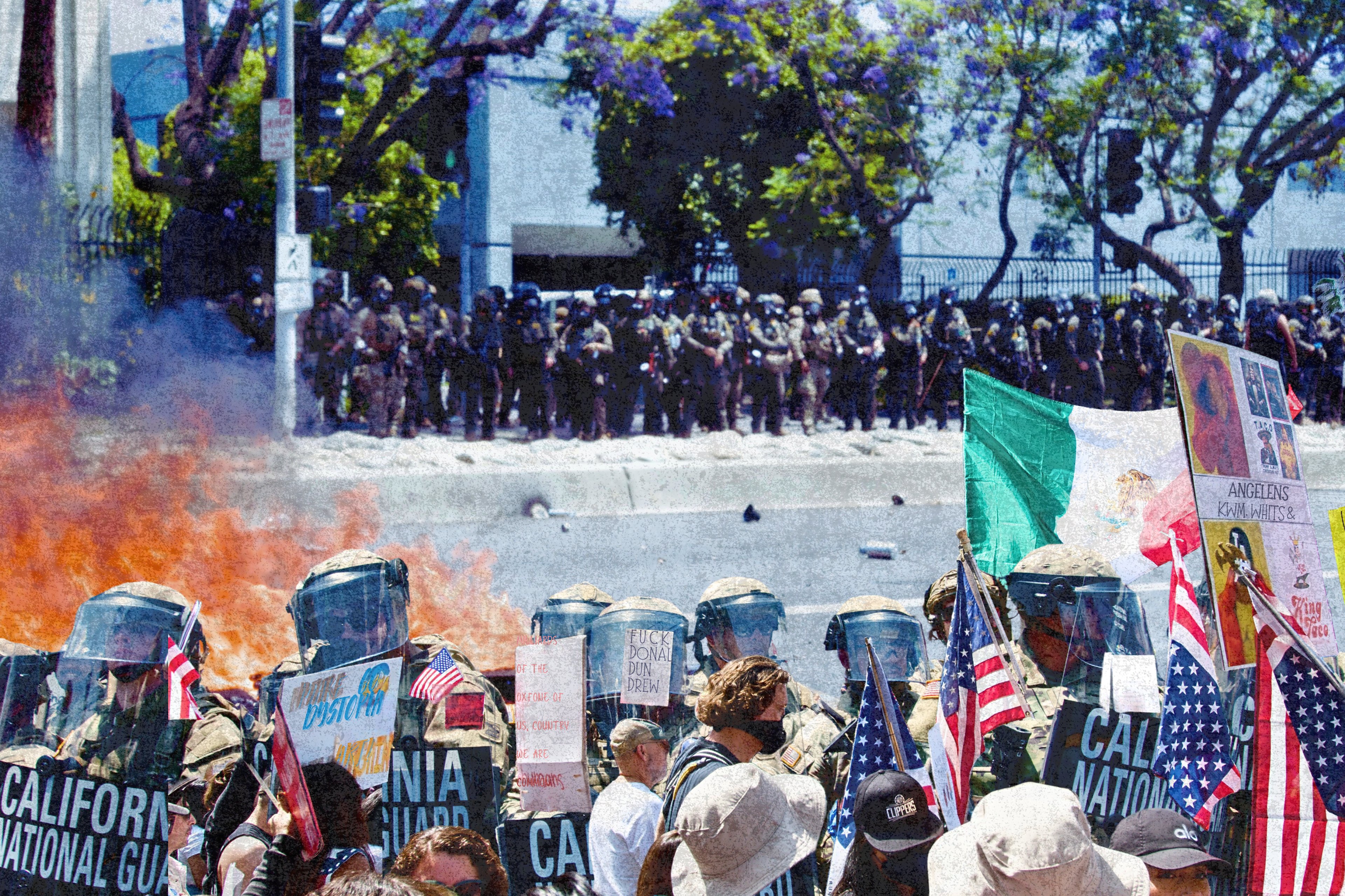
How can we shift the defensive efforts in our communities into a political offensive? What can we learn from the city of Minneapolis’ success in driving back “Operation Metro Surge”? How can we organize resistance in the face of a slow-burn normalization of fascism? Can we unite our diverse tendencies and tactics into a coherent strategic effort? Mass action is the key on all fronts. The resistance movements in LA, Minneapolis, and D.C., along with the history of the antebellum North’s Vigilance Committees, are good places for us to look for lessons.
Minneapolis
The people of Minneapolis, through their successful struggle against the ICE surge in their city, remind us all that we can come together and push back on the fascist regime. Indeed, the success of the people of Minneapolis in their struggle against occupation by ICE is another sign pointing toward our ability to make it go away on a larger scale. The rapid response efforts in Minneapolis and the protest movement in the city that helped turn back “Operation Metro Surge” had their roots in the 2020 George Floyd uprising. The sense of community, personal networks, and neighborhood group chats that came into being during the city’s struggle in 2020 carried through to, or were reactivated in, 2025, when thousands of ICE and CBP agents descended on the city.
Before the surge began in Minneapolis, rapid response networks were already in place but were very centralized. People would report ICE sightings to admins who would verify the reports before sending them via mass text to responders who would converge on the location. When “Operation Metro Surge” began, agents switched tactics and the centralized system no longer worked as effectively. In response to this shift, a much more decentralized rapid response system emerged organically from the experiences and experimentation of the rapid responders on the ground. This decentralized system for coordinating rapid response did not mean leaving people isolated as individual actors, connected only by a chat thread. Norms were established, and communities were connected, but responders had more autonomy and didn’t have to wait for directions from a centralized group of leaders. No single organization or charismatic leader sat at the center of the rapid response network, and everyone was able to play their part in the struggle. As the rapid response chats grew in numbers, they split into ever-smaller chats covering ever-smaller areas of the city, some covering areas as tiny as four blocks, increasing the response speed and connecting people to their immediate neighbors.
The rapid response Signal chats in Minneapolis self-organized a system of dispatchers who coordinated across chats, alongside data teams, translators, and other specialist roles. Chats sprang up around specific locations and affinity groups. Both totally open chats and more private and carefully vetted chats proliferated. Organizers created intake chats that could direct new volunteers to the chats they should be in and to contacts to connect with based on their area and interests. Organizers from Minneapolis have cautioned their counterparts from elsewhere against being overly attached to specific groups and organizations and have instead encouraged people to stay focused on the purpose of the work. Internal issues and conflict between groups cannot, and ultimately should not, be completely removed from our shared struggle. But in times of acute crisis we should center action, organic bottom-up leadership, experimentation, and both strategic and tactical flexibility.
Rather than looking for direction or waiting for permission from established community leaders and organizations, rapid responders in Minneapolis found success cultivating organic leaders who emerged from within their own ranks. These leaders developed through the experience of active struggle, and rising to meet the community’s need for both practical knowledge sharing and political education. New volunteers benefited from this leadership, as with each passing day, the atrocities perpetrated by ICE in the city continued to draw more community members into the rapid response effort. Atrocities like families being torn apart by ICE. Atrocities like police brutalizing community members when they fought back in their own neighborhoods. Atrocities like the murders of Renee Good and Alex Pretti, community rapid responders martyred by DHS for defending their neighbors and neighborhoods.
Following the murder of Renee Good at the hands of ICE in January 2026, the people of Minneapolis and people across the nation turned to mass protest. Amid calls for a general strike in Minnesota, hundreds of businesses across the state closed in solidarity. On January 23, more than 50,000 people, many of them certainly involved in rapid response efforts in the city, descended on the center of Minneapolis in sub-zero temperatures to protest the violent occupation of their city by the Trump administration’s ICE operation. The next day, Alex Pretti was murdered by federal agents. The people of Minneapolis continued to struggle in the streets, and their increasingly militant resistance led to elected leaders—including their mayor and governor—along with business leaders and faith leaders falling in behind the people and joining the call to end ICE’s occupation of Minneapolis. In response to this pressure, the Trump administration began to withdraw ICE agents from the city, and “Operation Metro Surge” officially ended on February 12, 2026.
The Trump administration hasn’t given up on its mass deportation agenda, and it is continuing to target activists using NSPM-7. Fifteen people from the Minneapolis area are facing charges from Trump’s Department of Justice related to resisting the ICE occupation in the city. While the government pulls together a vast range of innocent activities in an attempt to create the illusion of an “Antifa conspiracy,” brave people are facing serious consequences. Fortunately, some of the organizers impacted by NSPM-7-related charges from Prairieland, Minneapolis, and elsewhere are now organizing against this political repression, launching the NSPM-7 Defendants Union to help fight back. They deserve our support. We cannot leave our political prisoners behind, and we have both a moral obligation and a clear self-interest as leftists to resist this political repression.
Whether you are working to help expand and develop an existing rapid response network in your community or you are preparing to take the first steps to start a local rapid response network by talking to your neighbors and connecting with local groups, we can all look to Minneapolis for lessons. Just as their experience with the George Floyd uprising in 2020 created connections, community, infrastructure, and the muscle memory of resistance that helped power their city’s response to “Operation Metro Surge” in 2025 and 2026, our efforts today will help us build the community, capacity, and muscle memory of resistance that will help us confront the next crises in our own cities. We need to prepare for the coming political and social rupture.
D.C.
Just as the response to “Operation Metro Surge” in Minneapolis had its roots in structures and practices that emerged during the George Floyd uprising of 2020, D.C.’s response to the federal occupation of the city and to the mass deportation efforts of the second Trump administration has its origins in events, experiences, and organizing that long predate the current moment. While we do not seek to tell a complete history of organized resistance in D.C., and we cannot map the entire terrain of all of the organizations and individuals involved, past and present, in the struggle against ICE, the federal occupation of D.C., and the deportation agenda that has spanned both major political parties and multiple administrations, we can offer some examples.
In the first year of the first Trump administration, ICE launched “Operation Safe City” targeting “sanctuary cities” around the country. In Washington D.C., 14 people were pulled from the community over the course of the four day operation. Sanctuary DMV formed as a broad, interfaith group of religious congregations in the region that stood together against ICE and stood up for people in the community who were living in fear of profiling, detainment, and deportation at the onset of the first Trump administration. Early rapid response efforts existed at the time and were led by Sanctuary DMV. People would be contacted when a detention was reported, but frequently the time delay between the report, relaying the information, and the response made the approach ineffective. Some organizers from Metro DC DSA (MDCDSA) turned from rapid response to protest and other direct action. They researched groups and individuals connected to and profiting from ICE and then found opportunities to confront these people directly, with protests outside the homes of individuals and other direct action tactics. They seized an opportunity to disrupt and publicly shame then-Secretary of Homeland Security, Kirstjen Nielsen while she was out at dinner at a Mexican restaurant in D.C. Another group that has been involved in this work since before Trump’s first term and through to today is We Are CASA, founded in 1985 to oppose U.S. interference in Latin America. It has been fighting against the deportation machine and for the rights of migrants in the region. It offers a broad variety of programs to support the local migrant community and has been effective at filing lawsuits against the government to fight back against attempts to erode or ignore the rights that do exist for migrants in the U.S. We Are CASA helped lead protest actions in 2017, including a five-day hunger strike, to protect DACA, TPS, and the people who rely on them.
In April 2022, when the Biden administration announced it would end the COVID-19 era emergency order which had restricted immigration into the US during the pandemic lockdown, Texas GOP Governor Greg Abbott began sending buses of migrants and refugees from the southern border to be deposited in Washington D.C., and New York City without any contacts or resources to help them make their way. He framed this as a “protest,” suggesting that liberal cities should bear the ‘burden’ of caring for these people—a framing that devalues the human beings used as objects in this ‘protest’. Arizona’s governor Doug Ducey joined in on Abbott’s dehumanizing ‘protest’ the following month. In D.C., migrants were being dropped off unannounced, and the city government did not have an immediate plan to help them. Many had nowhere to go, and those who had a plan were unexpectedly arriving hundreds of miles away from where they thought they would be. District residents took matters into their own hands and began forming mutual aid networks to assist the people arriving on these buses. Out of these networks, Migrant Solidarity Mutual Aid (MSMA) formed. MSMA has continued its work supporting migrants in the D.C. area. The group has also been involved in responding to the more recent immigration crackdowns and the federal occupation of D.C. under the second Trump administration. They maintain a regional ICE Emergency Hotline and, together with the abolitionist group Harriet’s Wildest Dreams, host D.C.’s iteration of Film the Police.
Harriet’s Wildest Dreams is a regional, Black-led community defense hub founded in 2021 by veterans of Black Lives Matter DC and the BLM Global Network. A prison-abolitionist group centering all Black lives, the group has been involved in helping lead community defense, rapid response efforts, and protest actions in addition to its other work. FreeDC is another group active in resisting the occupation of D.C. Born out of organizing efforts in response to the congressional meddling that overturned D.C.’s criminal code reforms, the nonprofit-funded group has worked to organize a broad base of District residents with the goal of fighting for autonomy and self-determination for the people of D.C. FreeDC has organized a boycott of Amazon and affiliated brands for supporting the Trump administration. They are also leading a Delete DoorDash campaign as the company has both lobbied in favor of a bill in Congress that infringed on D.C. autonomy (under pressure, DoorDash has since withdrawn support of the bill) and for DoorDash not taking any action to protect their delivery drivers from ICE and the forces of the federal occupation. Among other efforts, FreeDC is leading a National Guard Out Now campaign opposing the deployment of National Guard troops to D.C. as part of the Safe and Beautiful Task Force.
In March of 2025, Trump created the D.C. Safe and Beautiful Task Force early in his second term. An alphabet soup of federal agencies deployed their law enforcement arms to the streets of D.C. in coordination with local police. D.C.’s outgoing Mayor Muriel Bowser has largely pursued accommodation and appeasement of the Trump administration, especially so in his second term. The integration of federal agencies into the daily work of policing in the district has continued to grow, largely unchecked by the city government. While the initial surge of federal activity triggered by the Trump administration’s emergency declaration in August 2025 briefly brought out a corresponding surge of active resistance in response, the occupying forces shifted tactics in response and have taken on a slow-burn approach with the apparent goal of normalizing the presence of federal police and armed National Guard patrols into the daily life of the city. The task force remains visible and antagonistic in ways that continue to grow resentment among District residents, but this remains in tension with the fact that their continual visible presence in the life of the city risks establishing the occupation as a new normal in the daily life of D.C.
Since the occupation began, other local groups, activists (and even existing coalitions) seeking to combat the federal occupation of D.C. have come together to form new coalitions like the Families Not Feds (FNF) coalition, which brings together, among other groups, Movimiento Migrante DC, MDCDSA, DC Alliance Against Racist & Political Repression, Anakbayan Washington D.C., and Sunrise Movement Washington D.C. to end the collaboration between the D.C. government, the Metropolitan Police Department (MPD), and the D.C. Safe and Beautiful Task Force. While organic and self-organized activity to resist the occupation continues to emerge, recede, and emerge again in D.C., the shifting relationships between preexisting groups and leaders in the city’s activist ecosystem continue to shape the opposition more than they did in Minneapolis, where it grew out of rapid response, and have not yet settled into the two-winged balance seen in L.A.
Fighting against the normalization of the Safe and Beautiful Task Force has been a challenge for the resistance in D.C. While “ICE” in the form of Enforcement and Removal Operations (ERO) is less commonly seen, agents from Homeland Security Investigations (HSI), the Department of Homeland Security’s (DHS) investigative arm, and U.S. Customs and Border Protection (CBP) agents are a constant presence in the streets of the city, along with agents from the FBI, DEA, IRS, Secret Service, and a myriad of other federal agencies. The Trump administration has also deputized many of these federal agencies to engage in immigration enforcement efforts, so the alphabet soup of agencies involved in the Safe and Beautiful Task Force is functioning as immigration enforcement while not registering clearly in the minds of residents as part of the national conflict between ICE and the people. Connecting the struggle against the occupation and for autonomy in D.C. to the national movement against ICE and for the Democratic Revolution is essential for organizers in D.C. and nationally.
A preliminary injunction that has been granted as the U.S. District Court case Escobar Molina v. Dep’t of Homeland Security proceeds has (at least temporarily) curtailed federal agents’ ability to make warrantless immigration arrests in the district without an individualized finding that the person is likely to flee. Following the initial injunction issued December 2, 2025, plaintiffs moved to enforce the original order, as evidence showed that warrantless immigration arrests had continued in violation of the court’s order. The court issued a memorandum opinion granting the plaintiffs’ motion on May 7, 2026. The court case has had an impact on conditions in the district. Enforcement tactics such as pop-up immigration checkpoints on major roadways, which had been prevalent in the early days of Trump’s emergency declaration and corresponding immigration enforcement surge, disappeared for months from the city streets. Recently, however, these tactics have quietly started to reemerge. While using the courts to try to ensure that the legal rights we do have are protected is a worthwhile tactic, the need for a second court order on the issue highlights the problems of pursuing a totally legalistic approach to resisting federal overreach, especially against a presidential administration that is comfortable testing and stretching the limits of the law. This is still an open case, and therefore it is an open question whether a full-bore campaign of warrantless, snatch-and-grab, mass deportations will return to D.C. streets in the near future.
In the early days of the federal emergency declaration in August 2025, people rushed to connect with rapid response efforts in the city. Groups already engaged in that work struggled at times to onboard interested volunteers. Tension occasionally arose as freshly activated residents made organic efforts to adopt tactics received from other cities, like whistles and noisemaking, and were met with resistance from established leaders and groups already rooted in the community. In other cases, groups spun up large, organization-specific chats covering, at least theoretically, the whole geographic area of the city (and sometimes beyond D.C.’s borders and into the surrounding states). Responders followed reports in these chats and rushed to ICE sightings in their immediate areas. Neighbors began talking to neighbors about what they were witnessing in their community, and more rapid response chats, increasingly local ones, began to spring up. Chats and patrol groups formed around schools, houses of worship, and other location-based and community-centered anchors.
The multiple jurisdictions that make up the greater D.C., Maryland, and Virginia (DMV) area present particular challenges for organizers. D.C. and the two states have varying laws, and both the impact of the Trump administration’s mass deportation agenda and the character of the response from the people and their local governments take a unique shape in the different states and also in the distinct counties that border D.C. ICE is uprooting people from their communities in Maryland and Virginia in ways similar to what we continue to see in other parts of the country. D.C.’s lack of statehood has allowed the federal government to deploy the Safe and Beautiful Task Force to the city. The lives, jobs, relationships, and communities of people in the DMV area extend across these jurisdictional boundaries. Some organizations extend across the whole region, and some are area-specific. Finding ways to connect with, learn from, and support each other across these artificial geographic boundaries and practical legal differences is an organizing challenge, but not one that is unique to this issue.
In some areas, rapid response tactics shifted from a purely reactive approach to proactive daily patrols. These patrols put responders in a position to be where activity has been most frequently observed, to both report on and quickly respond to incidents. In Wards 1 and 4 in D.C., these patrols have continued, uninterrupted, for more than a year. As local group chats continued to emerge, so did organic rapid response leaders. Different rapid response groups began developing their own vetting protocols, shared tactics, and formal trainings. Connective layers of coordination began to grow between formal, organization-driven chats and organic rapid response chats. In response to the ossification of some of these structures and to the renewed surge of federal activity, organizers have resumed experiments with citywide rapid response chats, but now with a foundation of local self-organization undergirding the idea. In addition to rapid response efforts, protests and other direct action tactics have been employed, targeting city elected officials for accommodating the occupation or not doing enough to resist the shootings, kidnappings, and other violence brought to the city by the federal occupation.
Rapid response efforts in D.C. have so far drawn on both organic leadership from the community and coordination between preexisting groups and leaders. These two directions for leadership of the resistance to the occupation of D.C. continue to exist in tension as the slow-burn federal occupation has so far failed to produce an acute enough crisis to force a resolution between these two tendencies.
This year’s Democratic Party primaries in D.C. ended with multiple victories for the broad progressive movement in the city and for candidates specifically endorsed by MDCDSA, FreeDC, and other organizations that are directly involved in resisting the federal occupation. Opposition to the occupation of D.C. and to the Trump administration was an important part of the campaigns of many of these candidates and was an important issue for residents of the district. When these candidates take office after their almost-certain victories in next month’s general election, they will possess a mandate to begin pushing back on the federal occupation from the halls of city government, and the expectation set by District residents is that they will use this mandate. There are limits to what is possible through the city government, and this is also just one tactic of many, but the people of D.C. will need to be prepared to push these incoming electeds when necessary. When they take office, we will need to demand that they hold to the promises they made to oppose the occupation. It will be especially important that Janeese Lewis George, a democratic socialist and the incoming mayor, begins resisting the Trump administration from the Mayor’s office on day one. Both the city government and the people of D.C. need to prepare to go on the offensive.
The Name of the Offensive is Democratic Revolution
Around noon on October 1, 1851, federal marshals and local police walked into a workshop in Syracuse, New York, and put a Black man named William Henry in chains. Henry had escaped slavery in Missouri and traveled the long and treacherous roads north despite the ever-looming terror of being recaptured. The Fugitive Slave Act of 1850 had empowered the United States government to do just that, anywhere in the country, even in Northern free states.
Around four months earlier, then-Secretary of State Daniel Webster, the bloviating doughface who had led the Northern members of Congress willing to help forge the compromise with the Slave Power, had come to Syracuse. He gave a speech promising the law would be enforced there even “in the midst of the next Anti-Slavery Convention, if the occasion shall arise." What he meant was the meeting of the so-called “Liberty Party,” a radical anti-slavery party locked into marginality by the iron grip of the Democrat-Whig duopoly.
When agents of the state came to put some action behind Webster’s promises by collecting William Henry, the Liberty Party was indeed meeting at a nearby Congregationalist church, many prominent abolitionists of the time included. Henry had been arrested for a theft he did not commit and was being held so he could be given back to his enslaver. But a member of the city’s Vigilance Committee saw Jerry (Henry’s slave name was Jerry) being taken and ran to the church, alerting its members.
These Committees, cells of anti-slavery activists embedded across the free states, had roots going back decades but truly picked up steam following the passage of the Fugitive Slave Act and the subsequent swarms of bounty hunters and agents that infested the free states looking for Black people to lock in irons and send below the Mason-Dixon line. They were diverse in tactics but united in purpose. Some went as far as violent vigilante action while others focused on legal representation. All were squarely opposed to the Slave Power, in their own way.
Syracuse’s committee, bolstered in size and strength by the Liberty Party members, began hatching a plan to free Henry. First, a group of lawyers and other well-to-do abolitionists met him in his cell, offered to represent him, and began throwing every legal trick they could concoct to slow down the proceedings and delay his deportation. Then church bells began to ring, and a crowd gathered around the police station, calling for Henry to escape. He managed to do so, but was recaptured and put back in his cell.
A sympathetic minister visited Henry and asked him to stay calm, to which Henry piercingly responded, “Would you be calm with these irons on you?” At about half past eight, the church bells began to ring again. A much larger crowd, filled with Black and white protestors, surrounded the building. The righteous mob busted down the door, freed Henry, and hid him for several days before spiriting him away by wagon to Oswego and then across Lake Ontario into the safety of Canada.
A federal grand jury would indict 26 people in response to this, but the government could get a jury to convict only one, a Black man named Enoch Reed, who died before his appeal could be heard. The abolitionists, for their part, managed to have the marshal indicted for kidnapping. For years afterward, the people of Syracuse would mark October 1 as “Jerry Day” and would taunt federal authorities, police, and bounty hunters with the chant “Where’s Jerry? Where’s Jerry?”
By 1854, three years later, men like Webster had seen their compromise positively ruined by the actions of the Vigilance Committees and the swelling abolitionist movement. The North simply wasn’t upholding its half of the deal with the Slave Power. The federal government, headed by men eager to see the compromise, and thus slavery, survive, worried they were losing control. This seemed to be borne out by the organizing of the Boston Vigilance Committee, which rioted and schemed to stop escaped slave Anthony Burns from being returned to his enslaver, an effort that ultimately ended in failure.
During and following his “trial,” Boston was placed under something approaching martial law to keep order. Anthony Burns was marched in a long procession to a ship bound for Virginia, guarded by federal marshals, local police, and an additional 140 U.S. Marines and infantrymen. All along the way, something like 50,000 Bostonians looked on, seething. State militia lined every street. Buildings were draped in black, and a coffin with the word “Liberty” was hung over the streets under which the party passed.
The procession eventually came across an oppositional crowd, which the officers met with violence. They beat the people mercilessly, cut some in the face, and arrested others to be hauled before the court. The government spent around $40,000 (something like $1.5 million in today’s money) to ensure the re-enslavement of this one man.
They managed to get Burns to the ship, but only at an even greater cost to the Slave Power than some paltry $40,000 sum. One contemporary witness named Amos Lawrence would put it like this: “We went to bed one night old-fashioned, conservative, compromise Union Whigs and waked up stark mad Abolitionists.” The Republican Party was formed that same year to unite opposition to the Slave Power into a national political force capable of overcoming it.
The lessons of the 1850s are the lessons of today, despite the obvious differences of our times. The Vigilance Committees won many days, in Syracuse and elsewhere. But their true worth is demonstrated in what they produced: a mass political force capable of not just challenging the Slave Power but of destroying it. They grew from a loose network of organic defense into an offensive fighting force seeking not just to govern the country, as the Whigs and Democrats before them had, but to transform the country. They looked at the contradictions of the Republic and pressed ever onward into the fires of revolution and civil war, and they had the opportunity to do so because they made this move from defense into offense.
The people of this nation are already resisting, as they did then. The church bells might now be Signal chats, but the abolitionist spirit of the multiracial and multinational working class remains, fervent as ever. We’ve spent decades preparing, organizing, and protesting against our racist and murderous police state. We’ve built a network of defense, each block a hodgepodge of strategies and tactics steeped in the places where each group developed and the ideological inclinations of their members. But we have yet to fully make the transition that the Vigilance Committees did. We have not turned the corner into offense.
Our offensive turn has a name: the Democratic Revolution.
What we need are institutions, structures, and organs built on mass politics. We need a point of unity, a center of gravity around which the swirling forces of militant resistance can begin to rotate. We need a hammer, a force prepared not just to challenge the fascist regime, but to sweep aside the fundamental structures of power that enabled its constitution in the first place. In short, we need a revolutionary movement, and beyond this, we need a revolutionary party that is the organic expression of this movement, and not of the sectarian desires of the worshipers of some or other long-dead thinker.
Such a movement, and such a party, must combine, expand, and radicalize our efforts in opposing the thugs of the Department of Homeland Security. It must leave room for all tactics. This means legal opposition, throwing wrenches in the Kafkaesque court systems wherever we can. This means Vigilance Committees in every neighborhood in America, a block-by-block network meant to frustrate the agents and shelter the immigrants. It means adapting to local conditions, communicating strategies that work, and adopting best practices wherever possible.
It also means we must seize the full possibilities of the electoral struggle. Donald Trump, the leader of the fascist regime, has made clear his intentions. He is entertaining pitches from January 6th veterans to seize ballots, and is continually counseled by more terroristic advisors to simply declare martial law. He has spent his term purging the military, an effort which has accelerated despite the American armed forces’ struggles in their imperial venture against Iran. He is openly calling for race riots against Somalis while ramping up ICE raids just prior to the midterms, hoping to give his DHS departments (now better funded than the IDF) the appearance of popular support alongside rallying his racist base.
If we are to meet this moment on the terms of mass struggle, we must challenge the fascists where they are worried about being challenged: at the ballot box and in the streets, in very large numbers. We need a Presidential campaign like that of AOC, as part of a broader strategy of electoral maximalism in which as many communist candidates as possible (or at least the leftmost candidates which can win) run for every office available. These candidates should make their radical, revolutionary intentions known. The candidates should call for dramatic, structural change, and they should call to hang the bastards stealing from and murdering the people.
Most importantly, the disconnected and decentralized networks, our modern-day Vigilance Committees, must prepare for mass struggle. We must prepare for crowds of millions; we must prepare for street clashes, police brutality, and general strikes. We must militate within labor to prepare to shut down the economy; we must protest and protest and protest, learning tactics from our comrades across Europe currently struggling for a revolution of their own. We must get ready for Trump’s coup and be prepared to meet it with a People’s January 6th of our own.
But even more than this, we must seize this opportunity to ensure today's revolutionary energy is building toward our party of a new type, the revolutionary organ that will take us much further than social democrats like AOC would ever dare to tread, and that will defend and radicalize the revolution with a strength and passion she could never muster. We must be ready to assert the people’s will in the face of fascist oppression and deliverist backsliding. We must be ready, and in position, to transform the country.
We sit in opposition, a furious and disorganized one, but we must ensure that opposition never loses sight of its goal: to seize power. That requires practicalities, and it requires audacity. We will make revolution together or we will not, just as the fascists will make their regime, their white and Christian America, or they will not. The choice is ours, and ours alone.