
Jul 23, 2026
Who Is William Lawrence? The Sunrise Co-Founder Running For Congress From Michigan
Sunrise co-founder William Lawrence is running for Congress as a left populist wary of the socialist label. Are socialist voters already out there?
by Andy C.
The recent Democratic primary wins of DSA-endorsed and aligned candidates in Philadelphia, D.C., and New York City have led to a surge of national interest in DSA’s electoral project. As commentators from all sides work to make sense of the political shift that these election results may represent and to situate these developments in their own political framing, one of the questions being surfaced is whether any of this is reproducible or has other implications for electoral politics outside of deep-blue districts in large, coastal cities.
There is a broader left-populist electoral movement underway in America that DSA’s specific electoral interventions exist within. There are indications that the specific demands, policy, and politics of the DSA and its endorsed candidates can move people outside of DSA’s urban strongholds, but there are further questions about whether the DSA endorsement itself can operate the same way in the rest of the country. Confusion also exists as to whether or to what extent DSA is driving this electoral trend. I would argue that the current left-populist moment in electoral politics is much bigger than DSA and that the shift in mass politics has aligned with DSA’s existing political trajectory in ways that have allowed DSA to secure wins where its capacity for electoral work is already developed. I would also argue that DSA’s electoral project can go further and find opportunities outside of deep blue urban districts and in places where the DSA electoral machine is less developed.
Some of those on the left who are skeptical of the ability of DSA or aligned left-populists to win in swing districts are skeptical because they don’t believe our politics can appeal to people outside of liberal, urban enclaves. They look at demographic data, existing partisan polls, and the short history of DSA’s electoral interventions and find themselves inadvertently aligning with one of the liberal media’s consensus lines, namely that socialism can only appeal to a specific constituency of young, urban, college-educated, cosmopolitan, left-liberal voters. They propose that a socialist couldn’t win a swing district without crossing one of DSA’s red lines to appeal to the supposedly monolithically culturally conservative mass of people outside of the country’s liberal enclaves. These skeptics seem to be buying what the mainstream media polarization narrative has been selling for years, that people in America define their politics exclusively in terms of what they stand against in the culture wars because that is the way they are, it’s in their nature, and not because of the absence of any positive articulation of their demands that they could be for or other injustices impacting their lives that they could be against. The skeptic doesn’t imagine that somebody could be more moved by their support for universal healthcare than their support for the police or that they could be more strongly against building data centers in their backyard than they are against whatever Fox News tells them drag queens may be doing this week.
Left-populism has been advancing because it can both articulate and propose solutions to some specific popular demands that both the Democratic Party establishment and the MAGA-populist right have been unable to acknowledge or address. Three issues where this dynamic stands out most clearly are:
1. The genocide in Palestine and the US relationship to Israel
2. AI and Data Centers
3. The Epstein Class and the absence of Epstein-related prosecutions
These demands have so far been next to impossible for either the Democratic Party establishment or the MAGA populists to triangulate or redirect. People aren’t buying the line that any of these things are “too complicated” to be achieved through the power of the state. The two-state solution isn’t moving people who’ve watched the acceleration of a genocide in full public view and with the full support of the US government. Nobody wants a data center built where they live, and the most realistic effort to triangulate on this issue seems to be Bernie Sanders’ proposal to partially nationalize the AI companies, a proposal that would have been too radical to be considered as a realistic demand before now. Popular outrage extends beyond the issue of the data centers themselves, to the hard push being given to AI technologies and the ever-increasing resentment of mass surveillance by both the big tech companies and the state. Coming into office, the second Trump administration tried to find a middle path on Epstein, making a big show of “releasing the Epstein files” before being forced by Congress to actually release the files. Neither party has taken any action to prosecute any of the crimes revealed in the Epstein files.
Popular demands that are clearly within the power of the present ruling forces to address, but that are simultaneously politically impossible for them to address, are the demands that can be seized upon to help allow new ideas and forces to contest state power and advance their politics. The ruling elite currently operating the helm of the state have to be able to contain, absorb, or redirect the popular demands animating the masses when the elite interests our rulers actually represent can tolerate meeting the people partway in the interests of maintaining the legitimacy of their rule. For popular demands where the elite interests represented by the current ruling coalition cannot tolerate even partial concessions to the people, the demand becomes impossible for the current ruling coalition to digest. Demands that are indigestible by the current ruling coalition destabilize their legitimacy. This doesn’t open a direct path for socialists to walk to total victory, but it creates openings in which we can intervene.
Washington D.C. is somewhat of an exception to this year’s broader left-populist trends and deserves closer examination for people who are more invested in DSA’s electoral project specifically. The recent Democratic Party primaries in D.C. involved a left labor alliance that I would consider more representative of DSA’s traditional electoral strategy than what played out in the New York City Democratic Party primaries, or what is playing out with left-populist candidates running without DSA endorsement, like Abdul El-Sayed in Michigan. The three issues I identify above didn’t play a central role in the D.C. Democratic primaries in the same way they have been playing out in the other Democratic primaries this cycle. This is due to D.C.’s lack of legislative representation at the national level and therefore no national campaign to connect to the broader left-populist wave. D.C. elected a DSA-endorsed mayor and councilwoman, a DSA member won an at-large council seat, and other progressives won their local races. The candidates did not as strongly present their races as a populist contest between the people and the elite nationally, but as the people of D.C. versus Trump’s federal government and the impotent local establishment that has tried to navigate that relationship through quiet compromise and appeasement.
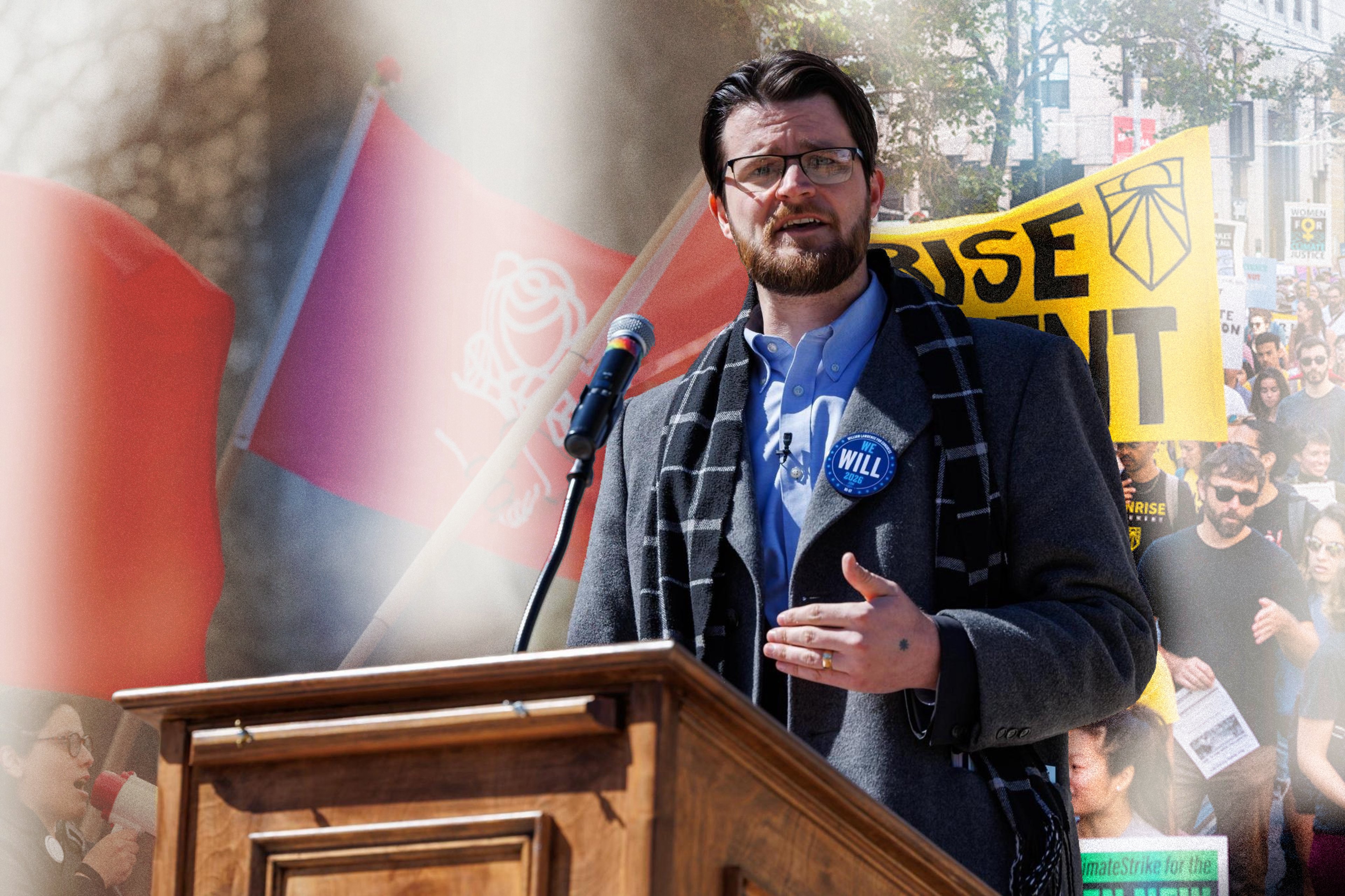
Michigan’s 7th congressional district has a candidate in their upcoming Democratic party primary elections running with a left-populist approach and platform who is attempting to bring together these wholly indigestible populist demands with affordability agenda policies (which themselves tend to cause some indigestion to both the establishment Democrats and most flavors of Republican) while attempting to reframe political polarization from the culture war version of “right versus left” to a left-populist formulation of “up versus down”. The candidate is William Lawrence (hereafter referred to as Will). Will has a deep background as an organizer and a leftist, co-founding the Sunrise Movement, the Rent Is Too Damn High campaign, and the Mid-Michigan Tenant Resource Center. He has been involved with DSA and the WFP. He has written for Convergence Magazine and hosted the Heginomicon podcast on their network.
Will has said that the 2003 Iraq war was “the formative political experience” of his life, and this is likely true for many of the candidates, organizers, and volunteers from the millennial age cohort involved in much of the current left-populist electoral moment. Will has “Say No to endless war” as a core pillar of his platform. He calls to end the war with Iran, and to end arms sales to Israel. At a candidate forum in June, Will was able to set himself apart from his opponents as the only candidate to call what’s going on in Palestine a genocide. He also calls for a reduction in overall US military spending as part of a strong overall anti-war position.
Opposition to the construction of data centers has also been a key position of Will’s. His platform calls for a 12-month federal moratorium on new data centers. Data center construction has been a controversial topic, especially in mid-Michigan. Saline, Michigan, in the neighboring 6th congressional district, has made national news as a billionaire-backed developer deployed lawfare to force forward the construction of a giant data center project despite the town voting no twice on the question. What’s happening in Saline is a clear and easy-to-explain example of how money can abuse the legal system to override the democratic will of the people, especially in small towns like Saline and the many similar towns Will would represent if he wins in the 7th district. On the topic of AI and surveillance, while he says he doesn’t have the answers, he stresses the importance of the questions, saying “We need to squarely face the negative impacts of AI and surveillance, and question whether we want Big Tech making the biggest decisions about our shared future.”
An interesting element of Will’s platform is his 4th top-level priority: “Restore the Rule of Law”. He highlights three points beneath this heading: “Prosecute the Epstein class for human trafficking & tax evasion”, “Hold ICE accountable for unconstitutional conduct”, and “Ban stock trading by members of Congress & the executive branch”. Instead of letting his opponents define the terrain of “law and order” issues and allowing them to punch left from there, Will has established a left-populist “law and order” plank in his platform, elevating the popular demand that calls to bring the law to bear on behalf of the people and against the elites.
Will has also distinguished himself from his opponents by clearly endorsing Medicare for All and hasn’t been shy about attacking both the Democratic Party and the Republican Party for being captured by corporate interests and “taking campaign contributions from the CEOs, lobbyists and executives of the multinational corporations that are the ones squeezing us all”. More so than some of his left-populist contemporaries, his platform and how he expresses his politics in many ways sound like a DSA-endorsed, socialist candidate, but WIll seems hesitant to connect his campaign directly to socialism, saying “If democratic socialism is believing that everybody deserves a good job and a good home and we should have healthcare that covers us for life, then, yeah, you can call me a democratic socialist or whatever you want”. Should we read this as Will being an opportunist, deceiving the masses by hiding his true politics in pursuit of a sliver of state power? Alternatively, should we view Will as a true, ideological left-populist, committed to no horizon further than carrying the most popular demands of a loosely defined ‘people’ with him to contest power in the existing state against an entrenched and oppositional ‘elite’? Or has it been left up to us to read the socialism back into Will’s platform and campaign? Does the fate of other openly socialist campaigns have any bearing on whether Will will identify himself openly and proudly with socialism?
Will has sought and received a broad array of endorsements from the hyperlocal like Dansville, MI Village President Ryan Bushard all the way up to prominent national political figures like Bernie Sanders, Ro Khanna, and Rashida Tlaib. One of Will’s latest endorsements came from Chris Rabb, who recently won his own primary in Pennsylvania while endorsed by DSA both locally and nationally. While neither is currently endorsed by DSA, Will and Abdul El-Sayed recently cross-endorsed each other. Will was a featured speaker along with Abdul, Bernie, and AOC at the Lansing stop of The People vs The Powerful tour. Will has also been endorsed by a variety of activist and traditional NGOs and groups, including National Nurses United, the Sierra Club, Track AIPAC, and the Congressional Progressive Caucus. From his endorsements, it doesn’t seem that Will is in any way unfriendly to socialism or the organized left, but he seems to situate himself in a broad left-liberal, progressive coalition.
In some way it appears that Will’s approach to his candidacy and campaign has been that of trying to run as an individual community organizer and local activist. He’s already using these qualities to position himself in contrast to his potential eventual general election opponent, Republican Tom Barrett. Saying in a recent opinion piece that when Tom Barrett “voted to kick 500,000 Michigan children off of food stamps; [Will] helped feed over 5,000 people through the Greater Lansing Food Bank and Mulliken Food Pantry.” There have also been effective agitational theatrics. To criticize Tom Barrett for not meeting with his constituents, Will set up a desk in front of Barrett’s office in Lansing and for seven hours he held an open Q&A with constituents. After both of his primary opponents declined a local news debate, Will announced that he’d hold a debate at a library in Lansing with a neutral moderator and invited all of his opponents to attend. Neither his Democratic Party primary opponents nor incumbent Republican Tom Barrett showed up to Will’s Library debate, so he held an open town hall with three empty chairs on stage, labeled with the names of his no-show opponents.
As election day approaches for the Michigan Democratic Party primary, the establishment is turning, right on schedule, from spending money and media to boost Will’s opponents to using PAC-funded ads and placing stories in the media to begin to attack Will directly. While the half-million-dollar ad from the DCCC-aligned ‘Crush MAGA PAC’ attacking Will as a hypocrite for condemning corporations while having $11,000 in his 401k seems comically out of touch, a recent story in the Huffington Post shows that Will’s past contributions to leftist discourse will be dug through as well. The attacks we’ve seen so far aren’t taking the line that Will is too radical and are instead trying to paint Will as part of a ‘white left’ opposed to ‘Black political leadership’. Pulling the quote from roughly 40 minutes in on an interview with activist Khury Petersen-Smith on Will’s Hegenomicon podcast, Will’s adversaries aren’t ignoring his long history of participation in organized leftism even if Will himself has seemed to want to downplay it in his campaign.
Comparing Will and his platform to the DSA-endorsed electeds who’ve already won their primaries as open socialists, there doesn’t seem to be much difference except for Will’s reluctance to explicitly frame what he’s doing and what he seeks to do as socialism. Comparing all of their platforms to the DSA’s program, Workers Deserve More, the biggest difference in many cases is the relative weakness or absence of the DSA’s democratic demands in their platforms as compared to what’s in the program. Some critics of the current socialist electoral intervention may find themselves agreeing that Will is not a socialist and that none of what these candidates are doing or stand for is of, by, or for ‘true socialism’ anyway. On the other hand, the primary victories so far have led to our enemies doing some free agitation on behalf of a much less fuzzy and much more clearly stated explanation of DSA’s platform. Politicians with low favorability ratings and Fox News pundits are reading our program aloud, and while they believe they are giving people a dire warning about our radical program, an increasing number of Americans are finally hearing their own demands expressed in the national media and attributed to an organization that proposes that politics could do something to address them.
Even without a DSA endorsement, Will’s campaign is one for the left to watch as we consider and debate whether our politics have broad appeal outside of places where the DSA electoral machine has years of development behind it or places that aren’t already a deep Democratic Party blue. Will’s campaign may also give an example of the kind of candidate and electoral coalition that DSA chapters with less developed electoral programs may want to consider pursuing. Will’s campaign should be seen as a challenge to the notion held by some on the left that our socialist politics should, in fact, be read as existing towards the far left end of a political spectrum that is itself defined by the left and right wings of the politics of our existing, bourgeois, ruling elite and the existing order that we seek to overturn. We should not believe that we must first convert people into culture war liberals before we can offer them a socialist politics that itself seeks to overturn the present state of things and put political power directly into the hands of the people.
If Will is elected, would he participate in an openly socialist bloc in the next congress? If he wins the primary, will he seek or accept a formal DSA endorsement before the general? Will he wait until the left-populist horizon is exhausted to declare for a socialist one? However Will would answer these questions himself—and however you may feel about them—I believe we should give him what support we can. As we look to 2028, we will need to expand our ambition and take our momentum into more races in more places as we attempt to find out how far this current wave can carry us. Will Lawrence and his campaign can offer us some lessons and may already be dispelling some mistaken notions as to whether socialist voters must first be created or whether they are already out there waiting to be found.