
Oct 14, 2026
Anti-Woke Redux Redux: A Review of Catherine Liu's Traumatized
Catherine Liu says trauma culture depoliticizes suffering and holds the left back. Walter Lucken IV argues that the public presentation of suffering has been more politically generative than almost anything else.
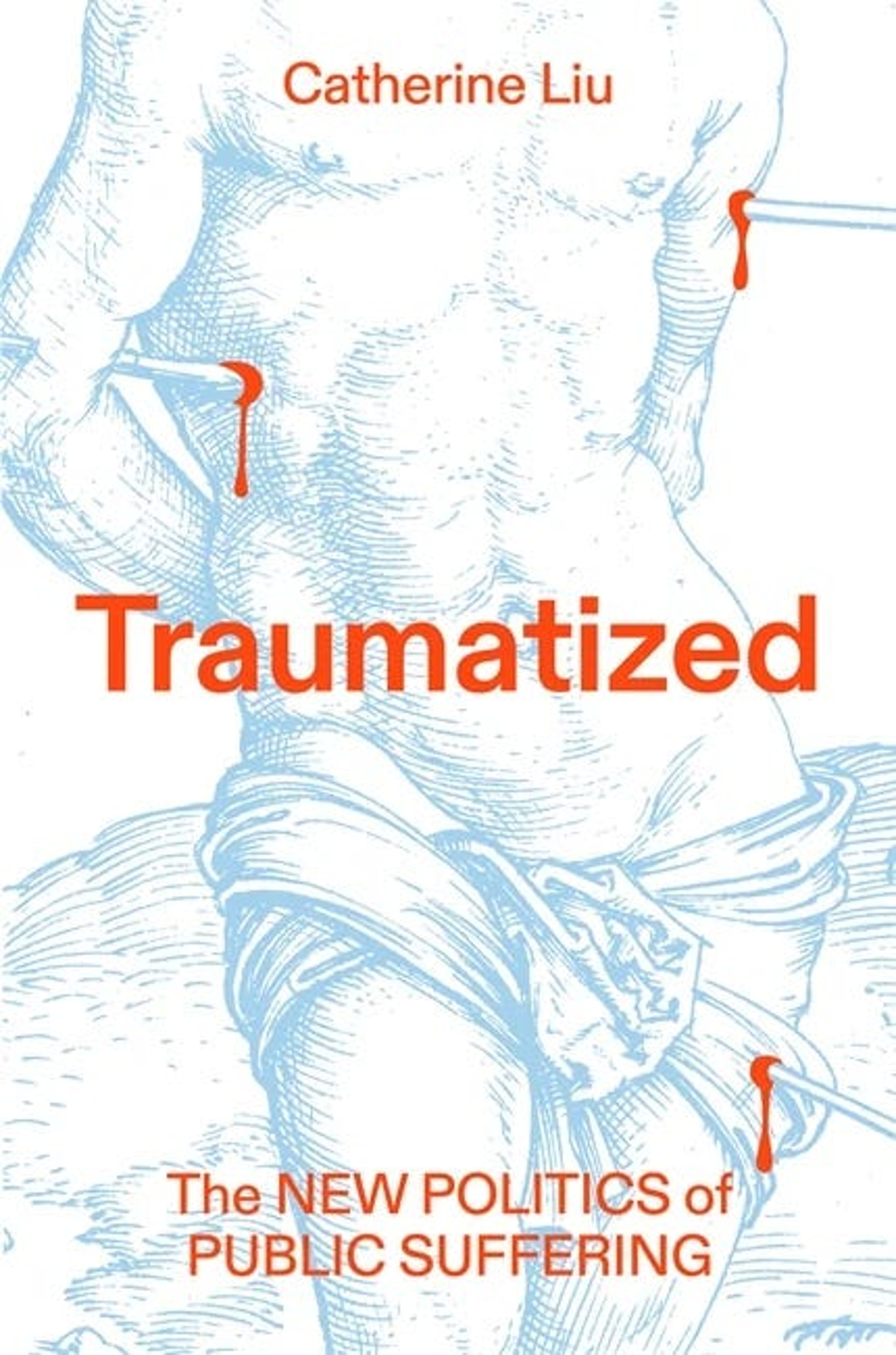
This article is a syndication from Monitoring the Situation on Substack.
“Liu, profoundly and powerfully, takes on the worldwide epidemic of trauma scripts. Her insights, honesty, passion, and courage shine throughout this important book.”
Elizabeth Loftus, Former President of the Association for Psychological Science
In 2014, well before the political center or the far right discovered trigger warnings, the para-academic Bully Bloggers released You Are Triggering Me! The Neo-Liberal Rhetoric of Harm, Danger, and Trauma. In this essay, Jack Halberstam argued that the emphasis on harm, danger, and trauma in contemporary feminist and LGBT politics, which had “re-emerged” in the 2000s, ran the risk of erasing the progress those movements had made since the 1990s by dividing up “politically allied subjects into hierarchies of woundedness." Halberstam argued that “hardship competitions” amongst feminists heightened internal divisions, ultimately harming the movement’s capacity to effect political change.
To be sure, Halberstam pointed to some important truths with currency beyond feminism and queer politics, in the sense that every social movement, including Marxism, has also been marked by the contradiction between coalition-building and universality on the one hand, and a recognition of social and individual differences between its members on the other. Nonetheless, the essay was controversial, with many critics pointing out that Halberstam had in fact reproduced the logic of neoliberalism by directing the “triggered” to suck it up.
Ultimately, the debate has remained unresolved. Debates about trigger warnings and trauma discourse have escaped containment, cycling through the political right and center and returning to the left alongside other perennial debates such as “identity politics,” the failure of 1968-era movements, and the over-emphasis on cultural issues at the expense of the plight of the working class. These observations are not particularly groundbreaking. In fact, they are daily topics for most anybody on the left, and are widely recognized as some of the movement’s central challenges. Particularly, for those of us who have spent our adult lives kicking around the leftist reading environment, these discussions have been done to death, and it’s hard to believe that anybody has anything new to say about them.
Evidently, this is not the case. An appetite for extended discussion on why the left has continued to fail itself exists, against all odds, at the level of writers, publishers, critics, and even readers. Enter Catherine Liu’s Traumatized: The New Politics of Public Suffering. In my view, the anti-woke leftist book that we’ve all read a dozen times by now continues to pop up, ironically, as an answer of sorts to the collective traumas of Trump’s rise(s) to power and the inability of the 21st-century American left to cement power despite waves of surging protest movements. Let’s examine the book itself.
In a quick 192 pages, Liu lays out her case against “trauma culture,” in which social suffering is removed from its material context and commodified within individual performances of pain, and narrativized via trauma and recovery. Child abuse, for example, is portrayed in trauma culture as an individual act of cruelty experienced by individual children, as opposed to the harms visited upon poor children by capitalism itself. Other instances include AOC’s recounting of how January 6th triggered memories of a past sexual assault and Oprah Winfrey’s disclosure of her childhood traumas on live TV.
In sum, Liu argues that “trauma culture” locates suffering in the individual, elides the systemic causes of said suffering, and depoliticizes it, offering a therapeutic solution instead of systemic change. This is a sound observation. It is not, however, a novel one, this point having been made many times in various feminist and leftist texts over the past few decades. What, then, does Liu contribute?
In my view, the précis of Traumatized applies this critique of “trauma culture” to the actually existing left, arguing that the left continues to fail due to the influence of trauma culture. Does this book demonstrate its case? I do not believe it does.
The biggest issue with Liu’s argument is a conflation between “trauma culture” as an ideological mechanism and the appearance or use of trauma itself in any form of left-wing politics. The latter is implied to exist exclusively in the guise of the former, and therefore anytime that trauma or suffering is introduced to the realm of politics, the book depicts it as having the function Liu attributes to trauma culture. At no point is a counterexample presented in which trauma or public suffering rhetorically serves emancipatory ends. The reader is led to derive via implication that there is no worthwhile use of trauma in politics.
But following #MeToo, BlackLivesMatter, the Gaza solidarity protests, and the outcry over Epstein’s crimes, Liu’s argument immediately fails. Indeed, the public presentation of suffering has been more politically generative than almost any other force. The only public feeling that rivals the presentation of suffering and trauma is, of course, the hope or belief that our society can be repaired, which explains the rise of figures like Zohran Mamdani, Abdul El-Sayed, and AOC.
The book’s introduction centers on an Instagram Live stream Alexandria Ocasio-Cortez did following the January 6th United States Capitol Attack. In the stream, Ocasio-Cortez describes hiding in the bathroom of her office while listening to rioters outside audibly searching for her, possibly to harm her. Indeed, on the night of January 6th, a man from Texas replied to one of her tweets calling for the impeachment of Donald Trump with "Assassinate AOC,” and she received thousands of death threats in the week following the attack.
Following her description of the riot itself, Ocasio-Cortez recounts that the experience triggered memories of being sexually assaulted in her younger years. Of course, anybody familiar with post-traumatic stress disorder will understand why.
On its face, it also seems obvious that a politicized right-wing indifference or hostility to women’s trauma is itself something of a public event. Trump’s political movement is immensely misogynistic and he has lived a life of near total impunity as pertains to his horrendous treatment of women. This is not a fact of his life that his followers overlook or excuse for reasons of political pragmatism: violent misogyny is part of the emotional substance of his movement for many participants.
Liu, however, rejects this framing rather explicitly. In the introduction, she writes that she:
“had joined the livestream hoping for some kind of political analysis of the roiling discontent and inflammatory rhetoric that had led the ragtag group of Trump supporters to break and enter the hallowed halls of government. I was also hoping that she would talk about the difficulty of representing a left point of view in the face of liberal and conservative adversaries in government. But Ocasio-Cortez had other ideas.”
Describing the stream, Liu argues that “Eleven months into the COVID lockdowns, we craved contact with others, and Ocasio-Cortez used the platform Instagram provided her to create an illusion of political and personal connectedness.” It is curious why Liu assumes that the feeling of political and personal connectedness that many felt was necessarily illusory. Why must this be the case?
Counterposing Trump with AOC, we can observe that the force of Trump’s personality and the ability of a somewhat disparate group of supporters to project their own fantasies, thwarted ambitions, and traumas onto his visage was a hugely activating element of his success in politics. Generally, when the anti-woke want to excuse Trump’s supporters for their investment in misogyny or racism, they suggest that they are actually motivated by “economic anxiety.” This may be true in some ways, but this rebuttal undoes itself by way of the fact that economic anxiety is just that: anxiety! Thus, the economic anxiety or loss of status experienced by Trump’s supporters is itself a form of public suffering. Indeed, Liu gestures to the right’s adoption of trauma narratives in recent years, but ignores the affective qualities that right-wing populism and fascism have always contained. What would have been interesting is to see how Trump’s rise incorporated an inverted (and thus mirrored) version of the “trauma script”.
Liu’s counterposing of political analysis with Ocasio-Cortez’s performance of suffering, by drawing a hard and fast distinction between the two, ultimately excuses Trump and his movement by holding Ocasio-Cortez to what is arguably an impossible standard. Ocasio-Cortez is expected to hold forth on a dangerous and traumatic event in her life in an objective and dialectical manner, removing herself from the frame. Trump and his supporters receive the opposite treatment in the anti-woke moral universe; everything up to and including the January 6th attack is rationalized in anti-woke logic as a manifestation of feelings of economic anxiety and loss of status that we must understand. Ocasio-Cortez’s public disclosure of being sexually assaulted, on the other hand, can only be false and cynical.
Liu’s discussion of the 2024 Democratic National Convention proceeds in a similar frame. Liu notes that “the Democratic Party was doing nothing to stop financial abuses at home and US support for genocide abroad.” This is an objectively correct statement, but leaves out who was committing the genocide, the State of Israel, and who was suffering it, Palestinians in Gaza. As an aside, in this book about public suffering, the word “Palestinian” appears exactly once in a citation from the 1990s. The Palestinians of 2024 do not appear in the frame at all in the discussion of the 2024 DNC, and they function rhetorically to attack the credibility of liberal elites.
The reader is left to wonder how the global explosion of horror at the immense suffering in Gaza, narrated by Palestinians themselves on their phones, factors into Liu’s thoughts on “trauma culture.” I will admit that I myself was immensely triggered by the genocide in Gaza and have suffered the worst C-PTSD symptoms I can recall since it began. Not only that, I was spurred to action by these feelings in ways that permanently transformed my life. Does this mean I fell victim to “trauma culture”?
These questions ostensibly pose a challenge to Liu’s argument, and yet they don’t appear in the text at all. Even her discussion of the DNC suffers from the book’s basic pitfall: its conflation of “trauma culture” and the force of trauma in politics.
Liu recounts Oprah Winfrey’s speech at the DNC, in which Winfrey lauds Democratic presidential candidate Kamala Harris as the “protector victims had been hoping for.” In Liu’s reading of the speech, Winfrey presents “the sexual predator Trump as the enemy Harris would defeat.” Per Liu: “She would not only protect women but would protect the Constitution and democracy itself. She would do it joyfully and courageously.” Presented in contrast with the Democratic Party’s full complicity in the genocide in Gaza, Winfrey’s speech is taken by Liu as a cynical performance which depoliticizes women’s pain and, at worst, abuses it to launder consent for the political elite’s moral bankruptcy.
In the 2024 presidential election, I myself wrote in Hind Rajab for president, alongside some of my neighbors in Brooklyn, and I share in the sentiment that the 2024 DNC was a grotesque spectacle of moribund politics and condescension toward the party’s base. I find it confusing, however, that Liu didn’t think to discuss the DNC’s refusal to allow a Palestinian-American speaker, even with a pre-vetted speech. Making the point that the DNC made allowances for the performance of some public sufferings but not others would have been the perfect way to demonstrate their moral bankruptcy: no acknowledgment of Palestinian pain was safe within the worldview of liberal elites; the erasure of Palestinians themselves becomes necessary for the political imaginary of the 2024 Democrats to maintain its coherence. We will never know, however, what this might mean for Liu’s argument.
What also remains unexamined is the fact that Trump is a sexual predator, and that his victory has had horrible material and symbolic consequences for just about everyone in America, women included. By representing the gender politics of the 2024 election as entirely cynical and illusory, Liu actually underplays how amoral the Democratic Party’s conduct was in the latter half of 2024. This is the heart of the debate over carceral feminism as well, not that violence against women is an exaggerated minor issue but that it is a huge systemic problem that thus far has only been met with carceral solutions.
The moral urgency of the situation is derived from the magnitude of gender-based violence in our society as well as the magnitude of the social harms of incarceration. The same is true of the potential consequences of a Trump victory in 2024 for the working class, women, people of color, gender and sexual minorities, civil society, public health, the planet, and so on. The horror of that moment is not because these are illusory threats, but because they are real threats wielded cynically to excuse American support for genocide in Gaza and the imbrication of American liberalism with the worst excesses of capitalism and state violence at home. If only we could just dismiss the consequences of the election because the Democrats are also bad. By failing to reckon with the genuine reasons that liberals and even many leftists felt we couldn’t risk a Trump presidency, Liu takes the easy way out.
In the end, my aversion to easy answers on this issue is at the heart of my criticism of Traumatized. Of course the concept of trauma is often misused to pull leftist ideas in a more liberal direction and away from meaningful political interventions. That doesn’t mean I think we should toss it out entirely as a generative force in politics; in fact, all evidence points to the contrary. Zohran Mamdani, the current mayor of New York City, built his campaign on a recognition of the horror of Israel’s actions in Gaza and the pain of being unable to make a life in New York City. Should he have given speeches and made videos full of objective political analysis instead? If he did, we’d be enjoying Andrew Cuomo’s tenure as “America’s mayor.”
Ironically, current events both show the limits of the “anti-woke” argument and reveal its origins. As audiences hunger for explanations of liberalism’s crisis of legitimacy. anti-wokeness promises to explain leftism’s failure to launch as well as the liberal center’s inability to resist the right.
Hence Traumatized, which explains why liberalism has been unable to maintain control of the narrative, and leftism has been unable to seize control of the narrative. The problem is, of course, that it can’t be 2017 forever. Everyone more or less acknowledges the failure of elite liberalism, and the left has begun to seize control of the narrative. What this means for anti-wokeness is anyone’s guess; what’s clear is that it simply has nothing new to say.