
This article was primarily written by J. Kraush, a prior NYC-DSA membership coordinator, with the assistance of A. Zeren.
This piece is a response to the Growth and Development Committee (GDC)’s “State of DSA” Report published in two installments in 2025 and 2026, and Gigi G.’s “We Can’t “Onboard “ the Working Class,” published in Geese Magazine.
Introduction
While the GDC report on chapter growth gives the impression of an extensively researched piece, it is a flawed document. While the authors were candid about their limitations, including a lack of capacity, their systematic blind spots have resulted in a misleading study. I should know—I was the membership coordinator of NYC-DSA, by far the largest chapter of the organization, for two years. During my tenure, we doubled in size and repeatedly outperformed national trends. Despite this, the GDC never reached out to my chapter for comment.
What’s so wrong with the GDC report? It argues that membership growth is "predominantly passive and externally driven” and implies no one knows how to grow a chapter beyond that (1). From experience, I can say that there are, in fact, many practices that foster growth, something I have routinely written about. The GDC report falsely encourages passivity in a way that I feel is dangerous—DSA’s continued success depends on our ability to grow.
In this essay, I provide an overview of NYC-DSA’s recent growth trends and analysis as to why we outperformed DSA nationally in 2023 and 2024—before the ramp-up of the Zohran campaign. I will then cover what I feel are some major issues with the GDC report and why they matter. Lastly, I will provide a brief review of the approach that led to NYC-DSA growing to 14,000+ members, one that I feel many chapters could benefit from.
Examining NYC-DSA Growth Trends
Historic Pattern
Despite the GDC being ‘unable to identify chapters that have been able to consistently recruit and grow at a faster rate than other chapters,’ at least one exists: New York City DSA.
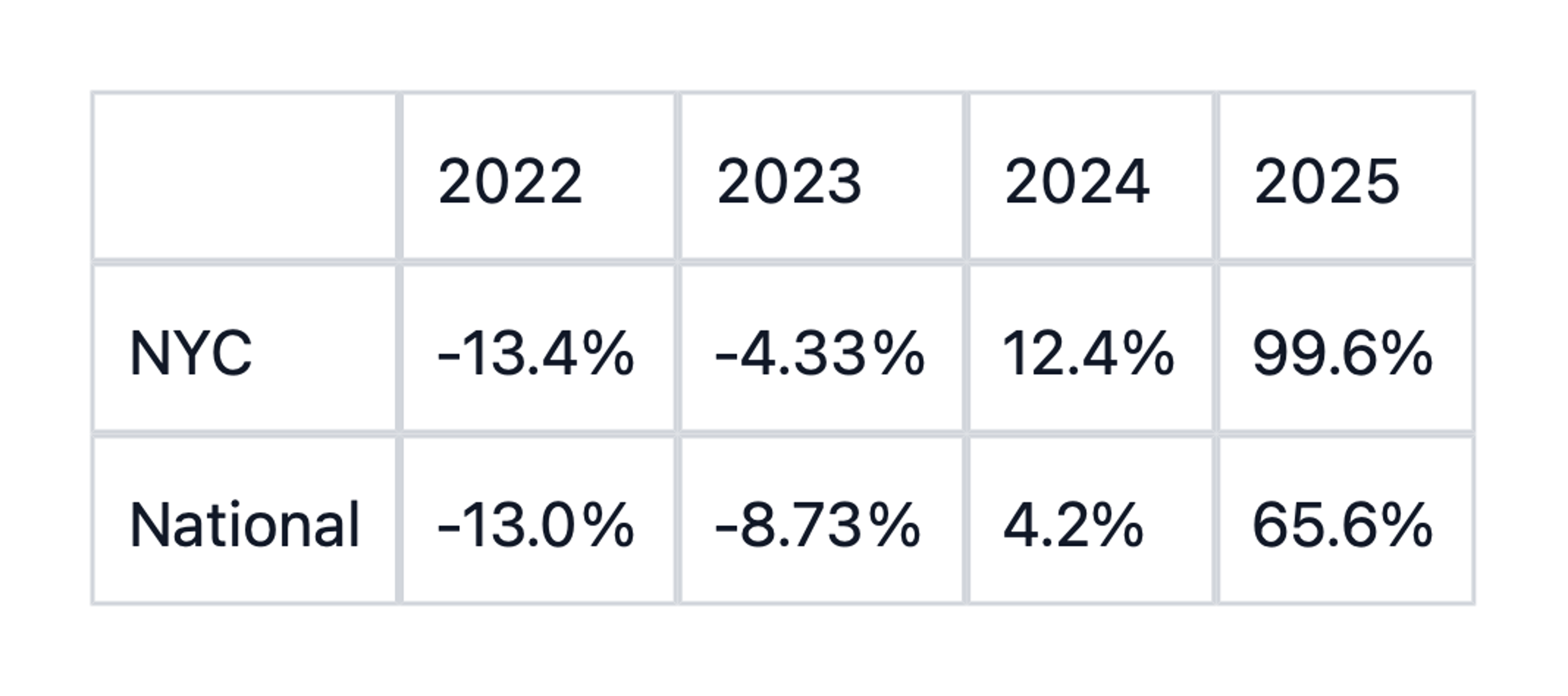
Figure (1) - NYC vs National Annual Growth Rate, MIGSSource: [Public] DSA Membership Numbers by Chapter
While pre-2021 data is less consistently available due to poor recording practices, national and chapter-level membership data from 2022 onward is publicly available via a spreadsheet provided by national DSA. This data has recently been updated to track Membership In Good Standing, so it can be consulted easily without inadvertently conflating different methods of calculating membership.
For the purposes of this discussion, the most useful insights we can glean from the data come from comparisons of national vs NYC-DSA growth. Notably, the freefall in national membership between early 2021 and October 2024 lines up with the Biden administration. This period is now understood as a time of decline for the American left, including both progressive and socialist organizations. Despite shrinking by over a third during this period, DSA likely outperformed most of the left as several other prominent organizations, such as Sunrise Movement, almost collapsed.
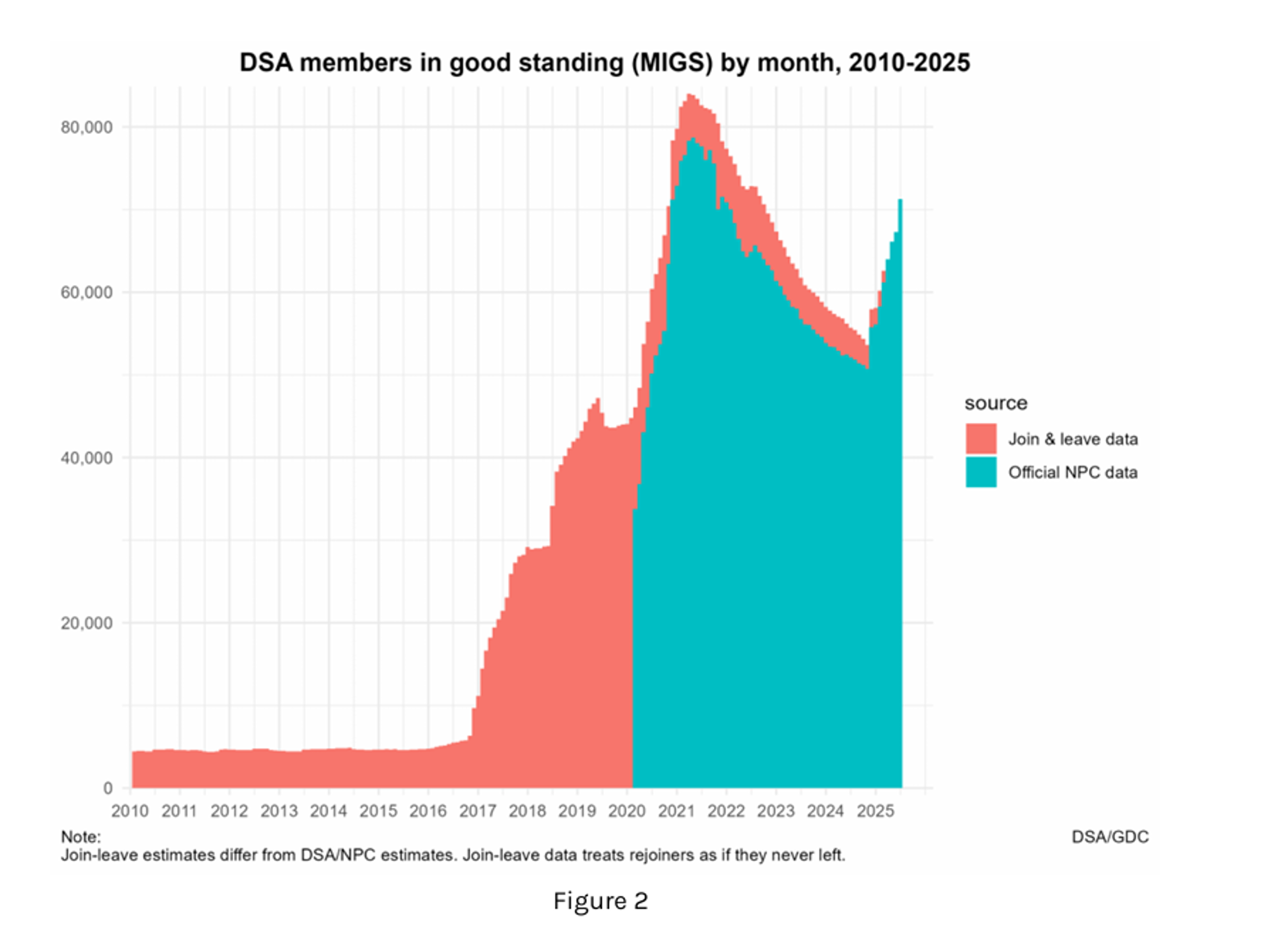
Figure (2) - DSA MIGS by monthSource: GDC Report - p11, figure 2
While NYC-DSA followed a similar trajectory through 2022, the chapter has maintained a consistently higher rate of growth than the national organization since 2023. The significance of this is enhanced by the fact that NYC-DSA represents a large portion of national membership, so the divergence in growth rates is even greater when subtracting NYC-DSA’s growth from national’s.
The data shows that while NYC-DSA shrank in 2021 and 2022, it began to diverge from national DSA’s attrition rate in 2022, significantly improved its attrition compared to national in 2023, and achieved rapid growth in 2024. In 2024, NYC accounted for over 30% of all national growth, a fact that I highlighted on the DSA forums last year. Interestingly, NYC’s percentage growth immediately following Trump’s reelection was not much higher than the national average—our outperformance that year was driven by our membership numbers holding steady while the rest of the organization was shrinking.
Making Sense of The Data
The general consensus among NYC-DSA leadership is that our strength from the 2022-2024 period owed to a few key factors.
Prioritizing Recurring Monthly Membership
NYC-DSA’s Tech and Tools Coordinator worked with national DSA to enable NYC-DSA to use a customized join page starting in 2023. This page was used to promote monthly renewing membership options and de-emphasize one-time, nonrenewing membership. This was paired with repeat outreach to recently lapsed members who were on yearly non-renewing membership to encourage them to renew their membership via the monthly option. This explains why NYC-DSA has such a high percentage of monthly dues payers and thus how we provide such a disproportionately large percentage of national income from dues—roughly 20% despite representing 14% of membership.

Figure 3 - As of January 2026, NYC-DSA was among the chapters with the highest percent share of members paying standard or Solidarity Income Based (SIBD) monthly dues. Data sorted by combined percentage.
Thankfully, national DSA implemented a similar change for the main join page in 2025, though the impacts of this will take some time to become apparent in the data.
Improved Member Experience & Recruitment
As I have written about elsewhere, I have strong reason to believe the growth of the Membership Committee during my term as NYC-DSA Membership Coordinator had identifiable impacts on chapter growth. This period also coincided with an increased focus on list building and recruitment outreach led by our then Tech and Tools Coordinator, including recurring emails to lapsed members and a highly successful Winter 2022-2023 member drive.
While I lack quantitative analysis as rigorous as the GDC report, my data goes beyond the anecdotal:
The period of 2023-2024 saw a major increase in the percentage of membership participating in chapter democracy—with turnout for delegate elections doubling in most branches to around 25-26% from 12-13%.
NYC-DSA’s list growth was completely stagnant in 2022 and began a notable uptick starting around mid-2023. During the period of 2023-2024 socials and large ‘spectacle’ style events were consistently the top weekly list builders alongside letter writing tools. This is also around the time when our run club formed, which routinely recruits new members—identifiable via source codes.
By 2025, our Membership Committee was engaging several thousand members and non-members.
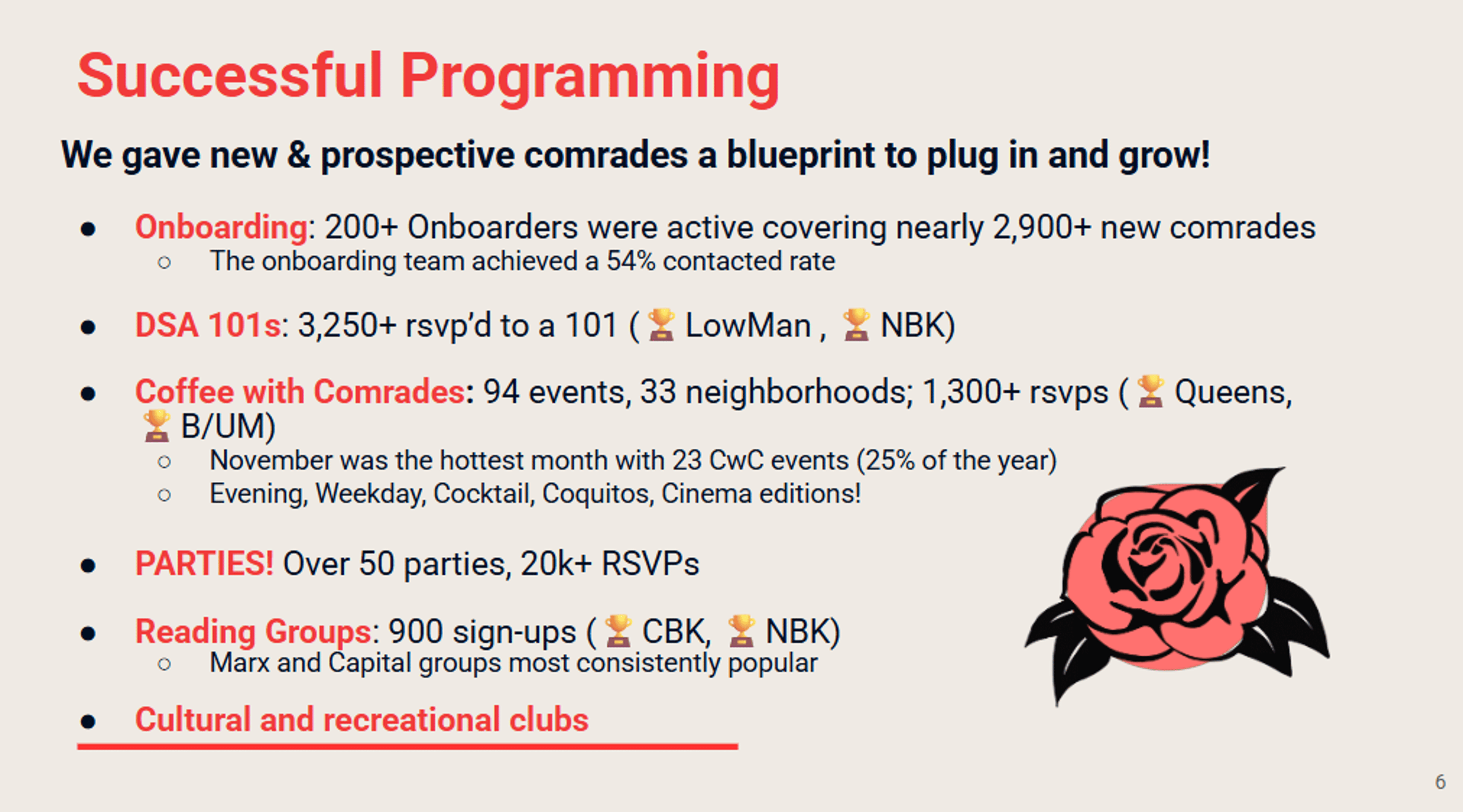
Slide from 12/9 Membership Committee Coordination Call Source: 12.09.2025 Final Slides - Dec 2025 Coordination Call
To my great joy, even articles critical of chapter practices now remark on our robust social and cultural life—a stark contrast to 2022, when many active organizers reported feeling they were only seen as ‘bodies for canvassing’.
Electoral Stability
It is well understood by most long-time DSA organizers, and even touched on in the GDC report, that there is a correlation between electoral performance and growth. But while the impact of electoral victories is well understood, stability is also important. I will define ‘electoral stability’ here as the ability of a Socialists In Office program to maintain participation among elected officials, to consistently win re-election, and to avoid expulsions as well as departures.
Until Zohran’s mayoral victory in 2025, NYC-DSA’s electoral program had seen its momentum stall, having only one newly elected candidate in each of 2022 and 2024. However, none of our politicians lost re-election, and our SIO did not experience any splits. While this was not a period of significant growth, the organization’s electoral wing was able to consolidate its previous victories and remain a notable presence in local politics.
A word of caution—it is entirely possible that any apparent relationship between ‘electoral stability’ and chapter growth may be correlative rather than causative. For example, if a chapter is in decline, there is more incentive for SIOs to break with the organization. Alternatively, if a chapter develops cultural issues, then SIO departures and member quits may originate from a common confounding variable rather than one being the result of another.
Issues with GDC Report
While the GDC report is well researched, and the authors admit to its limitations, the assumptions underlying the report, as well as some major omissions, compromise its utility.
The response to the report by Gigi G. for Geese Magazine covers some of its issues, and while the essay is a polemic, I believe it's worth a read. Rather than revisit that article’s talking points, this essay will focus on additional issues with the GDC report.
Excluding NYC-DSA
One of the most glaring omissions from the quantitative elements of this report was the comprehensive exclusion of NYC-DSA from the analysis. I was the chapter membership coordinator during much of the period the GDC report covers, and it was clear that we outperformed in 2024. Despite this, I had never received 1-1 outreach from the GDC team, and it was recently confirmed to me by a GDC member that this was a deliberate decision because we were ‘anomalously large’.
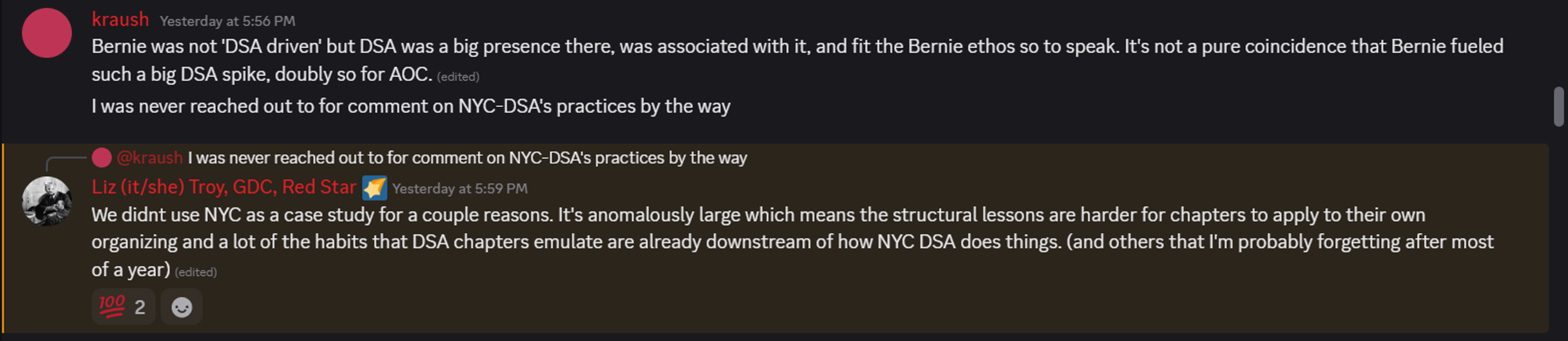
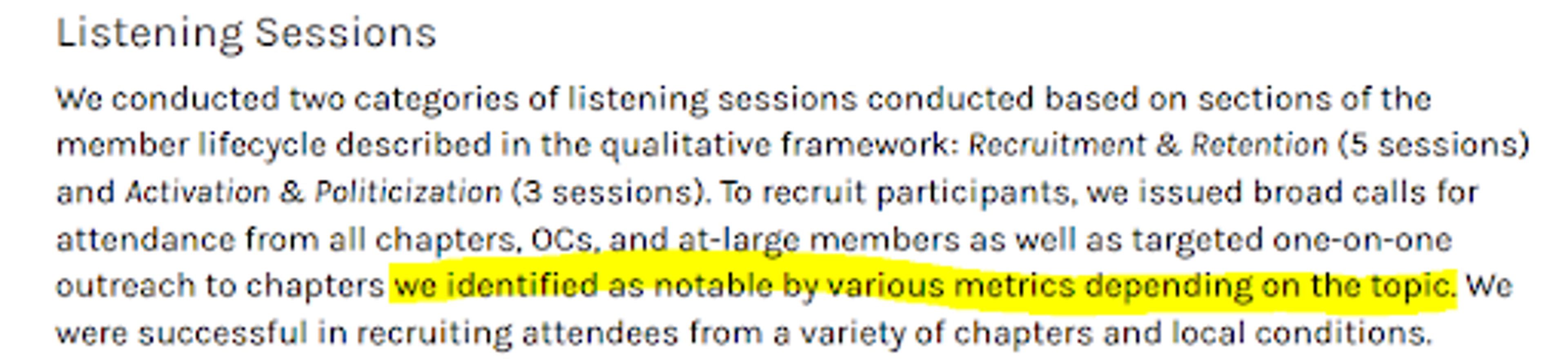
I am sympathetic to this argument. At our size, it is not reasonable to assume that other chapters can replicate everything NYC-DSA does. However, if the goal was to do outreach to chapters identified as notable, I fail to see why NYC-DSA would not at least be consulted. In the interest of identifying best practices, there is no reason why outliers should be excluded a priori when they may be precisely the instances that need to be researched.
I also reject the notion that our size would mean other chapters have less to learn from us, and vice versa. NYC-DSA did not invent socials or 101s, two practices recommended in the GDC report, but we did much to refine and popularize them as onboarding tactics. In this vein, I write a few articles a year on member development with the hope that leaders from other chapters are able to read them and evaluate how they may be relevant to their own circumstances.
Not Discussing Yearly Non-Renewing Membership
While the report identifies a consistent rate of members leaving in the first year across chapters, it barely mentions that, until recently, little was being done to discourage people from joining via yearly non-renewing membership. However, the prevalence of yearly non-renewing membership means the high rate of first-year lapses could be more noise than signal, because non-renewing memberships were combined with renewing ones in the statistics.
Lack of Focus on List Building
An alarming aspect of the GDC report is how limited an understanding of recruitment best practices most DSA members seem to have. There is a total lack of any direct mention of list building in the report and subsequent summary articles, despite it being of fundamental importance to sustainable growth.
While the survey response analysis in the GDC report does include list-building tactics such as letter writing campaigns, this may be misleading. What do chapters mean when they say they use tactics like letter writing campaigns? How many chapters have the infrastructure and understanding to quickly produce and circulate these in response to external events? How effective have these chapters been at growing their lists through these means? I believe chapter practices and capabilities would differ significantly here, making the quantitative analysis of the ‘effectiveness’ of these recruitment methods qualitatively flawed.
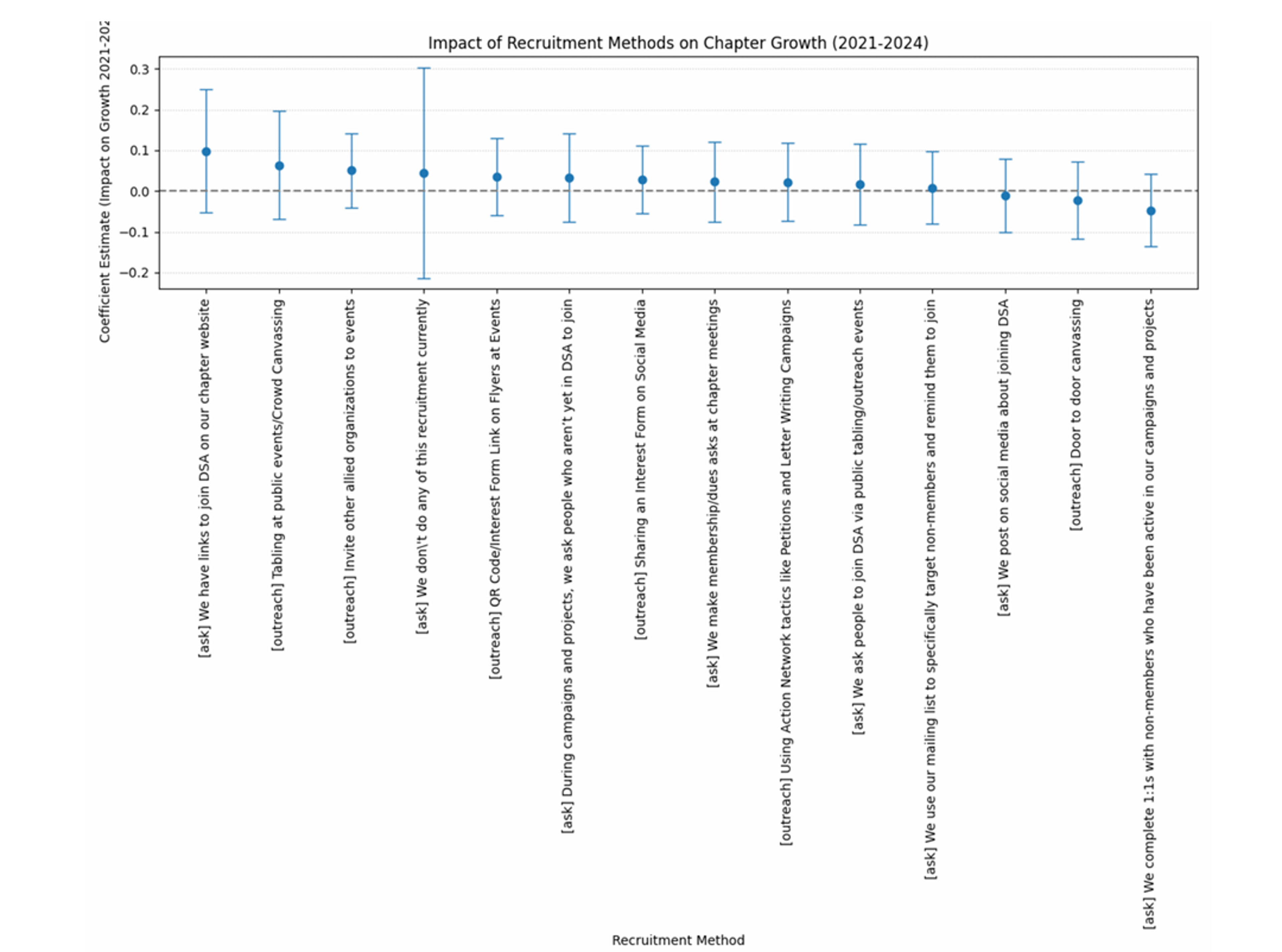
It is likely that most DSA chapters do not consistently and deliberately practice list building—though it is difficult to know, as list size data is (strategically) not publicly available in the way that membership counts are. If my assumption is correct, it speaks to the limitations of DSA organizers' understanding of how to grow an organization. This is starkly different than there being no ‘identified’ practices which can promote growth–these practices *do exist* and NYC-DSA utilizes them. This directly contrasts with GDC’s claim that there “aren't any [...] innovations that specific chapters have been able to implement to build their own momentum”.

(https://democraticleft.dsausa.org/2026/02/10/state-of-dsa-part-two-lessons-learned/ - section - recruitment is predominantly passive)
What Drives Growth?
Drawing on my experience as a prior term NYC-DSA membership coordinator as well as discussions I’ve had with organizers across the country, I believe there are several practices that encourage chapter growth. I would not argue that these are the sole practices which encourage growth, or that they are equally applicable to chapters of all sizes, only that they have been shown to work in some instances. In many senses, our movement is a young one and is coming off a trend of abject decline in American civil society, so it is entirely likely innovations coming from DSA chapters have barely scratched the surface of what is possible.
Build Your Lists
The success of recruitment outreach is also going to be a function of a chapter’s list size. Even if we assume outreach only has a 1% success rate, that has very different implications for a list size of 100 versus 10000. If you aren’t growing a list, the number of people you can do recruitment outreach with will remain limited, which will make membership growth more difficult over time.
Good list building should be considered in similar terms to membership growth—as a gradual process where you can take advantage of big moments to see large spikes. Some of the best ways to capitalize on the moment are salient letter tools or large spectacle-style events. The massive Zohran election night parties grew NYC-DSA’s list by several thousand, which went a long way towards driving recruitment.
The right big events can function both for recruitment and list building—NYC-DSA’s post 2024 presidential election mass call with AOC led to 32 joins and thousands of RSVPs. In practical terms, DSA chapters concerned with recruitment should ask themselves how they might be able to reach these large numbers of people and convert them into longer-term members through lists.
Every Member Matters
The GDC report is correct in identifying the importance of retention, despite issues with its framing. Small differences in member growth and retention add up tremendously over time—which is the main reason NYC-DSA was able to outperform the rest of the org so substantially in 2024.
The implication of this is that regular recruitment outreach to non-members and lapsed members is still valuable on a regular basis, even if it's less ‘impactful’ per attempt than when done following big moments. In 2023 and 2024, our DSA 101s were one of our most consistent recruiters, bringing in 1-2 dozen people per month, while that doesn’t compare to the thousands who joined after Zohran’s elections—it was very important for maintaining our ranks.
This also means that reducing quits and deliberate lapses via positive chapter culture is an effective strategy, especially when emphasized in periods where the movement may be treading water rather than growing. Fostering a sense of reciprocity in organizers is key to success here—so a strong internal community, opportunities for members to develop, and engaging and visible politics go a long way.
You Can’t Fight The Current, but You Can Ride The Wave
Thus far, I have substantially addressed a wide range of practices that have helped grow NYC-DSA and which could help grow your chapter. Here, I want to tackle more directly the GDC’s assertion that chapter growth is predominantly 1) passive, and 2) caused externally. The GDC is right to identify that DSA growth is substantially impacted by major political events not caused by DSA members, such as the election of Donald Trump or Israel’s genocide in Palestine. Where they go wrong is to imagine that DSA chapters have no agency in how they grow in response to those events.
As the previously discussed Geese article by Gigi G. proposes, how an organization responds to these moments has a significant impact on growth. Twin Cities DSA, for example, is one of DSA’s fastest growing chapters in 2026, and while Operation Metro Surge is a major crisis, the impact of that chapter’s response work should not be understated as a requisite for its growth. Rather than see growth as being left to chance, we should think of it as a function of how prepared we are to effectively present DSA as a left-wing solution for major political crises.
Many basic recruitment tactics the GDC report identified as ineffective are, in fact, exactly what a chapter needs to be doing following big moments. For example, recruitment outreach such as text banks and emails often don’t result in high conversion rates except during periods where people are mobilized. A textbank run by NYC-DSA immediately following Trump’s victory in the 2024 general election recruited over 50 new members on the spot. DSA’s recent member drive in late fall/early winter 2025 recruited over 1000 members tracked by source codes - it is unlikely they would have seen this level of success if not for Zohran’s win, but on the other hand, there is no guarantee most people recruited in that drive would have joined without outreach.
Go Big, Credibly
This last point is likely worth an entire additional essay. Zohran’s race proved that there are moments where DSA can make political interventions that drive chapter growth, both locally and across the country. While the statistical analysis at the heart of the GDC report was done before Zohran’s mayoral victory, it is bizarre that the recent follow-up articles make no mention of the substantial bumps in growth fueled by Zohran’s victories in the primary and general.
Zohran is a cadre DSA elected who keynoted our 2023 national convention; he ran as a proud DSA member and even personally recruited NYC-DSA’s 10,000th member. While Zohran’s victory was far from certain, the mayoral race was consciously identified before he was even drafted as a moment to build DSA and to visibly take on corrupt Democratic leaders, including Eric Adams and, later, Andrew Cuomo.
NYC-DSA running Zohran for mayor is not the first instance of DSA’s political work driving growth, but it is the biggest one to date. Zohran’s effect on growth was widespread across the country, with many chapters hosting election night watchparties and other Zohran-themed recruitment events. This network effect is exactly how we will build a nationwide mass party in the U.S., as DSA victories and campaigns in local chapters inspire people across the country to join our movement.
But growth through major political interventions isn’t just a matter of being present as a left alternative in a high profile race; the alternative DSA offers to working-class Americans has to be credible. Jill Stein’s protest campaign in 2024 did not lead to substantial growth in Green Party membership, unlike how Bernie’s 2016 and 2020 runs massively increased DSA’s. When Bernie and Zohran ran, they both presented a strong campaign with a credible path to eventual victory, where Stein’s race couldn’t even be considered a long shot.
During the Zohran campaign, we organized thousands and thousands of members in NYC-DSA, more than doubling from 6,000 members to over 14,000. Those members saw in NYC-DSA an emergent left-wing powerhouse, and joined because we offered a credible alternative to status quo politics. As someone who was there, I can tell you recruiting those members wasn’t a passive activity. Every DSA 101, canvass, mass text, and watch party made that growth happen.
Building lists, engaging members, and making effective interventions in important political moments, whether that’s reactively opposing ICE operations or proactively running DSA candidates for high profile races, is how we are going to build DSA into a mass party of millions.