
Mar 17
Desire is Sacred
Changing the world requires us to understand what people want, and what they think they want.
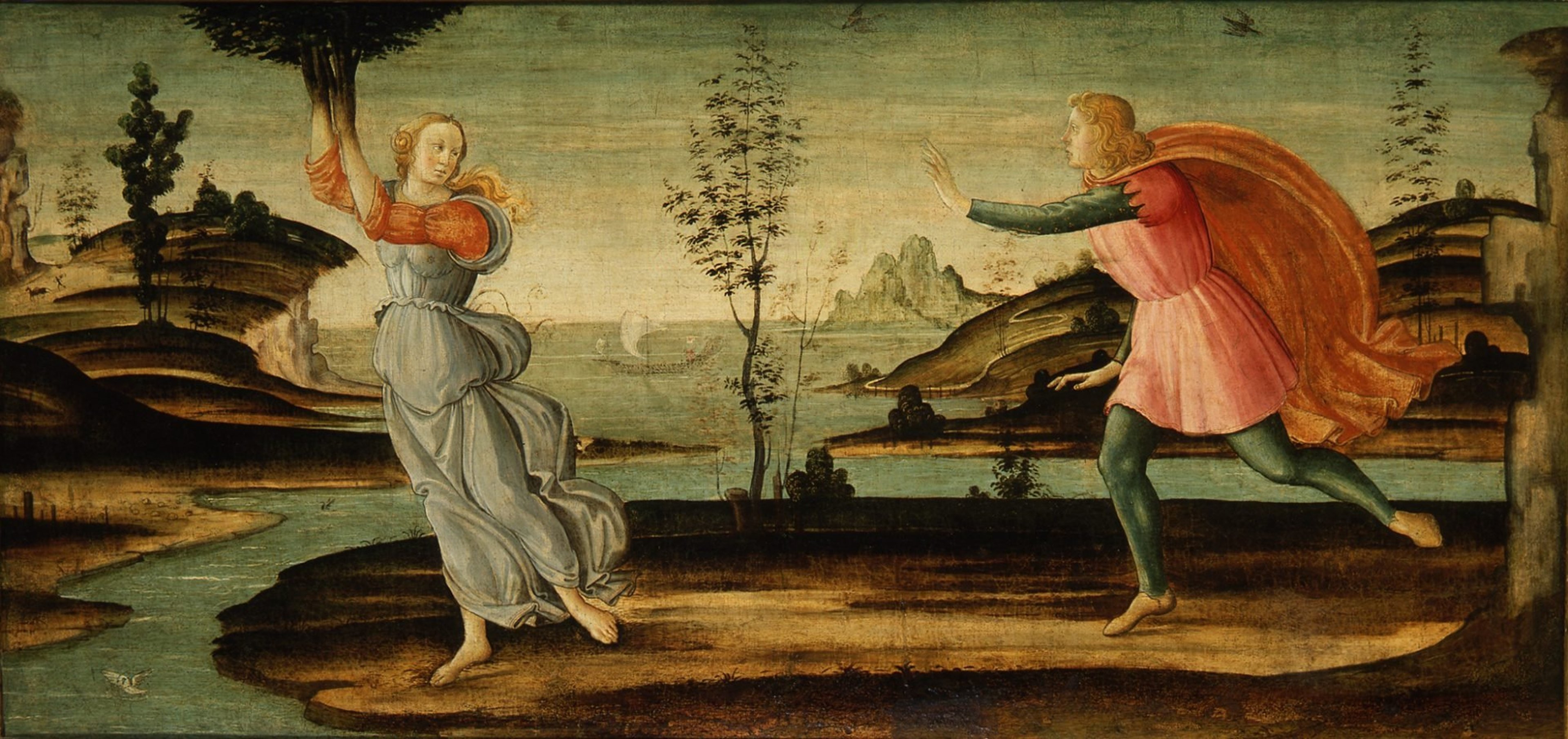
Daphe Fleeing From Apollo, c.1500
This essay was originally published in ‘Supermaterialist’.
A number of friends have asked what exactly I mean by this phrase, which I repeat frequently, and I want to attempt a more thorough explanation.
Psychoanalysts understand desire as a motivation found in all human behaviors, from short-term impulses for a quick hit of pleasure, like a free donut at work, to long-term fantasies about the person we’d like to be, which allow us to stay home and study when we’d rather go out drinking. Desire is part of the imaginative engine that allows us to create, innovate, push through adversity, and simply to tolerate the day to day humiliations, delays, adversities, and boundaries of our lives, taking our base needs for safety, love, power, belonging, and transforming them into fantasies about how to satisfy them. It’s the point about adversity, and the question of how society influences the form desire takes that I’m interested in here.
The process of growing up is a process of learning to delay gratification, to learn to do what you need to do (to survive, to make money, to maintain relationships) with the promise that this will let you get what you want. Individuals can be made to tolerate roles that might seem intolerable because of that promise. Women can be made submissive housewives with the promise of safety and love; office workers can tolerate day to day humiliations and the loss of control of their time because they can afford dinners and vacations and objects that make them feel like the person they want to be; blue collar workers can endure backbreaking labor and condescension from the wealthy yes, because they must work to survive, but also because this work gives them a sense of dignity and some small pleasures in life, the ability to have a family. The threats of violence and starvation are not enough; there needs to be a promise of something else, something that gives us enjoyment, pleasure, love, or at least the hope for it, and in the absence of that, willingness to endure erodes. The content of this promise is not fixed, and its form is culturally and systemically (and even individually) contingent. What we are dealing with here is fundamentally two levels of desire: the culturally and systematically and individually contingent concrete forms we can see (small “d” desire), and deeper unconscious Desires (for safety, recognition, love) which seek satisfaction and realization in these concrete forms.
I’ll begin with an example. Why is it that feminism is so deeply offensive to some men, to the point of irrational anger? A conventional feminist answer would be that the patriarchy benefits men and of course any movement that seeks to liberate women threatens those benefits. This is a good explanation for the system taken as a system, but it is, in my view, an inaccurate explanation for the system taken as a collection of individuals. Vulgar materialism can describe the aggregate behavior of systems, but psychoanalysis is required to make sense of the irrational choices of individuals.
Socialists face a similar problem in trying to understand why workers do not organically develop class consciousness en masse. They sometimes fall back on a shallow concept of capitalist propaganda, or other poorly fleshed out abstractions to explain the complacency of exploited classes. The particular propaganda, how it is experienced by workers, what Desires it activates that are strong enough to undermine solidarity, should be of great interest to any socialist, because those are the exact Desires that will need to be reconciled with the socialist movement. Yet, many socialists would rather demand adherence to dogma than ask about what it would mean for their family if they had a union to negotiate a better wage.
So how does the misogynist experience feminism as a threat? The reactions of these men to feminism reveal the answer. They accuse feminists of being ugly, jealous, prudes; they decry how feminists have unleashed the hypergamous, obscene excesses of female sexuality. On their forums they discuss feminism as a female sexual strategy to dominate and exploit men. These are at least the explanations they tell themselves and the world, but they conceal the real threat of feminism as they experience it. These are fears about a shortage of women they find suitably attractive and sufficiently accessible to them sexually. Feminists, they fear, make it okay for women to be nasty and fat and ugly and to take advantage of the power they have over men, limiting the sexual access to only men they want to have sex with (the horror!), and limiting the number of women men feel are suitable for relationships. This fear necessarily is an expression of more essential, unmediated fear: of rejection, of loneliness, of meaninglessness. Ironically, this misogynistic mindset–scaring women away with hostility and barely concealed desperation–makes it almost inevitable these fears will come true.
At their most plaintive, today’s misogynists suggest that, if they could have wives and families, they could make peace with their shitty jobs (or lack of jobs), their general unfitness. For incels, these absent (sometimes “aborted”) fantasy girlfriends or wives function as a kind of foreclosed happy future, and in that utter lack and hopelessness, they become nihilists and even violent psychopaths. For less hopeless men, there is still tremendous anxiety about only having access to the “wrong” kind of women: dirty, fallen women with tattoos, promiscuous women who spread disease, women with past lovers who might be better, women whose independence means they can betray, women whose jobs may mean less time for their husbands and children or who may just need them less.
On the margins of the manosphere, there are influencers like Andrew Tate and the slew of copycats who model an attitude toward women that shields against becoming a beta loser, paying for dates like a sucker, being cuckholded by men who put in less effort and treat women worse. Tate and the like offer men a fantasy: that by becoming sufficiently anti-social they can control women’s sexuality, or at least have enough emotional distance that they won’t be hurt or humiliated by a woman. These fantasies are fundamentally an attempt to deal with the lack of control men have over what women want, covering over the fear that they themselves are the undesirable ones.
Even outside the manosphere, in places like Reddit (frequented by men who manage to have reasonably healthy relationships and marriages) versions of these anxieties kick in. Creative writing subreddits like r/AmITheAsshole and r/relationships heavily feature stories about women’s infidelity. Many men (and women) place cheating on the same level as abuse, and in these comment sections, X (The Everything App) reposts, and substack essays you will find men so consumed by the experience, or fear, of infidelity that their ideal partner is conceived of primarily as a person who is “safe” and can be trusted above other qualities. Some are so paralyzed with this fear that it ruins their ability or desire to enter relationships entirely.
The commonality here is that women serve a load-bearing function in these men’s desire to live and participate in society, and that the love of a Good Woman could redeem them. In very consciously misogynist communities, she is a “high value woman,” low body count, enviably attractive, ready to obey her captain. She exists to make him feel masculine, powerful, and to signal to other men he has his life and priorities in order and that he’s valuable enough to get what he wants from a woman; it’s crucial that she never do anything he sees as humiliating or emasculating. For many men outside of these communities, the values remain fairly similar, they are just unenumerated and even unconscious. Perhaps when men don’t even feel powerful in their own fantasies, they can only be attracted to women who make them feel powerful in comparison.
The traits that this Good Woman comprises directly address the wounds these men have sustained from their upbringing and day to day life under modernity/post-modernity, capitalism, and the generalized sense of decline that defines the current period. The Good Woman is an exact inversion of the fallen woman: she has endless love and endless patience (a far cry from the fears men of past generations had about “clingy” women), she is knowable, not capable of infidelity (perhaps because she is sexually pure, ignorant, obedient, or just singularly devoted), and needs him and depends enough on him for him to feel useful, needed, not replaceable.
Returning to my more general point, these are understandable anxieties that many men and women alike have to some degree, and there are other anxieties that are not represented here that may be more common in women but are not absent in men (anxieties about feeling used or disrespected by a partner for instance). And just like in these men, all people develop desires in response to anxieties about the traumas, small and large, of their lives. Our families, friends, cultures (especially media) give shape to our desires by giving us sets of norms which we can accept or reject to ward against these anxieties–I may have had to separate from my loving mother, but a Good Woman will love me just as unconditionally. Especially for desires reified by these norms, satisfaction can even become something we feel entitled to, as in the case of the Manosphere.
Desire is not homogenous and different desires are not treated equivalently. Cultures tend to socially reify certain desires while others are judged, discouraged, or outright banned. It is those desires which are reified which also seem to be most viciously defended by the people who possess them. I’ve observed for many years that the men with the most normative desires seemingly feel the most urgent need to defend them, to canonize them as inherent to men writ large. When online feminist debates were most concerned with dilettante evolutionary psychology enthusiasts, it was not uncommon to see claims that it was because of evolution that men prefer blonde hair, blue eyes, 2:3 waist:hip ratios, long hair, large breasts, long eyelashes, shapely legs, etc. Were these very popular beauty standards ever under any threat? What point did it serve to categorically exclude from legitimate masculine desire men who preferred brunettes or fuller figures?
Homophobia is a more extreme version of this policing of men’s desire. And while clearly there are more complex mechanisms at hand (for instance the vulnerability that comes with a man realizing he, too, could be penetrated), there is also the threat of being forced to settle for less. That other men, failing at masculinity, have already settled. Maybe you can’t have the perfect woman, maybe you can’t have a beautiful woman, maybe you can’t have a woman you’re even attracted to, maybe you can’t even have a woman at all, maybe (so failed a man you are) you might even prefer a man.
It’s those whose desires conform most neatly to the normative conception of desire (men and women alike) who are the most sensitive about investigations into their origins. Like all psychoanalysis, examining the origins of desire can feel violating if not outright painful, like someone reaching into your guts and probing around. But chauvinists of conventional desire have never felt any compunction for putting deviant women, gay people, black people, the insane and disabled, or any other sexual deviants on the examination table. While Freud had no issue vivisecting the most “normal” relationships between men and women, he was an early pioneer in assigning the roots of homosexuality to relationships with overbearing mothers and absent fathers, and it’s this analysis that has been comfortably taken up and repeated by conservatives, who balk at the idea their own desire could be anything but natural and predestined.
Anyone paying attention to the aesthetic trends among conservative women would probably laugh at the idea that there’s anything natural about the desires at play: hair extensions, lash extensions, Mar A Lago Face, garish makeup. To anyone not totally bought into the conservative worldview, these women look uncanny, even creepy, but conservatives proudly claim “their” women are beautiful and feminine, unlike liberal women. The performance of femininity placates the anxiety in conservative men of ending up with the wrong sort of woman, and it quells anxieties about their sexuality. Conservative women perform the most extreme version of femininity, so if I as a man am most attracted to conservative women, surely I am the most straight a man can be. It’s not surprising that men with the most unconcealed anxiety about masculinity constantly state their attraction to only the most extreme expressions of femininity, even when those expressions defy conventional beauty standards.
This notion of inherentness of these desires is another mechanism to attempt to guarantee their satisfaction. Attraction to feminine signifiers is “natural,” therefore the performance of these signifiers must be an inherent aspect of womanhood. Women who perform gender in this way are “real” women, women who don’t are deviating from their nature, which can only be a result of liberal meddling (or something more sinister), remove the meddling and all women will return to their natural state, and I will be able to find my soulmate. However, if this is just one possible desire among many, if I’m only obsessed with this type of woman because of my own insecurity, and a culture that fed me a perverse worldview as the solution to my anxieties, the floor falls away and there is no reason women should have to have long blonde hair or tiny waists or fluttering eyelashes. Am I doomed to never be happy?
The reality is there is no singular normative desire, and that we are all profoundly shaped by our deepest fears of abandonment, rejection, humiliation, and betrayal and by the ways we learned to love from our parents and our peers. Through culture, we are shown idealized images that we reject or embrace, and we chart a path through our fears and limitations, to a fantasy that would make it all worthwhile, that would make us happy and satisfied. Clinging to desire is both compensatory for the imperfect lives we live and is a potent fantasy for satisfaction. It is in this sense that I mean desire is sacred.
A similar bargain is at work in religion. Certain behaviors, actions, items are forbidden for the good of society (murder, adultery), for safety (pork, shellfish), or for discipline of citizens (masturbation, gambling), and as a reward there is heaven. In a secular society, these same things are repressed so that we might each get what we really want in the end. If I as a man get a good steady job, I will have a decent wife who loves me and children to carry on my legacy. If I as a woman am dutiful and modest I will marry a man who will always care for me even when I’m old and no longer beautiful.
To anyone who can read between the lines, it’s clear none of these rewards were ever guaranteed; at best these are social strategies to have better chances of getting the things we want based on common sense and traditional wisdom, at worst they are fables some adults believe too earnestly. When these social rituals fail to make the fantasy come true it can be deeply painful. When the self-proclaimed “nice guy” who believed it was enough to follow certain etiquette rules to find a girlfriend, finds himself alone, he disavows and drops those rules entirely. When men see in their fun mirror reflection of feminists the threat that beauty, fidelity, legacy, pride, respect may be barred, what is really at risk is the notion that any of the work, the pain, the indignity, will ever have been worthwhile.
Similarly, desire can also sanctify transgression in the mind of the transgressor. Few people believe infidelity is ever justifiable, fewer still believe it is justifiable outside of extreme situations like abuse, and yet people cheat all the time. Contrary to the opinions of some, not all of these people are psychopaths or narcissists, and many of them continue to live and love and have relationships where they never cheat again. How? No situations are the same, but take the archetypal example of the husband and father of several years who suddenly becomes unfaithful.
These situations unfold in a similar pattern: the marriage, after years of being deprioritized in favor of children, careers, and the normal stresses of life has become stale and uncommunicative, the husband goes on in his day to day life, sometimes remembering the feeling of being desired, perhaps missing it badly, perhaps focusing it into his work, perhaps suppressing it with a bad habit or two, but largely continuing his responsibilities at work and home. Suddenly a new woman enters his life and he feels rediscovered; the feeling of being seen and desired again is intoxicating, even revelatory. In the early stages of infatuation, everything about this feeling seems important, special; it can even feel liberatory. Adulterers often feel that the affair is the most in love they have ever been, and it’s not uncommon for that feeling to carry the affair into its own lasting relationship. It is that evangelism of feeling, that sense of having been reborn as a passionate being from the husk of domestic monotony, that allows him to overcome guilt, fear of discovery, fear of judgment, to carry on betraying someone he loves without having to lack empathy or compassion. For him, it is sacred betrayal.
My point in this is not to justify the misogyny of the manosphere, or affairs or any of the feelings they generate in the adultors. The desire some men feel for a dependent woman does not make it necessary for their survival, and it’s certainly not an entitlement. A cheating woman is not justified in cheating because she has not felt desired in many years. The point is that the Desires that produce these behaviors are the sources of energy that allow us to endure the everyday humiliation and exploitation of our lives. More importantly, they are the drives that any person or movement who wants to move masses of people must contend with. When we make demands on one another to be more ethical, more considerate of one another, more kind, more giving, more pro-social, we cannot be successful unless masses of people see a path to satisfaction in that society. We can also use these drives in our favor if we can show those masses that the current structure of society makes their Desires (for love, for connectedness, for comfort) impossible.
A movement for feminism must not only appeal to men on an ethical level, demanding equality and an end to misogyny because it is right, we must also show that it is only through equality that deep and mutually satisfying relationships between men and women are possible. A socialist movement must not only argue that an end to exploitation of workers is necessary because it is an inherent good or a historical necessity; we must also argue that only a system built around the dignity and self-determination of all people can make it possible for each person to pursue their idea of the Good Life.
Understanding this tension does not mean giving up criticism of fantasies that involve the degradation of others, but it does mean understanding these fantasies have underlying motivations, and the best way to redirect the fantasies is to give people more pro-social paths to satisfaction.
Afterthought
As I was finishing editing this essay, the latest wave of Epstein files were released. I was reminded viscerally that there are many desires that cannot be entertained, and should not even be redirected to more pro-social alternatives. How can a society address desires so fundamentally invested in the destruction of the most vulnerable members of society?
The extremely wealthy are like everyone else in that the circumstances of their lives shape their desires, but the circumstances that shape their lives are exploitation, violence, domination over other people with few real limits on their behavior. Desire often feeds on overcoming barriers, wanting what we do not or cannot have. In life as most of us experience it, these barriers are the distance between us and other people, the judgments of our friends or family, our own inhibitions created by a lifetime of shame and repression. What is left to men who have never known a world in which there were laws they could not break, things and people they could not have, but the violation of our most sacred values?
The desires I’m describing in this essay, the ones we need to contend with in our politics, are the desires of the masses of people who will be part of the better world we want to build. The Epstein’s of the world, his lackeys, the men and women who participated in his exploitation of women and girls, have no place in that world. As much as we can stomach it, we should peel away the glamour and secrecy of the lives of the wealthy and powerful and understand just how much living at the expense of the world rots a soul from the inside out.