
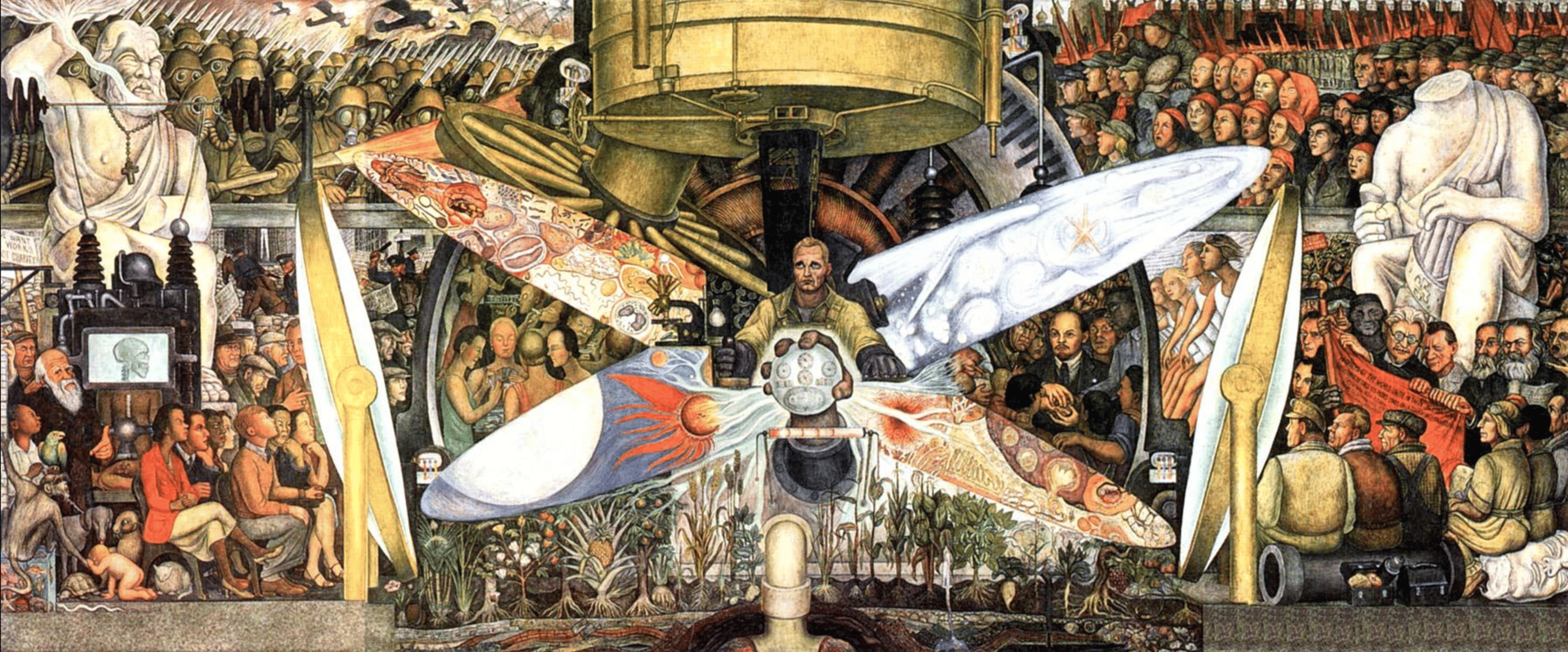
Man, Controller of The Universe by Diego Rivera, 1934
Elon Musk presented his vision of the future:
The irony is that the capitalist implementation of AI and robotics, which ensures prosperity for all (abundance of goods and services), will actually lead to a communist utopia. The problem with communism is its universally low income. Not that everyone is being lifted up, but everyone is being oppressed, except for a very small group of politicians who live in luxury. This happened every time it was tried. If a true communist utopia is achieved (where everyone gets everything they want), then it will be achieved through capitalism. Fate is a true maximizer of irony. (1)
Of course, in turn, one can sneer at the fact that the richest person on the planet, in this case, is no different from a small shopkeeper who convinces the consumer of the "huge advantages" of his product. But the question is really serious, since AI is of great importance for the fate of capitalism.
It is worth noting that Musk combined two long-standing and quite widespread opinions. The first is that capitalism is capable of transforming itself peacefully and evolutionarily into a new formation without great upheavals, providing all members of society with an abundance of material goods and fulfilling lives (Bernstein, Kautsky and other social democratic figures were the first preachers of this belief). Secondly, that technology alone allegedly will solve all the world's problems. How well-founded are these opinions and what kind of transformation is the capitalist system preparing to undergo? In other words, what future will we face with AI in capitalist society?
Capital and Human Individuality
It is obvious that modern, late capitalism faces the task of untangling a whole knot of interrelated problems, among which two of the most significant can be identified: the social consequences of the implementation of AI, robotics, other technologies, and maintaining system stability in conditions of a colossal structural imbalance in the economy, namely, an excessively bloated financial sector against the background of stagnation of real production, i.e., ‘deindustrialization.’ In order to adequately understand the meaning and scale of the ongoing processes, it is necessary, before proceeding to specifics, to briefly highlight a number of important historical and philosophical issues directly related to the topic.
Marxists (and not only them) have firmly absorbed the stageist scheme of the successive development of social formations — primitive society, slave-owning society, feudalism, capitalism, socialism. Meanwhile, in the «Economic Manuscripts of 1857-1859» («Grundrisse») Marx considers history from a slightly different point of view. The starting point is also the material conditions of society, but the emphasis is shifted to the interaction of objective social development and subjective human development.
Marx identifies three main stages. The first stage is appropriation of the ready-to-use products of nature (hunting, fishing, gathering). The form of social organization here is the clan and the tribe. A human in an appropriating society is merged with nature; he does not distinguish himself from the natural world. In this society, there is no alienation, but there is also no individuality, because a human is absolutely dependent on both nature and social forms of immediate biological origin (clan and tribe).
The transition to agriculture and animal husbandry creates an agrarian society in which land (or livestock among nomads) becomes the main value. Marx recognizes that the peasant community was at the heart of agrarian society, both in Ancient times and in the Middle Ages, both in the West and in the East. Communal social relations were primary with regard to slavery and serfdom. Slavery and feudal dependence arose on the basis of communal property. They did not eliminate peasant community, although they inevitably transformed it. In this regard, Marx analyzes the various forms of peasant community—the Western ancient community (Ancient Greece and Rome), the Western medieval community and the Asian community. The concept of private property in an agrarian society was very specific: "Ownership means belonging of an individual to a certain collective... and through the collective's relationship to the earth as its inorganic body—the individual's relationship to the earth" (2). A peasant owned property only as a member of the peasant community (in Asia, peasant ownership was the most conditional and limited). A slaveholder owned slaves as a member of a privileged social stratum (eupatridae, patricians, equites, etc.) or due to his membership in the military-bureaucratic apparatus (in Eastern despotism). A feudal lord had the opportunity to exploit peasants only insofar as he occupied a certain place in a collective of exploiters organized according to the principle of vassal-suzerain (or, in Eastern despotism, occupied a certain place in the military-bureaucratic hierarchy).
Thus, despite all the differences in the specific historical forms of agrarian society, they all have one important characteristic in common, namely that they function on the basis of hierarchically organized and all-encompassing relationships of personal dependence. In an agrarian society, alienation appears, the active forces of man separate from him and appear before him in an alien, transformed form (state, religion, etc.). Since the main productive resource is land, society adapts to natural cycles. Marx notes that in an agrarian society, "the object of production itself is to reproduce the producer in and together with the objective conditions of his existence" (3). Accordingly, this type of society is conservative, production relations and the entire social structure are extremely sedentary.
Nevertheless, from the point of view of the historical development of human individuality, an agrarian society was a step forward. Within the limits of its capabilities it acted as a sufficient basis "for a progressive human mass to develop on it" (4). Marx refers the individual's dependence on the collective and on the "inorganic body" (earth) to the "indispensable premise of his individuality, to the way the latter exists" (5) in these specific social conditions.
Unlike an agrarian, "traditional" society, human labor under capitalism is no longer determined solely by the needs that have grown on the basis of nature. In this way, capitalism creates a dynamic system of universal metabolism, universal relationships, and all-round needs. However, personal dependence is being replaced by dependence on things, thingness (of course, we are talking mainly about intangible things—abstract social relations, political institutions, economic categories, etc.). An individual is freed from "old clientele relationships or relationships of serfdom and feudal service". At the same time, he is freed from "all personal possessions" (6). What used to belong to the individual—his labor force and means of production (tools, land)—now become moments of commodity production. Individual labor, which produces concrete use-values and inextricably linked to the personality of the producer—the labor of this peasant cultivating this field, or the labor of this artisan creating this product—is replaced by impersonal, abstract labor, which has as its purpose the production (mediated by the production of an infinite number of goods) of only one single abstract thing: surplus-value. In this way, people and things turn into goods that create new goods. The use value of people and things as commodities serves as a means to increase value and accumulate capital. Marx notes that abstract labor, in turn, appears to be an abstraction, but it is an abstraction that takes place daily in the real process of capitalist production (7).
Thus, under the conditions of capitalism personal independence turns out to be inseparable from thingness dependence. Marx concludes that "these external relations are so little the elimination of "dependency relations" that, on the contrary, they represent only the transformation of the latter into a universal form — the development of a universal basis for personal dependence relations… These thingness relations of dependence, as opposed to personal ones, act in such a way that abstractions now dominate over individuals, whereas before they depended on each other" (8).
An individual in a capitalist society is an individual "torn" between two worlds. As the owner of commodity-labor power he is reified and acts as a thing along with other things, his movements in the main points coincide with the movement of things. In a certain sense, the capitalist individual is even more "abstract" than a thing, because the use value of the thing satisfies specific human needs, while the purpose of labor consists in its ability to produce surplus-value, that is, in its ability as abstract labor. On the other hand, as a person with self-consciousness, he is different from a thing and strives for a movement other than the movement of things. But this aspect of his life is marginalized and denied by the capitalist system. Systemic pressure imposes thing-like existence on a person, and equalizes him with other things and other abstract individuals like him (9).
Formal personal independence, provided to an individual by bourgeois law, acts as the basis of the ubiquitous and all-encompassing robinsonade of the capitalist individual. Robinsonade reigns in personal life, in the daily existence of a person. Robinsonade has long been firmly established as the ideological basis of bourgeois thought and bourgeois art. In modern, late capitalism, even social outbursts (the so-called "color revolutions") bear the stamp of robinsonade, because they appear as a momentary and fruitless indignation of "lonely crowds", atomic individuals who are not bound by any idea. From complete personal dependence in a tribal, primitive society, a person comes to the maximum of personal independence, but this independence is like the independence of a wanderer in the desert. The desert of abstract thinginess naturally turns into the inauthenticity of the existence of the capitalist individual (10).
From the point of view of human development, capitalism is a dialectical process of double movement. It develops productive forces to a gigantic extent, actually frees man from the power of the natural element, establishes the universal interdependence of individuals, develops the universal abilities of individuals and forms vast arrays of new, purely social, historically arisen needs. But this forward movement in the development of human individuality takes place in a form of thingness, in alienated form, and not in the form of the development of the active abilities of the entire totality of concrete living people. In other words, wealth (in a broad sense, i.e., as not only productive forces but also abilities, needs of people, the measure of their free vital activity) under capitalism is created and exists not for the sake of direct producers and even, ultimately, not for capitalists, but in order for the abstract objective entity, value, to continue its growth. That is why capital develops human individuality and, at the same time, destroys it.
It should be noted that Marx's well-known typology of social formations in no way contradicts his own typology presented in «Grundrisse». On the contrary, it complements it. Whereas in his other works Marx examines history primarily from the perspective of objective factors (ownership of the means of production, mode of exploitation) and contradictions between parts of social organism (class struggle) caused by them, in the Grundrisse he examines history from the perspective of the subject of the historical process, which is a human (11). Generally speaking, it is high time to understand that dialectical and historical materialism is not only and, in a certain sense, not even so much about productive forces, accumulation or potential abundance of material goods. The logic of capital (and the absurdity of this logic) consists precisely in the fact that the means (the material side of social wealth) acts as an end in itself. The alternative to capitalism should not be trapped by this logic. If Marxists do not fully understand the ultimate goal, then they will inevitably make big mistakes on the way to the goal.
Mutations of Capital
Marx's most concise and capacious definition of capital is: "Capital is a self-increasing value" (11). Capital functions solely for the sake of surplus-value. Capitalized surplus-value (reinvested profit) should create new surplus-value. But, in this process, capital faces its own internal contradictions. The production of surplus-value requires living labor, not just machines and technology.
The money that magically generates new money in financial markets does not create genuine surplus-value, but is, in fact, only numbers on monitor screens or expensive paper. The development of technology reduces the share of labor in the value composition of capital. Thus, the return on investment in fixed assets (machinery and technology) is being reduced. On the other hand, the growth of effective demand is bound to lag behind the growth of capital, since the share of the labor cost of the direct producers of surplus-value, that is employees, is always lower than the cost of capital. This factor, combined with the saturation of markets with individual competing capitals, creates "excess capital", that is, capital that cannot be effectively used in these certain conditions to produce new surplus-value. Thus, the processes of self-destruction are "hardwired" into the structure of self-increasing value. In fact, all the socio-economic and political transformations of capitalism over the past 200 years, starting with the first crisis of overproduction in England in 1825, are caused by the fact that capital sought to resolve these essential contradictions in one way or another.
In the era of classical, pre-monopoly capitalism, the system was "rebooted", getting rid of excess capital during regular overproduction crises. However, as productive forces grew on a global scale, the crises became stronger and deeper. Monopoly capitalism (imperialism) had launched a new method—the export of capital to the undeveloped territories of colonies and semi-colonies. Since, by that time, the world had already been divided between the imperialists, there was intense competition between them for capital export markets. This resulted in the First and Second World Wars.
As a result of the Second World War, a bipolar world was established—on the one hand, imperialist countries under the hegemony of the United States, and, on the other hand, the alternative social system led by the USSR. The complete economic and military-political hegemony of America and the need for consolidation in the face of the "communist danger" practically negated inter-imperialist contradictions for a while. During this period, regulatory institutions for capital export (GATT, now the WTO, the IMF, the World Bank etc.) were created, as well as a system for regulating global finance based on the US dollar pegged to gold. A characteristic feature of the post-war period up to the mid-70s was the unprecedented expansion of social security programs and the growth of real incomes of employees in Western countries. The reason was that, by increasing incomes, capital stimulated effective demand at that time. In fact, this course was a continuation and expansion of the economic policy of Keynesianism, which helped capital to overcome the crisis in the 1930s.
By the 70s, however, this method of capital allocation had exhausted itself. In the USA and other developed capitalist countries, "stagflation" broke out, that is, inflation combined with stagnation of production. The solution to the problem of another capital rescue is associated with the name of Paul Volcker, who was appointed head of the Federal Reserve in 1979. Before Volcker, the Fed fought inflation, using not only the key rate, but also the money supply clamp. These methods led to the result, in real terms, of less money in the economy, which limited the purchasing power of the population and enterprises.
Volker responded by proposing not to reduce the money supply but rather to increase it, and thereby stimulate both public and private final demand. From the point of view of capital accumulation mechanisms, this solution can be described as follows: if it is impossible to expand sales markets, then it is necessary to increase the consumption efficiency of each participant in the available markets. At the same time, in order to prevent acceleration of inflation, excess liquidity began to be "disposed of" by inflating financial bubbles. For this reason, starting in the 80s of the last century, the share of corporate profits generated by the financial sector began to increase dramatically.
"The truly unique power of a central bank, after all, is the power to create money," Volker said. Volcker's monetarist policy logically completed the rejection of the dollar's peg to gold in 1971 and finally severed the link between money circulation and the yellow metal.
Neoliberal monetarism was part of a whole package of measures to restructure the capitalist system. This restructuring consisted of: 1) the transfer of a significant part of real production to third world countries (cheap labor), 2) the reduction of government regulation, 3) the partial dismantling of the "welfare state", 4) the privatization of the public sector and public services. For the full-fledged success of the neoliberal model of the revival of capitalism, it was imperative to remove an alternative social system from the historical arena. And it was in the early 80s that Reagan and Thatcher declared a "crusade against communism", adding to the burden of accumulated internal contradictions of the USSR the pressure of external influence—the arms race (the Star Wars project), the war in Afghanistan, the collapse of oil prices, etc.
A distinctive feature of the neoliberal cycle was the development of new technologies (microelectronics, computers, communications, CNC machines, Internet, transport logistics, etc.). It is not difficult to see the connection between the needs of neoliberal globalization and rapid development of technologies that meet exactly these needs. The crisis of the neoliberal restructuring model began in 2008. Since the 1970s, the growth of real wage incomes in developed countries has practically stopped. Consumption growth, however, did not stop.
Why did consumption continue to grow even as real wages stagnated? The simple answer is the expansion of consumer credit, which started to grow like a snowball during this period. The global crisis began with the non-payment of mortgage loans in America, led to the bankruptcy of major banks, the collapse of the stock market, a sharp drop in production, and record unemployment (200 million people worldwide). The "Paulson plan", named after the US Treasury Secretary, has become a model used within the neoliberal paradigm to treat the effects of regularly bursting bubbles. The Fed has allocated $700 billion to buy back toxic assets from banks. Another $1.7 trillion was poured into banks through the purchase of Treasury bills, securities and debt obligations of federal agencies (13). Roughly speaking, in order to provide banks with real money and restore trust in them, the American government printed dollars and hastily distributed them to banks in exchange for questionable and low-grade securities. The key objective of such a scheme is to prevent a huge amount of money from entering the real economy, which would trigger hyperinflation. The issued money must be linked by instruments of financial speculation—derivatives, options, swaps, depositary receipts, bonds, etc.
It is important to note that these methods, by which capital found a way out of its inherent contradictions, do not cancel each other, but coexist. The fact is that in a certain period, each new method of survival invented by capital occupies a dominant position without eliminating others. Monopolistic capitalism (imperialism) did not eliminate cyclical crises. The Keynesian era did not eliminate imperialism, it only changed its external forms. Within the framework of the neoliberal capital accumulation regime, Keynesian measures are sometimes applied, partially and locally.
By the early 20s of the 21st century, the neoliberal model had exhausted itself. We will not touch on the numerous specific evidence here, because they are widely known (the halt of globalization, trade wars and fragmentation of the world market, Trumpism, the growing ineffectiveness of neoliberal methods in economics, the chaotic financial markets, etc.). The upshot is that capital is currently faced with the task of finding a new model, a new mode of its accumulation, and, accordingly, rebuilding the economy, ideology, and social management methods. Most likely, the economic crisis will be the catalyst for this new model.
The scale of the crisis is difficult to predict, but given the long buildup of economic problems and imbalances, it is likely to surpass the crisis of 2008 (some economists argue that the crisis will be worse than the Great Depression of the 1930s). And at this point, the problem of AI plays a key role. First, the collapse of AI companies' stocks is likely to be the actual trigger for a crisis. But there is a circumstance which is much more important. According to the logic of socio-economic processes, it is AI that should become the main technical support for the new capitalist model.
AI and Robotics from the Point of View of the Philosophy of History
Based on the very logic of the development of tools of labor, the emergence of AI and robots is absolutely natural. The invention and practical application of machines and mechanisms made it easier for people to perform physical, simple labor, and allowed them to produce more and more labor products by spending less and less working time. Robotics is the logical conclusion of this process, it puts on the agenda the complete (or almost complete) liberation of man from simple physical labor. In turn, AI solves the problem of processing a huge flow of information caused by the increasing complexity of technology and society in general. Combining robots with AI really represents another revolution in the development of productive forces.
Marx lived in the era of steam engines, but this did not prevent him from understanding (precisely understanding, and not "guessing") the trend that lies in the development of technology: "Labor is no longer so much as included in the production process but as a work in which a person, on the contrary, refers to the production process itself as its controller and regulator... Instead of being the main agent of the production process, the worker stands next to it" (14). However, within the framework of capitalism, this trend is doomed to be just a trend. Under capitalism, it is not able to develop to its final, complete embodiment in reality. Neither AI nor robots change anything about this.
Why? Let's imagine a factory where instead of hundreds or thousands of workers, there are several people who control and regulate robots and AI. Let's imagine an unmanned transport, not to mention empty offices. Let's imagine an abundance of goods thanks to robots and AI, when "everyone has what they want," as Elon Musk said. The question is: how, and most importantly, why then evaluate labor in the form of value (wages)? The robot has no needs and therefore there is no need to pay him a salary. It is possible, of course, to pay salaries only to supervisors of robotic production, designers and supervisors of AI. But it is obvious that their numbers will be relatively small. But what about the rest, that is, the overwhelming majority of society? Will they be on welfare? But then "having what they want" will not be "everyone", but a minority, only those who receive a salary. And what if the benefit amount is equal to the salary? But then, if everyone has access to abundance, regardless of whether they do anything or not, both salaries and welfare lose their economic meaning. But at the same time, profit also loses its meaning, because it exists only in unity and contradiction with wages. Finally, how can production costs be measured if robots, in conjunction with AI, produce other robots, equipment, machines and mechanisms, and, in addition, build production buildings themselves?
Some people, unable to imagine life without capital, are already suggesting: "let's measure value in units of energy or in algorithms for AI". One might as well measure value in moon dust or anything else. This idea does not solve the problem and in practice it will immediately reveal its economic meaninglessness and absurdity, as in the case if they simply leave the money as it is. The result will be an absolutely arbitrary manipulation of signs divorced from reality, like in-game currency in a computer play. The value is due to simple labor. The more simple labor, physical labor and mechanically monotonous non-physical labor, tends to zero, the more the value form loses the real basis for its existence.
Thus, in order to ensure, on the basis of AI and robotics, an abundance of material goods to which every member of society has access, capital must abandon value (profits, wages, money and market relations). But this means that capital must bury itself. But it will not want to bury itself and will resist with all its might.
A Grim Future
Thus, capital stands at a crossroads. It cannot completely abandon AI and robotics (primarily because the old markets are exhausted and no longer provide sufficient profits), but the implementation of AI and robots poses a risk of disaster for him. Capital is looking for a way out, and will try to fit AI and robotics into a new model of its existence in order to continue to reproduce itself, preserve the fundamental foundations of the social structure by changing its design.
Already today, the beginnings of this new model can be observed. Its logic is the controlled and limited implementation of AI and robots while strengthening systemic repression, expanding supervision and regulation of all aspects of social and private life, social segregation into "privileged", "ordinary" and "isolated", reformatting the ideological sphere (from subtle manipulation and lies to totalitarian justification of anti-human innovations and the demand for greater involvement), dehumanization of individuals and society as a whole, decomposition of culture, etc.
Since the new model is just becoming established, definitions can only capture its particular sides and look like epithets. Nevertheless, they are legitimate tools of cognition. The coming model of capitalism can be called "techno-fascist" and "techno-feudal".
The essence of fascism in Marxist theory is defined as the open dictatorship of finance capital with the aim of defeating the labor movement and cracking down on workers' class organizations. We must honestly admit that in our time, by and large, there is neither a labor movement nor organizations that would pose a real, deadly threat to capitalism. Why, then, does the question of "fascism" arise?
Let's return to the contradiction mentioned above. By developing the main productive force of society, a particular human, capitalism simultaneously sets limits to his development and puts this development into a false form. AI and robotics make this contradiction as acute as possible; they put the elimination of uncreative simple labor on the agenda, but capital cannot allow this. They put on the agenda a revolution in the consciousness of the entire human race, the liberation of human consciousness from the pressure of material conditions. But capital, on the contrary, is interested in a person finally and forever merging with the thingness. Thus, man as a product of history (including the history of capital itself in the early phases of its development), man as a "species-being" (Marx's term) becomes a threat to capital (15). In order to suppress humans in this capacity and create generations of a kind of "posthumans", capital, based on the latest forms of technology, will be forced to resort to methods reminiscent of fascist ones.
For example, let's take just one of the many problems. What will do the vast masses of people who are pushed out of production and the service sector by AI and robots? The "bullshit jobs", i.e. meaningless, fake work would not be enough. Capital can "hook" the masses on an Universal basic income (UBI) and give them the opportunity to rot in Zuckerberg's virtual "Metaverse". But even if a minority of people realize that they are being driven into a kind of social ghetto, they will begin to resist in one way or another. Over the centuries of its existence, capitalism itself has created among the masses a need for constant activity (16). Since the social structures of capitalism at the final stage are extremely unstable, the system cannot accept even disorganized resistance. Hence the need for total control through AI and the "social isolation" of the unreliable. Disconnection from digital services may be the mildest form of repression. Given that money and all social services will be digitized, such a shutdown is tantamount to expelling a person from society. Then it is possible for an individual or certain groups to disappear unnoticed.
Technically, the work of AI can be more effective than the work of not only programmers and taxi drivers, but also employees of the repressive apparatus. And one should not rely on bourgeois law. It will remain as an empty form, but in reality it will not protect anyone. There have already been historical precedents when most people did not notice or did not want to notice what was happening (the Germans did not know, although they probably guessed, what was happening in concentration camps). Totalitarian in nature, propaganda will explain to the masses that everything that is being done is being done solely for the sake of the safety and comfort of the "normal", obedient inhabitants of the "brave new world". Naturally, this propaganda will be effective if it is combined with the fear of the layman himself falling into the ranks of the "disloyal".
The "techno-feudal" features of final capitalism will consist in the absence of "social elevators", the reduction of upward social mobility to zero, and the acquisition of a caste character by society. Many thinkers have noted the ability of capitalism to overcome its limits and move forward. But, the advent of AI and robotics exposes that the endless and limitless accumulation of capital is utopia. This time, in order to survive, the system has to "pupate." Therefore, there can be no talk about any movement forward. Here, Marxist analysis perfectly agrees with the general theory of systems, which asserts that in conditions of an "existential crisis", fatal resource constraints, etc., any organic and inorganic system is simplified, cuts off its own structural elements.
It may seem like a paradox, but AI and robots will force capitalism to move not forward, but backward, towards conservatism, balance and stagnation of an agrarian society. Let us recall that the decay and disintegration of Ancient Rome began at the time of its peak. In contrast to the linear, vulgar view of history, the facts established by modern science lead to the conclusion that the economy of Ancient Rome represents the pinnacle of the economic development of an agrarian society. The level of Roman technology in handicrafts, agriculture, and construction, as well as the total volume of production, was reached in Western Europe only by the XVII-XVIII centuries. Obviously, this level was the limit of an agrarian society. Ancient Rome was unable to make the transition from an agrarian society to an industrial one. Western Europe in the XVIII-XIX century was able to. The current level of technology and production development is the economic limit of capitalism.
The process of Rome's decay and demise had been going on for centuries. Given the dynamism of all processes in modern times, it is unlikely that the terminal stage of capitalism will last for centuries. But the human dimension of social decay and rotting will be no less than in the darkest times of history. We should also not forget that previously mankind did not have the means to self-destruct. Now, capitalism, which refuses to give way to a new society and desperately clings to its existence, can bury the entire human race with it.
The contradiction between classes, between wage labor and capital, does not disappear. However, objective processes of reducing simple, direct labor, and, consequently, the industrial proletariat, due to the development of technology, coupled with the appropriation of elements of socialism by capital (the social security system, benefits, pensions, etc.) weaken the severity of class antagonism. On the contrary, antagonism of the contradiction between the main productive force of society—the "social individual" (Marx's term) and the capitalist system is escalating.
The Spectre of Communism
Let's return to the dialectic of objective and subjective in history. So, capitalism was progressive in the development of human individuality and productive forces, but now it has become an obstacle to progress, and, at this stage, it is even becoming a regression. The historical possibility of further progress of civilization is conditioned by: 1) the elimination of an obsolete form in which social wealth had previously grown, that is, value in all its forms, and 2) the elimination of social structures that arose on the basis of value and contributed to its reproduction.
A new society can only be born as a result of resolving the contradictions of the old society (capitalism and, more broadly, pre-capitalist class formations). Therefore, we can realistically assert something about the new society only on the basis of negative formulations, from what it is not in relation to capitalism. Classical Marxism emphasized the replacement of private property by public property, the absence of classes and the state. This is absolutely true, but it is completely impossible and impracticable without other equally important differences.
The logic of the historical process, according to Marx, leads humanity to a society where personal independence, as a relatively positive result of capitalism, being preserved, ceases to be an empty abstract form and is filled with concrete, living content due to the living, nonalienated connection of the individual with society (it is more justified in this case not to talk about society, «Gesellschaft», as a set of abstract-alienated ties, but about community, unity in individual differences, «Gemeinschaft»). Meanwhile, the dependence on abstract thingness is destroyed along with the form of value and other old bourgeois junk.
But the most important difference between communism and capitalism is the radical transformation of labor. In the Grundrisse, Marx explores the antithesis of universal work and simple, physical labor. Universal work is "truly free labor" where "self-realization, the objective embodiment of the subject" is possible (17). Universal labor is scientific and artistic creation. Simple labor is a "negative form of self-activity", it must be eliminated (which coincides with the dissolution and disappearance of the working class in the new society).
Simple labor, the amount of working time spent on the production of goods, is a measure of value. Consequently, communism has no problem where capitalism faces an unsolvable problem—when value, due to the development of technology and, especially, the implementation of AI and robotics, loses its foundation and meaning. On the contrary, AI and robotics are the technological basis and condition for real and complete communism (without a preparatory phase of socialism or with a minimum preparatory phase).
Some may object: "It turns out that under communism everyone will be engaged in science and art. But not everyone has the ability to do this. You will come to the same thing as capitalism—the masses of idlers will languish from idleness, spiritually and morally decompose". It is enough of a reply to look at the current situation. Capitalism has already made the profession of a scientific worker or engineer a massive profession. Almost half of the population in developed countries have higher education. To claim that the other half is too dumb would be pure nonsense. It is also worth noting such a massive phenomenon when millions of ordinary people try to realize their creative artistic abilities. They post literary texts, videos on social networks, create various artefacts. Yes, the level of these artworks is low, dominated by vulgarity and tastelessness. But this low level is a consequence of both the general social atmosphere of decaying capitalism and the fact that creativity remains a secondary, not the main occupation of the mass individual. Something else is more important in this phenomenon, namely, the very desire of people to create when the opportunity arises, and the fact that this desire is widespread.
Secondly, as already noted, capitalism has created a massive need for activity. Nowadays, it is destroying its own work ethic. Communism restores the need for activity, ennobles and develops it. The social example comes into effect. Under capitalism, not participating in the general race for money is a sign of some kind of inferiority of the individual. Under communism, not engaging in scientific or artistic activities is a regrettable individual trait. No one will force such a person to creative work, but he will be a kind of "white crow". No one will force such a person to work creatively, but he will be a kind of "black sheep".
Thirdly, we now perceive the image of science and art through the glass that has been blurred by capital. Science is bureaucratic and serves the utilitarian purposes of capital. Art is caste-based and also, to a large extent, utilitarian. The seal imposed by the prevailing alienation in capitalist society restricts the content and forms of scientific and artistic creativity. Finally, fourthly, it is likely that the contradiction between the laggards, who have not yet completely got rid of the remnants of capitalism, and the people ahead of them, will become one of the main contradictions in the new society. And this is normal, because contradictions are a source of development, and this contradiction, unlike the past, will not be an antagonistic contradiction.
Let us note once again that this is not a question of contrasting, in the spirit of Althusser, "scientific" Marx with "humanistic" Marx. Marx's humanism has a concrete and scientific character, and his scientific approach is humanistic. Only a poor understanding of dialectics or elementary ignorance prompted Marx's critics, both on the right and on the left, to accuse him of sacrificing man to the "objective course of history", the totality of social processes, or, vice-versa, of "unscientific" arguments about humanism. The dialectic of exploitative and non-exploitative societies, classes and class struggle, is organically integrated into the dialectic of human interaction (through his productive, labor activity) with nature and the dialectic of human development. This deeper and broader dialectic of becoming of a human as an integral, universally developed and developing his active forces human is the living soul of Marxism.
There is no other way to a new society, except as a social revolution. One can endlessly argue and find out from the Trotskyist, Stalinist, Maoist, left-communist point of view, "why it didn't work out", and "where they took a wrong turn". Someone might become, in Lenin's words, "the foolish victim of deception and self-deception" (18) and take the word of Elon Musk and the army of various "intellectuals" who are in the pay of the Musk’s and attack the idea of communism from different angles. Someone might, like a pack of assorted scribblers, enthusiastically savor the "crimes of communist regimes," while ignoring the endless stream of bloody and mundane horrors of capitalism. But from a scientific point of view, the question is very clear. There is a world-historical task set by the very course of the objective development of society and the development of man as a social being. This means that until the task is solved, it will remind of itself again and again in all positive (conscious struggle for communism) and negative (self-destruction of capitalism and possible destruction of entire civilization) ways.
And—to look for solutions. From the very begining, the "ghost of communism" relentlessly has been standing in front of capitalism (19). Individual and collective will and reason are called by history itself to ensure that communism becomes flesh and blood, and capitalism turns into a disappearing ghost.
Footnotes
See Musk's interview with Joe Rogan on 10/31/2025.
K. Marx and F. Engels. Collected works. vol. 46. part 1, p. 465. M. 1968.
Ibid., p. 485.
Ibid., p. 487.
Ibid., p. 487.
Ibid., p. 498.
It is easy for an empirical individual, that is, a common person, to imagine what abstract labor is. As a rule, people are willing to change their place of work or even their profession if they are paid more. The specific of the work for the employee are less important than the pay for the work. On the other hand, capital is completely indifferent to the specific inclinations, abilities, and interests of a particular person. It is precisely the dominance of abstract labor under capitalism that leads to the "mass man" and erases individuality.
K. Marx and F. Engels. Collected works. vol. 46. part 1, p. 107- 108. M. 1968.
It is worth noting that, since capital is a thing, and the organizers of capitalist production (owners and managers of capital) represent only a personalized function of the movement of capital, they are also in relationship of thingness dependence of a specific nature. Thus, thingness dependence under capitalism is as socially all-inclusive as personal dependence in an agrarian society.
The relative material well-being of the mass representative of the "middle class" in any developed country gives him only temporary and unstable self-satisfaction, and not human happiness in the true sense of the word. In “Grundrisse”, Marx notes the stamp that lies on the entire bourgeois civilization: "The modern world leaves us unsatisfied, or, where it appears to be satisfied, with itself, is vulgar and mean" (K. Marx and F. Engels. Collected works. vol. 46. part 1, p. 476. M. 1968).
It may seem that Marx is following in the footsteps of Hegel, who argued that "World history is the progress of the consciousness of freedom — a progress which we have to recognize in its necessity" (G.V.F. Hegel. "Philosophy of History", pp. 18-19. M. 1993). But the difference here is fundamental. Marx explores real historical processes in all their real contradictions. Hegel resorts to idealistic speculations. Marx writes about the material and spiritual prerequisites for human liberation, about emancipation as an opportunity that has not yet been realized. Hegel asserts the triumph of reason (first he saw it in Napoleon's victory at the Battle of Jena, then in the Prussian monarchy).
"Capital: A Critique of Political Economy" Volume I. Book I. "The Process of Production of Capital" (K. Marx and F. Engels. Collected works. vol. 23, M, 1960).
Testimony of Chairman B.S. Bernanke "Federal Reserve`s exit strategy" - US House of representatives. - 2010. - Febr. 10.
K. Marx and F. Engels. Collected works. vol. 46. part 2, p. 213. M. 1968.
On the "species being", see Viktor Yarov, "Capital, Human Nature and the “End of History"https://www.geesemag.com/articles/capital-human-nature-and-the-end-of-history
For the sedentary and conservative individual of a primitive and agrarian society who depended on nature and followed its cycles, activity acted predominantly as an external necessity. Only capitalism, through the universal thirst for the accumulation of wealth in the form of money, creates in the human masses an inner need for constant activity, instills in them a "Faustian spirit" (cf. the images of patriarchally inactive Philemon and Baucis in Goethe). Despite the inevitably distorted form of this universal need, its development is an indisputable historical progress and the merit of capitalism.
K. Marx and F. Engels. Collected works. vol. 46. part 2, p. 109-110. M. 1968.
“People always have been the foolish victims of deception and self-deception in politics, and they always will be until they have learnt to seek out the interests of some class or other behind all moral, religious, political and social phrases, declarations and promises”. Lenin, V. I. The Complete Works, 5th ed., vol. 23, p. 47.
It is worth recalling that theoretically (the French Socialists) and practically (Gracchus Babeuf and his "conspiracy of equals" of 1796), the movement for communism arose just as capitalism was established.