
Apr 13
100 days of Zohran: Celebrating the Wild Success of Left-Populism in New York City
Marked by public-facing updates, clear political messaging, and early governing successes, Zohran Mamdani’s first 100 days point toward a form of socialist leadership rooted in permanent popular engagement and participation.
by J. Ryder
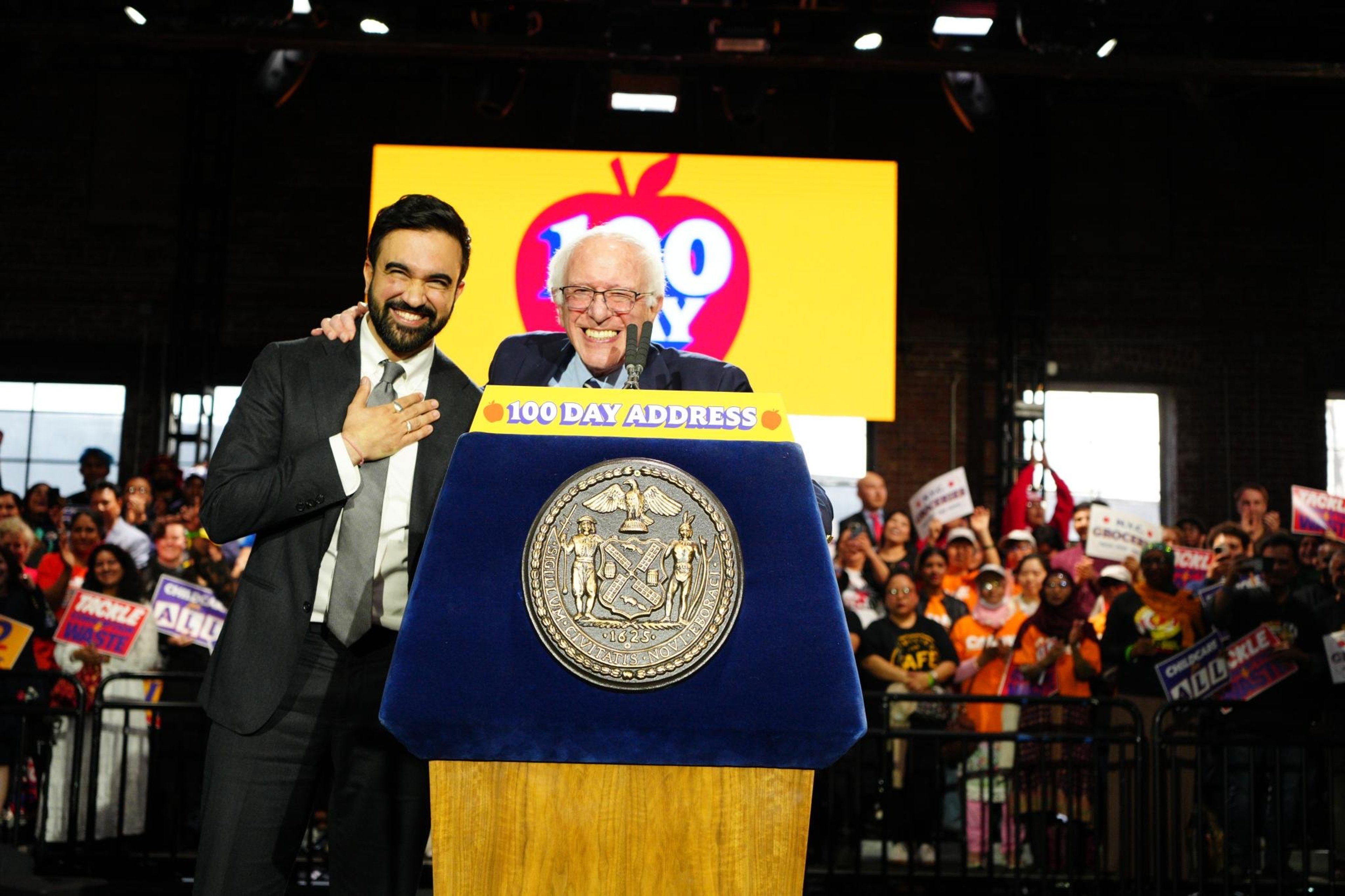
Mayor of New York City Zohran Mamdani alongside Senator Bernie Sanders at the 100 days address
On Sunday night, Zohran marked his first 100 days in office not with a closed-door briefing, nor a mundane press conference–but with something closer to a celebration, and a charter of new paths for socialism. Between the loud music, crowd interaction, and a surprise appearance from socialist Senator Bernie Sanders, the event felt more like a rally than a report. The address was staged as a direct communication to the people of the city, and they responded—with thousands of New Yorkers showing up to listen to Mayor Mamdani in Ridgewood last night. Zohran’s rally in effect served to collapse the distinction between governance and agitation, an approach quickly emerging as the signature strategy of his administration.
This staging was effective not simply at the level of optics, but because it rested on a real record of early political and administrative success. In just 100 days, Zohran has already offered the city a series of concrete proofs that his administration intends to govern on behalf of ordinary New Yorkers: advancing renter protections, moving against negligent landlords, expanding childcare efforts, pushing bus improvements, foregrounding the cost-of-living crisis as the central problem of city politics—and, as he announced last night, preparing to imminently open a new network of affordable, city-run grocery stores starting next year.
Just as importantly, the public appears to have recognized this momentum. At the rally, cheers and banners sported the cheeky slogan “Pothole Politics”, referring to Mamdani’s rapid and effective response to dealing with long-neglected public services. Strong favorability and approval numbers have suggested that Zohran has not only preserved the insurgent energy of his campaign, but successfully carried it into office—turning electoral enthusiasm into a governing mandate with unusual speed.
Rather than treating the first 100 days of his administration as a milestone to be interpreted by journalists and filtered through mainstream media, Zohran presented it as a collective checkpoint: a moment where the administration accounts for itself before the people it represents. This reflects a governing strategy that Zohran has consistently followed from the beginning, and that is at odds with traditional Democratic governance. Instead of resting on his laurels and treating legitimacy as something periodically conferred through elections, Zohran treats political legitimacy and agency as something that can and must also be built in governance.
In the weeks leading up to the address, this approach was already visible. Zohran has made a habit of issuing near-daily updates via platforms like TikTok, narrating policy decisions, legislative fights, and administrative hurdles in real time for a mass audience. These updates are not polished press releases; they are deliberately legible, often informal, and oriented toward explanation rather than the standard mystification we see from traditional establishment politicians. The effect is evident: Mamdani’s governance appears to the average person not as a distant bureaucratic apparatus, but as an interactive democratic process through which the people themselves are invited to participate in, contribute to, and identify with. This is left-populism in action.
Where traditional administrations retreat into managerial opaque secrecy following electoral victory, Zohran has done the opposite: he has intensified his visibility, and his organizing impact as mayor. The 100-day address thus did not feel like a break from routine but its culmination—a moment where the ongoing narrative of the administration was condensed and dramatized. Where previous mayoral administrations would hide behind their policies, blurring the lines to mask corruption, Zohran has centered his constituents’ will through his intentional transparency, and in doing so, is winning their trust.
This strategy has several immediate effects. First, it neutralizes one of the left’s perennial weaknesses: the perception of ineffectiveness. By constantly demonstrating action—signing orders, negotiating constraints, confronting opposition—the administration acts as a beacon of socialist governance that does not just talk the talk but will walk the walk. This isn’t only valuable for the sake of socialism in the abstract, it represents a real break with the establishment ‘do-nothing’ Democrats, and promises an active, decisive actor in lieu of technocratic opacity. Second, it reconfigures accountability. Rather than being mediated exclusively through hostile or indifferent press institutions, Zohran speaks directly, framing both his successes and his limitations. Through this process, the people at large are invited to engage in discussion and deliberation about their state in a genuine way, undermining the sense of apathy and isolation of the working class systematically facilitated by traditional political institutions. Perhaps most importantly though, Zohran’s approach helps construct a political subject that transcends the election cycle alone and will continue to exist long after his mayoralty.
In Leninism in the Age of Populism, the efficacy of such an approach for socialism was deliberated with urgency: how should the socialist left understand populism in an era where traditional forms of organization have weakened, and where mass politics is increasingly mediated through digital platforms?
In attempting to answer this question, Geese responded to Prometheus Magazine’s recent foray into the same question, which centered the tension between what it identified as two dichotomous tendencies. On one hand, a residual “organizational orthodoxy” that privileges structural discipline and internal deliberation as the only effective form of the modern workers’ party. On the other, a populist orientation that seeks to construct a broad, affective “people” through direct appeals, symbolic gestures, and visible leadership, posited by the Prometheus critique as a relatively new path fraught with risk.
Zohran’s approach suggests that perhaps even this simple dichotomization may be overstated—or at least misframed. What his 100-day address revealed is that populism, when executed at a high level, is not opposed to organization but can serve as its most effective elaboration in practice. The constant public updates, the mass address, the commitment to framing of governance as a shared project—all of these function to create and expand a critical, working-class base. They transform passive supporters who may have voted for Zohran because they felt vaguely engaged by his resonant messaging into an attentive audience–and perhaps an attentive audience into a potential socialist political force. Populism here is not a substitute for organization; it is a method of organizing, and functions as one with great efficacy.
Within formations on the left like the Democratic Socialists of America (DSA), debates around populism have often been marked by a certain anxiety: that simplifying political communication, or centering leadership figures, risks diluting socialist content or reproducing the logics of bourgeois politics. There is a kernel of truth in this concern. Populism is ideologically flat, and can subsequently collapse into empty spectacle; it can substitute charisma for structure. But this is also its strength. Populism not as an evil or a scourge but as a lens for analyzing political practice becomes an immensely useful tool for socialism. Zohran’s example points to what this might look like in practice in the United States in a specific form—populism as a means not to obscure or disorganize but to unify, organize, and render legible the potential and possibilities of radical politics.
By explaining policy in accessible terms, by narrating conflicts openly, and by repeatedly situating his administration within a broader antagonism (between ordinary people and entrenched interests in the Democratic Party on one end and the fascistic GOP on the other), Zohran is not abandoning class complexity, he is embracing it. He seeks to expand the scope of class struggle to engulf and reorganize the material representations it has concretely produced in the modern era. Alternative proposals that dwell on the necessities of bureaucratic internalism and class reductionism do not preserve radicalism, they confine it to an isolated subcultural stratum. But the task of our movement is to bring the masses into the struggle, as widely and deeply as possible. The significance of the 100-day address, then, lies less in any individual policy announcement than in the way it relates to Zohran’s intended political subject. It offered a glimpse of what a populist socialist administration can look like when it fully embraces mass politics instead of, as has been the norm for so long, shunning the cause(s) of millions in pursuit of perceived class purity.
If the left is to escape marginality, it must grapple with the problem Zohran appears to be solving in practice: how to maintain continuous contact with a mass base while navigating the constraints of governance imposed by an oppositional establishment. The lesson is not that populism or posting on TikTok is a substitute for good governance, it is that political leadership, under contemporary conditions, requires a permanent and meaningful public interface to ensure that its tasks and goals are genuinely reinforced by a mass mandate. Without such a strategy, even the most ambitious programs risk dissolving into invisibility or being defeated by political opponents more willing to embrace these terms.
Zohran’s 100-day address did not resolve the debates surrounding populism in the DSA and broader left. Instead, it shifted the terrain. It demonstrated that populism, far from being an organizational liability, or suppressive internal democracy, can be a strategic asset—provided it is grounded in real activity and oriented toward building a durable political subject. The mass enthusiasm around the rally on Sunday night was just a first glance of a politics that embraces the working class in its millions, understanding that its role as the touchstone of democratic politics is the motive force that governs the past, present, and future.