
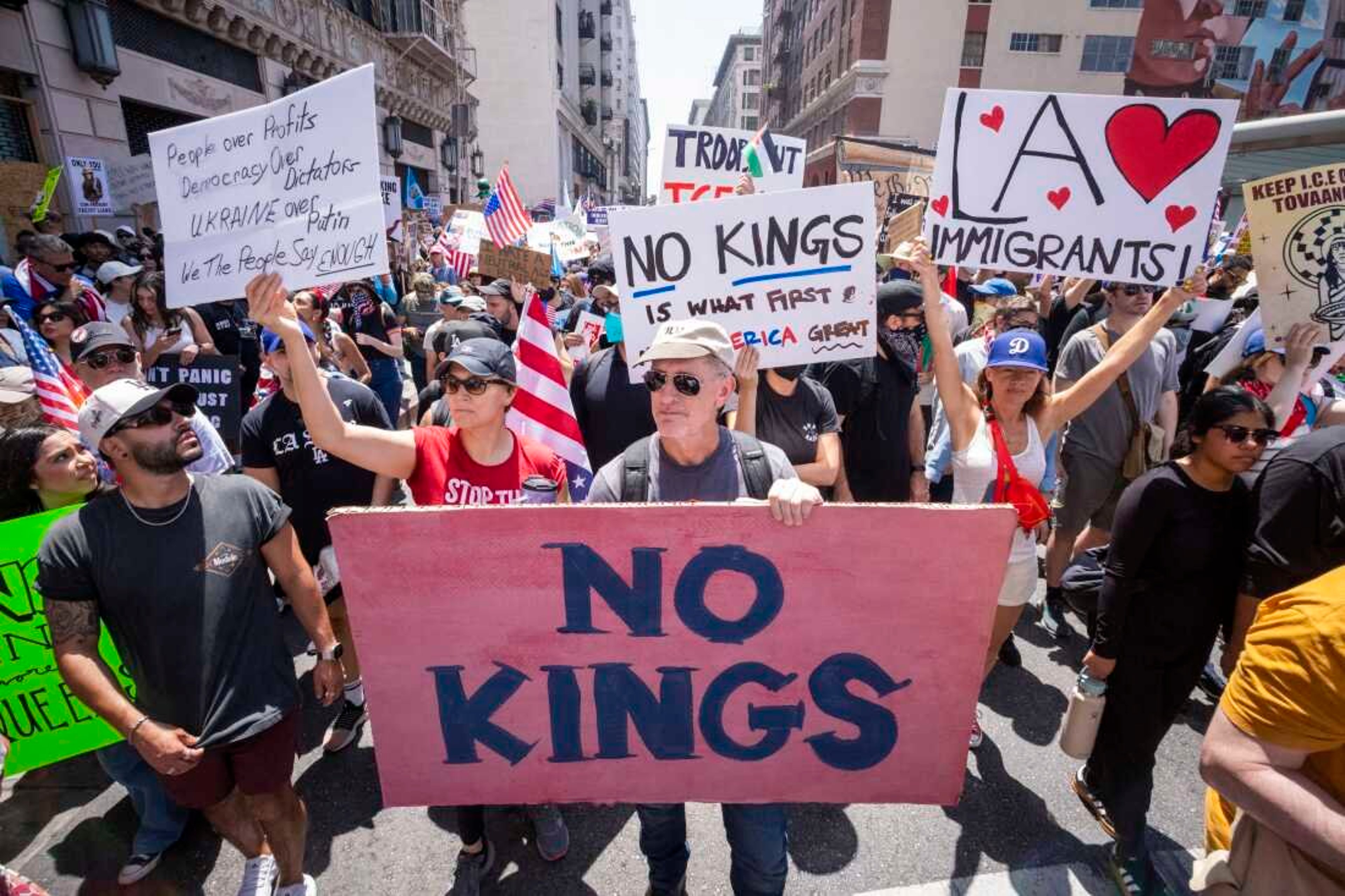
Last month, hundreds of thousands of Americans took to the streets for the third installment of the "No Kings" protests—one of the largest single-day mobilizations in recent American history, spanning hundreds of cities from New York to Los Angeles. The protests were directed at the Trump administration's accelerating assault on democratic institutions: its contempt for the judiciary, its deployment of ICE agents to Democratic Party-led cities, and its open embrace of oligarchic rule. The protests emerged against the backdrop of the ongoing US-Israeli assault on Iran, adding a streak of anti-militarism to the protests that connected them to the recent Palestine solidarity movement.
The energy of the protests was undeniable, but so was their political incoherence. This incoherence is not a failure of the movement, but an inevitable result of this historical moment. As argued in Zohran and the Democratic Revolution, the anti-Trump, anti-oligarchic, anti-militarist energy now coursing through American political life is real and powerful, but it has not yet found its organizing principle. It knows what it is against. It does not yet know, in any coherent sense, what it is for.
Alongside the protests, something else is taking shape. A wave of left populist electoral campaigns—Graham Platner running for Senate in Maine, James Talarico who won the Democratic primary for Senate in Texas, a state liberals have long written off, Abdul El-Sayed mounting a primary challenge in Michigan—suggests that the democratic revolution is not only in the streets but beginning to contest for institutional power. Each of these campaigns carries the same anti-militarist streak: a decisive break with the liberal orthodoxy of being “progressive except Palestine”, and an opposition to the US-Israeli war on Gaza, and now Iran, as a moral and political line.
Each of these follows last year's landmark election of democratic socialist Zohran Mamdani as mayor of New York City, the most important left electoral victory in a generation. These campaigns are all expressions of the same historical current—the latest chapter in America's long democratic revolution, the recurring struggle to subordinate liberalism to democracy, markets to public need, and empire to international solidarity.
But the Democratic Party, the party through which the democratic revolution has (in recent history) expressed itself, however imperfectly, can no longer meet this moment. Its leadership has offered nothing beyond nostalgic appeals to a normalcy that no longer exists, its base disillusioned by ineffectual opposition, its managerial reflexes oriented toward managing the existing order rather than transforming it. The energy in the streets, the left populist electoral wave, the anti-militarist internationalism coursing through the Democratic base — none of this finds coherent expression in the party's current leadership. What this moment demands is not the restoration of the Democratic Party's managerial mode of politics, but a new kind of political party capable of elaborating and rendering coherent the incoherent knowledge of the subordinated, and of making the democratic socialist horizon not a fringe position but the explicit and inevitable conclusion of America's own democratic tradition.
The organized socialist left, the Democratic Socialists of America (DSA), and the broader constellation of left forces now animated by this moment face a strategic choice. It can treat the No Kings movement as ambient energy to be cheered from the sidelines, dismiss them as inefficiently ideologically committed to socialism–or begin the work of becoming the political party that coheres the movement. To understand the role of the socialist left here, we must first understand what the democratic revolution is, and uncover its nodes of potential agency.
The United States has never been holistically democratic. From its founding, formal political participation was restricted to white male property owners, and every subsequent expansion—abolition, Reconstruction, women's suffrage, labor rights, the Civil Rights movement—came not from liberalism's internal logic but from popular struggles that forced democracy beyond its own limits. Liberalism, with its foundational commitments to private property, market autonomy, and limited government, has always functioned as a constraint on democracy conceived as mass will—shielding economic power from popular accountability whenever the two come into conflict. The Democratic Revolution is the name for this recurring counter-movement: the long, unfinished struggle to subordinate liberalism to democracy, to bring finance, housing, energy, and foreign policy under popular control, and to realize the justice that liberalism has perpetually promised and yet perpetually deferred.
The neoliberal consensus consolidated under Reagan represented the most recent and total triumph of liberalism over democracy. Public institutions were defunded, unions dismantled, finance deregulated, and political debate reduced to questions of technocratic management—all in the name of a narrowly defined conception of freedom. This was not merely a policy program but a hegemonic project: a deliberate disarticulation of the New Deal coalition and the rearticulation of a new common sense in which the market was the natural arbiter of social life and the state its servant. Bill Clinton's "Third Way" did not challenge this project, but rather professionalized it, completing the transformation of the Democratic Party from the vehicle of organized labor and public investment into the party of financial deregulation, globalization, and credentialed technocratic management. By the time the financial crisis of 2008 arrived, the subordination of democracy to liberalism was so complete that even its catastrophic failure could not, on its own, produce a rupture. The crisis that should have been the death knell of the neoliberal order instead became, in the hands of its managers, the occasion for its rescue.
It is in this context that Barack Obama's presidency must be understood. His 2008 campaign represented, regardless of its eventual disparation, a genuine crystallization of popular democratic energy. The coalition he assembled — youth, communities of color, union households, disaffected moderates — was mobilized by a felt sense that the existing order had failed and that something genuinely new was possible. "Hope and change" was not empty rhetoric to those who believed it. It was the Democratic Revolution speaking, however incoherently, through its only available national vessel: a historic figure whose very candidacy represented a repudiation of the order the neoliberal project had left intact. Following the 2008 financial crisis, there was a sense that here, finally, was the breaking point that might force a real reckoning with the consensus that had produced it.
Obama remains a genuinely popular president, and the nostalgia for his presidency becomes understandable, not least within the context of how catastrophically worse things have become since. But that nostalgia should not obscure what his presidency demonstrated: that popular democratic energy without a coherent governing vision and an organized political pole to sustain it will always be captured by the institutions it sought to change. Faced with a historic opportunity to be a transformative president like Franklin D. Roosevelt, Obama stabilized the system his electorate empowered him to dismantle. The financial oligarchy was bailed out rather than disciplined, and the democratic revolution's energy was absorbed into the management of the existing order.
A more recent instance of the democratic revolution was the 2020 Black Lives Matter uprising: a mass mobilization against state violence, racial hierarchy, and the systematic failure of institutions to deliver justice. Its demands, at their most radical, pointed precisely toward the Democratic Revolution's horizon: a fundamental reckoning with how public resources are allocated, who the state serves, and what genuine democratic accountability over institutions of coercion would look like. And yet, in the absence of an organized socialist pole capable of cohering and extending that energy, the movement's fate was determined by the only organized force available to absorb it: the Democratic Party establishment.
What followed was counter-hegemonic neutralization. The Democratic establishment, including figures who had marched and taken a knee, proceeded to demonize the movement and its demand to “defund the police”. The uprising's energy was first embraced as electoral fuel and then systematically deflated, its most radical demands reframed as liabilities, and its organizers abandoned. By 2021, the most powerful protest movement in a generation had been absorbed, neutralized, and in many cases even actively blamed for Democratic electoral losses.
The No Kings protests will suffer the same fate–absorption into a toothless Democratic opposition, their energy dissipated into the next electoral cycle–unless the socialist left intervenes as an organizing force.
American political life is not a simple binary, but a vast and contradictory spectrum of tendencies, each with continuities that blur into the others. The establishment of the Democratic Party has positioned itself as the default alternative, the responsible center, the only viable vehicle for those who oppose Republican rule, while doing nothing to challenge the oligarchic order that Republican and centrist Democrats alike serve. Chuck Schumer and Hakeem Jeffries oppose Trump in tone and temperament, but they do not fundamentally oppose him politically. Both parties take their marching orders from the same oligarchy, both have enabled or tacitly supported Israel's genocide in Gaza and the expanding war on Iran, and both have presided over the upward redistribution of wealth and the hollowing out of public institutions that produced this crisis in the first place.
A political frontier is necessary to make this continuity visible and to break it. Specifically, to expose the continuity between Democratic Party leadership and the Republican Party, but, perhaps more importantly, to break the continuity between the Democratic Party leadership and their own base, many of whom we saw on the streets during the No Kings protests. This means drawing a line not between Democrat and Republican but between the people and the oligarchy–between those who serve concentrated private power and those who represent the multiracial working class, the No Kings protesters, the Palestine solidarity movement, and the voters of the left populist electoral insurgency now taking shape across the country. This frontier does not require ideological uniformity. Its power lies precisely in identifying minimal points of unity—an anti-oligarchic vision, an anti-militarist foreign policy, a commitment to multiracial democracy—that can draw together constituencies that do not share a fully coherent political program but share a decisive antagonism to the bloc in power.
Not everyone in the streets on March 28th was a socialist. The point is that their deepest intuitions, about economic dignity, about the obscenity of genocide, about the illegitimacy of oligarchic rule, already place them on one side of this frontier, whether or not they yet know it.
This is ultimately the task of the communist political party. It is not to convert the No Kings movement to its view via mere ‘theoretical’ persuasion, but to articulate the socialist horizon as the coherent conclusion of what that movement is already reaching toward; to show the world, as Karl Marx put it, what it is really fighting for. The Democratic Revolution has always contained within it the seeds of a socialist horizon. Every expansion of democracy in American history has required not just the assertion of rights but the subordination of power to popular will — and every rollback has demonstrated that power left intact will eventually reassert itself over formal democratic gains.
This dynamic has reached a critical moment under the second Trump administration, where the MAGA movement also openly boasts about rolling back even the formal Democratic gains, including voting rights, reproductive freedom, labor protections, and civil liberties. The No Kings movement is therefore the political struggle to preserve and expand America’s democratic tradition. Democratic Socialism is not an external imposition on this tradition, but its fullest articulation, the point at which the Democratic Revolution finally becomes durable because it finally becomes structural. The task of the organized socialist left of the DSA, of the left populist electoral insurgency, and of the political party they embryonically represent, is to make that articulation explicit, to construct the frontier that makes it legible, and to find the national vessel capable of carrying it to the scale where it can become hegemonic.