
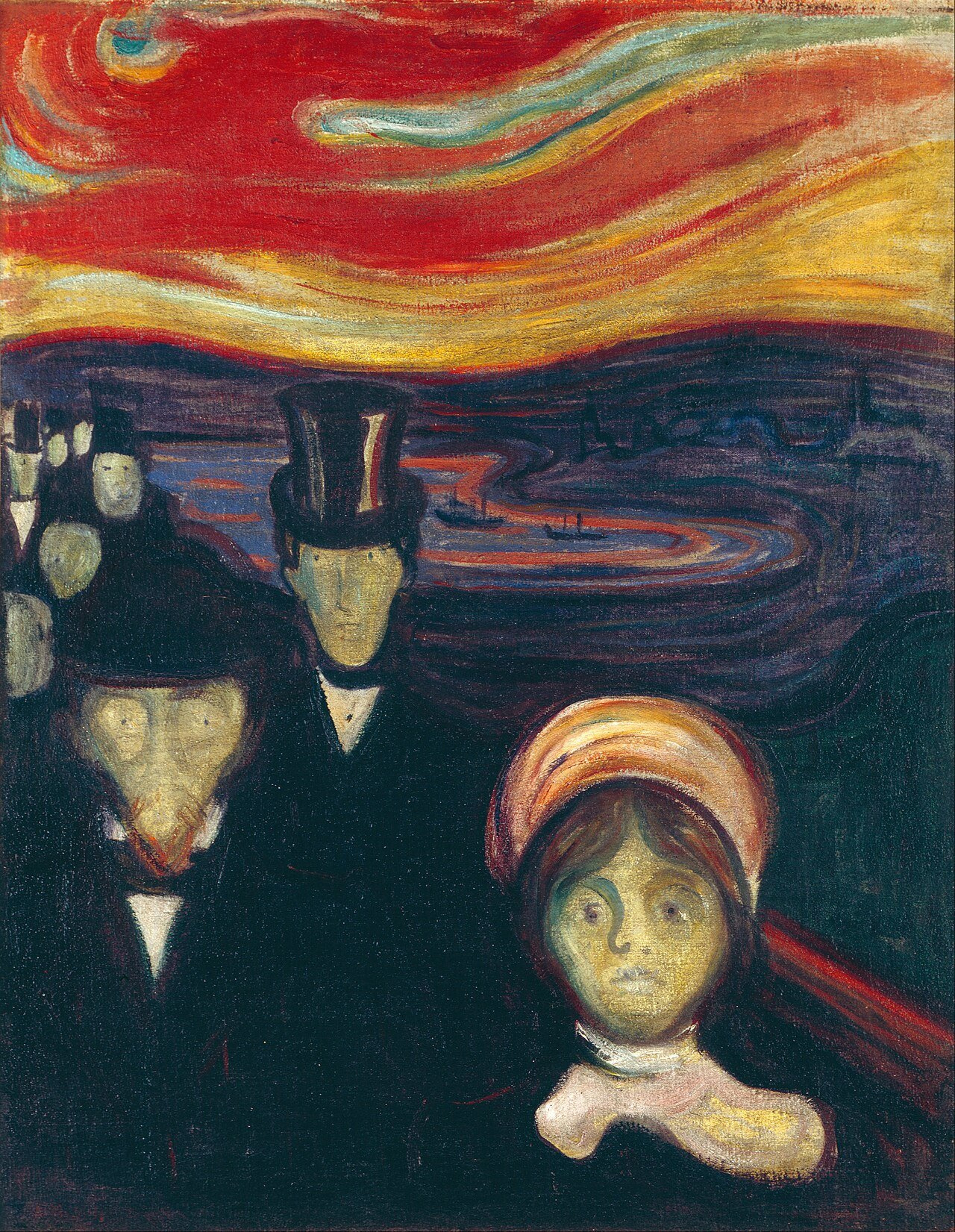
Anxiety by Edvard Munch
The Cisgender Question
“The division of humanity into two separate classes of individuals is a static myth.” (Simone de Beauvoir, The Second Sex, pg. 284)
A child is suicidal. They go to the doctor with their parents. The doctor informs the parent and patient that the diagnosis is a hormonal imbalance. “We’ll monitor your situation over the next couple of months while you take these hormones. Have a nice day.”
After thank yous, they leave.
“We’re never going back there.”
“But why?”
“You just need to buck up and appreciate your body. Depression isn’t real. Plus, a woman doctor? Please.”
Cisgender supremacy’s foundational ethos is that “East is East and West is West, and never the twain shall meet.” Biologically, men can’t get pregnant, a man cannot become a woman, a woman is simply an ovum, a man but a mighty penis; on and on, cisgender supremacists impose a fiction of hardness, fixity, rigidity to the human condition.
A person’s behavior over the course of their life is not rooted in one spot. People’s desires change as they become acquainted with new experiences.
The supremacists have attempted to establish cisgender existence as the only mode of human existence. This was the first priority of the incoming Trump administration in 2025. This denial of reality is fundamental to the way supremacists see the world.
They’re not just asking questions. What the transphobe wishes is for the elimination of transgender people in their entirety. The goal of anti-trans policies is to make our lives worse, and this erosion falls on both cis and trans people alike.
I am a trans woman. I go to the club. I hang out with my friends. My favorite book is Crime and Punishment. My favorite phrase is “let’s put a pin in that.” I want to get my bachelor’s degree. I am typing this on a sunny March afternoon. I write this to comrades of the cause, as an exercise in articulation, and in strengthening the tenets of our shared commitment to liberation.
But Bisexual People Exist
“Power is tolerable only on condition that it masks a substantial part of itself. Its success is proportional to an ability to hide its own mechanisms.” (Michel Foucault, The History of Sexuality, Vol. 1, pg. 86)
Cisnormativity is the supremacist notion that there are two “immutable” sexes. It is the premise that trans people do not exist, that a human being is one thing and can never entertain notions of being another.
When applied to policy, it is the stripping away of our right to receive gender-affirming care. They speak of defending women from dangerous gender ideology when they eliminate reproductive rights. They say they are restoring “biological truth” when they strip scientists of jobs and outright deny the results of research.
It is hypocrisy, of course.
I have three neighbors. Of course, they are your acquaintances too.
One, an American man, forty-three years old, 6’3”, about 245 after a stint on the toilet. He notices his hair is thinning. He gets a consultation, talks about how it is affecting his self-esteem, the doc says no worries, and orders up a scalp reduction. The man is elated at the results. Over the course of the next couple of decades, trichology techniques develop a bit further, and he can maintain the standard he set for himself.
Another woman, nearing her thirtieth birthday, has decided that enough is enough. A lifetime of stares, persistent biting pain in her lower neck, and self-image issues have made up her mind. She gets breast reduction surgery, and it’s like a weight has been lifted off her shoulders. Outfits, strolls about the park, a whole new lease on life has been granted to her by this body modification.
Finally, a woman. Getting ready for a night out, she is anguished by the fact that her clothes do not fit her right in one specific area. She is fearful of a stranger’s belief in her otherness. Above and beyond the stranger that she must worry about, she is concerned about her body. And she is made miserable by this misery. To receive the care that she knows she needs, she must “persist” in that state for the medically necessary amount of months and have two medical witnesses of that misery. Finally, she is “surged”, as we say, and can enjoy the life she knows she wants.
Cisnormativity is the attitude that characterizes the first as a normal want and the latter two as something sick, pathological, and an ingratitude for the natural body. A wariness of autonomy is central to cisnormativity. The truly consistent cisgenderist ideologue does not criticize the first man, as this body of thought rests on a hotbed of misogyny.
Make no mistake, this vicious cycle is a result of the situation and not something essential to cis and trans people.
When politics are thought of as just another mode of consumption, what is sold is participation in the blame game. “So, it is those people…” People are molded into the types of creatures who would spontaneously accept the bourgeois outlook of the world, accept death by a thousand advertisements, and express hostility towards emancipatory politics.
This ideology of consumption is not some blanket “no” forbidding the thinking of unorthodox thought. Rather, it says “yes” to a whole marketplace of ideas and impulses which whirs and dazzles and delights the bourgeois subject, lulling us into complacent contemplation of the show before our eyes.
It is a “Yes”, indeed a “Yay-saying” to punish a group of people designated as Other.
Cisnormativity erases trans existence. What is called normal is pitted against the abnormal, the weird, the strange, the ugly, etc. Cis people can learn from trans people. Taking on the arduous task of choosing to be oneself in the face of a society that constantly lies about one's very existence provides a unique perspective. Donald Trump and his lackeys will make audacious claims about elementary facts about my existence, and I do not find them the least bit amusing. He’s so loud. He lies so often about things, and the worst part is that people believe him so that they can share in the power of the ruler. Seeing a room full of people hear his decrees and work to impose his vision on us is chilling.
The Essence of Cisgender Supremacy
“One of the ruses of oppression is to camouflage itself behind a natural situation since, after all, one can not revolt against nature.” (Simone de Beauvoir, Ethics of Ambiguity)
bell hooks describes depoliticization in her essay Feminism is For Everybody. Feminist consciousness had its origins in women’s groups. Women got together to talk about the issues specific to their situation and began to strategize ways to educate themselves to see the oppressive mechanisms of patriarchal power. The conversations that women had were involved and tied to their lived existence. She
A notion has been advanced that our elders could have no concept of the present world, that we are so far removed contextually that a Dickensian orphan would explode on contact with a hyperpop beat and a Cheeto. There are a couple of passages in Simone de Beauvoir’s The Second Sex where I wince; her use of the word “transvestite” on top of her insistence that a woman’s body can only be cisgender presents a critical blind spot. Though still a powerful text that reckons with the existential condition of women as the Other, her critique does not explicitly contend with what life is like for a trans woman.
Those lovers of simple formulas dogmatically assert their crumbling worldview as an absolute. They say they are “restoring biological truth” while at the same time plugging their ears at basic science. This is the advanced guard of ignorance, the onslaught of the mediocre against our society. The transphobe revels in their impotence and seeks to make it a universal principle. They live the life of Karl Jaspers’ “mass man”; the soothing opiate of xenophobia is their chief expressive mode.
To our advantage, comrade, we engage with the texts and through this a rather suggestive critique in The Second Sex of the psychoanalytical account of women opens the floor to a deepening of our feminist understanding.
To counter the determinism she sees inherent in the drama of “drives” and the “collective unconscious”, she postulates that it is the economic situation that bears the most weight on each “existent.” The artificial conditions imposed upon her have a logic which psychoanalysis is apt to explore. Though it cannot establish any universal claims standing above and for all time, it is a light that can map out the symbols that exert the most pressure on individuals.
“Men make their own history, but they do not make it as they please; they do not make it under self-selected circumstances, but under circumstances existing already,” Marx writes at the beginning of The Eighteenth Brumaire of Louis Napoleon. It’s interesting because in the course of a person’s development, they are a part of a certain corridor of history.
His Loneliness is Killing Me
“...a solitary individual barricaded in a room lit only by a flickering screen, isolated from society except for the information they receive from the surrounding mass media.” (Barbara J. Phillips, In Defense of Advertising: A Social Perspective)
“People do pride themselves on their diseases.” (Fyodor Dostoyevsky, Notes from the Underground)
Young men are being filled with misogynistic ire towards their siblings and sisters. Young men who own nothing are taught to identify with a might-is-right philosophy, to see in conquest and plunder something natural, hardwired into their genetic code. Thus, he is taught that to be a consuming thing, an object, one ripe for the consumer society is nature’s highest calling. To say yay to gilded chains because his sister’s are tighter. Cut off from his future, from transcendence, reduced to an eye that gorges on video after video– the young man’s possibilities are bled dry by commodity culture.
I was being driven, and the driver mentioned that he was a single-issue voter. He abhorred abortion when that was in fashion, and now his sights were set on transgender people. He said, “Back in my day, we didn’t talk about gay people; now we talk about this trans thing.” Disgust was evident in his discourse. He opined that children are not meant to hear such things. When I mentioned that he probably talks about being cisgender and being straight, he tightened his jaw, and silence filled the car. I’d apparently touched a nerve. Rouge filled his face; he pulled the car over, hopped out, and yelled expletives at me.
Several things were evidenced to me by this encounter, chiefly, the formation of events as political problems in a person’s mind. Here was a man whose life was nothing of note, but who saw in the crusade against transgender people a cause worthy of passion. He had been equally passionate against women getting abortions. He mentioned that he had once been on food stamps and could verbally empathize with the millions who had it revoked by the Trump administration, but this did not stir in him the emotional response that the mere mention of trans kids did.
How curious.
Concerning the literal bread and butter on his table, the man lapsed into serene nostalgia, quietly glad that the moment had passed where he was reliant on the state. He was on food stamps, and now he was not. In his mind, the issue of trans people existing was a matter of the utmost importance. He’s protecting children from the possibility of being queer in any way, shape, or form. What do food stamps have to do with that?
This protection mindset is how the transphobes frame their attack on trans people. They posit themselves as crusaders against a supreme evil. You can tell that they think they are doing something righteous.
The legislative backlash against transsexual people takes its cues from homophobia. Fundamental to this backlash is a fear of the Other. The transphobe has swallowed the nationalist pill and sees difference as an attack on their sovereignty. They fear the human condition, our nomadic element. Sartre, in his Anti-Semite and the Jew, describes this type of person, the bigot, as someone who cannot reckon with the mutability of human beings.
Does the hard man, protector of women, thus blame those who profit off his status as a wage-slave?
Nope.
The media he is likely to consume is staunchly conservative. 9 out of 10 of the biggest political shows on the internet are right-wing. (The one outlier being Trevor Noah.) These shows have a vested interest in entrapping him in a spin cycle of hatred. The marketplace of blame gives him a yearly update on who to blame for his miserly condition: gay people, abortion as a concept, and now the transsexual.
They tell him, " You are a man. You are a patriot. You own your manhood and your citizenship, and this nothingness is more than all the riches in the world. You have rights, and women do not. This is your birthright.
Just as we are not in a post-feminist society, we are not in a post-capitalist one either. The master enslaves his brother and tells that brother to spit upon the sister. The enriched master employs the full communication apparatus in the service of glorifying the virtue of patriarchal authority. The slave is taught to blame his fellow bondsmen, identifying with the master’s riches.
Tyranically championing women’s oppression, conservative podcasts implore the young man not to get “political”, only the body of the Other is political. “She is a womb, an ovary; she is a female – this word is sufficient to define her.” (Beauvoir 1949) This messaging is a dissuasion tactic, a soothsaying, a way to relegate.
It is conservatism, defense of a “past which has assumed the icy dignity of being against an uncertain future whose values have not yet been won,” (Beauvoir 1947).
Conservatives use ‘feminist’ as an epithet to lambast women who march for liberation from the current state of affairs. This epithet, one of their politest, flattens everyone from milquetoast center-left careerists to anarchists into an amorphous blob termed ‘liberal’. This is an ideological defense of the status quo.
Cisgender Supremacy
A cisgender supremacist society is being erected before our eyes. This is only possible in the current moment, rather than previous ones, because transgender people exist. We have estrogen pills. We have testosterone. Hormone replacement therapy can alleviate gender dysphoria. This is the first century of the transsexual. This is a momentous occasion.
Being cisgender was seen as something “natural”. To modify the body you’re born in is seen as some The existing relation between cis and trans people is “not quite like that of the electrical poles” (de Beauvoir, 1952), for cis represents both positive and neutral poles, as is indicated by the legal codification of cisgender people as the ‘norm’ of the land, whereas trans people are seen as negative, a transgression of the norm.
Attack ads decrying trans children, trans athletes, and transgender rights as attacks against American society. Supremacy needs an Other to define itself against. The cis-supremacist mindset is contradictory because, at the same time that it says being cisgender is natural, it also marshals an entire army to convince people that being trans is an attack on a cisgender person’s sovereignty. Thus, the cis supremacist preaches contempt for the misery of “transgenderism,” and the misery of a transgender person’s life is all the more reason for treating them without remorse.
“Once the subject seeks to assert himself, the Other who limits and denies him, is nonetheless a necessity to him: he attains himself only through that reality which he is not, which is something other than himself.” (pg. 157)
Be it on the individual level through social disgust, jeering at attraction towards “a trans” (another polite society epithet), or on the societal level with laws intent on the erasure of trans people from public life, no punishment is enough for trans people. The Nazis burned the Institute for Sexual Science to the ground. Amerika today is brutalizing trans women by sending us to men’s prisons, depriving us of our hormones, and stripping our rights to travel freely.
Transgender people are maligned, punished, and caricatured because of our transsexuality. This falls especially hard on transgender women, an attitude known as “trans misogyny.”
“The bond that in every individual connects the physiological life and the psychic life—or better the relation existing between the contingence of an individual and the free spirit that assumes it— is the deepest enigma implied in the condition of being human,” Beauvoir writes. This enigma is an integral part of the transsexual experience. It is answered negatively by the alleviation of dysphoria. It is answered positively by allowing trans people to live in a more harmonious existence with their bodies.
The oppressor’s lie is exposed in the smile of a trans person who has begun to live. The smile on a woman’s face as she speaks about the first signs of change on her body, new clothes, selfies that begin to pop up on her page.
A baddie is born!
A man’s voice begins to deepen, and he discovers that the songs of his childhood are sung through new vocal cords. His beard thickens, muscles develop. He flips a page, tanning shirtless on the beach.
Trans and cisgender are antitheses. As such, they constitute a whole. The cis class and the transgender represent the same gendered human alienation. “But the former feels comfortable and confirmed in this self-alienation, knowing that this alienation is its own power and possessing it in the semblance of a human existence,” Marx writes in The Holy Family.
The dissolution of the class antagonism that exists between cis and trans is achieved by allowing trans people to transition. The difference between cis and trans folk is that the former has one puberty and the latter will have two. Why? What cis people develop in puberty is their adult body. Trans people have a set of secondary sex characteristics imposed upon us against our will. This process is traumatic to the trans child.
Should this state of affairs continue?
Treatment means early access to hormone replacement therapy. It means the socialization of medicine and access for all. Access to therapeutic intervention aids cis and trans alike, as it allows each one to begin to shape the project of their body for themselves. Harmony is not conversion therapy, an expansion of a parent's rights above and against the child. The arbitrary constriction of possibility is enforced to the detriment of the burgeoning individual. “It’s the dawn of another human organisation, a society where individual creativity gives its energy free rein, to shape the world according to each individual’s dreams harmonised by all.” (Vaneigem 1965)
Our individuation, our consciousness, our ability to be masters without slaves is the high point of humanity. The conservative position is constricting and twofold: 1) narrowing the definition of gender to imposed biology, and 2) castigation of people who do not contribute to a cishet reproductive regime.
“Life is occupied in both perpetuating itself and in surpassing itself; if all it does is maintain itself, then living is only not dying, and human existence is indistinguishable from an absurd vegetation; a life justifies itself only if its effort to perpetuate itself is integrated into its surpassing and if this surpassing has no other limits than those which the subject assigns himself.” (De Beauvoir)
The transphobic vision for women is insulting, reducing her totality to one facet of her biology. Emancipatory thought accords women a subjective existence beyond the physical attributes socially determined to be the content of their identity. What about other perspectives on her situation?
To Sum Up
Millions of men lived in a huge building with no doors or windows. The feeble light of countless oil lamps competed with the unchanging darkness. As had been the custom since remotest antiquity, the upkeep of the lamps was the duty of the poor, so that the flow of oil followed the alternation of revolt and pacification.
One day, a general insurrection broke out, the most violent that these people had ever known. Its leaders demanded a fair allotment of the costs of lighting; a large number of revolutionaries said that what they considered a public utility should be free; a few extremists went so far as to clamour for the destruction of the building, which they claimed was unhealthy, even unfit for human habitation.
As usual, the more reasonable combatants found themselves helpless before the violence of the conflict.
During a particularly lively clash with the forces of order, a stray bullet pierced the outer wall, leaving a crack through which daylight streamed in. After a moment of stupor, this flood of light was greeted with cries of victory. The solution had been found: all they had to do was to make some more holes. The lamps were thrown away or put in museums, and power fell to the window makers. The partisans of radical destruction were forgotten, and even their discreet liquidation, it seems, went almost unnoticed. (Everyone was arguing about the number and position of the windows.) Then, a century or two later, their names were remembered, when the people, that eternal malcontent, had grown accustomed to plate-glass windows, and took to asking extravagant questions.
“To drag out our days in a greenhouse, is that living?” they asked.