
Apr 3, 2026
AOC 2028: The Next Stage of the Democratic Revolution?
An analysis of the potential of an AOC run for President from the perspective of what the stakes are for the larger radical left.
by Nik M.
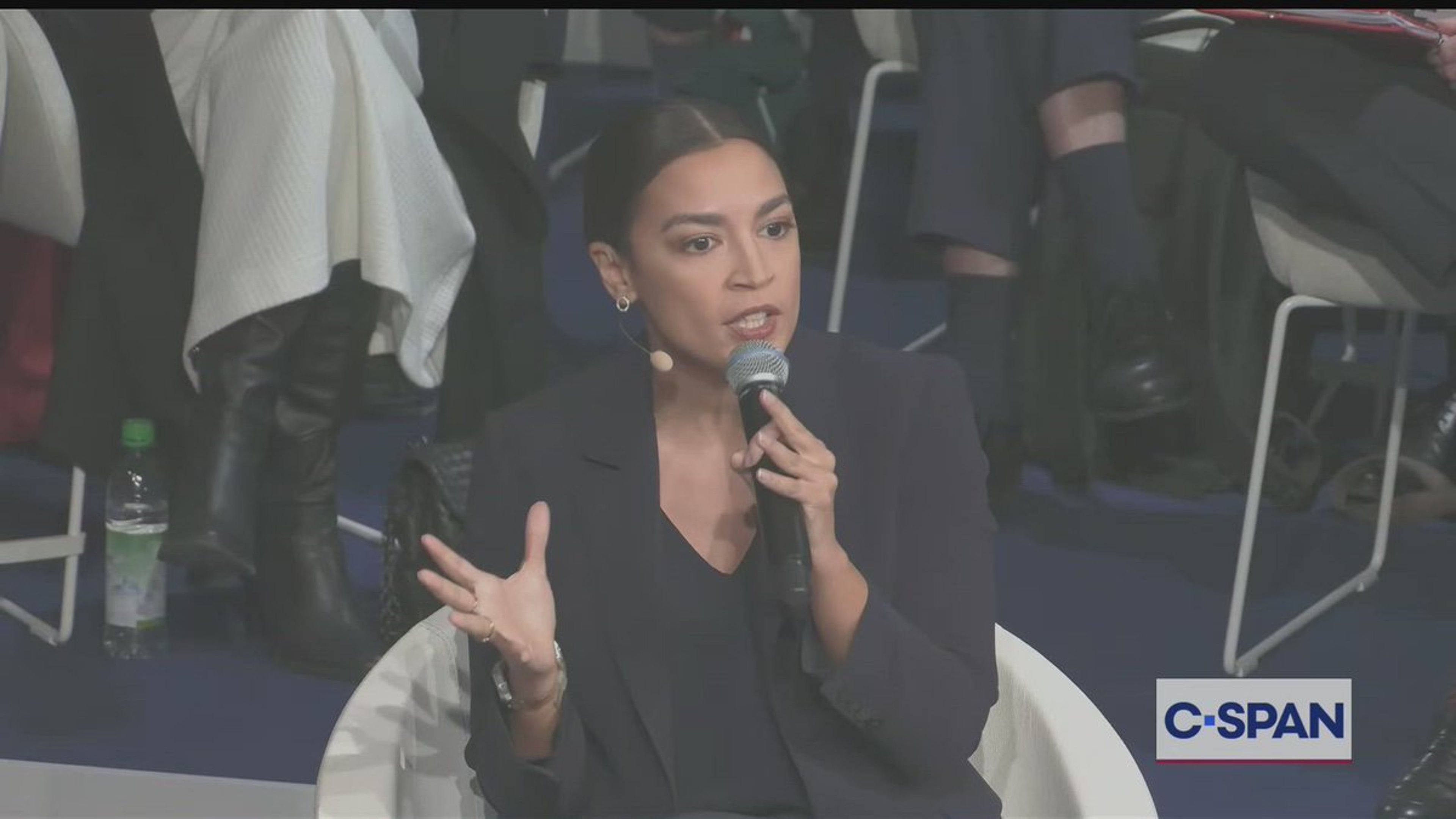
Alexandria Ocasio-Cortez at the Munich Security Conference speaking on “the rise of populism”
In her pamphlet For a Left Populism, Chantal Mouffe asks: What would it look like for the left to construct a hegemonic project with the ambition and strategic coherence of the Reagan-Thatcher revolution? That revolution, Mouffe reminds us, was not merely a policy program, but a political project that successfully disarticulated the postwar New Deal consensus and rearticulated a new common sense in which the market was the natural arbiter of social life and collective interference was the enemy of freedom.
This revolution–or counter-revolution–did this not through rational argument, but through the construction of a sharp political frontier: "Us"—the taxpayer, the entrepreneur, the property-owning middle class—against "Them"—the faceless bureaucracy, the overpaid union worker, the welfare dependent ‘leech.’ And it did this through vessels: national political figures capable of giving that frontier a human face, a combative voice, and a popular mandate. Thatcher in Britain, Reagan in the United States—neither was the intellectual author of the neoliberal project, but each was indispensable for political crystallization, the figure through whom an emerging hegemonic bloc announced itself to the country and dared its opponents to construct a rival vision.
The left populist movement now stirring in the United States—in the streets of the No Kings protests, in the left populist congressional campaigns of Graham Platner, James Talarico, and Abdul El-Sayed, in the historic mayoralty of Zohran Mamdani—is the latest expression of America's Democratic Revolution. It has begun to construct its own frontier: the people, the multiracial working class, against the MAGA oligarchy. It has begun to populate that frontier with concrete antagonisms—the cost of living crisis, the support for Israel’s wars in the Middle East, including the expanding war on Iran, and the open subordination of democratic institutions to private power.
What it does not yet have is what Thatcher and Reagan provided for the neoliberal project: a national political figure capable of crystallizing this frontier at presidential scale, of forcing a reckoning with the direction of the Democratic Party and the country, and of making the left populist common sense the dominant idiom of a 2028 presidential campaign. The No Kings movement and the left populist congressional wave are two expressions of the same Democratic Revolution—but without a national vessel to unify and amplify them, they risk remaining parallel phenomena rather than a coherent political force. That vessel is Alexandria Ocasio-Cortez. She is also, for a significant portion of the left, a figure of massive frustration, and any serious case for her must begin by acknowledging why.
For Palestine solidarity activists and the broader anti-war left, the defining moment of AOC's career was her characterization of Kamala Harris as “working tirelessly toward a ceasefire” in Gaza—a claim that strained credulity at the time, and has been rendered indefensible by subsequent events. More recently, she justified support for "defensive" military aid to Israel, as if this can be meaningfully distinguished from offensive aid–a position that became one of the primary sources of left frustration with her, and a central reason many in the DSA have been reluctant to re-endorse.
To her critics, these were instances of capitulation. Charitably interpreted, in the case of the ceasefire comment, it was wishful thinking—an earnest attempt to hold together her left commitments and her sense of electoral responsibility that ended up satisfying neither. She is not triangulating in the manner of a Clinton or Gavin Newsom, calculating the optimal position for electoral advantage. She appears to genuinely feel the pull of multiple commitments simultaneously, resolving that tension by erring on the side of institutional accommodation rather than bold rupture.
In many ways this is worse than cynicism, because politics requires a Machiavellian willingness to seize the moment—and her survival instincts, however understandable, end up running counterproductive to seizing the moment. In any case, the left's frustration with AOC is therefore a legitimate response to a real pattern. She is not the bold, unabashed left-populist the moment demands. Her instincts run toward self-preservation and earnest triangulation, shaped by a decade of operating as one of the few openly socialist voices in a hostile institutional environment, perpetually caught between the gravitational pull of the party's center-right and the expectations of a left base that looks to her as its most prominent national representative. This can be understood not just as a personal failing, but also as a structural trap–but it is a trap whose consequences are real, and the left is right to feel frustrated by them.
The problem is that survival-oriented politics and hegemonic politics operate on entirely different logics. Survival politics minimizes exposure, avoids unnecessary confrontation, and preserves options. Hegemonic politics requires precisely the opposite—the willingness to rupture, forcing confrontations that clarify the frontier and mobilize constituencies around it. The growing populist left flank in Congress is beginning to change this calculus, giving a potential AOC president more institutional cover and reducing the cost of boldness. But the transformation is incomplete, and the gap between what the moment demands and what her instincts produce remains real and visible. There are positive signs: on Tuesday March 31st, at the very NYC DSA forum convened to debate her re-endorsement, AOC reversed that position, stating unequivocally that she rejects all military aid to Israel. This change did not emerge from abstention or ultimatum. It emerged from engagement from the organized left, creating the conditions in which a bolder position became both possible and necessary.
And yet the conclusion that the organized left should therefore withhold its support, that abstention or the search for a purer vessel is the appropriate response to these frustrations, does not follow. It rests on a fundamental misreading of what political engagement at this level of stakes actually requires. The question is not whether AOC is the ideal figure. The question is what taking sides in the current conjuncture demands, and whether the left has the strategic maturity to do so without surrendering its critical independence.
Among those in the DSA who desire to see her improve her political positions, a tempting but mistaken strategy presents itself: using the endorsement as a bargaining chip, a conditional offer to be extended or withheld depending on her positions on Gaza or her willingness to confront party leadership more directly. But AOC does not need the DSA's endorsement. She will run with or without it, draw enormous crowds with or without it, and command the attention of the Democratic base with or without it. Treating the endorsement as leverage is not a negotiating strategy—it is a fantasy that flatters the left's sense of its own importance, while accomplishing nothing and risking leaving the organized socialist left on the sidelines of the most important left-populist presidential campaign in a generation. The DSA's actual leverage is organizational, electoral, and intellectual—built not in a negotiating room but in the streets, in primary campaigns, in the construction of the political pole that defines the real content of the Democratic Revolution and is, more than any particular politician, the force that will bring socialism to the United States. The DSA does not move AOC by threatening to withhold its blessing. It moves her by taking advantage of what she represents to create a world in which our politics are the ones that politicians like AOC find valuable—or even just find them necessary demands that they have to accept under pressure.
The history of the DSA's own growth makes the point directly: Bernie Sanders' 2016 and 2020 campaigns flooded the organization with new members, transforming it from a modest socialist formation into the largest socialist organization in the United States in generations. AOC's own first election to Congress in 2018 produced another surge. Mamdani's mayoral victory in 2025 did the same for New York City DSA. Each moment of left populist electoral energy at scale has proven to be an organizational accelerant for the socialist left, because the campaigns create the political conditions in which socialist politics becomes newly legible, newly urgent, and newly attractive to people searching for an organizational home. An AOC presidential campaign would dwarf all of these. The influx of members, energy, and resources it would generate for the organized socialist left is one of its primary strategic rationales. The DSA’s membership drive, aimed at achieving 100k members, would be a paltry sum in comparison to the strength of the organization after such a run.
A larger, more energized DSA is better positioned to construct the socialist pole in Congress, to staff the brain trust that a transformative AOC presidency would require, and to build the cadres and organizational infrastructure that can hold her accountable to the horizon she invokes when it proves expedient to retreat from it. The campaign is an opportunity to build the political party. What the DSA cannot do, if it wishes to remain a relevant political force rather than a sect nursing its purity on the sidelines, is abstain.
AOC is the only figure currently capable of anchoring that "us" at the scale of national politics. This is not an argument for uncritical devotion, but an argument for strategic engagement with the best available terrain. The DSA and the organized socialist left do not need to pretend that her record is unblemished or that her instincts are always equal to the moment. In fact, they should criticize these flaws–and AOC–consistently. In doing so, we remain authentic to ourselves and represent a real left sentiment.
At the same time, we also need to recognize that concretizing democratic socialism as a real pole in American national politics—not as an abstract doctrine, but a living political force with organizational infrastructure, electoral legitimacy, and a governing vision—can only be accomplished from building on and criticizing effectively the movement that inevitably will orbit her candidacy, not by refusing to participate in the struggle out of a mistaken sense of ideological propriety.
A left that stands apart, nursing its frustrations and waiting for a purer vessel, will find itself precisely where it has always been: morally consistent and politically irrelevant, watching the Democratic Revolution's energy get absorbed once again by the forces most committed to containing it. The condemnation of AOC as a potential turncoat leaving socialism in the dust reveals itself to be a self-fulfilling prophecy: by refusing to stamp the current moment with our communist politics, we only guarantee that the moment will pass into the hands of the bourgeoisie. This is the deeper logic of party-building as the left's primary strategic task. The Modern Prince, the political party, the collective political organism capable of elaborating and cohering the Democratic Revolution's incoherent energy, is built by constructing the organizational infrastructure, the electoral base, the cultural presence, and the ideological coherence that make a left populist politics durable rather than episodic.
The endorsement is also simply the prerequisite for engagement. A DSA that stands apart from an AOC candidacy forfeits its ability to shape the campaign's politics, populate its intellectual infrastructure, take ownership of the moment, push it toward boldness, and exert counterpressure when it inevitably retreats from the bold populist strategy that the moment requires. Endorsing and criticizing are not mutually exclusive, but are the only combination that makes political sense. The DSA can back her campaign and identify her limitations honestly, support her candidacy and argue publicly for the bolder positions she sometimes hedges, contribute to a vision such as the Green New Deal, and make clear what an AOC presidency must accomplish to constitute a genuine advance for the Democratic Revolution. We can win elections with socialist and left-populist candidates, creating a powerful legislative bloc that will be more effective than any individual politician both in terms of power and accountability. But we only get closer to these ends through an AOC campaign for presidency.
Where does all of this leave the communist horizon—the bolder vision that the Democratic Revolution has always pointed toward without yet reaching? AOC is obviously not a communist. She is a democratic socialist, a vessel for a Democratic Revolution that is itself still in the process of discovering its own most radical implications. The communist horizon is not a program to be imposed on her candidacy from without, but the direction in which the honest critique of her limitations, carried forward through and beyond her presidency, naturally points.
The American left has its own version of the debate Lenin engaged when he argued that British communists should support the Labour Party — not because Henderson and MacDonald were revolutionaries, but because the political experience of a Labour government would do more to advance working class consciousness than abstention ever could. In The Paradox of Icarus, J. Ryder has updated this argument for the contemporary American context with clarity. The parallel is instructive but imperfect, and the imperfection matters. Lenin had little sympathy for the Labour leaders he urged communists to support — his famous remark that he wanted to support them "in the same way as the rope supports a hanged man" captured a purely instrumental relationship with no illusions about its objects.
Like Henderson and the Labour Party, AOC and the Democratic Socialists are not communists, but the most advanced expression of popular politics that the current moment has produced, whose limitations will only become fully visible through the experience of governing. The Democratic establishment—the Newsoms, the Schumers, the Jefferies, much like Lloyd George—represent the "responsible" liberal center that positions itself as the only viable alternative to reaction while serving the same oligarchic interests. And the Republicans under Trump represent the openly reactionary force that the left must help defeat even while refusing to subordinate its politics to those who would contain the Democratic Revolution after the battle is won. As Lenin put it, to refuse to help the Hendersons defeat the Lloyd Georges and Churchills, on the grounds that the Hendersons are insufficient, is to hamper the cause.
The socialist and communist horizon is not located outside this movement, waiting to be imported once conditions are pure enough or a leader who is ideal enough. It is located inside it — in the contradictions the movement has not yet resolved, in the demands it has not yet fully identified. AOC's presidency, if it comes, will be a political experience that, whatever its achievements and disappointments, will do more to advance a genuinely socialist and eventually communist American politics than a decade of abstentionism ever could. The shortcomings of Obama produced Bernie, AOC, Zohran, and the DSA. The honest reckoning with AOC's own shortcomings—argued clearly, carried forward, organized around—will produce whatever comes next. The task of the organized left is not to stand apart from this wave but to be the force within it that pushes it toward its own most radical implications — that points to the communist horizon not as an external imposition but as the inevitable conclusion of what the Democratic Revolution is already reaching toward.