
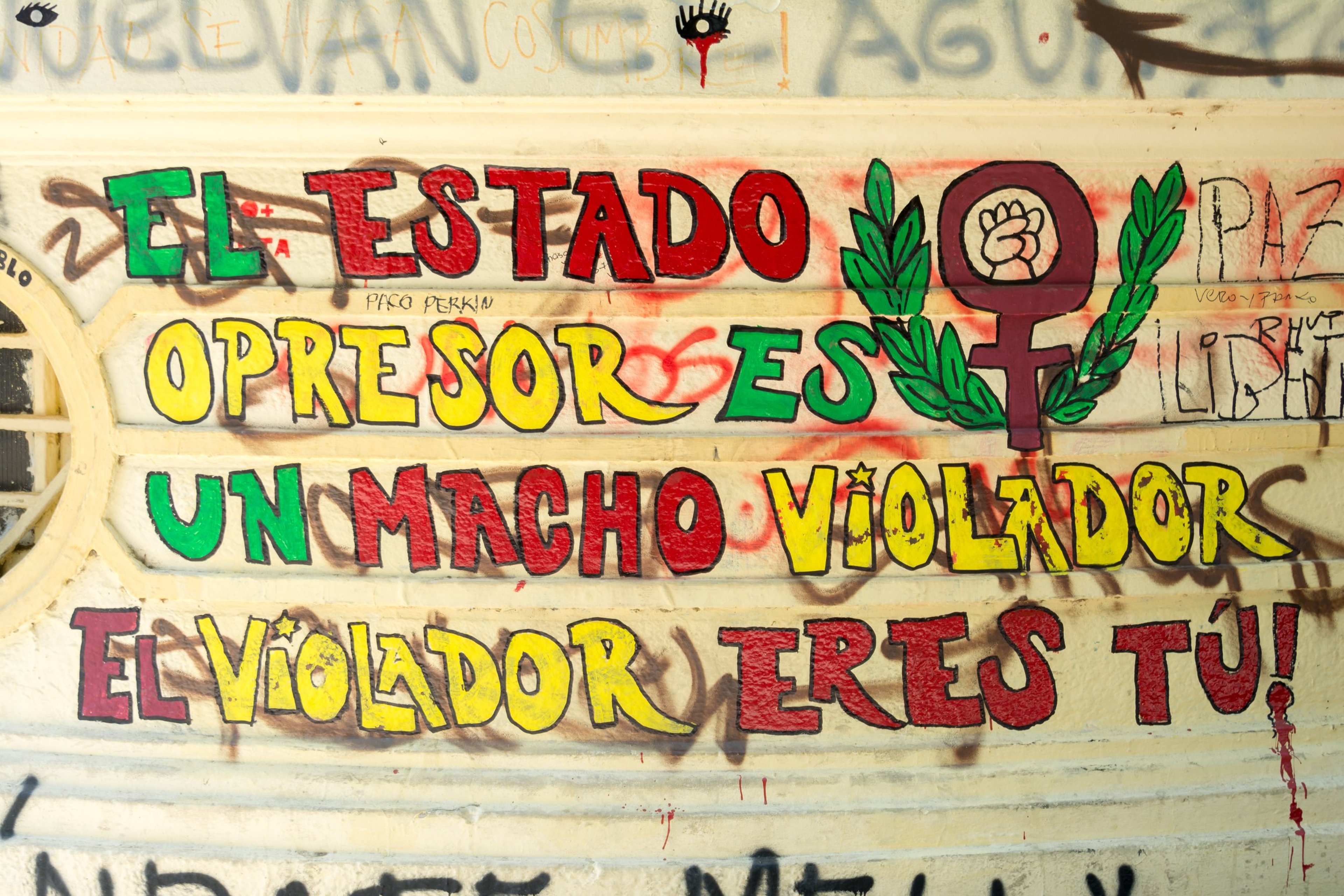
Carlos Figueroa Rojas (CC BY-SA)
In November 2025, Donald Trump was forced by Congress to release the so-called Epstein Files, that is, all documents possessed by the Department of Justice pertaining to Jeffrey Epstein. Championed by California Democrat Ro Khanna and Kentucky Republican Thomas Massie, the Epstein Files Transparency Act, over a period of months, squeezed out a trove of evidence—albeit heavily redacted—detailing the personal network of the notorious financier, philanthropist, socialite, scammer, and rapist.
The left can hardly take credit. The nebulous pseudo-populist moment calling for the release of the files, having achieved its goal in revealing the connection various celebrity figures had with the man in question, seems to have lost direction. Meanwhile, collective outrage is fizzling out, beyond a few selective prosecutions, to the point where Hillary Clinton feels comfortable dropping merch referencing her deposition. This doesn’t seem to have the makings of a durable political struggle. As Sarkozy correctly predicted in Geese’s prior coverage of the Files, the broad anti-corruption campaign did not materialize.
Something may still develop as the fourth estate and the public sift through the heavily redacted documents. Perhaps there’s a fight to be had in demanding that the administration release the millions of pages remaining that were identified by the Department of Justice as “potentially responsive” to the demands of the Transparency Act but were withheld for unknown reasons. In any event, communists should not be caught standing around with their hands in their pockets waiting expectantly for the results.
Khanna and Massie have also recognized the urgency of this moment. Having led the charge to release the files, they remain united in their stand against the so-called “Epstein Class,” a formation of the “rich and powerful men … who engage in heinous conduct.” The political content of their battle against this class is a polarization against elites and especially corruption. This is a familiar and obviously attractive articulation to leftists, but the discursive power of this category has been limited at best. Beyond the analytical coherency (or lack thereof) of centering the Epstein Class, however, this approach contains a gross, far more fundamental error: by centering a particular circle of perpetrators as the primary subject of analysis, the women and girls who were trafficked and raped for the enjoyment of these wealthy and powerful men disappear from view.
In the files, they are literally not present, censored for their privacy. As often happens in patriarchal society, this silencing and shielding from view is framed as “protection” from further harassment. They are, as a side effect, made a commensurate, abstract representation of a vast class of victims. Even in this moment where these elite men are exposed for the monsters they are, each of their victims remains objectified in the purest sense: a done-to. I am not arguing that the victims would be better off unredacted in the files, especially considering the fact that they were mainly minors; rather, I want to describe the effect that focusing on the files themselves has had on our public discourse. In effect, each victim’s entire being is literally reduced to the worst thing that has happened to them. More precisely, they are reduced to that which men have done to them.
This position of the done-to is one every communist should recognize as their own. It’s also a position we have constantly fought against from the beginnings of the workers’ movement. This dynamic of objectification mirrors that which is described in the first chapter of Capital, in which concrete acts of human labor are equalized in exchange to become congealed objects of abstract human labor. In essence, workers are reduced to ‘done-tos’, as their labor-power and their products. For Marx, this act of abstraction is at the center of the commodity-producing society; it is what enables exchange in the first place and undergirds capital's domination of all aspects of our lives. Overcoming it, then, requires the overcoming of the commodity-producing society, i.e., capitalism. Thus, to engage in political struggle and realize the subjectivity of the objectified is, in the end, our highest aim.
Likewise, for feminists, women’s subjugation is a fundamental aspect of patriarchal society. Women seek to overcome their subordinate roles in the family and in society, so important to social reproduction. This role in social reproduction is, as many socialist feminists have argued, necessary to the capitalist social order by providing the rearing and care of new workers and disciplining the male working class. In the words of Sylvia Federici, “In the same way as god created Eve to give pleasure to Adam, so did capital create the housewife to service the male worker physically, emotionally, and sexually—to raise his children, mend his socks, patch up his ego when it is crushed by the work and the social relations (which are relations of loneliness) that capital has reserved for him.” In both of these cases—the workers, through the very work they do, and women, in the lives they reproduce—the done-tos hold the key to their own liberation. However, it is only through collective struggle that this latent power can be actualized. In this very sense, the left is called to reinvigorate our commitment to a political feminism: our collective action must enable the reanimation of these victims as doers.
The life and death of Virginia Guiffre, who was brave enough to go public with her story before tragically taking her own life in 2025, shows us how treacherous the road will be. As a young girl, Guiffre was sexually abused by her father until being trafficked as a teenager, ultimately ending up in the orbit of Jeffrey Epstein and Ghislane Maxwell, being regularly trafficked to then-prince Andrew Mountbatten, among other notable johns. Her decision to go public with her accusations in 2015 was an act of individual heroism which greatly accelerated the public reckoning with the Epstein ring. Though it isn’t known what ultimately drove Guiffre to suicide, we must reckon with the fact that sexual violence at any scale is an intensely traumatizing experience that presents an obvious obstacle in re-learning to speak, much less act. To overcome it, we must build a pole of the silenced, seeking safety in numbers beyond just the specific victims of Jeffrey Epstein. The left must speak with the voice of the victimized.
To date, the left has not done a great job in fulfilling this task. It’s important to recognize that Epstein was not a lone perpetrator. Beyond the literal co-conspirators in his network was an entire social system that immunized him from accountability, and this social system pervades every aspect of our lives: e pluribus unus malefactor. The vast majority of sexual violence happens within intimate networks, primarily familial ones, and exists at all levels of wealth and class. Rather than focusing on a uniquely evil perpetrator, we should see how this fundamental division between doer and done-to makes perpetrators of us all—far beyond sexual violence on both its spectacular and horrifyingly mundane levels. It insidiously infects our culture in myriad ways: e.g., what we read, how we organize, and how we have sex. And, by God, the left is not immune! We’ve certainly all had experiences of leftist men abusing comrades or are ourselves victims. The list of acronymic cadre organizations rocked by sexual assault and cover-up scandals could fill a whole page: from ISO and PSL in the US to SWP in the UK and the FKO in Germany, just to name a few.
Like the family, these organizations are intimate networks imbued with a great deal of symbolic importance, and their betrayals upend our assumptions about them sharing our interests. Consider also the minor ways this dichotomy materializes. For instance, the division of labor in the movement: who speaks in the theory reading groups and who takes minutes at the meetings? Clearly, we’ve been doing something wrong. It’s not as if socialist feminism has not been an active area of development for as long as socialism has existed. It had a real moment of excitement and relevance in the 1970s and 80s through interaction with the women's liberation movement more broadly and in campaigns like Wages for Housework and in organizations like the New American Movement (one of the forerunner organizations of the Democratic Socialists of America). The organization of women as a political class, however, has taken an increasingly marginal role as priorities have shifted to other battles. This is an error that has allowed the left to become complacent to our own shortcomings and blind to the most obvious rallying cries that should have been called in response to the Epstein case.
Perhaps, in charting a course that responds adequately to the Epstein affair, we can find our way to effective collective action. In her 1988 book Bonds of Love, Jessica Benjamin noted that it was “only because women’s demand for equality had achieved real social force” that the end of sexual domination appeared as a plausible horizon. As this horizon seemingly sinks back behind the mist of spectacular sexual violence committed by the highest echelons of society, it is high time to press this social force once again. For Benjamin, “to halt this cycle of domination” of doer and done-to, “the other must make a difference. This means that women must claim their subjectivity.” The demand we must adopt as our own, then, is neither the metaphorical nor literal castration of the perpetrators—though I wouldn’t mind seeing it—it is the disentanglement of our relations to one another so that it is possible to meet each other as equals: for two doers to exist simultaneously. This fight is the means of liberation from sexual violence for these objectified subjects: women, girls, and children.
In other words, we must be feminists.
What does this mean concretely? Our feminism must be consequential, active, and consistent. If this moment has made anything clear, it should be that feminism is not a part of the struggle that can be relegated to the sidelines. Many particulars will have to be worked out in the course of the movement, but some concrete starting points seem obvious to me. One suggestion I would humbly put forward is to focus on putting an end to the femicidal violence—the killing of women based on their gender—that currently terrorizes the globe. This should be an especially salient battle in the United States, where 70% of global murders of women in high-income countries occur (despite containing 32% of the female population). In the United States, our ability to even track this epidemic is severely hampered by the lack of a legal category for gender-related killings. What data we do have is dutifully prepared by people like Women Count USA, who maintain a running database of victims of misogynistic violence (with the pictures and stories of victims). It is in this context that Epstein became a perpetrator. We cannot afford to consider his actions exceptional. The simple demand of making this violence legally and publically legible can reveal the scale of this violence. Insisting on the humanity of the victims is one way that communists can confront the outsized role the terrorization of women has in reproducing capitalist society. In actively fighting, the horizon of emancipation comes back into view.
Internally, too, there are battles worth fighting. There are simple ways we can make sure the burdens of administration and care are carried equally. Assigning roles at meetings by lottery or by rotation, rather than by whoever is fastest to volunteer (something conditioned by gendered socialization), is one such easy intervention. Making childcare available at events is also a great development, but we must also make sure this doesn’t result in closing off political participation to the care providers. Space and time must also be reserved to critically examine our gendered socialization and its effects. This type of active and continuous critical reflection is necessary for communists, especially male ones, to be in the position to act as feminists. As a sincere and continuous undertaking, it is the only thing that can stop and prevent the types of abuses committed in our ranks. Ultimately, by making our movement a hospitable space for the traumatized to become actors and leaders, we can find a strong, leading voice ourselves. Speaking with this voice is the only way we can overcome domination.
To distill what I have learned over the past few years and months through the Epstein case into a few simple mantras: the moment demands that we push for equality in all spheres, from our organizing to our homes. The moment demands that we oppose sexual oppression. The moment demands nothing less than the abolition of gender polarity and, with it, the dissolution of perpetrator and victim, doer and done-to. In the end, we must all claim our collective subjectivity as women and as human beings.