
Mar 28, 2026
War, Populism, and the GOP’s New Tea Party
As critique of American foreign policy grows more and more popular, the question becomes: who will seize the moment?
by J. Ryder
Credit: D. Everett
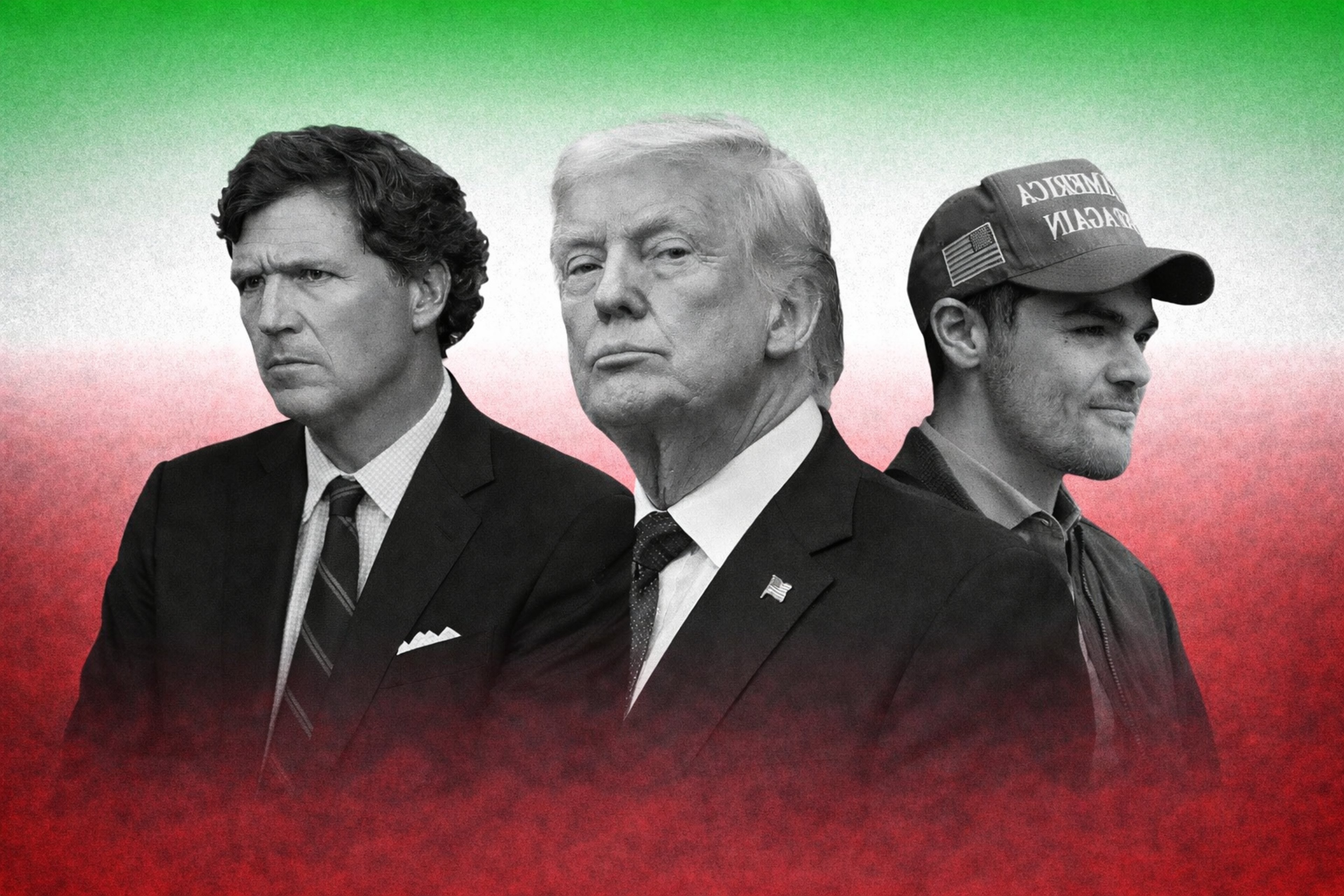
Unity around American foreign policy has begun to fracture. What presents itself as a sequence of seemingly disconnected interventions—Venezuela, Iran, and, as of last week, the renewed specter of “taking Cuba”—has revealed itself as a more clarified expression by the state department to rapidly increase its projection abroad. Despite resolute conviction from Trump and his allies, their campaign has brought the GOP into disarray. Recent developments have left the Republican Party base questioning whether the ongoing interventions, although led by Trump himself, represent a betrayal of the original tenets of the MAGA campaign set in 2016.
This skeptical section of the GOP base has correspondingly led to the rise of new prospective leadership in the form of populist challengers to the MAGA establishment. This bid for leadership is mostly made up of previous adherents of Trump, such as Tucker Carlson and Nick Fuentes. These figures have used their growing influence within the MAGA social network as a platform to now criticize it. Carlson and Fuentes, although representing vastly different generations of conservatives, encapsulate what is essentially the same agenda: raising skepticism around recent developments regarding American foreign intervention among the Republican Party base.
These developments within American foreign policy have not emerged as the result of coherent strategic design. On the contrary, they appear increasingly unmoored from the rational calculus that once governed American hegemony and imperialism in its era of unipolarity. When President Trump remarked to the press last week that he would like the honor of “taking Cuba,” and that he could “do anything he wants with it”, the statement registered as characteristic excess, a theatrical flourish consistent with his typically abrasive political approach. Yet it is precisely this collapse of distinction between spectacle and strategy that defines the present moment. Trump’s remark is not incidental to his policy—it, along with broader Trumpism itself, is symptomatic of the conditions under which policy is now produced.
What we are witnessing is a transformation in the logic of imperial governance itself. Where the United States once exercised power through the managed stability of alliances, institutions, and economic integration, it now turns with increasing frequency toward direct confrontation of a desperate nature in zones where its authority is no longer secure. Venezuela, Iran, and Cuba each represent a site where the persistence of independent political sovereignty intersects with the erosion of U.S. dominance.
Over the past two decades, the international environment that once sustained American unipolar dominance has begun to erode under the pressure of emerging rival centers of political power and influence. China’s rapid economic expansion, the consolidation of new multilateral formations such as BRICS, and the resurgence of Russian geopolitical assertiveness have together produced the outlines of an increasingly multipolar world. Such developments threaten the central condition upon which American global unipolarity has depended since the collapse of the Soviet Union: the absence of viable geopolitical competitors. As countries throughout Latin America, Africa, and parts of Asia deepen economic relations with China and explore institutions associated with BRICS designed to rival Western financial bodies, the architecture of the U.S.-centered neoliberal infrastructure has begun to strain.
This new dynamic has placed Trump in a contradictory historical role. While Trump finds himself as head of state of an empire in decline, he simultaneously is prone to the expectation of an electorate seeking change from the state bureaucracy he now encompasses. In a sense, he has fallen victim to the “outsider” branding he himself conjured and is now facing the consequences. It is exactly this tension that has made Trump’s coalition vulnerable to populist attacks despite his popularity within the Republican base on a personal level. The ruling coalition that carried Trump to power has begun to split along a fault line that had long been contained but never resolved: the contradiction between the systematic requirements of imperialist statesmanship and the populist energy that his rhetoric mobilized against that system itself. Trumpism emerged as a vehicle for discontent with the neoliberal order, but it did so while inheriting the institutional commitments of the very system it claimed to oppose. Once in power, the rowdy rebellion of the Trump campaign quickly became an astute servant of American imperialism, and this has become apparent to parts of his base.
In opposing these recent escalations, figures such as Tucker Carlson and Nick Fuentes have begun to position themselves as the authentic expression of the populist current that Trump first galvanized. Their criticisms reflect an emerging attempt to articulate a faction within the American right that sees endless military intervention, unconditional alignment with Israel, and the opaque entanglements of the national security state—now symbolized most powerfully by the seemingly indefinitely unresolved Epstein affair—as evidence that the populist revolt has been domesticated by the very institutions it once promised to dismantle.
What is taking shape, then, is not simply a disagreement over foreign policy but the early outline of a struggle over the political inheritance of MAGA itself. The administration governs through a coalition that includes sections of the traditional Republican establishment, national security institutions, and a layer of moneyed interests that benefits from geopolitical instability facilitated by this conflict. Yet the populist base that delivered Trump his political viability remains animated by a different set of expectations that facilitated the initial ascendancy of the MAGA movement in 2016. There is a promise that still looms for that base: that the state bureaucracies' sights would be turned inward, that foreign entanglements would be curtailed, and that the diffuse machinery of elite power would finally be exposed–that the swamp would finally be drained.
The contradiction here lies in the impossibility of indefinitely reconciling these two logics. A governing administration integrated into the existing state infrastructure cannot so easily fulfill the anti-systemic aspirations that propelled it into office, and in this case, has no intention of even trying. Each moment in which the Trump administration acts as a blatantly conventional steward of American power—whether through war, alliance management, or even the quiet preservation of institutional secrets—creates space for these new challengers to claim that the original principles of MAGA have been betrayed and the swamp monsters have only festered.
By framing their opposition to the Iran war as a defense of the “America First” promise, Carlson, Fuentes, and their broader milieu are attempting to construct a right-wing critique of the regime that mirrors, in distorted form, the grievances that facilitated Trump’s original insurgency. In doing so, they are not merely commentators on his administration but potential architects of its successor faction. The viability of this challenge has only been reified by Trump’s denunciation of his former protégés, claiming that Tucker Carlson has, in his newfound criticisms of the administration, “lost his way” and is “not MAGA”.
The horizon of this struggle extends beyond the present war. As the Republican Party looks toward the wide-open 2028 presidential contest, the question of who inherits Trump’s political mantle will be increasingly definitive. One faction will attempt to stabilize MAGA as a governing ideology compatible with the existing institutions of American power. Another will insist that the project has only begun—that the state itself remains captured by forces hostile to the ‘genuine’ populist will. For the Carlson/Fuentes wing, this has resulted in a careful balancing act where they must still claim adherence to Trump intermittently in order to stay within the acceptable bounds of his base while still ultimately criticizing their president.
Thus, the same hegemonic crisis that drives American power outward into increasingly chaotic global confrontations is also destabilizing the political coalition that sustains it domestically. The imperialist state demands continuity, discipline, and alliance with entrenched interests. Populism demands rupture, exposure, and the destruction of those interests. For a time, Trump managed to inhabit both worlds at once. The emerging right-wing challengers suggest that this equilibrium may not survive the coming decade, and that perhaps, in fact, it will be a decade defined by its demolition.
If the contradictions within the MAGA coalition reveal anything, it is that insurgent politics retains the capacity to reshape the internal balance of power within an existing political order. The populist challengers now circling the administration do not yet represent a coherent governing alternative, but their strategic instinct is unmistakable. They understand that the institutions of power can be transformed when a faction emerges that can threaten the political survival of those who steward them.
The right’s emerging populist insurgency poses a question that the left must confront with urgency. While the crisis of American hegemony has begun to fracture the ruling coalition that manages it, the left has largely failed to construct a political instrument capable of exploiting that fracture. The result is a peculiar inversion: as imperialist war once again exposes the contradictions of the American system, it is instead the populist right that is increasingly gesturing toward the language of anti-intervention and regime critique.
But this dissident right position is riven with contradictions. Their call to focus on “America First” does not signify a repudiation of violence as such, but rather its reorientation. For Carlson, Fuentes, and alike, the problem with American imperialism is not the domination of foreign populations but rather the perceived neglect of an internal project of domination left incomplete. The language of “America First” is thus not a demand that the immense resources expended on war be redirected toward meeting humanitarian needs within the United States; it is a demand that those resources be marshaled in service of a different form of coercion—one aimed inward, toward the disciplining and reconstitution of the American population along explicitly racialized, gendered, and nationalist lines. What appears on the surface, as anti-war sentiment, is in fact the ideological preparation for a more concentrated and intimate form of violence: the consolidation of a chauvinist social order that seeks not peace, but their own perverse conception of purification. In this sense, although their position on its face may seem like a challenge to Trump from his left flank, it should be more practically diagnosed as something far more nefarious: an ideological reinforcement for the advance of fascist oppression at home.
What appears here as dissent oriented toward the popular will should only be understood as duplicitous. The challenge from Carlson and Fuentes can only be meaningfully understood as a challenge from the right flank of Trump, inevitably reproducing the same trajectory in power, or worse. The fact that Nick Fuentes could likely be a young person’s first engagement with a critique of Israel, for example, has broadened the right-wing pipeline to an extent that should be of great concern. They are siphoning organic moral concern around American imperialism into their agenda of nationalism, ethnic & cultural homogeny, and even explicit Nazism. The spectacle outlined here is instructive; figures such as Carlson and Fuentes now speak in tones that echo a tradition that shouldn’t belong to them. Their denunciations of endless war, their suspicion of the national security apparatus, and their rhetorical appeals to a betrayed popular will must become the political terrain of any version of the American left that seeks hegemony.
The greater danger here is not necessarily in the strength of this right-wing insurgency, but rather in the vacuum that allows it to masquerade as the principal voice of anti-war dissent in the present moment. For the language of anti-imperialism—the recognition that American global dominance rests upon the blood-stained foundation of permanent war—has historically belonged to the socialist tradition. That this language can now be appropriated, even temporarily, by figures on the populist right reveals less about their ideological coherence than about the left’s failure to assert itself as the natural political home of this critique.
This crisis has already begun to destabilize the political terrain of the United States; the question is whether the left can construct a political current capable of intervening within that instability. The experience of the GOP’s Tea Party of the not-so-distant past offers an instructive, if inverted, lesson. Whatever its reactionary content, the Tea Party functioned as an insurgent apparatus that forced the Republican Party to reconstitute itself around a new generation of political actors.
The American left has produced its own figures representing an embryo of insurgency. A younger generation of democratic socialist politicians—figures such as Alexandria Ocasio-Cortez, Zohran Mamdani, and others—have demonstrated that the language of oligarchy, class power, and democratic control over American political life resonates widely in a society increasingly conscious of its own decline. Yet without an organized campaign capable of consolidating these progressive figures into a durable and influential faction, such moments risk remaining isolated episodes rather than the foundation of a new political alignment for the Democratic Party.
What is required, then, is the deliberate and insistent construction of a democratic socialist insurgency capable of operating within—and against—the institutional terrain of American politics. Organizations such as the DSA, along with a broader constellation of unions, political organizations, media platforms, and local political formations, represent the proto-infrastructure from which such a current could emerge. But the strategic objective must be clearer: not merely to occasionally elect sympathetic individuals to have them facilitate a managerial program of ‘deliverism’, but rather to cultivate a political force capable of qualitatively transforming state infrastructure; a party.
In this sense, the question posed by the right’s insurgent flank returns to the left in altered form. The populist challengers to neo-conservatism have demonstrated that the stability of the governing order can be threatened from within its own ranks. Yet because their critique remains bound to the political and structural limits of outright fascism, it cannot ultimately resolve the contradiction it exposes, and instead will redirect its base’s energy toward the justification of further domestic oppression. The anti-imperialist tradition they now invoke must be seized by the left.
The crisis of American hegemony has already begun to reorganize the terrain of political struggle. The right has sensed that opening and has begun constructing its own insurgent factions to capture it. The question is whether the left will reclaim this terrain—or whether it will continue to cede the ground of anti-war politics to those who can seek only to utilize it for its own opportunistic ends. If the coming decade will be defined by the fragmentation of the old order, the American left must decide whether it intends to observe that process—or to build the insurgent current capable of shaping what comes after.