
Jun 4, 2026
ChatGPT Simply Does Not Dream of Labor
Discussion around the effects of AI often center potential productivity gains or other economic consequences. But these debates forget that, fundamentally, human labor is tied to expression and purpose.
by Julia P

Self Portrait by Judith Leyster (painted circa 1630)
There is a common misconception that Marxists are opposed to work as a matter of principle—that we 'simply do not dream of labor,' as a meme-ified quote absurdly attributed to James Baldwin puts it. This may sometimes be true on an individual level, but is broadly false and constitutes an egregious distortion of basic Marxist philosophy.
Marx believed that under the proper circumstances, human beings find fulfillment and self-realization through labor—not outside of it. When we are able to independently or collaboratively direct the process of our own work and reap the benefits it yields, labor gives us pride, identity, and purpose. It fosters a sense of community and belonging. It helps us to develop creatively, intellectually, and even spiritually. Labor—if I may partake of the masses' favorite opiate—is what gives us our souls.
What Marx objected to was not labor per se, but an extractive and coercive system of wage labor which robs workers of what we create for the sake of the material enrichment of our capitalist overlords. Tedium, drudgery, exhaustion, exposure to poisons, the loss of limbs, the erosion of internal organs to blackened sludge, the deterioration of interpersonal relationships, and the existential anguish that drives us to addiction and suicide are costs that must be paid in the pursuit of enormous wealth for a privileged few that will surely trickle down to us any day now.
Under a Marxist social contract, individuals are expected to give according to their ability. This may include performing essential labor that they do not want to do, but this does not require unlimited self-sacrifice, nor does it have any bearing on whether one's basic needs are met. Self-directed creative, intellectual, and spiritual activities—along with adequate rest—are understood as essential for the health of society, and the state is responsible for creating a social and economic structure which maximally enables the pursuit thereof.
Under capitalism, which honors no social contract, workers are required to give until they are used up and then to keep giving anyway. Our self-actualization and intellectual development are of no concern to capital. If anything, they are nuisances to be eliminated—a worker who recognizes their own dignity and thinks critically about the social conditions that bind them to wage labor is much harder to herd and may even organize their fellow sheep to break ranks.
For all their differences, however, both capitalism and Marxism can agree on one thing: the necessity of automation. For the majority of people, life before automation was nonstop drudgery (those who dispute this are cordially invited to lug their dirty laundry to the nearest stream and wash it by hand). To capitalists, however, automation represents merely lower labor costs and faster production of commodities.
The system of wage labor thus pits the worker and the machine against one another: machines are not used to improve the quality of life of the worker, but as a means to lower workers’ wages and drive more and more workers into the so-called "surplus army" of the unemployed. Those who remain employed are pumped even harder; rather than shortening the work week and letting employees leave once production targets are met (like a soft-hearted sucker), the shrewd capitalist simply raises production targets and keeps workers chained to their machines for the same forty (or fifty or sixty) hours a week for twice the profit.
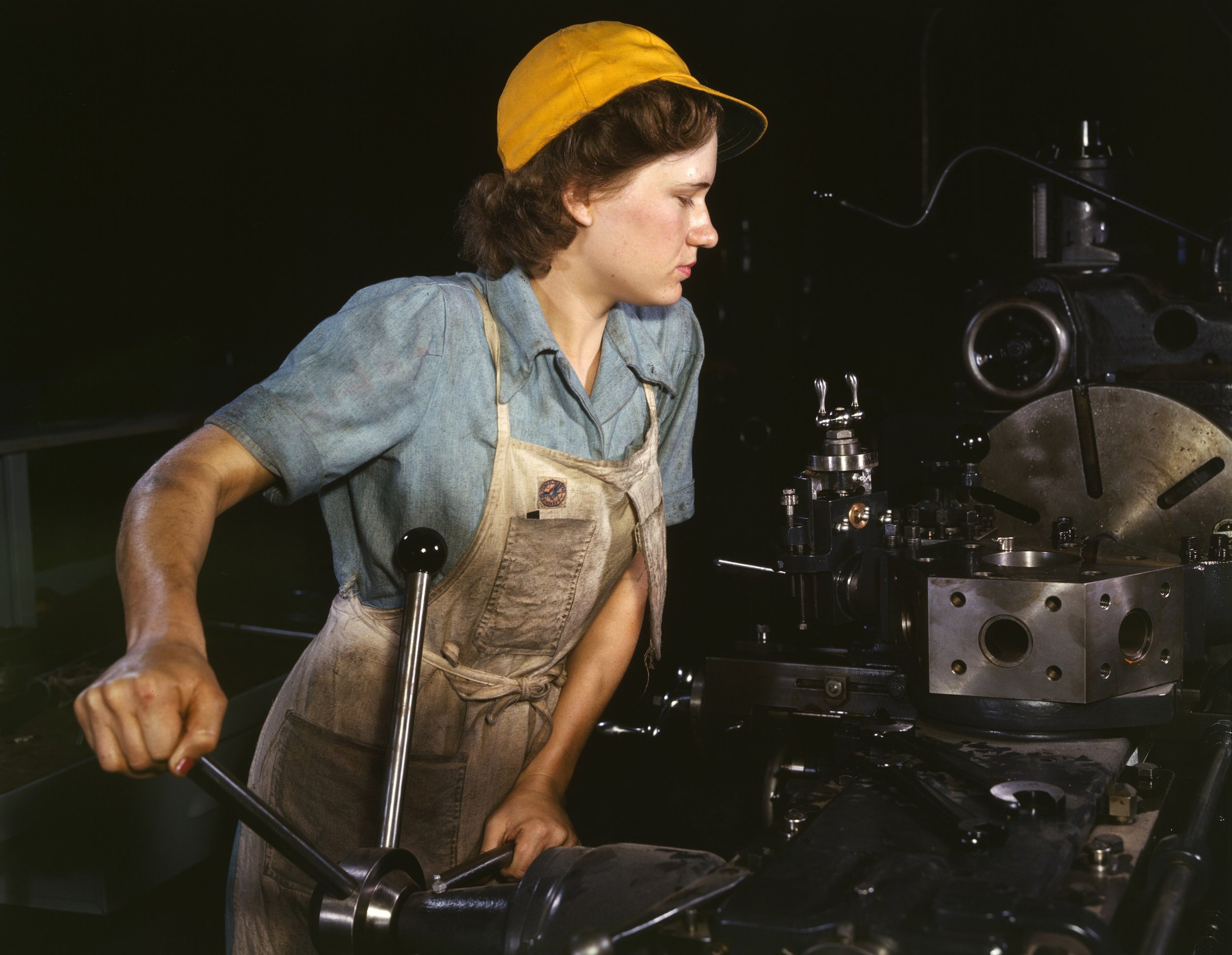
Turret lathe operator machining parts for transport planes at the Consolidated Aircraft Corporation plant, Fort Worth, Texas, USA.
Marxism, on the other hand, envisions a world in which basic subsistence is not dependent on one's employment status. This is the only type of world in which automation could be truly liberatory. When profit incentives are removed and the role of production is simply to produce necessary goods, automation means freedom from a life of endless work, a necessary precondition for the pursuit of self. True communism is impossible without automation.
This does not necessarily point to so-called "fully automated luxury communism"—a utopian vision of a post-scarcity society in which people leave all demanding work to collectively owned machines, receive housing, healthcare, and education free of cost, and dedicate the majority of their time to leisure—as the solution to the woes of wage labor. Many tasks can be made easier with automation, but this does not mean the total removal of human labor from the process is tenable—and it cannot be assumed that human workers desire to be totally removed even where possible.
If the purpose of automation is to liberate human beings from unpleasant work so they can freely pursue fulfilling work, it makes perfect sense to automate unpleasant tasks to the extent possible, but "fulfilling" and "unpleasant" are subjective terms: tasks that are enjoyable for one person may be unbearable for another. Sewing, for instance, is an extremely labor-intensive and repetitive task, but it is enjoyed by many as a form of creative expression. Cooking and baking are challenging and time-consuming, but both are perennially popular hobbies.
These tasks can be (and, at an industrial scale, necessarily are) substantially machine-assisted if not entirely automated, but hobbyists often choose a more analog approach even though it generates smaller returns because they enjoy the process. Machine labor may facilitate that process without displacing it. An amateur cook, for instance, might spend hours preparing an elaborate dish but wash the resulting dirty dishes using a dishwasher because cooking brings them joy and washing dishes by hand does not.
Capital, however, is not terribly concerned with the concrete labor-process and is more than happy to see it consumed in its entirety by machines. It only values the product, and an optimal process is one that generates more, faster, regardless of whether it is stimulating or satisfying or even safe for workers. The creativity and problem-solving that give workers a sense of pride and ownership over their labor are nice enough so long as they don't eat up too much time. Unfortunately, they frequently do just that. It is capital, not the looming specter of Marxism, which dreams of abolishing human labor.
Capital, if it could speak, would say our amateur cook is a fool for putting in all the work of preparing a meal by hand when they could have saved hours of production time by buying a pre-packaged, factory-made version of the same food. It would say the same thing about an artist who toils for days over a painting or a writer who spends years writing, editing, and rewriting a novel. Why, it would ask, would anyone put in all that time and effort on a project that could be completed in minutes by a machine?
This topic has become especially salient today due to the rise of generative artificial intelligence, which many fear will mechanize jobs hitherto considered safe from automation, such as artistic production. Much has been said about the heavy cost of generative AI:
It uses too much water. It is powered by data centers that plague working-class communities with noise and pollution. It plagiarizes the work of artists and writers. It can be, and frequently is, used to generate nonconsensual pornography and child abuse material. It "hallucinates" and turbocharges the spread of misinformation online. It triggers psychosis and delusional disorders even in people with no history of such problems. It is being created and promoted by people who stubbornly refuse to take any precautions. It is driving a speculative bubble that could very well crash the economy.
Last but not least, it may or may not become superintelligent and destroy us all within the next ten to five hundred years. All of these things are true, more or less (I remain skeptical of computerized superintelligence, although I suppose anything could happen), but, even if they weren't, generative AI represents a profound existential horror of the kind that only capital can produce. It is the natural result of—and can only exist within—capital's ruthless quest to bypass the process of human labor and get right to the product, even if that comes at the cost of humanity itself.
If I were to compare current generative AI programs, such as OpenAI's ChatGPT, Google's Gemini, and xAI's Grok (sometimes known as "MechaHitler"), to one machine from history, it would be neither Joseph Weizenbaum's ELIZA nor Richard Wallace's A.L.I.C.E. It would be the vibrating belt machine, a mid-twentieth-century contraption that purported to help users reduce body fat by encircling the target area (usually the waist) with a fabric belt which was rapidly shaken by a motor.
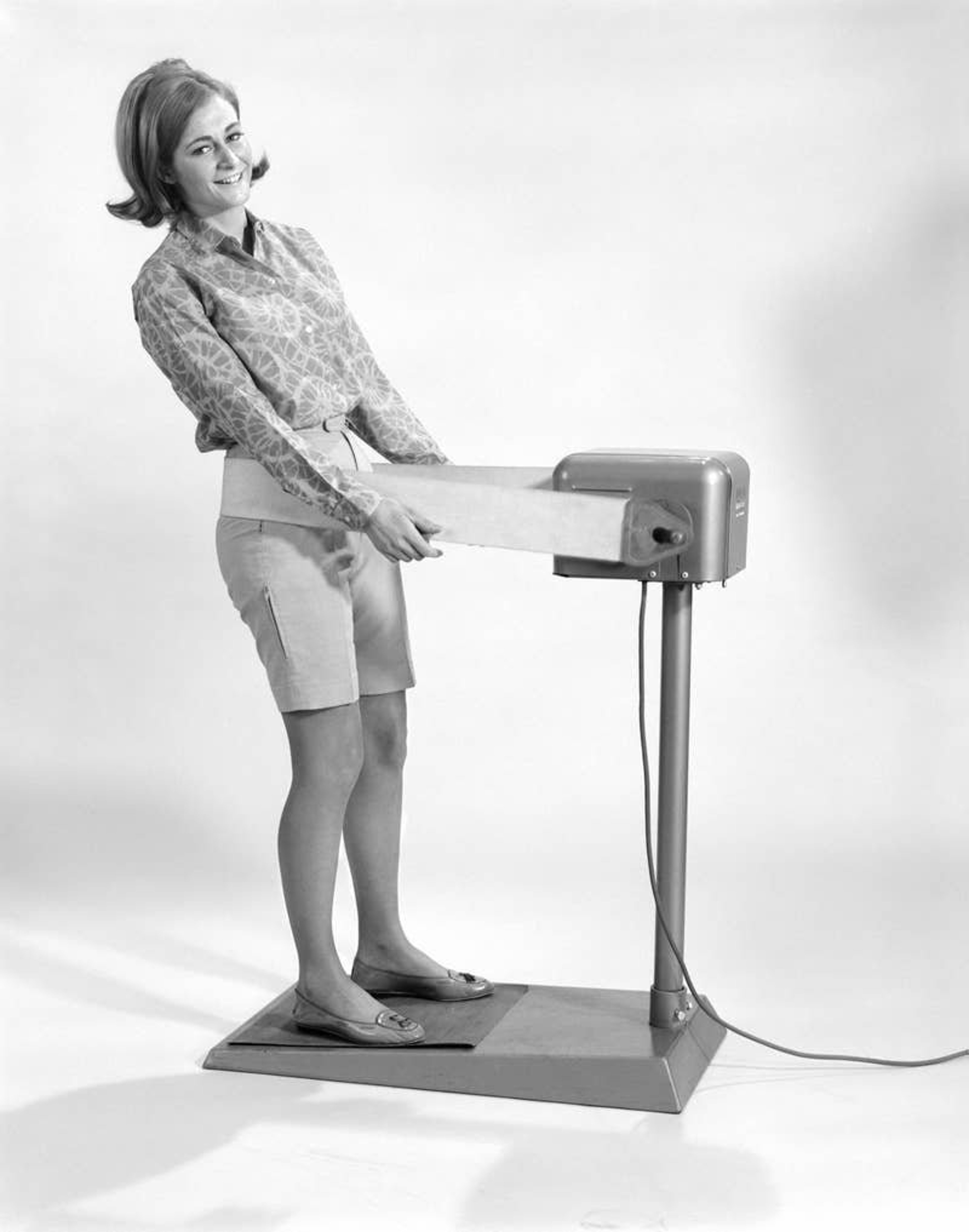
The fabulous vibrating belt machine!
With the vibrating belt machine, the user can supposedly bypass the effort of establishing and maintaining a consistent exercise routine and still lose weight; the process of exercising is subordinated to the desired output of a thinner body. But something is lost in the process of automating something as simple as weight loss. Regular exercise has been conclusively shown to offer a number of additional health benefits regardless of whether it leads to weight loss, and these benefits are as much mental as they are physical, including reduced stress, improved cognition, and greater self-confidence. The vibrating belt machine, a product designed to get around that labor, offers none of those benefits, nor, for that matter, does it even deliver on the promise of weight loss.
The machine fell into disuse by the 1980s, and while similar products pop up every now and then in infomercials and sketchy banner ads, they never seem to gain much cultural traction. The public largely understands that the process of exercise cannot be fully automated. Machines such as treadmills and stationary bikes may make it safer or more accessible, but they do not remove the requisite time or effort. Exercise, whether associated with a weight loss goal or otherwise, does not have an endpoint. The process itself is part of the goal, and attempts to skip the process fundamentally misunderstand and corrupt it.
The same is true for creative practices such as writing and the visual arts. Human beings do not write or draw because they yearn to produce commodities. We do so because we want to understand ourselves and the world we inhabit, to build new neural connections and sharpen our thinking, to express complicated emotions, and to develop and assert identity as thinking, feeling, sentient beings. We do it because, for reasons we ourselves cannot fully articulate or even register consciously, we need to. There may be a practical purpose to creative activities, such as record-keeping or education, but these purposes are ultimately auxiliary to the purpose of creativity itself.
It would be bad enough if generative AI corrupted only archetypally creative professions, but the soul of the humble bureaucratic functionary is no safer. This is an issue of deep concern for me; my professional experience is almost exclusively cashiering and standard nine-to-five office jobs involving journal entries, tax documents, filing systems, databases, and spreadsheets. The possibility of being replaced by AI hangs over my head like the sword of Damocles.
My rational self-interest in maintaining job security aside, I like my work and do not want it taken away. The tasks I perform can be frustrating and exhausting, and a machine might indeed be able to perform them more efficiently than I can. But the honing of critical thinking, problem-solving, and organizational skills cannot be rushed. Rote administrative work, despite superficial appearances, serves an essential purpose deeper than "getting the job done."
Forget the burning of libraries—imagine a world in which the basic organizing and records management skills required to create them in the first place were cannibalized by computerized pseudo-brains whose machinations were inscrutable to a deskilled human population. Administrative work is a key example of the risks associated with rushing into automation of labor that may seem rote: what is lost is not just the job itself, but the training of skills and familiarity with information characteristic of a human operator.
A world without human bureaucrats is a world in which capital can operate totally unchecked by human oversight. Existing bureaucratic systems are already designed to facilitate this to the maximal degree possible, but even the most apathetic office drone has wheels in their head that are liable to start turning when they come across blatant malfeasance, corruption, injustice, or inefficiency. Human beings cannot be reduced to cogs in a perpetual motion machine. Actual machines are not terribly good at this either; they are only as efficient and effective as they are programmed to be (and despite the hubris of Silicon Valley entrepreneurs, the human ability to program is subject to the same limitations as all other human skills).
The critical difference is that human beings ask questions when they encounter opaque and inefficient bureaucracies. Human beings who work within institutions instinctively try to improve them for the simple, self-interested reason that it will make their jobs easier. Computers will happily chug along sloppily and slowly, never asking for anything better, never even questioning why the system is so ineffective in the first place.
Theirs not to make reply, theirs not to reason why, theirs but to absolve human actors who benefit from rigid, obscurantist institutional structures of accountability for the fact that people are unable to access basic services or effectively push for substantive change that would allow them to do so. Can't get food stamps? Can't update your driver's license? Can't get your papers in order to become a naturalized citizen? Sorry, we'd love to help, but the computer handles all that now—do we look like tech geeks to you?
As I've watched the rise of generative AI over the past few years, I have often found myself caught up on questions of personal ethics. Is it right or wrong to use AI? Are there particular uses of it that are more acceptable than others, or does any use of AI contribute to the massive social and environmental harms done by the companies profiting from this technology?
In the beginning, it was easy to say we should all boycott AI and to morally condemn its users, but the way it's crept into search engines and online workspaces like a strangling kudzu vine has made total abstinence a practical impossibility. In this context I increasingly feel that focusing on individual habits is a distraction from larger and more important issues. Bizarre and eldritch as it may appear, the rise of AI is just another repetition of a cycle workers have seen a thousand times before. White collar professionals and creatives who assumed our jobs were safe from automation are now feeling the same pressure that industrial workers felt in the age of Marx and are thus being forced to confront the proletarian class position obscured by the creature comforts of our middle class lifestyles.
Despite the temptation to give in to despair, many such workers have taken this not as a harbinger of inevitable destruction but as a rallying cry for solidarity. SAG-AFTRA has been organizing around AI-related labor concerns since 2022, and workers at Wizards of the Coast called for generative AI protections as a core demand when they went public with their campaign to organize a union earlier this year. We can either give in to the dystopian juggernaut of AI slop and doomscroll until our brains go smooth or we can look to these examples of worker-led resistance and demand that our employers recognize what we already know: that our labor has value and we can't be replaced. If our bosses insist on using AI, we can at least insist that they use it on our terms.
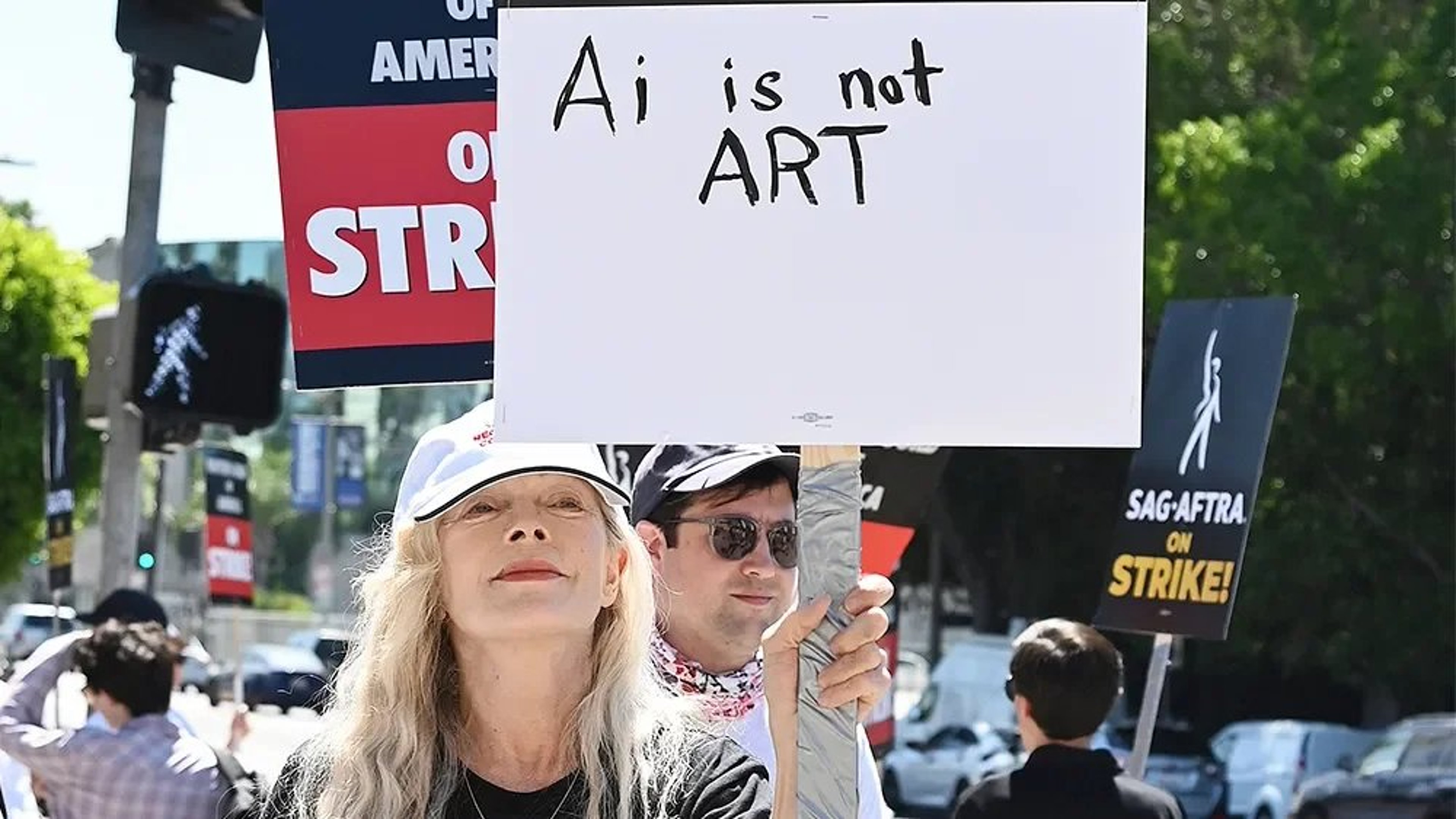
SAG-AFTRA strike against AI
Capital has spent over two hundred years insisting that the machines it builds will free us from labor. Gullible communists have bought into this lie and lost themselves in fantasies of a world in which labor is a thing of the past, in which we defeat capital not by reclaiming control over our own labor but by foisting it off on machines and fucking off to the park with our chosen family for a sustainably harvested picnic.
This is the same attitude that drives self-styled "entrepreneurs" hawking get-rich-quick crypto investment schemes on TikTok and Instagram in a digital continuation of the time-honored medicine show tradition. Its utopian revolutionary varnish obscures a fundamental fact that we cannot afford to forget: building a socialist world is going to take a lot of hard work.
Implementation and long-term maintenance of truly democratic systems of governance that put people first will not happen by removing human labor from the equation to the greatest extent possible. We are communists not because we hate work but because we recognize its inherent value and because we want to live in a world that recognizes that value at a systemic level. A communist society must allow for rest and respect natural variations in individual labor capacity, up to and including a total inability to perform work of any kind, but it cannot and will not be a land of indolent lotus-eaters.
So I say again: we are communists not because we hate work, but because we actually dare to dream of labor—labor that is dignified, purposeful, and wholly our own.