
Jul 1, 2026
Defeating Fascism Requires Trans Liberation
The far right's war on trans people shouldn’t be seen as a distraction from class politics, but as fascism’s blueprint.
by Mary C
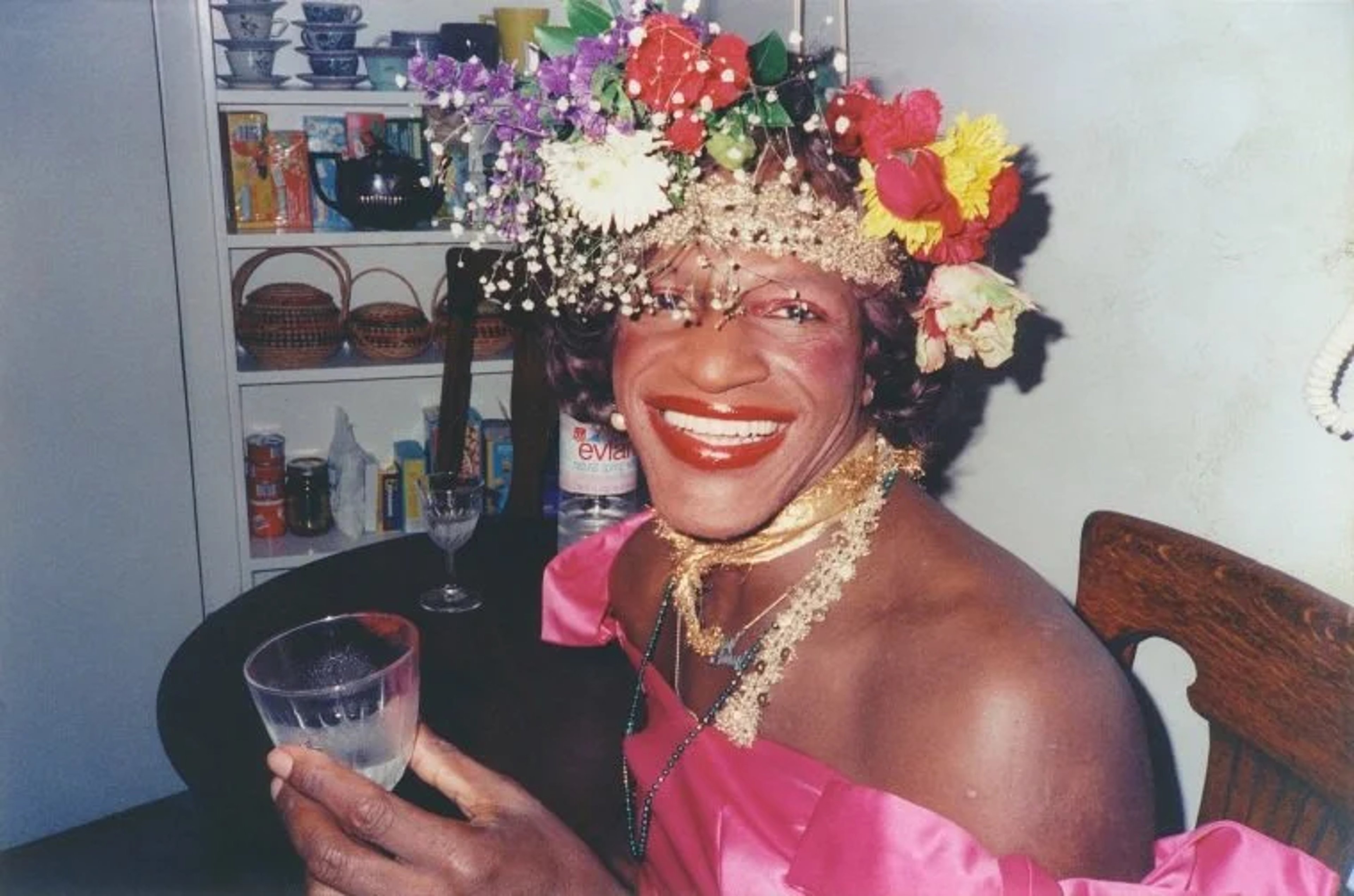
Marsha P. Johnson — Netflix
Introduction
To close out Pride Month, the Supreme Court ruled that states can exclude trans women from sports, opening the door for the total exclusion of trans people from Title IX and 14th Amendment Equal Protection rights. This attack on trans people is not new, but rather follows a pattern of increased acts of individual and state violence against trans people that began during the first Trump administration and has carried over into his second term. On the first day of his second term, January 20, 2025, Trump issued a presidential action titled, “Defending Women From Gender Ideology Extremism and Restoring Biological Truth to the Government.” This action targeted trans women, claiming that “The erasure of sex in language and policy has a corrosive impact not just on women but on the validity of the entire American system.” It mandated government agencies adhere to an understanding of gender that declares “women are biologically female, and men are biologically male.”
According to the Trans Legislation Tracker, there was a 45 percent increase in the number of anti-trans bills passed at the federal and state levels in 2025 compared to 2024, and this trend has continued into 2026. These bills have targeted education, healthcare, sports, and public bathrooms, collectively seeking to drive trans people from public spaces and block them from receiving lifesaving healthcare by punishing both trans people and the educators and healthcare providers working to protect them. This widespread attack has produced the internal displacement of over 400,000 trans people—roughly 10 percent of the U.S. trans population—who have fled the most hostile of these states—Florida, Texas, Kansas, among others—and relocated to the few remaining trans-friendly areas in the country.
In a 2024 poll conducted by the University of Chicago, 77 percent of respondents agreed with the statement, “Elected officials are mostly using debates over transgender and nonbinary people to distract attention from more pressing priorities.” This sentiment has been repeated by many journalists and politicians, including Maine U.S. Senate Democratic Party candidate Graham Platner, whose standard line on anti-trans legislation is that it’s “to make sure we have this discussion and we don’t talk about raising taxes” on billionaires.
While the anti-trans panic has entirely been stoked by billionaires like Charles Koch and right-wing publications like the New York Times, to claim it serves merely as a distraction from more pressing political problems is to misunderstand the challenge that trans people pose to fascism. I argue that anti-trans politics is fundamental for the establishment of fascism and that trans liberation is therefore crucial for the project of dismantling fascism and its capitalist, imperialist foundation.
Project 2025
The Heritage Foundation’s “Project 2025,” a 900-page-long policy guide for entrenching fascism at the federal and state level, emphasizes the significance of the nuclear family for the success of its project. The document states that a fundamental goal of the Health and Human Services secretary is the promotion of “stable and flourishing married families.” It defines “married families” as those “comprised of a married mother, father, and their children,” calling this arrangement “the foundation of a well-ordered nation and healthy society.” The document decries the Biden administration’s supposed emphasis on “LGBTQ+ equity,” and argues these policies should be replaced with those that encourage “marriage, work, motherhood, fatherhood, and nuclear families.” Likewise, the Heritage Foundation’s policy guide for Trump’s second term, a document formally called “Restoring America’s Promise,” but colloquially called “Project 2026,” reiterates this commitment to the nuclear family. In a section titled “Put Family First,” the document denounces the existence of “Radical ideologies that deny social and biological truths about sexual embodiment” and promises to “advance policies at the state and federal level to restore the nuclear family to the center of American life.”
Threaded throughout Project 2025 is an attack on “the toxic normalization of transgenderism” in American society. The document repeatedly equates transness with pornography, declaring that pornography is “manifested today in the omnipresent propagation of transgender ideology and sexualization of children.” It argues for the rescinding of “regulations prohibiting discrimination on the basis of sexual orientation, gender identity, transgender status, and sex characteristics.” In essence, the document places transness and the nuclear family as oppositional forces: the former seeks to corrupt children and destroy the moral foundations of American society, while the latter acts as the bulwark protecting both children and America from the existential threat of transgenderism.
Fascism and the Nuclear Family
The nuclear family is the primary site of social reproduction under capitalism, meaning it provides the things necessary to reproduce the capitalist workforce (food, love, transference of norms, and most crucially, the workers themselves) and it therefore reproduces the capitalist system itself. Because capitalist accumulation demands ever greater surplus value, it necessitates achieving social reproduction as cheaply as possible. Situating social reproduction within the home “made the factory system more profitable by undertaking time-consuming tasks and shifting the cost of production from the employer to the worker who usually supplied the space, tools, and other materials” necessary for capital accumulation. (1)
In order to ensure the existence of this unpaid or low-paid domestic labor (which was both productive and reproductive), capitalists claimed it was the natural purview of women. In pre-capitalist societies, there was little to no value distinction made between the productive labor typically performed by men and the reproductive labor typically performed by women. However, as capitalism transformed individuals into wage laborers, it placed different values on this gendered division of labor. As family abolition theorist M.E. O’Brien explains,
New systems of wage labor, private property, and social legitimacy under capitalism separated the privacy of the family house from the public and political sphere. Capitalist development also took up and expanded distinctions between different forms of waged work, such as feminized reproductive labor focused on direct people-making—childcare—and the masculinized labor focused on social control or object-making. In each case, how these divisions were made seemed natural and intractable. But the particular form of these divisions rapidly changed with each era of capitalist development and the particular dynamics between class and capital. The role of the family in class society was remade through these divisions introduced by capitalist production. (2)
For the bourgeoisie, the family serves the purpose of securing private property by creating a chain of inheritance and strict gendered division of labor, whereas the proletariat rely on the family to share their limited resources and fill in the economic and social gaps created by this class structure. Therefore, “class inequality and the class relations of capitalism are reproduced through the family as a system of private households.” (3) Moreover, due to this gender essentialism, class inequality is explained away as being both natural and a private matter, rather than the result of capitalist exploitation along class and race divisions.
Friedrich Engels writes in The Origin of the Family, Private Property, and the State that the bourgeois family “is based on the supremacy of the man, the express purpose being to produce children of undisputed paternity” to facilitate the generational transfer of wealth. Within this patriarchal arrangement, both wives and children act as extensions of the husband’s/father’s property. As O’Brien noted, this new system cut off women from surplus production and reduced them to managers of social reproduction, subservient to their fathers and then husbands, in what Engels calls the “world historical defeat of the female sex.”
More so than the working class, then, the nuclear family originated with the bourgeoisie, as this class could afford to have a single breadwinner within each family unit, while the sub-poverty wages of the industrial revolution forced entire working-class families to become wage laborers. As O’Brien puts it, “the conditions of industrial production made it difficult for proletarians to cohere any semblance of stable family life,” and wage labor even liberated some proletarians from their families. (4) Nevertheless, due to the gender essentialism embedded within capitalism, working class women were still expected to perform the bulk of the unpaid social reproductive labor within the home.
However, both the desperation of poverty and the destruction of the family provided members of the working class with new opportunities to engage in gay and gender transgressive acts, such as creating bathhouses and performing publicly in drag. The bourgeoisie used these displays of queerness as a justification for calling the working class “uncivilized” and reinforcing bourgeois capitalist morality concerning sexuality and gender. For example, in post-WWII America, the police used their ability to enforce “prevailing moral standards” to target Black women on sexual promiscuity charges. What emerged from these contradictions was the notion of the nuclear family as a symbol of capitalist success; the working class has continuously sought to emulate it rather than recognize it for the oppressive structure that it is.
The control over society the nuclear family afforded the bourgeoisie domestically was expanded through colonial and imperial violence, for the purpose of retaining ever larger groups of productive and reproductive laborers. As Kathi Weeks writes in Abolition of the Family: The Most Infamous Feminist Proposal,
…the model of the nuclear family…is the very same white, settler, bourgeois, heterosexual, and patriarchal institution that was imposed by the state, society, and capital on the formerly enslaved, indigenous peoples, and waves of immigrants, all of whom continue to be at once in need of its meagre protections and marginalized by its legacies and prescriptions. (5)
Anne McClintock expands this argument, adding that the nuclear family was essential for the success of colonialism because it enabled the colonizers to present the violent process as “a linear, nonrevolutionary progression that naturally contained hierarchy within unity: paternal fathers running benignly over immature children. The trope of the organic family became invaluable in its capacity to give state and imperial intervention the alibi of nature.” (6)
Maria Lugones furthers the scholarship connecting the nuclear family to colonialism. In her article The Coloniality of Gender, she posits that the colonial gender system contained a “light” and a “dark” side: the former “constructs gender and gender relations hegemonically,” while the latter is “thoroughly violent.” This hegemonic construction of gender reinforced the gender essentialism of capitalism, assigning the values of “sexual purity and passivity” to bourgeois white women and enabling them to reproduce the political superiority of bourgeois white men while themselves being banned from this authority. This “heterosexualist” gender construction then “permeates racialized patriarchal control over production, including knowledge production, and over collective authority,” relegating those who do not conform to it to labor exploitation or death. (7)
Within the United States, the government sought to assimilate Indigenous people into the nuclear family structure both as a component of cultural genocide and as a way to obtain property that was previously communally owned. Likewise, Black people were forced into nuclear families as a precondition for renting land during Jim Crow. The need to protect the white nuclear family (and white women’s purity and femininity) from Indigenous and Black sexuality, kinship, and gender diversity became the justification for racist violence. Drawing from an array of Indigenous scholars, Sophie Lewis writes that the enforcement of the nuclear family destroyed “tribal models of collective ownership that went along with gender-nonbinarism, nonmonogamy, and/or matrilocal open marriage: they instituted private property and then concentrated it in the hands of ‘heads of household,’ that is, husbands.” (8) The intent here is not only to assimilate Indigenous, Black, and other colonized peoples into the nuclear family, but to divorce them from alternative kinship arrangements so as to limit their imagination to the nuclear family. The success of these efforts is evidenced in the number of non-white residents in America who uphold the nuclear family as the key to and symbol of economic and social success, despite the fact that the institution does a great deal more to oppress them than it does to liberate them.
Returning to fascism, George Jackson, in his seminal theory of American fascism, Blood in My Eye, states that it has two primary characteristics: “its capitalist orientation and its anti-labor, anti-class nature.” When combined with his later observation that “the purpose of the chief repressive institutions within the totalitarian capitalist state is clearly to discourage and prohibit certain activity, and the prohibitions are aimed at very distinctly defined sectors of the class- and race-sensitized society,” it becomes clear why fascism seeks to re-entrench the nuclear family in society. Because fascism is the highest stage of capitalism—a capitalism desperate to retain its control over labor—it upholds the nuclear family as the primary unit of production, consumption, and reproduction. Moreover, it uses the nuclear family to eliminate alternative methods of kinship and labor relations that are most commonly found in the communities of its colonized subjects, both domestic and international. Thus, fascism’s reliance on the nuclear family protects capitalism from socialist alternatives and ensures the reproduction of the exploited laboring class.
Fascism’s Anti-Transgenderism
The extermination of trans people has always been a central project of fascist societies. One of the first targets of the Nazi Party was Magnus Hirschfeld’s Institute For Sexual Science, a leading institute for queer research and the only place trans Germans could find assistance for legal name changes and Westerners could access medical treatment, including sex reassignment surgery. In 1933, after years of propaganda calling Hirschfeld a pedophile, the Nazis forced him into exile, burned the institute’s research, and permanently closed it. In 1938, official Nazi Party anatomist Hermann Ferdinand Voss published a book titled On the Problem of Transvestitism, in which he argued that “in public [trans people] endanger orderly life and the wellbeing of society” because their “asocial mindset” pushed them into criminality. “Draconian measures by the state” were therefore necessary to deal with the problem of trans people.
This violence fed into the gender essentialism at the heart of Nazism: men must be soldiers and women must be housewives. According to National Socialist doctrine, “to be a wife and mother is the German woman’s highest essence and purpose of life,” because the expansion of the Nazi state required the existence of a strong Aryan populace capable of waging war on its enemies. When they rose to power, the Nazis sought to undo the supposed bourgeois decadence of the Weimar Republic, on which they blamed the declining birthrate. To promote the survival of the Aryan race, they embraced “conservative sexual values, which emphasized heterosexuality and chastity,” and asserted that sex ought to fulfill “national goals” rather than individual pleasure. (9) As such, the regime promoted the nuclear family, instituting financial penalties for unmarried men and childless married couples. Those who were thought to be queer faced harsher retribution, from unemployment and homelessness to imprisonment in concentration camps.
Fascism’s promotion of the nuclear family and attacks on trans people extends beyond the Nazis. As Robyn Marasco argues in a piece on fascism and the bourgeois patriarchal family, “The family is the institution that prepares its members to assume their place in a social hierarchy, adhere to the principle of inequality, and accept the rule of authority, rational or not. The family is where we first become political subjects.” (10) Analyzing Theodore Adorno’s The Authoritarian Personality, she posits that capitalism produces fascism when “male supremacy inside the home [falls] into conflict with the worker’s exploitation outside the home,” producing a mass culture of “imperial bloodlust, ethnocentric and racial domination, and misogynist fantasy.”
Thus, the framing of transgender people as sinister destroyers of the nuclear family serves an important function in the subjugation of the working class. Citing the Frankfurt School in conjunction with psychoanalyst Wilhelm Reich, Ryan Moore explains, “When the lower classes begin to organize to fight for themselves, the first line of defense for the ruling class is an appeal to morality and the sanctity of the family that is meant to resonate with the intermediate classes. These middle classes stand in a precarious position that is nonetheless crucial for maintaining a patriarchal class society.” (11) Similarly, Alyosxa Tudor points out that “The instrumentalization of anti-trans resentment, stylized as ‘common sense that unites the masses,’ has become a central engine for the acceleration of fascism.” (12) What enables fascism to appeal to the intermediate classes in this way is the fact that capitalist societies have already entrenched in people the belief that the victims of capitalism are responsible for their own victimization; it would be easy for these people to conform to the nuclear family and so their refusal to do so is painted as a natural moral shortcoming. The “civilization” of these “deviant” populations, then, becomes the most urgent project of budding fascist regimes.
Why Is Trans Liberation Fundamental for Socialism?
Socialism in the United States faces a monumental task of dismantling a 250-year old state which has ruthlessly deployed all of its weapons—domestic and international—to make its current billionaire technocratic rulers the wealthiest people to ever exist. In the face of bankrolling Israel’s accelerated genocide of Palestine, unleashing violent I.C.E. goons on American cities, and kidnapping another country’s head of state, devoting considerable resources to an issue affecting roughly 1 percent of the U.S. population might not seem like a strategically sound decision. However, taking trans liberation seriously provides us with the tools necessary to destroy fascism and build a socialist state in its place. Below, I offer five reasons why socialists should care more about the liberation of trans people.
It dismantles the illusion of the gender binary that props up the nuclear family.
As demonstrated, capitalism relies on the nuclear family as the essential unit of social reproduction. While some gay and lesbian people have assimilated into this structure by legally marrying and having children, the nuclear family is most commonly considered to be a father, mother, and their biological children. This construction of the family is important because it reinforces the gender essentialism necessary for producing a class of subservient women bound to the unpaid labor of social reproduction.
As Leslie Feinberg explains in Transgender Liberation: A Movement Whose Time Has Come, early communal societies throughout the world generally respected their trans members, and many even granted them religious favor. However, as we have seen, the justification for each stage in the privatization of property throughout history required “a systematic downgrading of the status of women and an assault on the transgendered population.” (13) Quite simply, “private property, the male-dominated family and class divisions led to narrowing what was considered acceptable self-expression.” (14)
The capitalist state seeks to overcome the contradiction between trans people and the gender binary by assimilating trans people into the nuclear family structure, but this tactic can only be so successful. To assimilate trans people into this kinship structure either requires a violent denial of their transness or it requires providing them with the necessary gender-affirming care. While this process may be available to wealthy trans people, particularly white trans people like Caitlyn Jenner, it can never be open to all trans people under capitalism. Assimilation still requires the acknowledgment that the underlying gender essentialism is constructed rather than natural, and women therefore are not designed by nature to fill this subservient role in society.
2. It pushes us to recognize Indigenous conceptions of gender and kinship as alternatives.
Decolonial scholars like Maria Lugones, Oyèrónkẽ́ Oyěwùmí, and Sandy O’Sullivan have written extensively on how colonization altered Indigenous populations’ relationship to sex and gender, violently forcing these peoples into Western binary conceptions of gender for the purposes of commodifying their bodies and labor and severing them from their histories. O’Sullivan writes that “If we cannot insist on the complexity of genders and gender expression, and reduce only to ideas of what can be proven through the colonial record, we will remain static and will succumb to the strictures of the colonial project of managing gender and everything else.” (15) Rediscovering these Indigenous conceptions of gender and kinship is essential for confronting the myth that capitalism is a universal, fixed economic and political system for which there are no alternatives.
This rediscovery provides us with examples of alternate kinship relations, such as Kim Tallbear’s analysis of the Dakota people’s expansive notion of kinship that included non-blood relatives and even the natural world. The fundamental question animating Tallbear’s work is this: “What is possible with a model in which love and relations are not considered scarce objects to be hoarded and protected, but which proliferate beyond the confines of the socially constituted couple and nuclear family?” If we admit that the nuclear family does not have a monopoly on our capacity to love and that we are contorting ourselves to fit our love into its confines, we can divorce ourselves from hierarchical conception of human relations, with the father as the head of the family, subordinate only to the will of the state. Indigenous conceptions of kinship open us to more democratic relations of power and make us less likely to see the “other” as uncivilized or an enemy.
3. It reveals the urgency and scope of anti-imperialism.
This embracing of Indigenous conceptions of gender and kinship forces us to contend with capitalism’s continued reliance on colonialism and imperialism. Uncovering these pre-colonial Indigenous approaches to gender and community marks the beginning of our understanding of how the transference of Western liberal values onto these populations serves to reinforce imperialism. For example, studying the way that colonized populations practiced gender pre-colonization helps us understand why the World Bank’s sanctions on Uganda for its anti-LGBTQ+ policies and Israel’s use of Pinkwashing to help facilitate its genocide of Palestinians are extensions of colonialism and imperialism, not concerted efforts to protect the global queer population.
Condemning colonized subjects for the very anti-queer sentiments imported through the colonial process does not liberate them but fortifies their subjugation by forcing them to further assimilate into the Western capitalist-imperialist system, ensuring the West can continue to extract resources and labor from them. As Rahul Rao writes about the use of N.G.O.s to enforce LGBTQ+ rights in the global south, by situating “economic growth as the very basis on which the extension of rights to certain subjects is justified, the argument encourages us to forget the many ways in which the pursuit of limitless growth has undermined social justice and the environment.” (16) Using N.G.O.s for this manner, then, is an extension of the colonial use of the nuclear family: it seeks to destroy alternate ways of living in order to position capitalism not only as the only viable economic system, but also as the moral economic system, the only system capable of liberating its victims. It thereby crudely papers over the violence and exploitation inherent in the global capitalist system by reducing this violence to the evilness of a handful of individual political actors.
If we do not understand this crucial aspect of the imperial system, we will be unable to dismantle it and will time and again position Western LGBTQ+ people against queer people in the global south, reinforcing the anti-socialist notion that they are, first, victims of their own regime, and only secondarily victims of the colonial violence from which Western LGBTQ+ people—particularly white ones—have materially profited. International anti-imperial solidarity therefore demands we take seriously trans liberation.
4. Without trans liberation, there cannot be imperial liberation, women’s liberation, children’s liberation, disability justice, or working-class liberation.
By now, I hope it is evident how the binary gender structure upholds capitalism and imperialism, and how these structures subjugate queer people, Indigenous people, disabled people, women, and children, even those members of these groups belonging to the bourgeoisie. Trans people, as a group fundamentally resistant to this binary, stand in opposition to the myriad ways the binary and the resulting nuclear family oppress all people. Therefore, as Alyosxa Tudor writes in Right-Wing Times: Fascism, Left/Right Convergences, and the Relationship of ‘Gender-Critical’ to Anti-Gender, “Trans politics not only speaks for trans people but advocates on behalf of many precarious and subjugated others, simultaneously recognizing that trans people themselves are part of communities subjected to overlapping regimes of violence and precarity.” (17) Let us not forget that it was Black trans women like Sylvia Rivera and Marsha P. Johnson who were at the forefront of the queer liberation movement in America.
Documenting the trans leaders at the forefront of the 1970s anti-fascist movements across Western Europe, Rosa Hamilton writes that their transness enabled them to construct “a robust anti-fascism rooted in revolutionary queerness and an analysis of everyday fascism as inherent to capitalist society and connected to existing oppressive structures of heteropatriarchy and racism.” (18) This queer Marxist analysis of fascism produced the firm belief that fascism “could only be defeated by a coalitional, democratic movement…united for a social revolution against white supremacy, capitalism, and heteropatriarchy.” (19) However, these movements and organizations were marginalized in the 1980s by, among other things, cishet organizers who called queer anti-fascists a product of bourgeois identity politics. What resulted was the collapse of these revolutionary movements and the victory of neoliberalism in Western Europe.
The cautionary tale of Western Europe demonstrates that socialist movements marginalize trans people to their own detriment. A coalition that does not take seriously its trans comrades is a doomed coalition.
5. Trans liberation forces us to broaden our imagination of what is possible.
Because “the everyday lives of trans people challenge the integrity of the fascist nation and the power relations that govern it, and fascist movements leverage anti-trans violence to police the borders of the body politic and unify its members through forms of violent exclusion,” trans people are primed as a group to see the existing social relations as they are, including the violence necessary to uphold them. (20) It is more often than not evidently clear to trans people that our liberation requires the abolition of the nuclear family, a process requiring us to rethink how we relate to one another and what social structures are produced from these relationships. In other words, the radical imagination requisite for trans liberation forces us to adopt “radical practices, ways of living otherwise, of cooperating differently, that reject, strain against, or seek to escape from the capitalist, racist, patriarchal, heteronormative, colonial, imperial, militaristic, and fundamentalist forms of oppression that undergird our lives.” (21)
Due to factors like rejection from one’s family, police violence, unemployment, and medical discrimination, trans people in America have always lived on the margins of society. Indeed, seventy percent of trans adults in the United States have been rejected by their parents. We have always needed to construct alternatives to the nuclear family because our very survival depends on nontraditional kinship networks to provide us with food, shelter, clothing, hormones, safety, and love. Our lives are a testament to the power and beauty of the human imagination.
So, What Now?
The question then becomes, “what will it take to build these kinship networks at the scale necessary to pose a serious threat to capitalism?”
Fundamentally, it requires not seeing trans rights as a niche or separate issue, but one inherently connected to all struggles for liberation. Not only are trans people ourselves a marginalized group, but many of us belong to other marginalized groups. Linking trans efforts to create alternative communities with those of Indigenous people, Black people, Latino people, and other marginalized groups strengthens solidarity and produces many more experiments in community-building from which we can learn.
Fortunately for socialists, even though many Americans continue to romanticize the nuclear family, fewer of them live in that arrangement. Only 22 percent of Americans live in a traditional nuclear family (father, mother, biological children), a number that continues to decline from the 67 percent it was at in 1970. Driven by economic and cultural factors, more people than ever are living in non-traditional arrangements and relying on non-traditional kinship networks. The ground is fertile for more radical experiments in community-building, such as we have seen in Minneapolis, where even those who do live in nuclear families were driven by necessity and care to form different community bonds.
If we allow our labor, electoral, and anti-imperial organizing to be grounded in the principles of trans liberation, we will be better equipped to work through the contradictions that arise from this work. We will more thoroughly understand the relationship between economic and social structures under capitalism, and will be more poised to build coalitions with colonized peoples. The white people among us for whom the nuclear family is very much the norm will be more willing to welcome non-white leaders as people who have the vital experience of constructing non-capitalist forms of kinship and community.
Let me end this piece with a few words from Maria Lugones on the power of community building:
One does not resist the coloniality of gender alone. One resists it from within a way of understanding the world and living in it that is shared and that can understand one’s actions, thus providing recognition. Communities rather than individuals enable the doing; one does with someone else, not in individualist isolation. The passing from mouth to mouth, from hand to hand of lived practices, values, beliefs, ontologies, space-times, and cosmologies constitutes one. The production of the everyday within which one exists produces one’s self as it provides particular, meaningful clothing, food, economies and ecologies, gestures, rhythms, habitats, and senses of space and time. But it is important that these ways are not just different. They include affirmation of life over profit, communalism over individualism, “estar” over enterprise, beings in relation rather than dichotomously split over and over in hierarchically and violently ordered fragments. These ways of being, valuing, and believing have persisted in the resistant response to the coloniality. (22)
Works Cited
[1] Eileen Boris and Kerstin Swith, “Household Matters: Engendering the Social History of Capitalism,” International Review of Social History 68, no. 3 (2023), 495.
[2] M.E. O’Brien, Family Abolition: Capitalism and the Communizing of Care (Pluto Press, 2023), 24.
[3] M.E. O’Brien, Family Abolition: Capitalism and the Communizing of Care (Pluto Press, 2023), 24.
[4] M.E. O’Brien, Family Abolition: Capitalism and the Communizing of Care (Pluto Press, 2023), 65.
[5] Kathi Weeks, “Abolition of the Family: The Most Infamous Feminist Proposal,” Feminist Theory 24, no. 3 (2021), 4.
[6] Anne McClintock, Imperial Leather: Race, Gender and Sexuality in the Colonial Contest (Routledge, 1995), 45.
[7] Maria Lugones, “The Coloniality of Gender,” 55.
[8] Sophie Lewis, Abolish the Family: A Manifesto for Care and Liberation (Verso, 2022), 35.
[9] Nicole Loroff, “Gender and Sexuality in Nazi Germany,” Constellations 3, no. 1 (2011), 52.
[10] Robyn Marasco, “There’s a Fascist in the Family: Critical Theory and Antiauthoritarianism,” South Atlantic Quarterly 117, no. 4 (2018), 799.
[11] Ryan Moore, “Fascism and the Patriarchal Family: The Studies of Authoritarianism at the Institute for Social Research,” in Feminism and the Early Frankfurt School, ed. Christine A. Payne and Jeremiah Morelock (Brill, 2024), 29.
[12] Alyosxa Tudor, “Right-Wing Times: Fascism, Left/Right Convergences, and the Relationship of ‘Gender-Critical’ to Anti-Gender,” 641.
[13] Leslie Feinberg, Transgender Liberation: A Movement Whose Time Has Come (World View Forum, 1992), 10.
[14] Leslie Feinberg, Transgender Liberation: A Movement Whose Time Has Come (World View Forum, 1992), 12.
[15] Sandy O’Sullivan, “The Colonial Project of Gender (and Everything Else),” Genealogy 5, no. 3 (2021), 8.
[16] Rahul Rao, Out of Time: The Queer Politics of Postcoloniality (Oxford University Press, 2020), 146.
[17] Alyosxa Tudor, “Right-Wing Times: Fascism, Left/Right Convergences, and the Relationship of ‘Gender-Critical’ to Anti-Gender,” Signs: Journal of Women in Culture and Society 51, no. 3 (2026), 639.
[18] Rosa Hamilton, “The Very Quintessence of Persecution: Queer Anti-Fascism in 1970s Western Europe,” Radical History Review no. 138 (2020), 61.
[19] Rosa Hamilton, “The Very Quintessence of Persecution: Queer Anti-Fascism in 1970s Western Europe,” Radical History Review no. 138 (2020), 74.
[20] Wiley Sharp, Sarah Fogel, Eden Kinkaid, and Nick Koenig, “Resisting Gender Fascism,” The Geographical Journal 191, no. 4 (2025), 2.
[21] Max Haiven and Alex Khasnabish, “What Is the Radical Imagination? A Special Issue,” Affinities: A Journal of Radical Theory, Culture, and Action 4, no. 2 (2010), xxviii.
[22] Maria Lugones, “Toward a Decolonial Feminism,” Hypatia 25, no. 4 (2010), 754.