
Jul 1, 2026
What Will You Do? The Prairieland 22 and Lessons of Mass Repression
The sentencing of the Prairieland 22 is the latest example of incoming suppression by fascist forces.
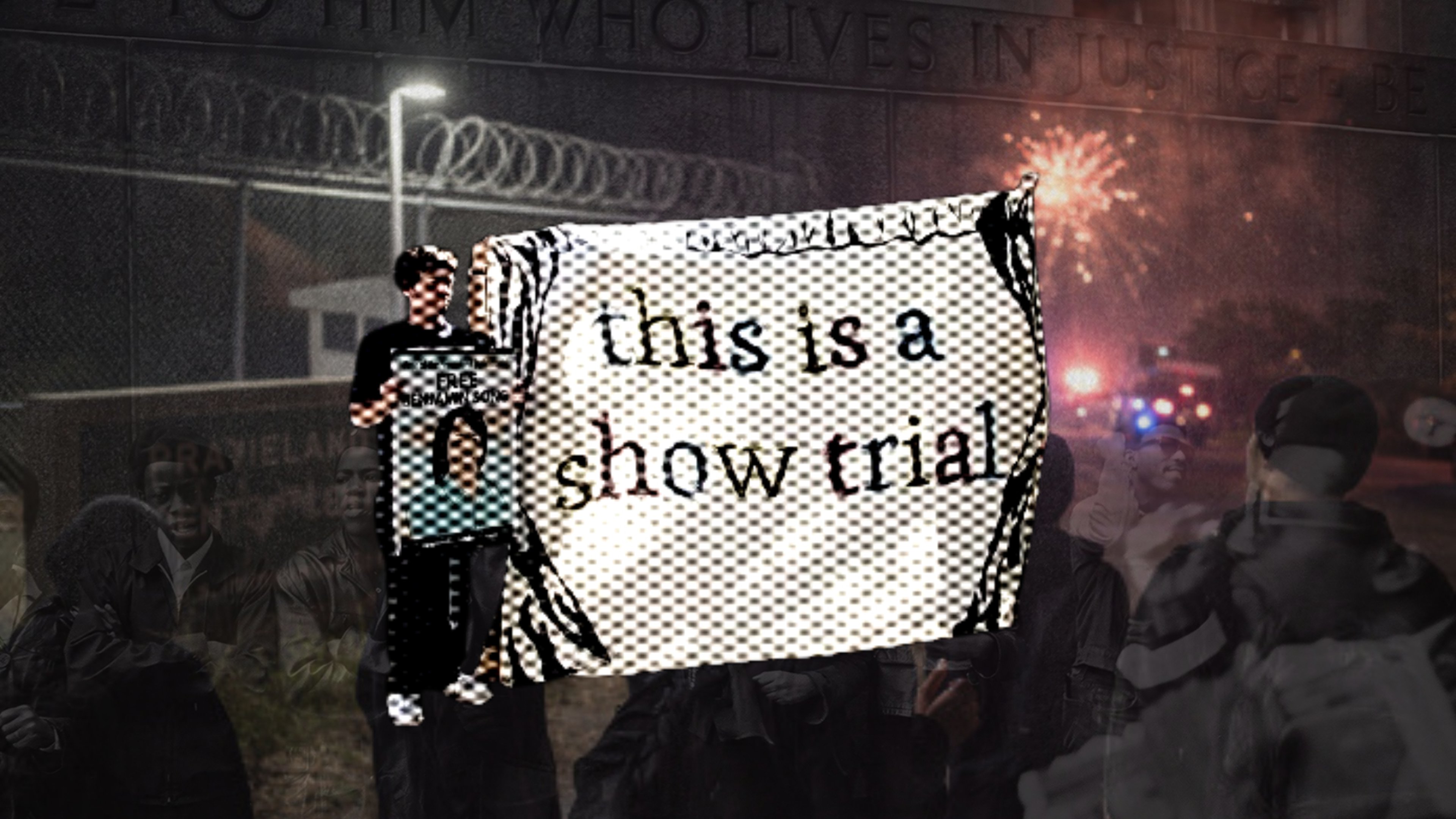
The Prairieland case has rightly sent a shock through the progressive strata of the American working class and oppressed groups. Out of the 22 people arrested and "tortured" over last year’s July 4th demonstrations, the first eight have received prison sentences of 450 years cumulatively. Benjamin Song received a sentence of 100 years for "attempted murder." Maricela Rueda was sentenced to 70 years. Autumn Hill, Savanna Batten, Zachary Evetts, Meagan Morris, and Elizabeth Soto were all sentenced to 50 years, while Daniel Rolando Sanchez-Estrada was sentenced to 30 years in prison. Importantly, as Song said, "for what?" These are prison terms longer than those of anyone involved with January 6, all of whom have been pardoned by the Trump administration and for charges such as moving zines.
An additional 20 community members are facing further possible state repression over the next few months; seven of whom have already pleaded guilty for "providing material support to terrorists." Ines Soto, who did not plead, was also sentenced to 50 years, while both Rowan Gibson and Rebecca Morgan were sentenced to 15 years in prison on July 1. The Trump administration and its far right media outlets will characterize these community members as orchestrating some mastermind "terrorist attack." The reality is this was a normal anti-ICE protest and noise demonstration that ended in police terror and attempted murder.
On July 4, 2025, in Alvarado, Texas, community members organized a protest where they would let off fireworks to agitate ICE agents stationed at the nearby detention center. Such acts of protest are constitutionally protected practices for all in the US, and, for any of us who have been active on the frontlines against ICE, noise demonstrations are a common occurrence. Some of the protest attendees allegedly broke off and sprayed graffiti, slashed some ICE car tires, and broke a camera. A police officer was called for the ‘disturbance’ and pulled his gun to murder one of the protesters. As Song described it:
When I saw Lieutenant Thomas Gross stop pursuing and point his gun at the back of a running, unarmed protester, like he testified, I was terrified. As a firearms instructor and a United States Marine Corps veteran, I understood what I was seeing. I knew what it meant for someone to lean forward into a gun, like he testified, to prepare for recoil. As the evidence shows, I did not want to hurt anyone. I never had the intent to hurt anyone. I tried my best to avoid hurting anyone. It is impossible to say that I was trying to ambush anyone or planning any violence. I was shocked, and surprised, and saddened. I am so grateful for what didn’t happen. I am so grateful that we are not here mourning another death and tragedy. Another Alex Pretti. Another Renee Good. Another Botham Jean. Another Manuel Teran. Another Atatiana Jefferson. Another Philando Castile.
This was the first trial under Trump’s new "counter-terrorism" campaign in the wake of the Charlie Kirk assassination and the implementation of NSPM-7. The new directive designated "antifa" a domestic terrorist organization, defining it as anyone who holds views such as "anti-Americanism, anti-capitalism, and anti-Christianity; support for the overthrow of the United States Government; extremism on migration, race, and gender; and hostility towards those who hold traditional American views on family, religion, and morality."
NSPM-7 is intentionally broad and vague to entrap and imprison as many people as possible who are rightfully angry at the rising fascist state violence. What are the "traditional American views" that if we are "hostile" to—whatever that means—we risk being charged as terrorists? How many organizers, activists, community members, and election campaigns use Signal or other types of encrypted messengers? What’s "extremism" on migration and race if not mass kidnapping people because they speak a different language? The very concept of attempting to criminalize anti-fascism, a nebulous concept that is only defined by being against a genocidal ideology, is just beyond comprehension. The administration doesn’t even attempt to hide behind buzzwords like "cultural Marxism" or anarchism.
Zines, wearing black clothing, and using Signal chats all became ‘evidence’ to use against people just mad at their friends, family, and neighbors being kidnapped by masked federal agents. Moving a box of pamphlets is now a crime under Trump’s America. This was not the Black Panther Party getting in shootouts with police, or militants raiding armories in solidarity with the Vietnamese, or the Deacons of Defense riding around with shotguns to protect their community against the KKK. This wasn’t the Battle of Blair Mountain and an army of rednecks fighting the state. The current administration quakes in fear at the most peaceful challenges to its authority, it brings terror to even the most minute opposition to the regime.
Prairieland and the state repression that’s becoming emblematic of this era is in a long continuum of America’s settler colonial violence. From its foundation on African slave labor and Indigenous genocide, the US is unique in its ability for fascist and reactionary violence to explode. Wars of extermination, mass deportations, and concentration camps are not a new phenomenon in US society. Neither is state repression against activists and organizers. Multiple Red Scares, Smith Act Trials, COINTELPRO, and other measures led to the imprisonment and death of many heroes of the movement.
COINTELPRO was a domestic policy from the FBI started in 1956 to initially continue the repression of the Communist Party USA, along with the Smith Act Trials. Starting in 1949, the trials targeted 144 party leaders across the country, including national figures like Gus Hall and Henry Winston. Out of the 105 convicted, fewer than half served prison time. They were cumulatively sentenced to 418 years in prison. For five years, the party leadership that remained went underground as entire leadership bodies of states like California had to organize meetings in jail. Years went by without any party conventions because the leadership was fragmented due to being underground or in prison. All of this was in the midst of the Rosenbergs being executed, the national outcry over Emmett Till’s murder, and other violence against marginalized people.
The repression of the Old Left, Jim Crow violence, and changing policy on Indigenous nations all fomented the rise of the New Left in the 60s and 70s. But the state repression that was modified through the initial Red Scare and anti-communist purges around the world, directed by the US, was redirected towards this rising political pole from Black, Indigenous, Chicano, and White youth. COINTELPRO was extended to the Black Panther Party, the American Indian Movement, the Weather Underground, and many more groups.
FBI director J. Edgar Hoover personally had a list of 28,000 people he wanted to arrest during this time. COINTELPRO targeted a disclosed 20,000 people through wiretapping, misinformation campaigns, infiltration of their organizations, and ultimately disappearances and assassinations. This was just the tip of the iceberg, too. This number doesn’t account for local and state police, DEA (which was created in 1973), and other state agencies. All arms of the state were directed inwards to deal with these revolutionaries.
Famously, sections of the New Left did "shoot back." There were organized militants orchestrating raids on US military armories to stock up for potential guerrilla warfare. There were allegedly 2,500 bombings from "left-wing radicals" between 1972 and 1973 alone. The Panthers organized arms shipments from Vietnam, Algiers, and Czechoslovakia. It was a violent era for the progressive and Left movement. Immense state repression produced a generation of freedom fighters; tragically, many became martyrs too.
In December 1969, the LAPD laid siege to the Black Panther Party headquarters in Los Angeles. They mercilessly shot up the building with over a dozen people inside, some from the Che-Lumumba club, which was for dual-carding members of CPUSA and the BPP. Twelve people were put on trial for conspiracy, attempted murder, and illegal possession of weapons. Their lawyer was Leo Branton, who famously helped defend CPUSA members in the Smith Act trials (1).
Nine of them were found guilty on the weapons charges, with the rest being acquitted. Tragically, the unified front between the Old and New Left—with its experience in court battles against state repression—was undermined due to physical in-fighting between different BPP factions even in the courtroom. The entire defense lacked mass popular organizing as there were "no demonstrations, no rallies, a weak defense committee" (2).
I. The San Rafael Uprising and Angela Davis
One of the more infamous trials and episodes of revolutionary violence during this period was the August 7, 1970, raid on the Marin courthouse in San Rafael, California, by Jonathan Jackson, brother to Black Panther Party leader and theorist George Jackson, and others. Jackson and his comrades attempted to liberate other Black revolutionaries facing trial. In the subsequent escape, Jackson, William Christmas, James McClain, and Judge Harold Haley were killed by police.
The San Rafael uprising became a lightning bolt across the country. It was immediately divisive not only among the general public but also within the Left. CPUSA chairman Henry Winston, in The Meaning of San Rafael, published in 1971, routinely dismissed the revolutionary potential of this type of armed struggle. At first, he wrote:
Today, the need to build a mass movement to free Angela Davis, Bobby Seale, Ericka Huggins, the Berrigan Brothers and Arnold Johnson—Catholic and Communist peace leaders, the Soledad Brothers, Ruchell Magee and all political prisoners is a vital starting point for speeding the formation of a great, popular movement to turn back the forces aiming to push the country into fascism…The people cannot afford the sacrifice of Black youth like Fred Hampton, Bobby Hutton, and Jonathan Jackson.
But Winston describes Jackson and the San Rafael uprising as a "futile self-sacrifice" and the Black Panther Party as "anti-Marxist, [with] adventurist policies." He immediately rejected comparisons to Nat Turner, John Brown, or other slave uprisings. However, with the CPUSA figure Angela Davis being swept up in the ordeal, this potential line was and had to be challenged. She would refer to the "San Rafael Revolt" as comparable to a "slave rebellion."
Davis was a unique political organizer and academic in the era of the New Left and was a bridge between the Old and New Left while being a prominent leader of the Black liberation movement. She was trained by Frankfurt School icon Herbert Marcuse and had family ties to the CPUSA from her childhood in Alabama. Davis was involved in the Soledad Brothers campaign too, in which George Jackson was a prominent member. In many ways, she connected a variety of segments of the Left and communist movement: a Marxist academic, Black liberation icon, connected to the New Left, and a member of the Old Left in the CPUSA.
So, Angela Davis had a unique place in the broad Left. Her time teaching at UCLA made her even more connected to what would at the time be deemed the "factional" side of the communist party on the West Coast. More tragically, UCLA and Southern California were in the middle of sectarian wars between Black liberation groups, which claimed the lives of multiple BPP members. Angela Davis was the personification of how Southern California became this epicenter bridging the Old and New Left and, more importantly, Black liberation and the communist movement.
After the San Rafael Uprising, Davis was allegedly connected to the event and supplied weapons. She would go underground, moving from safehouse to safehouse, for two months evading police and federal capture. This was not uncommon among revolutionaries of this era; for example, Carlos Montes, co-founder of the Brown Berets, went into hiding for years due to state repression.
Eventually, Davis was arrested and faced the death penalty from the US state. The decades of legal experience from both the party and its friends through the Smith Act trials and the recent BPP trials had created a strong organizational front from which to wage this counter-offensive. The CPUSA and BPP, which both had ties to Davis and Jackson, immediately started mobilizing Free Angela Davis committees throughout all local branches. They would develop 200 local committees in the US and 67 across Europe, Asia, Africa, and Latin America. The defense committees organized door-to-door canvassing for the "Free Angela Davis" campaign. Within hours of her detention, mass demonstrations were organized by the Young Workers’ Liberation League, a descendant of the Young Communist League, and within weeks mass rallies across Los Angeles. The hundreds of local committees eventually collected nearly 1 million signatures from across the world for bail.
All of this was done despite CPUSA figures taking swipes at the San Rafael uprising or Davis’ mentor Marcuse, and BPP leader Eldridge Cleaver turning on Davis and claiming CPUSA and the US state were doing the trial as a "smokescreen" to hide the Bobby Seale trial—even though both defense committees were being run together through the Che-Lumumba Club in Los Angeles, which was a club for dual members of the BPP and CPUSA. Davis was a member of that club specifically as well. Also, Seale famously worked at the CPUSA party headquarters in Los Angeles, the Red House, for the Free Angela campaign. Davis was the head of the Bobby Seale Defense Committee in Los Angeles.
Communist and party historian Herbert Aptheker was a mediator between the party and George Jackson—who was hurt by the CPUSA leadership response to San Rafael and his brother’s murder. Jackson wrote to Aptheker, "Why did Gus Hall defame my brother? Could he have simply refrained from any comment at all if he didn’t agree[?] Did support of Angela hinge upon a denial of my brother? If so, it’s alright—support Angela!! I must defend Jon tho" (3). Aptheker would assuage the elder Jackson that the party line was moving in the right direction, leadership was working with incorrect information on August 7, and that Jonathan’s San Rafael uprising was more analogous to "Nat Turner" than to adventurists.
By 1972, Leo Branton became the primary lawyer for Davis. Branton had decades of experience protecting CPUSA and BPP members from the worst sentences and, more crucially for the Davis case, successfully defended Wesley Robert Wells from the gas chamber. Branton was also famously the co-chair of the defense committee for the Rosenbergs.
Dr. Gerald Horne argues that Davis was able to win her case, while still proudly proclaiming she was a member of the Communist Party in open court, largely due to Branton and others’ legal expertise and the immense global support—something other BPP members did not have for sectarian reasons. Davis achieved support in places like the Soviet bloc, Cuba, and broader communities when some BPP members did not because the BPP was calling those countries imperialist and siding with CIA-backed groups in Angola. The lack of political unity in the face of fascist or imperial violence and repression is a significant issue then and one today. How many organizations across the broad US and global left made Prairieland a point of mobilization and organization? Which organizations were spearheading the coalition building for the defense committees? As Dr. Horne advised organizers who are looking to the past struggles and waves of repression:
[Organizers] should have an analysis…An analysis of the correlation of forces domestically—who will be our allies, who will be our antagonists? Above all, an international analysis. I hope they have been in touch with our comrades in Cuba…that they try to rally international support. That would be my only cautionary note…with regard to a replay of the 1960s and 1970s…
II. Millions must be involved
The class struggle in America went dormant for some time at the ‘end of history’ and the turn of the century, but, since the financial crash of 2007, Occupy Wall St., Black Lives Matter, Palestine solidarity efforts, and the recent anti-ICE struggle, we are seeing the reactionary, far right forces within class society lash out violently to stop the rapidly accelerating forward march of progress. There are still lessons to learn from the past struggles of the 20th century and the state repression that dominated that era. We cannot make the same mistakes as the New Left. We can’t lose each other in the struggle. Song continued in their statement:
When will you be called a domestic terrorist, too? When they killed Renee Good and Alex Pretti, they went on TV and they called them domestic terrorists, the same day, within the hour. When will that happen to you?
Donald Trump’s escalation, which can only be described as fascist, must be resisted on all levels. There need to be national coalitions formed yesterday with the resources to provide legal aid and jail support for those affected, and not just for the Prairieland defenders, but for all political prisoners and oppressed people in prisons and concentration camps. This must extend past local mutual aid. It has to be national and international in scope. One of the key lessons from the Angela Davis trial was the immense public pressure worldwide. It became an international story. We must show the world what is happening here. We have to gain international material support in our resistance movement if we hope to succeed.
With the upcoming election in 2028 and the most likely outcome of Trump or a disciple against Alexandria Ocasio-Cortez, we have to plan for the different outcomes and how we can leverage them to aid those political prisoners. If AOC becomes president, she must pardon all political prisoners affected by MAGA fascism and US oppression. If she does not, we must fight for it and demand it. If Trump can use his political capital to pardon all January 6 rioters, we can pardon everyone facing deportation and prison for fighting back. How many political prisoners are still stuck in cages from the days of the BPP? If Trump forces his way back into office, we have reached another stage of the struggle that all of these events, such as Prairieland, are pointing towards. The popular front has to be developed and ready through today’s struggles for that possible outcome of an overt fascist takeover. The lessons from past struggles are the necessity for a popular, mass-building movement linked with international support.
Prairieland is not an anomaly even today. The Minnesota 15, Centro CSO in Los Angeles, Swarthmore 9, and hundreds of Palestinian solidarity and anti-ICE organizers are facing state repression, and we need to rally around them today. The Prairieland defendants were, and still are, struggling for a better world where their neighbors don’t have to fear going to work or the grocery store. They want a world where people have housing, food, and healthcare without ever worrying about going homeless or starving. We all want that world too, and if that also makes us ‘terrorists’, then they will have to lock millions of us away, along with our comrades from Prairieland, to kill the revolution. The movement and struggle must include millions here and millions abroad if we hope to win the revolution.
Works Cited
[1] Horne, Gerald. Armed Struggle. International Publishers, p. 432.
[2] Horne, Gerald. Armed Struggle. International Publishers, p. 434.
[3] Jackson, George. Letter to Herbert Aptheker. 15 April 1971, Series 2, Box 44, Newton Foundation.