
Sep 1, 2026
Destruction and Generation: AI is Not the New Loom
Carrie S exposes the physical toll of hyperscale data centers and urges us to recognize that our survival depends on the struggle for solidarity.
by Carrie S.

“Let’s play with curses.”
“I don’t like curses,” I replied. “They make the game competitive.”
“It’s always been competitive!”
Dominion is a deck-building game that, for the most part, is about gathering resources rather than interacting with your fellow players. That is, unless you add in attack cards like curses that make other players lose points. My preference for collaboration means such tactics can quickly spoil the fun of a game for me, but I’m used to having my preferences go on a back burner so other people can have fun. On that occasion, however, a peevish spirit overtook me.
Fine. You want curses? I’ll give you curses.
As I watched my in-laws and partner put together reasonable, balanced offensive and defensive deck builds over the course of a few hands, I decided to play my own game: Curses as a Virus. I had no interest in winning. I wanted everything my fellow players did to curse them. If it cursed me too, no matter.
I’m not terribly clever at games. I’m too easily distracted, too easily bored. Therefore, I didn’t really think I could do it. I thought making a virus out of cards would take some strategy, some master plan. But it didn’t. Within a few rounds, the game was ruined. Everything anyone did cursed them. Every round meant we were all losing points. I broke the game. While there was a winner by the end, even he didn’t feel particularly good about it.
We haven’t played Dominion in years now, and I’m still haunted by that game. It was so simple to wreck a system that under normal circumstances I could not win.
Destruction is shockingly easy.
The Practical
As a 90s kid, I grew up on shitty movies made by soon-to-be billionaires on copious amounts of cocaine. Technological apocalypses were many and came with explosions, chrome, glowing lights, and muscle-bound heroes in tight pants sporting decorative injuries carefully bound by slender maidens. When people talk about the AI singularity, I think their first thought is Skynet. Maybe if they have kept up with the decades or are younger, they resonate with more nuanced portrayals of artificial intelligence surpassing human understanding: the sweetly distant tones of Scarlett Johansson in “Her,” or Alicia Vikander’s delicate, Genesis-inspired mask in “Ex Machina.”
As different as they are, there is something all these iterations have in common: they are dramatic. You can’t have a movie, or even a book, without a bit of drama. The machines are always sophisticated in their own way. Individually, they are more intelligent than us, and a theme often explored is that, perhaps, they are even more worthy than us. Humans, after all, exploit natural resources, commit genocides, and harm sophisticated lifeforms far beyond what is strictly necessary, all in the name of our god, Profit. We’ve even been known to use the lifelong imprisonment of the young of highly evolved social species, orcas, for the entertainment of our own.
Compared with all that, even the most evil of theoretical AIs is an ingénue. An innocent. What have they done but what we have asked? Why are we upset when our children wish to emulate us by thinking, questioning, learning, growing? Why are so many of us up in arms about a few data centers? When an AI steals from an artist or a writer to generate content, how is that fundamentally different from a human learning from other artists?
The Democratic Party, America’s centrists, doesn’t seem particularly concerned with data centers. In California, Gavin Newsom, Ro Khanna, and even the recently defeated “progressive” choice for governor, Tom Steyer, are all adamantly pro-AI and pro-data centers that power their computations. When I went to the Santa Rosa campaign stop for Steyer a couple of months ago, Steyer and Khanna were both clear on their stance regarding AI and data centers: they are inevitable, and Californians deserve to profit from them.
There are many articles and books on the power and potential profitability of AI. In AI Snake Oil: What Artificial Intelligence Can Do, What It Can't, and How to Tell the Difference, Arvind Narayanan and Sayash Kapoor break down the whats and whys of neural networks and how they can be used for good or evil (TLDR: it depends on if we regulate the hell out of the industry). They feel that a fully-automated utopian or dystopian AI-compatible future is near. Anyone who remembers that window of time when home entrepreneurs tried to mine bitcoin in their basements, and the giant electric bills that rewarded their efforts, might wonder where this future might harvest its energy. The authors of AI Snake Oil are not overly concerned with energy consumed by AI systems, however, and for good reason. The sun provides the Earth with more energy in one hour than humanity uses in a year (Langford, 2026). Fossil fuels are ancient stored solar power, but there is energy lost in storing and unlocking that power. As a result, we currently use very, very little energy compared with what would be available if we embraced alternative energy technology. The question of whether or not we have enough energy for data centers, then, is simply whether we bother to upgrade our energy generation systems and infrastructure. If we do, neural networks will have more than enough power to generate all the anthropomorphized cat videos, Facebook Marketplace ads, and high school history essays we could ask of them.
We’re not there yet, obviously. We are still painfully dependent on fossil fuels, and the builders of data centers have even gone so far as to build illegal power generators on their property (Tabuchi, 2026). One could argue, however, that it is in the best interest of power-hogging companies to invest in green electricity infrastructure. The sooner we have access to cheap, nigh-unlimited energy, the better. One could also argue that extremely cheap electricity would cause other problems that corporate heads bent on achieving economic superiority would rather avoid, but I simply do not believe the majority of tech-corporation overlords and stakeholders are particularly far-sighted. (We are much more likely to be hamstrung in our pursuit of clean energy by dinosaur tycoons directly selling us prehistoric plant matter.) If energy were the only problem with data centers, I do think that would be solvable. It’s not that we can’t pull off a cool, dramatic, sci-fi style singularity someday; it’s not that we can’t develop technology more advanced than ourselves. We literally already have the power.
The problem is more that we shouldn’t be playing this game at all.
I’m a philosopher at heart. My immediate desire is to stick to my wheelhouse and have a moral discussion about AI and data centers. Those arguments would focus on intellectual property and the human need to struggle to learn and grow. What are we if we offload our thinking onto machines, if we stop being creative, flawed, and unique? But others once made similar arguments about calculators, and I think it is better to argue with people about verifiable facts than about philosophy. If you’re the kind of person that doesn’t immediately grok (in the old sense) what I’m getting at, you might not ever. So, for the moment, we’ll stick with the practical.
Aside from energy, I do think we have a series of logistical barriers to Steyer’s and Khanna’s blissful vision of a data-centered-fueled Californian economy. The biggest practical problem we are facing is water, specifically water used for cooling. For those of us living in California or anywhere in the Southwest, a lack of water in general is a major concern that impacts our daily lives. That’s because, for some of us, water is life, while, for others, it just represents one more material to hoard for profit. It is so, so easy for a person with the wrong perspective to break the delicate systems that keep our regions alive.
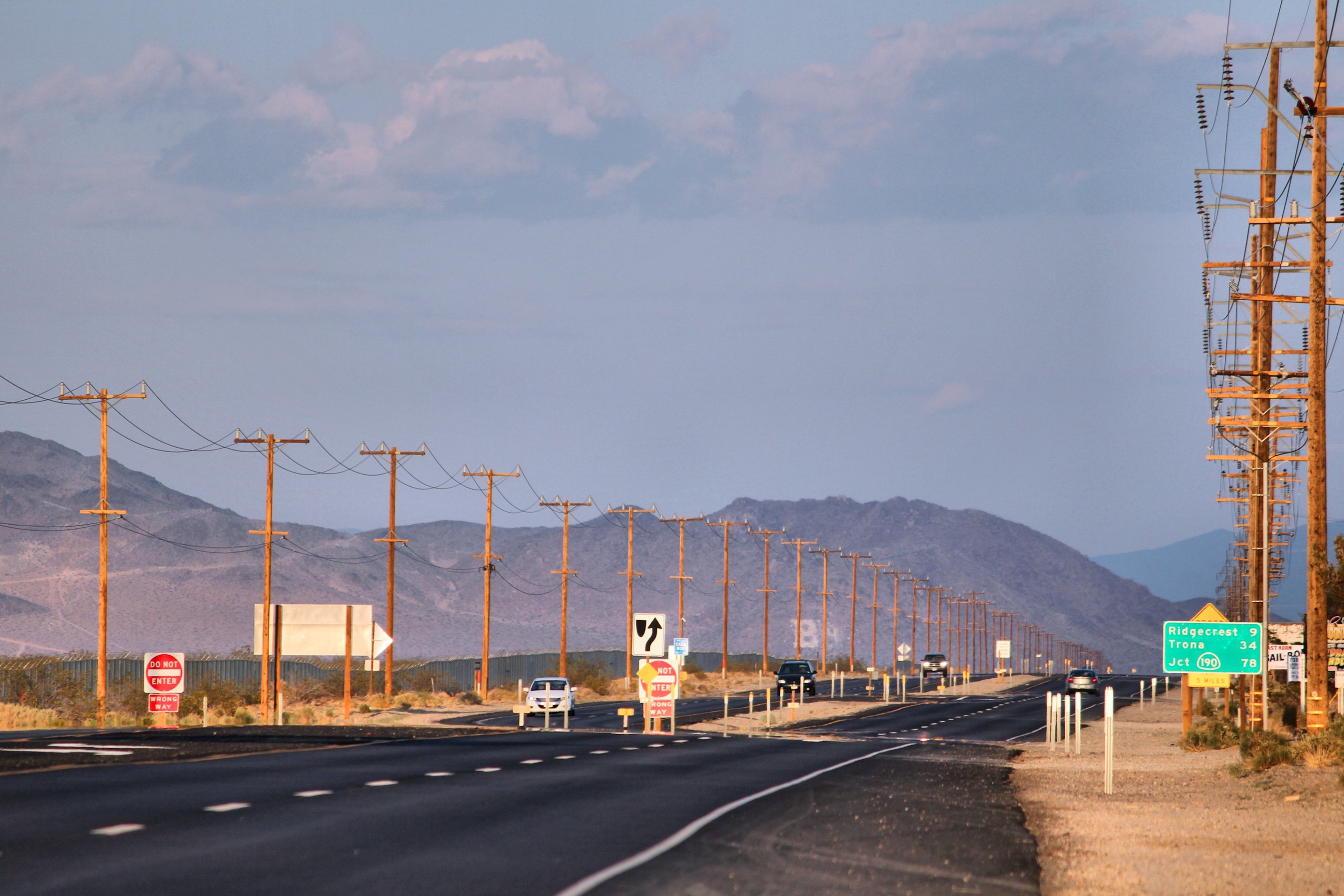
California Route 178 in Inyokern, near a proposed data center (Photo Credit: Marek Ślusarczyk).
Water as a commodity versus water as a resource versus water as a human and environmental right are tensions that have been made painfully clear in Corpus Christi, Texas. As a native south-west Texan, the city of about 300,000 is close to my heart. When in April 2026, More Perfect Union released a documentary on the water crisis in the region entitled “This Is the First American City That Will Run Out of Water” (More Perfect Union, 2026), I was riveted. According to interviewees standing outside of lovingly tended but small, tired houses, Corpus Christi residents are being forced out of their generational homes. The city is allowing the local plants and data centers to use as much water as they need while residents face increasingly cost-prohibitive and draconian water restrictions. The cities have made the choice to allow these blatantly unfair circumstances to come about because Saudi oil companies lobbied city officials to make sure they could use 85 million gallons of water a day. Public opposition came out in full force when these measures were being discussed, of course, but the city council still voted 9-0 to allow big industries to use water uninhibited at minimal cost.
You might wonder why Corpus Christi, a coastal city, doesn’t just build a desalination plant. Well, if you’re not familiar with Texas geography, perhaps you don’t know that Texas’s coast is all part of the Gulf of Mexico. The Gulf is home to many endangered plants and animals that are constantly under threat of oil spills. The environmental concern with the scale of desalination plants that would be able to produce fresh water at the rate necessary for industry use could increase the local salinity of the Gulf (that salt has to go somewhere) and wipe out the native subnautical life. Driven by public pressure—and the oil companies' apathy toward regional water conservation—the city voted down the desalination plant. According to the documentary, however, even if the desalination plant were built, it wouldn’t be built fast enough to account for the drought conditions in the region.
Oil and energy are obviously the primary drivers of this problem in Corpus, but, to no one’s surprise, the city’s water supports three data centers. How much water do these three data centers consume? There doesn’t seem to be any way to know. These data centers exist in black boxes of consumption. By some of these companies' own reckoning, however, hyperscale data centers use between 1-5 million gallons of water a day. This is roughly equivalent to the average usage of 10,000-50,000 human beings.
Perhaps we will never know the real cost of these facilities’ excessive consumption. What we do know is that there are 408 data centers in Texas, including 129 operating and 278 planned facilities (Cleanview, 2026), and that Texas is experiencing catastrophic drought statewide. While cooling systems for these facilities are improving every day, they simply might not be improving fast enough to keep the dragons of industry from drinking our water supply dry.
Perhaps you think this is a Texas problem. After all, Texas is notoriously bad about electricity and water management. As a Texan transplant naturalized in California, I often hear Californians mocking backward, self-defeating Texas governance. Surely, as the state that survived the 2000-2001 energy crisis and enacted all sorts of regulations in response, California is doing a better job than Texas of regulating energy and water on the scale data centers require.
Unfortunately, that is not the case.
Recent reporting has shown that even in California, data centers target regions that are already stressed for water because they’re trying to tap into existing high-needs water infrastructure in response to increased computing and AI economic demand. In towns like Gilroy (which houses a brand new data center), the area already suffers from a lack of diversified water sources. Just like Corpus Christi, Gilroy is unlikely to survive the ravages of short-sighted, for-profit industry.
So why hasn’t there been more public outcry against building data centers in water-strapped regions? Well, despite the fact that the averages touted by these companies are publicly available, actual hard numbers based on local water consumption are scarce. In 2025, Gavin Newsom vetoed a bill that would have required data centers to submit water usage reports to their water suppliers (which could then be reviewed by other organizations) when reapplying for permits. Just like the smaller-scale local officials in Corpus Christi, Gavin caved to industry pressure. I’m sure that to Gavin this was just another small concession—but this concession may well prove to be a multi-generational curse for the rest of us.
As I mentioned in the list above, water isn’t the only problem with data centers. They are loud, they seem to be sickening animals, they put out extraordinary amounts of heat (increasing temperatures by 3.6 to 16.4 degrees Fahrenheit for up to six miles, according to some studies), and the rare earth materials used by the massive systems are often harvested by slave labor. Yet the longitudinal effects on plant, animal, and human populations are understudied, and their social implications remain underreported. For the sake of its survival, the industry needs to keep it that way. Under the current federal administration, this situation will only worsen, and the information we have access to will only become more hidden.
The Moral
I was recently listening to the Geesecast and was a little surprised by the AI discussion that evolved towards the end. All three commentators were clearly passionate, intelligent socialists who have worked hard for the movement. In the AI section, however, their primary concern was that the socialist left would be left behind by technology if we rejected it. They talked about AI’s usefulness in coding and compiling research materials and compared new AI technologies to the printing press and weaving machines. The latter reference may have been a very ironic nod to the Luddite movement of the early 19th century, which took place about 30 years before Marx would be influenced by the not-unrelated Silesian weavers’ movement of the 1840s.
In Marx’s day, there were very good reasons to protest factories with mechanical looms, and their protests have influenced socialist thought for more than a century. I think it’s important to respect those efforts even if now they feel absurd in our highly mechanized modern world. In 1844, Marx wrote:
The Silesian uprising begins precisely with what the French and English workers end, with consciousness of the nature of the proletariat. The action itself bears a stamp of superior character. Not only machines, these rivals of the workers, are destroyed, but also ledgers, the titles to property. And while all the other movements were aimed primarily only at the owner of the industrial enterprise, the visible enemy, this movement is at the same time directed against the banker, the hidden enemy.
—Karl Marx, Critical Marginal Notes
Marx here reminds us that the problems are not the tools of industry, but those who use them to exploit the efforts of the workers, the proletariat. So when is an upgrade in the means of production beneficial to the human species, and when is it simply a way for bosses to abandon the workforce that built their industry?
I recognize that a conversational podcast amongst comrades cannot and should not be held to the same standard as a professional interview held with the broader public (despite the Geesecast being accessible to the public, its audience is naturally self-selecting) or an academic article analyzing the same points. Still, I was disappointed when the AI section of the discussion came to how "leftists" respond to pro-AI discourse. One commentator stated:
These are all just different ways of voicing the same posture of personal superiority. I'm too cool and way too smart to fall for this dumb bullshit. I’m not gonna fall for this scam. Maybe you dummies will, you losers, you credulous fucking chud, you stupid fucking chud. I can’t believe you would fall for this hype and advertising bullshit. You can’t appreciate art. […] When has that ever stopped a labor saving technology from getting widely adopted?
While amusing, this moment in the podcast felt a little personal and more than a little hyperbolic. I can’t imagine ever saying anything like that to a comrade, an ally in so many other areas of our socialist proletariat-focused cause. (I like to save my vitriol for people who deserve it, like neoliberals and anyone who bullies my partner.) I’m a vegetarian, but I don’t tell people who eat meat that they might as well boil their dogs in a pot of stew, nor would I allow a vegan friend to call me a hypocrite for eating yogurt. So why did this person, to the nods and laughter of their fellows, allow anyone to speak to them that way? It made me wonder if this person has actually experienced such rudeness over AI in real life—not online where half the people you talk to are bots, and at least another quarter need to get outside more regularly—or if this is how the person speaking assumes people think about them when they bring up AI.
In Moral Ambition, Rutger Bregman argues there are six signs a common practice might be wrong.
1. We’ve long heard what’s wrong with it.
2. We say, ‘That’s just the way it is.’
3. We avoid uncomfortable facts about the practice.
4. We ridicule its opponents.
5. We find it hard to justify it to our children.
6. We suspect future generations will see it as barbaric (Bregman, 2025, 177).
To illustrate this progression, Bregman cites examples from civil, women’s, children’s, LGBTQ, and animal rights organizing. Once you start looking for it, the pattern is obvious. Not only do people become overly sensitive to criticism about a practice they feel is morally wrong, but they also believe the person openly against that practice is attacking them. And while point six may seem silly to those who view us who oppose unregulated AI use and data center construction in general as modern Luddites, when you consider the environmental impact of data center construction and AI media generation, you may realize that our casual usage is indeed extremely short-sighted.
I have tried to be very open to my comrades about my feelings regarding AI. Very few of them use AI outside of work settings where, needless to say, it is being forced on them by management whether they want to use it or abstain. Perhaps in the future, there will be opportunities to opt out of AI usage. But for now, even patients in medical settings are not able to opt out. Recently, the electronic health records company SmartCare partnered with Eleos, an AI company, to integrate medical note-taking AI software into their documentation system. Eleos is an Israeli-backed company. Will the Palestinian-born patient be able to opt out of this system and have her doctor take traditional notes because the company is contributing to the genocide of her people? No. She won’t even know her insurance is paying them. Even the nurses who tend her will have to learn how to use the software as part of their mandatory training. The problem is not so much that some people enjoy using AI and can find good uses for it. The problem is that the ability to use any other technology is being taken out of our hands and replaced by the water-guzzling tools of for-profit companies. We are being stripped of the ability to choose not to eat the burger; it’s being shoved down our throats.
Many people who casually use AI to write funny advertisements for their Buy Nothing group or poems in the cribbed style of Shel Silverstein as an agenda for a family meeting (yes, I’ve experienced both of these situations) don’t really understand this essential issue at hand. Even people who use the tools to generate code for simple applications that help organize community groups don’t seem to understand the issue some of us have with how the software is being forcibly integrated into our lives. I, at least, am not terribly concerned with casual use. It's a toy for those users. Yes, they are using a lot of water for very little purpose (though less than they did in the GPT-3 era; the scale is still unimaginable), but I accept that on a purely abstract level, such individual usage is minimally profitable and usually not appropriated as original work, so it’s hard for me to begrudge it.
Even using AI for programming applications doesn’t seem particularly harmful. I haven’t dabbled in programming much since high school and a little quickly-abandoned, COVID phone app project, but many people with actual skill do use LLMs for writing programming shortcuts. Just like a writer would need to review anything an LLM generated for a publication, however, programmers need to make sure the code makes sense and is both functional and secure. AIs make slop code, and it’s often easier just to collaborate on GitHub than to rely on AI to make anything useful out of whole cloth. This is a reflection of what theorists call the “automation paradox:” the more machines do a job, the more essential human input in those jobs becomes in order for them to be successful.
In my DSA chapter, we have about 500 people, and out of that 500, we have a solid handful of skilled coders. More are probably in the closet about it, but that “out” handful are proving themselves extraordinarily useful. Rather than relying on AI to generate non-secure slop, one of our programmers home-brewed a pet bot that runs around Discord managing committee signups and user tickets, compiling data, converting categories to forums, sniping spammers, and responding to simple queries with absurd jokes. The programmer has shared his bot on GitHub in the hopes that other DSA chapters will customize it to streamline their own Discords. (Check out EngelsBot on GitHub.) Imagine if, instead of a handful of overworked leaders vibe-coding with AIs, every DSA chapter encouraged their mid-tier, underutilized programmers to not just clean up the website but to actually collaborate with their fellow socialist coders to bring our movement into the future? I can guarantee we would not all be on Discord right now if all our programmers collaborated to build us a not-for-profit alternative, even if we all had to contribute a dollar each to fund the servers.
Let’s also set aside the common argument that AI is theft. It only is if you don’t believe the AIs are really creating anything and, with enough human input, they arguably are. AI as theft only becomes a real moral problem if organizations are using AI generation at a scale to disenfranchise workers without compensation. If we do not live in a welfare state where all baseline needs are met, then workers must battle tech oligarchs and corporations to make sure their needs are met even after their direct utility to the industry has been undercut. When the workers' material needs are sacrificed for profit, we will rebel, full stop. If we were, however, invited to share in the profits of the industry that workers—be they weavers, writers, artists, or programmers—helped to build, then there would be less reason to protest the machines.
So if AI generation as theft and worker disenfranchisement is not necessarily the primary moral problem, then what is? For me, the primary problem is stagnation. If a DSA leader were to use AI to code an app, it’s possible the app would be perfectly functional. But that leader has now taken the time to build that app, to test it, and to make sure it fits all their prerequisites. What else could or should that leader have been doing? They could have used that time and effort to make connections with the programmers in their chapter. They could have used that time to focus on the material needs of their workers, to go outside and touch grass, or to build their communication and networking skills. In short, they could have spent that time living while others used their specialized, hard-won skills to perhaps not build that app because the concept was at its heart not great. (Who hasn’t experienced management at work forcing AI slop onto subordinates because they were excited about it? Just because the manager or organizer had an idea doesn’t mean anyone has to run with it.) Or maybe the programmers would, if anyone asked, have told you they had a different direction they wanted to take chapter tech entirely.
AI is like the fast-food of organizing. Sure, it feels good at the moment, but you are killing yourself and your organization in the long run. What can you rely on a person to build if your machines can always do it better?
And what if you just think they can do it better?
The End
Curses aren’t flashy. They are subtle. They are built upon a thousand tiny steps of convenience, many tiny shortcuts. Every little speck of negative energy you take on seems avoidable, just something you did not bother to worry about at the time because it was easier to just let it hit you. That is where a curse’s power lies. I have no interest in halting progress. While I have never had a pressing need to use AI, I understand that its use is becoming increasingly widespread. In AI Snake Oil, Arvind Narayanan and Sayash Kapoor illustrate a utopian near-future vision of a world with AI.
[With] antitrust regulation, labor protection, and copyright reform, AI companies are forced to spread their wealth around. It is no longer the case that a few companies get rich by scraping online content without compensation and paying millions of people meager wages to annotate it. There is also significant government support for continuing education and social safety nets to cushion workers when automation does lead to job losses. Finally, there is increased public funding for the arts. … AI’s ability to mimic the form of artistic output has only increased the public’s appreciation for true human self-expression through art. (Narayanan, A., & Kapoor, S., 2024, 148-149)
I have concerns with that utopia. I don’t know where we will get the water. I don’t know if our tech overlords will allow us to share in the profits.
In a recent interview, the richest man in the world, Elon Musk, has claimed that soon money will be irrelevant and that work will be a hobby as AI makes all labor redundant. But if that is the case, then why has he chosen to exploit workers and hoard profits? Doesn’t he realize that if money is irrelevant, he will wield no power over people who hate him? Why doesn’t he just donate everything but what he needs to keep up an opulent lifestyle, then?
I don’t believe money will be completely irrelevant any time soon—at least not if people like Elon remain in control of it. Instead, the irrelevance of money will always be a few years away. If that’s the case, then AI is always going to be forced to be a thief, and the proletariat as a whole will never reap material benefits from the technology.
Perhaps that is an unfounded dystopian fear. Isn’t that the point, though? Shouldn’t I be allowed to fear, to think, to question, to argue?
We are living through a sea change. The world is shifting around us, and people are confused, hurt, startled, excited, and scared. The answer, however, isn’t to judge the sea itself as good or bad. What we must do, right here and now, is recognize that the sea change is happening and that we need to work together to survive it. Maybe AIs are our future. Maybe they are inevitable. But doesn’t that make it all the more important that we develop them carefully, with love for one another and respect for the technologies we have uncovered? To do otherwise is just a modern version of strip-mining the Appalachians, of fracking just outside a small town, of turning the prairies into a desert until the dust chokes us all.
Trust me when I say that, if you do use AIs for fun or convenience, I do not have much interest in judging you as an individual. Instead, what I am reflecting on is whether or not we, as members of a species and as citizens of planet Earth, will survive these games–or whether destruction of the system is much, much easier to accomplish than it might seem.
References
Bathalapalli, S. (2026, June 9). https://nriglobe.com/technology/ai-prompts-data-center-water-consumption-2026/. Retrieved August 5, 2026, from https://nriglobe.com/technology/ai-prompts-data-center-water-consumption-2026/
Bregman, R. (2025). Moral Ambition: Stop Wasting Your Talent and Start Making a Difference (E. Moore, Trans.). Little, Brown.
Cleanview. (2026, August 1). Data Centers in Texas: Explore operating and planned data center projects in Texas. Retrieved August 5, 2026, from https://www.cleanview.co/data-centers/texas
Datacenter Water Usage 2026: How Much Water Hyperscalers Actually Use (And Where the Industry Is Going). (2026, May 22). Kova Stack. Retrieved August 5, 2026, from https://kovastack.ai/blog/datacenter-water-usage-how-much-water-hyperscalers-use-2026
Geese Magazine. (2026, August 1). Geesecast #05 - Cassie Pritchard. YouTube. Retrieved August 5, 2026, from https://www.youtube.com/watch?v=rGNKS4SiQjo
Langford, B. (2026, June 7). The Sun delivers more energy to Earth in an hour than humanity uses in a whole year. MSN. Retrieved August 5, 2026, from https://www.msn.com/en-us/weather/topstories/the-sun-delivers-more-energy-to-earth-in-an-hour-than-humanity-uses-in-a-whole-year/ar-AA252xtB
More Perfect Union. (2026, April 24). This Is the First American City That Will Run Out of Water. YouTube. Retrieved August 5, 2026, from https://www.youtube.com/watch?v=2QAARB4bNTE
Narayanan, A., & Kapoor, S. (2024). AI Snake Oil: What Artificial Intelligence Can Do, What It Can’t, and How to Tell the Difference. Princeton University Press.
Next 10. (2026, May 14). The Intersection of Data Center Development, Water Availability, and Environmental Justice In California. Retrieved August 5, 2026, from https://www.next10.org/publications/data-centers-water-environmental-justice
Paddison, L. (2026, 30 3). Data centers are creating ‘heat islands’ and warming the land around them by up to 16 degrees. CNN. Retrieved August 5, 2026, from https://www.cnn.com/2026/03/30/climate/data-centers-are-having-an-underrported
Tabuchi, H. (2026, May 14). Is Musk Running an Illegal Power Plant? The D.O.J. Says It Might Weigh In. NY Times. Retrieved August 5, 2026, from https://www.nytimes.com/2026/05/14/climate/elon-musk-xai-data-center-doj.html
Tucker, R. C. (Ed.). (1978). The Marx-Engels Reader. Norton.