
Feb 27, 2026
DSA Should Re-open the Vote to Endorse Chi Ossé
Primarying Jeffries Represents an Existential Struggle
by J. Ryder
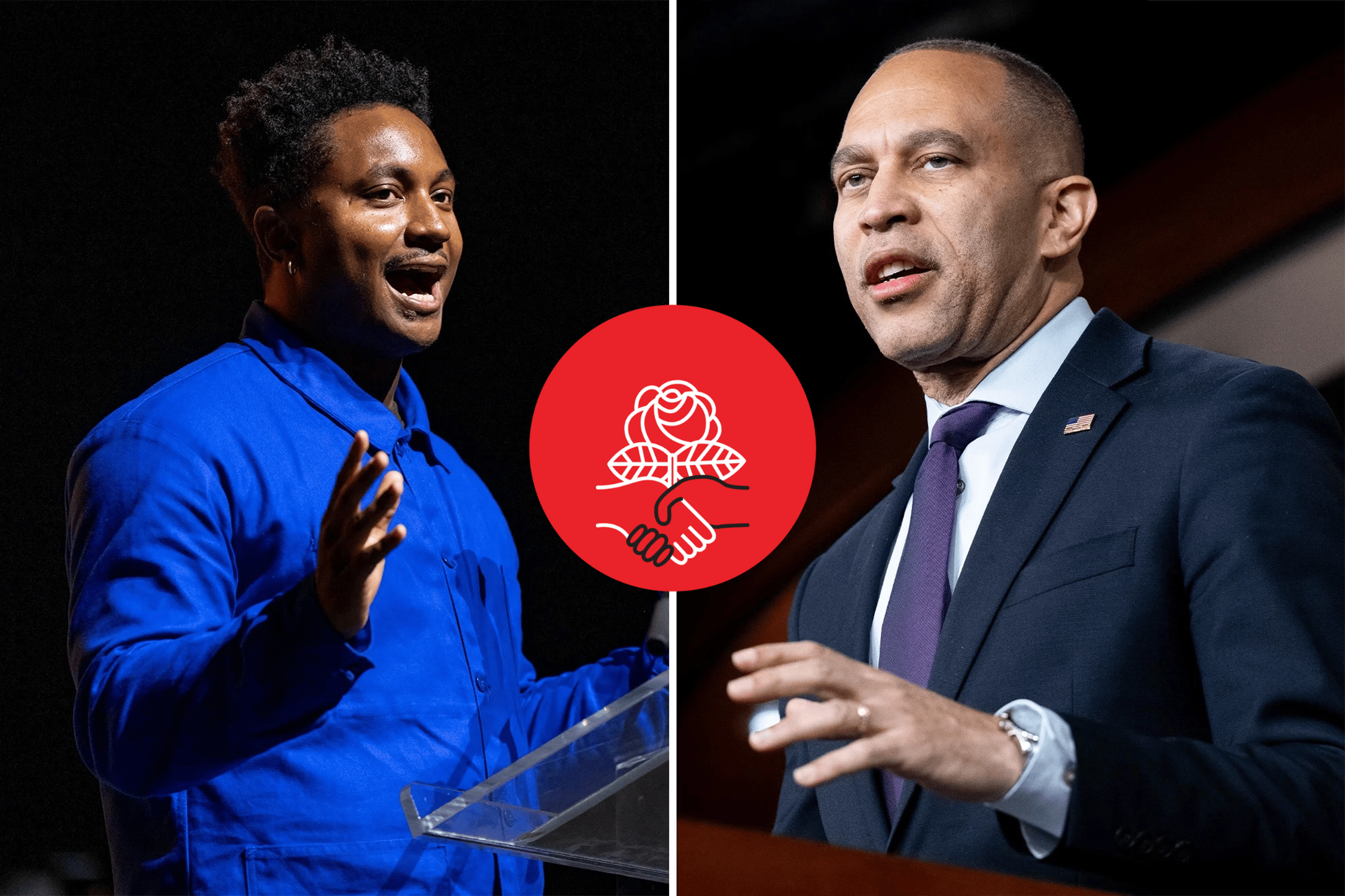
New York City Councilman Chi Ossé (left) challenged the seat of Democratic House Minority Leader Hakeem Jeffries (right) for his congressional seat, dropping out after DSA voted not to endorse him
“Silent defiance.”
- Hakeem Jeffries’ response strategy to Donald Trump’s State of the Union
In November of last year, New York City Councilman and DSA Member Chi Ossé launched a bid to primary Democratic House Minority Leader Hakeem Jeffries for his seat as the representative for New York’s 8th congressional district. But when he failed to acquire the endorsement of recently elected New York City Mayor Zohran Mamdani, with Zohran even explicitly instructing the DSA to do the same, the DSA followed suit and chose not to endorse Ossé. Consequently, as a show of good faith to DSA and with the belief that his run would be reliant on their political power and organizing machinery, Ossé decided to drop out.
What here seems like a rather nondescript narrative of an organization following the lead of its most prominent elected actually entails something far more detrimental to DSA’s existential goals. There are moments when an organization is confronted with a choice that will define its purpose; the question of whether DSA should reopen the vote to endorse Ossé in a primary challenge to Jeffries is one of those moments. If DSA refuses to reconsider, it will not merely be declining a tactical opportunity; it will be indicative of a concession of its position as the emblematic fighter for socialism against the neoliberal Democratic establishment.
Hakeem Jeffries represents the leadership of a specific orientation within the Democratic Party: disciplined message control, donor-aligned incrementalism, and a theory of governance that treats insurgent energy as a resource to be managed and sequestered rather than a force to be empowered. A primary challenge to him would not simply be a symbolic gesture, it would be a confrontation with the traditional Democratic mode of politics in a period where it is facing intense crises of external legitimacy and internal confidence.
Just this week, Jeffries came under fire for his purported gameplan for Trump’s State of the Union address: the farcical idea of “silent defiance”, a strategy being multilaterally lambasted, even by the same liberals that constitute Jeffries’ base. Instead of allowing these establishment politicians to operate without challenge, we have to give shape to the frustration and force a choice within the Democratic party electorate between the continuation of a technocratic managerialism that hides from radical change and decisive action or a structural realignment towards a confrontational and fundamentally pro-people left.
Regardless of the result of such a challenge, contesting Jeffries’ power would make him vulnerable and therefore more accountable to a shifting Democratic base, a necessary dynamic to develop if we are to create a non-superficial left-opposition to the fascism of the Trump White House. Even more importantly, it would threaten the faction of Democratic politics that is and has continued to hold it back for decades. Some representatives of that section, like New York governor Kathy Hochul, are likely to adjust their own positions and compromise with the left when they see the writing on the wall. Those who refuse such an adjustment will be isolated and increasingly vulnerable to further primary challenges.
A challenge to Jeffries, in other words, is a challenge to the entire establishment Democratic Party leadership. For DSA to decline this confrontation and its implications preemptively, on the grounds that it complicates internal relationships for Zohran, is to narrow the field of struggle in advance. It means abandoning the responsibility of articulating the position of socialism in a time where the moderate and right-wing of the Democratic Party are attempting to discredit the left’s credibility for political leadership. When the Democratic Party asks Spanberger to host the Democratic State of the Union, for example, they are actually struggling to win legitimacy for the moderates against the threat of the left. To cede the struggle here is to let them win it.
DSA was not built to be a support group, it was built to contest power. It was constituted to be a vehicle for recomposition within, against, and beyond the Democratic Party. This involves identifying sources of tension within the existing political formation and pushing them to their breaking point; it means understanding that the terrain of the Democratic Party is contested ground. This understanding is not foreign to the organization, it is often at the forefront of its agenda when fighting for power.
Take Zohran’s election itself, for example; after Zohran's victory, DSA's membership exploded and found their entire organizational apparatus rejuvenated. Why? Because the organization effectively represented the national struggle against hegemonic neoliberalism, contesting the battleground that is the Democratic Party’s antagonistically big tent (read more on DSA membership growth analysis here). Now that Zohran has been elected, however, his struggles for stability and influence within the Democratic Party have clouded the previously audacious and resolute conviction of the DSA to continue using electoral struggle as a means to continuously push mass politics leftward. This strategy,which defines the DSA and lends it an existential purpose in its struggle for challenging neoliberal hegemony, has suddenly collapsed on itself, subordinating itself to the will of its most prominent electeds.
Zohran is, at present, the DSA’s most prominent, visible, and influential elected. His victory has revitalized the organization and its membership, embodying the leadership to look to for guidance in such an otherwise harsh political climate.The clarity his election has given as a socialist in office under the banner of the DSA has lended the organization a moment of coherence at a time when their identity has been in recurrent dispute and crisis. It is precisely because of this dynamic that the problem here presents itself: when Zohran signals caution, large swaths of the organization interpret that signal as instruction for its own strategy.
This is not some moral failing, it is a purely political one. It's through this lens that Zohran’s refusal to endorse Ossé can be properly understood. Jeffries is not merely another incumbent; he represents the managerial apex of House Democratic power. For a Mayor’s office whose political landscape has federal ramifications like Zohran’s, maintaining a non-antagonistic relationship with the House Minority Leader is rational. For Zohran, access matters; viability matters; coalitions matter. We can understand the reasoning without necessarily following suit, because what is rational for an individual officeholder is not necessarily rational for a socialist political formation. The incentives of the former bend toward preservation of its working relationships; the mandate of the latter is to expand and rupture the limits of those relationships.
Without the aggressive electoral posture the DSA has taken, there is no Zohran to begin with. If the continuance of this approach in other elections leads to awkwardness for Zohran while in office, the DSA must be willing to not only understand but embrace that kind of institutional leverage (maybe even using it to gain more of a political tether over its electeds). Where an elected calculates mobility within the institutional hierarchy, an organization committed to socialist politics must ask whether that is in line with its own agenda, and act accordingly. The deeper issue here is made clear in that the DSA is mistaking Zohran’s personal political calculus for its own strategic horizon.
There is an emerging model of left-populism in which insurgent rhetoric and movement energy serve as the launching pad for institutional integration, after which the overriding priority becomes maintaining maneuverability within the Democratic Party apparatus. Zohran, much like Obama, has ridden into power under the banner of left-populism just to find that all that exists for him to do is to maneuver through the maze of the Democratic machine and use the acquired influence to attempt a ‘deliverist’ agenda that minimizes political conflict in favor of technocratic promises for better state management. This is less a fault of his own and more the fault of a socialist movement that has hitherto failed to establish a political pole with a sufficiently organized and coherent base that could reward him for being more intransigent in his relationship with the Democrats; herein lies the potential of agency for the DSA and the left as a whole going forward.
If the DSA internalizes the proposition that contesting the Democratic leadership is off-limits whenever it threatens access for its electeds at the top, then their ‘inside strategy’ ceases to be a strategy of tension and becomes a strategy of accommodation. The danger here is not necessarily that Zohran seeks influence, but that the DSA quietly redefines its purpose around preserving his pathway to it while simultaneously erasing the approach that leads to the creation of new Zohran’s being able to gain influence in the first place. An organization that calibrates its interventions according to whether they complicate the mobility of its most prominent electeds risks becoming an appendage to that trajectory rather than towards the creation of the independent political pole necessary to win power.
DSA’s historical intervention has never been to protect access for electeds, it has been to widen antagonisms and subsequently take agency in constructing the resultant landscape. Democratic Party primaries are one of the few institutional sites in American politics where leadership can be made accountable to our base rather than insulated from it. If the organization cannot endorse an insurgent against the most powerful Democrat in the House, then its claim to be contesting power within the party rings hollow.
What emerges instead is a subtle yet significant transformation of function within the DSA. The organization becomes a message amplifier and political relations firm for its most successful electeds. Debate orients around what preserves their viability, risk is evaluated in terms of their exposure, and political strategy becomes derivative. In this vein, reopening the vote to endorse Ossé isn’t about spectacle or factional score-settling; it is about reasserting that DSA’s strategic line is determined by collective political analysis rather than by proximity to institutional authority.
If the ‘inside strategy’ for socialism within the Democratic Party is to retain substantive meaning, it must entail periodic rupture and visible willingness to contest concentrated power, even when doing so carries risk. Without the element of rupture, the organization finds itself magnetized by the more powerful pole possessed by the Democratic machine. The DSA should reopen the vote to endorse Chi Ossé, or concede that its organization’s agenda has contracted to the mere maintenance of its proximity to power rather than its own wielding of it.