
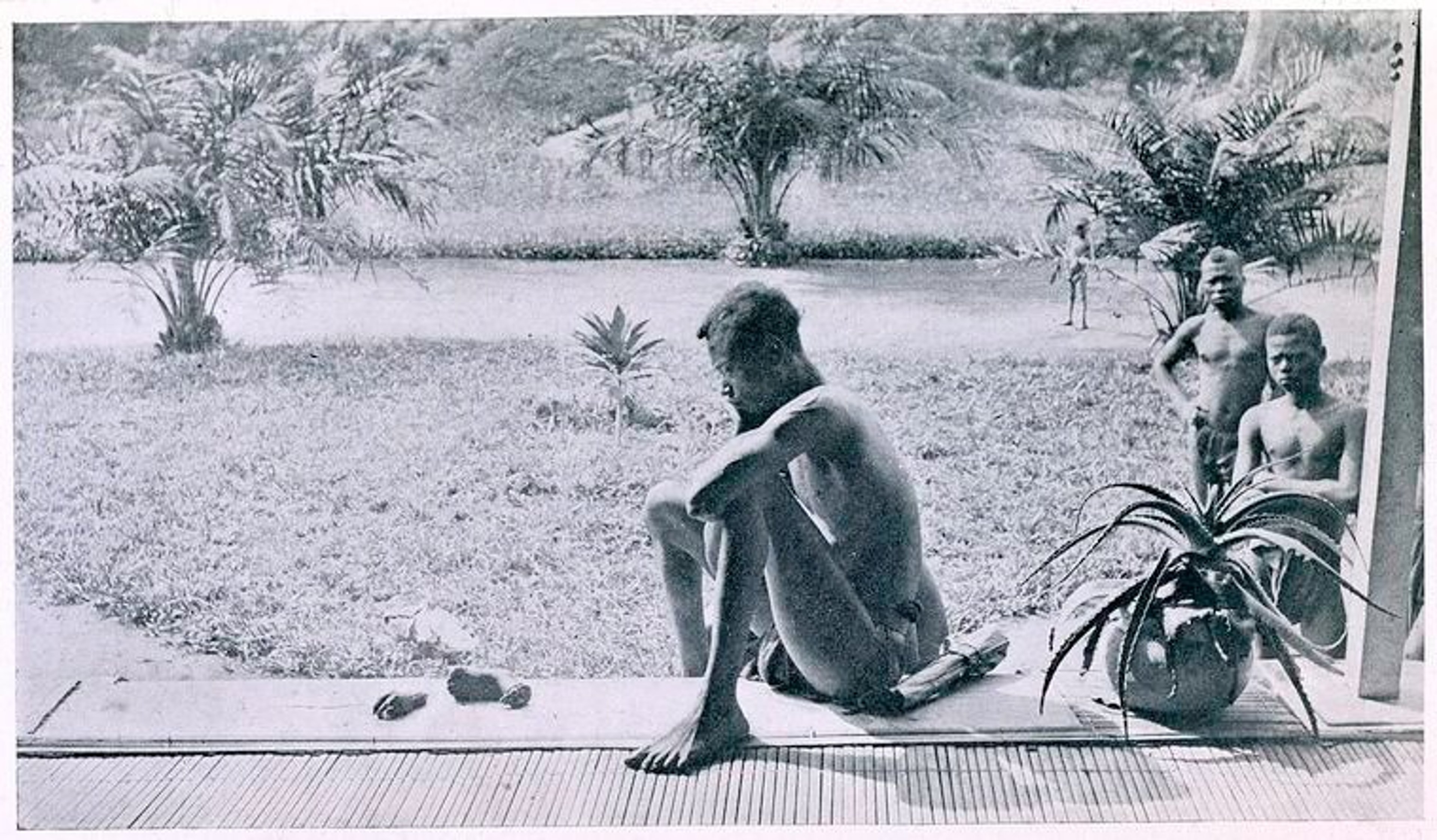
Credit: Alice Seeley Harris / John Hobbis Harris
Content Warning: This article contains the historic use of racial slurs that some readers may find distressing.
According to a report released after the highly controversial police beating of Rodney King, the judicial system of Los Angeles would use the acronym N.H.I.—literally, “no humans involved'“—whenever there was a “case involving a breach of the rights of young black males who belong to a jobless category of inner city ghettoes.”
In a letter titled "No Humans Involved: An Open Letter to My Colleagues," published in 1994, Sylvia Wynter presents a critique of Western humanism by analyzing the acronym N.H.I., which stands for "No Humans Involved." (Wynter, 1994, 42) The use of N.H.I. reflects Wynter’s general critique of the Western “order of knowledge” that fundamentally contextualizes and produces this acronym.
Through the construction and reconstruction of prevailing historical narratives, knowledge of ‘humanness’ in the Western world operates against an explicitly bourgeois conception of man. This conception produces a racialized category that dehumanizes the subjects it deems non-human, and this is reflected in N.H.I. It is this same order of knowledge that structures the Western image of the current human rights conflict in the Democratic Republic of Congo. Under Wynter’s philosophical framework, no humans are involved in the genocide in the Congo.
Sylvia Wynter’s central concern is the Western conception of Humanism, specifically the “meaning of non-being” that the concept of “Man” imposes on Blackness. (Wynter, 2006, 1) She conceives ‘humanism’ as an intellectual rupture centered around a constantly-changing vision of man:
“Both forms of “sanitization” would, however, function in the same manner as the lawlike effects [...] and institutional re-elaboration of the central overrepresentation, which enables the interests, reality, and well-being of the empirical human world to continue to be imperatively subordinated to those of the now globally hegemonic ethnoclass world of “Man.” This, in the sameway as in an earlier epoch and before what Howard Winant identifies as the “immense historical rupture” of the “Big Bang” processes that were to lead to a contemporary modernity defined by the “rise of the West” and the “subjugation of the rest of us” (Winant 1994)—before, therefore, the secularizing intellectual revolution of Renaissance humanism…”
“One thing … is certain: man is neither the oldest nor the most constant problem that has been posed for human knowledge … the figure of man … was the effect of a change in the fundamental arrangements of knowledge.”
This translates into an idealized version of humanity that she argues effectively classifies all of humanity. This ideal is born out of and tethered to a specific historical stage. It divides people into two categories: “ethnoclass man” and “Human”. The former category is relegated to a specific “genre” of human, while the latter is “overrepresented” as the universal image against which the ethnoclass man must be evaluated. Wynter sees this overrepresentation as constituting an ongoing global crisis:
...the struggle of our new millennium will be one between the ongoing imperative of securing the well-being of our present ethnoclass (i.e., Western bourgeois) conception of the human, Man, which overrepresents itself as if it were the human itself, and that of securing the well-being, and therefore the full cognitive and behavioral autonomy of the human species itself/ourselves.
Underlying this concern is the sociogenic principle, derived from Frantz Fanon’s concept of sociogeny, which Wynter takes as a foundational component of her thinking on the overrepresentation of man. This principle holds that all social “orders” rest on “codes” determined by social practices, not by the contingent scientific facts of “objective reality” or any other number of perspectives accepted by the Western world as revealing a “true” reality.
For Wynter, the order of knowledge is the social structure that dictates our experiences, measurements, and evaluations of people, places, and things. Loosely speaking, this order reduces to a series of “codes” that delineate the role of social objects - in general, of institutions, practices, classes, concepts, etc. The order of knowledge reveals the horizons of our thought - we cannot think beyond the terms set by the current ‘order of knowledge’, a term borrowed from Foucault. However, this order isn’t static; it evolves through concrete historical stages. Throughout history, the content of knowledge has changed, but its form remains; it still functions in the same way at each stage. Codes emerge to regulate not only our outward-facing social behaviors but also the ways we know and experience ourselves as human beings. They manifest as general social realities: cultural practices, educational institutions, artistic endeavors, religious beliefs, legal codes, and so on. In other words, the entirety of social experience can be viewed as the actualization of codes.
If left here, it isn’t very concrete in Wynter’s terms how all of social reality actually operates to achieve this regulation of our experience. But Wynter, despite acknowledging that biology is the primary mythos that drives the current genre of man (more on this shortly), still works within ‘bio-logic’ to explain the real mechanism by which codes affect human behavior. She links the effectiveness of codes with our neurology. Codes only work because they invoke a reward system in our brains. The reason for this view is beyond the scope of this essay. Nonetheless, it’s important to include here to give Wynter’s analytical framework some concreteness. Her view of the neurological mechanisms behind the function of social codes is best illustrated by Katherine McKittrick, a Gender Studies professor who studies and dialogues with Wynter:
Thus our postbiblical origin stories might also be described as macroorigin stories—as they [...] function to semantically activate the endogenous opiate reward- and- punishment system of the human brain….We presently live in a moment where the human is understood as a purely biological mechanism that is subordinated to a teleological economic script that governs our global well- being / ill- being—a script, therefore, whose macro- origin story calcifies the hero figure of homo oeconomicus who practices, indeed normalizes, accumulation in the name of (economic) freedom. Capital is thus projected as the indispensable, empirical, and metaphysical source of all human life, thus semantically activating the neurochemistry of our brain’s opiate reward / punishment system to act accordingly…
One of the categories in the order of knowledge is Human Others. The Human Other isn’t considered fully human, and all judgments made of it are based on its essential lack of humanity. In the current order, the Ideal Self is the White person, and Wynter refers to the Human Other as “Natives & Niggers” - the colonized black and brown people of the world, usually concentrated in the “Global South”. Western society justifies this designation at the biological level, stemming from what Wynter calls a “biocentric belief system” (Wynter, 1994b, 3). Previously, the physical sciences (the Newtonian picture of the world, for example) were the “code” that contextualized our scientific knowledge.
To clarify this role, remember that a code is a generalized social ‘form’ in the sense that any social object, in Wynter’s system, can be understood as the manifestation of that specific code. Think of the universalizing effect of Marx's concept of "practice" - it encompasses all human activity as a general productive process. Codes operate in the same way for Wynter’s theoretical conception. They are a holistic encapsulation of how contingent social forms regulate our reality, how our thoughts and behavior follow a particular script generated by the ethnocentric mythology of Man, instantiated by society as a whole, and implemented at the neurological level.
In our current order, biology is the prevailing code. Darwinian biology justifies the current world order through the logic of the survival of the fittest. In this picture of the world, Human Others are “dysselected” as an inherent law of natural evolution. (Wynter, 1994b, 5) This results from treating Man as a “natural organism or a purely genetic being” (Wynter, 1994b, 3). The assertions and denials made by Western knowledge regarding the Human Others are justified and regulated by common perspectives on the biological constitution of this Other.
Another clear example of how this “biocentrism” plays out is in the problem of IQ and race. Although the concept of a biological race is a myth, as there is no scientific basis for separating homo sapiens into different races or temperaments, Western thinkers like Charles Murray and Richard Hernstein still reflect the order of knowledge by asserting that intelligence is mainly genetic. The differing levels of intelligence correlate to the different races, placing Asians and Ashkenazi Jews at the high extreme of the bell curve, Whites in the middle, and Black, Hispanic, and Arab populations at the low extreme.
The biocentric order of knowledge brings us back to our acronym - No Humans Involved. It’s clear now how the order of knowledge designates the “jobless” Black males in Los Angeles as Human Others. They are classified as part of the Global Poor, and the biological sciences inform this classification. The black male body is the site of a brutal biological evaluation, both theoretically (think of Charles Murray) and as a praxis. We can understand Rodney King's beating as the praxis of the theoretical and biological dimensions of the order of knowledge, thereby affirming his non-humanity.
The Democratic Republic of the Congo is in crisis. Since its formal independence in 1960, the country has faced one major national disruption after another: a migrant crisis following a cholera outbreak, the First Congo War, the Kasai Conflict, and a volcanic eruption. These circumstances have perpetuated instability, which has now culminated in a violent civil war in the eastern provinces of North and South Kivu. Thousands have been displaced by the conflict, and if not fallen victim to all the terrible crimes that come with civil conflict: endless death, rampant sexual violence, disease, etc. Despite the brutality of the war, the Congo crisis isn’t a humanitarian one, given that, if we accept Wynter's conclusion, the Congolese are not Human but Human Other.
The Congo has a dark history. Under the murderous regime of the Belgian king Leopold II, the Congolese people faced unprecedented atrocities centered around the production of ivory and rubber. It is widely estimated that between 1.5 and 13 million Congolese people died. In the Western consciousness, it is fair to say the Holocaust is seen as the worst atrocity in human history.
Notice how there is a culture of Holocaust denial, perpetuated primarily by white supremacists, but not one that denies the Belgian-Congo genocide. These supremacists feel no need to deny White crimes in Africa - they simply ignore them. It's almost as if genocides and atrocities are natural in the “dark continent,” - that the Congolese tragedy is something akin to clearing a forest, something that happens to non-essential natural objects. The Congolese are seen as a part of the natural “background” of humanity. No humans are involved. The Holocaust was an exceptional event, an embarrassing blunder in European history that white supremacists are unable to bear, so they have to deny it ever happened rather than openly justify it. Humans (white Jews) were involved in the Holocaust, at the center of the Western world, in Germany. It occurred in the metropole, not the colony, at the center, not the periphery. Again, the focus on the Holocaust is because of the biocentrically justified order of knowledge.
This isn’t to say the Holocaust isn’t an atrocity and that Jews weren’t dehumanized; they indeed were. But their proximity to whiteness fundamentally alters their classification in the order of knowledge. In our collective memories, a genocide occurred in Germany. At the same time, in Africa and the Congo, something vaguely bad happened in the dark place where bad things always happen to non-essential Others.
In the West, the image of the Congo crisis has no independent existence - it is always brought up alongside the Palestine genocide. In a more general sense, Wynter’s conception of the order of knowledge highlights a tendency among revolutionaries and progressives to permanently attach the struggles and movements of black people to other causes. I experienced this in real life - I attended the protest of the police shooting of a young Black male who hopped the New York subway turnstile. The man was shot in the face at a station in Brownsville, a predominantly Black neighborhood that we can view as being a part of the “colonial periphery” of New York City. At the start of the protest, the chants were typical pro-Black, anti-cop calls to action. They quickly descended into chants of ‘Free Palestine’. This moment should be the expression of anti-imperialist, decolonial unity.
However, Wynter’s perspective begs the question of whether this substitution of chants is antiblack. Is this tendency because Palestinians are seen as “more human” than Black Africans? Palestinians are “natives” in Wynter’s conceptual schematic, so in a technical sense, they should be fundamentally ignored just the same as the Congolese. But the conflict in Gaza has taken the center of the world stage; as it stands right now, Congo can only hope to “ride the coattails” of the Palestinian genocide if it ever wants to achieve the same level of recognition.
Does this position of the general image of the Congo genocide undermine the Palestinian genocide? Does this mean that Palestinians don’t suffer, or suffer less than the ignored black subject? No, clearly the Palestinian genocide is an ongoing crime against humanity, and the people of Gaza have suffered in unimaginable ways. Instead, Wynter’s analysis of the overrepresentation of Western man and its clear effects on how we engage with other human beings serves as an analysis from below, an intellectual intervention on behalf of the Congolese subjects who lack a voice. This ‘on behalf’ role of the Western black intellectual is clearly problematic, considering the generally antagonistic, imperialistic, and colonial relation between any Western subject and Africa.
Nonetheless, there is an ongoing intellectual struggle to herald the birth of a new Black subject, as this is the implicit goal of the black liberation movement since 1492. It is constituted by bringing the negated black ontological condition to a new place of social recognition and will unsettle the overrepresented genre of man. Pulling the Congolese genocide out of ontological marginality, and by an admittedly reductive yet necessary extension, pulling the whole totality of Africa out of this fundamental condition of being, is simply another small step in the process of black liberation, in this emergence oriented towards the future recognition of a new, emancipated Black race.
Citations
Wynter, Sylvia. 1994a. No Humans Involved: An Open Letter to My Colleagues. Forum N.H.I.
Wynter, Sylvia. 1994b. A Black Studies Manifesto. Critical Perspectives Forum on the Culture Wars.
Wynter, Sylvia. 2006. PROUD FLESH INTER/VIEWS: SYLVIA WYNTER. Proud Flesh: New Afrikan Journal Of Culture, Politics & Consciousness.