
Feb 20
We Will Build: The Green New Deal and ‘Producer Populism’
The climate crisis necessitates a fresh understanding of the modern capitalist economy.
by Nik M.
Credit: AP
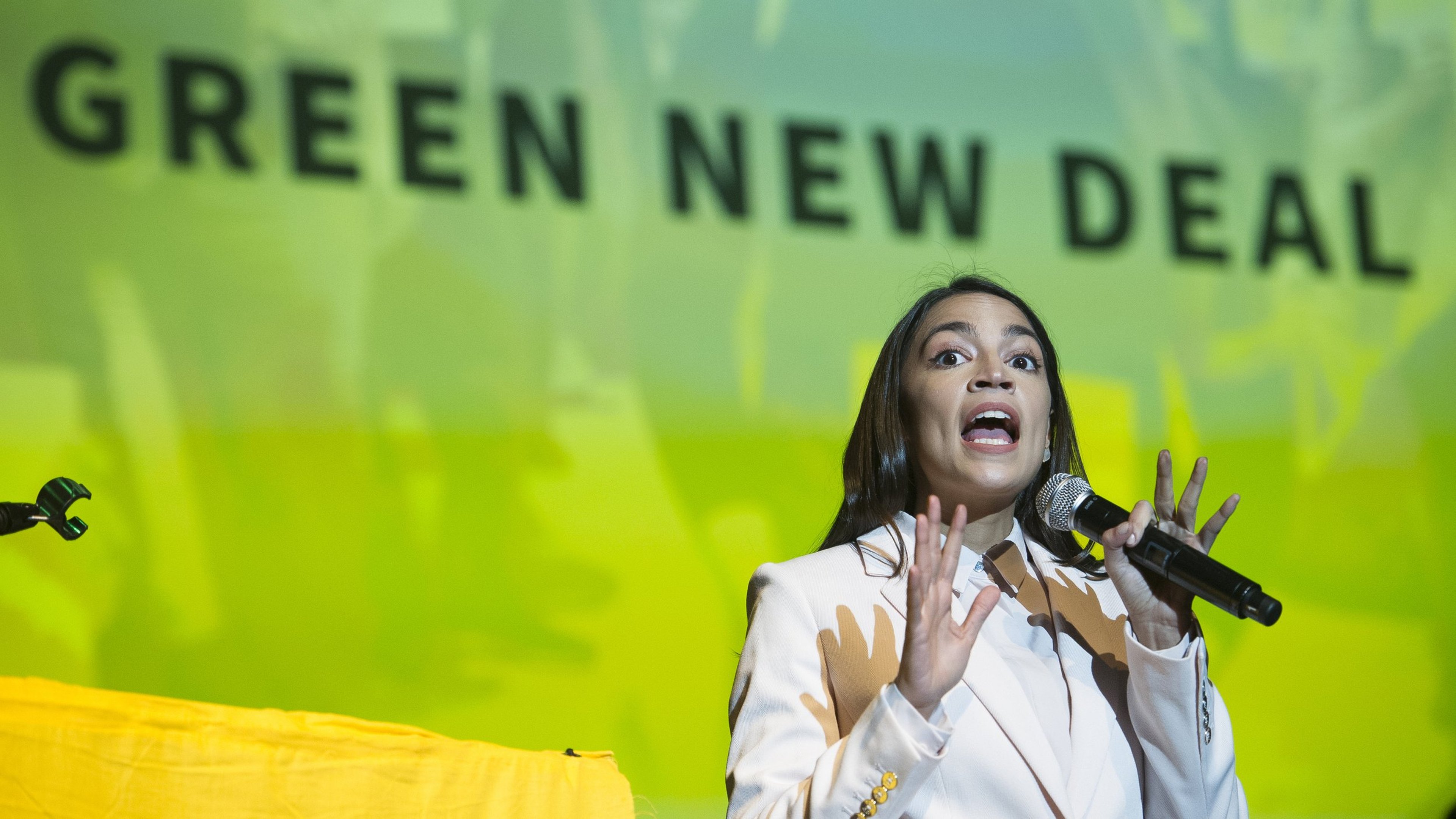
American politics is gripped by a pervasive sense of despair and impossibility. We watched the Biden administration’s inability to marshal its congressional majority to enact its Build Back Better agenda—a modest bid to revive the tools of the New Deal for a green transition—paralyze the nation in the face of climate breakdown. Meanwhile, the spectacular rise of China’s titanic, state-directed electrostate has become a source of both envy and deep anxiety. Now, we are in the second year of the second Trump administration that promises climate apocalypse, as well as the active demolition of the state’s remaining regulatory and administrative capacity. The question is no longer one of policy design but of power: For nearly a decade, Alexandria Ocasio-Cortez has advocated for the Green New Deal—transforming it from a fringe idea into the left's most ambitious vision of economic and ecological transformation. If she or another left populist seeks the presidency, they will discover that a policy agenda, however popular, is powerless without a governing strategy capable of overcoming oligarchic resistance. How can we seize the necessary state power and articulate a new hegemonic consensus to rebuild state capacity and make the Green New Deal a reality? To answer this, we must first understand the original source of our political nostalgia—the New Deal itself. Its historic memory continues to shape every contemporary vision of transformative politics, yet its true nature remains misunderstood, its lessons obscured by competing fantasies of what it was.
What is remembered fondly about the New Deal depends on the political lens. For the left, it is redistributive justice: Social Security, high taxes on the rich, and a powerful labor movement. For modern managerial liberals who make up the leadership of the Democratic Party, it is the sense of rational competence and stabilizing power—not only a state that tamed market volatility at home, but one that successfully orchestrated a global Cold War order and sustained American hegemony, with its public works serving as the domestic monument to that overarching achievement. Each perspective offers an incomplete nostalgia, focusing on outcomes while ignoring the machinery that produced them. The engine of the postwar "Golden Age" was something far more consequential and systematically novel: a new architecture of public finance and coordinated power. To understand it, one must look past the nostalgia to the cold, functional machinery described by economist John Kenneth Galbraith in The New Industrial State (1967).
Galbraith argued that mid-century America was not a free-market paradise but a tripartite planned economy with inputs from corporations, labor, and the state. Stability and growth were managed by a “Technostructure”—a science and managerial elite spanning large corporations, the state, and the military, which coordinated production, planned prices and profits, and managed aggregate demand through Keynesian policy.
This system possessed several defining features:
Sectoral Industrial Policy: Rather than merely regulating, the state directed investment and guaranteed markets for “national champions” in industries such as aerospace, automotive, and electronics. Public capital and guaranteed demand (often military) de-risked and scaled these strategic sectors.
The Revolving Door of Expertise: A shared class of scientists, engineers, lawyers, and professional managers circulated between corporate suites, federal agencies, and Pentagon offices. This created a unified worldview and a common toolkit for national-scale project management.
Profit as a Means: For the Technostructure, the primary corporate goal was not shareholder return but the continuity and growth of the organization itself. Profit was necessary, but its chief function was to retain earnings, fund expansion, and keep the industrial state employed and innovating. The result was the rise of the sprawling conglomerate.
Keynesian Demand Management: The Technostructure actively managed the economy’s total demand to absorb surplus output and prevent stagnation. In practice, as documented by Paul Baran and Paul Sweezy in Monopoly Capital, this meant sustaining high levels of military spending and fostering a vast corporate “sales effort”—the rise of massive advertising departments that manufactured consumer desire and planned obsolescence.
The New Deal order proved that the U.S. state possessed and was capable of wielding massive planning capacity. But this planning capacity was a tool deployed to stabilize monopoly capitalism, guide its growth, and secure its legitimacy through broadly shared (if unevenly distributed) prosperity. It succeeded in doing so until it was deliberately dismantled amid a dual crisis in the 1970s.
The collapse was both economic and ideological. Stagflation—the previously impossible combination of high inflation and high unemployment—shattered the Keynesian consensus that had held together the American economy till now. Stagflation invalidated a key assumption of Keynesianism: that unemployment was more or less inversely proportional to inflation, modeled by the ‘Phillips curve.’ This crisis was fueled by a wage-price spiral, where the hard-won power of organized labor to secure higher wages was responded to with price hikes by large corporations, creating an inflationary feedback loop that Keynesian tools could not control. The material foundation of the system crumbled further with the U.S.’s transition from a surplus to a deficit nation, and the end of the Bretton Woods agreement in 1971, which ended the tethering of the US dollar to Gold.
The elite response to this dual failure was not to rescue the planning model but to break it and build a new one. The violent monetary policy of the Volcker Shock—sky-high interest rates that induced a deep recession triggering mass unemployment—was the decisive anti-labor strategy that broke the wage-price spiral by breaking the unions. As economist Yanis Varoufakis argues in his account of the rise of “The Global Minotaur,” the strategic turn was toward financialization. Having shifted from a surplus to a deficit nation following the Vietnam War, the U.S. decided to abandon its ambition to be the world’s premier producer and instead become its premier financial vacuum, leveraging Wall Street and the dollar’s privilege to attract global capital flows.
This paved the way for a political rupture. The economic crises that characterized the 1970s, blamed squarely on the system’s managerial elite, combined with the insurgent energy of new social movements to create a potent backlash. The post-war consensus faced a crisis of legitimacy. The "faceless bureaucracy" of the Technostructure, once seen as a pillar of competent modernity, was recast as a parasitic source of alienation and economic pain.
As political theorist Chantal Mouffe explains in For a Left Populism, the Reagan-Thatcher revolution was a hegemonic project. It succeeded in disarticulating the New Deal consensus and rearticulating a new one through a potent populist strategy. By constructing a sharp political frontier—“Us” (the “taxpayer,” the middle class property owner, the entrepreneur) versus “Them” (the “faceless bureaucracy,” “overpaid” union labor, “welfare queen”)—it recast the Technostructure’s administrators and its labor allies as enemies of the people. The ensuing program of financial deregulation, crushing labor power, and tax cuts for capital was the means to implement a new vision of America and reassert the primacy of shareholder profit.
However, the planning state was not ended and replaced by a return to laissez-faire, as advocated for by the likes of Friedman and Hayek. Although the libertarian image of laissez-faire was useful, the Reagan-Thatcher revolution did not eradicate the state as a stabilizing force in the economy, but reoriented it. The goal was no longer to plan for production, but to plan for capital mobility. This redesigned state found its role fully realized in Bill Clinton and his “Third Way” project. Clinton’s administration did not roll back the core neoliberal victories—capital unleashed global mobility, a disciplined labor force, and the primacy of financial markets. Instead, it professionalized their governance. The state’s mission was meticulously re-engineered from directing the industrial economy to facilitating the financial one.
This required a new kind of expertise. The revolving door now spun between Washington and Wall Street. Treasury was reconsecrated as the command post for managing global capital flows, staffed by figures like Robert Rubin, who imported the Goldman Sachs worldview into the heart of policy. The state’s toolkit changed accordingly. Industrial policy was out; "fiscal discipline," financial deregulation (culminating in the repeal of the Glass-Steagall Act), and the rigorous defense of asset prices were in. The Federal Reserve’s role expanded from managing employment and inflation to implicitly backstopping the entire financial system. The state became a sophisticated market-maker.
The heart of this shift was Clinton’s deliberate courtship of Silicon Valley. This move marked a decisive break from the old Technostructure’s sectoral perspective. In its place, Clintonism adopted a platform perspective, influenced by a Schumpeterian faith in entrepreneurship as the engine of progress. The state would not build industries; it would build the ecosystem—research and development, strong digital property rights, and protected capital gains—in which venture capital could conjure them into being. This model of the state as an entrepreneurial facilitator also accelerated a parallel trend: the hollowing out of internal state capacity through the offloading of core functions to consulting firms, a dynamic detailed in The Big Con by Mariana Mazzucato and Rosie Collington. This defined the new Managerial State: an architect of market ecosystems and a purchaser of managerial services, while private actors captured the spectacular rewards.
The ideology that justified this redesigned state was “West Wing” liberalism: a faith in smart, procedural, and market-friendly administration by credentialed experts. Its politics was the management of inevitabilities—globalization, technological change, financialization. This new managerial elite exercised its “relative autonomy” less to discipline capital, as the old Technostructure sometimes did, but to optimize capital’s environment and mitigate its systemic failures. The state was less of a countervailing power, and more its essential partner for a financialized age.
The function of this redesigned state was revealed in moments of systemic crisis. When the financialized economy faced collapse in 2008, President Obama’s administration deployed its managerial expertise to preserve the system of financial instability, rather than to restructure it. The massive liquidity injections, bank bailouts, and the careful socialization of catastrophic risk were the logical endpoint of the “Third Way” project: a state that existed to underwrite capital. A similar managerial reflex defined President Biden’s 2020 pandemic response, where historic fiscal stimulus acted as a life-support system to resuscitate the pre-crisis economy rather than reorient it. In each case, the Democratic Party’s professional stratum executed its core competency: the expert management of emergencies to ensure continuity. This ethos, however, confuses competent administration with political vision, proving this managerial class’s capability of saving the system but incapability of transforming it.
This Managerial State’s defining feature seems to be that it can only govern the world it inherited; it cannot conceive a new one. This inherent limitation has defined its response to every major crisis. Faced with the collapse of the financialized system in 2008, the Obama administration had a historic opening to transform it. Instead, its response—expert, stabilizing, and ultimately preservative—proved that the state’s retooled capacity was for rescue, not reinvention. A decade later, this same limitation would define the failure of its most ambitious modern challenge: the presidency of Joe Biden.
Biden entered office heralding a “once-in-a-generation” opportunity to end the “Reagan era.” His Build Back Better agenda was an explicit attempt to revive the New Deal toolkit. Its collapse, however, was not merely a story of legislative mechanics. It was a failure of perception inherent to the managerial worldview. Where Franklin D. Roosvelt leveraged patronage and public confrontation, and Lyndon B. Johnson deployed insider pressure and the moral force of movements, the Biden administration defaulted to a managerial bargain. Oligarchic veto power was treated as an administrative puzzle to be solved by smarter policy design and closed-door negotiation. It operated on the belief that it could manage opposition, refusing to wage the public, hegemonic struggle that would redefine the boundaries of the possible.
This perceptual blindness characteristic of the managerial class was crystallized in the Inflation Reduction Act (IRA) that survived. The IRA is a masterpiece of managerial logic: a sprawling array of subsidies and market incentives designed to nudge private capital toward green investment. It throws money at the problem, operating on the faith that financial signals, rather than direct public planning and build-out, will automatically summon a transformed industrial base. While it may spur significant investment, it accepts the existing balance of power. It does not disrupt the incentive structure of financial capital or directly challenge incumbent monopolies–it merely pays them to participate, hoping the market will deliver what the state dares not explicitly command.
Furthermore, the administration never successfully framed “Build Back Better” as the nation’s new core purpose—a galvanizing vision of rebuilt livelihoods, clean industry, and renewed public capacity. Instead, it often messaged the agenda as a subsidiary necessity for Cold War-style competition with China. This was a hollow echo of the New Deal era of American hegemony that managerial liberals romanticize, but without the domestic class coalition or productive state capacity. This also represented an unwillingness to accept that the prospects of a renewed American hegemony in the 21st century are rather dim and a new vision of America’s role in the world is necessary. This framing ceded the moral high ground, failing to mobilize the popular energy required to overcome entrenched domestic opposition.
It also proved pragmatically counterproductive. As a report from the Center for Economic and Policy Research (CEPR) illustrated, tariffs on Chinese solar panels led to higher U.S. prices, job losses, and net welfare losses, as production simply shifted elsewhere. While the need to catch up with China does require the ambitions of the Biden administration, it requires a domestic vision so compelling that it becomes the organizing principle of politics on its own terms. To succeed, such a project must be articulated as America’s own positive future—one that in all likelihood will require pragmatic cooperation with China, such as importing solar panels and capital goods, to accelerate a transition, rather than a self-defeating narrative of reactive rivalry. This futile attempt to sustain American hegemony through managerial policy and economic conflict with China prompted historian Adam Tooze to characterize the project as "MAGA for thinking people.”
In the wake of the failure of Biden and Harris following the 2024 election, a new vision has emerged to define the boundaries of liberal reform: the politics of “Abundance.” Promoted by Ezra Klein and Derek Thompson, it correctly diagnoses American sclerosis as our inability to build housing, infrastructure, or clean energy at speed and scale. But its prescribed cure is characteristically apolitical: “deregulate to build.” This framework reduces the complex legacy of deindustrialization and financialization to a problem of “red tape,” imagining that removing procedural barriers will somehow unleash latent productive capacity.
In practice, the “Abundance” narrative has been swiftly co-opted by oligarchic, rentier interests that stand in the way of transformative vision as a “pragmatic” alternative to left populism. It invokes FDR while stripping the New Deal of its essence—the state as an industrial planner and the class struggle that empowered labor. “Abundance” offers a vision of a streamlined, frictionless Managerial State. It is the latest iteration of a neoliberal faith that simple regulatory tweaks will magically unleash desired outcomes via market dynamics, mistaking administrative adjustments for a new political economy.
If “Abundance” represents a flight from politics into limp wonkery, the politics of left populism which sparked with the Occupy Wall Street movement, and is now represented by notable figures such as Bernie Sanders, Alexandra Ocasio Cortez, and Zohran Mamdani, represent the explosive return of politics. It successfully rebuilt a language of class conflict, framing politics as “the people versus the oligarchy.” This movement channels a righteous nostalgia for the New Deal era. Yet, tellingly, that nostalgia is for the outcomes: for Social Security, for strong unions, for steeply progressive taxes. It is, in essence, a redistributive imagination.
This focus shapes its inherent limit. The energy, while powerful, remains trapped in a framework of demanding a fairer share of the existing, financialized pie rather than building a new one. Its horizon is securing benefits—Medicare for All, student debt cancellation, etc.—from the state. It assumes the resources are simply there (in the form of money) to be redistributed, an approach that cedes the fundamental questions of how material goods are produced. By focusing on the distributive outputs of the state, it inadvertently reinforces the authority of the Managerial State as the sole legitimate dispenser of goods. The movement acts as a strong petitioner, but not yet as a rival sovereign power. It critiques the state’s failures but has not yet broken with its underlying, managerial form or formulated a comprehensive theory to replace it. The task, therefore, is not to abandon populist energy, but to redirect it and clarify its aims.
This impasse—between a managerialism that cannot transform and a left populism that only makes demands of the state but cannot (in its current form) become the state—demands a new path. The solution is not to abandon populist energy, but to redefine its strategic imperative. The task is to disarticulate the Managerial State’s neoliberal consensus—the core ideology of the modern Democratic Party—and articulate a new one in its place. This requires more than making demands; it requires forging a new political subject and a new ruling-class project. We might call this producer populism.
Its first move is to redraw the political frontier, executing a hegemonic strategy analogous to Reagan and Thatcher's in the 1980s. The “Us vs. Them” is reconceived not simply as the people versus the oligarchy, but as the Producers versus the Rentiers. “Us” encompasses the multi-racial working class, various intelligentsia (managers, scientists, engineers, etc.), and what Varoufakis refers to as the “vassal” capitalists: productive green tech entrepreneurs, and other smaller manufacturers who are strangled by the monopoly rents extracted by Monopoly Finance Capital. “Them” is that very bloc: the extractive alliance of fossil capital, financial capital, and tech monopoly capital whose power derives not from building but from controlling resources, assets, and network access and information. The goal of this disarticulation is to assemble a new historic bloc with a shared material interest in a state that builds, produces, and invests, clearing the ground for a new ruling class equipped with new ruling ideas; with an intellectual toolkit and political mandate to implement a true Green New Deal. This is the prerequisite for any project that sincerely aims to “build back better”—it must first build a new political power capable of wielding the state.
Second, the Green New Deal program flows from this political frontier. It moves the political horizon from “we demand” to “we will build.” This means articulating a Neo-Galbraithian Green Industrial State, an explicit rejection of the market-nudging of Biden’s IRA and the deregulatory fatalism of “Abundance.” Where those frameworks ask the state to incentivize or get out of the way, this model demands the state reconstitute itself as a direct, productive agent.
The Green New Deal is therefore a national planning framework. Its goal is not merely to subsidize green sectors but to build them through public institutions: a National Department of Science and Industrial Innovation to direct R&D; public finance instruments to provide patient capital for priorities set by democratic input; a State-Owned Energy Company to rapidly deploy renewables and build the grid; and a State-Owned Construction Company to tackle a national high-speed rail network and the chronic housing shortage. This revives the New Deal’s sectoral ambition and state capacity, but directs it toward democratic and ecological ends, rather than military-industrial surplus absorption.
This logic extends to the core of the economy. Social programs are reimagined as productive infrastructure: Medicare for All mandates building the infrastructure for a decommodified health system, rather than the public financing of private care. And the same can be said for universal childcare and housing as a public good. This Green New Deal seeks to break the financialized corporate governance that prioritize shareholder extraction. This could be done via a 30% shareholder cap in publicly traded firms, and a legally mandated system of worker codetermination with a pathway to significant employee ownership.
This project possesses its ultimate weapon and compelling rationale: the climate crisis as an “advantageous antagonism.” As Mouffe suggests, a vibrant democracy requires conflicts that channel divisions into constructive, transformative projects. The climate emergency materializes the Producer vs. Rentier frontier with visceral, unavoidable force. It pits community survival against extractive plunder, and the imperative to build resilient infrastructure against the logic of short-term financial extraction. It makes democratic planning—the ability to coordinate society’s resources toward a collective survival goal—not a nostalgic ideal but a civilizational necessity. Climate is the antagonism that forces the role of the state back to the center, demanding not a better manager of the status quo, but a sovereign power capable of building a new world.