
Jun 23
Morena: Key Contradictions The US Left Should Understand
Mexico’s Fourth Transformation is at a critical impasse, squeezed between the historic gains of a populist resurgence and the suffocating grip of US imperialism.
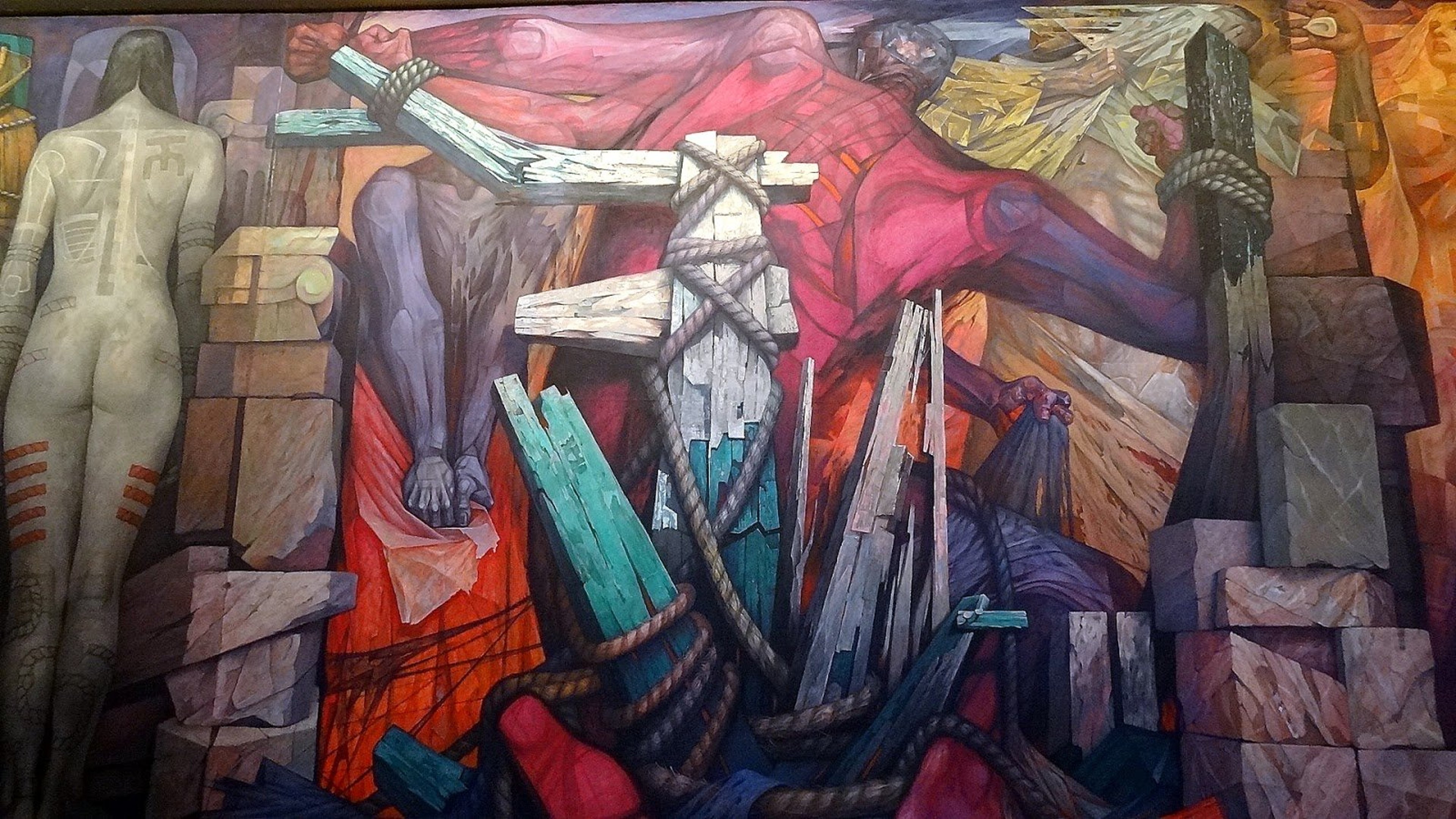
La humanidad se libera de la miseria, Jorge González Camarena (1963)
The drug war is heating up again. The aerial execution of Venezuelan boaters that culminated in the January 3rd abduction of Venezuelan president Nicolás Maduro on trumped-up trafficking charges was only the opening salvo. On March 7, 2026, Donald Trump announced the creation of the “Counter Cartel Coalition,” also called the “Shield of the Americas.” In his characteristically meandering and boastful speech at the inaugural summit, Trump spoke before a consortium of right wing leaders across Latin America, “most of whom are friends”, and spoke about a military first vision of civic governance across the Americas.
For Trump, the new program is a “commitment to using lethal force to destroy the sinister cartel and terrorist networks” with “our amazing weaponry.” Of these supposed networks, Trump said, “they’re cancer and we don’t want it spreading.” They require a strong unilateral military policy to control: a clear escalation of the use of force in what has traditionally been the terrain of conventional law enforcement.
Trump spoke to a sympathetic audience, including Argentine president Javier Milei and then president-elect of Chile, José Antonio Kast. Kast, whose German grandfather was a card carrying member of the Nazi party, has, since he has been sworn in, both hailed the capture of Maduro as a strike against “narco-terrorism” and announced his own efforts to close the Bolivian/Chilean border to oppose the same. It would seem that the Shield of the Americas conforms to a broad consensus across the Latin American right wing about the military destiny of public life. What this portends for left-wing, communist, and populist movements across the region is best gleaned from the three most prominently mentioned countries in Trump’s speech: Venezuela, Cuba and Mexico.
Trump celebrated the toppling of Venezuela’s government on January 3rd, 2026. He hailed the cooperation of acting-president Delcy Rodriguez “who’s doing a great job working with us[…],” warning her that “if she wasn't working with us, I would not say she's doing a great job.” What the consequences of “not doing a good job” is remains to be seen as the former President Maduro continues to sit in prison in Brooklyn, New York awaiting trial.
Venezuela is mentioned as a clean victory throughout the speech, and its name is invoked 11 times throughout. Cuba, a longstanding target of the US, is mentioned 14 times–as many times, in fact, as Trump mentioned his chief cretin, Marco Rubio, who was apparently busy behind the scenes securing this entire right-wing coalition. Despite his Drug War rhetoric, however, Trump hardly bothered accusing Cuba of having concrete cartel connections. Instead, he mainly celebrated Cuba’s isolation and what he sees as their impending destruction. Cuba “has a bad philosophy,” it is a “disaster.” Because of the decapitation of Venezuela, “it can’t afford oil” and is now particularly exposed.
Mexico was prominently mentioned as “the epicenter of cartel violence” and a national security threat both to the United States and to the people of Latin America broadly. Trump characterized President Claudia Sheinbaum, who was not present, as “a very good person”, a “beautiful woman” with a “beautiful voice” who was not equipped to handle her own country’s security crisis. “I say, ‘let’s eradicate the cartels. ‘No, no, no, please, president.’” Trump said, imitating Sheinbaum’s accent. He continued: “We have to eradicate them. We have to knock the hell out of them because they're getting worse. They're taking over their country.” Trump played the hard-nosed pragmatist looking out for both the US, the people of Mexico, and the people of Latin America. “The cartels are running Mexico. We can't have that. Too close to us. Too close to you. We must not allow our criminal justice systems to be corrupted so that they protect these criminals and animals at the expense of your people.”
Meanwhile, in Mexico, the drug war has been lighting off in its usual conflagrations of conflict and scandal. The killing of Jalisco New Generation Cartel’s alleged leader Nemesio Oseguera Cervantes, also known as “El Mencho” in the tourist town of Tapalpa, Jalisco on February 22, 2026, sparked off the kind of predictable power struggles and street warfare that have been a feature of the US/Mexican “kingpin strategy” since long before the extradition and ensuing conflict around succession of Joaquin “El Chapo” Guzmán Loera in 2017. The CIA’s connection to these drug war efforts has been a strongly rumored and reported presence. Mexican journalists, writing for Reuters in September 2025 reported that the CIA had been running covert operations for years targeting high profile drug-smugglers, despite strong criticisms of the DEA and CIA coming from Morena party leadership like Andrés Manuel López Obrador (AMLO) and Sheinbaum herself. This situation has culminated in the April 2026 deaths of two CIA agents in Chihuahua (governed by Maru Campos of el Partido Acción Nacional/PAN), alongside two Mexican law enforcement officers after their car “drove off a ravine” and “exploded” (per the US Public Broadcasting Service) on the way back from the alleged destruction of a synthetic drug lab. The Mexican federal government, for its part, maintains that these agents had no permission to operate in the country.
The deaths coincide with the indictment of Sinaloa governor and Morena party member Rubén Rocha Moya by the U.S. Department of Justice on drug trafficking charges. Rocha cannot be arrested until he leaves office as governor next year and the announcement of the charges is broadly construed by the Morena party as a political move and a threat by the US. According to the Spanish periodical El País, this has opened up a major rift both within the Morena party and in the US-Mexico security relationships spearheaded by Omar García Harfuch (Secretary of Security and Citizen Protection), which have thus far been a success in bolstering Mexico’s negotiating positions around tariffs and trade agreements.
A clear battle over sovereignty seems to be in the works, and, in response, various political factions in Mexico are duking it out for control. One of Morena’s more prominent opposition parties, el PRI (Partido Revolucionario Institucional) has, for their part, under their leader Alejandro Moreno, called on May 8th, 2026, for the US to recognize Morena as a “Foreign Terrorist Organization” and for the US Department of State to intervene. It is exceedingly rich that El PRI, which has a history deeply colored by assassination, criminal complicity, and corruption, is making such a move. It may well be an act of desperation, as el PRI, which dominated the country for much of the 20th century, is in a period of historic weakness and many of its mainliners have moved to Morena. Whatever the case may be with el PRI’s call for US intervention, this much is clear: Mexico is soaked in gasoline and every military intervention, whether by US or even Mexican forces on their own account, is a potential match-strike.
In the midst of all this is the ascendance of the Morena party to national dominance following its founding by AMLO in 2011. Morena, meaning “Brown skin woman” in Spanish (also a reference to La Morena, the Virgin of Guadalupe, one of Mexico’s most important national symbols), is a syllabic abbreviation for the party’s official name: el Movimiento Regeneración Nacional/the National Regeneration Movement. As their name suggests, the party is built around a project of nationalist revitalization, often called the “Fourth Transformation” (hereafter, simply the 4T), which is preceded by: 1) the Mexican War of Independence (1810–1821), 2) the Reform War (1858–1861) and 3) the Revolution (1910-1917). The 4T is an ongoing left-populist project that involves expansive reforms to the health care system, infrastructure, energy sectors,anti-corruption measures, as well as the controversial creation of a new branch of the military, the National Guard.
Outwardly, many of these goals are broadly commensurate with leftist political ideals. In practice, however, several of these goals have been belied by disturbing reports of institutional abuse, primarily against Indigenous communities in the case of the flagship (tourist-centric) Tren Maya project, per Mexican left magazine Proceso. The elevation of figures like Omar García Harfuch, a man who was instrumental in the cover-up of the disappearance of forty-three students allegedly by local police, raises further questions about the putatively leftist goals of the 4T. Further, García Harfuch’s grandfather was Marcelino García Barragán, the PRI Secretary of Defense who executed the order for the infamous Tlatelolco Square massacre of some 500 revolutionary students on October 2, 1968. His father, Javier García Paniagua, another high level PRI figure was head of the now defunct Federal Security Directorate from 1976 to 1978, was strongly rumored to be responsible for a wide range of repressive measures during the Mexican Dirty War, a period of anti-Communist and anti-peasant counter-insurgency that lasted from the late 60’s to the 80’s. García Harfuch’s prominence in the security policies and international cooperation with the US suggests a disturbing continuity between the Morena party and Mexico’s anti-Communist past that makes its commitments to leftist ideals possibly suspect.
Alongside all of these contradictions is the long lasting political deadlock formed by the drug war, which only stands to intensify as the Shield of the Americas is raised. The formation of the Counter Cartel Coalition (CCC) seems to be intended to target the last holdouts of socialism in South America, or at least independent minded left-wing governance, more than it is any authentic attempt to handle the problems of drug trafficking. This can be seen by looking at Trump’s pardons. Trump’s pardons feature a near-plurality of drug traffickers, including the former president of Honduras, Juan Orlando Hernández, who was convicted of smuggling 400 tonnes of cocaine in June of 2024 and pardoned on December 1st, 2025.
Trump’s pardons convey a cynicism that has always been at the heart of the drug war, but this cynicism is not the only picture: in addition to being a cynical project, the drug war is one of the more fundamental traps for any left-governance in the region. The kinds of security issues the drug war inculcates will remain a baked-in political problem for whoever holds the reigns of power in Mexico. So long as the drug war persists, it will be a short circuit to Mexican self-determination. The 4T, Morena’s political project as a whole is in a fraught place indeed as the US yanks the leash at any sign of independence. However, it would be a mistake to whitewash the contradictions and failures of the Morena party’s project in the spirit of solidarity.
Just because Mexico is so highly placed on Trump and the Shield of the America’s list of targets does not mean that the Morena party is leading a socialist movement or that they are supporters of socialism in Latin America broadly. Sheinbaum’s recent betrayal of Cuba by shutting off oil sales is a prime example of this. The future of any socialist tendencies in the Morena project are in flux, but the project of the 4T itself is mired in key contradictions which the rest of this article will explore. These contradictions are
The attempts to establish a center-left welfare state while retaining a structure of neoliberal austerity.
The deep dependency that the 4T has on the United States via the policy of “nearshoring”.
The inability at the present historical juncture to resolve the drug war and its foundationally corrosive influence on any left project in Mexico.
Contradiction 1: Welfare through Austerity
Morena’s accomplishments for the Mexican people deserve some level of recognition, even if they are built on shaky foundations. At the very least, they represent a paradigm shift in the climate of mainline Western governance: politics have been shifted, so often characterized by rightward brutality and contempt for the poor, towards an at-least-nominal concern for the wellbeing of the people. El Paquete Contra la Inflación y la Carestía/the Package Against Inflation and High Costs (PACIC), or the basic food basket, for example, freezes prices of essential grocery staples at affordable levels for the poor. This is already far and way more than the US does for its own people, although that itself is a low bar to clear.
Morena’s efforts have doubled, and in some states tripled, the minimum wage. As Dissent reported last year , “vacation days have doubled, employer retirement contributions have tripled, outsourcing has been curbed, and secret-ballot union elections are now mandatory. This package of reforms is a historic achievement that has improved millions of lives in ways the left [in the United States] has long only imagined.” Leaving aside who gets the vacation days, the union representation, and the retirement, and so forth, all benefits which accrue to the formally employed, in a country where, by any measure, at least half to a clean majority of the country is informally employed, these are still important gains.
At the same time, as Dissent’s writers acknowledge, Morena has “left key pillars of neoliberalism intact.” Chief among these are the ongoing commitments to austerity. Mexico’s existing infrastructure and social spending projects are based chiefly in reshuffling rather than expanding the national budget. As scholars Rebecka Villanueva and César Villanueva, writing for the journal Globalizations, argue, Morena’s project is built on a central paradox:
[Its transformation and expansion of the state] “is supposed to be sustained via austerity measures, massive lay-offs and cuts akin to neoliberal principles constrain the functioning of public institutions. Now, and this is the other side of the paradox, the 4T has set out for a ‘political transformation’ without really challenging the underlying ideas that continue sustaining Mexico’s neoliberal economic course.”
Writing for Phenomenal World, César Morales Oyarvide elaborates this tension: The 4T has had many successes in “redefining the national narrative and restructuring public spending priorities” but, in contrast to countries like Bolivia or Brazil, the tax base has not been expanded to transfer wealth to the poor. Oyarvide notes that this paradox stems from “a state that asks for allegiance without demanding a contribution, and a citizenry that asks for rights without viewing taxation as a duty.”
One of the chief contradictions, at the heart of the 4T, then is a crisis in its own fiscal model. It wants to secure a state that sees to the benefit of the average Mexican citizen, yet none of its fiscal models allow for the expansion of its tax base and an organized redistribution of wealth. Instead, the 4T relies on an increase in income and job generation for the state based on other means, such a “nearshoring”, a project that highlights the second of the three contradictions facing the party.
Contradiction 2: The dependency on the United States
The “curbing of offshoring” that Dissent celebrates is a product of “nearshoring.” “Nearshoring” refers to a package of tax cut incentives and stimulus for the relocation of manufacturing to Mexico, and takes place within the framework of North American trade agreements. “Nearshoring”, also called the “National Relocation Strategy”, is, as articulated in Sheinbaum’s “Nearshoring Decree” , an organized plan to draw in manufacturers who can provide tax income to Mexico to stimulate job growth and social programs. The English name “nearshoring” derives from the term’s contrast with “offshoring”, to describe the goal of shifting the pattern of manufacturers locating factories in the Asian hemisphere (“offshoring”) to one where those factories are constructed on the “near shore,” i.e., places close to the main consumer markets of the US–the most relevant one being Mexico itself.
The difficulty with this approach is contained in the English name itself. “Near” or “far”, but not “here”: What is, in Spanish, much more neutrally called “la Estrategia Nacional de Relocalización/the National Relocalization Strategy” is, for its European and Anglophone North American audience, under the gaze of the countries and institutions with real power here, characterized exclusively by its proximity to the United States. Mexico is the United States’ largest trading partner, and the United States is Mexico’s largest trading partner in turn (by a much larger margin). This means that nearshoring, which is the strategy at heart of the 4T’s developmental program (also called Plan Mexico), fundamentally depends on an opposition to Chinese manufacturing power, a competing economic force in Latin America. Nearshoring can be seen as an attempt to sniff out and exploit a weakness in China’s BRICS program, an attempt to undermine China and Latin American independence broadly while offering a fig leaf of economic growth to participating countries. This is an important policy in maintaining US power in Latin America, at least according to one of the US’ chief envoys to Latin America, Marco Rubio.
The trap here is precisely this dependence on the United States. As Günther Maihold, writing for die Stiftung Wissenschaft und Politik (SWS, the Foundation for Science and Politics), a thinktank component of the German Institute for International and Security Affairs, writes in view of Trump’s aggressive tariff regime: Mexico is vulnerable to an “increasingly urgent demand by the United States for third countries to adopt an anti-Chinese course, Mexico is at risk of being caught in the trap of “security-shoring” and losing its autonomous room for manoeuvre.” Security-shoring refers to the way that the objectives of nearshoring become bound up in US elites’ security perceptions which bundle together migration, drugs, and competition with China as part and parcel with their economic interests.
The fact is that nearshoring requires Mexico to act as what Maihold terms “an extended workbench for the United States.” The importance of relocating multinational factory production inside of Mexico to the 4T as part of Plan Mexico puts Mexico, in Maihold’s words, “between the grinding stones of the two great powers in its economic relations.” Any move to increase nearshoring already puts Mexico in a contentious position with China and the BRICS+ program, one of the most promising guarantors for Latin American independence from US economic hegemony. This makes the project of nearshoring exceptionally fragile–a fragility which has been borne out in a tide of investment insecurity and fear that the trend of nearshoring may collapse or recede as the July 2026 United States–Mexico–Canada Agreement (USMCA) review approaches.
The problematic of “security shoring” and the close weaving of the economic destiny of the 4T with the caprice of the US ruling class may already be the deciding factor in the economic and political pressures that lead Mexico to pause oil sales to Cuba in January of 2026. Sheinbaum, for her part, has sent aid to Cuba and asserted the rights of Mexico to supply oil “for commercial or humanitarian reasons” to the country. Regardless of the current status of Mexican oil sales and economic aid to Cuba, it cannot be denied that the pause in oil sales and any other form of capitulation to US interests has contributed to the severe humanitarian crisis in Cuba and its isolation on the Latin American political stage, particularly following the political decapitation of Venezuela. A deeper look at the uncertainties behind the nearshoring project, what is indexed by the Center for Strategic and International Studies as investor concerns about “the rule of law”, reveal a political contradiction which has dogged the realities of Mexican governance for the past fifty years at least and which particularly stand in wait to undermine all attempts to establish a paradigm of governance which acts on behalf of its people. This third and final contradiction is what we will call the “War on Drugs.”
Contradiction 3: The War on Drugs
Outside of the apocalyptic blow dealt by NAFTA and the Mexican peso crisis in 1994 of the mid 90’s, the US War on Drugs has been one of the most singly destabilizing factors in modern Mexican politics. Even before the official declaration of the War on Drugs by then-president Richard Nixon in June of 1971, US narcotics policy was used to strong-arm and manipulate Mexican domestic politics, often with the assistance of the Mexican bourgeoisie and frequently with their own participation (as the historian Isaac Campos argues, “reefer madness” arguments about marijuana were developed by 19th century Mexican social elites to target and indemnify Mexico’s criminalized Indigenous, Mestizo, and military lumpenproletariat).
A signal example from the early years of the US Drug War comes from the head of the Federal Bureau of Narcotics (a precursor to the DEA), a man named Harry Anslinger, and his interactions with Mexico in the 1940’s. Anslinger was a man so racist that he was seen as an extreme white supremacist even by the standards of his time. He is, among other things, responsible for having Billie Holiday handcuffed to her hospital deathbed in 1959 on account of his dual suspicions about her connections to the heroin market in New York, faked up drug posession allegations, and an overall reaction to the deep anti-racist indictment of the white power structure in her song “Strange Fruit.” Anslinger also ensured that the heroin prescription and drug legalization programs put in place by Leopoldo Salazar Viniegra, which had a notable calming effect on street crime in Mexico City, were firmly put to a halt in 1939 lest Anslinger’s own interests in a punitive and racist model of drug policing were falsified by a better alternative.
This short history is indicative of the general contradiction the drug war poses within the efforts of the 4T and in Mexican politics generally: no matter how far Mexico strives, the country is caught in the cold reality of the drug war and the way the US can use it to apply its own legal and security frameworks at will on any foreign country it chooses. As the work of historians Alexander Aviña, Paul Gootenberg, and Benjamin Smith, journalists like Dawn Paley and Oswaldo Zavala, and scholars like the late David Lenson (among many others not mentioned here) have attested, the Drug War is a long project of anti-communist, anti-Civil Rights, anti-Left counter-insurgency which acts as a radical constraint on Latin American independence. It is a rearguard action within the borders of the US, shoring up de-industrialization and other assaults on the working class with a mass security regime–and a vanguard action in Latin America announcing, wherever it goes, anti-peasant and anti-working class changes alongside national privatization. Within the US and across Latin America, the drug war is a project waged by an international bourgeoisie under the fig leaf of public health and national security while it undermines both.
Examples of this bourgeoisie, or at least their servants, include Felipe Calderón, the former Mexican president from el Partido Acción Nacional (National Action Party/PAN, in office from 2006 to 2012), the recently elected and already discussed José Antonio Kast, of Chile, and Nayib Armando Bukele Ortez of El Salvador. Calderón, from the arch-conservative party that invited the recently exploded CIA agents into the region (as mentioned at the beginning of the article), plunged Ciudad Juárez into an infamous wave of violence following his military occupation of that and other border cities in 2006. As Oswaldo Zavala notes, the most consistent predictor of “cartel” violence over the longue durée of the drug war, particularly in its most chaotic street level manifestations,is the imposition of military control over the business in the first place. Bourgeois states use the drug war to create a generalized network of security, counter-insurgency, and mercenary activity that wraps up the entirety of Latin America and acts as an important funding source for entities like “Israel.” Kast is the most recently inaugurated inheritor of this tradition. Meanwhile, the hyper-incarceration schemes of Bukele’s government are forming an important node in the US deportation-regime as well as a major regional booster for “Israel”. This has been and will remain the story of the drug war: a broad climate of violence and counter insurgency is authorized by prohibition which serves as a covert means for radically undermining the possibilities of leftist movements and governance across the region.
The drug war in Mexico has been a profound driver in the breakdown of institutional and social trust and led to a stark militarization of daily life. The drug war by its very nature introduces calumny, competition, and corruption on whatever side of the border it is to be found regardless of any existing “Counter-Cartel Coalition.” In Mexico this has led to a profound distrust of civic and political institutions due to perceptions of widespread corruption (although, in fairness to Morena, these numbers have been improving since they first took federal power in 2018). This has been particularly the case for the judicial system, where a lack of trust is so profound that it led the Mexican anthropologist Claudio Lomnitz to argue that Mexico’s chief political problem isn’t sovereignty per se, but an inability to administer justice. Thus, what foreign investor agencies and economic think tanks abroad identify as concerns over “the rule of law” are not exclusively propaganda against a fledgling left-populist government in Latin America, but a real political and security issue within Mexico itself. In answer to this problem, Morena brought the judicial reform of 2024 and the creation of a new branch of the military, the National Guard, in 2019 to combat organized crime.
The creation of the National Guard was not met without controversy, especially because it seemed to contradict AMLO’s vows to pursue non-military channels to solve the problem of internecine drug war conflict as captured in the campaign slogan “abrazos no balazos” (hugs not bullets). Sheinbaum, for her part, denied that the creation and expansion of the National Guard represented militarization in her inaugural speech on October 1, 2024. What Sheinbaum meant in her denial was that the National Guard would only be used in a spirit of coordination “with municipalities, states, with the Public Prosecutor's Office, with the Attorney General's Office” and not as a top-down autonomous tool of the executive. It is hard, however, to say that militarization has not been achieved. According to the group México Unido Contra La Delincuencia (Mexico United Against Crime), tracking militarization (defined as the transfer of civil functions to the military) between 2006 (the beginning of Calderón’s drug war) and 2023, over 77% of the bills expanding military power were proposed in the last two legislatures, that is between 2018 and 2023, and over 44% of those were proposed by the Morena party.
To be clear, the role of the National Guard is not just caught up in traditional military functions like combat and counter-insurgency. These have been the functions of the Mexican military since its inception, as that military has only ever deployed within the nation’s own borders. This is also a key to the 4T’s developmentalist aims. The National Guard has become an answer to the longstanding difficulties in Mexican federalism by creating a new instrument which can be used both for militarized intervention and for infrastructure and cultural at the control of the executive branch. The National Guard has been involved in everything from traditional drug war combat to the Tren Maya project and a prominent reforestation project in the Topilejo community of the Tlalpan borough of Mexico City. Despite all the caterwauling about "authoritarianism" from US groups like the CATO Institute or from former Mexican president Ernesto Zedillo, it should be kept in mind that what Morena is doing with the National Guard is not at all different from what guaranteed any kind of historic progress in the United States. It was only the creation of a strong federal apparatus and a military with it that led to the destruction of slave power in the South, to the defeat of Jim Crow, and to the creation of many important infrastructure projects by the US Army Corp of Engineers. There is nothing exotic or uniquely "authoritarian" about the National Guard or about Morena’s governance compared to any other power in the hemisphere.
All that said, however, the contradiction of the drug war still rears its head in terms of the 4T’s ability to secure a future for Mexico. The same outbreaks of violence and chaos that have marked all prior military strategies on drug war fronts still break out here, most notably in Guadelajara after the raid that killed the Jalisco New Generation Leader “El Mencho”, which led to the death of 25 National Guard troopers amongst a whole host of civilians and others in a desperate rush to fill the power vacuum left by the latest manifestation in the drug war called the Kingpin Strategy. The Kingpin Strategy, which originates in the Foreign Narcotics Kingpin Designation Act of 1999 in the US, has been a singularly destabilizing influence on Mexican politics since the days of El Chapo or, before, Amado Carrillo Fuentes. The disturbing reality of the National Guard is that it maps onto a longer history of the US jerking the chain of Mexican independence and forcing its governance into internal conflict, as we have seen in each moment that the National Guard has been used to serve as an anti-migration taskforce. The National Guard has served on the country’s Northern and Southern borders as an augment to the border patrol forces on either side, and their activities on the US and Guatemelan frontiers serve as an example of how the US has an influence that makes the government of Mexico, no matter who is in charge and what their project is, act as proxies to their interests. In the drug war, we see billions of dollars of trade run through Mexico that the country itself can scarcely nationalize, because the merest attempt to do so will put a target on the country’s back. Morena’s accomplishments are not negligible, but they are not without obstacles and not without their own compromises. But this does mean there are significant lessons for the American Left.
Conclusion
The picture I want to draw here is not one of condemnation, but one of deep ambivalence and critical support. The people of Mexico deserve our support, as ever. To an extent, Morena likewise has to be supported by the US Left. The 4T, and Plan Mexico, is, for all of its faults and inherent difficulties, an authentically populist movement that changes the paradigm of Mexican politics and shifts the national discourse there to what the country can do for its working class. As Viri Ríos notes, writing for Project Syndicate on May 8 of 2026, , “Mexico has reduced its daily homicide count by 41% over the past 18 months.” Abrazos no balazos; the social welfare and job programs the 4T have forwarded have been enough to guarantee important reductions in violence and increases in social prospects that have been heretofore untold. There have been important successes in the 4T, but the trouble is any amount of murder is enough in the eyes of communities aligned with the US to condemn the entire project, a double standard which none of the hostile powers that look at Mexico apply to their own polities.
The trouble between all these three contradictions remains. On June 4, 2026 AMLO accused the US of trying to undermine Morena and support its opposition by its discrete activities, such as the CIA actions mentioned at the head of this piece. As Jacobin puts it, the CIA is up to no good in Mexico. It would be exceedingly easy for us to condemn the Mexican government based on its uses of power and the ways it has to play to both the interests of the US and the needs of its own people. The presidency of Mexico is many things, but one thing that it is not is an enviable position. There is scarcely any margin for error. Trump’s statement at the Shield of the America’s conference, “too close to us, too close to you” has an eerie resonance with one of the more famous apocryphal quotes in Mexican history, from the dictator and US servant Porfirio Díaz, the figure the entire Mexican Revolution was concentrated on overthrowing. Just as Trump said “too close to us, too close to you”, Porfirio Díaz once said “Pobre México. Tan lejos de Dios, y tan cerca de Estados Unidos.”
Poor Mexico, so far from God, and so close to the United States.