
Not Built in a Day: Metro DC DSA’s Journey from Infancy to the Mayoral Run
Metro DC DSA’s endorsement of Janeese Lewis George marks a new stage in the chapter’s electoral work. After years of organizing, the chapter is helping build a serious left challenge for control of the Mayoral office.
by Ken B.
Janeese Lewis George
It is a hot September day. DC has always had warm Septembers, but today the heat feels more intense and oppressive than it should–a palpable reminder of our changing climate and the woeful inaction being taken by the political powers that be to address it.
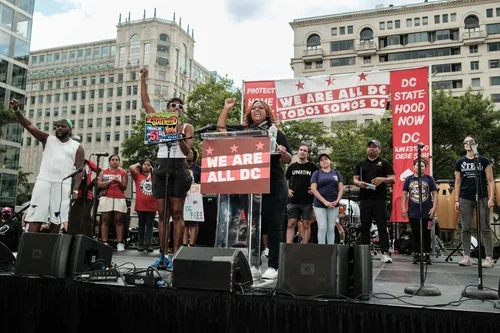
About ten thousand gather in Malcolm X Park (officially named “Meridian Hill Park,” but unofficially rechristened by Angela Davis and Black Washingtonians in 1969). They come from all walks of life. Black and white, transplants and DC natives, socialists and liberals, rising together under the banner of “We are All DC,” in protest against the occupation of the city by federal troops and the ICE agents surging into intimidate and abduct our neighbors. Unions including SEIU, UNITE HERE, ATU, and WTU are all represented, with UNITE HERE even bussing members in from Philadelphia (including some Philly DSA members who filmed the march and interviewed several MDC members) to show solidarity.
As we march down 16th Street towards the White House, churches ring their bells and congregation members gather on their steps waving Mexican, Palestinian, DC, and African American flags. Once we reach Freedom Plaza, speakers from unions, migrant justice groups, and Free DC all take their turns, but energy begins to ebb and the heat is causing attrition in the crowd. Finally, Councilmember Janeese Lewis George gets up to speak, and the mood shifts. She gives a fiery speech condemning attacks on DC’s autonomy and urging resistance against them. As she finishes with a call and response chant of “Hands off / DC,” someone shouts out that she should run for Mayor. The suggestion electrifies the crowd, which starts chanting “Janeese for Mayor.”
Months later, in December, she would announce her campaign for that very office.
Across the country today, thousands of Democratic Socialists are going door to door, making phone calls, and going on block walks on behalf of hundreds of socialist candidates for public office. DSA chapters are endorsing more candidates than ever before, and often for higher profile and more influential offices. Here in the Metro DC Chapter, we have endorsed a near-record of eight candidates: two for Maryland State Legislature (Gabriel Acevero and Raaheela Ahmed), two for Montgomery County Council (Izola Shaw and Josie Caballero), two for Prince George’s County Council (Imara Crooms and Shayla Adams-Stafford), one for DC Council (Aparna Raj), and, finally, Janeese Lewis George for Mayor of Washington, DC.
The quantity of these candidates is not the only remarkable thing about our slate this year. Aparna and Imara join Frankie Santos Fritz, elected in 2025 to the Greenbelt City Council, in our chapter’s first generation of “Cadre Candidates”: candidates and electeds like Zohran Mamdani who cut their teeth organizing in DSA and served in leadership positions in our organization. Imara and Aparna both served on the chapter Steering Committee (including a term as Chapter Chair for Aparna), while Frankie served on the Steering Committees for both the Montgomery and Prince George’s County Branches in addition to a tenure on Chapter Steering. In other words, these candidates are not just politically aligned with DSA but have developed as organizers through it and built their political apparatuses out of it.
The other notable development is our endorsement of Janeese for Mayor. The District of Columbia is a unique political entity in the United States: our government carries out all the functions of a state-level government like Medicaid while also holding responsibility for municipal functions like sanitation and public transit. This makes Janeese, in essence, a gubernatorial candidate (one of two such DSA candidates this year, the other being Francesca Hong in Wisconsin).
While all of these candidates exist as part of the same political project and moment, it is Janeese’s campaign on which we will focus. To start, we will go over a brief history of the chapter’s electoral program, followed by an overview of the political situation here in the District of Columbia along with how it fits in to the national context, and, finally, a discussion of how both the Janeese campaign and the chapter are navigating this political moment as we seek to build a people-powered DC.
The modern history of Metro DC DSA begins in 2016, when Bernie Sanders’ first presidential campaign led to a renaissance in DSA and Americans’ interest in socialism. This was possible through canvassing efforts, flyering at rallies, and search engine optimization undertaken by National DSA and chapters across the country. Young, hopeful organizers poured into the chapter. Our first post-Bernie endorsement was Ross Mittiga, a Charlottesville candidate running against David Toscano, the Democratic Minority Leader of the Virginia House of Delegates in the primary. Canvassers made overnight trips from DC to Charlottesville to knock doors. Mittiga lost badly, but DSA electoral organizers gained valuable canvassing experience and built relationships with Charlottsville DSA’s leaders, leading to a large MDC presence at the anti-nazi protests there that same year.
Fresh off this experience, we soon seized on a promising electoral opportunity closer to home: Lee Carter’s campaign for Virginia’s 50th District House of Delegates seat in the general election. Volunteers drove down from DC to Manassas to canvass, and we defeated an incumbent Republican in one of the first victories for DSA in its modern iteration (pre-dating AOC’s historic electoral win by seven months). Carter ran on a platform of universal healthcare and clean energy, and once in office he introduced legislation to cap the price of insulin and to overturn “right to work” in Virginia and created a legal framework for worker-owned cooperatives to incorporate in the state.
While Carter’s tenure in office would be ill-fated and he would end up retiring from politics in disgrace, electing him was a crucial step for both MDC and DSA as a whole. It showed us, and the country, that socialists could win over voters, even in swing districts–and that DSA could be a meaningful political force. In 2018, we would run a slate of candidates in Montgomery County with the goal of establishing a local caucus on the Montgomery County Council. We would elect Gabe Acevero and Vaughn Stewart to the Maryland House of Delegates, where they have fought for a universal basic income, affordable housing, and improved access to healthcare. Gabe Acevero has also successfully passed “Anton’s Law,” which makes police disciplinary records available to the public. Our County Council candidates, however, all lost.
Our 2018 slate also included Marc Elrich, who we elected to the Montgomery County Executive seat. Elrich is an early example of DSA’s forays into executive power: for a time he was the most powerful DSA elected in the country in terms of the size of his constituency and the budget he controlled. 2018 also saw us attempt an unsuccessful DC Council candidate, and run a slate of candidates for hyperlocal DC seats called Advisory Neighborhood Commissions, which saw mixed success in terms of victories although resulted in little real change or power. While not all of the 2018 electeds who won have maintained their relationship to the chapter, these races provided invaluable experience, win or lose, and our electoral work only expanded from here.
After two unsuccessful Virginia races in 2019, the focus of our chapter’s work would turn towards DC itself more fully in 2020. In addition to launching many large DSA for Bernie canvasses in Virginia and Maryland, we endorsed and elected Janeese Lewis George to the Ward 4 seat on the DC Council. In 2022, we would mount our largest canvassing operation up to that point, knocking 40,000 doors to add Zachary Parker in Ward 5 to our council bloc. Unfortunately, he would be censured in 2023 over his support for the SecureDC omnibus bill, a punitive and draconian crime bill that the chapter invested significant resources to oppose, and no longer has a significant relationship with the chapter. 2022 would also see the chapter play an instrumental role in the passage of Initiative 82, a ballot measure that would phase out tipped minimum wage.
In 2024, we reelected Janeese and knocked thousands of doors in Maryland for the Uncommitted Movement in the presidential primary, building consensus against the genocide in Palestine. We also knocked doors for Maryland Question 1, a ballot measure to guarantee reproductive freedom in the state constitution. We focused our efforts in Prince George's County District Five, to lay the groundwork for electing Shayla Adams-Stafford, a former teacher and Board of Education member, in an early 2025 Special Election. Shayla ran on affordable housing and promised to hold developers accountable. We then elected Frankie Santos Fritz to the Greenbelt City Council in the General Election that same year.
That brings us to 2026, where we have our slate of eight candidates running across DC and Maryland–including Janeese for mayor. This organizational history demonstrates that Janeese’s campaign did not materialize out of thin air. Her candidacy, and the chapter’s role in it, were made possible by years of effort, previous wins, and our fair share of defeats in the mix as well. This campaign is the culmination of almost a decade of work: thousands upon thousands of hours spent canvassing and painstakingly building trust and credibility with labor unions, community organizations, and other political players. Most critically, this work has all built the MDC chapter itself into a powerful local political force.
Throughout this entire period, DC has had only one mayor. First elected in 2014, Muriel Bowser initially positioned herself as an anti-corruption reformer, but that quickly gave way to the same sort of graft and no-bid insider contracts characteristic of neoliberal austerity politics that DC was already used to. Bowser’s three terms in office have been marked by systemic disinvestment from working class communities, attacks on workers’ and tenants’ rights, and spinelessness in the face of federal attacks on our autonomy.
Under the second Trump administration, these trends have only intensified. Now our city is under outright occupation, with federal troops patrolling the streets and ICE agents abducting our neighbors as Bowser’s administration denies and attempts to cover up MPD collaboration. This summer saw serious attacks on workers’ and tenants’ rights in DC with two pieces of legislation: a pause in the implementation of Initiative 82, freezing the tipped minimum wage at $10.00/hour and stretching the remaining increases out over the next ten years (when it will still only be 75% of the standard minimum wage) and the Rebalancing Expectations for Neighbors, and Landlords (RENTAL) Act, which makes it easier for landlords to evict tenants, strips rent control from new buildings, and further erodes the Tenants’ Opportunity to Purchase Act, a crucial piece of legislation that provides a pathway for DC tenants to take ownership of their housing.
This year and last have seen vicious fights over DC’s budget, as it continually gets ransacked by the federal government, which Bowser’s regime uses as justification for austerity policies (despite giving half-billion dollar handouts to sports team owners at the same time as the price of rent and groceries skyrocket for working class Washingtonians). There has also been an upsurge in militant labor organizing, with union recognition or contract fights waged at cultural institutions like music venues and restaurants, in the DC school system, and by our regional Starbucks workers participating in SBWU’s rolling strike effort.
Amidst these events, our chapter has been organizing ferociously. We have been a major participant in the struggles around the DC budget and the attacks on DC tenants’ rights through the “Fams not Feds” coalition, our Community Defense Working Group, which documents and disrupts ICE detentions, and our Labor Working Group, which stands in solidarity on picket lines with unions like UNITE HERE and Starbucks Workers United. Our public pressure campaign enabled Janeese and “progressive except Palestine” councilmember Brianne Nadeau to mitigate the harm caused by the RENTAL Act and strip out some of the most harmful provisions. Stomp Out Slumlords, or tenant organizing campaign, has continued to organize tenant unions and develop relationships with existing ones. We have also developed good working relationships with organizations like Free DC, an NGO which sprang up in the wake of Trump’s inauguration to fight back against his attacks on DC autonomy, as well as other local left-wing organizations, like the DC chapter of Freedom Road Socialist Organization.
This is the context in which leaders in DSA and the labor movement encouraged Janeese to run for mayor. Events like the “We are All DC” rally described at the beginning of this article and public statements by union leaders such as Linda Martin of UNITE HERE Local 25 made it clear that both the working class masses and the organized edge of the working class movement saw the need for a substantial break from the status quo.
Ultimately, our public pressure campaigns succeeded in calling attention to Bowser’s attacks on the District’s working class and tarnishing her political brand. This, combined with the political sea change signalled by Zohran Mamdani’s victory in New York City, resulted in Bowser choosing not to seek reelection. Instead, she endorsed as her replacement conservative councilmember Kenyan McDuffie, a close ally of housing developers, landlords, and PEPCO, and someone who has taken more meetings with utility company lobbyists than any other member of the council by a large margin.
Janeese announced her candidacy days after Bowser chose not to join the race, and one of her first stops was to speak as the keynote at MDC DSA’s local convention. Since then, she’s stood with DSA at every available opportunity and defied bad-faith attempts by the right to drive a wedge in the campaign’s coalition over her support for Palestine. Since our endorsement in January, DSA has become the largest single contributor of personnel to the campaign, with many members volunteering regularly, maxing out donations, and even working on the campaign as staff. Together with our labor allies (especially UNITE HERE), we stand as a strong left pole in the campaign coalition, ensuring that Janeese can take bold, pro-working class stances and fully embody the change her campaign represents.
Many have been quick to compare Janeese to Zohran, and while these comparisons are largely apt, there are a few key differences that should be understood by those who believe in the left wing electoral project. As Zohran was a cadre candidate, DSA had a far larger role in setting up the early stages of his campaign. While Janeese has a close relationship to Metro DC DSA and participates in the chapter by engaging in our democratic process and speaking at chapter events, she also has a broader coalition outside of it (though it should also be noted that many of these coalition partners are themselves fairly aligned with DSA–progressive unions, Free DC, and so on). Due to a difference in how endorsement processes are structured, Janeese set up her campaign before applying for endorsement, though many DSA members were still involved in the process. This was also the case with our cadre candidates this year. In addition, Zohran lacked broad name recognition in New York before running for mayor, initially polling at only 3%, while Janeese has been perceived as the front runner from the day she announced.
Janeese’s campaign shows that, while support from DSA was essential to his win, the progressive coalition is broader than just our organization, and chapters do not necessarily need a well-positioned cadre to pull off a Zohran-style campaign. Instead, the balance of forces and the openness of the masses to socialism in a particular situation can only tell us whether or not there is an opportunity for a political victory.
This also means we have to be proactive and aware of our role and tactics within this coalition. Our goal was to find a specific role where we could have the maximum value-add. For us, this has been canvassing tenants in apartment buildings. DSA’s long experience with tenant organizing enables us to gain access to apartment buildings that are dense with working class voters, but typically inaccessible to electoral campaigns due to management rules that try to reduce tenants’ political participation. DSA volunteers are not afraid to run afoul of property managers where other canvassers might not be willing to try. By and large, the tenants I’ve canvassed have been very responsive to Janeese’s message. I’ve also encountered a few tenants who had not yet heard of Janeese, but had heard of DSA, and our endorsement told them all they needed to know. DSA has also sponsored several hugely successful fundraisers and rallies, attracting national figures like Rashida Tlaib to help drive support for Democratic Socialist candidates in DC.
Ultimately, however, DSA’s role only makes a difference because Janeese has a strong message that speaks to working class needs and interests. It is abundantly clear that it is the left wing message, not a watered down, milquetoast version of it, that resonates with DC’s workers and tenants. She has been consistent and focused in her messaging about the need for a fundamental change away from a system where greed is good and government exists to enrich the friends and business associates of those in power and towards one that is driven by and for workers, that is designed to serve the people rather than rule them. She is also clear that we must act through government to achieve the changes we need: “No amount of mutual aid,” she said at her campaign launch rally in December, “is a substitute for a government that cares.”
Janeese is the latest in a generation of candidates decisively shifting the electoral playing field to the left and demonstrating that a better world is possible. Keep your eyes peeled for one coming to a city near you.
You can learn more about Janeese’s campaign here and join DSA here.
