The Populist Horizon: Julius Malema and the Case for Left-Populism
by Ant L.
Julius Malema’s treatment exposes the Western left’s discomfort with populist leadership. That discomfort limits its ability to engage in effective mass politics.
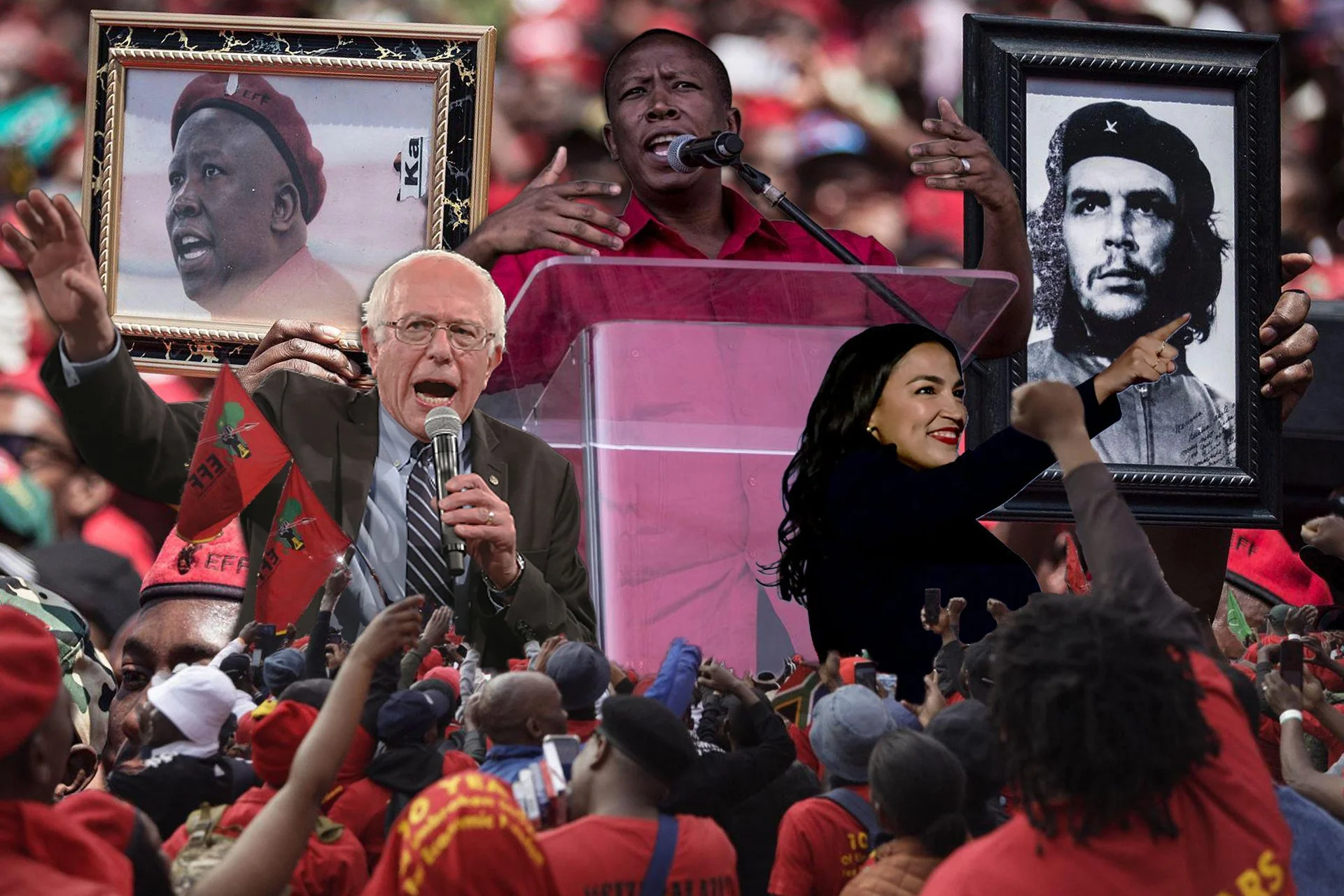
Credit: D Everett
Last week, South African opposition figure Julius Malema was sentenced to 5 years in prison for the crime of illegally possessing a firearm and discharging it in public. Malema, founder and leader of the leftist Economic Freedom Fighters (EFF) party, allegedly fired a semi-automatic rifle into the air during a 2018 celebration commemorating the party’s 5th anniversary in the Eastern Cape province. The sentence has a much deeper significance for Malema and his party than the mere possibility of time behind bars: under South African law, Malema’s conviction would bar him from serving in parliament, depriving the EFF of its leader and possibly threatening its future as a political party. Thus, regardless of the motive, the sentence effectively bars Malema from future participation in formal politics in South Africa.
The conviction has been widely reported and condemned across Africa and elsewhere in the Global South, but the reaction from the North American and European left has been contrastingly muted. This is odd given that Malema is perhaps the most prominent figure in post-apartheid South Africa and the leader of a Marxist party that claims to uphold and continue the legacy of the struggle against apartheid. Indeed, Malema receives much more attention from the international right than the international left, with Trump and his surrogates furiously condemning his recitation of anti-apartheid protest song ‘Dubul iBhunu’ and his demands for land expropriation.
Why is this? All sides of the Western left had some level of involvement in anti-apartheid solidarity before the 1990s, but South Africa now garners much less attention in our organizations and publications than it once did in general, Malema especially. This question has several possible answers, but one stands out in particular here: the failure to cognize the importance of figures like Malema today is rooted in a hatred of populism in the Western left intelligentsia. Western leftist intellectuals regard populist leaders and movements with a fundamental suspicion, as if they fear their own liquidation or annihilation if they get too close. This presents a fundamental challenge both for theory and praxis across the left.
In order to make this case, I will offer a broad definition of populism, its relationship to democracy, and why left populism in particular inspires the antipathy it does amongst leftist thinkers. Malema is at once a globally significant leftist leader and a polarizing populist figure in South African democracy. His charismatic and at times provocative leadership style is similar to figures like Hugo Chavez and Jean-Luc Mélenchon on the left and Trump or Berlusconi on the right, yet he is most often compared to Trump (or even Mussolini) by academics and journalists despite his strong connections to the left and his progressive political objectives.
While different perspectives on left-wing populism abound (expanded in this analysis to encompass figures like Bernie Sanders, Abdul El-Sayed, Zohran Mamdani, AOC, and Graham Platner), none have been so bold as to mount a full-throated defense of left-wing populism against its critics. Thus, I will take it as my task, if only for the sake of discussion, to defend left populism on its merits as a horizon that points to new and unforeseen political vistas and opportunities for the left. In conclusion, I will argue that abandoning our hatred of populism is the key to unlocking a number of the political deadlocks we confront amidst an interlocking set of crises both at home and globally.
First: What is populism? It is a contested concept that academics use liberally but often refuse to define. Para-academics often find themselves doing so to an even greater degree, basing their rejection of populism on a set of unstated priors. Indeed, Laclau reminds us in On Populist Reason that “a persistent feature of the literature on populism is its reluctance—or difficulty—in giving the term any precise meaning,” going on to note that “Notional clarity—let alone definition—is conspicuously absent from this domain.” We ought to linger for a moment and wonder what is to be gained from using a term so liberally whilst its definition remains unresolved. The practice of left populism, as it has been observed and defined, exists in an uneasy tension with the meanings with which leftist intellectuals have imbued the term “populism”, often standing in as an ersatz solution to unresolved intellectual challenges.
Nevertheless, certain elements that are vaguely agreed-upon can be identified: populism, for most interlocutors, is a style of politics based on an us/them distinction, attacks on elites and institutions, and provocative or charismatic rhetoric. As is also generally agreed, it can be put to almost any imaginable political purpose. What often goes unremarked upon is populism’s relationship to liberal democracy, and how it commonly arises in a context where a given society is democratic in theory but, for whatever reason, experiences a crisis. In such a crisis, we see either a degradation of democracy or a slide into a post-hegemonic condition where its political elites lose their mandate due to their inability to manage crises. Populism arises thus when elites appear to focus on the pursuit of their own interests, and/or the masses perceive some combination of democratic back-sliding and loss of legitimacy in the political class.
Populism can also be identified by its narrative structure. The populist leader emerges here through general appeals to the founding myths and concepts of the society in question, positioning themselves as the defender of a given set of principles and labeling the current leadership as illegitimate usurpers. Thus, a populist like Bernie Sanders is, in a certain sense, a deeply conservative figure: he has positioned himself as a standard New Deal liberal and argued that the Washington establishment has embraced runaway neoliberalism and corrupted an otherwise historically purer American democracy. France’s Mélenchon similarly positions himself as an avatar of France’s Republican ideals, much like Chavez’s Revolution was designed as a continuation of the legacy of the revolutionary Simon Bolivar. In almost all cases, then, the populist figure appeals heavily to the past and tradition, even as they shake up existing political configurations.
Analyses of populism generally focus on efforts by populist leaders and movements to curry mass favor by focusing on broad appeals to grievances and values, often at the expense of sharper ideological positions. This is certainly accurate, but the specific relationship populism has to liberal democracy often remains unexamined. Populist leaders, of both left and right postures, generally arise in (perhaps only nominally) democratic contexts, and almost always participate in elections in some way on their road to power. This ambiguous relationship between populism’s violation of liberal democratic norms and its ultimate recognition of its legitimacy arises from the contradiction within liberal democracy between the orderly and peaceful recognition of social conflicts and democracy as the will of “the people” expressed in politics via electoral means. The necessary tension between the two definitions gives rise to the populist as we understand them, which explains both the success of populism in liberal democratic societies as well as its absence (and thus the continuation of left politics via other means) in situations where democratic or republican ideals are not the basis of the political system.
Opponents of populism often focus both on its refusal to construct a political subject based on their preferred category (whether it be class, race, or so on) and its implicit acceptance of the legitimacy of its host society, which comes by way of participation in its formal political processes. Anti-populists generally ignore the basic historical fact that revolutions primarily occur in contexts where the political status quo makes no paean at all to popular sovereignty or institutional checks on sovereign power: the twin pillars of democracy. By its very nature, democracy is designed to contain and absorb social friction and use it to strengthen its own legitimacy. It may very well be that the United States and other capitalist democracies continue their backslide from liberal democracy into various explicitly oligarchic forms of political life, such that a revolutionary response becomes inevitable. Leftist intellectuals, however, cannot dictate this inevitability; only the masses can. At this time, given the immense gains by the Left within the Democratic Party and the labor movement, the anti-populist leftist thinker is left celebrating or bemoaning what appears to be a series of genuine victories, trying to explain why they somehow don’t count. Of course, populism and revolutionary politics are not mutually exclusive, and the forced opposition between the two is a false dichotomy. Indeed, the purpose of a cleavage between the two is to construct a pure (perhaps Platonic) form of revolutionary politics which has no ontic presence in the world before us and is always waiting to be ushered in by some kind of existential break. Thus, anti-populism comes to us as a means of rescuing revolutionary politics from contact with reality, removing revolutionary theory from history.
Critics will point out that left-wing populists like Zohran Mamdani have yet to abolish capitalism, end American imperialism, shepherd us to the good life, and so on. The idea that left populism has been successful in the United States invites a good deal of critique, given that it has not achieved its goals and, to some, has sapped energy from more revolutionary or truly anti-systemic movements.
However, the many critiques of American left populism are, in reality, subtle acknowledgments of its success. It is a simple fact that inchoate left populism, like that practiced by Abdul El-Sayed and Summer Lee, has made a huge qualitative impact on the political environment in the United States, and that left populist commentators like Hasan Piker are commanding a level of influence within progressive politics that would previously be unthinkable. Even if they have not yet succeeded in the sense of achieving the ultimate revolution, they have, nonetheless, shown us how to succeed in politics.
Thus, the increasing prominence of left-wing populism generates more and more criticism of left-wing populism, because there is a visible and impactful left populist movement to critique in the first place. Critiques of other tendencies in American leftism, when made in good faith, mostly boil down to their inability to achieve anything meaningful at all. Zohran Mamdani’s victory over Andrew Cuomo and his assumption of the executive office of the world’s financial capital, on the other hand, necessarily means that there is now a socialist mayor to critique.
The same can be said of DSA, which is a big tent and contains a wide range of ideological viewpoints, but attracts intense criticism and attention because it has been so impactful. Nobody can credibly accuse critics of left populism of punching down or top-down ideological policing, because left populism is in the power position in American leftism. Thus, it can be critiqued endlessly with no burden of proof on its critics to provide a more effective alternative. Therefore, leftist intellectuals are incentivized to build an audience, if not a career, attacking it with no real downside for doing so.
By triangulating between leftist ideals, democratic or republican values, and the political feelings of its mass audience, left populism thus has the consequence of displacing leftist intellectuals. Regardless of ideological position, if a leftist politician like AOC threads the rhetorical needle between the lived experience of her constituents and an inchoate leftist program effectively, you are left out of the conversation. There is no need for you to explain to the masses their false consciousness, because the program has already been laid in front of them in terms they understand and identify with. Indeed, Lenin teaches us in Left Wing Communism that “Revolution is impossible without a change in the views of the majority of the working class, a change brought about by the political experience of the masses, never by propaganda alone.”
Mamdani’s use of the phrase “a New York we can afford” displaces “the working class” as the subject of politics, and is effective for precisely that reason. The leap between identifying oneself as a New Yorker or an everyday person and internalizing a series of leftist concepts like class consciousness or internationalism is immense in comparison to the impact of left populist rhetoric, and in our current information environment, which is light on substance and heavy on imagery, left populism is guaranteed to be more persuasive.
The fact remains that the concept of class most commonly in play by leftist intellectuals does not mobilize masses to political activity in the 21st century. Ironically, this produces a reverse effect wherein left populism can continuously be critiqued by virtue of its capacity to actually produce political effects, whereas a “class first” politic remains unsullied by the dirt and grime of historical life due to its non-appearance beyond a few small sects. Witness the shell game where every failure of organized leftism is due to the fact that we simply haven’t tried the right focus on “class,” and when we get it right, everything will fall into place. This is not dialectical at all, but does rescue the bright minds of the intellectual left from having to be accountable for their ideas failing to launch. Perhaps even more ironically, many of those who insist on an idealist version of working-class politics would defend or contextualize the shortcomings of the USSR (rightly so) based on the fact that there is no successful example of a (insert tendency here) revolution to make a comparison. The success of the October Revolution then becomes evident in the many criticisms of actually existing socialism. Why can’t we defend actually existing leftism on the same grounds?
It may be true that, from a theoretical perspective, the use of “we” rather than “the proletariat” isn’t orthodox class framing, or that AOC, despite all her success, has taken and continues to take compromising, liberal Zionist positions for the sake of electability. We can ponder and explore the viability of these perspectives as much as we like, but ultimately, we must understand that they are irrelevant in a media environment where the more inchoate or multifarious demand of “affordability” mobilizes a mass base, and the average politically involved person perceives AOC to be one of Israel’s primary opponents in Congress.
It is easy to feel frustrated. Mamdani, in particular, has made a few turns on Palestine that are totally inexcusable given the centrality of Palestine and Palestinians in his political career. The answer, however, cannot be to insist on being correct while refusing to acknowledge that the information environment we are operating in does not allow us to make our critiques effectively to a mass audience. The way out is through, and only by elevating left populism to a hegemonic condition and defeating the forces of overt reaction can we open a space to correct its errors. This seems to be true regardless of the value judgments involved. Leftist thinkers must accept that our destiny is fundamentally tied to left populism, whether we consent to it or not. Further, as J. Ryder argues in the Paradox of Icarus, a critique of left populism can achieve much more in a scenario where said populism is hegemonic. The Palestine solidarity movement made tremendous gains in recent years, criticizing DSA and its elected officials for their missteps on Palestine, critiques which derived their force from the popularity of Sanders and AOC. Thus, defenses of DSA and its electeds from “ultra” criticism miss the underlying point that a focus on targets perceived to be both moveable and within striking distance of the now lifted PYM boycott of DSA, for example, has ultimately in the end advanced left populism itself, the organized left, and the Palestinian cause in lockstep. Viewed from this angle, we see that it is in our interest to see figures like Graham Platner elevated, even if we disagree in some ways with their politics.
This is borne out in the facts, as well. Left populist electoral campaigns, as has been observed in Geese, are responsible for much if not most of the growth in numbers seen on the organized American left over the last decade. Yes, social movements like BLM, Palestine solidarity, Land Back, and others have grown rapidly during the same period and made huge strides. Yes, left populism has had a complex relationship to those movements and their critiques of American democracy. There are a great deal of contradictions that need to be worked out. But can we truly say that left populism itself has not been generative of a great many opportunities for the broader organized left to make political interventions from whatever angle? Prior to the Occupy movement and Bernie Sanders’ political campaign, the leftist reading environment was limited to small literary magazines, academia, and obscure newsletters. Today, we have Hasan Piker, who broadcasts an inchoate and at times underdeveloped leftist worldview to his 3 million subscribers daily. But even granting his faults, would we be better off without him? Could our talking points reach a mass audience? Do they, right now?
The answer is no. In fact, it begins to seem that left populism is the only generative force capable at this time of bringing the masses into contact with any form of political engagement, regardless of your tendency or ideology. Indeed, the vast majority of Americans are downwardly mobile in economic terms, and our political elites continue to wreck their own legitimacy and moral authority as time goes on. These phenomena do not, in isolation, “radicalize” anyone. An alternative must be presented at mass scale that millions of people are able to understand and identify with, and as Marxists, we understand that it is the masses that make history. We can already observe the massive qualitative shift in organized American leftism wrought by Bernie Sanders’ two presidential campaigns. What reason do we have to insist that similar phenomena will not produce similar effects in the future? We genuinely do not know what will happen if left populist candidates keep winning elections all over the country, much like we do not know what will happen if Hasan Piker keeps growing his audience and learning how to occupy his new position of growing power and influence. Perhaps this subtle recognition that a political horizon is opening elicits a fear of flying, and it is easy for us to stick to what we know best: permanent, unending failure.
Across the Atlantic Ocean, Julius Malema (who will appeal his sentence) faces political repression from the South African political elite and constant attacks from the global right wing; his mode of politics clearly poses a threat in this regard. Does the West’s left intelligentsia have its own role to play in keeping everything in its right place?
We have a choice. We can accept that things are changing, we do not have every answer, and that we genuinely do not know what happens next. We are not contractually obligated to rehearse 20th-century arguments in perpetuity. There is something more important happening: a left populist worldview is arising all around us and gaining in prominence across new swaths of our society. We must decide what role we want to play in it; history will not wait for us.