
Apr 24, 2026
An Autopsy of MAGA Communism: Into the Crisis of the so-called “American Communist Party”
An examination of how Haz Al-Din, Jackson Hinkle, and the American Communist Party mistook social media engagement metrics for popular sovereignty—and why their theory of an "empty signifier" could never fill MAGA with anything but MAGA.
by Gigi G
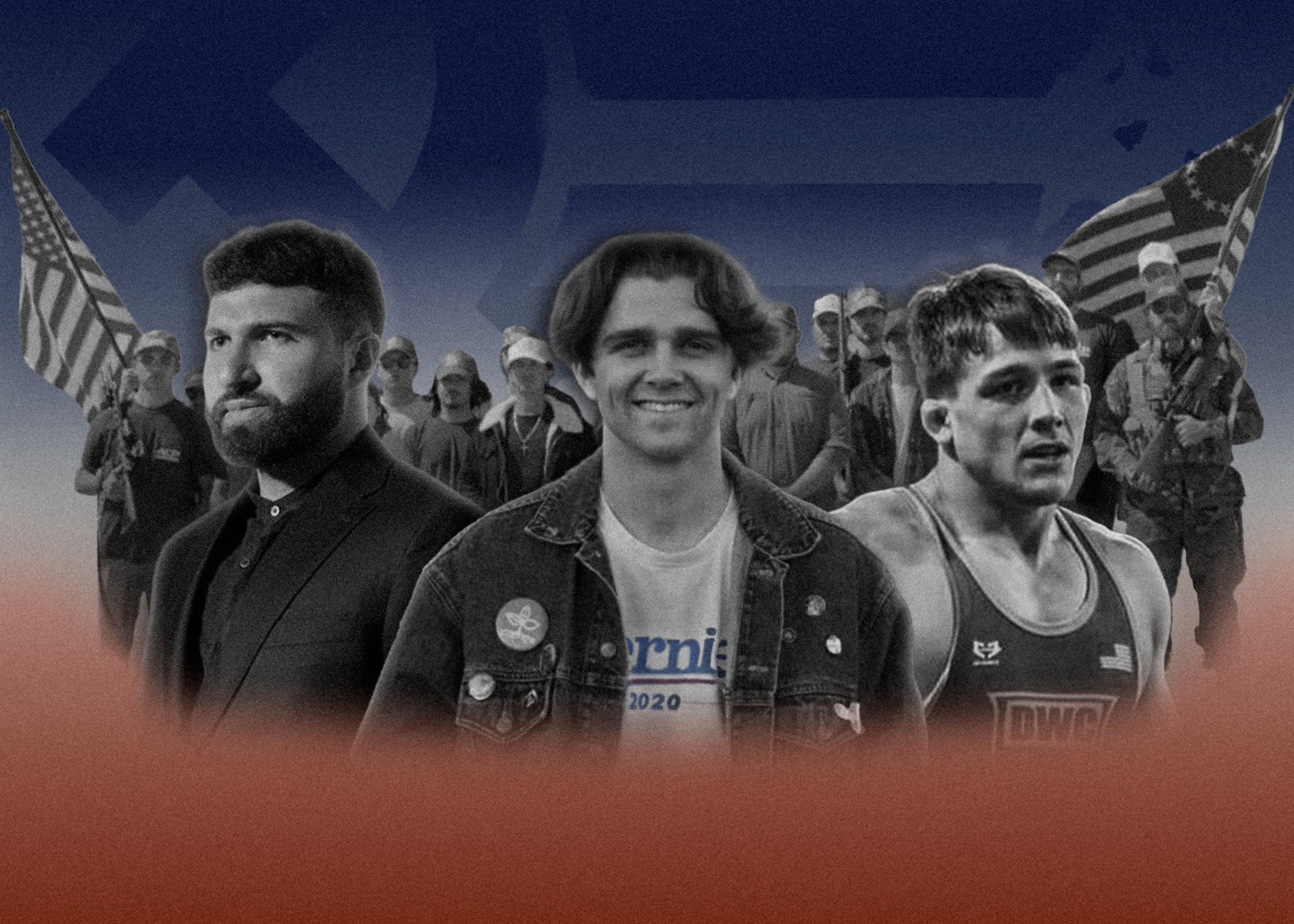
Credit: D Everett
In the fall of 2022, a young man with a camera worked a MAGA rally in Michigan.
He asked rallygoers, “Don’t you think Wall Street and the big bankers are screwing over the working class?” They agreed. He asked if the government should be “by and for American workers.” They agreed again. He asked about Bill Gates buying farmland, corporations crushing small farmers, and the need for "common prosperity" over Wall Street profits. Nod after nod.
And then came the punchline: “So there's a new idea called MAGA Communism...”
Most interviewees laughed and grew evasive. A few tried to find common ground: "I like the idea of common prosperity, but I'm a free market capitalist."
This young man–Haz Al-Din, self-described “Orthodox Marxist-Leninist” and “Tankie Warlord”–came that day not to support Trump. He came to try to prove that his idea could gain traction in the MAGA base.
Al-Din elaborated:
“The Communism thing means common wealth, common prosperity. We all come together: the workers striking at the railways, the MAGA industrial working class, the small farmers, we all unite with our power. We kick out the globalists. We kick out George Soros. We kick out Klaus Schwab. We stop that Great Reset agenda in its tracks.” [1]
Al-Din's pitch notably lacked any reference to class struggle, internationalism, abolition of private property, or any other concept central to the communist worldview [a]. Taking its place is right-wing conspiracy culture. Even so, rallygoers balked at the word "Communism." So Al-Din swapped it back out for ideas they could nod along with. Al-Din told rallygoers that MAGA Communism was "an internet trend," a meme, not to be taken too seriously. MAGA Communists, meanwhile, promoted this video as “proof that MAGA is ready for Communism” [b].
Between 2022 and 2024, MAGA Communism managed something most esoteric political tendencies never achieve: it became the object of public fascination (and derision). The Guardian called it a "deranged fringe movement." Jungle World called it "Not left, not right, but fascist." Yale professor Daniel HoSang called it an "opportunistic ideology," "redirecting working-class discontent into a reactionary framework." Vice News and Compact Magazine argued it lacked any form of ideological consistency at all.
Al-Din built Infrared into a platform with notable reach on YouTube, Twitch, and Kick. His collaborator Jackson Hinkle—a former political activist and Bernie Sanders supporter turned self-described "Christian Communist American Patriot"—has amassed millions of followers on X. Together with Midwestern Marx, a TikTok collective with hundreds of thousands of followers, the MAGA Communists built a theoretical journal, an organizational strategy, and finally, in July 2024, a political party.
They called it the American Communist Party (ACP).
The party launched to considerable online virality and controversy, but failed to distinguish itself in practice from the dozens of already existing communist micro-parties. It immediately stagnated—it held no conventions of substance [c], ran no candidates, organized no workplaces, led no tenant fights. Its primary output remained the same as the organizations that formed it: content. The "party" functioned as little more than a PR machine for this influencer network.
Today, the MAGA coalition has fractured. The multifaceted crisis of Trump's second administration has the populist right scrambling to capture the political momentum. Tucker Carlson and Nick Fuentes have begun to appropriate the language of anti-imperialism and economic populism, constructing a right-wing insurgency within the Republican Party that positions itself as the authentic heir to the MAGA movement.
Carlos Garrido, writing in Midwestern Marx in May 2025, saw this fracture coming. He predicted Trump would alienate his own base, leaving MAGA voters up for grabs. Garrido saw the ACP as the heir apparent of this base, going so far as to say that, “pretty soon we will be in a situation where political actors in America will be forced to choose what political vision they will align themselves with: MAGA Communism or the Nazis.” [2]
And then, in March 2026, Al-Din announced via livestream that "MAGA Communism is dead."[3] —abandoned at the exact moment its theorists had predicted would be its breakthrough. Asked to explain this sudden reversal by his livestream chat, many of whom devoted considerable energy to the strategy, Al-Din’s only explanation is that it had been "sabotaged by Leftists."
Al-Din once called his movement "irreversible" and "historically necessary," only now to declare its premature demise. How could a few "leftists" have simply sabotaged a cause with such supposed weight? It is a convenient excuse, but leaves us with questions. What was this project? What were its guiding principles and goals? And why did it fold the same instant they theorized it would break through?
1. What was MAGA Communism?
There is a tendency among critics to wave away the MAGA Communists as something foreign to the socialist movement—a coordinated infiltration, fascists, mere internet trolls, or a meme not to be taken too seriously. They are portrayed as people who were never really one of us. Critics have focused on dubious domestic and foreign intelligence connections, ties to neo-fascist intellectuals like Aleksandr Dugin or Lyndon LaRouche, and the group’s extreme hostility to the broader left, including an attempt to covertly infiltrate and seize control of the Communist Party USA[h].
This is not the whole picture. It does not explain how the MAGA Communists arrived at their positions. The vast majority of founders and active members of the MAGA Communist tendency came directly out of the Communist, Socialist, and progressive movements. They were more often supporters than leaders, and when they did lead, they led profoundly marginal groups. They were union stewards and rank-and-file members. They participated in mutual aid, marched with Black Lives Matter, and occupied Wall Street. They were founders and members of tiny DSA chapters, DSA factions, and the handful of Communist micro-parties that dot the American landscape. Some are academics in history, politics, and even hold degrees in Marxism itself. Some fought against the seizure of Native American land for oil pipelines, and against the oil industry generally. Some were volunteers in overseas socialist military organizations. Some worked on independent socialist or left-progressive political campaigns and ran as candidates themselves, usually for offices they had little chance of winning.
While the MAGA Communist tendency did not attract very many people, it did draw from diverse strata of the Communist movement. It was able to do so because it was, in part, an expression of more widely felt disillusionment with this movement—its chronic marginality, its organizational impotence, its inability to offer any credible political power to the masses, its myopia. Every Communist in this country has shared these grievances to some extent. The MAGA Communists were people who were part of our movement, had seen the results, and concluded that the movement itself was a dead end–and opted to go a different direction.
MAGA Communism developed in embryo during the first Trump administration. It was a convergence of the growing influencer economy with the deep political disorientation of the left after the failure of the Bernie Sanders campaign, which the vast majority of the MAGA Communists once counted themselves as supporters of.
They began from a premise all communists share: Communism must become a mass politics, or it is nothing. But from this common starting point, they drew inverted conclusions. Faced with the collapse of the Sanders campaign, most of the left responded by turning toward the progressive working class—building new organizations, new cadres, new strategies, new infrastructure aimed at developing the masses Sanders had demonstrated were reachable into a political movement.
The MAGA Communists moved in the opposite direction - towards the “MAGA working class”. In their pursuit of something new, something more energetic than the old left, the MAGA Communists became a reflection of the myopia they sought to escape. Much of the left has been too embarrassed by this reflection to examine it properly. It is far easier to denounce the MAGA Communists and wave them away.
A. In their own words: An Examination of the Theory
MAGA Communists have offered, at varying points, contradictory self-definitions. In 2024, Al-Din attempted to clarify his philosophy in "MAGA Communism - A Response to Critics":
"First of all, MAGA Communism is not a 'new' or 'syncretic' ideology. It is a slogan coined by American Marxist-Leninists. This slogan reflects a very specific appraisal and analysis of the current historical situation in America from an Orthodox Marxist-Leninist perspective. In no way does it amount to combining Marxism with American Right-Wing ideology." [4]
For Al-Din, then, MAGA Communism was nothing more than a “slogan.” And, when attacked, this was what the MAGA Communists frequently retreated to: “it is just a slogan, don't take it too seriously”. But Al-Din contradicts himself:
“MAGA Communism is a historical and strategic perspective, which amounts to the following: The rise of MAGA in 2015-2016 marks an irreversible point in the rise of a new form of popular sovereignty in America - which American Communist politics will be rebuilt out of.”
Instantly, MAGA Communism is promoted from a slogan to a theory of history! Al-Din then asserts that MAGA permanently altered American politics and that a new politics must be rebuilt on its foundation. He elaborates:
“[MAGA] was the genesis of a new form of popular sovereignty, based on cybernetic relationships that could give expression to the general will better than the 'democratic political institutions' were able to. [...] Additionally, it only represented the birth of a new popular sovereignty—one that still lacked a correspondingly new political authority and organization - such as a new party.”
MAGA Communists believe that the MAGA movement, through “cybernetic relationships”, i.e., social media engagement, achieved something closer to the expression of the general will than the American democratic system ever had. This new sovereignty "lacked a correspondingly new political authority and organization—such as a new party"—a party, naturally, that Al-Din and his collaborators would supply.
The MAGA Communists never articulated a functional theory for what this new "cybernetic party" actually is. How does it operate? How does it recruit, educate, and develop leaders? How does it grow beyond digital metrics and translate into material power?
The Marxist-Leninist theory of change treats organization of the party as a continuous process of selection, concentration, and return: to gather the dispersed and contradictory aspirations of the most advanced, most progressive strata of the masses, synthesize those aspirations through a revolutionary framework, and then, finally, to return that synthesis in the form of a political line capable of organizing the masses in transforming reality, seizing state power, and abolishing class society.
Crucially, this theory necessarily gauges differentiation within the masses. Not all tendencies are equal; some point beyond the existing capitalist order, while others are regressive, binding their adherents to the reactionary past. The task of the party is not to collapse this distinction in the name of a hollow, "cybernetic" populism, but to clarify, organize, and develop it. It is by consolidating the most advanced elements into a force capable of organically leading the rest that the Communist Party form manifests.
Despite claiming to be based in an “Orthodox Marxist-Leninist” perspective, Al-Din does not engage with this theory whatsoever. Instead, Al-Din returns to his grandiose conception of MAGA—elevating social media itself to the level of a historical rupture:
"The highpoint of dictatorial consolidation of all [democratic] institutions by the financial elites - is simultaneously the point at which the productive relations have outmoded them the most. What we witness is the rise of a cybernetic form of mass politics, or 'e-populism,' which is post-liberal not simply in terms of its ideological content (Communism, nationalism, conservatism, etc.), but in terms of its actual material form."
Al-Din identifies a dictatorial character of liberal governance under monopoly capital—the hollowing out of democratic institutions by bourgeois dictatorship[i]—but what here begins as a realistic assessment quickly constructs idealistic prognoses. Because liberal democracy is a facade for bourgeois dictatorship, Al-Din reasons, any form that supersedes it must represent an advance. Fascism also superseded liberal democracy in Italy and Germany—does Al-Din propose that Mussolini's corporate state represented a progressive development? The criterion for historical progress in Marxist thought is not the novelty of “material form” but the class content of that form—which class wields power, and toward what end.[d]
This absence of class analysis is characteristic of MAGA communist theory. Al-Din's “cybernetic sovereignty" does not place the working class as the referential centerpiece of this feedback mechanism. It places a bourgeois demagogue at the center of a loop whose infrastructure—the platforms, the algorithms, the data—remains the private property of capital. To call this an advance over liberal democracy is to confuse the replacement of one form of bourgeois rule with another for the abolition of bourgeois rule itself.
These social media platforms have been thoroughly integrated into normal dictatorial political practice. Political institutions of all stripes participate in social media, and representatives of disparate bourgeois factions struggle to control property and narratives in the digital space exactly the same way they do in traditional media. What Al-Din describes as a rupture in political form is, in fact, merely a new terrain upon which the same class forces contend. MAGA Republicans and establishment Democrats embrace social media populism only rhetorically. Their actual governing bodies—their donor networks, their legislative apparatuses, their judicial pipelines—remain as exclusive as they ever were.
To summarize: MAGA Communism was simultaneously:
An original analysis rooted in “Orthodox Marxism-Leninism”
A theory of history asserting an irreversible transformation in American politics
A theory for a new type of political party, a “cybernetic” political party built on social media.
A theory of democratic legitimacy, of popular sovereignty, of the will of a people, that has already superseded all existing democratic political institutions, to be realized through social media engagement metrics, and finally;
A mere slogan, internet trend, or meme, not to be taken too seriously.
B. The Hidden Meaning of MAGA?
MAGA Communists argue that “MAGA is an empty signifier” [5], a word or symbol whose specific content is less important than its populist function as a pole of attraction for diverse, contradictory constituencies. In the MAGA Communists’ analysis, "MAGA" operates like "Hope" or "Change" did for Obama in 2008. And, if untethered to a concrete program or history, an empty signifier can theoretically be filled with any meaning, including Communism.
Al-Din describes the meaning he finds in MAGA in an interview with Platypus Review:
"I really like the idea of 'Another America.' Many think 'Make America Great Again' means 'return to the past.' To me, it means there's another America that's not this one, a material, Bizarro World America. I'm very interested in that. My crazy thesis that so many people lost their minds over is that MAGA bears a lot of similarities to an American socialistic - even socialist realist - movement." [6]
For Al-Din, MAGA is simply a term that can be filled with socialism. But his attempt to reimagine what MAGA means ignores the fact that the term is already overflowing with the content of a concrete reactionary political movement. MAGA is not a blank slate; it is a meticulously constructed vehicle for white grievance, imperial nostalgia, and the worship of a billionaire strongman. Al-Din is well aware of this history, but simply waves it away.
"That the MAGA masses are articulating their yearning for popular sovereignty eclectically, imperfectly, and wrongly does not reduce their yearning to the imperfect expression readily accessible to them [...] In terms of political content, MAGA is rather mundane. It is just a basic transcription of standard American ideology into an entirely novel and cybernetic form.”
MAGA’s base is reduced to a naive expression of a 'yearning for popular sovereignty'. Racism is just 'eclectic,' nativism is 'imperfect,' destruction of civil rights, democratic rights, women’s rights, and so on is “standard American ideology”, worshiping a billionaire strongman is merely a 'wrong choice,' and all of it is ultimately dismissed as “mundane.” He strips both the movement and its supporters of their actual political beliefs. He dismisses the concrete reality of what MAGA is and what it does, preferring his ideal: that underneath the real MAGA movement lies a pure, democratic yearning waiting for him to mold it.
Al-Din treats "MAGA" as a pre-existing vessel that can simply be filled with new content, ignoring that its content is already determined by a specific chain of equivalences (white grievance, anti-immigrant sentiment, imperial nostalgia) that constitute it. An empty signifier emerges from a “chain of equivalences” among disparate social demands—it is empty because it signifies the unity of many particular struggles that are only contingently linked to it in the course of real struggle, not because it lacks any meaning at all. It is a product of political practice rather than rhetoric.
To claim this vessel is “ready” for appropriation to socialism by rhetoric is a delusion—a delusion that Al-Din is at least somewhat conscious of, as he pulls punches when directly communicating with MAGA.
The MAGA Communists are right about one thing: They assert that American Communism must be rooted in American history. They insist that the revolutionary war, the civil war, the civil rights movement, and Abraham Lincoln's vision of government "of, by, and for the people" form the legitimate inheritance of the Communist movement. They warn against "national historical nihilism" and insist that the "positive aspect of our history must be celebrated and studied."[f]
Yet their chosen base—MAGA—is actively demolishing that history. MAGA does not celebrate the civil rights movement. It does not honor Lincoln's democratic vision. It carries confederate flags, it rallies behind Trump—who hates democracy and hates the last 100 years of American progress. The "national historical nihilism" MAGA communists consider unacceptable and worth separating themselves from on the left is apparently inconsequential on the right.[g]
Al-Din insists that MAGA is "unique" and represents the "most advanced section of the working class," only because MAGA “represents a genuine break with liberal institutional form,” a "cybernetic populism" that bypasses the dead structures of representative democracy. But what is unique or advanced about any of this? A yearning for popular sovereignty against elite institutions is not a discovery of the MAGA movement—it is the animating impulse of populism in every era and on every point of the political spectrum. The Populist Party of the 1890s, the New Deal coalition, the movements behind Sanders and Occupy, the anti-war movement, the Black liberation movement—all express precisely this yearning, and most of us do so with far more advanced politics than MAGA. To carry the actual inheritance to the progressive American historical tradition, Al-Din claims, means celebrating the legacy of these fighters for progress, not making excuses for the inheritors of the Confederate historical tradition.
The obvious heir to the history of democratic popular struggle stood right in front of them: the growing progressive base. The MAGA Communists ignored it. Instead, they chased after MAGA. They shed distinct political identity, independent organization, and concrete demands to court MAGA. MAGA, flattered but unchallenged, nodded along and returned to its actual political home. The progressive worker rejected MAGA and returned to theirs.
In 2026, as MAGA fractures, the MAGA Communists fail to attract anyone. They have nothing to offer its dissidents—no organization, no institutional power, no viable program. They abandon their theory, and instead, it is the Democratic Socialists, Democrats, and alt-MAGA forces like Tucker Carlson and Nick Fuentes who have won over those who have departed from the MAGA movement.
2. Cultural-Political Deference to the Bourgeoisie
Eddie Liger Smith, a Midwestern Marx leader and later ACP founder, addresses the MAGA Communist approach in "In Defense of the MAGA Communism Strategy." [7] Communist politics must be acceptable to workers with right-wing cultural and political beliefs. Workers who might be put off by "leftist jargon" or "the near obsession with liberal identity politics that many leftists have" are to be "routed"—split off from the mainstream left and directed toward the MAGA Communists. There, they are offered a sanitized version of anti-imperialism and social-democratic economics, stripped of any demands that might disturb their prejudices.
This is not a new argument. The deferral of social and cultural questions in the name of “class unity” is one of the oldest and most persistent errors in the American socialist tradition. Each generation of American socialists has produced a faction convinced that the struggle against oppression is a distraction from the "real" class struggle, and each is paralyzed the moment the bourgeoisie deploys the divisions it declines to confront.
A novelty of the MAGA Communist movement is that it emerged in part as a reaction to the New Left, influenced by post-Marxist cultural theory, drawing from analysis detached from working- class organization, or from the semi-trade-unionist community-organizing tradition of Saul Alinsky. These tendencies had, in practice, dissolved class organization into a constellation of identitarian appeals, producing a left that was, as the MAGA Communists rightly observed (along with everyone else), organizationally inert and divided, with no mass base.
MAGA Communists did not correct the error; they reflected it. Where the post-Marxist left collapsed class into the various subcultures of urban professionals, the MAGA Communists collapsed class into a mythical monoculture of the white rural worker. But this mythical worker is himself an invention of the urban professional—a stereotype inherited from the traditional media ecosystem that the MAGA Communists claim to reject. Both are essentially factional politics—seeking to organize a sliver of the class. Both tendencies sever what Communism insists must be joined: the organized, independent political power of the whole working class and the struggle against every form of exploitation that divides it.
The MAGA Communist solution to win over the whole working class is to set aside, or, in some cases, even intentionally reinforce reactionary positions around cultural and social questions in order to build unity around social-democratic economics combined with rhetorical anti-imperialism (rhetorical in the sense that it often lends itself more to right-populist isolationism than any anti-war effort). The MAGA Communists understand, at least in the abstract, how the ruling class deploys racism, nativism, and chauvinism to fracture working-class solidarity. And yet their strategic response is to surrender this entire field to the bourgeoisie. Rather than contesting bourgeois cultural hegemony—rather than fighting for a working-class culture of solidarity, internationalism, and democratic self-determination—they instruct the working class to defer cultural questions to whatever dominant formation the worker already inhabits. For the MAGA worker, this means deference to MAGA culture.
For all their posturing as hard-nosed realists against liberal sentimentality, the MAGA Communists' approach to the divided working class is the most naive, kumbaya, utopian position on offer. Their theory of unity amounts to this: if we simply stop talking about the divisions—oppression will cease to operate along those lines.
Eddie, in a livestream [8], gives the example of the two friends of different races making racist jokes to each other and posits that racism is effectively dead in America among the working class. This is a common enough story, but one that has little bearing on the political racism which plagues America and which many American workers are engaged in. The question at hand with racism is the political-economic structure—who is hired, who is jailed, who is deported, who is shot, who is lynched. Saying what we know must be done about American racism might upset the Trump supporter, whom he is desperate not to offend. They do recognize that these things exist, but they do not attempt any position on these issues other than a vague notion of “building socialism.”
When a unity built on the suppression of cultural questions meets a challenge that divides on cultural lines—when two people come into conflict over a question that cannot be reduced to economic equality or “anti-imperialism”—Can my transgender daughter join the women’s volleyball team? How is this to be mediated?
On concrete questions of human dignity, the MAGA Communists vacillate. Sometimes they see no question at all, dismissing it as a distraction from class struggle. But just as often, they actively reinforce reactionary cultural positions through their particular fetishization of the worker: "No, she can't—this threatens traditionally working class sports culture." When asked about immigration: "No, they can't come in—they upend opportunities for other workers.”
During a MidwesternMarx Livestream, viewers attacked Cuba's Family Code as being “woke”, a code that legalized same-sex marriage, transgender rights, adoption, and surrogacy, which was approved in a landslide by national referendum after over 79,000 public meetings. Eddie mustered a defense only by couching it in anti-imperialism—the policy was defensible not because the working class deliberated and affirmed it, not because it is morally right, but because it is Cuba's, and Cuba has the right to self-determination.
But self-determination is not a prize collected after victory. The Cuban working class has long exercised self-determination through precisely the kind of struggle that Eddie's framework abstains from.
Twenty years before the Cuban Revolution, under Batista's de facto military authority, an impending coup, and the onset of World War II (A frighteningly familiar situation for American Communists), the Communist Party of Cuba, Black and feminist organizers, labor activists, and other progressive leaders convened the Third National Women's Congress. The Congress built the organizational and ideological groundwork that the Communists carried into the 1940 Constitutional Assembly, where six Communist delegates—led by Blas Roca and Juan Marinello—argued for the abolition of birth-status discrimination, for racial equality under law, and for women's economic independence. They earned through this struggle, as part of a broader left coalition, one of the most progressive constitutions in the Western Hemisphere, as a deliberate project of working-class self-determination.
Yet in America, when the working class takes up these same questions, to practice our own right to self-determination—to unify on our own terms, the MAGA Communists consider it a disunifying diversion. Contrary to the MAGA Communist attitude—this is the only way for the working class to actually unify, to actually become sovereign and self-determining.
Eddie and many other MAGA Communists admit privately that the left is correct on these questions of oppression, but ‘discipline’ themselves not to say so publicly. This is the MAGA Communist's peculiar form of faith in the working class: he honors the worker's intelligence by lying to him. He has such profound faith in the people that he dares not tell us what he actually thinks, in fear that we may not be able to take it!
A movement that surrenders debate on cultural questions to the bourgeoisie cannot hold the line against total political capitulation. If the working class is instructed not to form its own positions on the questions that divide it—if we are offered no choice but to defer to whatever political formation we already inhabit—then we have no really independent unifying political content.
The Class Character of the MAGA Communists
The leaders of the MAGA Communists are social media influencers—"content creators"—whose relationship to politics is the production and consumption of online content. The influencer experiences politics as a feedback loop between content and audience: he posts, the audience reacts, he adjusts, the audience grows. When the MAGA Communists elevate this feedback loop from a communication tool to a mode of political organization superior to democratic institutions, they are asserting the universality of their own class’s habits, horizons, and organizational forms—and in doing so construct a sect.
"I have spent years trying to study the sociology of the internet - how communities form, what this new form of media represents - with French theory bullshit. [...] I've cultivated an audience and a community, and all of this is just on the internet. [...] I'm laser-focused on this niche of a niche of a niche, because I believe that if we can make the communist party great, the rest will follow." [6]
“A niche of a niche of a niche”: it is hard to better describe the MAGA Communist project. Their sectarianism is the construction of an online subculture whose internal consumption and fetishism of content serve to indefinitely displace the urgent tasks of creating a mass political subject. Their leaders engage in production of theoretical journals, livestreams, and manifestos that address no concrete struggle and organize no one. They are not the only class fraction who routinely asserts their microcosm of social habits, horizons, and organizational forms as universal.
For example, the sectarian academics often organize a reading group which fragments over theoretical, interpretive disputes into rival “micro-parties” that each claim the correct line. The sectarian nonprofit activists often build a coalition that lobbies, advocates, protests, and positions itself for a “seat at a table”. The sectarian technocrats and engineers often build a “vanguardist” managerial apparatus that does all the thinking for the working class and hands down ‘optimized’ marching orders.
Communists must demand that our party derive its political line not from the social habits and forms of its internal cadre but from systematic investigation—deep integration into the conditions, needs, and struggles of the working class; that it synthesize these into a coherent political program; and that it return this program to the masses for verification through practice. Through this, it grows to embody not a fraction of the working class, but the whole class; the party learns from the workers not only about the issues, but even the organizational forms that are appropriate to the struggle.
The MAGA Communist “cybernetic” model inverts this at every step. When engaging with MAGA, the MAGA Communist influencer arrives, offers hollow slogans, and leaves with footage. The MAGA worker remains exactly where he was, his reactionary politics intact, reduced to raw material for the various social media content forms. What is produced is not a deeply integrated, mutually beneficial political relationship, but a media product—consumed and consolidated into an online subculture of socialists who enjoy this consumption. This content production and consumption is imposed as the appropriate organizational form. The ACP, in the classically sectarian way, has substituted its class’s internal life for the working class struggle. Its horizon narrows to reproduce and advance itself rather than to transform the conditions that produced it.
The MAGA Communists arrived at the only conclusion their constraints permitted: as far as real American politics are concerned, we should not fight at all.[e] They instructed workers to stay home from the 2024 election entirely, arguing that "NOTHING would terrify the regime more than a <25% turnout” [4]. In reality, many factions of our ruling class—not least MAGA Republicans—actively suppress the vote and are thrilled when the working class stays home.
“Our voice simply doesn't matter. Whether Republican or Democrat, the agenda will be the same. Trump is simply not feeling enough grassroots PRESSURE to be trustworthy on anything.”
“Pressure" is the very method the MAGA Communists despised in the post-Marxist activists and NGOs orbiting the Democratic Party. Where progressive leftists lobbied Democratic leadership to adopt better positions, the MAGA Communists lobbied Trump. They cede political power to the most reactionary sections of the bourgeoisie without challenge, permitting the “elite” they claim to oppose to rule and consolidate power.
The MAGA Communists designate any worker who might take an independent position on cultural or political questions as a leftist saboteur—sabotaging a unity that has no program, no democratic process, no cultural content, and no mechanism for action. A unity that exists nowhere except in their ideals. And their ideals are so important that we are asked to surrender our political initiative and liquidate ourselves as a political subject entirely. [j]
“The most efficient contribution the worker can make to accelerate political change”, we are told, is to abstain from politics. By this standard, the ACP is the most efficient party in American history.
3. Lines of Division
MAGA Communism failed because it was little more than a systemic liquidation designed by a new stratum of digital influencers who, operating on the elitist assumption that the American worker is too backward to grasp Communism, attempted to goad Republicans and young socialists into consuming their content by audaciously slapping the "Communist" label onto politics MAGA already held. A small number of young communists, disillusioned with the shortcomings of the left, were fooled into thinking this could actually work.
Instead, MAGA supporters are following authentic MAGA influencers they actually believe in. Influencers like Tucker Carlson, who, unlike the "MAGA Communists," genuinely embody the racist, nationalist, and capitalist MAGA project. Or, they are abandoning MAGA entirely for other political forces.
MAGA Communism's failure is not merely a cautionary tale. If Communist politics can only gain a hearing by ceasing to be Communist, it is addressing the wrong people.
Political realignments advance through the consolidation and strengthening of their most advanced positions. When the most progressive and organized sections of the working class cohere around a struggle against racism, sexism, and national oppression alongside economic demands, social justice broadly, we constitute a hegemonic pole of attraction. Our unity and militant unwillingness to abandon core positions while winning tangible, concrete gains disarticulates the worldviews of rival ideological formations, making them incapable of organizing popular aspirations. The existence of this organized power doesn't just persuade or proselytize; it restructures the political terrain, altering the horizon of possibility for every other social force.
Workers organized into reactionary political formations do not abandon them because they have been convinced of the theoretical economic ideas of another group that has no authority to actually implement them. They abandon them when the social and political cost of remaining where they are becomes untenable. That cost becomes untenable in this sense only when there is a visible, credible, and powerful alternative standing ready to receive them. And that Communist alternative can only be built by the advanced sections of the working class acting together.
Communist engagement with the progressive masses of the Democratic coalition necessarily entails conflict with liberal leadership and its institutional constraints, and with the limits of reformism itself. It is here, and only here, that the line of division can be drawn in a way that reorganizes political life—splintering the existing formation and reconstituting its most dynamic elements under new leadership—Communist leadership. Under such a process, MAGA does not need to be "won over" directly, but rather won through the structural displacement and subsequent rearticulation of the American political landscape.
This is the dynamic we understand as a kind of political Icarus: a formation that rises on the basis of popular energy it inevitably cannot contain. The Democratic coalition, precisely because of its breadth and social function, accumulates progressive demands it cannot satisfy. Its periodic crises are signs of overextension, and the role of communist politics is to intensify these contradictions—to force a break between the masses and the political ideology and leadership that falsely claims to represent us. The MAGA Communists, fearing ideological compromises of engagement with the Democratic base, instead pursued an imagined mass outside of it, only to discover that this mass did not exist in a politically mobilizable form—at least not for Communism.
This is the blind spot not only of the MAGA Communists, but of much of the ‘vanguardist’ left—the micro-parties, DSA factions, and sects that dismiss the Democratic base as "labor aristocracy," "petty-bourgeois liberals," and "sheeple," despite the fact that they also contain the most advanced progressive masses in America. These groups treat engagement with actually existing progressive movements as inevitable and irredeemable 'class collaboration', and have spent decades demanding the revolutionary proletariat abandon the Democrats before beginning the task of winning over the working class [k]. The vanguardist who waits for a "real" proletariat and the MAGA Communist who courts a fantasized one both refuse to engage the working class where it actually stands.
Communists do not avoid divisiveness. We draw the line of division correctly, so that we progressive masses consolidate into political formations capable of ending capitalism. The task before American Communists is not to court the disaffected—not to flatter MAGA, not to wait for a proletariat that meets our theoretical specifications, not to lobby leaders from the margins, not to hand down orders to the working class. It is to build the independent political power of the working class by consolidating its most advanced sections into an organized, disciplined force that draws a line against MAGA reaction, which divides and attacks the working class, and against the capitalist leadership of the Democratic coalition, which constrains the progressive masses by denying us independent political life.
Here, we put forward our own program: Communism. For the social liberation of all against all forms of oppression, wherever that oppression may be and whatever form that oppression may take. We carry this forward with pride, as a signifier of our fullest theory, history, and with conviction that it is the only political idea capable of meeting the crises of our age.
P.S. To the MAGA Communists:
Having abandoned your project at the exact moment you theorized would achieve its historical breakthrough, you leave us with a lingering question: what comes next?
MAGA Communism was not sabotaged. It was tested and found lacking. Since the re-election of Trump, you have effectively ceased to publish works about the political struggle in America. The lone exception is a recent piece by Carlos Garrido, which attempts to frame the ACP’s full-scale retreat into basic community activism—activism indistinguishable from that which many Democratic Party activists and associated nonprofits do—as "building dual power." [9] Garrido is a Historian and Theorist—he knows what dual power really means, and he should be embarrassed to mangle this concept for political cover.
You are at a theoretical standstill and politically directionless. However, you have not quite achieved nothing. You have consolidated your entire tendency into one place. Will you clarify the failure of MAGA Communism? Will you emerge ready and willing to join with the popular movement for democracy? Or will you follow the path of countless other petty sects—and take your ball and go home with it?
This is a direct invitation to all MAGA Communists: write a response. Geese Magazine offers to publish any such effort to reconcile such matters in good faith, toward the realization of an American communist class theory and party.
Footnotes
[a] - Compared to the MAGA Communist, the rallygoers have coherent politics. They affirm sympathy for small farmers and resentment of Wall Street, and a desire for common prosperity, but reject any solution that would require transgressing private property, class society, or Trump.
[b] - One could prove that MAGA is ready for a “MAGA Veganism” by the same method: drop the prohibition on eating meat, drop the concern for animal welfare, drop the concern for the environment, and voilà.
[c] - The ACP did hold what it called a "Founding Congress" in July 2024. It consisted of repetition of their ideas and did not have any public substance worth addressing.
[d] - For several years, TikTok was the only major platform not structurally integrated into some faction of American ruling-class narrative control. The shocking reality of the genocide in Palestine was broadcast nearly uncensored to millions of Americans in a way that we had never seen before—permanently altering the trajectory of our generation. The Trump administration worked tirelessly to force TikTok's sale to loyal owners, and the platform was reconstructed to suit this faction’s political needs.
[e] - The MAGA Communists often posit that imperialism negates democracy; therefore, democracy is unattainable under imperialism; therefore, engaging in democratic struggle is futile. The argument is wrong. It is precisely because imperialism negates democracy that democratic struggle is the terrain on which imperialism must be fought. They observe that the political struggle is constrained by bourgeois democracy and conclude to abandon the political struggle itself.
[f] - The MAGA Communist historical narrative of America typically runs from the American Revolution through the Civil War, Reconstruction, and the civil rights movement up to the assassination of Martin Luther King in 1968—and then skips to the present. The history of European colonization and genocide in America is cut out. The half-century between 1968 and today is collapsed or ignored: the modern civil rights struggle after King, second-wave feminism, the gay liberation movement, the contemporary labor revival, Black Lives Matter, the transgender rights movement, and the culture war era generally.
[g] - One wonders what would have to happen for Al-Din to find MAGA objectionable. Perhaps if they began quoting Engels' Origin of the Family—arguing that the patriarchal family is an instrument of class domination, that women's oppression is the prototype of all exploitation, that the 'traditional household' is a workshop whose unwaged workers have never been liberated—that might genuinely alarm him.
[h] - The strategy asked MAGA Communist supporters to conceal their MAGA Communist sympathies, apply to the party online, and to struggle to win positions within the CPUSA. The CPUSA’s democratic-centralist structure, which they sought to capture—the structure their theory dismissed as obsolete—turned out to be quite effective at the basic task of preventing this. Typical CPUSA members are expected to participate openly in mass work—in their unions or workplaces, their tenant organizations, their local political formations, their electoral campaigns—and to report the political problems raised in that work back into the party. Members are known to one another, to the organizations they work within, and to the broader progressive milieu. A tendency attempting to capture such an organization covertly must operate against this grain at every turn: it must avoid the mass work that would expose its real politics, avoid the deliberative processes where its positions would be tested, and avoid the working relationships through which comrades come to know one another. The resulting behaviours and patterns of participation (or more often lack thereof) were immediately anomalous and this made the tendency easy to identify, isolate, and study.
[i] - This framework shares its structure with right-wing populist paranoia regarding the “Deep State.” Waving away the entire democratic system as shadow puppetry fails to analyze and exploit the very real fractures and contradictions that exist within bourgeois partisan politics. This paranoid style of politics leaves its followers with nothing to do but consume online conspiracy content.
[j] - This demand completely ignores the reality of American labor. Existing trade union consciousness has led organized labor to align almost entirely behind the Democratic coalition. Demanding an immediate rupture has time and time again been refused by the workers themselves—because, in practical terms, asking them to abandon these institutions is asking them to prematurely abandon the only concrete avenues of struggle they currently possess in this terrain. It is not organized labor’s duty to abandon the Democrats, it is our duty to provide a compelling alternative that can actually attract them.
[k] The abstentionist logic is not unique to Al-Din. On September 15, 2024, the National Political Committee (NPC) of the Democratic Socialists of America voted 10-6 to defeat a resolution that read, in relevant part: "DSA commits to work to defeat Trump in the 2024 election, without endorsing the Democratic nominee." — a minimum program for opposition to Trump. One view argued that for people to embrace socialism, they had to lose hope in government and the system — that the destruction of the status quo would encourage the pessimism necessary for radicalization. Another view argued that withholding support from Harris would "create better organizing conditions after the election". For both MAGA Communists and a majority faction of DSA’s national leadership, letting Trump win was a strategic investment. “After Trump, our Turn.”
Trump unleashed paramilitary sweeps against immigrants and protestors across American cities. He escalated the genocide in Gaza and supported Israel's expansion of war into Iran and Lebanon, to deport students who protest the war, and threatened to impose a military dictatorship in response to any unrest. One must wonder if these people stand by their position—Have “organizing conditions” improved?
Citations
[1] - https://www.youtube.com/watch?v=kf9ucXmA9gE
[3] - https://x.com/i/status/2031051111784714483
[4] - https://x.com/InfraHaz/status/1797431662185185325
[5] - https://infrawiki.us/index.php/MAGA_Communism
[6] - https://platypus1917.org/2024/02/01/the-epoch-of-empires-an-interview-with-haz-al-din/