
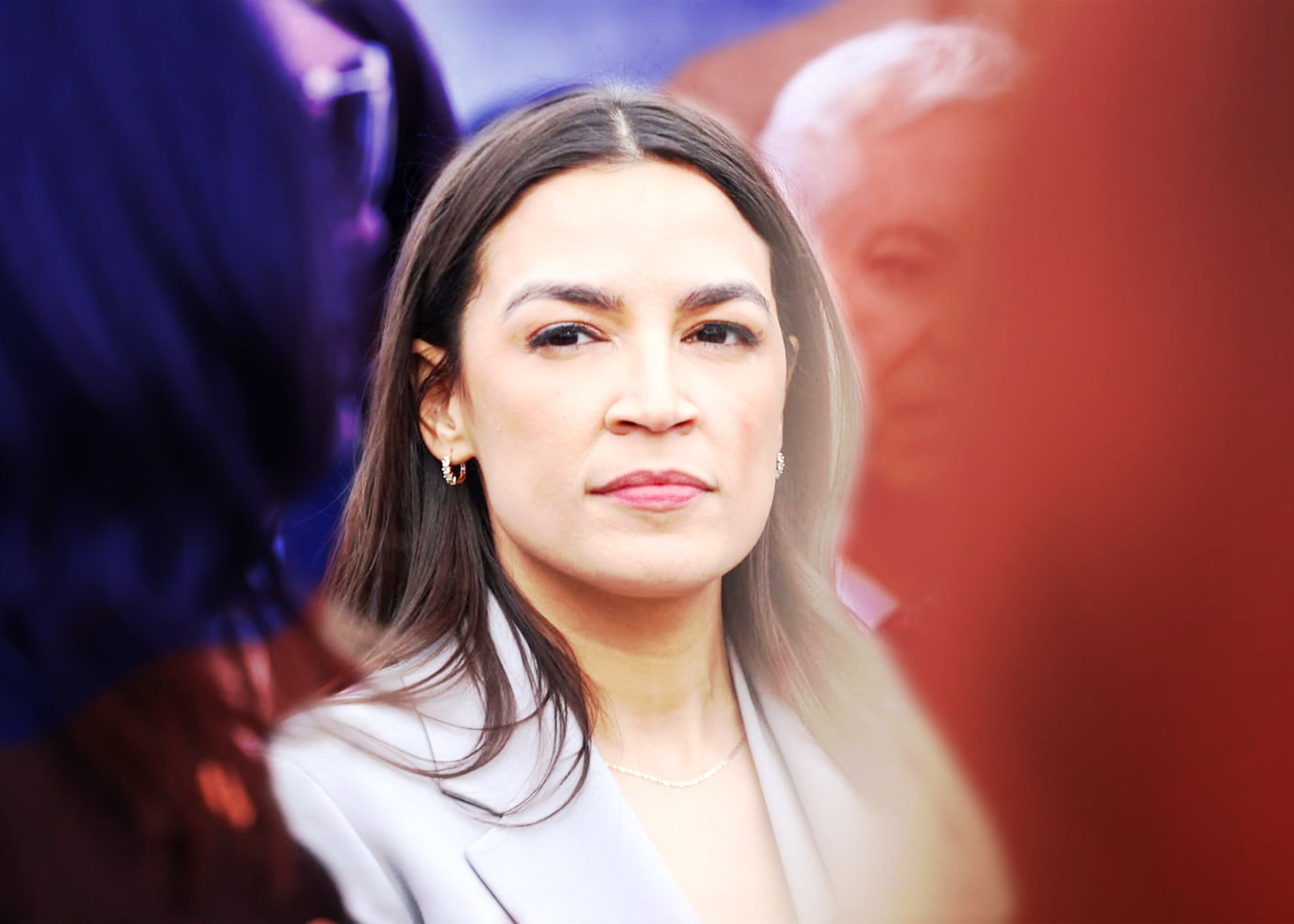
Alexandria Ocasio-Cortez recently shifted positions on Israel’s Iron Dome. Let’s examine why. Credit: D. Everett
Introduction
In what came as something of a surprise, AOC made headlines last week at an NYC-DSA endorsement forum when she pledged not to vote for any military aid to Israel. While AOC has a strong record on Israel and Palestine relative to most of Congress, her defense of aid to Israel in service of so-called ‘defensive weapons’ has been an ongoing issue. While she has unfortunately doubled down on the validity of defensive weapons, she clarified that she supports an arms embargo and will not support any aid going forward - a major improvement. In classic DSA fashion, various caucuses proceeded to take credit for this victory.
Our goal now must be to move AOC further, alongside the entirety of the political establishment, and ensure anti-Zionism becomes a hegemonic force within the US. Therefore the question we need to answer is not ‘who deserves credit?’ but ‘how did this happen?’—and ‘how can we replicate it going forward?’ This is especially necessary as DSA has no consensus on the best approach to ensure ‘discipline’ among electeds. Broadly speaking, the two largest camps are those who favor ‘the carrot’ of building power and strengthening interpersonal relations with electeds, and those who favor ‘the stick’ of red lines and consequences for breaking with party lines such as censure, revoking endorsements, or outright expulsion. Most DSA members would agree that some combination of carrot and stick are necessary - but their relative importance and appropriate use cases remain an open debate.
The goal of this essay is not to end debate, but to move it forward. To this end, rather than framing the question in terms of the merits or problems of ‘discipline’ itself, the focus must be on outcomes. This comes with difficulties, however, as outcomes fit less neatly into a binary than ‘discipline’, which complicates our analysis of cause and effect. While conditions change and there will never be a definitive answer to this question, DSA in its current post-Bernie incarnation has enough history to review and come to informed conclusions. What the record suggests is that the carrot has a more proven track record of favorable outcomes, though there is still a place for the stick. As socialists, we must understand the importance of both in our current context, and accept the contradictions that come with them.
Historic Record
The Beginnings
AOC was elected to Congress in 2018 alongside several other progressives and socialists who made up the original ‘Squad’. She was endorsed by national DSA in the lead up to the primary, where she famously ousted Nancy Pelosi’s second in command Joe Crowley. The importance of DSA’s role here has been disputed: DSA knocked around 20,000 doors during the primary, but this was a fraction of the 120,000 doors knocked by the campaign, and we did not raise significant funds. AOC has gone on record saying that DSA contributed to her race—but had only begun participating a month before the primary and was not responsible for her win. Regardless, her victory led to a significant DSA membership spike and she was closely associated with DSA for her first term, even periodically attending our Queens branch meetings.
Unfortunately, the DSA and NYC-DSA of 2018 were not what they are today: the organization was in the middle of massive demographic and political shifts and many practices we take for granted were not yet developed. At this time, NYC-DSA did not have a robust Socialists In Office committee like we do now, let alone a Federal Socialists In Office committee. While the chapter had a close relationship with AOC, it was not well organized and was held by individuals rather than clearly designated committees or chapterwide leadership bodies. National DSA’s relationship with her office during this time was likewise inconsistent.
This laissez-faire approach to organizing one of the most prominent socialist politicians in the country began to break down in the early 2020s. The lingering impacts of the COVID-19 pandemic disorganized both national and NYC-DSA, and both organizations shrank during the malaise of the Biden era. Meanwhile, AOC’s relationship with the Democratic party grew more conciliatory during this period, to the chagrin of many socialists. While she continued to agitate to move the party left, she was increasingly doing so positioned from ‘within’ rather than from without. Rarely mentioned but crucially important is the impact of the January 6th insurrection, where AOC was targeted by rioters who were publicly calling for her assassination. AOC made fewer public appearances after the insurrection, especially at DSA events, which further exacerbated the growing sense of distance between her and the organization.
This coincided with issues surrounding her voting record, primarily around Israel/Palestine. Her infamous ‘present’ vote on the Iron Dome in 2021 marked a rift between her and the Palestinian Solidarity movement, which came to a head after 10/7. While AOC worked with NYC-DSA during the initial blowback against the left and helped coordinate ceasefire organizing, she also took several particularly bad votes such as Yea on Resolution 1449 which affirmed the IHRA definition of anti-semitism as including anti-Zionism, though she has disputed that characterization of the bill. AOC’s drift away from her relationship with DSA and toward the liberal-Zionist wing of the Democratic Party culminated in her 2024 Democratic National Convention speech praising the Biden/Harris administration for "working tirelessly to secure a ceasefire in Gaza”; prompting comparatively sympathetic DSA National Political Committee members to denounce her speech as a betrayal of the Gaza movement. Only a month following AOC’s DNC blunder her national DSA re-endorsement failed over a backdrop of escalating tensions between DSA and NYC-DSA.
Thus the story of the relationship between AOC and DSA in her first few terms is primarily one of negligence. While some have attributed disagreements between AOC and DSA as due to her not being cadre, this explanation is too convenient for DSA. The truth is that if we do not take an active role in organizing DSA endorsed politicians, we shouldn’t be surprised when they act contrary to our wishes. If our only offering is to alternate between indifference and the stick we should not be surprised when they respond positively to the carrot offered by our class enemies in the Democratic Party establishment. The question remains - what courses of action can we take to maximize alignment between us and powerful representatives?
The Bowman Affair
The fallout of Jamaal Bowman’s vote to fund the Iron Dome in 2021, often referred to as ‘The Bowman Affair’, is likewise a useful case study. Following the vote and outcry among DSA members, representatives from DSA met with Bowman and his team regularly to discuss the issue. Unfortunately the situation continued to escalate and erupted when Bowman took a trip to Israel against the insistence of DSA organizers in the BDS Working Group. J Street, the liberal zionist lobbying group that bankrolled the trip, was a key backer of Bowman in his 2020 primary against Eliot Engel and not an organization he felt he could alienate at that time. This resulted in DSA national issuing a statement effectively censuring him, though NPC members at the time differentiated the statement from a formal censure. This killed the relationship between Bowman and most of DSA - while he continued to coordinate with the NYC-DSA backed Public Power campaign, he did not seek NYC-DSA’s re-endorsement for 2022.
Yet, by 2024, Bowman had improved his positions on Israel and even sought NYC-DSA’s re-endorsement (though not national DSA’s). This was a surprising about-face for a politician in just two years, and, while it was driven by an ultimately successful primary effort against him by Zionist George Latimer, he was made vulnerable to this challenge in part *because* of the change in his positions on Israel. His district was ratfucked in redistricting by an ally of Latimer, which may have been met with more resistance from establishment Democrats had he not broken ranks on Israel. Furthermore, without the massive AIPAC spending levied against him, and without losing the backing of J Street, he would have been better positioned to survive the primary and may not have been challenged at all.
Bowman’s improvement on Israel/Palestine has sometimes been attributed to pressure from the left, but there is little evidence this pressure was relevant. Bowman’s relationship with DSA terminated in 2021-2022 and his positions shifted after this despite him not seeking re-endorsement, which suggests that our criticisms weren’t the determining factor in moving him. In fact, Bowman was so put off by the blowback from DSA that it discouraged him from seeking endorsement even after the threat of a primary by Latimer became apparent, indicating a lack of leverage on our part.
This is not to say that Bowman’s positions on Israel/Palestine were moved by the ‘carrot’ either—by most accounts, the origins of this shift were the very J Street trip that terminated our relationship. During this trip, Bowman met Palestinian children in the West Bank and was confronted firsthand by Israel’s clear practice of anti-Palestinian Apartheid as well as Israeli leadership’s contentment with the status quo. This may be because Bowman was previously a school principal and pushed for youth programs and Green New Schools while in office - he has always cared deeply about children and civil rights. In a particularly revealing quote about the trip, he said the following:
What stuck out then, but sticks out even more now is seeing pictures of kids starving to death in Gaza, and then pictures of Jews in the Holocaust who starved to death.
It was Bowman’s own moral compass that moved him, which ultimately came at great professional cost. In what turned out to be the most expensive House primary in American history–with AIPAC contributing over 15 million dollars to defeating Bowman–he was replaced by pro-Israel centrist George Latimer.
Where we can say the ‘carrot’ succeeded, however, was Bowman’s eventual decision to apply for NYC-DSA’s endorsement. While it was clear by at least early spring 2022 that Latimer was a serious challenger, Bowman still waited months to apply for our endorsement, and ultimately only applied for local endorsement. But what drove Bowman to apply is instructive: months of urging by friends and allies within DSA, especially connections made during the Green New Schools campaign and climate organizing, as well as the potentially meaningful benefit of NYC-DSA’s organizational support. Ultimately, relationships developed with Bowman and NYC-DSA’s reputation for strong electoral ground game are what led Bowman back to the organization.
Chi & The Zohran Bump
It’s an understatement to say Zohran Mamdani’s mayoral campaign changed DSA’s political calculus. His victory spurred massive growth and cemented DSA, especially NYC-DSA, as credible left opposition during the second Trump Administration and independent from the Democratic establishment. Unlike AOC’s 2018 race, NYC-DSA’s participation in Mamdani’s race was likely a deciding factor in his victory, having been a key contributor to his field operation which knocked 3 million doors. This has led to something of a renaissance period for NYC-DSA. Bernie Sanders’ recent Tax The Rich Rally with NYC-DSA, for example, was the first DSA event the ultra-popular senator has ever directly participated in. Chi Ossé and Shahana Hanif, two charismatic and generally aligned New York City council members, have also joined our city Socialists in Office (CSIO) after remaining independent for years.
Chi’s history in particular provides another example of ‘the carrot’ having an identifiable positive impact. While Chi held NYC-DSA at a distance after we didn’t endorse him in 2021, Chi has remained a generally principled left politician and backed Mamdani’s mayoral campaign before it was politically safe. Over the course of the campaign, he developed strong relationships with several NYC-DSA members who encouraged him to rejoin. His request for our endorsement to run a primary campaign against congressional minority leader Hakeem Jeffries underscored the strategic incentives for joining us - he understood the race would make him a pariah even among progressive organizations, and that only NYC-DSA was capable of making his run viable. Despite failing to secure our endorsement for this race, Chi still joined our CSIO and has since whole-heartedly supported our movement - going from failing to endorse Eon Huntley for Assembly in 2024 to endorsing him in 2026 alongside our entire insurgent slate.
Chi, who had developed his own base independent of DSA, has brought with him several talented organizers and creatives into the organization. In doing so, he has provided a good example of how parties can grow. Historically, parties thrive when they are able to integrate new bases. This was common practice for MAS in Bolivia for example, and contributed to their explosive growth as covered extensively in Santiago Anria’s How Movements Become Parties. In order for this strategy to succeed, the party or protoparty in question needs to be worth integrating into from the perspective of the external groups it wishes to organize. This is especially true in the American context, where massive election spending is the norm and anti-Zionist candidates are targeted by AIPAC and the wider Israel lobby. There remains a political cost to associating with DSA, sometimes a steep one, thus, the carrot is a necessary incentive.
AOC Now
AOC has long been identified as a force largely independent from DSA, partnering more closely with Senator Bernie Sanders and the Squad (Reps. Tlaib, Omar, Pressley and later Bush and Bowman). Bowman’s censure by DSA was in fact opposed by several members of the Squad, including AOC, and diminished their impression of the organization at the time. Beating fascists has long been one of her top priorities, and she has been willing to work within an often hostile Democratic party to this end. She has routinely called for the party to move left among other things, rejecting efforts to blame support for LGTBQ+ issues for losses, but has also been willing to endorse moderates such as Pat Ryan in order to keep swing seats blue. It is not a coincidence that she grew closer to the DNC in 2024—the electoral defeat of Bush and Bowman revealed the brittleness of the American Left while the success of the Harris/Biden ticket became the apparent last line of defense against a second Trump administration.
Despite this, AOC has been a consistent ally to NYC-DSA and worked with us even during our lowest point during the period of blowback immediately after 10/7. In the past few years our relationship has built to its healthiest point since her 2018 victory - one of her first responses to Trump’s 2024 victory was to headline an NYC-DSA mass call and make a join DSA ask. This relationship has only grown stronger since Zohran won—it was after all an appearance at an NYC-DSA forum where she stated a desire to work closer with us and improved her position on Israel/Palestine.
With NYC-DSA’s current congressional candidates Claire Valdez and Darializa Avila Chevalier there is an opportunity to further cement the relationship. AOC is one person - if our organization doesn’t appear to be aiding in her top priority of fighting fascism it will be difficult to continue to move her positions as we recently did. However, if we are an asset to her the socialist movement stands to benefit enormously. AOC is a superstar politician with a massive war chest who has outraised every other congressional candidate this quarter with an average donation under $20. She is an essential part of our movement and a potential frontrunner in the 2028 presidential election - a key opportunity for a national intervention. There are reasons why membership of NYC-DSA, the chapter which has continued to work with her, voted by an overwhelming margin of 85% in favor of re-endorsing her.
What Can We Learn?
How Does The Carrot Work?
Powerful interest groups like AIPAC and the Israel lobby are of concern to the left because of their ability to spend massive amounts of funds to unseat anti-Zionist or even non-Zionist politicians such as Bowman and Bush in 2024. But campaign spending is just one of the tools lobbyists employ, and is often used to ingratiate an interest group to a campaign that is already winning, rather than a determining factor. At least as important in the lobbyist toolkit is a social approach which we underestimate to our detriment. Lobbyists befriend politicians or otherwise position themselves as experts whose accounts can be relied on. Congress is hardly stocked with America’s best and brightest, but even brilliant politicians can find it difficult to keep up with dozens of issues on ever-shifting terrain and thus come to depend on lobbyists for advice.
Similarly, an effective approach to the carrot is not just renewing our endorsements and knocking doors, but regularly meeting with politicians to ensure we have their ear and endorsement does not become a ‘rubber stamp.’ The several years where neither NYC-DSA nor national DSA held regular meetings with AOC or her staff speaks to the fact that we have failed, as a movement, to meaningfully understand and apply this in the past.
Conversely—politics is a game of survival, and our relationships with electeds will always have transactional elements predicated on aligning with their material interests. Even ‘cadre’ politicians will sometimes act against the wishes of leadership if they feel their position or credibility may be at stake, such as when Assemblymember Sarahana Shrestha and several NYC electeds voted for Hochul’s budget in 2024. As a general rule, politicians may sometimes be convinced to take votes against their personal best interest in service of the movement, but it is much easier to keep them aligned when our support is an asset.
This is also why ‘the stick’ can backfire from an outcomes based approach—it can destroy our relationships if not used judiciously. This is not to say there is no time for more serious action when irrevocable differences occur - for example DSA LA declined to support Nithya Raman’s bid for LA mayor due to her disinterest in working with the chapter for several years. Where possible, and barring serious and irreconcilable political differences, it is generally better to maintain an SIO relationship than to sever it. While this approach is useful for gaining and maintaining elected alignment, it also elides the question of when a politician’s divergence from a movement becomes a net negative to the movement as a whole. This question merits further thought, but it’s outside the scope of this article.
What Of The Stick?
Specifically evaluated on its effectiveness at aligning politicians to the demands of the movement, the stick has a poor track record. It can help clarify DSA’s position, but often puts us on weaker ground - both because it risks killing a beneficial relationship with a largely aligned politician and because of the internal and external blowups it can lead to. Mike Connolly, who publicly left DSA after being notified by Boston DSA leadership that they were bringing a resolution to expel him for nonalignment to membership. This led to scathingpress and disorganized the chapter ahead of plans to organize around the 2023 UPS spikes - and may have contributed to Boston DSA shrinking substantially more than the national average that year. There are surely examples of discipline of this form working but under normal circumstances expulsion and public censure should be considered an extreme measure, one which DSA members often treat with too blasé an attitude.
We need to be able to criticize our elected officials, but the key is that it needs to stay within the movement or it increases the chances of us being seen as a liability. I can say confidently (without going into the level of detail I would prefer to, out of respect for all parties involved) that the leadership of NYC-DSA has been more than willing to pressure our electeds. There has been a genuine failure to communicate this to our membership in an effective way from NYC-DSA leadership, myself included. But we have also identified ways to pressure electeds in full view of our membership without resorting to censure - such as a resolution passed by NYC-DSA’s Citywide Leadership Committee last year urging our electeds to endorse Zohran and rank him #1 in the NYC Democratic mayoral primary. The stakes of this resolution were nothing more than noting which of our electeds endorsed Zohran during their own future endorsement bids, but it made the will of membership clear and was a risk taken in service of the chapter’s top strategic priority at that moment.
This is not to say that the sort of pressure you see online has no use—it acts as a signalling mechanism to show the potential orientation of the base and identify lines in the sand which could lead to schisms if left unaddressed. It is unlikely that AOC improved her positions due to a last minute petition to condition endorsement votes on her doing so, but it was well understood that her statements on the Iron Dome were a weak point on her record and the petition at least helped communicate that. This incentivized organizers running AOC’s re-endorsement forum to prioritize questions pertaining to the Iron Dome, as it was clearly important information to potential voters.
Furthermore, there has been some evidence that the “good cop, bad cop” dynamic of tensions between those favoring the carrot and the stick may lead to good results. However this emergent dynamic is rarely invoked deliberately or in a coordinated fashion; the actions of the ‘bad cops’ have often risked severing the relationship between electeds and their chapter. This approach also requires follow-through, with clear rewards for the elected maintaining alignment and a clear consequence if they fail to change course. This is something the left often fails to do - the most recent example of which is the debacle where several caucuses publicly stated certain conditions that AOC needed to fulfill to receive their votes for endorsement and then decided to withhold that support despite AOC meeting those conditions. While these caucuses never explicitly promised they would endorse if the conditions were met, it nonetheless weakens their positions and thus the credibility of the movement’s ability to ‘hold candidates accountable’ if our statements cannot be taken as credible. A degree of trust and good-faith bargaining is required for a potential “good cop, bad cop” dynamic succeeding. If the elected doesn’t trust the ‘bad cop’ to follow through on their threats, they have no reason to respond to their pressure.
Conclusion
The modern incarnation of DSA is still a young organization, tasked with rebuilding the American Left almost from the ground up. If we are going to succeed at this task, we must take our recent history at least as seriously as that of the New Left. Our experience of the last 10 years tells us that politicians and campaigns are a means through which DSA builds robust and lasting power. We shouldn’t approach our relationship to politicians through a moral lens - we are socialists, and in all other situations we pride ourselves on using a clear-eyed analysis of the world’s material conditions to inform our strategy. If we want to succeed in winning and preserving our influence in the halls of power, we must take a similar approach to how we deal with politicians. We must make a science of our revolutionary work, the stakes are nothing less than our future.