
Jun 29, 2026
The Impending Dystopia and How to Combat it.
The capitalist system is barreling towards a dystopia. Both dogmatic Marxism and right wing nationalism are unequipped to combat it.
by Victor Yarov
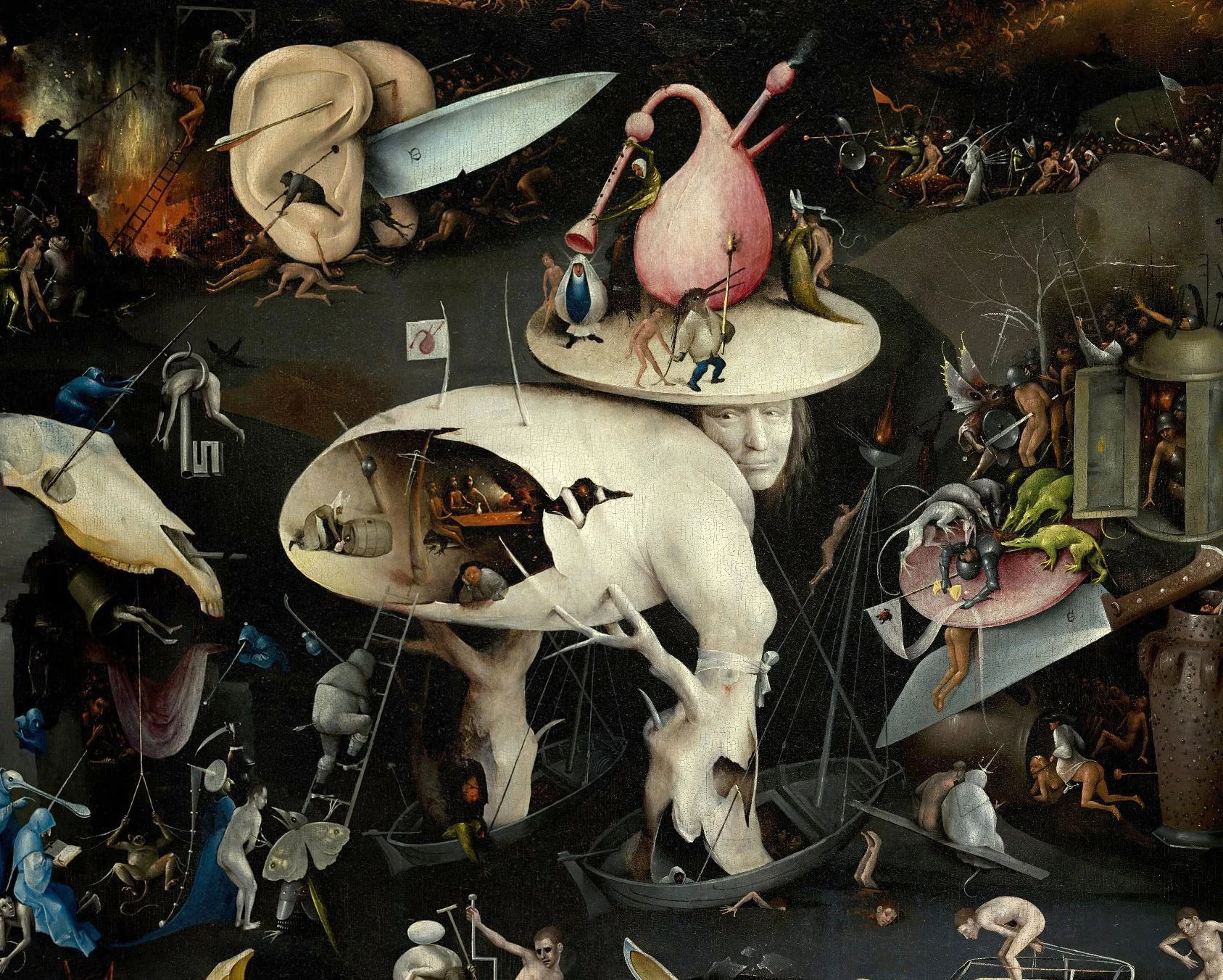
'The Garden of Earthly Delights', Hieronymus Bosch
"Capitalism with a human face", a global unified world of consumption in which legality, prosperity and order reign — all the stuff the mainstream media has been trumpeting over the past decades and echoed by "lonely crowds" on the Internet, is now turning into a pumpkin like Cinderella's carriage. A grandiose global economic crisis looms on the horizon, apparently inevitable, given the scale of global debts, widespread financial bubbles and unsecured bonds, stocks, futures, options, etc. (despite the fact that real production is not growing). There is no end in sight to regional wars and local conflicts. Corruption and sexual scandals regularly shake the elite Olympus. And at the bottom of bourgeois society, the mass philistine, stupefied and degraded, outwardly self-satisfied but internally frustrated, gets horrified at himself watching reports about crimes, which seem to be competing in madness.
Everyone (at least those who have not yet lost the ability to think and feel) understands that something is wrong with the world system. Everyone understands that it has to change and is already changing. But in which direction is it changing? What is the essence of the processes taking place in the world? Some, the most dim-witted, are already ready to believe in the new myth of prosperity: "AI will save the world. Everyone will be rich and happy thanks to robots and artificial intelligence". "Leftist and progressive" intellectuals derive their thoughts from the ideas of Lacan, one of the plethora of postmodern cheaters. And, of course, their thoughts do not go beyond petty criticism of certain cultural phenomena, of almost fruitless alarmism and "moral condemnation". Dogmatic Marxists have nothing better to offer than the repetition of abstract universal formulas, and, in fact, refuse to proceed from living reality rather than from dogmas. The confusion in the brains of millions of ordinary people is evident in a ridiculous vinaigrette of pseudo-religious, liberal-democratic, conservative views and orientations. And above all this mental landscape of modernity, there is an all-encompassing falsity, inauthenticity, feelings of fear, uncertainty, and powerlessness to change anything.
What is really going on, and most importantly, what has to be done?
The literary genre of dystopia presupposes a description of the future, imaginary society characterized by typical features: mass-like type, standardization of everything, aggressive primitivism of the crowd, intolerance to manifestations of genuine individuality, reduction of all the diversity of life to a single common denominator, total control based on technology, suppression of dissent and any life manifestations that differ from the established standard. Many people think that dystopia is more relevant to communist practices than to liberal capitalist ones. But that is not true. It can be noted that communist practice was similar to dystopia to the extent that, due to various objective historical circumstances, it was unsuccessful in relation to its original goals and ideals, whereas capitalism embodies dystopia to the extent that it is successful as a system. And, accordingly, it would not be an exaggeration to say that we are all already living in the period of the initial phase of a dystopian society. All the trends are evident and are only getting stronger.
In fact, isn't the average man in the street, a representative of the "middle class" of any developed country in the world, with all his lifestyle, all his standard, mass-type, primitive thoughts and feelings, isn't he the "measure of all things", a role model, which is forced to follow by the soft violence of family, school, university, the media, entertainment industry, and other practices of individual socialization? And isn't this Frankenstein, Golem, aggressive in rejecting everything that doesn't fit into his brainwashed mind? Don't modern means of communication, messengers and social networks make the existence of average person absolutely transparent to the System? Doesn't digitization of money deprive an individual of financial independence? Doesn't the sophisticated and extensive legislation adopted under the pretext of "ensuring freedom and security" in all countries, including those previously considered "democratic", allow the System to selectively (so far selectively) prosecute thoughts and actions it dislikes?
So, the trends are obvious, but where is it all heading? Towards a techno-fascist and neo-feudal social structure. Human, as a product of history (including the history of early capitalism), becomes a threat to the System. In order to suppress humans and create generations of a kind of "post-humans", capitalism, based on the latest forms of technology, will resort to methods reminiscent of fascism. For example, let's take just one of the many problems. How can they occupy the vast masses of people who will be pushed out of production and the service sector by AI and robots? They can put the masses on an Unconditional Basic Income (UBI) and give them the opportunity to rot in Zuckerberg's virtual "Metaverse". But even if a minority of people realize that they are being driven into a kind of social ghetto, they will begin to resist in one way or another. Since the social structures of capitalism are extremely unstable at its final stage, the System cannot accept even the disorganized resistance of a relative minority. Hence the need for total control through AI, repression, and "social isolation" of the unreliable. The "neo-feudal" features of final capitalism will consist in the absence of "social elevators", the reduction of social mobility to zero, and the acquisition of a caste character by society. In order to survive, the System must "pupate", cut off from itself the elements that have become superfluous and harmful to its survival (for example, bourgeois freedoms, which formally can be preserved on paper, but will not work in practice).
After the capitalism of free market competition, the era of monopolistic capitalism began at the beginning of the 20th century. Among the most important features of this era, Lenin singled out the fusion of banking capital with industrial capital and the formation of "financial capital" in the hands of the financial oligarchy. Another important feature is the intertwining of the financial oligarchy and the state apparatus. Of course, neither the dominance of the financial oligarchy nor its link with the state in modern capitalism has disappeared anywhere, but, on the contrary, has consolidated. However, the configuration of the financial oligarchy has changed. Technological monopolies are now at the forefront of capitalist production. Capital has relied on AI and robotics, firstly, hoping to use them to bring production out of stagnation and raise the rate of profit, and secondly, it needs them as a means for the final spiritual enslavement of humanity, the "reformatting" of human, total control, and the nip in the bud of all threats. The three coldest monsters of the modern capitalist world are the state, banks, and big-tech monopolies.
At the same time, it should not be thought that the road to slavery, the coming dystopia, is building solely because of some special malignity and moral perversity of the elites. Moreover, it is pointless, in the spirit of QAnon, to look for a conspiracy. The bourgeois elites do only what, under the given conditions, is objectively necessary to preserve and expand their rule. Naturally, if they do not encounter resistance from below, their program is fully implemented. In the 19th and 20th centuries, capital retreated when it encountered massive grassroots resistance (in the limit — the revolutionary movement). It was only thanks to this resistance that social programs appeared, rights and freedoms were preserved to a certain extent, and wars were sometimes abandoned, etc. In other words, the resistance of the "grassroots" kept the System from the extremes of its inhumane nature. The decisive role was played not by the movement itself among critical intellectuals, but by the will and willingness of the masses to resist. The heyday of theoretical criticism of capitalism occurred not because intellectuals burning with sympathy for the working class came to the conclusion that socialism was better than capitalism, but because the working class itself showed the will to resist and go beyond capitalism (among the many examples are the Luddite and Chartist movements in England, the Lyon uprisings, the proletarian uprising in June 1848 and the Paris Commune of 1871 in France, the Silesian weavers' uprising, the revolutionary movement of 1918-1923 in Germany, the revolutions of 1905-1907 and 1917 in Russia).
However, having conquered social benefits, the class of employees (at least in the developed countries of the world) "calmed down". The "welfare state", "consumer society", etc. are not only apologetic propaganda, these concepts have a real basis to a certain extent. The bottom line, however, is that the position of an employee under capitalism has not fundamentally changed and cannot change. Is he the master of his destiny and his time? No, he is not. Is he a passive object of control, an eternal victim of deception and manipulation? Yes, he definitely is.
Karl Marx himself did not rule out the possibility of temporary subjugation of employees to the conditions of "comfortable slavery". In his work "Wage Labor and Capital" he wrote: “the more rapidly the working class increases and enlarges the power that is hostile to it, the wealth that does not belong to it and that rules over it, the more favourable will be the conditions under which it is allowed to labour anew at increasing bourgeois wealth, at enlarging the power of capital, content thus to forge for itself the golden chains by which the bourgeoisie drags it in its train”. But the "comfortable slavery” of the "society of spectacle and consumption" still remains slavery, because: “if, therefore, the income of the worker increased with the rapid growth of capital, there is at the same time a widening of the social chasm that divides the worker from the capitalist, and increase in the power of capital over labour, a greater dependence of labour upon capital”. Lenin writes even more figuratively and emotionally: “The slave who is aware of his slavish condition and fights it is a revolutionary... The slave who drools when smugly describing the delights of slavish existence and who goes into ecstasies over his good and kind master is a grovelling cad.”
Many leftists, who either reject or do not understand dialectics, think that the more material wealth and free time the working masses have, the more they gravitate towards emancipation. But it doesn't work like that.
Everyone knows the term "middle class". By itself, from a scientific point of view, it is, of course, completely inadequate. People with different social roles, often hostile to each other, such as a manager and employees subordinate to him, a policeman or a minor official and ordinary citizens, are enrolled in the "middle class" only on the basis of income. Nevertheless, the term "middle class" can be used in a strictly defined sense — in relation to relatively privileged employees of physical and mental labor and the mass of well-to-do non-proletarian elements who have capitulated to capital. After World War II and until recently, the middle class made up the majority of the population in developed countries. The unwritten contract of social peace in these countries was that the elites provided the middle class with the opportunity for widespread consumption, while the middle class either remained silent or passively approved of the status quo. This agreement is becoming a thing of the past.
For reasons of declining real profits, the displacement of labor through AI and robots, and, not least, the lack of any political subjectivity among the middle class, the financial oligarchy does not need to feed the mass middle class, and it faces some kind of "dekulakization" (this process began at the end of the 20th century and will only gain momentum). In this regard, it should be expected that part of the middle class will lean towards a more radical right—wing ideology, another part towards a more radical left—wing ideology, and the third, most passive part will be inclined to accept the new principle of survival in the System — "Have nothing and be happy!".
The fading of the spirit of disagreement is especially clearly seen in the moods and orientations of youth and youth culture. The last surge of protest activity in Western countries was in the late 60s of the XX century. At the same time, subcultures of hippies, punks, the "sexual revolution" etc., appeared. Even though they represented a deadlock, they were in opposition to the System. All they was easily absorbed by the System and, naturally, degenerated. Hippies were replaced in the 90s by "yuppies", a generation that sought the meaning of life in hedonistic careerism, bourgeois "family values", etc. The spirit of the newest generation of Z ("zoomers") is conformity combined with escapism in the world of virtual entertainment. They are just trying to distance themselves from the System a little, not allowing any thought of fighting it, they look at it, as well as at the life around them, with empty, fishy eyes. Sometimes some zoomers get a little excited when the next fake fabricated by the bourgeois media, like climate activist Greta Thunberg or puppet "leader of the democratic opposition" in the authoritarian segment of the united world of capital, calls them to "fight evil." The only thing that can be positively assessed among zoomers is that, according to sociological research, this generation feels the most unhappy among all living generations. If, under these conditions, it would have felt the happiest, then, without any doubt, one should be admitting that this generation is the most heinous in the entire human history.
What kind of ideology and practice can challenge the impending black death, technocratic dystopia? The right—wing idea is unable to do this because it ignores the main objective reason — the capitalist mode of production. Criticizing (often more vividly and intelligibly than many modern leftists) single effects of alienation, the spiritual entropy of modern civilization, the right remains within the boundaries of alienation, does not leave the field of spiritual death. The right always reduces everything to a single country, nation, or group of countries and nations. For example, they vehemently oppose the «One World» project, a globalist liberal version of dystopia. But dystopia can (and, as we can see from current events in the world, most likely will) perfectly implement into reality on the basis of a world split into blocs. Competing and negotiating regional entities under the control of separate regional factions of the financial oligarchy. Using a literary analogy: "Oceania", "Eurasia" and "Eastasia". Of course, the conditions of the opposition of the blocs only stimulate technofascism.
On the other hand, the critical baggage of many modern leftists clearly does not meet the demands of the times. First of all, because dialectics as a way of thinking and a powerful tool for transforming life has been almost forgotten by them. Non—dialectical thinking, a fundamental misunderstanding that every phenomenon or process in nature and society is a living contradiction (and, accordingly, human concepts such as "progress", "freedom", "wage labor", "working class" and all the others are also contradictory) has led many modern leftists to capitulation to bourgeois progressivism, to separation from real practice, to the liberal-bourgeois agenda of "small affairs", organically complemented by fruitless dogmatic exercises and sectarian disputes and squabbles.
It is easy to see that objectively, in fact, the program and practical agenda of many modern leftists is to protect and preserve the "middle class" (in the meaning of the term, which is indicated above). This is the program of modern social democracy, modern collaboration with the System. In fact, this program does not prevent the impending dystopia, but helps it (for example, when it comes to the widespread use of Unconditional Basic Income, these leftists will be the most agitating for it. Out of the habit of their "progressive" thinking, they already prefer to ignore the destructive side of total digitalization, AI in the interests and under the control of capital).
It is necessary to recognize the objective fact that the working class, which is still quite numerous, certainly exists at the present time as a socio-economic category, but does not exist as a socio-political entity capable of action. Nowhere on the planet. But does this mean that there are no more paths of resistance? No, it doesn't mean that. Marx's teaching is an organic dialectical unity of two types of analysis, two optics of considering a living historical process. One side of history is the history of classes and class struggle. The other side of history is the history of the development of human individuality, taken as a social phenomenon (from a person without individuality in a primitive society, subordinate to nature and the tribe, to a capitalist person subordinate to abstract thinginess, a person with a one-sided and crippled, but still individuality). And if the line of class resistance is abandoned, then the line of resistance at the level of individuality remains until the person has turned into a post-human.
And even if we consider the real history of the class struggle, it did not happen according to the schemes in the minds of Marxist intellectuals. The socialist revolution won in China, meanwhile the term "proletariat" was translated by Chinese Marxists as "a class without property" (无产阶级, wuchan jieji), in literal sense — "the poor" (it goes without saying that in this case, peasants and workers, townspeople and villagers fall into the category).
Let's put the question bluntly and acutely: is it worth focusing attention and fighting for more material goods, in other words, emphasizing economic demands, if the growth of prosperity does not lead to anything other than plunging employees into the swamp of consumerism, to their even greater atomization, individualism, if it serves not the spiritual uplift of the masses, but vice versa stupefaction of their moral and will? Is this agenda an inadequate anachronism in modern conditions?
Liberation of consciousness is the primary, most important task in our time.
Economic demands (higher wages, job retention, shorter working hours, etc.), the entire agenda that was previously the focus of the left's attention, must now be subordinated to more fundamental demands, let's say, spiritual and political.
Accordingly, uniting people in modern conditions can and should take place not only on the basis of economic demands (as is the case in trade unions), not only on the basis of political claims and ideology (political parties) and not only on the basis of cultural development (educational and art societies), but on the basis of a holistic and comprehensive principle, which includes rethought economic, cultural and political issues.
It is necessary to create the broadest possible movement, largely informal and non-hierarchically organized. The ideological platform of this broad movement may be "realistic humanism." Realistic humanism is by no means an abstract and fake humanism, to which the mainstream of "cultural figures" and, in general, the entire bourgeois-liberal ideology appeal.These pseudo-humanists "love" a person only as an extremely simplified, distilled and disciplined being of their "society" — the bearer of a certain set of formal, abstract "rights", obliged every minute to comply with the snowball-growing volume of "norms and rules" (which are established by their state, their banks and corporations). The humanism of modern bourgeois liberals exalts the human-consumer, obediently subordinated to the technocratic machine alienated from him. The individuality of the human-consumer has been erased, the more he cultivates egocentrism with the help of modern bourgeois culture (and its many subcultures), the more he becomes like a herd animal. The human-consumer sells his human dignity for a mess of pottage for the sake of "comfort and security". But the worst thing is that he loses the ability to realize his spiritual poverty, the real squalor of his life, his un-subjectivity. He may, of course, experience situational psychological frustration when next illusion of material "success" or personal "happiness" fails. But the "psychoanalysts" rush to the rescue, the consumer "culture" lulls (this is one of its functions — to lull), and life is no longer seen in a gloomy light, and one illusion get replaced by another... Awareness leads to struggle, to uniting with others in a common struggle, while frustration leads to individualistic avoidance of struggle, to one or another version of consumer hedonism.
Realistic humanism exposes the depth of human's fall in modern society, but it remains humanism, because it fights for the fall itself to become the starting point for a new ascent. The price of this struggle is very high. Because the question is, either the capitalist Matrix will reformat the human—consumer into a post—human in the not too distant future, in fact, into a biorobot, or a human will fully find himself as a truly free, active, constantly surpassing himself.
Some would say, "Your movement will become another sect with a spiritual bent". In order to prevent this from happening, the movement (the "Movement of the Anthropological Resurgence" or simply the "Anthropo—Union" can be suggested as the variants of the name) must have a clear practical agenda from the very beginning, giving a person a sense of meaning, purpose, confidence, and feeling of belonging to a common big cause. The practice of the Movement can include:
1. Resistance to systemic anti-humanism, the policies of states and corporations aimed at building a techno-fascist dystopia.
2. Spiritual development based on a new culture that preserves the best content of the culture of the past, but seeks new ways.
3. Mutual assistance and solidarity (in all aspects, economic, legal, moral and spiritual).
From the very beginning, the movement should be built and operated as an international organization. But we must be aware that the movement can and should spiritually save people and resist the System, but in order to completely destroy the System, "break the haughty power" of parasites and degenerates dangerous to the human race, movement alone is not enough. Beyond the movement, a party is needed. The party is built not by recruiting people, but by careful selection. Its tasks are to intervene in events when there are conditions for it, to organize a mass movement, to clearly understand and resist the logic of the actions of the bourgeois elite, and, finally and most importantly, to destroy the bourgeois state. Not to usurp power on behalf of the people, but as a necessary condition for the destruction of the entire world of violence and lies. Having completed the task of creative destruction, the party gives way to the creative activity of the majority of people. Of course, like the movement, the party must be international.