
Credit: D Everett
This article originally appeared in Black Lodges, by Steven Vogel. It can be found in its original form at this website.
Morning Comrades.
Last week saw both Lent and Ramadan start on the same day, and with that, my algorithms across the board decided—well, were engineered by the rightoid capitalist powers that be—to flood my online experience with what essentially amounted to an unnatural amount of celebrities and politicians with Ash Wednesday crosses smeared across their foreheads. Now, contextually, Christianity did play a role in my early life. I was raised Catholic by my mother, and I did go through the whole procedure of communion and confirmation only to grow out of it, first through protest and then logic by my teenage years. It is fair to say that the northern European and English experience, especially in the working classes, is comparably atheist, especially in regards to the experience in the US, something that I came across a few years later for a good decade.
Obviously, upon starting to learn about Marx and the subsequent teachings after his time at the beginning of university, which coincided with the new Radical Atheist nonsense around the turn of the millennia, Marx’s idea that religion was the opiate of the people, my own opinions of the subject of religion were clear, but as I was growing up, and this is by the time Bush Jr. and Blair genuinely leaned into weaponizing their own take on Christianity, I started to become interested in exactly that subject. How increasingly fascist-leaning capitalists were utilizing “Christianity.”*
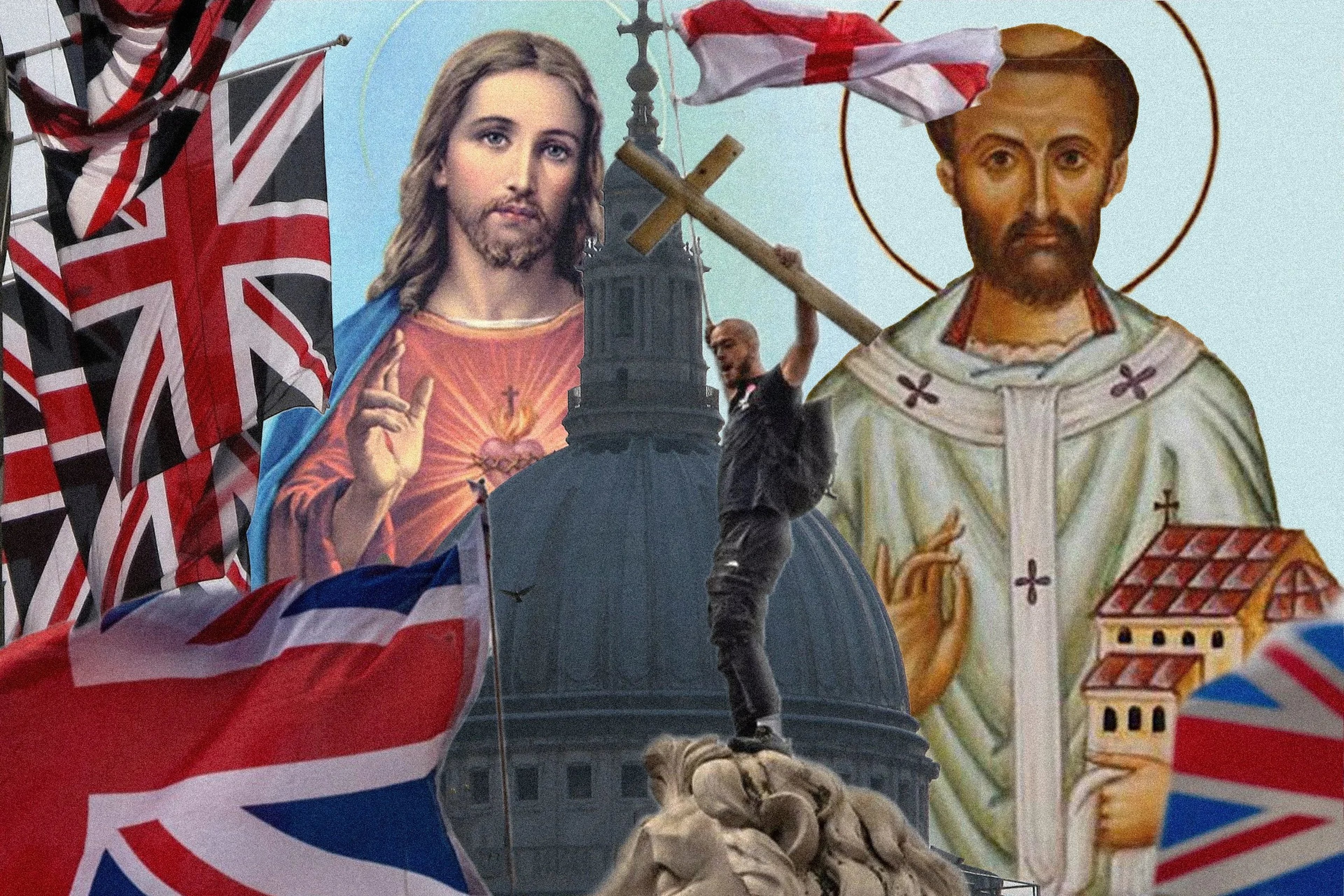
Now, coming back to last week, there has been a significant increase, especially in the UK, and increasingly so in continental Europe, where a similar cultural language, modus operandi, and structuring of this increasingly radical Christianity is ping-ponging between the US and the UK/Europe, which is then utilized in their ongoing culture war, or radicalization of online spaces. To be clear, I couldn’t give a rat's ass if Gwen Stefani, Mark Wahlberg, or any other vapid shell of a human being uses their celebrity to con people into pay-per-view Christianity apps, but when influential politicians like Marco Rubio and, for example, leading far-right agitators like Stephen Christopher Yaxley-Lennon aka Tommy Robinson or this rabble start all speaking the same language and are using the same symbology, it’s time to get into it.
To start, Marx and the Opiate of the People reality. Any serious analysis of the contemporary politicization of Christianity must begin with the framework offered by Karl Marx in his 1844 Contribution to the Critique of Hegel’s Philosophy of Right, because his argument clarifies a crucial point often lost in both secular polemic and religious apologetics: religion is neither the primary cause of social conditions nor a simple deception imposed from above; it is a social product. When Marx writes that “man makes religion, religion does not make man,” he is rejecting the idea that belief systems operate independently of material life. Religion, in his formulation, is the emotional, moral, and symbolic language through which a society experiences and interprets its own contradictions.
This insight matters because it shifts the analytical focus away from theology and toward political economy, institutional power, and social dislocation. For Marx, religion emerges from what he calls an “inverted world,” a social order marked by alienation, inequality, and powerlessness. In such a world, religious consciousness performs multiple functions at once: it consoles suffering, gives moral coherence to injustice, and transforms powerlessness into narratives of meaning and endurance. When he famously calls religion “the sigh of the oppressed creature” and “the heart of a heartless world,” he is not simply dismissing belief as illusion; he is identifying it as both a symptom of real distress and a form of emotional survival within conditions people cannot otherwise control.
At the same time, Marx insists that religion also stabilizes the very conditions that produce the suffering it expresses. It offers what he calls the “illusory happiness” that allows individuals to endure structures that deny them real agency. This dual character, both protest and consolation, both critique and accommodation, is the key to understanding religion’s political volatility. Under certain conditions, religious language can express moral outrage against injustice; under others, it can sanctify hierarchy, obedience, and resignation. Which function dominates depends not on doctrine alone but on the social forces that organize, fund, and institutionalize religious expression.
Placed within the context of contemporary Britain and the United States, Marx’s framework helps clarify why the current intensification of politicized Christianity should not be interpreted simply as a revival of faith or a spontaneous cultural reaction. The material conditions of the past four decades—economic precarity, declining social infrastructure, regional inequality, cultural dislocation, and the erosion of stable collective identities—have produced precisely the forms of anxiety and loss that Marx described as fertile ground for religious re-articulation. In this sense, the emotional appeal of narratives about moral decline, cultural displacement, and civilizational threat is rooted in real experiences of instability and disempowerment.
However, Marx’s analysis also directs attention to the second, decisive question: who organizes this religious consciousness, and toward what ends? Religion does not simply arise from suffering; it is shaped, structured, and directed by institutions embedded in “the world of man, state, society.” In periods of social strain, religious feeling becomes politically consequential only when it is captured and given institutional form. The transformation of diffuse anxiety into a coherent political identity requires organizational infrastructure, legal advocacy groups, media networks, donor systems, and political alliances that channel grievance toward specific enemies and policy objectives.
Marx’s concluding formulation that
the criticism of religion is… the criticism of that vale of tears of which religion is the halo
is therefore not a call to attack belief itself, but a warning against misrecognition. The central analytical task is not to debate theology nor to ridicule faith, but to identify the social order that makes certain religious narratives persuasive and the political actors who transform those narratives into instruments of power. When religious identity becomes a vehicle for nationalism, culture war, or authoritarian politics, the relevant question is not why people believe, but why particular organizations invest resources in shaping belief in specific directions.
Seen through this lens, the engineered rise of politicized Christianity in the United Kingdom, mirroring earlier developments in the United States, appears not as a religious awakening but as a political project operating within Marx’s framework. Real social dislocation produces the emotional demand for meaning and protection; institutional networks translate that demand into narratives of persecution and civilizational crisis; and those narratives, in turn, redirect popular anger away from economic and structural sources of insecurity toward cultural and minority targets. Religion becomes, once again, both the language of distress and the mechanism through which that distress is politically managed.
Secondly, it is important to look at where the weaponization in our modern context took form. The contemporary weaponization of Christianity in the United States did not emerge suddenly in the twenty-first century; it is the product of a political realignment that began in the late 1970s and achieved national consolidation under the presidency of Ronald Reagan. What occurred during this period was not a simple alliance between religion and politics, but the construction of a durable electoral machine that reframed evangelical identity as a partisan bloc and recast social policy conflicts as moral and civilizational struggles.
The origins of this realignment lie in the crisis of postwar conservatism. Following the civil rights movement, the expansion of federal authority, and the cultural upheavals of the 1960s and 1970s, conservative strategists sought a mass constituency that could unify economic libertarianism with social traditionalism. Religious mobilization provided the solution. Organizations such as the Moral Majority, founded by Jerry Falwell, transformed previously disengaged evangelical communities into a disciplined voting base. Issues such as school prayer, abortion, and opposition to LGBTQ rights were framed not merely as policy disagreements but as evidence that Christianity itself, and by extension the nation, was under attack.
Reagan’s political genius lay in symbolic integration. Although not personally rooted in evangelical culture, he spoke the language of moral restoration, national decline, and divine destiny, presenting conservative economic policy and anti-government rhetoric as part of a broader struggle to reclaim America’s spiritual foundations. Under his administration, the Republican Party absorbed the Christian Right as a central pillar, institutionalizing a model in which religious identity functioned as a political mobilization tool.
In the decades that followed, this alliance became increasingly professionalized. Advocacy organizations such as Focus on the Family, the Family Research Council, and later legal networks such as Alliance Defending Freedom built a permanent infrastructure combining media production, litigation, policy development, and grassroots training. The strategic shift was significant: rather than relying solely on electoral cycles, the Christian Right developed long-term capacity to shape courts, educational policy, and regulatory frameworks while sustaining a continuous narrative of religious persecution.
After the end of the Cold War, the movement’s emphasis increasingly moved from anti-communism to cultural conflict. Demographic change, secularization, and expanding civil rights were reframed as existential threats to “Christian America.” This period saw the emergence of a persecution narrative that proved politically powerful: even as Christians remained the religious majority, they were encouraged to see themselves as a marginalized group whose survival depended on political mobilization. The language of “religious liberty” became the legal and rhetorical vehicle through which opposition to anti-discrimination law, reproductive rights, and LGBTQ equality was advanced.
The fusion of religious grievance with populist nationalism reached a new stage during the rise of Donald Trump. Trump’s personal life and rhetoric were often at odds with traditional evangelical moralism, yet he received overwhelming support from white evangelical voters. This apparent contradiction revealed the transformation that had taken place: for many within the movement, Christianity had become less a moral discipline than a civilizational identity marker tied to immigration restriction, cultural hierarchy, and strong executive authority. In return for judicial appointments, regulatory rollbacks, and symbolic gestures of cultural protection, religious leaders provided institutional legitimacy and mobilization capacity.
Today, the infrastructure built since the Reagan era functions as a mature political ecosystem. Think tanks, donor networks, legal advocacy groups, media platforms, and church-based mobilization operate within a shared strategic framework that treats Christianity as both a cultural boundary and a political resource. The emphasis on persecution, moral emergency, and national restoration sustains high levels of political engagement while directing social anxiety toward cultural and demographic change rather than toward economic or structural sources of insecurity.
This historical trajectory is essential for understanding the transatlantic developments that we are witnessing now. The British intensification of politicized Christianity does not represent an isolated phenomenon but the international diffusion of a model first refined in the United States: a system in which religious identity is organized, funded, and strategically deployed as an instrument of long-term political power.
The recent intensification of politicized, confrontational forms of Christianity in the United Kingdom is not an organic religious revival but the product of a transnational political project that has been refined over decades within the United States and deliberately exported abroad.
What appears on the surface as a spontaneous “return to faith” is better understood as the institutionalization of a political theology designed to mobilize grievance, define cultural enemies, and reorganize religious identity into a tool of nationalist reaction. The British version mirrors the American model not because of shared religious tradition alone, but because of shared networks, funding pipelines, strategic organizations, and ideological entrepreneurs who treat Christianity less as a spiritual practice than as an instrument of political power.
The United Kingdom has become a receptive site for this export. One of the most significant conduits is the British branch of Alliance Defending Freedom, which operates through ADF UK. ADF UK has supported high-profile cases involving street preachers, employment disputes, and restrictions around abortion clinic buffer zones, carefully selecting litigation that can be framed as evidence of a broader “war on Christianity.” The legal strategy mirrors the American playbook: generate symbolic cases, frame regulatory enforcement as oppression, and use media amplification to construct a narrative of systematic persecution regardless of legal outcomes.
Parallel to this legal infrastructure is a growing ecosystem of British advocacy groups that blend evangelical theology with culture-war politics. Organizations such as Christian Concern and its legal arm, Christian Legal Centre, have become central actors in shaping public controversies around education, gender identity, abortion, and free speech. Their leadership networks maintain close relationships with American Christian-right institutions, sharing speakers, legal strategies, and fundraising approaches. The messaging is notably transatlantic: British secularism is described using American terminology such as “cancel culture,” “religious liberty crisis,” and “ideological capture,” indicating not merely influence but ideological synchronization.
The financial architecture behind this convergence is equally important. American philanthropic networks tied to conservative religious donors have long funded international projects aimed at influencing social policy abroad. While the flows are often opaque, investigative reporting and charity disclosures have documented links between US donor-advised funds and UK-based religious advocacy campaigns. These funding streams allow relatively small British organizations to operate with disproportionate media visibility and legal capacity, creating the impression of a mass movement where, in organizational terms, there is often a tightly coordinated professional core.
Media amplification forms the third pillar of this engineered escalation. In the United States, outlets aligned with the Christian Right perfected the technique of transforming isolated incidents into civilizational flashpoints. In the UK, sympathetic platforms, including networks around GB News and digital ecosystems connected to transatlantic conservative media, have adopted the same narrative logic. Individual disciplinary cases, local school disputes, or minor regulatory decisions are reframed as proof that Christianity itself is under siege. The emotional economy of outrage, once established, feeds political entrepreneurs who promise protection, thereby reinforcing the cycle.
The political uptake of this framework within Britain is increasingly visible. Elements within the Conservative Party have begun to echo themes of Christian heritage under threat, while backbench networks and affiliated think tanks integrate religious grievance into broader culture-war positioning. Although the UK lacks the demographic scale of American evangelicalism, the strategy does not depend on majority status. Its effectiveness lies in agenda-setting: a relatively small but highly organized constituency can shift media discourse, influence legislative framing, and pressure political leadership, especially in periods of institutional instability.
Underlying this entire process is a strategic reframing of Christianity from a pastoral or communal identity into a civilizational boundary marker. The theological content is often secondary to its political function. “Christian values” are invoked less as doctrines of charity or humility than as shorthand for national identity, social hierarchy, and resistance to multiculturalism. This transformation aligns the movement with broader far-right currents in both countries, where religion operates as a cultural signifier rather than a purely spiritual commitment. The convergence with anti-immigration rhetoric, anti-Muslim narratives, and opposition to diversity initiatives reveals the extent to which weaponized Christianity functions as one component of a wider nationalist ecosystem.
The transatlantic character of this development is not accidental. American conservative strategists have long viewed Europe as a secondary ideological theater, both as a source of legitimacy, demonstrating that “Western civilization” is globally embattled, and as a regulatory battleground where legal precedents can shape international norms. British organizations, in turn, gain access to professionalized campaign methods, litigation expertise, and donor networks that would otherwise be unavailable domestically. The result is a feedback loop: American frameworks structure British activism, British controversies are then cited by American actors as evidence of global persecution, and the narrative of civilizational crisis is reinforced on both sides of the Atlantic.
The concept of persecution itself is central to the project. Sociologists of religion have described this as the “persecution narrative industry,” in which the perception of marginalization becomes a resource for mobilization and fundraising. In the UK context, where Christianity remains institutionally embedded through the established Church, the construction of victimhood requires selective storytelling and strategic exaggeration. Legal losses are reframed as moral victories, regulatory neutrality as ideological hostility, and pluralism as suppression. The political power of the narrative lies not in empirical accuracy but in its capacity to produce solidarity through perceived threat.
What emerges from this analysis is not a conspiracy in the crude sense, but a coordinated field: think tanks, legal organizations, donor networks, media platforms, political allies, and ideological entrepreneurs operating within a shared strategic framework. The engineered rise of weaponized Christianity in the UK reflects the globalization of a political technology first developed in the United States, a technology that converts religious identity into a mobilizing instrument for cultural conflict and nationalist politics. Its strength lies precisely in its hybridity: part faith movement, part legal campaign, part media strategy, part political infrastructure.
Understanding the phenomenon in these structural terms is essential. Treating it as a spontaneous religious awakening obscures the institutional actors and strategic choices that have shaped its trajectory. What is unfolding is not simply a revival of belief, but the deliberate construction of a political identity built around grievance, boundary-making, and the promise of restoration. In that sense, the British case does not represent a local anomaly. It is the latest iteration of a transnational project that has learned, through decades of American experimentation, how to turn religion into a durable architecture of power, and as always, when this transatlantic reality sneezes, the rest of the world catches a cold.
Taken together, these developments point to something more systematic than a cultural dispute or a clash of values. The strategic mobilization of religious grievance, the construction of persecution narratives, and the institutional alignment of faith-based activism with deregulatory, anti-labor, and anti-welfare agendas reveal a convergence of interests between religious-nationalist movements and economic elites. Organizations linked to policy networks such as the Heritage Foundation and corporate advocacy structures like the American Legislative Exchange Council have long promoted an agenda centered on privatization, weakened social protections, and reduced democratic oversight. Within this framework, weaponized Christianity functions as political insulation: cultural conflict absorbs public anger, reframes material insecurity as moral decline, and redirects social frustration toward symbolic enemies rather than structural power. In this sense, the contemporary fusion of capital, media, and politicized religion represents not only a cultural project but a material one, an architecture of distraction and division that stabilizes inequality by transforming economic discontent into civilizational struggle.
As always, thank you for your time and attention.
Yours, warmly,
V.
* I use quotation marks here only to emphasize that what is being sold as Christianity has little to nothing to do with the teachings of their prophet but is a very flexible brand that is used to obscure a mixture of white supremacy, imperialism, and fascism.