
Jun 27, 2026
We Can’t Ignore Our Way Out of This Wave of Trans Hate
A wave of violence, a federal program of erasure, and a party that would rather look away.

Still from “I Saw the TV Glow”
Over the last year, the transgender community has been ravaged by multiple killings of their own. After the brutal and untimely deaths of Juniper Blessing, Eryka Caldwell, Davonta Curtis, Shyyell Diamond Sanchez-McCray and Kelsey Elem in the United States, trans people around the globe are rightfully worried about their security.
This trend of growing violence falls in line with the 281 murdered trans people between October 2024 and September 2025, of whom 31 were murdered in the United States alone, according to the non-profit Trans Europe and Central Asia. These murders were highly racialized and gendered, with 88% of all victims worldwide being Black or Brown and 90% being trans women/transfeminine people. These killings are also just the tip of the iceberg.
While the actual numbers on it are thin, the numbers that exist point towards trans people also being more endangered in every other meaningful aspect of their lives as well. For example, the housing crisis within the US hits transgender adults harder than the rest of the population: within the homeless population, 63% of transgender adults and a staggering 80% of gender-non-conforming adults were unsheltered, compared to 49% of cisgender adults, according to the National Alliance to End Homelessness. This threat has only been exacerbated since 2019 by the increased threat of job insecurity for trans and non-binary people.
While the data is scarce, a non-representative 2024 report by the UCLA School of Law-based Williams Institute, which focuses on LGBTIQ issues, found that 54% of transgender individuals report being fired from their job, compared to 20% of their cisgender peers. Further, those in jobs usually earn less than their peers, according to a 2022 snapshot poll by the Human Rights Campaign Foundation. They found that trans men were earning a median wage of $700 and trans women $600 per week compared to $1,000 median earnings. In the workplace, trans people also reported, according to the HRC paper, a higher likelihood of being harassed in the workplace, with 68% compared to their 35% cisgender LGBTQ peers. This doubled ratio also continues with the reporting of verbal, physical and sexual harassment.
This comes into a political climate where trans people were scrutinized over the last 10 years in an ongoing, evershifting culture war, switching back and forth from topics like the usage of public bathrooms, trans people in sports or the correct treatment of underage people coming out as trans.
This culture war culminated in the last couple of years with right-wing political pundits like Michael Knowles calling on the 2023 Conservative Political Action Conference (CPAC) for the “eradication” of “transgenderism”, and the 2024 Trump campaign spending, according to The Bulwark, $29 Million Dollars on Aanti-trans Ads, the largest amount of money on any issue– capped off with the slogan that “Kamala is for they/them. [And] Trump is for you”. After the election of Trump in 2024, center-left think tanks within the Democratic party started to urge the party leadership to drop the issue or, worse, to embrace the reactionary side of the culture war and offer similar policies as the Republicans do.
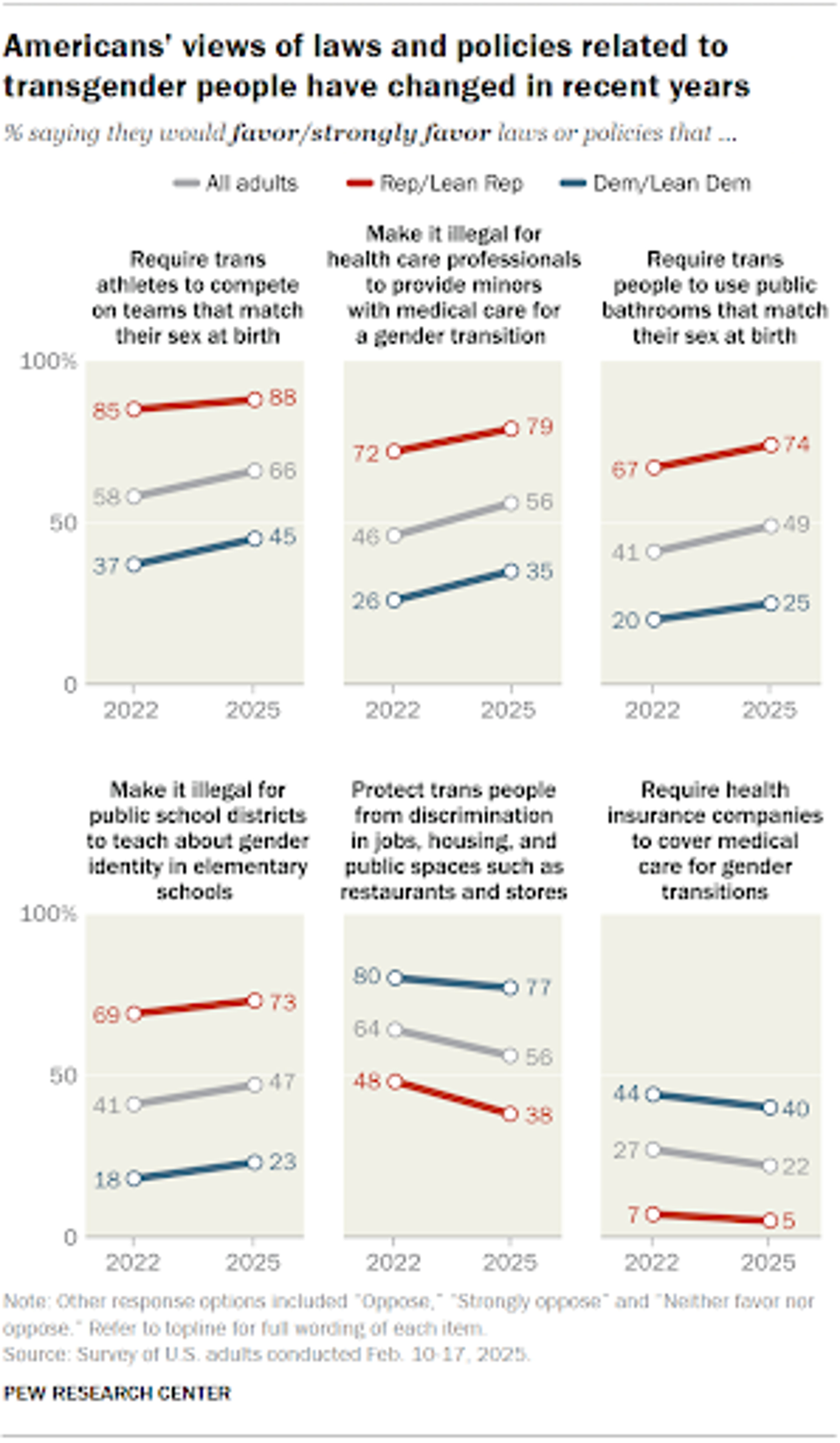
But it wasn’t just the political parties that shifted their minds on trans people. According to a Pew Research Center report from February of 2026, now almost half of American adults were in favor of trans people using bathrooms according to their assigned gender at birth, compared to 41% in 2022. This rise in support for anti-trans policies is visible in all questions asked, be it the teaching of gender identity in elementary schools, the ban ofn healthcare providers covering gender-related healthcare for minors or the requirement of trans people to compete with people of their assigned gender at birth in sports. Additionally, the support for the protection of trans people from discrimination and the requirement of health care providers to cover gender-affirming health care for trans people in general sank (by 8 and 5 points respectively). It is notable that the numbers show that the support for anti-trans legislation rises both amongst right- as well as left-leaning participants. This reflects the story of Nico, another trans individual I talked to recently for this article. Nico grew up on the West coast in what she described to Geese as a “liberal or even socialist leaning household”. But despite this left-leaning household, her mom accused her of being “brainwashed” when she came out. This echoes the idea of “Rapid-onset Gender Dysphoria”, a hypothesis which states that trans people develop their dysphoria by spending too much time with other trans people. Even though this has been debunked multiple times, it still has some cultural leeway–apparently even amongst self-described liberals and left-leaning people like Nico’s mother.
As the Trump administration took office in 2025, they almost immediately started to harvest the fruits the broader right sowed. With Executive Order 14168, issued on the day of his inauguration, Trump mandated that the federal government would:
incarcerate trans people according to their assigned gender at birth;
no longer allow individuals to self-select their gender identity on official government documents (e.g. passports, visas);
advise the attorney general to provide guidance to “to correct the misapplication of the Supreme Court's decision in Bostock v. Clayton County (2020) to sex-based distinctions”. This threatens Title VII of the Civil Rights Act of 1964 protection of “sex-based distinctions”;
stop the Bureau of Prisons from funding gender-affirming care;
advise federal agencies to use the category of “sex” instead of “gender” in official documents.
This focus on prisons especially is an escalation of an already very precarious situation. Compared to cisgender people, trans people are more likely to be incarcerated behind bars. Further, some states have passed what are commonly being called “walking while trans” laws. These are loitering laws which target trans workers, and are used in practice to stop and frisk trans women, especially trans women of color. In fact, trans women have a 10 times higher chance to get arrested and thrown into jail compared to [x]. There, they usually are imprisoned in accordance with the gender which they were assigned at birth. While they are able to apply to be transferred into the correct facility, according to a 2020 NBC article, most of these applications get denied. When trans people get stuck in these wrongly assigned facilities, they face a higher likelihood to be sexually abused–around 13 times compared to their cisgender peers according to a 2007 paper from the University of California in Irvine. With this executive order, prisons now stop providing trans people the healthcare they need, forcibly detransitioning them while they are serving their sentences.
While many of these policies were stopped by courts, the direction of trans policies under Trump II was clear: the administration and the GOP were issuing a relentless wave of attacks on the existence of trans people. The administration has an almost obsessive focus on this issue, featuring numerous Executive Orders, targeting of trans people in the military, the gender-affirming care of people under the age of 18, education about gender in K-12, and trans people in sports; as well as a federal funding freeze for everything that “advance[s] Marxist equity, transgenderism, and green new deal social engineering policies” and an investigation to restrict trans people in exercising their Second Amendment right to purchase firearms. The GOP in the House of Representatives has launched attack after attack on trans people, with their latest attempts in December 2025. Rep. Marjorie Taylor Greene introduced a bill that would criminalize providers for providing gender-affirming care for minors, which passed the vote with a 216-211 majority, even though it is unlikely to pass the Senate after that. The second bill voted on in this session was one by Rep. Dan Crenshaw, which would ban the coverage of gender-affirming care for trans people under Medicare, which also passed the House majority, and which would effectively ban gender-affirming care.
In their “Red Flag Alert” from March 2026 the “Lemkin Institute for Genocide Prevention and Human Security” stated that between 2024 and 2025 there has been a 45 percent increase in anti-trans bills across the country, making 2025 the sixth consecutive record-breaking year in this regard. Overall, in this decade, the number of anti-trans bills has ramped up at a staggering 668 percent increase, leading the Institute to speak of a threat of genocide on trans people in the US.
This wave was already outlined in the policy paper “Mandate for Leadership”, commonly referred to as “Project 2025”. This document was published by the “Heritage Foundation”, a think tank deeply entangled with MAGA leadership. Regarding trans people, the policy paper suggests, among other things, to:
rescind the Medicare coverage for sex reassignment surgery;
ban of “critical race theory” and “gender ideology” from public school curriculums;
redefine the “sex” into a biologically fixed category;
abandon the redefinition of “sex” into “sexual orientation and gender identity” in Title IX;
allow religious employers to be able to employ based on religion.
According to the community project “Project 2025 tracker”, out of the 19 policies tackling LGBITQ issues (mostly aiming at trans people), 11 are already done with 4 in progress as of June 2026. These policies have the united goal to make the lives of trans people more and more inconvenient to the point that it becomes almost impossible to live as a trans person. The slashing of Medicare for sex reassignment surgeries, for example, leaves trans people only the option to pay for them themselves, with costs ramping up in the thousands of dollars. After the rest of the Medicare cuts which increase medical spending in non-transition-related cases of illness, the increasing costs of living, the discrimination at work (if trans people even find a job at all), this option becomes almost impossible.
These attacks on trans people in both the ‘base’ and the ‘superstructure’ of American society take an enormous toll on trans people themselves. Data provided by the Good Law Project in the United Kingdom shows that, after the ban of gender-affirming health care for youth, suicide rates among trans people increased by 440%. This increase comes into an already volatile demographic, which is, according to a study analyzing Swedish citizens over 10 years, more at risk of mental health issues. The study showed that trans people were six times more likely to have a mood or anxiety disorder, three times as likely to be prescribed antidepressants and anxiety medications, and six times more likely to attempt suicide compared to the cisgender population. The study implied that undergoing gender-affirming care would decrease said risks.
Because many of these policies are not likely to be overturned in the next couple of years, many trans people are considering leaving their state or country altogether. Meredith, a trans woman from Austin, TX, told Geese that her circle of friends is “dwindling.” “Everytime you meet someone new, there is the fear of when this person also has to leave.” After I asked her if she had considered leaving as well, she told me that she did. “It is a shame that I have to consider uprooting myself. I have a nice apartment, a good job, an established social circle here.” Meredith’s experience maps perfectly onto what surveys show. According to The Hill, 50% of all trans people in the United States have considered leaving their state due to anti-trans laws.
This is a crisis.
Making Sense of Transphobia
This continuous wave of attacks has brought some scholars, such as Judith Butler in their latest book “Who’s Afraid of Gender?”, to assume that this is a new development instead of a continuation of the antifeminism we have already seen in the 20th century. They base this assumption on the fact that, in their rhetoric, the far-right centers focus explicitly on the eradication of trans people or their synonyms like gender ideology or DEI instead of directly taking (or rather talking) away the rights of women.
But this assault on women is still happening. After the overturning of the Dobbs decision by the Supreme Court in 2022, it has become open season on the reproductive rights of women. While tracing this assault would go beyond this article, it is enough that journalists like Jessica Valenti and her team are able to fill an (excellent) daily newsletter with this topic alone. To disregard this is to disregard the other side of the same coin. Transphobia is not the sole focus of the gender war, but it is another battleground in the ongoing war on women.
Within capitalism, the role of bigotry is mostly to divide the working class, on the one hand to create a lower price of labor within a certain group, on the other hand to use the momentum of the prejudices amongst workers themselves to prevent them from unionization and to fight back as one. Misogyny has, within the capitalist mode of production, the additional task of compelling women to take on the largest share of reproductive labor within the household. This is crucial to capitalism since women are the only group capable of reproducing the most critical resource in capitalism: the worker and their labor power. To work, this system relies on rigid upholding of the boundaries between men and women. With hormone replacement therapy, hysterectomy, orchiectomy and vaginoplasty, the most common and most invasive gender-affirming treatments heavily impede or even remove the ability to reproduce if no precautions like sperm or egg cell freezing, were taken before undergoing the procedures. (see Moravek & De Haan, 2023) This toll on fertility is especially taken when transitions start young, which explains the rhetorical focus on trans kids. The discourse of child-bearing, abortion, and the rights thereof are part of the same discourse weaponized against trans people as well.
This opting out of the reproduction of the new worker is true for most LGBTIQ constellations, since (especially) homosexual relationships are not able to reproduce new workers on their own. But, unlike these homosexual relationships, who, with enough economic and social pressure can be coerced back into heterosexual relationships, trans people ‘opting out’ usually cannot be reversed. In addition, trans people are a more socially vulnerable population compared to most other members of the LGBTIQ community.
The mode of production can accommodate a certain amount of people opting out of the social reproduction of the working class. As the Marxist historian John D’Emilio traced in his essay “Capitalism and gay identity”, with the advent of capitalism from the 18th to the 20th century, the family unit lost its status as the prominent productive unit, with the productive labor now mostly happening in the factories of the industrial revolution. With the increasing mechanization and therefore increasing productivity, fewer and fewer workers are needed to reproduce capital, leading to declining birthrates. D’Emilio traced this back to the settlers coming to New England in the 17th century, where the birthrate averaged around 7 children per woman. This rate sank drastically over the coming centuries in the US, averaging at 2 per woman in the 1970s and staying around this number since then. (p. 241) This lessened need for new workers, along with the entry of white middle class women into the workforce due to the decline of the rate of profit combined with social movements for the economic independence of women and the legal rights of homosexual people, created the right social climate for gay identity to emerge. This does not mean that homosexual desire did not exist before but that, in most cases, people, especially women, were not economically able to follow their homosexual desires before. For trans people, a key change was also the increasing medical progress in surgery techniques and the availability of hormones key to be able to fully embrace their true identities. With that, the ‘transvestites’ became ‘transsexuals.’
In the general historiography of the queer movement, the period stretching from the 1990s to the 2010s was dominated by the goal of integration. The AIDS epidemic had been managed and State repression had mostly ceased, even though D’Emilio added correctly that the “enforcement of gay oppression [had] mere[ly] changed […] from the state to the arena [of] extralegal violence in form of open physical attacks on lesbian and gay men.” (p. 244). But LGBTIQ people faced large levels of employment discrimination and still earned less, which forced most of them to fill lower service jobs or entry level positions in booming industries like IT. In Marxist terms, they were still in the reserve army of labor. But their newly emerged identities were welcomed by the marketing departments of the Fortune 500, who eagerly used their commitment to diversity to pay lip-service to the new sensibilities of the time–and sell more.
This window of relative freedom for queer people was only a short one. The crisis cycles became shorter and with the increasing gutting of the public welfare systems and sites of social reproduction, e.g. kindergartens, hospitals, and schools, there arose a serious problem to reproduce new workers. This lead to two phenomena: The increased interest of capital in robotics and AI, as shown at the recent CES, to simply replace workers and, in order to distribute the necessary reproductive labor, to restore the nuclear family. In the reproductive unit, this labor was able to be done with no extra cost for capital whatsoever, unlike in publicly funded sites of social reproduction, which have to be paid by tax money mostly derived from capital. This development was predated by an increasing privatization of these sites and of insurances, so there could be capital extracted from the reproduction of the human body. This led to the decreasing quality of care affecting both patients/children and staff, which means that, in healthcare, for example, people are prescribed unnecessary surgeries, overprescription of drugs like opioids and, in general, care focused on symptoms rather than causes. While medical work is highly trained cannot easily be replaced by measures taken at home, healthcare can look like only taking painkillers to carry through your workday which, then, is all the capital class cares about. Healthcare in a privatized system is only about restoring enough labor power to carry through a work day instead of actually healing people. But if this work is not done at all, society would simply just collapse. While it technically would be possible for every worker to just care for themselves, this is an enormous waste of time and resources. Capital found in the nuclear family already a suitable constellation where reproductive labor could be done relatively effectively and, more importantly, without direct payment. The costs of reproduction could be obscured within the family wage. Since, however, the rate of return on capital is not at the level of the post-WW2 boom, a family wage is not in the books anymore. In fact, the gameplan for the far-right seems to be to literally ‘babytrap’ women into marriages where misogyny and the continued stripping of laws will do the rest to keep them in the reproductive role. For trans people, this means either delaying their transition by targeting trans children so the window they are able to reproduce new Workers is longer, or to stop them from transitioning at all.
In order to do so, the allies of capital in the far-right have orchestrated an ideological attack on feminism as a whole, arguing that women now have everything, that it's one the one hand time for men to step up, since they got left behind and, on the other hand, for women to get back into their place–all combined with the fearmongering around children being confused into transing their gender. This very successful campaign rallied especially young men behind them. With no organized workers or communist movement to speak of, women’s and trans people’s rights were just for the taking.
The Trans-itional Program
After the 2024 elections, trans people seemed to be the Achilles’ heel of the Democratic party. With attack ads from the Republicans and a growing majority for reactionary policies inside the party, the commitment to even moderate support of transgender people seemed to be a hindrance instead of a winning issue. Prominent party members and officials like California Governor Gavin Newsom came out in favor of restrictions for trans people in sports, giving into the culture war in order to pander to the right. But, like Iowan State Representative Aime Wichtendahl correctly stated, voters won’t vote for “diet Republicans”. The adoption of these culture war issues won’t make anyone’s life better. Not billions of Americans who can barely afford their own survival, and certainly not the 10-40 transgender people who participated in collegiate sports. Falling for these narratives means closing the eyes to the true problems of the Democratic party: deep entanglement with corporate interests, a program for the few and not the many, an unwillingness to change, and a bureaucratic apparatus that is keen on keeping anti-establishment popular forces out. And, while a progressive stance on transgender issues might not be key to winning a race, it is certainly not a campaign-killer.
In his race for the seat of the mayor of New York, Zohran Mamdani pledged to not only make the city a LGBTQIA-sanctuary, meaning data security, protection against federal interference regarding the legalization for gender-affirming care even for people coming from outside the city, and creating an office dedicated for the LGBTQIA+-affairs, but also to re-invest into gender-affirming care. As history proved, this was not a problem for New Yorkers. Without ensnaring himself in the culture war, Mamdani’s campaign provided a substantial answer to one of the most pressing issues of the trans people of New York. Embedded into a generally progressive agenda rooted in the material improvement of the living conditions of working class people, trans issues deserved the same dedication and care like any other. They are not a side issue, to be dropped when the consent gets manufactured to blame trans people or any other minority for the ongoing crisis of capital and the winds of public opinion are changing. A progressive platform works in favor of all, no matter what the public opinion might be at the moment.
But it is not only the policies specifically regarding gender-affirming care and the protection against discrimination which are issues that improve the lives of transgender people. Trans people are also disproportionally affected by a lack of housing, income equality and the slashing of the welfare state. Re-building this will not only raise the boat for everyone, but especially for those who are affected by these issues the most. This will also leave the culture war with nothing to attach itself to. If your income is stable and your housing secured, why would you worry about what the issue the right-wing media apparatus wants to drag into the spotlight today is?
But the end of the rather short period of liberal integration into the capitalist system showed that, within capitalism, LGBTIQ people, like any minority, will always be only one crisis away from their rights being stripped in order to create a spectacle of a “crisis being solved” and be sacrificed to the demon god of capital growth. In order to properly protect them, we have to overcome the root causes. In addition to obvious solutions like the protection of Gender-Self-ID laws and the access to free gender-affirming care, we need a fully publicly-owned housing and healthcare system which does not operate for profit but for the people. We need a democratically controlled businesses and guaranteed employment to end job and wage discrimination as well as a fully-funded network of crisis responders to support victims of violence. Additionally, we need publicly funded media that reports on the issues actually affecting people instead of catering to their capitalist owners and caving into the culture war story of the day.
But we won’t get that with the Democratic party. To properly protect trans people, we have to build a proper workers’ party that does not cater to corporate donors, but to their own base.
So that, as Meredith told us, trans people–and all of us–can live our lives without being uprooted.
Works cited
Moravek, M. B., & De Haan, G. (2023). Reproduction in transgender and nonbinary individuals: A Clinical Guide. Springer Nature.