
May 4
The Marxism of Crisis, The Crisis of Meaning
From Althusser's structural causality to Derrida's spectre: the case that the crisis of Marxism is a definitive one, essential.
by Liam Egan
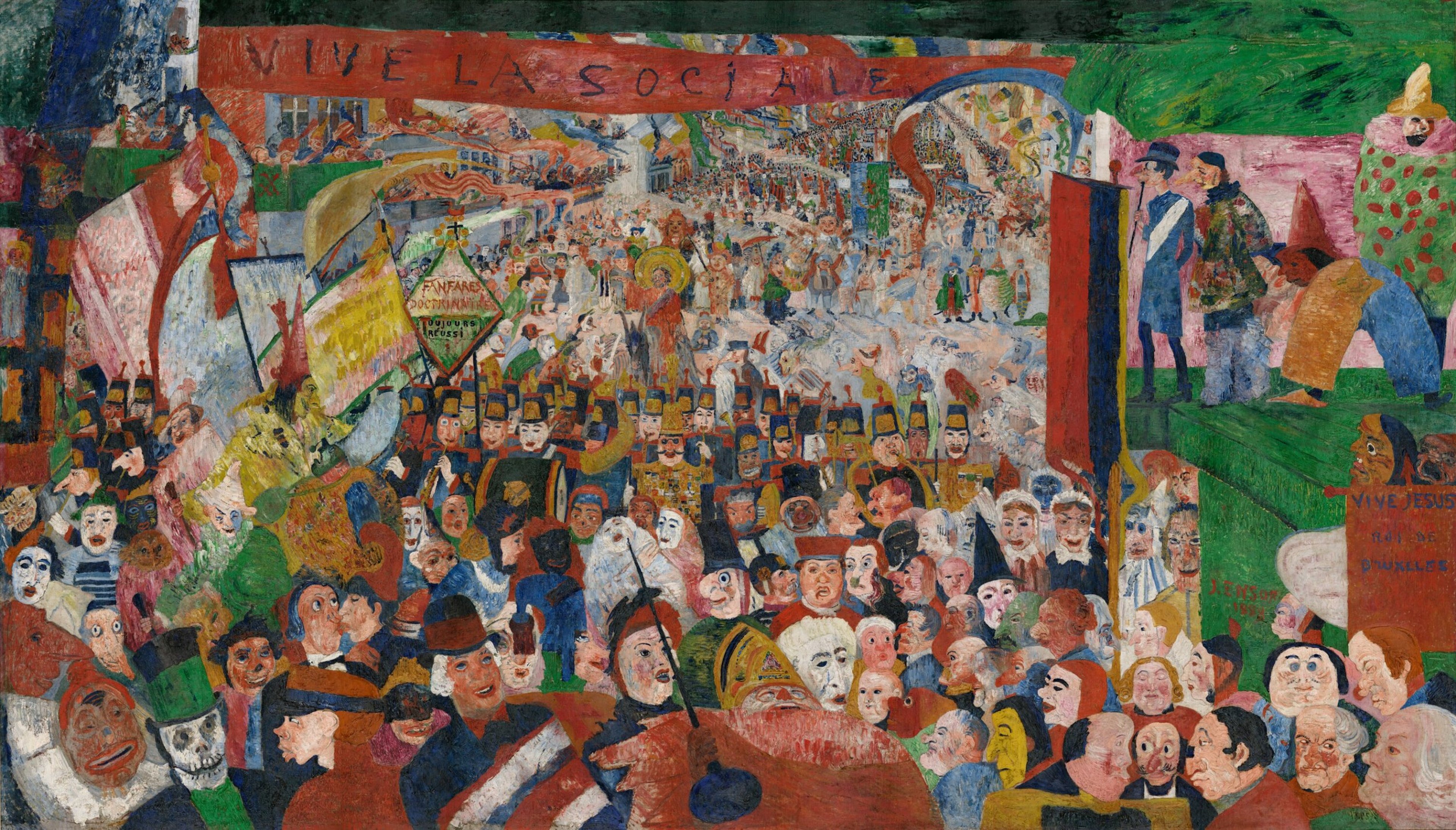
Christ's Entry into Brussels in 1889, James Ensor 1888
This essay is an expanded form with a new conclusion. The original version can be found here.
In 1977, Louis Althusser noted the "crisis of Marxism," which had come to the fore in the aftermath of fractures between the PRC, the USSR, and the communist parties of Europe. He refers this particular crisis to several preceding ones in the history of Marxist thought and practice: the dissolution of the Second International from the conflict over the First World War, the internal conflicts within the USSR with respect to Stalin, etc. We could, of course, cite our own later "crises of Marxism" that Althusser was yet to know: the Latin American Marxists finding themselves combated by fascists supported by the global imperium, the decline in labor density and labor militancy in the global North, etc.
One notices that Marxism, it seems, always finds itself in crisis. Both from within and without, it appears to be the structural condition of every Marxist project to be challenged. Althusser suggests that this is because of a set of basic contradictions in the work of Marx, which each historical incarnation of Marxist thought finds itself attempting to address. Dialectically, however, we can realize that this observation is two-sided: on the one hand, each Marxist political project finds the contradictions it must solve in the source material, made up not only of Marx's texts but also the political practices of all those movements which have followed; on the other hand, therefore, each project recognizes in itself the production of future contradictions to be solved by Marxist politics yet to come. In other words, Marxists find themselves always making history, just not in the conditions of their choosing.
It is this basic fact—that every Marxist project finds itself in crisis, asking "what is the Marxism of today?"—in which we might be able to identify something like the fundamental structure of Marxism itself. This core of Marxist thought is not, as Engels argued, to be found in a deterministic relation between economic forms and their content. Nor is it in the pure translatability between one form and the next, or the eventuality of the absolute break. Marx himself may have thought this—that is for others to decide—but this is not what his philosophy ultimately affords. In looking to the material history of struggle, we are reminded that Marx is not a thinker of determinate negation, but one of the necessary disjunction. We look to the history of collective struggle and see both its changing forms and the ways in which these forms, in one and the same moment, derive from and are producers of a shared project.
Derrida points to this structure in the coming of the spectre, in our choice to respond to an injunction which we cannot reject. At the same time, what has been and what will be are fused together; the haunting presence of the coming future and the crushing weight of the unavoidable past. If we are always asking, on which the very possibility of a publication like this one depends, "what is the Marxism of our time?" it is because such a question is not only introduced by Marx himself but constantly re-introduced and re-negotiated by the structure of Marxist thought. In this gesture we could go beyond Sartre when he called Marxism the "unsurpassable philosophy of our time," and understand it to mean not only that the conditions for its dissolution have not yet been produced, but that its structure demands that the appropriateness to "our time" always be raised.
Of course, I am well aware that I have yet to answer that question. What is the Marxism of our time? I could point towards some empty signifiers: actually existing socialism, the working class, dialectics. I could, in perhaps a less dogmatic fashion, suggest that the Marxism of our time is always that which involves us in or points us towards pragmatic political activities. Are we therefore to think that the dynamic between theory and practice is reducible to "experimentation," whereby politics is subject to the scientific theory of rational, instrumental actualization? Surely if we are to do justice to dialectical thought, we may instead want to identify an underlying ambiguity which exists between, or at the base of, these two poles.
I would suggest that this structural necessity for reinvention and reimagination is the defining feature of Marxism tout court, and we do a disservice to it—I am inclined to say to do it injustice, forget to pay our respects to our collective history of struggle—if we reject this capacity in the ways that are radical and perhaps unsettling. The key insight that Marx takes from Hegel is not the dialectic, but its necessary precursor: that notions, and their corresponding material existence, cannot be radically divorced from their structural situation. Derrida pushes us further in this respect, and we begin to understand that this detachment indeed cannot be radical but is nevertheless always present. So Marxism's present is always simultaneously itself, its past, its history, as well as its future, its undoing, its making into something which it cannot possibly imagine for itself now.
Perhaps we then understand, by the structure that we have identified, that because Marxism's concrete crises arise from the singular structural crisis which it presupposes and on which it depends, the appropriate response is not to attempt to fix it in place. That would be a rejection of the structure of Marx's thought, of the openness which constitutes its internal differentiation and allows it to function whatsoever. The embrace of this openness would not be to make an injunction to move "beyond Marx" or "beyond Marxism" but to embrace and attempt to move forward in response to the movements of collective political organization, which cannot be integrated into any "dogmatic" or "ideological" system of Marxist representation. It would be to continually ask: what is, and by is I also mean has been and can be, the Marxism of today?
In the early 1960s, Althusser suggested that Marxism possesses a different fundamental structure than that which I outlined above. At first in For Marx and later in Reading Capital, he locates the theoretical distinctiveness of Marx's thought in its ability to give an account of the precise mechanism by which it arises out of its discursive context. Per Althusser's framing, Marxism is not merely a critique of existing economic categories in terms of their analytical insufficiencies, but moreover a logical extension of the former to their absolute limits. As the notion of a limit implies, when brought to its extreme, a category demonstrates what is contained in its negative space by a positive exclusion. In other words, at the core of every category's concept is its definition against what it is not, i.e. that which makes it what it is. Through the recognition of this fact, the category itself is upended and a transformation is affected which seeks to resolve this constitutive repression. Marx's thought thus is distinctive for Althusser insofar as it can illustrate the process by which structures can give rise to the resolution of their own contradictions.
Before this 'structural' account is fully articulated however, Althusser introduces his interpretation by singling out Marx's distinctiveness as a reader. It is not simply the case that he extensively reads, for example, Smith and Ricardo, that he quotes from them and develops his arguments in relation to their specific texts. Rather, Althusser's Marx is a reader of a new variety, one who participates in a transformation in the practice of reading itself. In the old modality of reading, arguments are interpreted at face value and 'meaning' is something transparently available within the text itself. In the case of Marx, this would correspond to an understanding of his intervention as responding to classical economics on a purely argumentative level. Following Althusser's interpretation, however, Marx's novel practice of reading rejects the notion of the argument-as-such and instead produces 'meaning' from the upending of the source text's foundational categories by means of their necessary repressions.
Several features are distinctive of this novel practice of reading which Althusser attributes to Marx. In the first place, it is one of depth rather than surface. Parallel to Foucault's later essay "Nietzsche, Freud, Marx," in which he distinguishes the three titular figures as those as interpreters of depth or verticality as opposed to surface or horizontality, Althusser sketches a Marx who reads in a mode that contrasts interior to exterior, included to excluded, latent to manifest. Moreover, the Marx with which Althusser begins is one who participates in an ongoing process. It is not simply the case that the contradictions of classical economics are latent and that they must be corrected; rather, it is because they were not visible on their own terms and thus had to be made visible that demanded a fundamentally new practice of interpretation. One notes the necessity of temporality here—the non-visible is subjected to a process through which it becomes visible and in so doing is transformed into something radically outside itself. Such a transformation is inaugurated by the intervention of the reader, and is not automatic in and of itself.
Yet, the relevance of temporality and the intentionality of intervention is forgotten by the time that Althusser demotes Marx's thought to just another instance of a structure reflecting on itself. Having introduced Marx as a reader of a new variety, Althusser instead suggests that he is merely "play[ing]" the part assigned to [him] by the mechanism of the process." Forgotten is the new modality of reading, in its place a purely mechanical process within which thought "merely reflects in its own place," and the repressions which make up a given system of thought produce by "immanent necessity" their own revelation and resolution. Hegel rears his head, and the engine of history begins once again to progress of its own accord.
If we were to take Althusser's thought on its own terms, however, we might think to linger for a moment longer on the fact that the metaphor of reading with which he so emphatically introduces the novelty of Marx is so quickly discarded. If we were to do so, as I suggest, we might even notice that this emphasis on reading is discarded at the very moment that it would pronounce its most dire and perhaps unsettling consequences. In other words, the moment that the new modality of reading would truly rupture the limits of thought, it is repressed.
What would follow if meaning were not to be found as an immanent, transparent necessity within a text but was instead produced by the process of reading itself, as Althusser initially suggests? As readers, indeed of Marx, but truly of all those who follow and proceed, were we not to shirk our responsibility in the face of such a possible paradigm shift in the act of reading, we would be forced to reckon with the consequences. The recognition of this fact would demand that we similarly recognize that if meaning is made in the act of reading, it is simultaneously also made in the act of writing about reading, a writing which in turn demands to be read. Interpretation would therefore produce meaning in an indeterminate, non-resolvable sense and would correspondingly necessitate that we, as interpreters, take responsibility for our participation in this act. We would, in writing, in reading, most importantly in writing about reading, be obliged to continually produce meanings adequate to the always-absent wound resulting from the understanding that meaning is not something in itself.
It would be at this point that the framework which I proposed above, that which supposes a Marxism always in crisis, would come into fuller view. The crisis of Marxism and this proposed 'crisis of meaning' are one and the same, the former a particular instance of the latter's general principle. These same obligations—of meaning production, of responsibility both to the thing analyzed but more properly to the coherence of the interpretation itself—would bear on us but, with this fuller understanding in mind, in a much more fundamental way. What would become the primary activity of the Marxist mode would be meaning production and the articulation of positions, not the adoption of the "correct" analysis or the adherence to a particular "dogmatic" mode. The Marxism of today would be, in this sense, the Marxism which undoes itself of its own accord, that which stakes out its absolute ground on the fact of its conditionality, and ultimately that which rejects the demand to settle its own meaning while simultaneously proposing a final meaning itself.