
Jun 18
The Monadology of Man
Masculinity and femininity are not objects to reclaim, but social structures to abolish.

Paradiso Canto 31, Gustave Doré
Lyra Sieradzka is a bartender in London. She writes for Negate.
This article is a response to The Left Must Reforge Masculinity by E. Day and The Poisoned Promise of a “Reforged Masculinity” by Maria Luise Guenzel.
And in the sacred forum then shall be
A Prefect such, that openly or covert
On the same road he will not walk with him.
But long of God he will not be endured
In holy office; he shall be thrust down
Where Simon Magus is for his deserts,
And make him of Alagna lower go!
Divine Comedy — Paradiso
Dante Alighieri
Introduction
In the pursuit of a 'scientific socialism', there are those who have taken it to mean that the positions of extant science may be uncritically adopted and developed to inform the positions of a communist programme. Deprived of the structural ability to develop science autonomously beneath the suffocating morass of bourgeois civil society, the self-appointed standard-bearers of Communism have decided they ought settle for second place in science, though they arrive closer to fifth or sixth.
So comes Mara Luise Guenzel's response to E. Day's The Left Must Reforge Masculinity, in which she, invoking the good name of feminist sociologist and gender theorist Raewyn Connell, attacks E. Day's argument for a 'reforged' masculinity on the basis of her own concept of the existence of an irreducible masculine core, which insidiously demands the subjugation of women. For Guenzel, Connell’s arguments in 1995 are accepted uncritically, and formulate the crux of what is effectively a phenomenological essentialism.
The purpose of the social sciences is not to illuminate any positive truth of universal utility, but to provide transient, re-evaluated, and modifiable premises that provide conceptual and analytic frameworks to inform the practical approaches taken by civil society. Connell cannot beat this drum enough: she is not providing an essential framework, but a social analysis. Yet, for communism—a world-historic movement that, while finding itself within civil society, is the doctrine of its abolition according to a historical logic—Guenzel sees this framework as essential to overturning the 'masculinity' that frustrates social revolution.
But, for communists, this sort of 'positivism'—to say, lockstep adherence to the deductions of one scientific conclusion or another—is antagonistic to our objectives. Not because we spurn scientific conclusions, but because we do not take for granted the social neutrality of science; something Connell herself understands implicitly. Guenzel, however, uses this framework to argue for a closed concept of femininity: one that leaves "desertion" as the only option for living men. It seems for Guenzel, whose analysis does not question the fundamental purpose of sociology as a discipline, every single word Connell writes was sent by God.
Guenzel is helped only by the poverty of her critique's subject. Day’s essay argues that masculinity today is "in crisis", with reactionaries using the rhetoric and narrative of a traditional masculinity to promote their own reactionary politics. Consequently, Day posits that the left must offer its own concept of masculinity in turn. But Day, who boldly proclaims the left must "risk exposure to flame," proceeds to offer a relatively milquetoast form of neo-chivalry based on progressive masculine virtue, without providing any concrete path for this to arrive in practice. While Guenzel pledges fealty to positive science, Day pledges fealty to sociocultural neuroses. He attempts to connect to a ley line of thoughts and feelings, where the masculinity he grapples with is something self-developing and self-sustaining on its own terms, far away from the things it assuredly represents.
Most peculiar is how, despite reducing masculinity to a form—for Guenzel, an assemblage of 'clothing' surrounding an impermeable core; for Day, a weathervane to be directed by a lucky gust of wind—neither are able to concretely define what masculinity is. All that is left is a common notion: an understanding that there is a masculinity, but no established grounds upon which it occurs historically.
Let's investigate this phenomenon, then, so we may understand it. And after, we may return to Day and Guenzel, and see how their respective critiques hold up to scrutiny.
I — Demystifying the Masculine
A: The Development of Man
All science is essentially social. Natural science appears post-facto as impermeable truth, but this is only appearance. The real content of science is only in evidence in its social use-value, contingent on both nature and the society in which it is developed.
To apply this to gender and sex: human "sexual dimorphism", therefore, is a product of both the bimodality of observed sexual characteristics, and its utility to a social division of labour. At its basest, the function of gender reveals itself to be a concern with social reproduction.
Social reproduction is more than the ability to belabour a womb with a child. It is the active conditions under which society reproduces; their caretaking, their socialisation, their feeding, their raising to the point of adulthood. One may diagnose the existence of sexed characteristics as the base premises for social reproduction, but it is hard to argue that they are any more necessary than the existence of food, of shelter, of education, of society in general. We cannot surmise that the basic 'laws of nature' are the social root of sex and gender any more than we may assume the basic structure of an animal cell is the social root of metallurgy.
The man, however, is a definite social being within the conditions of social reproduction as we know it. It is well-known that the man, as a social being, has not, historically, been inextricably coterminous with the biology often assumed as the social genesis of the male sex; nor have gender roles historically related to each other as we know them today. Rather, the extrapolation of a particular scientific conclusion over these cultures to describe their gender relations embodies a post-facto standardisation that happens to suit contemporary understandings of these relations, transhistoricised and flung back to the past.
We do not need to go back far to see how this complicates the historical position of the 'man'. In mediaeval Europe, the assumption was of man as given, and woman, alike Eve spun from Adam's rib, was a perversion thereof, an outgrowth of the given male position.
But things have changed. Modern gender relations are in fact an inversion of premodern gender relations, at least in Europe. While, as Day notes, modern masculinity establishes the man as the rock to which the family was nailed, premodern femininity was indeed the franchise of women as that rock, in pursuit of heavenly salvation through childrearing. This gendered division of labour was the social confinement of childrearing to the woman; furthermore, the confinement of the role of 'woman' to those capable of childbirth. Women were conceived of as the lynchpin of familial stability, and in the husband's frequent absence would hold authority over the immediate premises of social reproduction.
This 'matriarchal' family organisation—whereby the woman was the primary instrument of tyranny over the children—therefore defines the premodern family as (a), rooted both ideologically and materially in the feminine, which we may only now define, and (b), an unconscious standard-bearer of what would later be called biological essentialism.
Nevertheless, as seen with the 'gender criticals' and the anti-trans lobbies, who for all their banal philistinism still hold the ear of Presidents, Chancellors, Prime Ministers, etc. and find their root in the vulgar development of liberal feminism, we see the women's struggle defining itself politically as, transhistoric, in opposition to modern masculinity; where men back then are seen the same as men today. But this, clearly, is not the case.
With the dawn of fully-fledged capitalist production, the institution of the citizen graciously restored individuality to the peasant masses, in order to have them work in factories for most their waking hours.
Here, the ideological structure of modern masculinity begins to take hold; not as the continuation of the chivalric tropes once belonging to male nobility, but as the reconstitution of man as the supreme being. Man, here, is still the franchise of all humanity, the power of massed industry, of supremacy over God.
Under such circumstances, it logically follows that woman should simply be folded into man, into humanity. Yet, the institution of private property, through the subsequent implication of 'private life', aided in the preservation of the family model under which social reproduction occurred; but now as more and more definite, alienated units. The family, preceding capital, had its own internal logic that had to be conquered—and when the men were enough for industry, premodern 'matriarchy' at home persisted. But this was still dependence upon men. The man may have become even more absent, even more distant, sometimes even stuck in a factory dormitory; but the dependence on the man grew firmer. The more the man spent away from his family, the more he earned, the more his family had—the alienation of man became the prerequisite for the development of the family.
Where educated women managed to develop their own independent theories of femininity, then, they could not fold into either the new man or the old woman. They had to produce a new femininity, one unbound by the traditional family relationships. Liberal feminism now prima facie appears a recognition of developments in sexual biology, that accepts women were not spat out of men a deformed failing of God's image, but are indeed beings of their own—essential things. But in this new feminism we see the extension of the citizenship franchise on the premises of an essential, private social reproduction; historically, the preservation of the family throughout the necessity of capital's expansion, to conquer the women, who had not yet been conquered, and instead remained a provincial governor for their absentee husbands over their children, finding strength where their dukes were demoted to levies in the great imperialist wars. These conditions necessarily structured the concept of liberal feminism.
Before the first and second world wars, women's attempts to enter the labour force were largely consigned to petty bourgeois endeavours and small production. Only after all the men were enlisted to die for capital were women finally capable of working for it in their stead. This period saw the rise of feminist advocacy, women's suffrage, political mobilisation—most notably, in the Soviet Union, where women were at their most 'empowered', even following the Stalinist rollbacks and degeneration.
This influx of new capital eventually laid way for a full-scale resolution of the gendered workforce issue. Whereas capital had for the longest time consigned its direct extraction to but one half of the potential workforce, now, as the example of the proletariat's half-finished business in Russia had demonstrated, it could now move itself to fully conquer the entire human race, to square the circle. The family's 'private' affairs, so long enduring its prying-open by capital, were finally pierced wholesale through successive moments of crisis, and the full-scale conquest of the entire potential workforce ensued.
For Day, this is the genesis of the masculine crisis; the fact that as time went on, women's growing 'parity' with men led to the dissolution of the traditional relationship between men and women, thus rendering the prior social expectations unachievable for men in general. For Guenzel, it is most welcome, ushering in perhaps the death of 'masculinity', this exponent of oppression.
Day and Guenzel are both arguing over 'masculinity' as a reified property. They are not, however, reckoning with its real practice, its real social evolution, which, as an ideology of the real position of social reproduction, cannot be explained through this abstraction.
B: Masculinity and Women
We start from the position that there is no masculinity without men. It is the way men practice their lives that gives real masculinity its essence, and thus, when abstracted, its modification only occurs in relation to the extant positions of civil society; either its existence as practice, or its existence as reified by the position of the ruling class.
It is therefore impossible to claim an 'essential' masculinity, nor that masculinity itself self-develops or self-sustains.
As such, masculinity does not self-develop for long, and is eventually drawn back to the real practice of men. We know that in the Middle Ages, the male nobility betrayed their chivalry almost as much as their male serfs betrayed the Bible's preferred masculinity with brothels, drink, and fighting.
There does, however, remain a distinction between men on the basis of class, and thus their attendant 'masculinities'.
Let us consider a man, and his 'masculinity', and on the basis of class see its relationship with social reproduction. We do not see in masculinity—namely, the toxicity of its individual behaviours—any obligation to social reproduction beyond the basest necessities. We see men historically perform in fashions actively detrimental to the health of their families, and indeed through alcohol, fighting, and adultery, masculinity actively deteriorates the family. Marx observed the conditions of the Victorian-era proletariat, and deemed them actively detrimental to the family model, and named explicitly widespread prostitution as a part of this process.
It became not simply harmful to the women and children that men behaved as they did, but in fact harmful to the family itself. And the behaviour of men, of masculinity, was not a self-produced thing, but a direct response to the incentives of production, and social reproduction. This behaviour of men only becomes masculinity when we isolate men as a political subject, where we may then say that due to their social nature as men, they are behaving in a masculine fashion.
But this is not so simple as extricating a given masculine behaviour. It is part of the greater process of the family's emerging negation under the position of early capitalist society: proletarian families crowded into single rooms, subject to only more deprivations when the father, who worked, broke first. As Engels' observes in Condition of the Working Class in England, the poor law workhouses, into which many families were forced, actively broke up family members, and deliberately limited their time spent together.
And again, only now, with the man the sole proprietor of the family's fortunes, the 'breadwinner', may we say this is part of a patriarchy, whereby the patriarch of the household rules. As with Guenzel:
The ‘man of the family’ gets to be governor over the small enclave constituted by his family unit, pretending to be a king to soothe himself for the fact that he is being exploited by the actual powerful people in the world, the capitalist class.
Guenzel argues that the reward of masculinity is in the domination of the household. Yet, with the patriarch so consistently absent, with his masculinity defined by that very absence, with social reproduction predicated on his alienation from his own family, how can we say this masculinity develops further his domination over the family—instead of ceding yet more ground to the mother, all while the family itself frays at the edges? How does this alienation soothe him? Does it not frustrate him further, bring him closer to the bottle, to the brothel, to the brawl? Does it not eventually conclude for him the wholesale abandonment of the family itself?
Of course, one may add: yes, but the man, in controlling the family fortune, selects at his whim, with his departure, the family's doom. He remains the ultimate authority. Therein lies the patriarchal element.
This is very true! But this is still the man's abdication from the family, his defeat of it, his realising that, in his power over the family from which he is alienated, he may leave it. This is not because the man possesses any natural power over the woman, but because the extant social forces, conditioning his life, have created a way of being by which such a decision is open to him.
And what of the woman, who, in her hands, possesses a key element of social reproduction? Who realises, in this situation, that it is she alone who births children, who rears them, who trains them, who teaches them, with the man only the instrument of its financial stability? What of women in general, who realise this power, who, with the development of bourgeois society, the ever-lusting desire for the conquest of more capital, to expand the workforce, the reconstitution of relations between 'the sexes' on the basis of an ever-advancing social standpoint, finally decide they have had enough?
This explains, in fact, the firm conservative streak that dominated women's politics in many societies well into the 20th Century, and the contradiction within women, the family, and the bourgeois standpoint of liberal feminism. For many women, the most direct means to secure their safety was, in fact, the consolidation and protection of the family from the deprivations capital inflicted upon it.
There developed two contradictory interests in the politicisation of women: the liberal, bourgeois position, and the reactionary, patriarchal (or matriarchal) position.
The liberal position—often advanced by middle class and bourgeois women, who came about through the slow but steady advancement in women's higher education (though almost always for those with wealth)—advocated for the reconstitution of 'woman' as not a mere child-rearer, but an equal citizen in civil society.
This struggle was not merely legal, but social. The long-term connotations here would advance two things:
The socialisation of certain elements of social reproduction (through institutions such as childcare, widespread public schooling etc.), and therefore a firm strike against the institution of the private family.
The swelling of the labour force with women, the equalisation of financial power thus allowing for the steady growth of dual-income households. This, in turn, would advance, as with early wage growth, the stability of a new family model. Legal and social frameworks began to coalesce around the mutual dependency of men and women who, despite increasing divorce rates, would change the grounds upon which separation occurred: instead of men simply abandoning their families by fiat, the separation was, through legal and social pressures, more 'mutual'.
These developments combined transformed the family from an instrument of social necessity to a means for legal adjudication of social reproduction. Or: it transformed the family from an instrument of property, governing the legal individual, to an instrument of the legal individual, governing property. Chief among all this property remains the children, the fruit of social reproduction, who, while not generally bought and sold on the market, remain beneath the jurisdiction of their legal guardians, provided bourgeois law does not witness a too fierce brutalisation by their relatives.
Only now may we divorce masculine social behaviour from the aggregate social practice of men, identify a shared masculinity on the basis of isolated common behaviour, and thereby consider it a property of men and not social masculinity. For Guenzel's critique is not a critique of social masculinity—though she certainly seems to think otherwise—but a critique of masculinity as a property of individual men that they gradually shed with the trajectory of history.

Andrew Tate sharing a sensitive moment with Adin Ross
In Connell's framework of 'hegemonic masculinity', the obvious fact is noted that this masculinity is often not practiced by most men. Instead, masculinity functions as a mere aspiration toward which men are guided. Guenzel's 'dialectic of the sexes' takes the present 'crisis of masculinity' (where, as Day tells us, men are killing themselves much more than women because they cannot meet a given social standard), and aligns it with an 'untethered force', the reclaiming of the 'wages of masculinity', therefore making manifest a violent response through the individual 'Manosphere' advocacy of rape, abuse, murder, &c.
For those of us sensibly opposed to rape, abuse, murder, etc., we thus find the 'manosphere' repulsive. Guenzel identifies in the manosphere the attempt to rebuild the family, to re-establish traditional gender relations, seducing men with the promise of a traditional wife to bear his woes and children. But this is not social masculinity. It is a historical phenomenon that has repeated itself many times: where, diagnosing some terrible feat of nature as the carrion of all modernity's failings, any group of people set out to go and restore a traditional order.
What Guenzel does not seem to understand is that this 'Manosphere'-style advocacy—despite its obvious doom in the face of capital's iron hand, which dutifully finds new and clever ways to further evaporate the family—is not an exponent of 'masculinity' at its basest. It is an exponent of the family as a form of organisation dedicated to its self-preservation; most evidenced by the fact that, when men became alienated from their families, it was women's movements that often demanded their resocialisation, the rectification of the family relation. This was not just liberal feminists and their legal family, but the conservative women, who relished in their tyranny held over the children to the extent they wanted to consecrate the traditional family relation once more; these were at their fiercest in the backward, primordial countryside yet to be brought to heel by the might of the city.
In the U.S.A., these bible-thumping hicks were the ones to ultimately set the ball of Prohibition rolling. In stalwart defense of the family, they were then picked up by educated middle-class women, who, in good evangelical tradition, set out to advocate for women whose men were so alienated they drank themselves half to death on a whim.
As the 'Manosphere' are soon to find for themselves, the triumph of the prohibitionists did little to restore the virtue of the Christian subject. Nevertheless, it emerged from housewives who believed in rectifying the man's alienation from social reproduction, had a staked interest in doing so, and acted accordingly.
Now we have disabused ourselves of the notion that the impulse to 'rectify' social reproduction is any unique property of a gaggle of freaks fighting their 'longhousing' by white women in human resources (or otherwise essentially masculine), we thus see the critique proposed by Guenzel is not social, but in the individual form of the men themselves. This is the legal citizen in riot against other legal citizens, an exponent of a historical tendency that is necessarily 'misogynistic', but not masculine. So when Guenzel says:
In giving masculinity a new form, we might give masculinity a new set of clothes it can dress itself in, but we cannot change its core.
She can only say this because the concept of masculinity has in fact been painted onto a historical process, and is not an essence itself, that no such phallic cascade hell-bent on sexual plunder and social dominance is the immutability here. Rather, masculinity is the clothes the family "dresses itself in", more than masculinity being some static thing, a monad. What is constant is the social relation, not the closed identity. Guenzel’s analysis thus presents a return to metaphysics which is only possible because of a positivist fetishism of academia that takes its conclusions as real truth, and not a social process that can itself be studied.
The liberal feminist position eventually rendered the family, as concerns the sexes, a legal arrangement before a social domination system. Social domination is more and more projected onto the children. In every society where the legal family now prevails, there were two historic 'revolutions' in this regard, so to speak. The first was the legal revolution that secured women's suffrage. The second was the social revolution that embarked, bravely, to conquer the philistinic cultural norms that refused to acknowledge this new equal legality; the ongoing process by which money and power are redistributed between 'the sexes'.
One could say the goal for Communists is the wholesale abolition of social masculinity and social femininity, which themselves are mere instances, dynamic, and changing. Only the wholesale abolition of civil society stands in our way. As such, the answer is not to take aim at any given gendered exponent, but to attack gender at its root, that is, the position of civil society. And yes, to say this is to invoke nothing but a propaganda theme. But this is only opposed to Guenzel's propaganda theme, which instead of considering the concrete, considers the transient, that which may soon be air. So she concludes:
We as a Left need to offer a safe haven for those who intend to desert [masculinity], who want a more equal world, and who want not just to cling to the identities of yesterday but to build those of tomorrow. By betraying masculinity, refusing to embrace differentiation from the Other, and becoming equals, they will cease to be men, as we understand them. They will become something much more important. They will become comrades.
So fetishised has the masculine form become, that it is now a thing with an army, and presumably uniforms, which stands in opposition to a mass of non-masculine 'comrades'; as in, those dedicated to social revolution. Thus, Guenzel wagers, the abolition of civil society's standpoints is something that makes possible the abolition of civil society, as opposed to the premises upon which those standpoints are actually capable of being abolished. So it is said we must abolish masculinity for this title, 'comrade', to be claimed.
II — Guenzel's Man-Stood-Still
A: Crises and Reconstitution
For Guenzel, masculinity is quite literally a monad, in the rationalist sense. It is a static property from which gendered dominance is elaborated. No matter what it presents itself as, it will always possess the interest of domination over women, of rape, of abuse, of murder etc.
Guenzel characterises modern men as "kings without an empire," and makes this claim of 'male supremacy':
Its primary function within capitalism is to enforce the division of reproductive labor and the division of the working class.
Male supremacy, which preceded capitalism, is now appropriated by it, rendered a function thereof, a force within it. This is down to the framing used: understanding male supremacy as a mere function of capital, and not a pre-existing system appropriated and reconstituted by it, thus precluding a sober analysis of the historical competition that defined the basis of the women's struggles against it.
This point of pedantry will nevertheless aptly contextualise Guenzel's apparent belief that gender and masculinity are self-sustaining forces, despite ostensibly characterising them as exponents of capital. In Guenzel's model, it is a gendered supremacy that enforces the division of reproductive labour—this conceptual system—and not the behaviour of the people within it; it logically follows that those men successfully de-alienated from their families were not done so via social reform in large part down to the efforts of women, but the sheer clarion call of gender itself, insidiously reforging the family.
Now, Guenzel tells us:
In other words, male supremacy is itself a feature of capitalism necessary for its reproduction.
This extremely bold claim advances the position that the supremacy of hegemonic masculinity is not just a depravity inflicted by capital, but as of present necessary for its social reproduction.
It is, of course, impossible to argue that 'male supremacy' is a not an observed phenomenon of all hitherto existing capitalism. But capitalist history is littered with the grave of its own exponents, once proclaimed immutable, which became morphing historical instances, which may at some point be done away with entirely. It is here that we pay respects at the grave of the 'iron law' of wages.
If we look at the development of the family, of masculinity's waxes, wanes, woes, and crises, all of which have been talked about at length before, we see two things:
'Masculinity' is not an essence of our existence, and is indeed declining.
It is neither an invariance of capitalist existence, nor essential to its social reproduction; masculinity's death does not bring with it the death of capital.
For the compulsion of men to the family is not an artefact of man's ideological expression as reified by the positions of bourgeois society, but the real existence of men, as they relate to those around them. As such, the reproduction of the family order may employ men, but it is not defined by them, as a masculine essence.
Here remains again, the assumption that the chains of any given determinate ideology are removed piecemeal; with the destruction of a determinate 'masculinity', we are left with one less obstacle in the path of the objective of communism, the abolition of civil society, the removal of the chains of capital. For Guenzel, it seems the defeat of capital is multideterminate, rather than overdetermined; that, like a video game, we must check all the prerequisite boxes before we may finally hit the 'revolution' button and institute communism.
I, however, would wager 'men', even as the wretched creatures we know them as, are perfectly capable of shattering these chains at their weakest link, just as everyone else.
Ultimately, the bulk of Guenzel's "Kings Without an Empire" thesis is that the women's liberation movement has disempowered men by dispossessing them of power over women, stripping of them of a creature comfort, made manifest in social domination: their "wages of masculinity", as she puts it. Without their psychological and social support "simply for being a man", their only thing left was the "untethered use of force" against women, in order to conquer it.
By then re-iterating the premises of the latest crises, all well known to us (say it with me: 2008, Brexit, Trump, COVID, Ukraine, Gaza, Iran, etc.), Guenzel then suggests the economic deprivations inflicted upon the 'imperial core'—the wretched metropole, but also where the noble women's struggle is nevertheless the most advanced, so she doesn't have to talk about third world countries, with their own women's struggles, in various stages of development, and the fashion in which the global crisis has impacted them—have thus provided fertile ground, in conjunction with masculinity's retreat/crisis/etc., for the rise of the hard-right 'Manosphere', of familial restorationists, of men who are told all their problems with modern life are down to the perfidious feminists that so emasculate them.
This is all correct, in a sense, and indeed Guenzel appears to agree that the 'Manosphere' project is not necessarily feasible or desirable for even its participants.
Ultimately, this has, for Guenzel, culminated in a Manosphere-driven rollback of progressive policy; abortion rights were attacked in Hungary and Poland, then Roe v. Wade was overturned in America; queer literature stripped from schools in Florida; renewed offenses against gender-affirming healthcare.
Given all the factors applied to these things, which cannot be reduced to just the 'Manosphere' (MAGA's infatuation with the angry young men the 'Manosphere' denotes came only quite recently, and this support has slipped from them as fast as it came), it seems an odd move to, as Guenzel does, consecrate the 'manosphere' as a widespread political project, with its hands in every pocket; that is connections are not merely incidental of a wider reaction, but the source of the reaction itself.
Not only does Guenzel fail to see overdetermination where it matters, but she apparently sees it where it simply is not occurring. We are again invited to see masculinity as its self-sustaining self, not its political, actual self, as a result of the contradictions in the family order; we are not invited to see the kaleidoscopic array of determinations in the multifaceted hegemony thereof, especially as includes the children. Only hegemonic masculinity remains.
To summarise my contention, the issue with Guenzel's approach is not her analysis of a decline in masculine social power, coupled with its attempt to reconquer it, but rather the fact she sees these forces as only themselves, as nothing more, and as such folds reaction itself under the masculine. But as even the most vulgar feminist will tell you: there is no real analysis of masculinity without the 'handmaidens' who reinforce it, and who still exist!
We may even discuss where the handmaidens come from, what informs them, how their own forms of social domination and repression have shaped their own ideological development—but this, it appears, is beyond the scope of Guenzel's critique. As such, Guenzel only has one side of the argument, and despite her appeal to the 'dialectic of the sexes', erases the feminine equivalent for but a quantity, a linear progression, and as such the appeal to 'dialectics' itself appeals crude and even Fichtean. Without this, the men themselves can only be considered yet another phenomenal ghost, but one that cannot move, only appear in different forms, obscuring its true form, like a shadow on the wall in a cave.
If we look at this from a more in-depth perspective, we see a variation of alienations; the alienation of man from his family through his domination of it under the world-system of capitalist production; its rectification completed with the mutual alienation of the masculine and feminine gendered subject beneath capital; the men were never soothed by the family they constantly ran from. We thus do not see the women's struggle as a uniform progression toward family abolition, but rather the family's reconstitution under different terms. The issue of the 'masculine reaction' can be understood as a loss of privilege, but not a strict continuity; and indeed, this cannot be answered without discussing in more detail other forms of social domination, including that imposed on children, transgender people, and even the men themselves.
B: On Masculine Normativity
Guenzel finally breaks into the meat of her critique by invoking, as established earlier, academic Raewyn Connell, with the same rigidity and uncompromising fealty as a religious text.
In her section The unbearable normalness of masculinity, Guenzel does the following: she discusses the framework of 'hegemonic masculinity' Connell proposes, discusses how 'hegemonic masculinity' appears, then acknowledges, in fact, that most men do not in fact behave in a fashion conducive to hegemonic masculinity. But then Guenzel says even 'good men' (we all know them) still benefit from this situation in a negative sense; not by advancing themselves, but by "being spared the worse life [...] of a woman."
To substantiate this, she then lists off a litany of rather shocking statistics that depict the sheer extent of male violence against women: deeply sexist beliefs, sexual assaults, widespread rape, and, even of the comparatively small amount of men found victims of rape, it is mostly done by other men.
For Guenzel, these statistics 'quantify' Connell's framework. She is correct; however, it does not qualify Connell's framework, describe it in a propertied sense. All Guenzel states is that because women are subject to immense amounts of violence, Connell's framework governing masculinity is ipso facto correct. This, again, is based on an appeal to Connell.
Why are we to take Connell's 1995 Masculinities as authority? Especially when Guenzel does not once contend with the 2005 revisiting of hegemonic masculinity, after Connell had come out as a transgender woman, and further addressed the concept especially as relates to 'transsexuals'? I'm hardly predisposed to standpoint epistemology (which, as with all epistemology, is essentially religious), but I'd at the very least be interested in what she had to say, with this in mind!
Anyway, if we bring up this 2005 'revisit', we find some interesting points. While Connell (alongside James W. Messerschmidt) first dresses up what hegemonic masculinity successfully brings to the table, she then moves onto the more interesting part: the critiques thereof.
To summarise, Connell and Messerschmidt bring up several critiques. Most important of these critiques for our purposes:
"The masculine subject"—hegemonic masculinity does not in and of itself represent the character of groups of men, but rather a discursive set of norms strategically adopted by men.
"The pattern of gender relations"—hegemonic masculinity regards gendered development as self-contained, dichotomised between men and women without shared properties.
Connell and Messerschmidt ultimately conclude:
Research has also documented the durability or survivability of nonhegemonic patterns of masculinity, which may represent well-crafted responses to race/ethnic marginalization, physical disability, class inequality, or stigmatized sexuality. Hegemony may be accomplished by the incorporation of such masculinities into a functioning gender order rather than by active oppression in the form of discredit or violence. In practice, both incorporation and oppression can occur together.
In other words, “hegemonic masculinity” exists alongside “nonhegemonic patterns of masculinity,” modifying the dynamics of how people relate to gender. While Guenzel pays lip-service to 'nonhegemonic masculinities', she does not take on board this crucial nature: incorporation and oppression; namely, the process of incorporation.
Here, we see an assessment of how nonhegemonic masculinity does in fact exist, and either remains marginalised, or is integrated into hegemonic masculinity, often violently, like a frat house hazing ritual. This twofold character—incorporation and oppression—remains eerily similar to the genesis of modern masculinity itself, as described earlier in this article. Where the standpoint of 'the man' as a regulated and multi-alienated subject of the wage relation was built in tandem with his new social supremacy as breadwinner, it also came with violence and oppression embodied in that alienation. This was then diffracted, through the man, into the family, onto the women, and onto the children—and for the children, it even occurred most often through the women, their primary caretakers.
If we furthermore take another raised critique—that the concept of 'a masculinity' risks dichotomising shared experiences between 'the sexes'—then we are left with an interesting shared experience instead here.
Let us depart from the hierarchy of a gendered dichotomy for a brief moment and speak only in rawest terms: social domination. The social domination of the men over their women was continuously won through the sustained oppression of women; likewise, the social domination of women over children and other types of oppressed strata, often enabled by the social domination of the man, nevertheless grated against the fact the man, as a lynchpin, often held their fate and fortune in his hands at their expense. The ultimate physical fate of his family was in his hands, be it through him abandoning them, or merely dying. As Engels puts it in his anthropology of the English working class:
Of course such a way of living unavoidably engenders a multitude of diseases, and when these appear, when the father from whose work the family is chiefly supported, whose physical exertion most demands nourishment, and who therefore first succumbs – when the father is utterly disabled, then misery reaches its height, and then the brutality with which society abandons its members, just when their need is greatest, comes out fully into the light of day.
Through a multitude of new and old oppressions, yet via an incorporation into a given social supremacy, women were both "incorporated" and "oppressed" together. They were made legal citizens beneath the liberal state, remaining oppressed subjects, but, upon the new racialised/gendered/ableist/etc. strata system (as diverse in women as it is in men), finding a new grounding, especially as related to a new set of subjects, the exploitation of the child by their parents on an even ground. Perhaps this is alright for the feminists, for the softer palm of the woman may hit the child with less force than the coarse fist of the 'hegemonic' man.
But for the rest of us, we are left to consider; does this make femininity, itself, a 'nonhegemonic masculinity'?
Guenzel's failure to account for the agency of the 'feminine subject' thus finds its place again in Connell and Messerschmidt's own revisiting, where they write:
The concept of hegemonic masculinity was originally formulated in tandem with a concept of hegemonic femininity, soon renamed "emphasized femininity" to acknowledge the asymmetrical position of masculinities and femininities in a patriarchal gender order. In the development of research on men and masculinities, this relationship has dropped out of focus.
In other words, Connell and Messerschmidt are identifying the ways in which masculinity and femininity are mutually interconnective forces; not separable essences. They do not clash as solids, as a hammer on concrete, but as liquids: two streams joining the same river.
Perhaps the most utility in Guenzel's critique can be found in her designation of an 'Other', another thing borrowed from Connell. Here, we find the real social practice whereby men are separated from women; when hegemonic masculinity directly Others categories, and must exist in contradistinction to them. This Othering, Guenzel acknowledges, is not just to women, but to 'nonhegemonic masculinities'. So she may say:
One might imagine masculinity as a pyramid, with the hegemonic masculine men on top, below them the non-hegemonic men, othered and subordinated, and, below them, women.
Yet again, by excluding women from the equation in any active sense, leaving only a negative force of nature forever resisting men, she pays lip-service to the question of racial hierarchy but does not for a moment even bother to take it seriously. Thus, her critique has definitively assumed the transcendentality of gender, its ability to govern all, to be all, to subsume everything into itself—men, women, children, the whole question of race. It is not a theory of masculinity in society, but a theory of society as masculinity.
Many of the critiques levied against Connell's "hegemonic masculinity", even the strawmen, nevertheless ring true against Guenzel's vulgarisation of the concept. Whereas different terrains of gender and race are positive and negative in some sense, and negative terrains experience the overlap of more concrete positions, and these all mutually develop in some fashion or another on these bases, for Guenzel masculinity can now only be understood as a linear hierarchy, divorced from everything, all hierarchies developing in exclusive incidence, in some world above, only placed together in the real world once perfectly crafted beforehand, in a world of pure thought.
There are fashions in which masculinity, and masculinities, can be assailed in a deconstructive sense, to demystify, to explain in relation to other things. But with Guenzel's reification and fetishisation, we have thus seen the creation of an essential masculinity, that self-develops, self-sustains, and stands on its own two feet.
C: Deserting the Poisoned Promise
The final two parts of Guenzel's critique are best summarised in a single line of logic: masculinity offers little to those who now aspire to it, and, as such, the only option for men who realise this is desertion. It cannot be reformed. Any attempts to do so will only victimise women in the end, maintain the structures of hegemonic masculinity, dress it simply 'in new clothing', etc. As such, the fashion in which we deal with the 'pyramid' of masculinity is to encourage defection, build spaces for those who want to 'defect' from 'the war on women', and thus destroy the rotten edifice of masculinity once and for all, in preparation for the coming world-revolt.
Ultimately, this boils down to what was said earlier: Guenzel has managed to, by transposing the revolution/reform dichotomy onto the 'gender struggle', inadvertently reinvent the monad.
In the conception of Marxism as an academic position, as abstract from its real practice, we see emerge positive theories of history that are opposed to said real practice as a mode of critique. So, we see a transcendental critique, testing positive theories gleaned from Marx on social revolution, assuming the permanent longevity of certain structures that, through such a transcendency, are subsequently transhistoricised as immutable forces. Masculinity can only be understood as a concrete gender relation in practice; in this view, however, the word has an essence, and ultimately the debate is debased to semantics.
In any case, in attempting to develop Marx, the positive sciences, so confounded by their negative subject of study, render Marx a subject of interpretation rather than the progenitor of a definite doctrine—as a foundational religious text rather than a self-sealing theory of critique. For such academics, the mystical shell is wrapped back around the rational kernel, and though they claim to move beyond Marx, most of them rarely make it further than Kant.
And Guenzel, who is apparently still stuck at Leibniz, works much to assure us she considers masculinity to be an ensemble of the given social relations, but she is only capable of conceiving of it as an essence unto itself in the end:
In giving masculinity a new form, we might give masculinity a new set of clothes it can dress itself in, but we cannot change its core.
What an admission! So let us remove from Guenzel all the semantic pretensions of her piece and instead see the concrete programme offered: the left must provide a safe space for men where they may at long last become comrades.
One wonders what the rest was all for.
III — Day's Man-In-Motion
A: The Death-March of Men
It would make more sense, at first glance, to tackle the critiqued pieces chronologically; to begin with Day and succeed with Guenzel. But the framing of both actually leaves us somewhat at the point where, paradoxically, it is Day who appears to be developing Guenzel's critique. This is what happens when you treat philosophy and academia as a self-serve ice cream parlour.
Let us start by, as Day tells us, risking exposure to flame. Let us imagine, for a moment, that 'men', as a category unto themselves, may have reasonable concerns worth noting. Let us sit down and consider what they might ask of us.
Sit for a moment, and contemplate.
Having now achieved the same level of political awareness as the "dirtbag left" and most mainstream liberalism, we may move onward.
In only one area is Day a bit better than Guenzel, where he considers women agents capable of doing things. Where 'masculine expectations' are not only broadly unattainable, but in fact no longer a sole property of men at all, thanks to the previously discussed changes in historical social relations, this is a reactive force to a positive femininity. He writes:
The fulfillment of traditional masculine ideals–to provide stable income, act as stone-cold suppressors of internal and external emotion, strive as pillars of the community, and seek a wife who will give them children to continue this process—has become noticeably less achievable, but, more importantly, also less exclusive. Women have become fully capable of earning their own income, or even surpassing their partners' income, and are arguably more involved in communal spaces. The social pressure to step into the role of homemaker who births and raises children has shrunk compared to years prior.
For Day, then, the women are in fact better at masculinity than men, and the lesbians who seek a wife to give them children are the best men. This would leave us to conclude that in fact the new gender hierarchy has sensitive young men at the bottom, and trans lesbians with cis partners at the top. Day's new feminism thus paints a clear picture: the revolutionary subject, sensitive young men, must erect a new standard to carry in the face of that famed exponent of patriarchy, transgender lesbians.
Leaving this aside, Day invokes the 'dialectic' between men and women. Day tells us the 'cisheteronormative monolith of masculinity' is being chipped away. But in the evening-out of this playing field, Day notes (in material terms, he stresses), this means men now have a deteriorating supremacy, but must meet a bunch of the same expectations regardless. Such elaborates itself into the diversity of woeful things experienced by men, etc. etc. More statistics follow, yet again to quantify, but never qualify.
In short: For Day, men and boys without a common social community diffract into atomised communities that appeal to their alienated tastes; where the left does not articulate a counterculture appealing to these men, the right wins. And as such, it is all congealed, piecemeal, into MAGA.
Having been exposed to this flame, full of things we have assuredly never even once heard or entertained before, broken this fresh ground, etc., we are now asked to contend with Day's proposed solution to this conundrum.
For Day, there is no masculine monad, as such. Instead, there is a motive masculine identity, something which embodies fundamental bases but is not any specific one of these things; instead, it is something strung between them, something which links all the bases, but is, assuredly, something more than these things.
This masculine identity, for Day, can thus be harnessed.
As such, Day lives in a world of esoteric Vril: one where, as the masculine essence is declining, the people whose purpose were once sated by it are motivated primarily by a new purpose offered. At the end, then, they must find new purposes and, as such, the motivation of human life as relates to the masculine becomes mere purpose.
Day, because he takes masculinity as a phenomenon unto itself, connecting to psychological impulses that extend beyond the simple premises of life, is now capable of saying: we can harness this power. We must appeal to those led to these subcultures, contend on the realm of culture. But, for Day, there is no substantive nature to this culture itself, it is pure energy and purpose; we are instead possessed by the thoughts of yesterday, and the atomising substance of the present day, the fractious incoherence of the standpoints attended, is neglected in favour of the past, reaching forward, even now, into the future.
Now, we see Day declaim our belabouring by the past:
Yet, the social conditions of the past are bequeathed to us today in the same manner that those of yesteryear were bequeathed to us yesterday, and time’s arrow marches onward.
In good positive fashion, Day sees this as a standpoint of the communist programme, and not the position of the bourgeois society. Thus, he argues not in tackling the material premises of the present, but the past. He sees the traditions of dead generations, weighing like a nightmare on the brains of the living—and decides he'd like to play with them.
As we see, for Day, the 'superstructure' and 'base' are not actually a materialist dialectics; they are a quantified iteration of a formist, transcendental phenomenology. Day proclaims: the superstructure weakens as its base does! For Day, the superstructure falls apart directly with the material base's own demolition, and phenomena are infinitely separable, measurable only after their beforehand preparation, and thus we can, again, take masculinity in its isolation, then apply a base/superstructure metaphysic, and subsequently devolve to mysticism. As we can now tell, Day is actually very similar to Guenzel in this regard.
Simply, Day believes men are best serviced by appealing to their masculine purpose, the stringing-together of something from the past, and not, say, appealing to their real conditions of life.
I say, when pressed for one or the other, the men will take bread over purpose.
Day bemoans the negative approach that treats masculinity as something to be curtailed, and erased, wagering we cannot advocate from the standpoint that tells men what not to do.
This is correct. It is thus slightly disheartening to see that Day fails to see how a positive programme for 'masculinity' is just as redundant as a negative one.
B: Come On, You Cowards!
Day proposes a masculinity that will negate the masculinity of the manosphere squadristi. Here we see yet again his dialectical naturalism rear its ugly head: dialectics can now be applied everywhere, no matter what, on any terms at all, so long as we use the right terminology.
Day's three 'questions' for "left-wing men's advocacy" are as follows:
What is to be left behind?
How does the left embody masculinity without offending the gentle womanfolk, and also while reckoning with the toxicity of past masculinity?
What ideological terrain must this new masculinity fight on?
I will refrain from proposing my own answers to these questions, because they would necessarily involve profanities too cruel for this magazine. I also happen to think they are silly questions that miss the point. But in any case, let us see how Day answers them.
For the first question, Day raises the standpoint of modern liberal feminism ("girlboss feminism"), and correctly identifies it as a cancer manifestly unsuited for liberation of any kind. Nevertheless, he raises a point that I must riotously object to:
Many have posited similar center-left critiques toward this complex and multifaceted phenomenon [liberal feminism], but far fewer are looking at the other half. For the left, turning a blind eye to this phenomenon is the neoliberal framework. If one acknowledges only a single thing from the arguments made until now, let it be that this is an issue that we cannot afford to ignore any longer.
Day is correct in that considering the feminine without the masculine is just as bad as considering the masculine without the feminine. But Day's language of urgency here does not correspond to the actual fashion in which men are today addressed.
Here, Day does not argue we ought 'leave behind' anything, but in fact, pick something up: the 'other [male] half' of liberal, 'girlboss' feminism, as if the dialectic is contained within the historical instance alone, reified and fetishised, made a procedure in its own right, an essence of nature. He continues:
Discovering the correct incentives required to construct a political majority begins with investigating the current struggles and limitations of its base. Neglecting this is arguably one of the worst forms of idealism one can take – not to simply propose a different idea in place of the contesting, but rather to argue that the phenomenon doesn’t exist at all! Do we really need to give more ammunition to accusations of gaslighting?
I'm the one who feels gaslit here. While Day seems to believe that denial is the primary attitude towards masculinity, I cannot agree. Nary a second passes in the gender debate without the infernal call from all aisles: "what about the men," "male loneliness crisis," "men's mental health," "we NEED a leftist Joe Rogan, to appeal to young men," "is Hasan Piker the answer to the redpill?" etc. etc. etc.
It is beyond ridiculous to suggest that it is we who ought dictate the heat of the crucible in which masculinity must be reforged. Day exposes nothing to flame which is not already burnt. Perhaps in our little revolutionary bunker, the slogans of the world-revolt splayed on red banners above our stools, lit dimly by our various candles, we may place our fingers over his candle as a dare, and withdraw our ashen fingers with a cry of pain. But please, for the love of God, man, take a look at the veritable wildfire outside! We're all choking on the smoke.
Unlike Guenzel, Day does contend with the children. As things to be liberated? Heavens no! Things to actualise the masculine, of course. Day builds off the relationship of early man with his children, as an evolutionary necessity to help assist in the acquisition of calories for a child. This, supposedly, can inform a type of father-child relationship 'decoupled from marriage and cohabitation'. Keep in mind that here, Day is attempting to redefine man in relation to woman, or rather, attempting to abolish this relationship, surpassing the dialectic of gender entirely without abolishing gender itself.
Day, it appears, is steadily inventing male separatism. He halts just before that conclusion, though, saying this conception is out of reach "for now." Instead of advocating directly for MGTOW, he seeks for masculinity's self-producing negation.
So having seen masculinity deteriorate, decline, enter crisis, completely break down on all fronts, and lamented the woes this has reaped, he goes: ah, but how does this negate itself? He fails to see how he has answered his own question.
Leaving nothing behind in spite of saying he would, and proposing nothing to sate the gentle womenfolk, Day seems to only re-iterate again and again the same premise: the strange notion that the 'crisis of masculinity' is being neglected, and that we need to instill virtues in men, give them purpose again, from the left.
So, he writes:
In the current stage of political struggle, masculinity must be reshaped for center-left/progressive and communist causes – this remains absolute. But the stage we are in is also one of negotiation; a series of sequential material compromises that tactically lead to a greater positional advantage, with the eventual goal of state abolition, followed by the abolition of patriarchy and gender altogether. This political imperative mandates isolation of the productive and unifying elements of masculinity as we currently understand them for use towards our own ends.
Here is the crux of the thesis, that masculinity must, by some agency or another, be reshaped, remoulded, reforged for leftist purposes. But by whose authority does this strategy take shape? Day leaves this unanswered, instead letting 'communist' and 'centre-left/progressive' causes melt together, proposing yet another bloc politics—this time attempting to carve out 'men' as a space within it.
Day talks much of the need for the left to do what he suggests, but does not programmatise it, does not offer its political solution in a real sense. Instead, he offers the purpose but not the means, the geist but not the practice.
Such is the standpoint of a man who uses accusations of 'idealism' ad nauseam.
For those of us who do not care for the centre-left, the progressives, the masculine, or anything else, who simply see a determinate terrain to be struggled on, and not a series of separate struggles forged in heaven and placed together on Earth, we see only in Day's standpoint a cowardice.
He sees masculinity negate itself, produce a crisis, and its real woes. Not a fan of this particular negation, Day finds a subject of blame for this: the left, who did not provide the right position for that masculinity to negate itself, and thus capital's depravity is vested in this left, who cruelly did not think to contend with men, even though they have repeatedly tried to do so.
Here's some exposure to flame: I think 'masculinity' is doing just fine on its current trajectory, the woes be damned. We take no responsibility for the work of capital, only responsibility for the real movement that abolishes it.
For his part, Day's proposed solution is simply to list off some virtues, request we make them 'manly', and then be done with it. He seems just as willing to leave the men with crumbs.
C: Ideology From Air
Here we contend with the final question of Day's: the ideological terrain to be conquered from fascism, in the name of communist masculinity.
This ideological terrain? The internet.
It is banal and philistinic to suggest, of course, that the internet is not useful. On the contrary, it does seem to be the only place where things happen, for many. Real life grows more strenuous, but no less boring. Online, however, the ever-mixing kaleidoscope of escapist subcultures mix evermore with the political, exposing many to perspectives they would not have otherwise acquired.
Much has been written about this revolution in communication; regardless, it has gotten to the point where 'terminally online', far from an isolated niche, is a major standpoint for the generation. As such, Day is getting somewhere in the sense of communicating ideas. The problem, as is oft discussed, is where the necessary unity of critique and practice elaborates itself. Without one, the other does not exist in the real sense, as they are the same thing; the words on our screens only matter when they enter a type of social practice beyond being words on our screens.
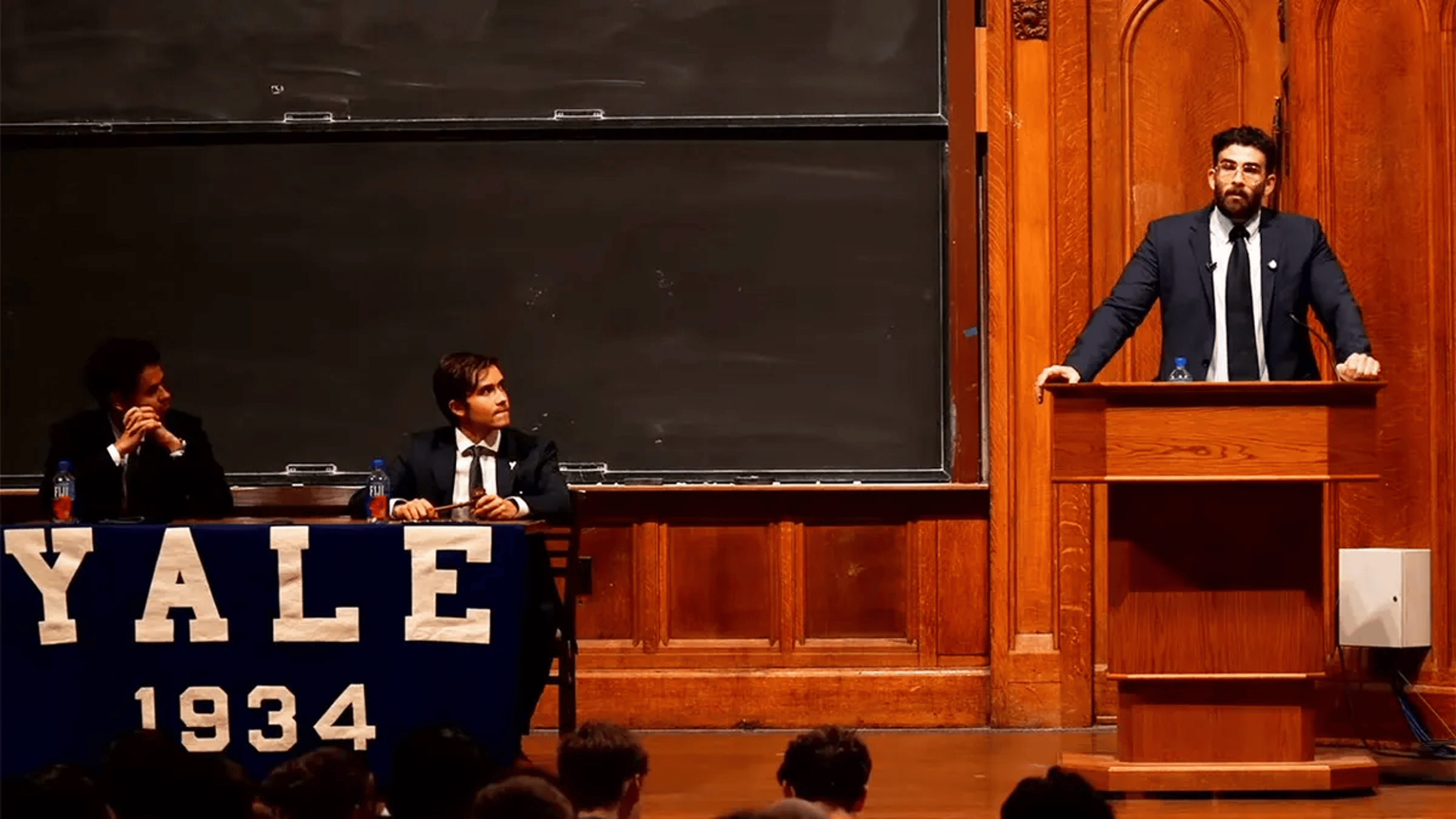
Hasan Piker at Yale, calling for a "Dictatorship of the Proletariat"
In this sense, Day is correct when he brings up Hasan Piker as an example of actual momentum: Hasan has successfully translated his online 'spectacle' into a real force in the real world. The question is how this is replicable to the terrain of real communism; how much the method of Hasan's sparkling Browderism can be translated into a method by which to provide an authentic base of communists.
For Day, however, this only exists in the realm of men. And unfortunately, while his 'post-truth society' does in fact exist, it is a discursive notion in the standpoint of the bourgeois intelligentsia—the notion that we are now lying to ourselves and each other, as opposed to the past, where assuredly we told the truth more often.
Rather than being marked by a new disregard of truth in favour of lies, then, the post-truth society only amplifies pre-existing discursive tendencies. Only once the contradictions of past discourse are made more visible can then can they be comprehended as a newfound reconstitution of discourse.
This is to say: our discourse may appear post-truth, but this transformation of discourse itself cannot modify the definite premises of civil society.
Day wants a movement, acquired through a definite terrain, but he focuses solely on the discursive, and not the political practice it leads to. As such, he is alien to political practice.
Inasmuch as it relates to real masculine practice, Day's new masculinity is an ideology of air, an illusion and facade. He believes that, should there be the resources invested in his propaganda offensive, it should address primarily the masculine.
So ultimately, the overarching critique of Day's thesis here can be found in the fact that the internet is a general terrain, whereas his specification on the masculine requires a particular terrain; not just the internet, but a definite space as relates to masculinity; this does not preclude the involvement of the internet, but must specify the character and lens of that involvement.
The absence of a particular space to contend with leftist masculinity here may well be down to the simple fact that no such thing exists.
D: The Phenomenology of Man
In all of Day's discussion of masculinity, despite his consistent references to a continuous, definite social basis, he is incapable of providing one in evidence. Rather, his appeal is on the basis of virtue, of purpose, of what ought be done in relation to the present ideology.
But the present ideology is no such systematisable force from the communist perspective, and for all his Eighteenth Brumaire invocations (at least, in subtext and at least one instance of direct quotation; the work, which contradicts him, is not otherwise mentioned), Day neglects the central thesis of the text: that the position of bourgeois society cannot help but create farcical repetitions of what once has happened, the continuous recycling of its dead weight to reinvent itself, to no avail.
Instead, Day does not understand the present masculine ideology as a subject of critique, but a negotiable force to be wielded positively. Yet the Marxist doctrine makes no weapons out of ideas alone.
Through his mediation of the ideological, and only the ideological, Day produces a metaphysical essence that cannot find its reality in social practice, only in propaganda. Propaganda is no self-generating force, though, but the advocacy of a real platform with a real goal: something Day is incapable of producing.
The Marxist doctrine, by contrast, is not the propagandisation of any standpoint of civil society. It is the propagandisation of its abolition. If masculinity falls at the altar of capital, so be it. At the cusp of what appears to be another crisis, we ought do away with this liberal personhood, the liberal individual, the 'man' and 'woman' as essential social standpoints, not rally behind them.
As it stands, the epicycle of idealist philosophy is reproduced: Guenzel as a Leibnizian rationalist, and Day as Kant, spinning the noumenal masculinity out of the monadology of man; the man-in-motion emerging, at long last, from the man-stood-still.
The fact that Guenzel's critique succeeds Day's, whereas the established philosophical analogues appeared in reverse order, needn't matter. As any good teleologist will tell you: time travel is eminently possible if you use formal logic.
Nevertheless, let us thus remove from Day all the semantic pretensions of his piece and instead see the concrete programme offered: the left must provide a safe space for men where they may at long last become comrades.
One wonders what the rest was all for.
Conclusion: For a Negative Marxism
When you look at the essential programmes proposed, Day and Guenzel have shockingly little to dispute. What they seem to disagree on is the semantics. To toss a stone from my glass house: the whole thing is disastrously venal, little more than the recitation of (positivist, naturalist) poetry to justify a largely semantic disagreement over the nature of masculinity.
What this really shines a light on is the danger of fetishising the dialectic, the seduction of positive theology based off of a revision of Marx that positions him as providing an essential worldview.
I feel today, when all the tragedies and farces are inseparable from each other and world-history creaks beneath its own dead weight, we would make much more of critiques rather than positive theories. We ought have a firmly negative Marxism, which draws its positions only from the definite terms provided by capitalist production.
The abstraction of certain concepts serves definite utility, but only on the terms of what that abstraction represents, and an accounting for its various inadequacies. But positive Marxism inevitably reduces the abstraction to a reification, and it is thus reduced to a fetish object.
Reification is a prerequisite for fetishism, i.e., taking abstract concepts as not just concrete, but standalone self-developments—contingent on logical premises and not their real existence—and it is this cycle of reification-fetishisation that seems to characterise many of the errors of the movement at present.
As such, a debate is permitted where everyone seems to agree on a masculine metaphysic, and the shape in which it can be contorted with our words becomes the geometry by which we map the life and death of the communist movement.
Should this be allowed to become the shape of an emergent discourse, I am afraid the movement may not get very far at all. Rising from the horizon of the present crisis, which is by all accounts becoming a general crisis, whereby the 'economic', 'cultural', 'geopolitical' spheres all cascade into a frothing mess, we see yet again glints of what could be. But if we want the cascading tumult of our times to host our heroes of the commons, to smash the exploiters, to once again learn ambition, to provide evidence of success to a weary proletariat, then we needn't dress up our objectives in any propaganda theme ossified around capital's variant qualities, like gender. Day's propaganda asks us to advance the man. Guenzel's propaganda asks us to enable the man's desertion from a given hegemony.
The position of the communists—the historical party, demanding of its constituents an unabashed honesty of means and ends—is the defeat of gender entirely, as our first and most essential advocacy on the issue. Our position is not 'femininity' or 'masculinity', but the abolition of both.
There is a persistent shame and reticence around this particular communist position, even among our 'militants'. I will remind the communists, however, that they are attempting to foment revolution in the name of a world beyond class, beyond money, beyond the state. We know this is possible. We know people can be convinced of its possibility. But how can you expect to do that, when you can't even broach the subject of the abolition of the gendered division of labour?
Hold with pride each and every communist position and elaborate clear, without an ounce of hesitation, to anyone who asks.
You may be surprised by just how many people agree.