
Jul 31
There is Only One Anti-Zionist Force in the US
Finn S. argues that only the Socialist Left can connect the struggle between Zionism and Capitalism, Imperialism, and Colonialism.
by Finn S.
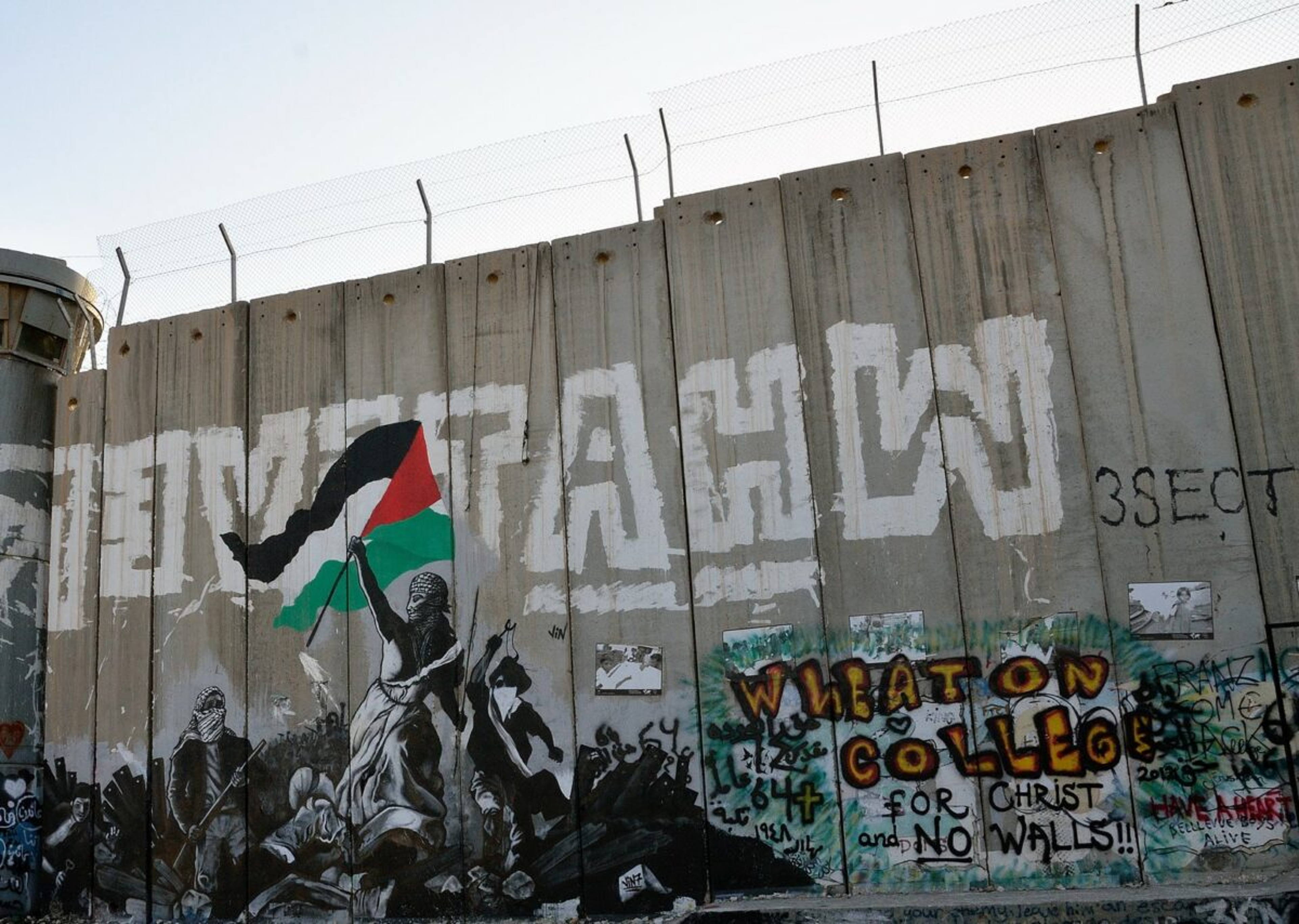
Graffiti art on the West Bank Wall near Bethlehem, reinterpretation of Eugène Delacroix's painting Liberty Leading the People
Can the Right successfully articulate (and moreover, create the political support for) anti-Zionism? Had this question been asked at any point in the last few years, many would respond by pointing to Thomas Massie, a Congressman for Kentucky’s 4th congressional district. Massie has held a consistent record against support for Israel; in 2019 he was the only Republican to vote against the condemnation of the BDS movement and, in 2021, he voted against sending $1,000,000,000 in funding for Israel’s Iron Dome. As the genocide in Gaza has continued, Massie has, in words and actions, continued to stand against Israel.
Massie is a part of the political thought that we now call “paleoconservatism” – a broad name that generally refers to a laissez-faire economic belief and an anti-interventionist approach to politics. This ideology saw a resurgence during the Tea Party movement as a response to the 2008 financial crisis. But its time in the spotlight came and went, and with it so did most of the support for this old branch of Rightist politics. Instead, we now live in Trump’s Right, and the old guard is becoming exactly that: old.
Case in point: Massie was primaried earlier this year. He lost in what may well have been the most expensive primary in United States history to former Navy SEAL Ed Gallrein. Looming over the race were the influence of two emblematic groups: Trump’s White House, and the pro-Israel lobby. While AIPAC and other pro-Israel PACs sent in millions, Trump lent his significant political capital to Gallrein. Even the Secretary of Defense, Pete Hegseth, visited Kentucky for the express purpose of voting and campaigning for Gallrein. The message is clear: there is no room in Trump’s Right for dissent. Already, he has begun going after another republican candidate, Maine’s Susan Collins, presumably for her past criticism of him and his policies.
Compare this now to the race in Pennsylvania, which saw Democratic Socialist and anti-Zionist Chris Rabb win in a landslide against his dynastic, and, importantly, Zionist opponents. Rabb is not unique in this. Most famously, Zohran Mamdani won the New York City mayoral race against Curtis Sliwa and Andrew Cuomo, two ardent Zionists. Though the Democrats are still a definitively Zionist party (seeing Jamaal Bowman and Cori Bush, two critics of Israel, lose their primaries), the victories of Rabb and Mamdani alongside other names like Analilia Mejia, Sam Rasoul, and Maureen Galindo indicate a shift in national politics.
There are two points I wish to make here: the first is that there is only one genuine anti-Zionist force in the United States, and it is the socialist left. All sides of the political spectrum have had time to digest and react to the atrocities of Israel’s genocide in Palestine. It has only been the Left (properly called) that has been able to articulate and maintain a consistent anti-Zionist position. The Right, under Trump alongside other political and ideological figureheads like Ted Cruz, Elon Musk, Ron DeSantis, and Ben Shapiro, has solidified itself as Zionist and pro-Netanyahu. And more importantly, because it holds political power in America, it is not in much of a place to rethink its stance as such. The Democrats, on the other hand, are beginning to see that their old ways - their tepid and spineless stances on most issues - will continue to cost them races. At the same time, a new generation of Democrats are being born, a generation that is looking to lead the party to a new paradigm that does not include support for Israel’s atrocities.
The second point I wish to make is that, of the many frameworks that exist across the political spectrum, it is the socialists who are not just the stalwart supporters of anti-Zionism, but also the only ones who can properly articulate it. Firstly, Israel is a hub of global capitalism; an outpost in an illiberal area, it has become a powerhouse of technological innovation and venture capital, as well as a testing and breeding ground for AI. Secondly, while America First (and movements like it) claim that Israel’s prioritization is anti-American, what they fail to realize is that, by racializing Israel (claiming Israel is the nucleus of Judaic control over America), they obscure the real relations that make Israel a worthwhile investment for American politico-economic hegemony. While the anti-Israel Right argues that there is a hidden, supposedly “true” America that is being obscured by Zionist interests, the Left has no such confusions: we say America is flawed, and it is our duty as Americans to remedy those flaws
But it would be dishonest not to acknowledge an uncomfortable truth for the Left: Israel began as a leftist project - which is to say, a project that the Left historically supported. How can we reconcile with this past, and how can we claim to be the only true anti-Zionist force?
It is strange to say, given the disdain modern socialists have for Zionism, but it is nevertheless true that Israel had support from the global left (Ho Chi Minh, the USSR, not to mention the various historical proto-Zionist labor movements which early Israel took inspiration from). Within Israel itself were formed Kibbutzim, places of communal living where property, labor, and responsibility are shared equally which were, in essence, the utopian picture of socialist living. Indeed, Israel’s key founder David Ben-Gurion sounded originally much like a leftist, speaking of equality between the Jews and Arabs in Israel, not to mention his usage of messaging similar to that of the landback movement in the United States. He saw similarities between his political project and the October Revolution, and hoped the Soviets would as well. There was even a time when Stalin, for many the cornerstone of an authentic post-WWII Marxism, supported the Zionist project (though he later firmly rejected it).
How can we on the Left say, then, that Leftism is the only bastion of anti-Zionism in 2026? Even in 1948, at the peak of Zionism’s progressive energies (a clause which, to any who know the history of Israel, is a dark condemnation), there were cracks in its Leftist credentials. Take, for example, Ben-Gurion again: it is important to note that “what he admired was not Lenin’s ideology, but his ability to reshape his people’s destiny,” according to historian Tom Segev. This presents Ben-Gurion’s leftism as opportunistic rather than a genuine ideological commitment. Additionally, his Zionism was predicated on the promise of a ‘land without a people for a people without a land’. But when push came to shove, his desire to build his own nation trounced his desire for equality; his vision for Israel, from the very start, precluded the very existence of Palestinians.
Fundamentally, Ben-Gurion held an untenable position: creating a state based on a religious identity while espousing values of equality. The Zionist project was unique in that it assumed a special, ancestral connection to the land which implied an empty identity of its current inhabitants. The Zionist ideal of equality is based on a generalization: the idea that Palestinian Arabs are Arabs first, and thus have no problem assuming a new national identity. However, this idea is always found to be subordinate to Israel’s own right to exist. If Israel, or the Israeli identity found itself threatened by the existence or identity of the native Palestinians, the Zionists took no issue resorting to violence.
Ben-Gurion thought of himself as a leftist. Perhaps it’s even reasonable to call him one. But regardless of that, his politics only share a surface-level similarity to the leftism of today, and over him is cast a long and dark shadow: the Nakba. How cruel must an event be to be known as “the catastrophe”? In the Nakba, Ben-Gurion and Israel as a whole faced a crossroads: make peace with the Palestinians, live up to his aspirations of equality, but thereby sacrifice its uniquely Jewish identity–or assert its belief in its right to the land it occupies through violence. Over the course of the Nakba, at least 700,000 Palestinians were forced from their homes, while thousands died, and a likely untold number were victims of rape or other sexual violence.
This, rather than the (comparatively empty) platitudes of Ben-Gurion, must be recognized as the kernel of Zionist ideology. And what we Marxists can recognize is that the Nakba, as the expression of the ‘theory’ of Zionism, must necessarily be immanent to Zionist ideology as a whole. This is another advantage we have in articulating anti-Zionism. Because Marxism (from its Hegelian roots) is a totalizing and systematizing ideology, we are capable of grasping Zionism in its entireity. Thus, the left can see Zionism not as a mere foreign agent (Massie’s view), nor as the expression of a mystic, nearly omnipotent “Jewish supremacy” (the view of people like Nick Fuentes), but as it is: a deeply complex and historical phenomenon, interconnected with capitalism, imperialism, anti-Arab sentiment, and settler-colonialism.
In the same way, the right-wing’s ‘anti-Zionism’ must be seen as what it really is: not true anti-Zionism, and much less pro-Palestine. For people like Thomas Massie, the issue of Israel is less about supporting the victims of a horrific ethnic cleansing than it is an issue of anti-interventionist principles. When Massie (and figures like him) opposed support for Israel or condemnations of BDS, he did so not out of opposition to Israel’s crimes – but because he supports “no foreign aid”, or because he doesn’t believe in condemning any boycott movements. While he has made statements in support of the plight of Palestinians, they come off rather opportunistically when contrasted with what little he has to say about Israel’s atrocities or actually helping the victims of the genocide. He even once said that the US should stop “accepting refugees from Gaza”.
For figures like Fuentes, on the other hand, the crux is purely racial. His problem with Israel is not about supporting Palestinians (he has made it clear that he does not care much for any non-white people), but rather about opposing Israel because of its supposed Judaism. Fuentes and people like him see Israel as the ultimate confirmation of their anti-semitic global conspiracy; here, Judaism and all its alleged evils are congealed into one geopolitical entity, which is accepted prima facie as the absolute representation of Judaism on the whole. These far-right actors, seeing the justifiable outrage at Israel’s atrocities, beckon horrified onlookers and potential activists away from principled, rational opposition to a genocidal ideology and towards the belief in a world of shadows, where invisible hands pull puppet strings. These actors drum up an impotent hatred, one that sees all evils as the result of an opaque Jewish conspiracy. It is not just that this belief is bigoted, nor that it is wrong (though it is both); it is inoperable; the belief that every major evil in the world results from a series of illicit deals between Judaism and political officials necessarily makes power unlocatable. Those who promote this conspiracy can only vaguely gesture at Israel and Zionist Jews on one hand and the politicians that support them on the other and insist that there must be some connection, but beyond that they see no concrete action which can be taken to fight this. Even when they offer AIPAC bribes as an explanation for the United States’ political support for Israel, they fail to a.) explain why these interest groups claim so much power without resorting to conspiratorial anti-semitism, and b.) offer a genuine plan of action to fight against these interest groups.
It is easy, after two and a half years of genocide in Palestine, to look to the right and ‘give credit’ to those who have dissented against it. And while opposition to genocide is an admirable sentiment, theirs is not an opposition to genocide. At every turn, the most important voices of the supposedly anti-Zionist right have shown that they do not genuinely care for the Palestinian cause, nor do they have any interest in putting in the intellectual effort to understand and fight Zionism. Their shallow opportunism can and must be contrasted with the principles that guide the left. During times when Zionism and Israel were the default position, when they were at their ideological, cultural, and political dominance, it was the left, not the right, who stood firmly with Palestinians in their suffering, who organized the economic movement now known as BDS, and who organized countless protests, organizations, and direct action campaigns to fight for the just cause of a free Palestine.
The only political group that has been able to build an anti-Zionism based on the suffering of the Palestinians, the evils of colonialism, and the despotism of the United States’ hegemony has been the Left.