
Jul 5, 2026
Towards Active Revolution: Sects versus the DSA
In the first part of this work, we schematize our movement after 2016 and attempt to provide some analysis of where the DSA succeeded against the sects in defining our current moment.
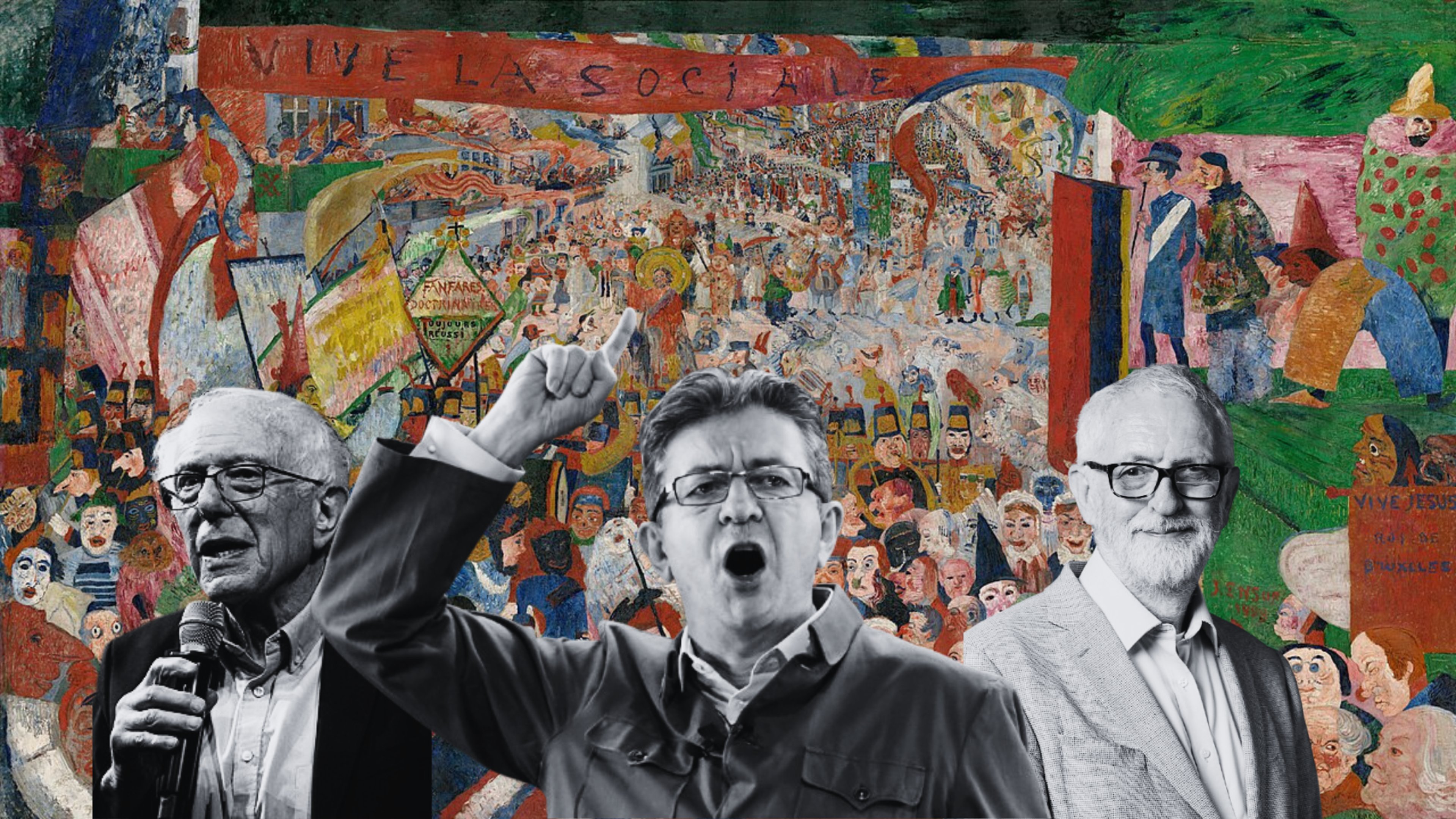
Christ’s Entry into Brussels in 1889, James Ensor (1888)
I. Sects versus the DSA
II. Populism and The Proletarian Revolution
III. The Permanent Revolution and the Tactics of the Communists
IV. Where to Begin? The Permanent Campaign
There is no use in discussing controversial points in any social theory […] unless such discussion is part of an existing social struggle. There must be several possibilities of action for the party, group, or class to which the social theory in question refers. The difference may concern social aims, tactics, forms of organization, or the definition of the enemy, of allies, neutrals, or the master plan (if any) to be based on one or another way of judging a given social situation or development. Yet the result of any such materialist discussion must in all cases “make a difference” in respect to the actual behavior not of an individual nor of a small group of people, but of a veritable collectivity, a social mass.
In this materialist sense, it is not even sure that the particular social theory called Marxism has ever been the subject of a discussion in this country.
Karl Korsch
The period after 2016 is so drastically different for organized leftism in the United States that it is trivial to mark it as a turning-point in the development of our movement. Structurally, the function of Bernie Sanders ended up being similar to the modern functions of analogous left-populist politicians in the West, such as Corbyn in the UK and Jean-Luc Melenchon in France: whereas, for decades prior, socialism was largely ossified and moribund, in exclusively the hands of ideologues and activists, it is only after the dynamic entry into the politics of these bold left-populists that socialism as an idea is returned to the masses—that it becomes something that social groups rather than individuals engage with.
We can, with the acceptance that this division is necessarily schematic, further subdivide the post-2016 period as follows: the first, going from the Sanders campaign in 2016 to approximately the end of the Biden administration and the rise of the Uncommitted movement–with 10/7 functioning as a turning point; the second, following the victory of Trump in the 2024 Presidential elections. From the internal perspective of our movement, we might term the first the sect-period, the second, the ongoing one, the populist-period. This additionally, hopefully, clarifies the magazine’s approach to contemporary populism as a historically delimited but genuinely living social phenomenon rather than populism as a means or ‘trick’ to develop the working class organization in-itself.
The sect-period is defined, ideologically, by the explosion of interest in historical left literature and left organizations. Basically universally, despite having no formal relationship to Bernie Sanders and little ideological overlap, the various American party-formations (PSL, CPUSA, WWP, etc.) ballooned in size. The DSA, prior to 2016, was also functionally a sect: it was isolated from any serious political work, had basically no political leverage, and, ideologically, it remained attached to a post-Harrington consensus that would only truly fall apart in the years following as the organization’s core quickly shifted to a new, young and enthusiastic base. For the DSA, the Sanders run was not only a boost—the DSA embodied the energy of the Sanders campaign in a way no rival organization did, internalizing it (often unevenly, with many bumps on the road) into its strategy and tactics.
This is precisely why DSA succeeded and came to define the current populist-period—and why the other political formations that flourished after 2016 have quickly run into a wall, stagnated, and remain at roughly the same level of strength and influence as they did a decade ago.
Unlike the various sects, the DSA absorbed this explosion of socialist energy and attempted to organize it rather than command it. This is evident in the fact that a historical turning-point, 2016, also subsequently led to ideological change and real shifts in the strategy and line of the DSA as an organization, along with its internal composition. To this day, the DSA remains a lively place of ideological and programmatic dispute and maintains an environment of relative openness. The same cannot be said for the sects: despite the massive changes in history and society, their lines and internal disputes have, more or less, remained the same. Where vitality does erupt, it is often in response to the DSA’s political activity and not produced by the sect itself, e.g., the current orientations (positive or negative) towards the ’26 election results, Zohran Mamdani’s victory, or even a potential AOC presidential run.
Obviously, there are minimal exceptions. But even granting the highest charity to these sect-formations, the failure for a single one to even approach DSA’s 100,000+ membership count—the failure to define themselves as any form of serious political opposition to the Democrats or the Republicans in the eyes of the millions of workers—is undeniable.

Like the sects, DSA had no meaningful organizational apparatus or political insight in 2016. Some of its advocates will argue against this, but it was only with Sanders introducing, like a bomb, left populism into the equation that the old state of affairs finally began to shift. Unlike the sects, however, the DSA had a surprisingly rare and remarkable trait that allowed it to take advantage of this moment and rise to the position of being the only meaningful mass representative of leftism in the current period: unlike the sect-formations, the DSA was functionally (not just formally) democratic in its political structure—with basically no common line, minimal conditions of membership, etc.—and also had a relatively weak prior structure.
Many of the sect-formations have relatively open membership processes, as anyone who actually has attempted to join any of them can attest to. But once you are in the organization, there is a more or less open line—not a political line—but a set of organizational habits and organizational norms that is the implicit standard for being able to play an influencing role within these parties. Nowhere is this described as well as in the opening to Fifi Nono’s Welcome to Violence:
In living memory, there was no better time to be a marxist-leninist than in 2017. Those of us who came to those organizations were very young and enthusiastic. We were excited to be in a revolutionary party and prepared to do whatever shit work for the parties that leadership required; we were fully convinced that it was happening. There was no dissonance starker and more needling than the one between those of us who were attempting to put our ideas into practice in a field molded by a state of constant agitation and the sclerotic leaders of the revisionist parties who conceived of the whole period as another propitious recruitment cycle. Therefore, there was no better time to test our illusions against social and political realities, and lose them, than in our little tiffs with that immovable, unsympathetic, and deluded general staff of ancient trotskyites, as they condescended to us and browbeat any inclination towards practical, real-life struggle out of us as a symptom of “maoism.”
Swap “trotskyist” and “maoism” for your milieu’s preferred invectives, and this picture is easily universalizable to the organized sect-formations in the first period described (and many today). Of course, there is no shortage of reasons for why this is the case: the line must be defended from opportunism, the party must be defended from spies, we are building professional cadre, etc. etc. etc. These excuses may even be true (they are largely not), but they do not change the calculus. They only point us to the intellectual cliches and patterns of thought that prevent this milieu from being able to effectively articulate itself outside of the sect-form—their abstract ‘truth’ becomes a superficial means to avoid directly addressing the tactics concretely, or the situation of the sect seriously.
In any case, the DSA grew, and these organizations grew. In some places they worked together, in others, they clashed. The “real” left was easily definable—this is the positive element of the formality of the sect-form—the “real” enemy was similarly easily definable—both parties, Democrat and Republican, without exceptions—and the DSA, as neither sect nor internal to the Democratic Party, sat awkwardly in the middle, with glares sent at it from both directions.
The political logic of the sects was rather simple, which also explains why they were so attractive. The double contradiction was that we were all young Marxists who did not quite realize in its full significance that Marxism in the United States was also young, even younger than we were. So, having just dipped our feet in the pool, we were naturally susceptible to those who told us that they could teach us how to swim—that they had been swimming for years, and that those of us who had just began only had to follow their instructions, read the right books, do the right work, and: Build the revolution! Build the Party!
So that’s what we did. Where the old leadership was relatively stronger, such as in PSL or WWP, and which were most effective at producing tonnes of slop of Tutorial Marxism for the young and undiscerning, we saw the largest immediate growth. As Fifi Nono points at in the text, there was a weird relationship between these young “cadre” and social media. Many who were on Twitter circa this time period can probably easily recall the many PSL Twitter accounts, the function of which has largely shrank and been replaced by assorted unorganized internet personalities and DSA members.
But the PSL—and these young cadre—were on a road to nowhere. They had no serious politics or organizational commitments beyond the mystical world they had conjured within the sect. In Good for the Gander!, I write:
The American left is obsessed with activism and ‘doing things’ the same way that an old man is obsessed with going out every weekend to play football. Chronic incapacity breeds a fixation on physical action. If we want to understand left-sectarianism and right-opportunism, we have to look at the content of programs, which has nothing to do with the formal terms or propositions contained within the programs themselves—but which is only explicable in reference to the relation that program has to the political practice of society as a whole and of social groups within society in particular.
Because the sect-period practically dismissed (and continues to dismiss) the question of “the political practice of society as a whole and of social groups within society in particular,” the ultimate horizon of the project was quickly exhausted. The exhaustion of a historical phenomenon, let us remember, is rarely a passive dwindling of resources after reaching an apex. No—the sect-form exploded, with countless organizations, especially PSL, being accused of sexual harassment or rape and then, very quickly, being accused of covering up sexual harassment and rape. The revisionism that has followed this period is shameful: largely, people prefer to blame the traditional “Old Guard” for these problems and the failures of the sects. But the young people flooding into these organizations were fervently faithful to the sect-form and, more importantly, were more often than not the perpetrators of these disgusting crimes. On the whole, it was millennials targeting vulnerable individuals, millennials flying out cadre to nationally for “training sessions”—millennials assaulting, manipulating, raping.
Activism without results becomes frustration, sustained frustration becomes fuel for violence, for weaponizing the mechanisms of organization and the language of liberation towards the end of subordination, silence, marginalization, and open violence. The justice for these victims? Largely: quiet dismissal, social media furor, and, in the case of PSL, the collapse of the social media network. Identified perpetrators were usually kicked, without any of the structures, cultures, or people involved shifting whatsoever. The sects, having failed to adjust to the post-2016 turning point, assumed that this would go the same way it went every time in the history of these sects: they would suppress it, and everyone would move on. But 2016 was not just, as Fifi Nono described the contemporary sectarian attitude towards the upsurge, a “particularly propitious recruiting event.” It was a sea change in mass consciousness and in the conditions of class struggle. So, when the sects began their age-old means of resolving these scandals, they found that the response was exodus, and the collapse of more or less the entire project.
Again—today, the sects are largely in the same place they were 5 and even 10 years ago. In the interim, the DSA, no matter what its flaws, have engaged in mass political struggle and brought literally millions of workers into the struggle for socialism. The only response of the sectarian to this is that this “doesn’t count”—that Zohran and AOC are evil, bourgeois, etc. This may be the case, but it does not change the practical analysis of the relative success that each formation has had on organizing the proletariat and advancing the class struggle. Sexual assault, lack of internal democracy, and complete isolation from the working class are considered under the sect framework as contingent errors of the revolutionary party, but right-opportunism, here, is not understood as a historical error but a black mark with which there is no compromise.
There is little to say that is more damning than just that.
As materialists, we might say that the evidence speaks for itself. The outcome of the political practice of the DSA has been a massive expansion of its scope, influence, and strength in civil society. The outcome of the political practice of the sects has been flyers, showing up to “support” other initiatives, and covering up rape.
I put this so starkly because I think this needs to be taken extremely seriously and the style of analysis we have adopted towards this question is deeply flawed and reproduces the logic that creates these sects in the first place. The negative acts that come out of these organizations are easily dismissible as individual aberrations or due to lack of effective accountability mechanisms (the latter, especially, was a favorite watchword for those of us organizing in the sect-period). But this is not the first time the sect has existed. Whether it is Maoist commune in South London or an unremarkable house in Philly or a high-control group-chat—or Jonestown, which was, by the way, self-describedly communist and received delegations from the Soviet Union and the DPRK—it is the environments and the politics of the sects that produces these outcomes with depressing regularity. There is no accountability mechanism that can fix this any more than the logic of capital can be fundamentally altered with an effective social-democratic administrator.
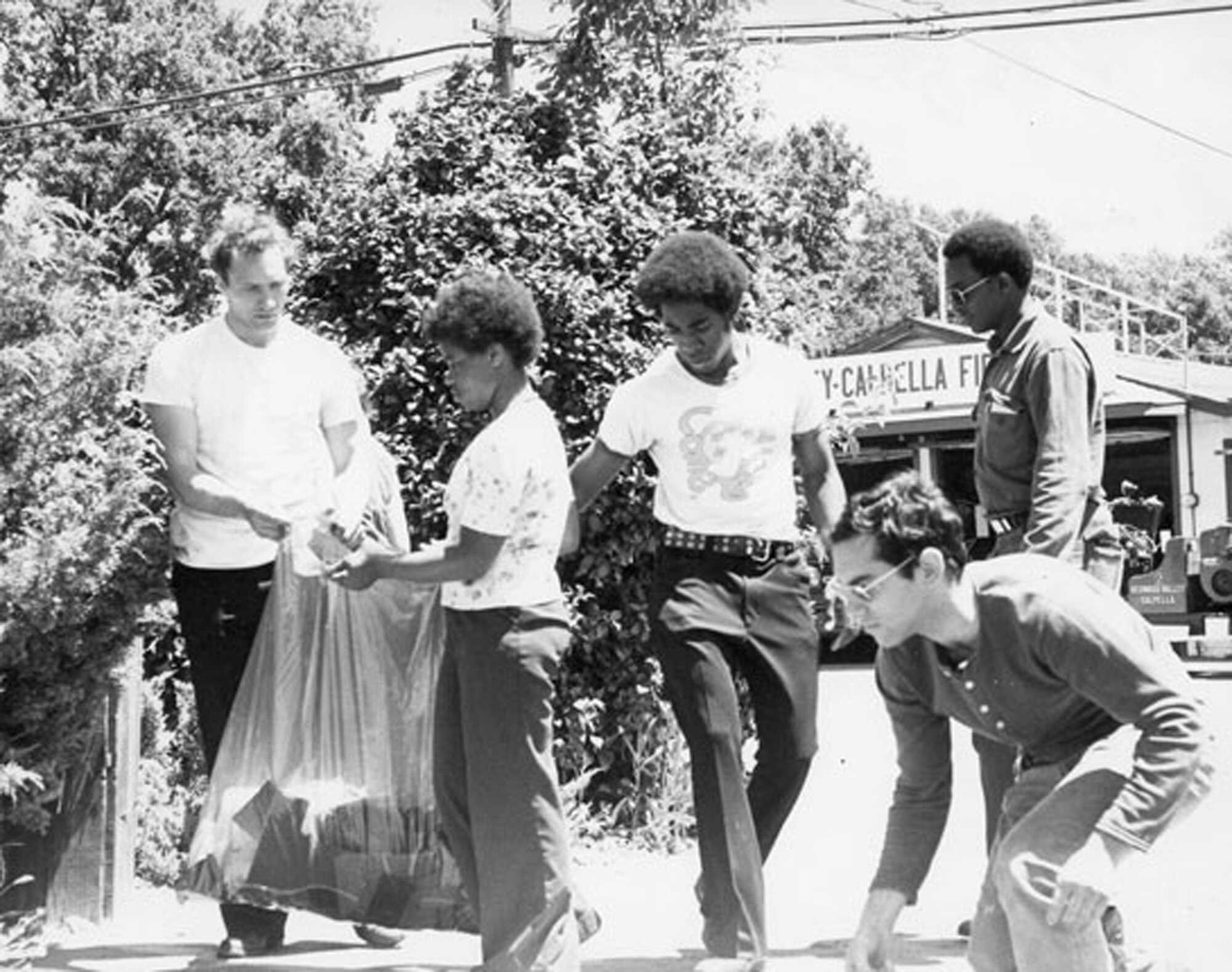
Peoples’ Temple (Jonestown) members picking up trash.
This is not a condemnation of revolutionary theory. The sects have long defended themselves and their catastrophic failures by appealing to the sympathy of fellow communists: Look! We too are socialists, we too are radicals, we too read Marx!. Let them read Marx!—Let them call themselves revolutionaries!—it does not mean they are Marxists, it does not mean they are communists. It is precisely the massive perversion of Marx and Lenin, especially the latter’s theory of democratic centralism, that is the root of why these sects have failed to act. This failure to act coupled with the extremely high-control, inward-facing organizational apparatus can only lead to one thing and will only lead to one thing regardless of the formal intentions of the parties involved: failure, more failure, and the turning of the frustration inward, the turning of desire for control not being found in politics being turned against those innocent enough to voluntarily put themselves under the authority of these actors. This is not a failure of revolutionary theory, it is a lack of revolutionary theory.
But what, specifically, was lacking? If I could give this phenomenon a name: what was lacking was a concept of active versus passive revolution. For the sects, the purpose of Marxism is to draw effective binaries—between proletarian and bourgeois parties, between revolutionary and non-revolutionary practice, between correct theory and false theory. Naturally, the proletarian party was the sect, the revolutionary practice was the practice of the sect, and the correct theory was the theory of the sect. The sect, in other words, was marked by an internal sense of self-completeness. This, combined with the most grotesque distortions of Leninism, became the basis for the sect’s approach to politics: cadre, not workers. Implementation, not analysis. The line and program was understood as the most “accurate” analysis of American conditions, not as the line that most effectively would bring millions to the party and organize millions around it. The Party are the halls of those who have the insight to see the Truth of the Matter, and, consequently, their task is to spread the Good Word, to flyer and march so that everyone can hear the Good Word and learn the truth.
Marxism transformed from a science of revolution to a theory of the nature of things.
But this is only the theoretical form of a social phenomenon contained in the slogan: cadre, not workers. The goal was the identification and inculcation of faithful so-called “professional revolutionaries” that would devote themselves to the line, to democratic centralism, and to perpetual activism. This had a distorting effect on the entire chain of political practice. Again, to return to PSL: the front organizations it ran which received limited success did manage to win a degree of support, but were unable to translate it to any sort of political program or political support for the PSL itself because 1) these front organizations were practically indifferentiable from bog-standard liberal activism, and so unable to meaningfully supplant it and unable to convert its supporters to proletarian politics on a mass scale, 2) these fronts were organizationally compromised and ultimately subordinate to the narrow interests of the activist strata of the party rather than the actual tasks of mass struggle (again, because the latter was constantly subordinated to the abstract task of “building the party” and “developing the cadre”).
Fundamentally, this was a failure of political struggle: the sect cannot find a medium between reformism and terrorism, as Lenin pointed out a century ago. Without mooring in the revolutionary working class, the sect can only oscillate from the most superficial liberalism on one end to the most destitute form of communist sloganeering on the other. Ultimately, this meant that they could never be genuine workers’ organizations but slightly awkward and inorganic attempts by closed activists to impose their shibboleths on large groups of people who thought they were there for something else. Echoes of this attitude exist today in the bizarre and yet extremely popular prejudice many subcultural Marxists possess towards, e.g., paper members of organizations.
The point of the binary (or Manichean) form of Marxist analysis, encapsulated best in slogans such as “class character” of XYZ social phenomenon, is to blur the practical tasks of revolutionary work. Revolutionary work is stripped of its content and its end and is instead gratified self-reflectively: the intellectually-determined “class character” of a given action defines the meaning and significance of the action, while the actual consequences of that action for mass consciousness or organization of the proletariat is left out of the question completely. The trumpet of “Better fewer, but better” was sounded to justify the closedness of the sects—forgetting that the formulation also requires not just “fewer” but “better.” Further: lacking any mooring in social struggle, the sect is unable to understand when and how to apply concretely various slogans and lessons of history, instead mechanically repeating them in form without developing their content.
With familiarity, one can begin to predict the objections of the opponent. Already, I can hear in the distance: What have you done? We are trying our best, we are organizing the workers, we are doing things! Revolutionary beekeeping, food distribution, flyering, here, is each a blow against the capitalist state; the electoral victories of the DSA, the mass organization of the working class along progressive lines, on the other hand, is excepted from the model of “doing things.” With this farce of logic before us, we can recall what Lenin says to the Mensheviks who slung at him the slogan that “Every step of real movement is more important than a dozen programmes,” penned by Marx:
“To repeat these words in a period of theoretical disorder is like wishing mourners at a funeral many happy returns of the day.”
The sect is in the cursed position of forever being the mourner at the birthday or the reveler at the funeral, forever saying the right thing at the wrong time or the wrong thing at the right time. Active revolution is the essential concept because it provides the mooring: it provides the social ‘sense’ that allows the party to avoid putting its political foot in its mouth.
Without it, our politics is left up in the air.