
Jul 4, 2026
A New Patriotism or a New Regression? How “Bill of Rights Socialism” falls below Browder’s Americanism
Communist Party USA leader Earl Browder’s positive view of Jefferson may seem like an uncritical adoption of the founding fathers. But it really represented a commitment against the alienation of the 20th century administrative state.
by Claudius B
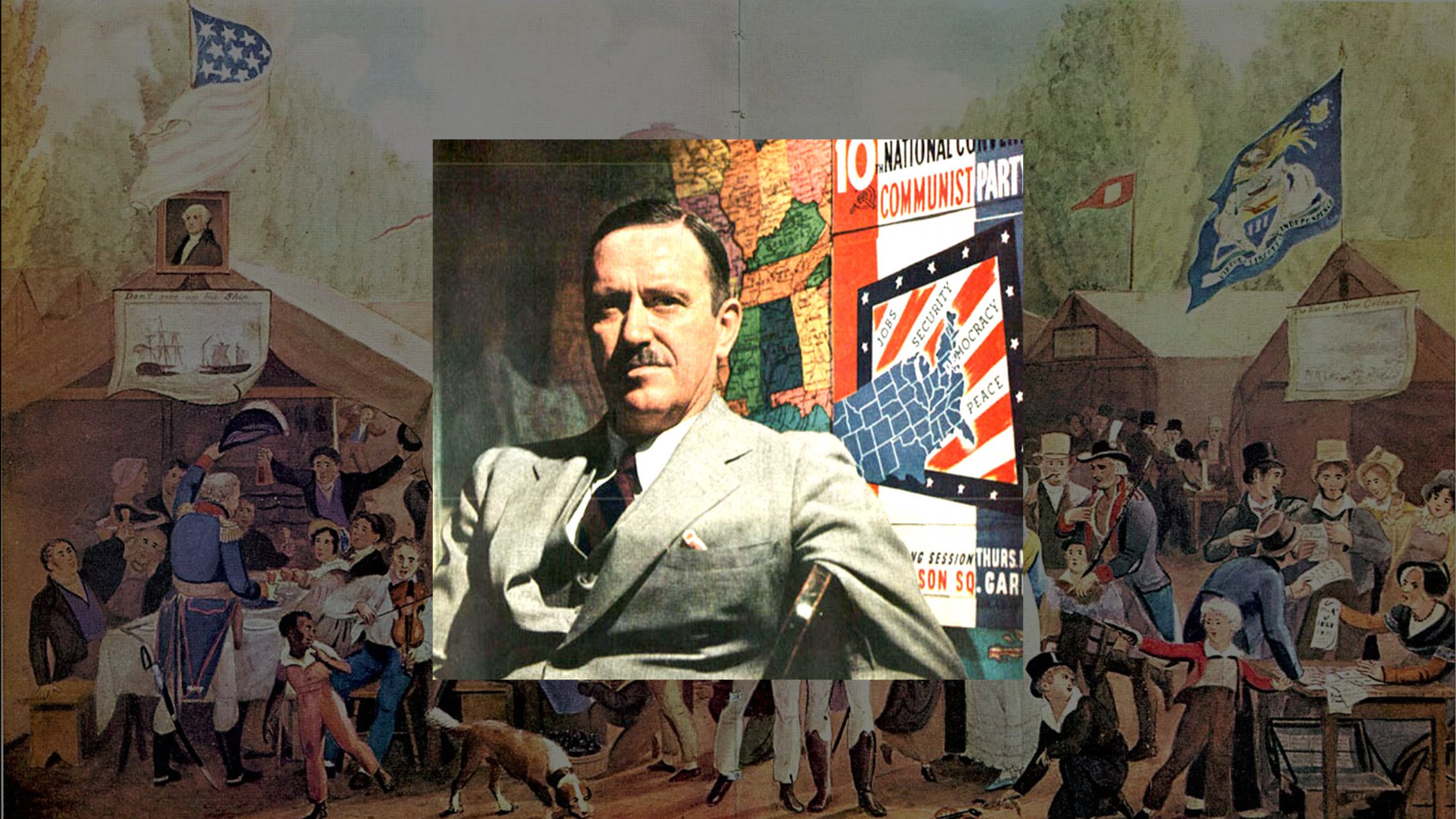
Earl Browder.
In her recent article for Geese, Towards a New Patriotism: A Critique of Browder’s ‘Americanism,’ Comrade A. Rocha critiques the politics of former Communist Party (CPUSA) Chairman Earl Browder, arguing that the CPUSA’s current politics take up the progressive kernel of Browder’s American patriotism while discarding its overly positive orientation towards American bourgeois revolutionary history. While the article’s critique of Browder’s orientation towards capitalist politics during his time is sound, it fails to capture the political content of his celebration of the American Revolution. Misrecognizing Browder’s celebration of figures like Thomas Jefferson as a capitulation to capitalist politics, Rocha fails to grapple with the stakes of Browder’s appropriation of the bourgeois revolutionary tradition at the great crossroads of American political development in the early 20th century. This misreading of Browder leads Rocha to wrongly separate popular democratic impulses and the Bill of Rights from the broader bourgeois revolutionary project aimed at the freedom of society, and to assert a narrower appropriation of American Revolutionary history.
Rocha starts her argument by comparing our time to Browder’s as posing the necessity of the popular front against fascism, a strain of thought that runs throughout the essay and motivates her usage of the writings of Georgi Dimitrov. She argues, however, that Browder, especially through his restructuring of the CPUSA into the Communist Political Association of America in 1944 and his advocacy of a theory of peaceful cooperation between the USSR and capitalist powers like the United States, went beyond this necessity into a full-throated embrace of capitalist politics. Rocha’s critiques of Browder’s practice are generally correct. She identifies his increasingly close orientation towards capitalist politics, specifically the Democratic Party, as compromising the Communist Party’s politics and, eventually, even its organizational form during his tenure as chairman. Additionally, she correctly recognizes that the turn towards Americanism, as Browder termed it, in the CPUSA’s messaging coincided with the popular front turn in the party, its significant membership growth prior to the Molotov-Ribbentrop Pact, and, eventually, the malignant symptoms of this period.
However, Rocha’s account of Browder’s turn to “Americanism” muddles the critique of his turn towards capitalist politics. Rocha writes, drawing on CPUSA leaders William Z. Foster and Gus Hall’s critiques of the period, that “[Browder’s] uncritical patriotism led to the blurring of the demarcation between communism and bourgeois ideology, which resulted in a collaborationist understanding of class struggle and the dissolution of the CPUSA for the CPA.” Rocha argues that later Communist Party leaders have moved towards a more critical account of patriotism, and a more critical anti-fascism, taking up Browder’s correct impulse to claim American history for Communism while rejecting his uncritical approach.
While not rejecting the revolution outright, as many recent leftist commentators like Gerald Horne have, Rocha identifies Browder’s original sin in his treatment of the American Revolution. She argues that Browder, in his uncritical embrace of the revolution and documents like the Declaration of Independence, fudged the important distinction between the bourgeois and proletarian revolutions. She writes, “The American Revolution, while serving a progressive historical function for the development of capitalism in this country, cannot be conflated with the ideals and concepts of Marxism. It was fundamentally a bourgeois revolution with several reactionary elements, including the rebolstering of slavery, the denial of women’s suffrage, and the continuation of genocidal displacement against Indigenous peoples.”
While not a blistering denunciation of the revolution, her account is still rather damning, especially her claim that the revolution bolstered slavery. The “progressive” historical content of the American Revolution is identified as the progressive function it had in developing capitalism and “bourgeois-democratic ideals,” the class character of which is nevertheless also deemed problematic for proletarian socialism. By taking this up as a whole, and especially through his embrace of Thomas Jefferson, Rocha argues that Browder “uncritically accept[ed] the traditions of slaveowners and reactionaries” and “fail[ed] to acknowledge the constraints inherent to bourgeois democracy, let alone the atrocities committed by the United States historically and today against Black Americans and Indigenous peoples.” Was Browder’s embrace of the American Revolution so ignorant of its limitations? Or did Browder recognize a political content in the revolution that Rocha does not?
Earl Browder on the American Revolution
Let us start with Browder’s article “What is Communism: Americanism – Who are the Americans.” In this text, Rocha identifies the “absurd statement” that “the Declaration of Independence was for that time what The Communist Manifesto is for ours.” Rocha takes this statement rather literally, treating it as an identification on Browder’s part of the essential contents of both documents, leading her to criticize his conflation of bourgeois and socialist democracy. Certainly, Browder’s praise of the Declaration of Independence in the article is effusive, identifying a passage of the Declaration as “the heart of the American tradition” which the CPUSA seeks to claim:
“Whenever any Form of Government becomes destructive of these ends [life, liberty, and the pursuit of happiness], it is the Right of the People to alter or to abolish it, and to institute new Government, laying its foundation on such principles and organizing its powers in such form, as to them shall seem most likely to effect their Safety and Happiness. Prudence, indeed, will dictate that Governments long established should not be changed for light and transient causes; and accordingly all experience hath shewn, that mankind are more disposed to suffer, while evils are sufferable, than to right themselves by abolishing the forms to which they are accustomed. But when a long train of abuses and usurpations, pursuing invariably the same Object evinces a design to reduce them under absolute Despotism, it is their right, it is their duty, to throw off such Government, and to provide new Guards for their future security.”
The political content of this passage, as Browder argues in his article, is not merely for bourgeois democracy, or, more accurately for the time, bourgeois republicanism. Rather than arguing for any specific form of governmental organization, Jefferson asserts the necessary subordination of the governmental form to the basic needs and freedoms of society, and that society has a right to overthrow and replace any form of rule that is incompatible with the freedom of society. While Jefferson’s account here certainly remains within the realm of bourgeois liberal thought, and does not locate the fundamental problem in society as later socialist criticism would, it is the fundamental claim of the subordination of the state to society that Browder is claiming.
While Browder does not make this argument explicit, this passage in fact echoes Marx’s writings on the state, as collected by Lenin in State and Revolution. In the years following the revolutions of 1848, which Marx argues in the Eighteenth Brumaire acts as a turning point, the bourgeois state across the world transformed into the Bonapartist state of industrial capitalism, with the state seeming to be “suspended in air” above society rather than subservient to it. Even as Marx identifies the fundamental problem in society, ultimately rooted in political economy, he still identifies the immediate necessity of the proletariat in claiming state power for themselves, not to reconstitute a “free people’s state” as the Gotha Program claimed, but instead to assert the “freedom [which] consists in converting the state from an organ superimposed on society into one completely subordinated to it.” Rather than serving as a call to subordinate the Communist Party to capitalist politics or reformism, Browder takes Jefferson’s call as one to overcome the American constitutional order, which Browder describes as emerging from a Hamiltonian “counterrevolution.” Most essentially, his Jeffersonianism leads him to oppose the administrative state that was growing on top of the existing constitutional order. Browder saw the socialist revolution as leading to the renewed subordination of the institutions of governance to the needs and freedom of society in the dictatorship of the proletariat.
Perhaps one might object that I am reading Browder far too kindly, that I am taking up his words in a more theoretical, a more explicitly Marxist, manner than he does in the article. Certainly, Browder writes in a popular manner and is less concerned with appeals to Marx than with the leading figures of the American revolutionary tradition. How can I claim Browder’s revolutionary and anti-statist credentials when his politics ended up so subordinated to that of the Democratic Party, which was in the process of putting the finishing touches on the new American state, the administrative state?
To answer this question requires turning to what many communists likely find most offensive in Browder’s Americanism: his embrace of Thomas Jefferson. While she does not discuss Jefferson extensively, Rocha refers to Browder as “completely conflat[ing] Jeffersonian democracy with the party program” and generally objects to his choice of figures like Thomas Jefferson as symbols of American Communism. She argues this is embracing “slaveowners and reactionaries” over “the multiethnic subaltern classes, the masses of which are just as much a part of our tradition, and which constitute the authentic origins of our current democratic movements.”
That Browder was embracing reactionaries over the people might seem like the case today, when Jefferson is primarily associated with slavery by leftists. However, Browder’s selection of Jefferson was not a careless embrace of a problematic figure. Beyond his invocation of the Declaration of Independence discussed above, Browder’s usage of Jefferson as a symbol for Communist politics was a specific intervention in the debates over the transformation of the American state in the early 20th century. It was particularly provocative as a symbol against the Democratic-led creation of the New Deal state, which Browder ultimately tailed in practice.
In the Progressive Era debates over a new national administrative state, despite actually representing a new development of industrial capitalism, the dispute often took the form of relitigating the Hamilton-Jeffersonian debates of the 1790s. This focus was particularly strong in the circles around the first President Roosevelt and his 1912 presidential campaign, who saw their project as the repudiation of the Jeffersonian victory and the revival, in the words of Herbert Croly, of “Hamiltonian nationalism in the interest of a democratic social policy.” Despite Roosevelt’s defeat, progressives like Croly saw the continuation of their Hamiltonian revolution in the Wilson administration and, eventually, in the New Deal. While FDR was more willing to embrace the Jeffersonian tradition than his cousin, exemplified best in his characterization of his program as “liberal,” the project of national state-building championed by the latter-day followers of Hamilton in service of social policy found its first full realization in the New Deal.
Browder’s constant invocation of Thomas Jefferson, alongside his denunciation of Hamilton as a counterrevolutionary, thus stands starkly against the progressivism of his time. Instead, it echoes back to an older tradition in American politics that sought a solution to the social problems of the day without creating a large Bonapartist state: the agrarian Populists. Unlike the Roosevelt progressives, the Populists saw themselves as upholding Jefferson’s tradition in their fight against monopoly. While heavily limited by their petty-bourgeois standpoint, the Populist movement fed into the creation of the Socialist Party, especially in more rural states like Browder’s home state of Kansas. Historian Theodore Draper, in his work on the origins of the CPUSA, identifies the radicalization of the young Browder, whose father was a Populist, as an attempt to take up the movement’s legacy in its failure and in contrast with the Roosevelt progressives. Thus, in his usage of Jefferson as a symbol of the Communist movement, Browder not only sought to assert a patriotic socialism, but also to claim a longer and popular political tradition for Communism: a tradition that, far from being the statist monster that its opponents portrayed it as, instead was the true heir of the American defense of the freedom of society against the development of the capitalist state.
This leaves us with Browder’s Americanism once again taking a contradictory form, but a much sharper one than Rocha identifies. Browder’s rhetorical turn towards Americanism does coincide with the Popular Front strategy and the beginning of the CPUSA’s orientation towards the Democratic Party. It is, in that sense, the application of the ideas about patriotic anti-fascism from Dimitrov that Rocha positively invokes. However, the content of the rhetoric outstripped the practical politics of Browderism. Browder was not just invoking “proletarian patriotism” against fascism, but taking up the specific legacy of the American Revolution as a critique of the capitalist politics of his own day. Even as he practically supported the Democrats in constructing the modern administrative state, his Americanism preserved the critical potential of another, more popular solution to the social crisis. In his invocation of the bourgeois revolutionaries, and most especially Thomas Jefferson, he expressed not his capitulation to capitalist politics—but the continuing desire for a free society radically different from the one that was being built at the time.
Bill of Rights Socialism
Rocha argues that, instead of Browder’s invocation of the bourgeois revolutionaries, communists should instead take up “the participation of the toiling masses” as the symbol of “proletarian patriotism” in the fight against fascism. She contrasts two contemporary approaches to the American Revolution and patriotism to Browder’s. The first is embodied by a comment by Alexandria Ocasio-Cortez (AOC) analogizing her current fight against billionaires to the American Revolution, saying it was against “the billionaires of their time,” and that the struggle of the working class has deep roots in American history.
AOC’s comment is a rather strong piece of populist rhetoric: it captures not only the spirit of the recent No Kings protests but also the anti-monopoly aspect of the American Revolution. Rocha argues that “AOC prioritizes the historic struggles of the multiracial working-class as the primary movers of history toward a more complete democracy, connecting this momentum to the current fight of today’s American working class against Trump and the billionaire domination of our political system.” While AOC’s comments are certainly a good example of a contemporary invocation of the American Revolution by the left and are adjacent to the rhetoric of contemporary protests, Rocha’s claim that her argument represents a claim on a working-class history distinct from the bourgeois revolutionary tradition that Browder claimed is dubious. Rather than invoking a distinction between the bourgeois and workers’ components, AOC claims the impulse of the revolution against king and parliament as a whole.
The second approach is embodied by Rocha in a much more recent CPUSA slogan: “Bill of Rights Socialism.” While the Bill of Rights is certainly an embodiment of the freedom of society against the state with which Browder’s invocations of Jefferson were so concerned, Rocha takes it much more as an example of an anti-fascist, really popular-frontist, approach to patriotism that is supposed to maintain the distinction between bourgeois-democratic and socialist politics. However, by jettisoning Browder’s invocation of the bourgeois revolution without seriously considering its content, Rocha is left not with the contradiction between Browder’s radicalism and his class collaborationism. Instead, she affirms the basic impulses of his practical politics, distinct national roads to socialism and pop-frontism, which enabled Browder’s politics to become ever more accommodationist to the Democratic Party and its neo-Hamiltonian project. It is these impulses, which Rocha retains in her account of Bill of Rights Socialism, that led to Browder’s liquidation into Democratic Party politics in the first place. Instead of overcoming Browder’s errors, we are left with their calcification–without his contradictory moments, without his historical critique of the modern administrative state that the Democrats still champion. Instead of a new patriotism, we are left with a new regression: an invocation of American revolutionary history as a nebulous symbol devoid of the content that Browder once found in it.
With the 250th anniversary of the Declaration of Independence this year, Rocha and AOC are right to look to the history of the American Revolution as an inspiration for the left, especially in a time in which its legacy has been maligned by many leftists and completely misapprehended by the two capitalist parties. Rather than taking the popular struggles of the revolution as a vague symbol to adorn yet another popular front with the Democrats, let us return to what Browder, quoting Jefferson, found at the heart of American history: “Whenever any Form of Government becomes destructive of these ends [life, liberty, and the pursuit of happiness], it is the Right of the People to alter or to abolish it, and to institute new Government, laying its foundation on such principles and organizing its powers in such form, as to them shall seem most likely to effect their Safety and Happiness.”
In the present, this can mean nothing less than the establishment of the dictatorship of the proletariat.