
Jul 4, 2026
A Reflection on Left-Wing Americanism
On July 4th, Joe W. reflects on what it means to be both within and against empire as a leftist.
by Joe W
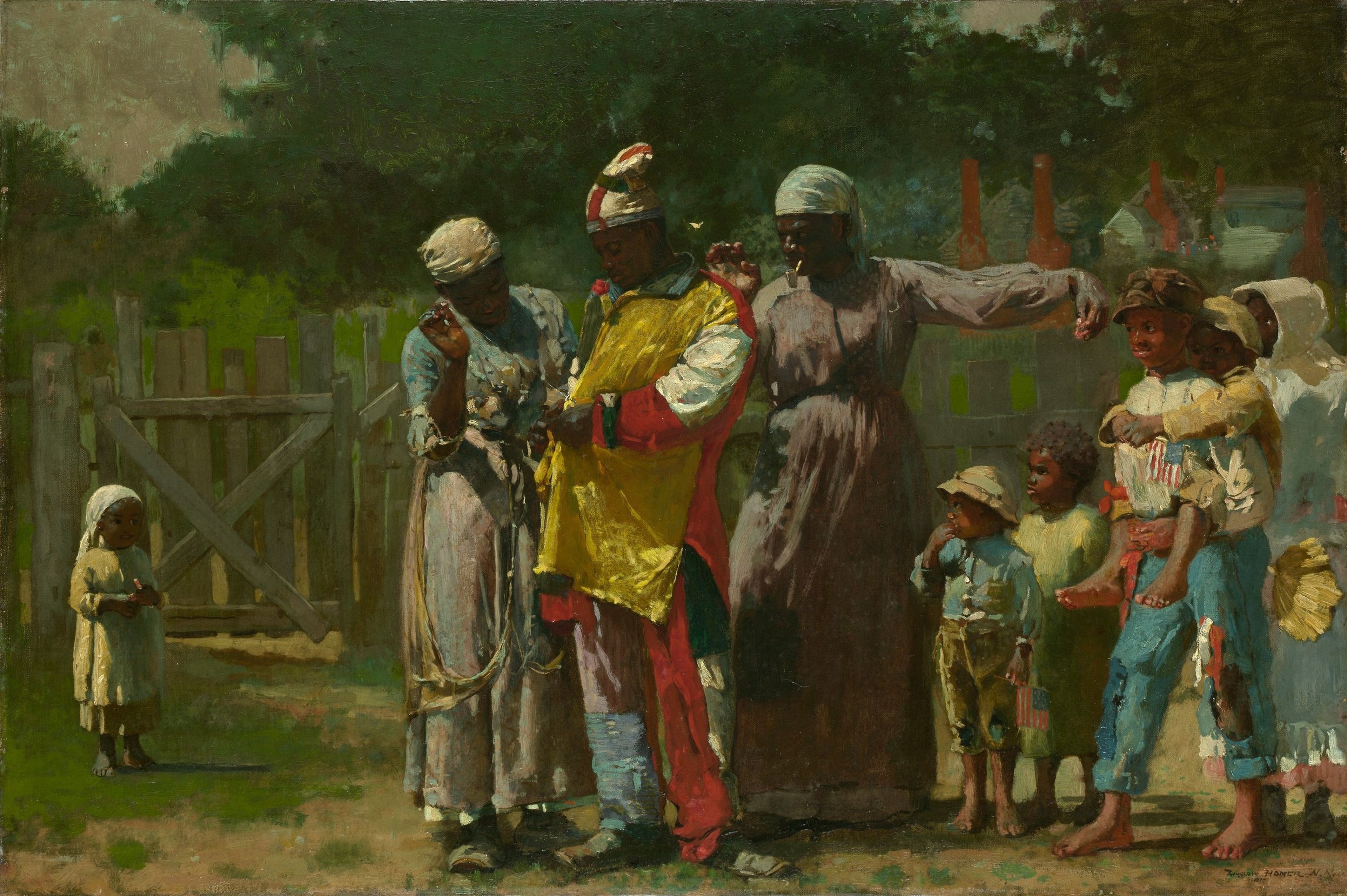
Dressing for the Carnival, Winslow Homer (1877)
At 3 a.m. in a Danish dive bar, I found myself in a novel predicament. After determining I was not ‘one of the Trumpers’, complete strangers-turned-drinking companions began a multi-hour indictment of the United States as a concept, directed towards me. As a lifelong American and self-identified leftist since the 4th grade, I felt more than prepared to turn what was obviously an attempt at drunken rage-baiting into a commiseration—“yes, we are the hegemon, we are the Great Satan, but some of us are the good ones- we agree!”
But, instead, I experienced a different feeling, an odd pull in my gut. After a week in northern Europe—despite its best-in-the-world bike and rail infrastructure, green energy production, abundant new-build housing, and utopian ethos—I was not so ready to take the slander lying down.
In the morning I struggled to recollect what exactly had frustrated me. I had never experienced that sort of national attachment. I am without a doubt an American – what the right calls a ‘Heritage American’ at that, with ancestors who came to Plymouth in the 1630s in my family tree right next to those who fled Germany in the 1930s. But much of my political life has been spent attempting to promote some self-reflection here at home, telling my countrymen we should be ashamed – ashamed of our stagnant quality of life, our broken political and economic systems, our murderous imperial wars. My defensiveness the night before was obviously not on behalf of any of those things—I had been more than willing to concede that the president is a boorish pedophile, that we’re chauvinist and disrespectful when we travel abroad, that one party is incompetent and the other outright evil.
Then it struck me: I had been more disappointed at how little these people had known of my America, an America beyond the mass media and political headlines that trickled out into Europe. It occurred to me that there was an America that I felt kinship to, not despite my politics but because of them.
Part of it is geography: I’ve lived in Chicago, New York, and Boston. The cultural perception of an American as a burger-eating, Walmart-shopping, big truck-driving rube (itself based in elitist tropes on both sides of the ocean) didn’t match the suburban liberals of my childhood or the Commie Corridor socialists of my adulthood. But that didn’t stop me from feeling like John Wayne throughout the whole conversation, undeniably stamped by accent and intonation and culture as part and parcel of the very political project I have worked so hard to fight. It became clear I had unknowingly invested mental stock into dividing myself off from the United States and the vulgar nationalism of its reputation, and it had disappointed me to see how little it mattered overseas.
Since the post WWII Red Scare, most left-wing Americans have been forced into a defensive posture on the question of national pride. McCarthy-era reactionaries, and before them American Legion types during World War I, discovered vulgar nationalism was a helpful wedge issue with the American masses. It allowed them to preclude direct political questions by casting universal solidarity and anti-militarism as domestic threats. Our forefathers on the American left, and their modern acolytes, have often tried pivoting, attempting to fashion a vision of Americanism that either merges explicit communist iconography (think the CPUSA of the thirties displaying a bust of Lincoln next to one of Lenin) or harkens to a populist vision of left-wing values (think Bernie Sanders 2016 America campaign ad). The product ranges from uncanny in the case of the former to sentimental in the case of the latter (I, as much as any of us who lived through the Bernie campaigns, of course, still find that ad profoundly moving). Lincoln, after all, participated in the genocide of Native Americans in the West and was no communist, despite some notable correspondence with Marx. As to Bernie Sanders' homage to agrarian populism and Simon & Garfunkel, it’s striking how devoid of hard substance it is. The ad is conveying a positive image of modern America, but the image is not inherently American so much as inherently communal and diverse, which, while good, does not make a direct case for this place in particular on its own merits. There seems to be no way to locate an Americanism that is not tainted by four centuries of slavery, humiliation, exploitation, genocide, and brutality.
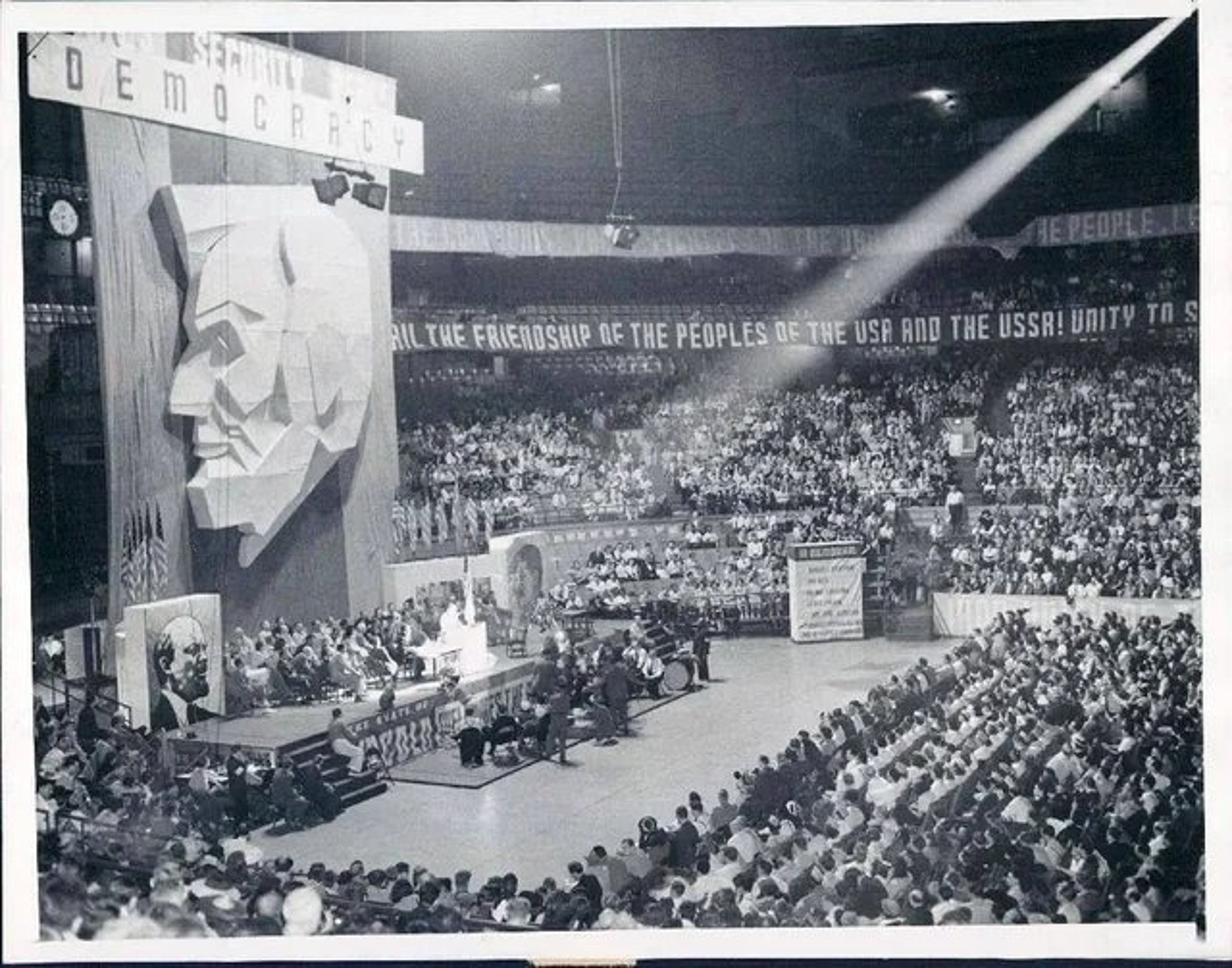
Lincoln participated in the genocide of indigenous peoples despite praise from both Marx and formations in the 20th century like CPUSA, pictured here using an icon of Lincoln at a rally.
That tension breeds cynicism. There is a transhistorical rot in the foundation of American life caused by those four centuries. The specter of this nastiness, especially in the minds of developing political consciousnesses, can begin to infect the entirety of the human experience. The inherent contradiction between the fastidious niceties of what is literally there and the violence beneath the surface is unstable politically, psychologically, and emotionally. The magnitude of the injustice that many millions toiled and died for this is contained in every inch of land, every consumer good, every interaction with society, a powerful headwind against the current of any American patriotism.
These forces come to a head most often in times of war, most notably during Vietnam and Iraq. Amidst the disillusionment created by these wars, the left-wing critique of traditional Americanism became culturally ascendant. This scared our conservative enemies, who responded by out-grouping the left with allegations of disloyalty—opposing imperial murder was actually insulting soldiers making the ultimate sacrifice, ‘don’t you love your country and want it to win,’ and so forth. Meanwhile, our erstwhile liberal allies backslide into, as John Kerry put it, “reporting for duty”. They didn’t challenge militarism, but welcome it with a customary salute to the flag. The reaction to this tendency on the left has affected our own culture, too—we have become obsessed with performative rejections of this political theater. No pledging allegiance, no singing the anthem at sports games, no flags. The performance of rejection is emotionally cathartic to the contradiction of continuing to live life as both an American and a leftist. Fundamentally, however, this catharsis leaves us with no way to reach those who retain a personalized sense of national identity and does little to actually challenge American imperialism. We are instead left waiting for the masses to so-called “wake up”, recognize what we now cannot unsee, and join us out of the same sense of moral outrage.
This utopian ideology only reifies our marginalization. Working class Americans, Americans of color, and especially immigrants, all major constituencies of the masses we seek to organize, retain a cultural connection to the flag and nation. Most NYC-DSA canvassers with a few shifts under their belt can tell you who’s likely going to be behind a door with an American flag sticker on it. The archetype of the American patriot out of Toby Keith’s Courtesy of the Red, White and Blue of course still exists. But a much more subtle connection to America, one that we should want to appeal to, is also commonplace, beyond the stereotype.
Yet by playing into conservative fears of the America-hating lefty without providing an accompanying positive frame, we are only further reifying our perception as ridiculous and out-of-touch figures, in short, people not mature enough to manage political decision-making literally because we cannot suppress our emotional, catharsis-seeking response to the contradictions of American life.
This is more politically damaging than it can appear. The conflict is no longer that we on the left have a different understanding of American history, culture, or society: by playing into their binary and accepting the role of villain, we implicitly demonstrate our own inability to frame our politics as fundamentally our own, transcendental and accessible. We do not reject reactionary politics through one-sided anti-Americanism, but dutifully play the role that the binary of mainstream politics has cast for us. Conversely, the corrective is not to cynically parrot the existing patriotism of sections of the American working class in hopes of earning scraps of credit. It’s to escape the trap altogether.
Yet, despite widespread understanding across the now ascendant American left of the dangers of accepting your opponent’s framing, we remain unable to construct our own in this sphere. In DSA, we have already seen candidates be attacked for flippantly expressing criticism of American patriotism in the past. Thankfully, this has only marginally hurt us thus far. But allegations of anti-American sentiment have long been career killers when political winds shift. So long as we follow down the democratic road (and even if we don’t!), we will continue to face a basic legitimacy test of governance: How well do you produce human beings who are successful at living in a community with each other? Or to rephrase, how do you create communal identity? More importantly, how do you create identity anew when presented with an already extant definition?
On a very simple level, we have to start being able to say what we like about this country, why we like it, and how we are going to expand what we like—not because we are required to flatter and tail the American voters’ ego, but because we have to be able to root people’s desires in their experiences. Everything that will exist in the near future must already exist in a nascent form in the present. The bleak unknown is unfamiliar where a continuation and development of the already present is not. I’ll start: I like that within an hour's journey from my apartment in Queens I can meet the people, have the food, and hear language from nearly every corner of the globe. I like that this is one of the only countries in the history of the world to have had a full-scale multi-year civil war on the basic question of human freedom, and one of the only countries where the central government at the start of the war and at the end of the war was on the side of freedom. I like that, if you look close enough at any period in our history, from the worst of the Southern plantation system to the massacres of Native Americans in the West to the forgotten early 20th century imperial invasions of Haiti and the Philippines, you will find Americans with the same conditions and contradictions as you and me not only vocally opposed to these crimes but organizing to stop them–that, for every evil of America, there was someone there to fight against it. I like the music, political singers like Pete Seeger and Sam Cooke and nominally apolitical artists like Prince, the Beach Boys, Rick James, BB King, Scott Joplin, the Strokes, all of whom are the products of a uniquely American history and culture. I like old Hollywood and HBO in the 2000s. I like Debs and DuBois, Paul Robeson and Barbara Ehrenreich. I like that our political battles imprint on the world, that our civil rights movement of the 50s and 60s was the direct model for ensuing movements in Northern Ireland and South Africa, that our labor movement gave the world May Day, even if we’re the only country who has forgotten.
I like stories of immigrants coming to America and transforming their entire life, and I like that these stories are not so different over the years no matter where the person is originally from and what they ended up doing (except that they almost always seem to stop off in New York at some point). I like football and baseball and basketball, all sports invented here and largely played by people from here. I like that this is a country where the material has always been foregrounded—politics is about ideologies, about battles between factions where there’s hefty stakes, about money and power and our collective direction. I like that any one of these things could be replicated elsewhere, but they only all come together here. And I like that many of them are wholly unique to this country: my Danish interlocutors, for example, do not have a society and culture permanently imprinted upon by Black and Jewish people, groups persecuted by two of the most destructive prejudices in history. In fact, nowhere else on the planet has a dominant culture been so fundamentally defined by the contributions of the most otherwise marginalized. In many ways, that alone is its own testament to a brand of Americanism—but not one necessarily capturable by the left.
So what does that leave me from the standpoint of creating a positive left-wing Americanism? A couple records, my old baseball mitt, a sentimentality for living in our only “global” city, and an inflated sense of the liberatory potential of our history?
No. There can be something more. What we have is the power to shape a shared understanding of community. Ronald Reagan was wrong (at least on a practical level) when he said ‘you can go to [X] country, but you will never be them, but anyone who comes to America can become an American’, but the second clause approaches a conception of Americanism that is shockingly versatile. The benefit of America, and Americanism, is that it is something created. This country was devised in a time when most European nations still operated under a conception of the divine right of kings—nation-states were practically determined by the relative power of ruling families and doctrinally categorized by race, creed, religion, literal lines in the sand. This country was the first to set the borders of its culture and nationhood in an intentional repudiation of the old order. The borders set were, of course, abhorrent, outright robbery, and nakedly in pursuit of class and status accrual for an elite minority. But what is most fundamentally American, then and now, what drew Ho Chi Minh to the model of the American Revolution, what led Fidel Castro to lay a wreath on George Washington’s tomb, was not what community was imagined but the act of imagining at all. There are far more impactful revolutions in world history and in the history of social classes, including the French and Haitian ones that immediately succeeded 1776. But the American Revolution was the first to take Enlightenment philosophy and implant it into a brand new social cosmology. It is not a coincidence or a bitter irony that it has therefore been a named inspiration for countless ensuing revolutions for freedom.
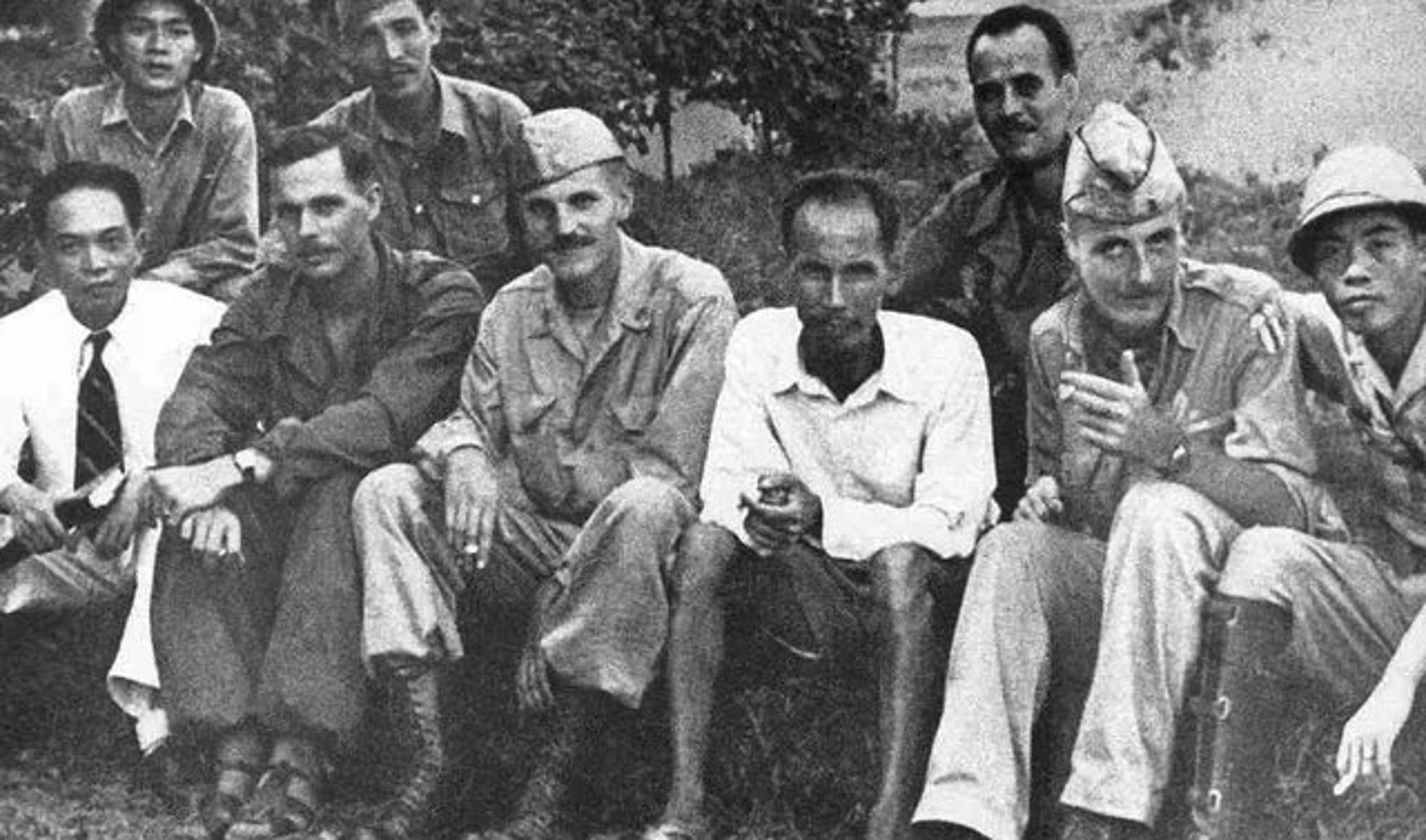
Ho Chi Minh (pictured center), leader of the Vietnamese Communist revolution, was inspired by the American revolutionary tradition.
What I feel when I talk about politics to regular Americans, a term I use in the Bundist ‘here where I live is my country’ sense, is that the intense atomization of everyday life has left us all starved. We, as the left, are at our most successful in our political work when we can present ourselves as something not alien to the body politic but of it, something that can provide a relief to social malaise and an expansion of people’s horizons. Zohran Mamdani and Bernie Sanders succeeded when they, and the millions of people who supported them, were able to reshape the mental map by which ordinary people considered politics. The lesson of the American Revolution and the 4th of July is not that we come from a strong tradition of great forefathers who indelibly set this country on a path to permanent success. It is not that we have a superior and unique culture. It is that groups of people organized into social classes can move masses in the pursuit of re-organizing society– and that we have the power to organize these classes as we please, to include everyone in the struggle for human liberation. We can re-orient people’s mental maps. We are not bound by the restrictive ideologies of what has come before. Our history can be a boon as much as it is a burden.
So this 4th of July, the 250th, I will experience the same ambient shame and revulsion I have for many prior. I will eulogize the innumerable masses of Native Americans forcibly displaced, the millions of enslaved persons brought in chains to suffer, the generations of workers who built this country’s wealth and never saw more than a dime in return, and the countless numbers killed by the American war machine in my own lifetime, from Iraq and Afghanistan to Gaza and Iran. And, in turn, I will also experience a desire to transform the identification Americans have with their founding into a desire for a new one: one committed to human freedom, to resources collectively managed for the good of the public and its environment, to an end to want, sickness, and fear. There is just as much of a tradition to draw of that struggle to draw on as there is a tradition of hierarchy and violence.
To quote Debs:
I like the 4th of July. It breathes a spirit of revolution. On this day we reaffirm the ultimate triumph of socialism. It is coming as certain as I stand in your presence.
That is what an Americanism for the left could be.
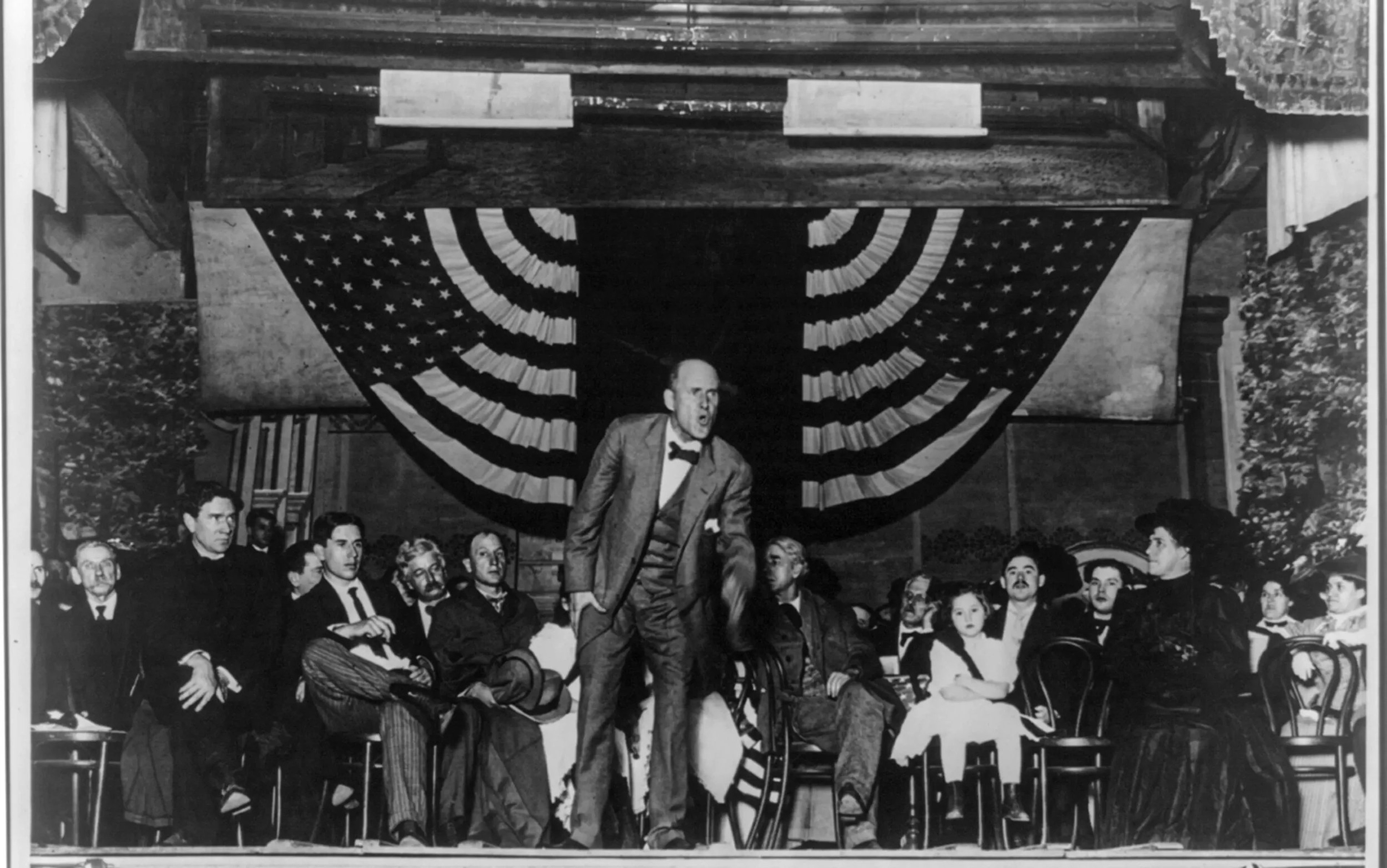
Eugene V. Debs