
Aug 14
When a Republican Presidential Candidate Defended a Communist in the Supreme Court
The Second Red Scare’s origins, McCarthyism, and the connection between immigration law and US crackdowns on left-wing dissenters.
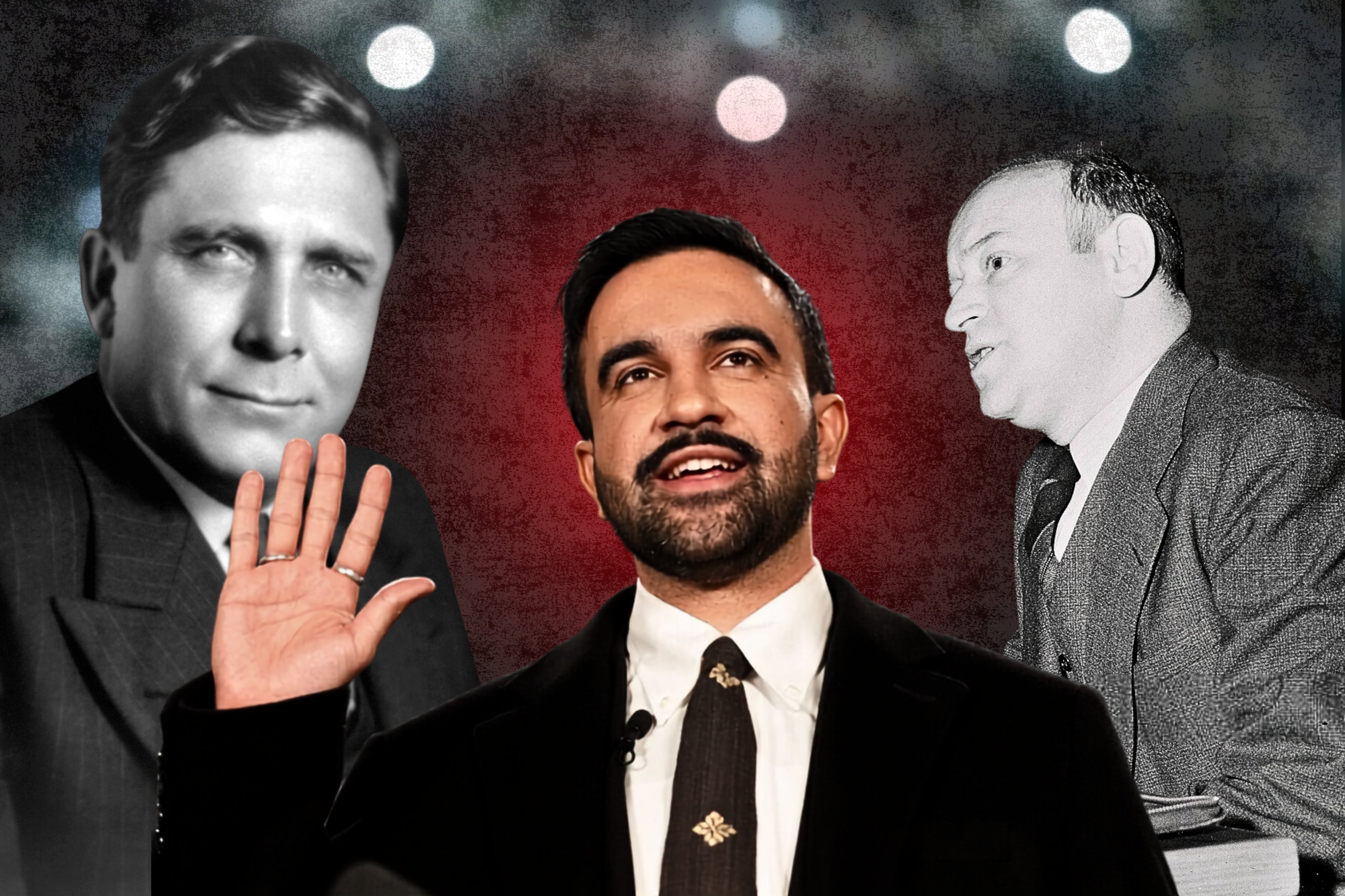
In June 2025, shortly after his shock victory in the Democratic New York City Mayoral Primary, Zohran Mamdani faced depraved attacks by numerous right-wing US media figures. Many focused on his avowed socialism, many focused on his Islamic faith, but a few focused on something in particular: his status as a naturalized citizen of the United States.
"Zohran "little muhammad" Mamdani is an antisemitic, socialist, communist who will destroy the great City of New York. He needs to be DEPORTED. Which is why I am calling for him to be subject to denaturalization proceedings." Republican House Representative Andy Ogles tweeted. He attached to this tweet a letter he said he’d sent to then-Attorney General Pam Bondi demanding she act.
Ogles repeated his call in October, right before Mamdani defeated both the Republican candidate and disgraced centrist Democrat and former governor Andrew Cuomo. This time, Ogles was backed up by ultra-conservative Randy Fine, who insisted that he must have lied to earn his citizenship in 2018. While I was writing this very piece, another odious Republican, extremist Chip Roy, proposed a MAMDANI Act that would "Denaturalize and Deport Marxists and Islamic Fundamentalists".
The crux of the claims of these extremist Republicans, beyond simple Islamophobia and xenophobia, lies on the basis that Mamdani is a member of the Democratic Socialists of America (by no means a communist organization, but that makes little difference to the conservative movement which has accused Nancy Pelosi of communist sympathies). In particular, they claim that by being a member of DSA and then applying for and earning US citizenship, he must have lied about having associations with a communist party, and could not be loyal to the principles of the constitution as a result.
Their arguments are wrong, but they do offer us the opportunity to recount another story, a story of an actual Communist, and the court case that brought him together with a Republican Presidential candidate all the way to the Supreme Court, to prove that Communists can be citizens too.
William Schneiderman Comes to the US
In August 1927, a 21-year-old immigrant was due to speak in Los Angeles in honor of the lives of two other immigrants, who on that day were to be executed by the US in Massachusetts. The two executed men are well known to those familiar with the left and the First Red Scare in US history.
Nicola Sacco and Bartolomeo Vanzetti were two Italian anarchists who, in 1920, were caught up in accusations of armed robbery and murder. Whether they were guilty or innocent of the crime was of little interest to the US, which focused on their status as prominent anarchist activists. At the end of the First World War, it had proven remarkably dangerous to be a left radical in the United States, and Sacco and Vanzetti were convicted of the crime and put on death row in what has become known as a show trial.
The other man, William Schneiderman, would deal with many of his own conflicts with the US legal system. But on this day, he sat in a church and prepared to give a speech about two men executed for their political views.
Schneiderman was a Russian Jew who came to the United States with his family at the age of two in 1907. He grew up in Chicago, joined the newly founded Young Communist League of America at 16, and the Workers Party of America (later the Communist Party) at 18. After moving to California, where he attended UCLA, he would become deeply embedded in Communist Party activism.
As Schneiderman described in his autobiography Dissent on Trial: The Story of a Political Life, that day in 1927 would not pan out as any in the California Communist Party hoped. The city had outlawed any gatherings dedicated to the two executed activists; thus Schneiderman never got to give his speech honoring Sacco and Vanzetti. After arriving at the event, he found the intended plaza surrounded by police blocking attendees from entering. When many nevertheless attempted to make it into the plaza, or simply refused to back out of the surrounding streets, police arrested them.
The day transformed from there. Schneiderman describes 'join[ing] the crowd as it fell back, and a few hundred of us formed a march down to the First Street police station where the prisoners [those arrested for attempting to enter the square] were held. There, the crowd set up a chant, "Free the prisoners," and would not leave... a remarkable thing happened ... to our astonishment and joy, they released the prisoners, and we wrested some solace from this tragic day.'
1927 was not only the year William Schneiderman did not give a speech, but helped rescue several jailed protestors. 1927 was the year he became a US citizen. This would last 12 years.
The Origins of the Second Red Scare
The FDR administration is often, and to an extent rightly, hailed as a brief triumph of left-wing ideology in the United States’ conservative political history. The transformative New Deal introduced significant elements of social democracy to the US economy and transformed the Great Depression into the post-war boom; a period when US economic growth surged but also acted like a tide lifting plenty of boats across class.
But for all the New Deal’s good, by the late 1930s, conservative forces in the Democratic Party and the conservatives throughout the nation were beginning to express severe unease about how the New Deal coalition allowed space for "left-radicals" in the coalition. Thus, the beginning of the two-decade-long Second Red Scare can be traced to that very same New Deal government.
One of the first adopted tools of the Second Red Scare was a borrowed tactic from the First one: weaponising immigration policy. We have already seen the example of Sacco and Vanzetti, and the method of targeting immigrants with the wrong political opinions was not dissimilar to recent attacks on anti-Zionist activists like Mahmoud Khalil, Mohsen Mahdawi, and Rümeysa Öztürk. Conor Lynch has covered these particular parallels with the First Red Scare.
Relevantly, though, the most famous victim of the First Red Scare was Emma Goldman, another immigrant anarchist who would have her citizenship revoked by the US government after they found fraud in the citizenship application of her husband - whom she had earned her own citizenship through.
The government's process was important. While Goldman's targeting was surely to do with her political prominence, the actual reason for her denaturalization was given as apolitical.
The state leveraged this denaturalization in 1919, deporting Goldman to live in effective exile in Europe. She was initially deported to Soviet Russia, where Bolshevik leaders did not appreciate her anarchist views, and where she herself felt politically unrepresented, writing a polemic titled "Disillusionment in Russia".
But with the Second Red Scare, the US government had found a new priority for denaturalization. They would not just target political dissidents; denaturalization itself would be political.
This process began with denaturalization proceedings against the far-right using the same tactic of prosecuting fraud. Fascists and Nazi sympathizers like Herman Schwinn, a German immigrant who naturalized in 1932, were denaturalized in 1939 for fraud, like Goldman, but targeted because of his prominent position within the Nazi-aligned German-American Bund.
Fritz Kuhn, Bundesführer, would also be denaturalized for fraud in 1943 and later deported back to Germany in 1945. As historian Patrick Weil describes in The Sovereign Citizen: Denaturalization and the Origins of the American Republic, the Kuhn case asserted that:
"an alien could not in good faith take the oath to the United States and at the same time have allegiance to the Bund, whose character, precepts, and activities were contrary to democratic principles; and (2) this new citizen “had not been, for the five years previous to his naturalization, attached to the principles of the Constitution” if he was a member of the Bund, a group that backed the Fuhrer Principle."
However, it was in denaturalizing a communist that the United States government would legally argue that a political view and attachment to a political organisation could be "un-American" and worth denaturalization on its own. This would become an essential argument for the Second Red Scare.
William Schneiderman Battles Denaturalization
Despite not being able to make his speech in 1927, Schneiderman did achieve significant prominence in the Communist Party of the USA (CPUSA). In 1932, Schneiderman would return to the Midwest for an unsuccessful bid to become Minnesota’s Governor as a Communist. From 1935 to 1936, he travelled to the Soviet Union, returning to California as the new state secretary of the California Communist Party, a role he held for another two decades.
In 1939, Schneiderman was informed that the government was coming for his citizenship. The US government argued that as his naturalization occurred after joining the Communist Party, he had been associated with an organisation "opposed to the principles of the Constitution", that advocated "the overthrow of the United States by force and violence". His case was first heard by a district court, which agreed with the US and nullified his citizenship. He would appeal that decision but lose in the Ninth Circuit Court of Appeals. He appealed it again, this time to the Supreme Court.
Through his first appeal, Schneiderman had been represented by Carol King, later to become nationally prominent as a civil and human rights lawyer. King was on the defence of union organizer and outspoken left-wing activist Harry Bridges, originally from Australia, as he fought deportation in 1939. While working on Bridges's case, King and Schneiderman met, and Schneiderman, impressed, asked that she join his defence.
King wanted some extra firepower for the Supreme Court, so in 1940, just after he became the third straight Republican to lose to FDR and the New Deal Democrats, Wendell Willkie was invited to join the defence of a Communist radical FDR's New Deal government was attempting to denaturalize.
A Republican Defends a Communist
A Republican presidential candidate may have seemed an unusual pick for such a defence team. But Willkie was no straightforward Republican.
Willkie was perhaps best known for the Commonwealth and Southern Corporation, a utilities company that under his leadership as President led a 6 year battle against FDR's attempt to expand a publicly owned utility company, the Tennessee Valley Authority. Despite all this, Willkie was something of an enigma. He’d begun his career as a lawyer, and until 1939 was a registered Democrat. In the 1920s, he was a significant activist for the party in Ohio, eventually attending the 1924 and 1932 Democratic Conventions as a delegate, where he fought for a resolution to condemn the Klu Klux Klan.
But in 1939, he sensed a political opportunity, switched his registration to Republican, and offered himself as a compromise candidate for a Republican Party largely split between isolationists (who believed the nation should stay out of the increasingly troubled international environment) and interventionists (who supported intervention in Europe against Nazi Germany).
While Willkie's success in a divided Republican convention in 1940 was tied to his foreign policy positions, domestically, Willkie was more than happy to position himself as a traditional Republican. He derided FDR as "anti-business" and threw intense skepticism on New Deal politics. Even if such positions were heartfelt, they were nevertheless politically unviable, and his campaign wound up defined far more by his ardent defence of human rights, civil liberties, and an increasingly isolationist tone aiming to somewhat distinguish himself from a Roosevelt who favoured cautious interventionism (previously Willkie's position to win the Republican nomination).
But it was not the national prominence of Willkie, nor his 1940 campaign, that convinced King he might be a good fit; it was an article in the liberal New Republic magazine. Willkie, while attempting to prove his anti-New Deal bona fides, had authored an article attacking FDR from the left, describing his administration as an overly censorious, aggressive government attacking civil liberties.
In particular, he highlighted the court prosecutions of radicals "from Eugene Debs to Earl Browder, from Huey Long to Fritz Kuhn". He derided the New Deal government's weaponization of the IRS against Huey Long and the investigation and imprisonment of Communist Party General Secretary Earl Browder for traveling on fake passports and lying about it. He even referenced Sacco and Vanzetti. His thesis was simple:
'"Equal treatment under the law" means exactly what it says, whether the man before the tribunal is a crook, a Democrat, a Republican, a Communist, or a businessman; whether he is rich or poor, white or black, good or bad. You cannot have a democracy on any other basis. You cannot preserve human liberties on any other theory.'
And so Willkie would put theory into practice and try to get a Communist equal treatment under the law.
A Communist and a Republican Before the Supreme Court
The Supreme Court first heard Schneiderman's appeal in November 1942, three years after the US government had first stripped his citizenship. In that time, the Attorney and Solicitor General Robert Jackson, who'd first prosecuted the case against Schneiderman, had become a Supreme Court Justice and thus recused himself. The court was further decreased with Justice James Byrnes recently retired and not yet replaced.
Nevertheless, Willkie, fresh off a trip to the Soviet Union, made the case for the US communist. Willkie was intentionally conversational and relaxed, at one point even self-deprecatingly joking, "I doubt any Presidential Candidate's acceptance speeches are ever read", after being prompted by the court to explain why his client had claimed to not have read failed Communist presidential candidate William Z. Foster's acceptance speech.
Willkie focused on two specific claims: Schneiderman had not lied in his naturalization process about being a Communist, because he had not been asked about it, and Schneiderman's being in the party did not mean he must have personally subscribed to every view expressed by a Communist, or all the views expressed by the party itself.
He picked up the philosophical tune he'd struck in The New Republic, recalling a previous Supreme Court Justice's dissent holding that 'the American idea of freedom was not "freedom for those who agree with us but freedom for the thought that we hate."' He also invoked the right of natural-born citizens to free opinion on their form of government. "When I read a review of a book by Henry Hazlitt, one of the economic editors of The New York Times, advocating revolutionary changes after this war ... I thought how lucky Mr. Hazlitt was to be born in this country and couldn't be deported because he had some ideas?" He insisted that the right to free speech included the right to radically challenge the government and dominant political views.
Willkie also leaned on his own immigrant origins: "his grandfather had left Germany in 1848 ... after the defeat of the democratic revolution, in protest against the German autocracy.”
Finally, he questioned whether such views might have even been disputable. As examples, Willkie provided a quote from Thomas Jefferson: "The tree of liberty must be refreshed from time to time with the blood of patriots and tyrants", and from Abraham Lincoln: "This country, with its institutions, belongs to the people who inhabit it. Whenever they shall grow weary of the existing government, they can exercise their constitutional right of amending it, or their revolutionary right to dismember or overthrow it." If it were unconstitutional to argue for the reform, replacement, or overthrow of the current US constitutional system, as the US government suggested of Schneiderman, then both men should have been denaturalized and their views marginalized.
On the other side, US Solicitor General Charles Fahy argued that the Communist party advocated the overthrow of the government and insisted that Schneiderman, as a member, must have agreed with those principles. Further, he pointed to the rules for naturalization during the period of Schneiderman's applications, highlighting that among them was the insistence that an "alien be and behave as a person attached to the principles of the Constitution and well disposed to the good order and happiness of the United States" and that they "not be a disbeliever in, or opposed to organized government."
The case was not decided here. Because of the small size of the court at the time and the significant political implications of the case, the justices agreed to hear it again after the replacement for Byrnes had been appointed. The second hearing occurred in March, 1943.
Fahy's second argument remained focused on the Communist Party's opposition to the US form of government, though slightly more forceful this time around, arguing they wanted "the complete destruction of the existing form of government in the United States." Further, as a Communist, Schneiderman held beliefs "contrary to the principles of [the] United States Constitution."
On the other hand, Willkie was described by Fahy as more lawyerlike and effective the second time around. The New York Times also noticed he was "much more restrained.” He once again disputed the charge of fraud or lying: "He was never asked if he was a member of the Communist Party. I don't think it ever occurred to anyone to ask him. Any allegation that he committed fraud by concealing his Communist affiliation is completely dissipated by the facts." He described teenage Schneiderman as a "young man of an inquiring mind” who read the Communist Manifesto, which he went on to insist "Believe it or not, ... is one of the great historical documents." A Republican House Representative would go on to condemn this quote, bitterly reflecting that "he has never said as much for the Republican platform" in a house Speech. It reflected an attitude that would become commonplace in the US legislature a few years later.
Willkie continued to insist Schneiderman could not be prosecuted for the views of the party, or others within it; he wanted the court to focus on the personal politics of Schneiderman, who had been consistently peaceable. "He never suggested to anyone that they take violent action. The very fact that he might have different economic views from us is no criterion." Nevertheless, Fahy concluded by insisting on this point, "He said he 'believed' in the principles of these parties which he joined", "He did not pretend that he was not what he was".
The Second World War in the Supreme Court
While Schneiderman had first been stripped of his citizenship in 1939, before the US or the Soviet Union's entry into the Second World War, or the two nations' resulting alliance, his Supreme Court cases were heard in 1942 and 1943, the peak of the US-Soviet entanglement. In a subtle nod to that situation, Willkie began his first arguments by mentioning Schneiderman had come from near Stalingrad (despite Schneiderman's having actually been from a Ukrainian town more than a 1000 miles from Stalingrad), while the battle raged on in the city.
While the war was by no means lost, March 1943 was still some of the darkest days for both the US and the USSR. It had been just a month since the Soviet victory at the Battle of Stalingrad, and much of Eastern Europe and Southeast Asia was still under Axis control. As a result, while the Supreme Court denied it, the decision for a US court to strip the citizenship of a Russian-American Communist because he was a Communist was a charged one. Given this, before his first argument before the Supreme Court, Fahy met with FDR and spoke specifically about the case. Weil highlights that in any case, "President Roosevelt seemed unconcerned with the potential political effects of the case."
Whether Roosevelt was or was not unconcerned mattered little to how concerned the Justices may have been. Writing in the Michigan Law Review three decades after the case, Jeffrey Liss suggested that the "political context ... affected the Court's deliberations, if not its ultimate decision". Liss showed that political implications were on the mind of the justices by highlighting that: 'In his draft dissent, Stone was quick to claim that "the case obviously has nothing to do with our relations with Russia ...." Murphy responded by inserting in the first paragraph of his opinion an assurance that "[w]e agree with our brethren of the minority that our relations with Russia ... are immaterial to ... this case."'
A Law Review from 1943, though, mostly overlooked the political implications, focusing instead on the wide divide between the justices in the decision. "One might expect to find some core of agreement among the Justices regarding the Constitutional principles, some basic point of departure. Instead, we discover the Great Divide - a juristic chasm separating the members of the Supreme Court on the most fundamental principles of our organic law." A review of the discussions informing that divide offers evidence for both those arguing for and against a decision informed by the political context.
While explaining his dissent from the majority opinion, Justice Felix Frankfurter complained to Chief Justice Harlan Stone, "What is plain as a pikestaff is that the present war considerations - political considerations - are the driving force behind the result of this case." However, Justices Hugo Black, Stanley Reed, and William Douglas were united in deliberation conferences that their decision fell on the merits of the case and that the US government had failed to prove its central contention. More significantly, they had caught tune with Willkie that the government should not be targeting citizens just because they were a Communist. As Liss himself writes:
‘Black demanded to know "what right" the government had to attribute a belief in violent overthrow to Schneiderman, "when his conduct was exemplary. He never did an act of violence." Schneiderman was tried only because he was a Communist, Black asserted. Reed struck a similar note: "We should not construe him as unattached simply because he taught Communism."’
In the end, whether the Justices wanted to protect the government and the US from international embarrassment, or had been won over by Willkie's effusive defense of US citizens' civil liberties, the Supreme Court found in favor of the Communist and returned his citizenship.
The Decision
In a 5-3 vote, the Supreme Court sided with Schneiderman. The majority opinion, penned by Justice Frank Murphy, held that though Schneiderman's "principles and views are not generally accepted -- in fact they are distasteful to most of us -- and they call for considerable change in our present form of government and society. But we do not think the government has carried its burden of proving by evidence which does not leave the issue in doubt that petitioner was not, in fact, attached to the principles of the Constitution and well disposed to the good order and happiness of the United States when he was naturalized in 1927."
"The constitutional fathers, fresh from a revolution, did not forge a political straitjacket for the generations to come. Instead, they wrote Article V, and the First Amendment, guaranteeing freedom of thought, soon followed ... This provision and the many important and far-reaching changes made in the Constitution since 1787 refute the idea that attachment to any particular provision or provisions is essential, or that one who advocates radical changes is necessarily not attached to the Constitution."
Perhaps most stunningly for socialists then and now, Murphy argued, "With regard to the constitutional changes he desired, petitioner testified that he believed in the nationalization of the means of production and exchange with compensation, and the preservation and utilization of our "democratic structure . . . as far as possible for the advantage of the working classes." He stated that the "dictatorship of the proletariat," to him, meant "not a government, but a state of things" in which "the majority of the people shall really direct their own destinies and use the instrument of the state for these truly democratic ends." None of this is necessarily incompatible with the "general political philosophy" of the Constitution as outlined above by the Government.
While this passage reads as shocking to a lay reader, the piece of the case that has actually persisted in judicial history, and which in 2002 PhD Student David Fontana in the Connecticut Law Review argued should be considered a part of "Twenty First Century Constitutional Canon" was that the standard for stripping a US citizen's citizenship should only happen with "the clearest sort of justification and proof." This remains the standard to this day.
The dissent, by Chief Justice Stone, focused on the many Communist and Marxist beliefs Schneiderman acknowledged agreeing with that explicitly advocated revolution. "The evidence shows, and it is not denied, that the Communist Party organization at the time in question was a revolutionary party having as its ultimate aim generally, and particularly in England and the United States, the overthrow of capitalistic government and the substitution for it of the dictatorship of the proletariat." ‘"the Communist Manifesto, published by Marx and Engels in 1848, had openly proclaimed that Communist ends could be attained "only by the forcible overthrow of all existing social conditions."’
But even Stone could not adequately insist that this justified undeniably concluding Schneiderman had those opinions to meet the standard that has since been made explicit for denaturalization. "It is possible, though not probable or normal, for one to be attached to principles diametrically opposed to those to the dissemination of which he has given his life's best effort. But it is a normal and sensible inference which the trier of fact is free to make that his attachment is to those principles, rather than to constitutional principles with which they are at war. A man can be known by the ideas he spreads as well as by the company he keeps. And when one does not challenge the proof that he has given his life to spreading a particular class of well defined ideas, it is convincing evidence that his attachment is to them, rather than their opposites. In this case, it is convincing evidence that petitioner, at the time of his naturalization, was not entitled to the citizenship he procured because he was not attached to the principles of the Constitution of the United States".
While Murphy's opinion has stood the test of time in the constitutional order, it would be Stone’s that became consensus among the US ruling class by the late ‘40s. In many ways, we are still overcoming opinions like Stone’s above. The 1940s were the peak of leftist leadership in the United States, and yet a few years later, the anti-fascist movement would give way to McCarthyism. If we are to learn anything, it is that we on the left must always be vigilant of the precarious situation we are in, especially while struggling under a neo-fascist administration today, bent on revitalizing McCarthyite repression.
Schneiderman Victorious
After the decision, Schneiderman said: "The Supreme Court in their decision acted in the best traditions of Jefferson and Lincoln. What was at stake in the case was not only the rights of citizenship for Communists. There are eight million naturalized Americans who know now, by this decision, that their citizenship rights are inviolate, that no arbitrary court or authority can re-examine their citizenship status ... that they are not on probation." "The Supreme Court has done a great service to our country at a moment when we are engaged in a life and death struggle against fascism".
The telegram from his two historic lawyers, Willkie and Carol King, simply said, "Congratulations." But Schneiderman was in no mood to simply stop and celebrate. How did he conclude that speech after he finally had his citizenship restored by the Supreme Court?
"Now let us demand that the Attorney General drop his persecution of Harry Bridges".
It would take a decade. In 1953, Bridges would finally win out in his struggle, being granted by the Supreme Court the right to become a US citizen, while Schneiderman’s struggles with McCarthyism did not stop there. He would be before the Supreme Court again in 1957 to defend his First Amendment rights after being charged with conspiracy under the Smith Act.
But back during those deportation cases that eventually earned Harry Bridges his citizenship rights, Bridges would be asked about his association with Schneiderman. 'Did he meet with Schneiderman? "Yes," was his reply. Where? "He would come to my office.”
Today we also have public meetings between immigrant activists targeted for deportation because of their left-wing views and socialist political leaders facing calls for denaturalization. Rather than a union office, though, it can now occur in Gracie Mansion. That is only because generations of activists like Schneiderman and Bridges persisted. We owe it to them to continue this fight and remain ever aware of how xenophobia and immigration law can be weaponized to marginalize left-wing politics.