
May 18, 2026
Zohran Mamdani: There Is No Socialism Without Black Socialists
Zohran Mamdani has gained a lot from ‘playing ball’ with the Black political establishment in New York. But if he wants to achieve his agenda in the long-term, he must turn to the Black socialist insurgents.
by Terah E
credit: D. Everett
Terah E. is a Black Zohran Field and NYC-DSA organizer.
It is Thursday, June 26th. The fresh winner of the Democratic primary, Zohran Mamdani, has a problem: Emblazoned on the front page of The New York Times is a story titled, “Mamdani Triumphed Without a Majority of Black Voters. Where Does That Leave Them?” The future mayor had won the Democratic primary without winning a majority of Black precincts. Given the unmistakable footprint of Black political power in New York City, this was a serious problem. It would be impossible to govern effectively without Black New Yorkers as a key political constituency.
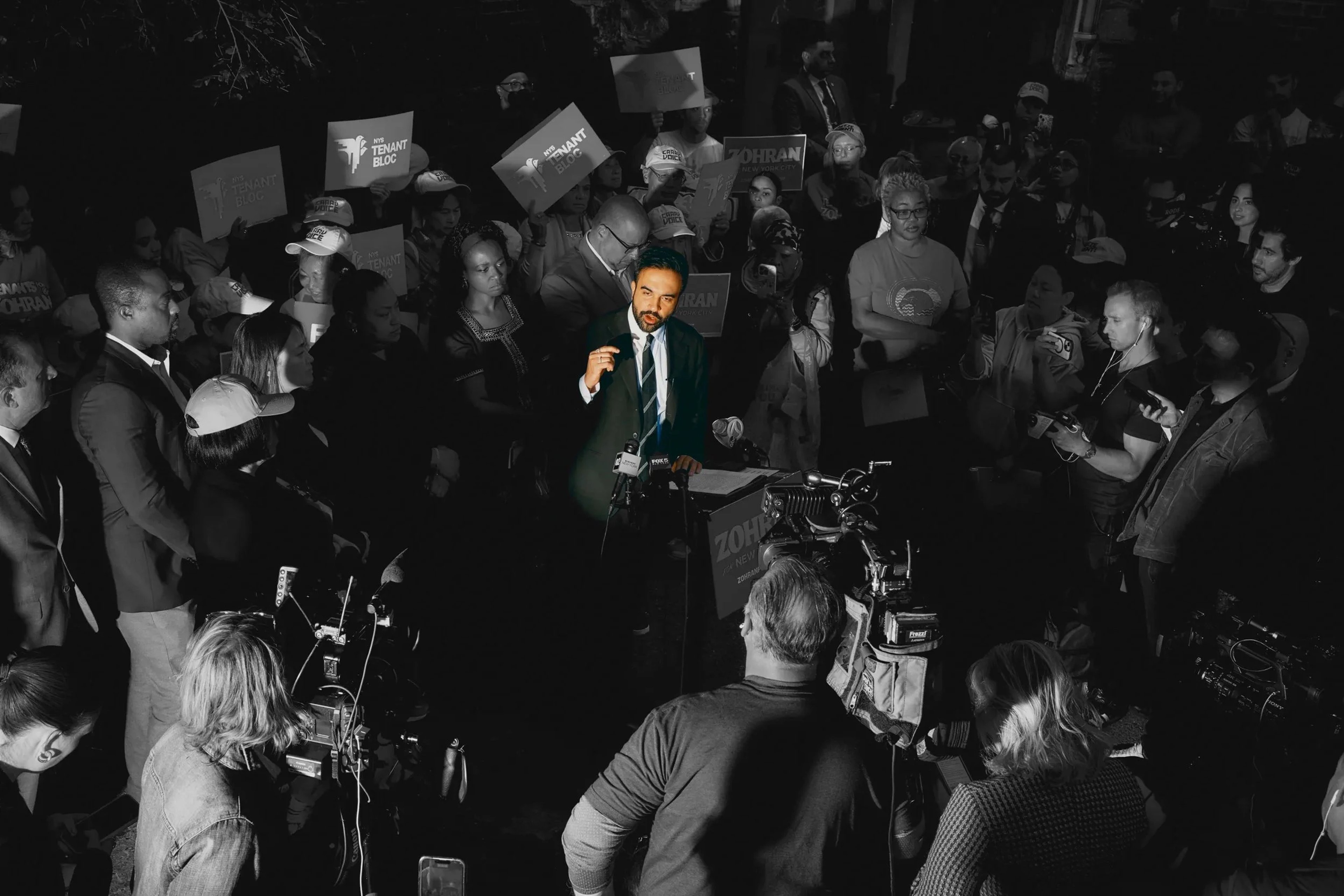
So, after Mamdani lost the Black vote during the primary, his Black supporters got organized. Black New Yorkers mobilized through organizations like NYC-DSA’s Afrosocialists and Socialist of Color Caucus, We Grew Here, and affinity groups like Africans for Zohran. People threw parties, ran fundraisers, and canvassed throughout the city, focusing on predominantly Black and brown neighborhoods such as Jamaica, Brownsville, and East Flatbush. Many of these volunteers were young, some even in their teens. These young people spoke with their parents, organized in their unions, and worked hard–successfully organizing their communities around the campaign.
Mamdani himself, meanwhile, prioritized building relationships with Black establishment figures. Several local elected officials who had originally endorsed the disgraced Andrew Cuomo, like Assemblymembers Erik Dilan and Jordan Wright, switched teams once they saw the wind was behind Mamdani’s sails. Mamdani also received a congratulatory call from President Barack Obama, and even tepid endorsements from the former Vice President Kamala Harris and House Minority Leader Hakeem Jeffries. The result? In the general election, Mamdani improved his vote margin with Black voters by a landslide. He had successfully brought the Black political class into the affordability agenda. His efforts had worked.
Then something happened. On the heels of Mamdani’s November victory, Black 27-year-old City Councilmember Chi Ossé made a NYC-DSA endorsement bid, seeking the organization’s support to challenge the seat of Hakeem Jeffries.
During the primary and general election campaigns, Chi Ossé was one of Mamdani’s fiercest advocates. But he is also a political force in his own right. In 2021, Ossé won his insurgent City Council race without the support of the Black Brooklyn political machine, instead winning his surprise victory by building a grassroots campaign not beholden to corporate interests and unabashedly progressive in its vision. At the endorsement forum, many of Mamdani’s most ardent Black volunteers called on NYC-DSA members to vote ‘Yes’ and endorse Ossé’s candidacy, hoping his campaign could cohere a Black socialist alternative to the establishment politics of Hakeem Jeffries in New York. Mamdani, however, urged members of NYC-DSA to vote ‘No’. He believed that the affordability agenda depended on support from important members of the Democratic establishment and would be compromised if NYC-DSA challenged the House Minority Leader. Ossé lost the endorsement vote by a slim margin.
Ossé’s endorsement fight illuminated a key feature of Mamdani’s political strategy for Black New Yorkers: protect the Black political establishment (through favors and protection from challengers), and, in return, they would support his affordability agenda. In a truly remarkable fashion, the Mayor was able to close this fiscal year’s historic budget deficit with a mix of state aid, a new pied‑à‑terre tax, and a pension‑funding maneuver with the support of New York State Assembly Speaker Carl Heastie. Many people have argued that this clearly validates Mamdani’s approach. But in order to fund the affordability agenda, the Mayor will need more than insider politics. Despite his success with the budget, there are cracks: from his proxy fight in the City Council Speaker’s race to the botched property tax gambit, Mamdani has not been able to build true political allies within the Black political class.
For the Mamdani administration to achieve its ambitious goals, the Mayor will need to develop a political vision that speaks to the diversity of New York City's Black working class. The Mayor needs to cohere an alternative political pole that centers Black working class people in New York politics—a socialism that centers Black New Yorkers with its own political leadership and treats Black New Yorkers like their own, active political subject.
The most pressing need is for the Mayor to endorse all four of NYC-DSA’s Black insurgent candidates: Conrad Blackburn (AD-70), Darializa Avila Chevalier (NY-13), Eon Huntley (AD-56), and Christian Celeste Tate (AD-54). The strategic motivations for this decision are clear. These four candidates represent the beginnings of an alternative political pole in Black New York politics—one rooted in mass organizing and democratic socialist politics. They want to tax the rich, protect our immigrant neighbors, and build a New York everyone can afford—no political cover needed. With Mamdani’s weight behind them, they pose much more credible threats in their races and gain access to support and resources otherwise held exclusively by the decaying political establishment.
This need is not distinct from his desire to achieve the affordability agenda. To succeed, the Mayor ultimately needs to build a coalition that is actively invested in his administration's success. While transactional politics may notch him some early successes, Black establishment figures are concerned with maintaining the status quo and see democratic socialism as a threat to their own power. This is clear from their most high-ranking leaders. House Minority Leader Hakeem Jeffries has been openly antagonistic to the socialist project, stating that he would “never bend the knee to hard-left democratic socialism,” and has quietly dueled with Mamdani ally and NYC-DSA member State Senator Jabari Brisport for hegemony in Brooklyn. Congresswoman Yvette Clarke has all but called democratic socialists like Bernie Sanders interlopers in the Democratic Party. Congressman and Queens Democratic County Chair Gregory Meeks never endorsed Zohran Mamdani.
Most importantly, all three congressmembers take money from the Israel lobby. Hakeem Jeffries, the man who said, “Israel today, Israel tomorrow, Israel forever,” will not allow himself to be usurped by a Muslim, anti-Zionist, democratic socialist—even if he is willing to engage in short-term compromise to neutralize a challenge from the left.
When Mamdani pitched his mayoral race to NYC-DSA, he stated that his base of support would be young people, tenants, those motivated by the Palestine solidarity movement, and South Asian and Muslim New Yorkers–and he was correct. Mamdani’s campaign cohered a disparate group of people who had no political home into protagonists capable of advocating for their own class interests, delivering one of the greatest political upsets of the century. However, his vision for working class protagonism has not extended to Black New Yorkers in the same way. This is a mistake. Few communities have more to gain from democratic socialist politics—or have been more consistently denied political champions—than Black New Yorkers.
Further, the crisis of Black political leadership is real–and the potential for democratic socialism as an answer to both the economic and political problems facing Black New Yorkers cannot be understated. The affordability crisis has hit Black New Yorkers hard. Between 2000 and 2020, there has been a sharp exodus of the Black working class–literally 200,000 people, or 9% of Black New Yorkers. The political machines that built the Black Democratic establishment institutions have, correspondingly, also been hollowed out. In New York Magazine, journalist and Inside City Hall host Errol Lewis writes worryingly that local institutions can no longer attract young people, and Congressman Meeks states that he has trouble even recruiting Black male lawyers for judicial slots. “I have zero that come in to get interviewed,” he complains.
The political anxieties of waning Black political power are manifest in the Mamdani administration. “High-profile Black appointees like Afua Atta-Mensah, who is the city’s chief equity officer, and Jahmila Edwards, the director of intergovernmental affairs, are not veterans of the Democratic clubhouses…” Lewis writes. Then, in January, Mamdani announced his appointments of five deputy mayors. None of them were Black. Though he has since appointed a Black woman as Deputy Mayor for Community Safety, Renita Francois, the narrative had been written: The Mamdani administration marks the end of traditional Black political power.
Or, at least, it marks the end of that particular strain of Black political power. When old institutions fail, new opportunities emerge. One example is the rise of Black socialist Charles Barron in East New York in the late 90s. Strategist and political organizer Michael Lange profiles the Barron political machine in a neighborhood that is 87 percent Black and Hispanic: decades of disinvestment and systemic racism had rendered democratic institutions non-existent. Murders were so high in East New York that the neighborhood was referred to popularly as ‘the killing fields’. But this meant the field was open for an alternative, as well. In 1997, the sitting Democratic city councilmember, Priscilla Wooten, endorsed Republican Rudy Giuliani for Mayor. This was a political opportunity: a moment that showed that Black elected officials were out of step with the political sentiments of the Black community. Charles Barron seized upon this moment: he named an enemy–the bought-and-paid-for Black establishment–and positioned himself as the working-class alternative. He ran twice for City Council without institutional support, but was able to secure the endorsement of Black democratic socialist and former Mayor David Dinkins. Barron won his City Council seat on his second try in 2001, building a Black socialist political dynasty that lasted for over twenty years until he was narrowly defeated by Chris Banks in 2023.
Mamdani’s victory reveals a similar political opportunity. CNN exit polls from the mayoral general election show that Mamdani won a supermajority of Black youth aged 18-29, 84 percent compared to 66 percent of white youth. Two-thirds of Black New Yorkers are renters, and nearly half of those New Yorkers live in rent-stabilized housing. The people most affected by the affordability crisis in New York City are young, Black New Yorkers. The demographics of Black New York have also shifted: nearly half of Black New Yorkers are foreign-born. This emergent class of Black New Yorkers needs new leadership that can unify their demands.
The Black establishment has no real plan to organize these emergent constituencies. In order to maintain power, they cater to corporate sponsors who, in turn, undermine and displace their own base of support through gentrification and the refusal to address the affordability crisis. Moreover, the Republican opposition is aware of fractures within the working class and seeks to exploit these divisions. On November 2, 2024, Donald Trump said that “illegal” immigrants are taking the jobs of African-Americans. Establishment Democrats are weak-willed and feckless, and the MAGA opposition knows it. “Do-nothing Democrat” leadership has been one of the most disorganizing forces for the American working class, especially the Black working class. Even more crucially, it is already on its way out. If the Mayor continues to play to the traditional Black establishment, he is choosing the losing team and risks dissolving this crucial constituency.
Mamdani must choose: he can govern in coalition with an ideologically opposed eroding Black establishment, or he can organize the emergent Black coalition that mobilized for him. But he cannot do both. Many in the political class have remarked on Mamdani’s incredible talent for communication and charm, but his most distinctive attribute is his commitment to political organization. Thousands of New Yorkers joined political organizations like NYC-DSA when he won his election, and many thousands more volunteered in his campaign. Mamdani can name a political adversary, present a clear pathway for defeating the enemy, and then bring his coalition into an organization where their struggles can be actualized.
Take, for example, Harlem. NYC-DSA has no elected officials in Harlem, but, in the primary election, Mamdani won this region by 18 points in the first round. Blackburn and Chevalier’s races are an opportunity to consolidate this victory, and present NYC-DSA–and Mamdani–as a truly ascendant political project.
First, both candidates have clear principles that allow them to name enemies they can polarize their base against. Both Blackburn and Chevalier are anti-Zionists and democratic socialists. Blackburn comes from a working class background, is the son of a single mother, and has dedicated his life to service as a public defender and union organizer. Wright is heir to a political dynasty with his father, Keith L.T. Wright, sitting in that same assembly seat for over twenty years, and, in 2024, received the endorsement of Solidarity PAC, a pro-Israel group. Before running for Congress, Chevalier was a PhD student at Columbia and, like Mamdani, organized closely with Students for Justice in Palestine; Congressman Espaillat, by contrast, is an ardent supporter of Israel and has received over $100,000 from AIPAC this cycle. Both Espaillat and Wright take money from the real estate corporations, even as their constituents experience record levels of displacement. The incumbents are out of step with their electorate.
The presentation of an alternative has been galvanizing for the base: current growth in the Bronx and Upper Manhattan branch of NYC-DSA far outpaces that of Brooklyn and Queens. Even early polling shows Chevalier has already made a strong challenge to the ten-year incumbent.
Tate and Huntley’s races in Brooklyn even more aptly represent Mamdani’s power. Mamdani won handily in these districts: Bushwick by 67-points in the primary and Bed-Stuy by 43-points. Each of these candidates has a strong chance of winning their seats regardless of Mamdani’s endorsement, but, by endorsing, he has the opportunity to make a positive intervention in the success of Black socialism in New York City.
There may be trepidation in endorsement against Black incumbents, especially Espaillat, Wright, and Tate’s opponent, Assemblymember Erik Dilan. Each incumbent endorsed Mamdani during the general and together helped produce the coalition that allowed him to take power. It is possible to argue that endorsing these insurgents would alienate even more members of the Black political class and put a wrench in his governing coalition.
But the strongest coalitions are built on shared goals, not personal relationships. Only a shared goal can provide a serious basis for cooperation. Without that shared goal, even the most deep personal connection will fall to the side and be replaced by political interest. The congressional race in NY-7 is a prime example: After announcing her retirement, Congresswoman Nydia Velázquez endorsed Brooklyn Borough President Antonio Reynoso, while Mayor Zohran Mamdani endorsed fellow NYC-DSA member Claire Valdez. Although the progressives and the socialists had worked together to win Mamdani’s mayoralty, as soon as the political stakes were clear, the war between the progressives and the socialists began.
To win the mayoralty, Mamdani had to build a large coalition with socialists and progressives, and in the general election, the liberal establishment, all united under a single project: ensuring Andrew Cuomo’s defeat. Congresswoman Velázquez was an early and prominent endorser of the Mayor, but she had a different vision for her congressional seat. As political conditions change, so do coalitions. The coalition that delivered the mayoralty has served its purpose.
Wright, Espaillat, and Dilan endorsed Cuomo in the primary and then endorsed Mamdani in general, not because they suddenly believed in Mamdani’s political vision, but because they saw the movement’s power. They needed to protect themselves: get along with Mamdani’s movement or be left behind. By building working class power in the primary, even while losing a plurality of Black voters, he scared the Black political establishment. It is time for Mamdani to continue to build that same independent and progressive working class power, and to build it where it may be the weakest, Black New York.
To secure the transformative vision of his administration, he will now need to expand the base to the Black working class. He must include them not merely as supporters, but as active and political agents in his project; as people who share his political vision for what society could be. Furthermore, building with Black socialists will make for much more durable coalitions. Because socialists' primary goal is to shift power to the working class, the shared interest between the Black working class and Mamdani’s own coalition has a longer horizon, more distinct strategies, and a defined enemy: the billionaire class. Black socialist incumbents like Assemblymember Phara Souffrant Forrest, City Councilmember Chi Ossé, and State Senator Jabari Brisport genuinely believe in Mamdani’s political project for transforming New York City. Disagreements like Ossé’s endorsement bid are strategic, not ideological: They all share the same vision and work to actualize it.
Relationships and favors can never substitute the power of people coming together for a common goal. We have all but forgotten communist-affiliated institutions like the Highlander Research and Education Center, founded in 1932 by white labor and civil rights activist Myles Horton. The Highlander Research and Education Center was a social justice school focused on training critical leaders in progressive struggles, including figures like Rosa Parks and Septima Clark, the latter of whom was key in the fight for the Voting Rights Act. “At Highlander, I found out for the first time in my adult life, that this could be a unified society… I gained strength there to persevere in my work for freedom, not just for blacks, but all oppressed people,” Parks recalls. Organization makes clear our shared goals.
And this political vision is not just necessary for New York City. Black populations have decreased across blue cities in Northern and Western parts of the United States. Some call this phenomenon the “New Great Migration,” as the cost of living crisis has forced many Black families to move from cities like Chicago and New York to Republican-controlled states like North Carolina, Tennessee, and Florida. By displacing Black urban-dwellers, the national affordability crisis is throttling working class organization where it is strongest: nearly 30 percent of Black workers in New York City are unionized compared to the city average of 20 percent, for example. In right-to-work states in the Southeast, the number of Black workers unionized is only 7 percent. Many of these states have weak social safety nets, little to no public transit, and have gerrymandered maps such that Black people have been drawn out of political power. New York City’s ability to stymie Black displacement and shore up Black working class organization could serve as a blueprint for other cities across the country, setting a new political vision for the 2028 Presidential election. But this is only possible if the Mayor commits to organizing the Black working class.
Someday, Mamdani will leave office. Will he do it like Mayor Bill de Blasio, as a competent manager in a city of entrenched inequality, a feckless Black establishment, and ever-dwindling Black political participation? Or will he be able to build a political movement that makes Black New Yorkers leaders in their own struggle for a better future?
By not endorsing NYC-DSA’s Black insurgent candidates and deferring to the Black political establishment, the Mayor is foreclosing opportunities to build a new political project that actually serves Black New Yorkers, articulates their political struggle, and unifies the broader working class.
Unlike the Black political establishment, Mamdani has many political successors who share his vision. However, if he does not organize these successors into a political force, the socialist project in New York and beyond is doomed to fail. By the numbers, Black workers are the most advanced section of the working class: they are the most unionized and most likely to be tenants, but they currently lack a political home. If Mamdani does not endorse NYC-DSA’s Black insurgent campaigns, he will sever himself from the emerging Black socialist pole and, in doing so, fracture the socialist movement rather than build it.
This is not inevitable. The Mayor has the chance to build a bench of Black socialist leaders and organize a new constituency for democratic socialism for decades to come. He only has to reach forward and take it.