
Nov 13, 2026
A PACT* with the Devil: On the Demolition of the Fulton Elliott-Chelsea Houses
New York promises to save public housing through private redevelopment. But at Fulton and Elliott-Chelsea, developers receive decades of publicly backed revenue while tenants struggle to secure the protections they were promised.
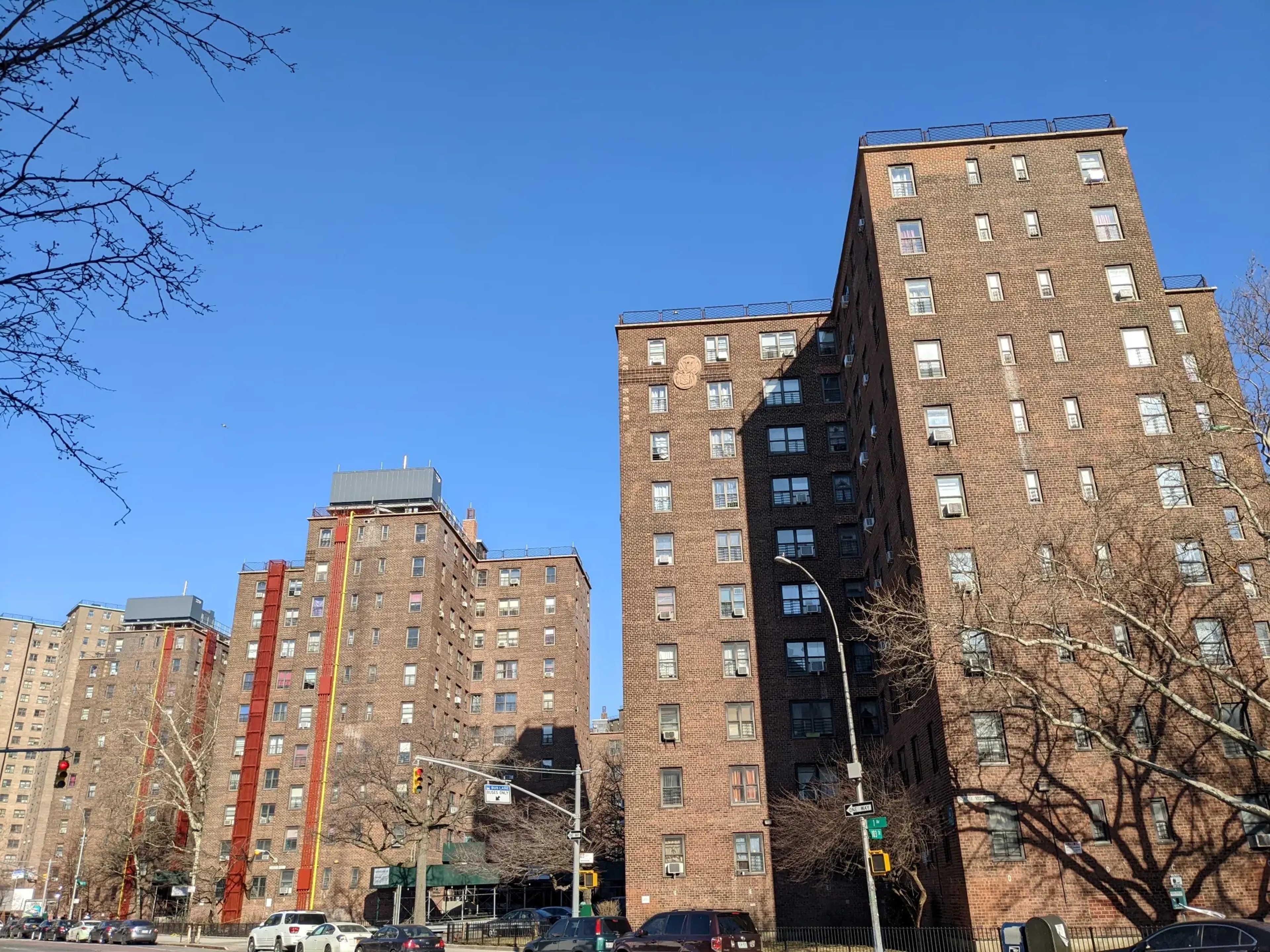
East River Houses Credit: Eden, Janine and Jim on Flickr
PACT* is the NYC version of a federal program promised to repair public housing. In reality, it might be the final nail in the public housing coffin. It changes who controls the buildings, who profits from them, and how easily a tenant can lose their place.
The call came from a friend who lives at Fulton Houses, the public housing development in Chelsea. She was anxious, speaking quickly, trying to explain an emergency that had not yet occurred but had already entered her family’s life.
The emergency concerned her daughter-in-law, whom I will call Jennifer. Jennifer lives in a New York City Housing Authority development in Harlem. One of her children is severely autistic and requires a therapeutic bedroom of her own. The family’s apartment is too small to accommodate the child’s needs. In 2025, after the usual accumulation of forms, medical documentation, interviews, calls and waiting, NYCHA approved Jennifer’s request for a transfer to a four-bedroom apartment.
“Approved,” in the jargon of public housing, doesn’t mean that she will be moving. It means that NYCHA has agreed that she qualifies, and that she will move when a suitable apartment becomes available. The distinction between “approved” and “housed” may consume several years of a family’s life.
Still, the approval matters. It means that NYCHA recognized what her child needs and has agreed to act on it.
Then she was informed that her building would undergo the PACT conversion.
At first, Jennifer, like thousands of other public housing tenants, was told that PACT was “just the same” as public housing; that it was actually still public housing, and that all her rights were intact. Her rent would still be based on her income, but a private company would become her landlord. The old lease had been under Section 9, the traditional federal public housing subsidy. The new one was under Section 8, which comes with its own, distinct legal obligations.
Jennifer had taken the assurances at face value. The contract was “ironclad.” She would “keep all her rights.” Then she learned that the conversion could cost her the transfer NYCHA had already approved.
My friend wanted to know whether this was possible, or even legal. Could an accommodation approved because of a child’s disability simply disappear when the building changed programs? Who now had authority over the transfer? Was Jennifer still a NYCHA tenant in the same sense? She surely had to be, as she was told to sign the Section 8 lease because “it is the same as Section 9”. Except of course, that it is not.
These were practical questions. They also happened to contain the entire moral and legal architecture of the Permanent Affordability Commitment Together (PACT) program.
PACT has a reassuring tone, the sort of cool acronym that is reverse-engineered from a mostly nonsensical name. It is New York City’s version of the federal Rental Assistance Demonstration, or RAD. The program is described by NYCHA as one of its “most successful tools” for modernizing public housing. Its official promise is comprehensive repairs, permanent affordability and the full preservation of resident rights. Except that tenants’ rights under Section 8 are not the same as under Section 9.
The need for repairs of the NYCHA portfolio is beyond dispute. Decades of federal, state and municipal disinvestment have left public housing residents living with failing elevators, broken heating systems, mold, leaks, pests and deteriorating façades. Human Rights Watch calculated that, after inflation, federal capital funding for public housing was about 35 percent lower in 2021 than it had been in 2000.
The buildings were deliberately starved. Then their hunger was offered as proof that the public model had failed.
RAD was created by Congress in 2011 as a demonstration program, under President Obama. It allowed housing authorities to move apartments out of Section 9, the federal program traditionally associated with public housing, and placed them under private management through project-based Section 8 assistance.
Unlike Section 9 appropriations, which Congress has shown tepid interest in adequately funding, a project-based Section 8 subsidy is believed to produce a more robust rental stream. The subsidy flows at market rate into the pocket of a private owner or developer. Why? The first reason is that Section 8 housing is everywhere in the country, not solely in large cities. Section 9 subsidized buildings tend to cluster in dense urban areas, so they have less broad political support. The second and more pernicious reason: Section 8 subsidized buildings are owned and operated by a very savvy and lobbyists-rich real-estate industry.
For the companies taking over, there are several places to put the cash register, and very little private equity to invest. They collect a development fee, usually 10% of the total project cost, and hire an affiliate to do the construction and collect the federally backed rental revenue for operating the property. Miami-Dade’s projections anticipate roughly $107 million in future cash distributions for the developers in just two conversions, in addition to development fees. In Manhattan, PACT Renaissance signed a $247 million construction contract with its own affiliate. The equity on the other hand is satisfied not through private finance, but through public bonds, loans and subsidies. [1]
And if you think that the Section 8 subsidy is a better deal for public dollars, look at what Washington pays compared to Section 9. At Bay View in Brooklyn, HUD’s figures predict federal support will rise from about $784 per apartment per month under Section 9 to about $2,576 under Section 8. At Fulton, Section 9 currently provides an average of about $1,060 per apartment per month, including capital funding. The negotiated Section 8 rent schedule provides a federal payment of about $5,000 for a one-bedroom that will land nicely on the balance sheet of the developer. The estimated Section 8 subsidy more than triples at Bay View and roughly quintuples in the Fulton example. Section 8 is much more expensive than Section 9. [2]
The case for PACT is not frivolous. NYCHA’s buildings need sums of money that the political system has repeatedly refused to appropriate. Private financing can produce renovations more quickly than waiting for a Congress that has spent decades demonstrating its hardened indifference.
That is precisely why PACT is difficult to oppose and dangerous to examine lazily. The program places a genuine public need inside a structure that changes the nature of the housing intended to meet it. It offers residents relief from conditions created by disinvestment, but requires them to enter a financialized system to obtain it. The choice is presented as repairs or decay, as though the government played no part in producing the decay and possessed no power to fund the repairs directly.
That is the indictment of PACT. It makes repairing public housing the occasion for transferring control of it. Public agencies put up the land and line up the public financing as if they were a rich uncle. The private partners get long leases and years of rent backed by federal subsidies. Tenants get the repairs, initially, but soon after, the buildings start their slow travel towards disrepair. And now, tenants have to find out which of several institutions will stand behind the protections they were promised. When the arrangement fails them, they are the ones who have to find another apartment or go to Housing Court.
The issue is not whether tenants need new bathrooms and a dish washer. It is whether a public failure should be cured by transferring control, revenue and enforceable financial interests to a collection of private entities and whether the resulting system preserves a tenant’s security in practice–rather than formally, in a brochure.
The official position is that the conversion changes the funding source without diminishing the tenant’s essential protections. On paper, the resident remains protected. The paper, unfortunately, is not worth much. NYCHA says the PACT conversion preserves essential protections. Rent generally remains tied to income. Residents retain succession and grievance rights and can be evicted only for cause. But under PACT’s project-based Section 8, the rules for tenant organizing change, the annual option to choose flat rent disappears pushing rents increase up to 30%, and the standard income ceiling for a new applicant living alone drops by more than a third, from $95,000 to $59,400 a year in New York City in 2026. And the right to transfer is now in limbo. [3]
Several years before Jennifer’s call, Human Rights Watch interviewed Tina M., a resident of Ocean Bay Apartments in the Rockaways, the first major NYCHA development converted through PACT. Tina M. spent eighteen years on NYCHA’s waiting list for a transfer to Manhattan. When Ocean Bay converted to PACT, NYCHA took her off the list. She told Human Rights Watch that NYCHA told her “Ocean Bay is not Public Housing anymore.”
Elizabeth Gyori, a legal scholar who represented NYCHA tenants during RAD conversions, has written that the alteration of transfer rights is one of the clearest examples of the ideology embedded in the program. A site-based transfer and a voucher are deemed equivalent because, in a schematic prepared far from the tenant’s life, both could produce housing in the abstract. The big difference: the original system places the burden on the housing authority, while the other places it on the family personally. Should the family fail to find a landlord, the market is considered to have functioned; only the family has failed. This subtle shift of responsibility has massive consequences.
Gyori describes RAD as a system that facilitates capital accumulation by “financializing a public good,” using government power to support private capital and redistribute value from public-housing tenants toward developers and landlords.
In December 2024, the City comptroller found that the PACT developments it examined evicted tenants at nearly five times the rate of conventional NYCHA housing, roughly in line with the city’s rental market. The gap was visible before anyone was put out. In 2023, the filing rate at the PACT properties studied was 9.5 percent, compared with 1.9 percent in conventional NYCHA housing and 5.8 percent citywide. Every manager examined used a lower threshold than NYCHA and offered stricter repayment terms. NYCHA called housing stability central to PACT, yet its stability guidelines did not bind the managers, and the auditors found failures to report evictions and filings and to conduct required outreach.
Then came the paperwork crisis. According to records obtained by the Legal Aid Society, Section 8 subsidy terminations for failure to complete annual recertification rose from 42 in 2024 to 836 in 2025. Lawyers said many affected tenants had submitted their paperwork. NYCHA acknowledged a scanning backlog that led to erroneous termination warnings and said it would correct erroneous balances. But the error had already traveled. When NYCHA’s records erroneously showed the subsidy had stopped, private managers billed tenants for the full contract rent. One resident was reportedly told she owed $45,600. Another was told she owed $80,000. A missing document in one office became an eviction case in another. [4]
The first two replacement buildings at Fulton and Elliott-Chelsea are projected to cost ~1.3 million per unit). The financing rests on public bonds issued by the city’s Housing Development Corporation (HDC) and loans backed by public agencies, including up to $185 million loan at 8% interest. The public sector issues the debt on behalf of Related and Essence. And the federal public subsidies create Related and Essence the very revenue used to repay the debt, and enrich the developers.
Even if you think PACT is a reasonable neoliberal answer to decades of neglect, ask what happens if Washington pulls back. In 2026, the White House already proposed replacing Section 8 and four other housing programs with a state block grant and cutting their combined funding by $26.7 billion. Congress kept the programs that year. At Fulton and Elliott-Chelsea, the first 626 assisted replacement apartments alone could draw roughly $39 million a year in federal rent subsidies. A contract can require the owner to renew for another twenty years, but Congress still decides how much to put up each year. And if it’s not enough, the owner can pack up and leave. If Washington stops paying its share, who makes up the difference?
Jennifer is not asking for a luxury apartment. Jennifer is asking NYCHA to honor a decision it has already made about the needs of a disabled child. Her story is still unresolved. We do not yet know whether the transfer will be canceled, replaced with a voucher, restricted to a smaller group of developments or preserved.
A program capable of producing a forty-year loan, a ninety-nine-year ground lease, multiple bond series and a precise order for the distribution of cash should be capable of explaining, in a sentence, what happens to an approved disability transfer.
Instead, the family is frightened. My friend calls me. We begin looking for policies, precedents, lawyers and people inside NYCHA who might return a telephone call (spoiler: we found none). Somewhere, in a filing cabinet or database, the approval still exists. And maybe someone even knows the answer to Jennifer’s angst.
The developers in the RAD and PACT saga have been shrewd negotiators. They looked after their own interests, and they did it admirably. The more interesting question is what the people on our side of the table thought their job was. At HUD’s RAD “office hours,” federal officials offered to help developers and municipalities “noodle themselves out of” regulatory tangles rather than push for their strict enforcement.
PACT promises a bright future, with tenant rights on the side. Once the ink dries, a developer knows exactly what the deal entitles him to. Jennifer is still trying to find out who will honor a transfer NYCHA already approved.
This is how New York sells the soul of the public housing FDR and La Guardia imagined. At Fulton and Elliott-Chelsea, the devil is hoping for a ninety-nine-year lease.
[1] Perrine Gardens agreement · Heritage Village agreement
[2] HUD rent workbook · NYCHA’s Bay View bid assumptions · Fulton rent schedule, Exhibit C · Bay View final bond statement, page 9